EXPLORING ACADEMIC DEVELOPMENT PROGRAMME
EVALUATION AT A UNIVERSITY: A SYSTEMATIC SCHOLARLY
APPROACH
H. Johannes*
e-mail: [email protected]
A-M. Olsen*
e-mail: [email protected]
T. T. Batyi*
e-mail: [email protected]
E. Champion*
e-mail: [email protected]
S. P. Goldstone*
e-mail: [email protected]
*Centre for Teaching, Learning and Media Nelson Mandela University
Port Elizabeth, South Africa
ABSTRACT
The systematic review, critique and evaluation of Academic Development programmes are increasingly becoming important for informing ongoing and future programme design. Programme evaluation requires an in-depth comprehension of the programme to be evaluated (Chalmers and Gardiner 2015, 55). This article reports on the evaluation results of Academic Development programmes at the University, with the aim of constructing a conceptual and design framework for thinking about Academic Development programmes. The study applied generic impression, systems theory, reflective and evaluation lenses to determine and evaluate the characteristics of nine Academic Development programmes. The aim was to determine whether these include the promotion of conceptual change, to think differently about teaching and learning in Higher Education. Questions about why do we have Academic Development programmes and, are these needed at all, were explored. This process of moving from a “common-sense approach” (CHE 2016, 168) to a more scholarly approach, includes evaluative-research methodologies, as well as critical reflection within a system theory paradigm. The research outcomes include a conceptual framework, data-driven programme design specifications and a blueprint for a generic Academic Development programme design.
Keywords: higher education, academic development, programme evaluation, programme design enhancing teaching and learning, data-driven programme design specifications
BACKGROUND AND INTRODUCTION
Academic Development (AD) in Higher Education (HE) includes various aspects of teaching
and learning development support for staff and students alike. According to Bamber (2008) AD
programmes can be evaluated effectively by applying theory-informed evaluation research
approaches in the natural settings of the programmes (Bamber 2008, 108). Over time, assorted
AD offerings by a Centre for Teaching and Learning (henceforth Centre) of a South African
programmes, which comprise the subject of this investigation. The Council on Higher
Education (CHE) (2004) describes a programme as “a purposeful and structured set of learning
experiences that leads to a qualification” (CHE 2004, 36). However, as only a few of the nine
offered programmes lead to a qualification, a broader description for AD programmes was
adopted and it states: Academic Development programmes can be described as “purposeful and
structured sets of learning, teaching and assessment experiences, together with a scholarly
approach that leads to the changing of teaching practices”. The SA Education White Paper 3
(CHE 1997 Chapter 2.5, 12) states: “A programme-based approach recognises that higher
education takes place in a multiplicity of institutions and in various sites of learning, utilising a
variety of methods, and attracting an increasingly diverse body of learners”. Therefore,
although AD programmes are complex, and not easy to describe, several key attributes capture
the essence of these as “system interconnectedness; multiple stakeholders; multi-levelled and
multiple formats; and emerging outcomes” (CGIAR 2013, 3). Academic Development
programmes include a variety of programme modes, namely short-learning programmes, in situ
training, academic working groups, consulting, peer assessment and mentoring, one-on-one
support, student assessment of teaching, as well as intensive staff-development programmes
(Prebble et al. 2004, 25). The AD programmes reported on in this article include all the
programme modes mentioned above to a greater or lesser extent.
Within a context of a third generation of AD (Boughey 2007), the AD Centre’s Indaba
provided opportunities for reflection on, and informal analysis of its AD offerings. This led to
a conceptualisation of a programme-based approach to AD, which contributed to the structure
of the AD focus, by providing general, as well as, specific structural elements. These included
format, purpose, approach, alignment with other programmes, role-players and roles, processes
and procedures, and programme outcomes. (Table 5). The diverse complexity of the emerging
AD programmes both enriched and fragmented the programme-based approach adopted by the
Centre. For example, horizontal and vertical non-alignment required not only evaluation and
redesign of the individual programmes, but it also highlighted the need for a new generic
programme design contextualised within the HE system. The CHE (2017, 16) states that the
“role of academics as teachers encompass teaching as delivery, programme design, evaluation,
and the scholarship of teaching and learning”. Building capacity through systemic and
collaborative research between academic developers, and academics allows for professional
learning on both sides (CHE 2017, 17).
The rationale for the study was to move “from a common-sense approach to a more
systematic, scholarly approach” to AD (CHE 2016, 168) via an evaluation research process to
themes highlighted in the CHE review of HE (CHE 2016) are represented, either as a main
theme or embedded in all our programmes namely, teaching and learning with technology,
academic literacies, multilingualism, SoTLC and AD research (Figure 1).
Figure 1: Nine AD Programmes at the University
The departure point was not the under-preparedness of the academic staff, but rather,
participatory communities of practice within AD and faculties, the institutional Vision 2020
and supportive development plans. These have implications for the ways of doing, and how the
programme modes and models are applied to effect a range of outcomes. The aimof the study
was to align and integrate programmes that have become disconnected, to avoid the so-called
AD rag-bag approach, carrying on from year-to-year with the status quo (McAlpine et al. 2009).
In so doing, the AD team realised that academic developers need to develop their own practices,
and to reflect critically on AD programmes at the University. The authors concur with the views
expressed by CALPRO (1997), which emphasise the importance of ongoing and systematic
evaluation procedures for professional [academic] development activities. The reasons for this
include the increasing demands on resources, as well as, the demands for accountability. As
CALPRO clearly states, “Professional [Academic] development is about CHANGE with the
purpose to improve learner outcomes by changing instructional behaviour to achieve a
pre-determined goal” (CALPRO 1997, 4-2). The change process affects not only a number of
role-players, e.g. the academic developers, academic staff (“students”), and the relevant
programmes, but also subsequent student learning (Ho 1998; Ho 2000; Ho, Watkins and Kelly
Numerous studies suggest frameworksfor indicators of effectiveness and the evaluation
of AD (Chalmers and Gardiner 2015, 63). One example is Guskey’s (2002) five-level model
which provides a useful matrix for decision-making. This model includes participants’ reactions
to the programme, conceptual change in participants’ thinking, identifying changes in
institutional culture, behavioural changes, and identifying changes in student learning. Some
examples of focus areas are participant reactions, organisational support, participants’ use of
new knowledge, conceptual and behavioural change, and the impact on student learning
(CALPRO 1997; Kutner et al. 1997; Chalmers and Gardiner 2015; Gibbs and Coffey 2004;
Guskey 2002; Gilbert and Gibbs 1998; Weis and Klein 2005/2006). The research group was
encouraged by the work of the aforementioned authors, particularly Chalmers and Gardiner
(2015, 53) who state that, “there is a need for research on systematic measurement on the
effectiveness of these programmes”. Research conducted by Chalmers and Gardiner (2015)
only became available to the research group at the University after the research, on which this
article is based, was conducted. Informal comparison between the research group’s work and
Chalmers and Gardiner’s (2015) research approach and findings were highly motivating, and
supportive of our conceptual and theoretical frameworks (Figures 2, 4 and 5). Chalmers and
Gardiner (2015) identify four types of quality indicators of the impact and effectiveness of AD
programmes, commonly used as input; output; process and outcome indicators. They further
describe their effectiveness framework as a “matrix of indicators related to the intended
outcomes” within an institutional context (Chalmers and Gardiner 2015, 64, 66). The
institutional context for this study contributes an enabling environment for authentic
programme offerings, customised for relevance, underpinned by theory, practice, research and
real world features to accommodate a variety of needs. These are illustrated by the variety of
offerings (different modes) available at the university. However, before “impact” could be
evaluated, the basic input into the equation should be examined. Therefore, the first step in the
process of a systematic scholarly approach to AD programme evaluation should be to explore,
analyse and describe the input into the system. The input would include inter alia the
nature/characteristics, structure and components of the programme to be evaluated. Joyce and
Showers (1995) are of the opinion that “To link professional development activities and student
learning, there must be potent content and a good design, not only of professional development,
but of the organization in which that content is to be implemented” (Joyce and Showers 1995,
in Kutner et al. 1997, 2). Kutner et al. (1997) continue by highlighting ongoing programme
enhancement and accountability as two important roles that evaluation plays in the AD process
(Kutner et al. 1997, 2). Various evaluation frameworks indicate the importance of the evaluation
(Kurtner et al. 1997, 4) or sequence and stages (reaction, learning, behaviour, and results) of
evaluation actions (Killion 2006, 5). Kutner et al. (1997) describe three targets, namely, the
instructor, the adult student and the program, as the legs of an “essential triangle for change”
(Kurtner et al. 1997, 4). The AD research team at the University identified a fundamental gap
in some of these evaluation frameworks. Many of these frameworks include participants’
evaluation feedback and self-reporting evaluations, as well as subjective observation methods,
without questioning or analysing the starting point (input into the system), which is the
programme attributes. Programme attributes are essential inputs in the triangle of change.
Identifying programme attributes, such as the structure, components, features, and
characteristics to describe the nature of the programme and to map these to the required
programme outcomes, are frequently overlooked. Another core feature not always recognised
as such, is the importance of programme theory, also called a logical model or impact pathways
(MMWR 1999, 3) and the theories of change (CGIAR 2013, 3; MMWR 1999, 3). Hence, this
research study aims to map the linkages and pathways between the legs of the triangle, although
the programme leg of the triangle is the focus of this article. The structure of the article includes
an explanation of the evaluation research design, with theoretical underpinnings, research
lenses, methodology, data collection, analysis, findings and a conclusion. The second cycle
described elsewhere, focuses on to what extent redesigned AD programmes include the key
elements of effecting conceptual change. The third cycle focuses on data-driven impact design
for AD programmes in HE.
EVALUATION RESEARCH DESIGN
The selected evaluation research design includes interpretive meta-theories, as well as
qualitative, quantitative and participatory methods. Mouton (2001) describes qualitative or
naturalistic evaluation research approaches, as programme evaluation in natural settings.
Mouton (2001, 158). The study population included all existing, as well as emerging, AD
programmes at the Centre and, due to the small number involved, no sample selection was
included. Relevant literature, programme-evaluation practices and research studies guided the
research design and the methodologies utilised. The participants are seen as being integral to
the study design and the research activities. Research participants act in a number of roles,
namely programme evaluators of the programmes, which they co-ordinate, reflective
practitioners and participatory researchers. The “evaluation approach is best suited to
action-oriented evaluation questions” (Rogers and Williams 2006, 83‒84), and as such, these were
applied to determine each programme’s attributes. We concur with Chalmers and Gardiner
programmes needs to move from the research paradigm to the evaluation paradigm to inform
ongoing and future teacher development programs and enhancement” (Chalmers and Gardiner
2015, 53). For each programme, design components, conceptual and theoretical frameworks,
plus epistemologies were analysed, reviewed, evaluated on various levels, interpreted, and
given critical reflection.
PARADIGM, THEORETICAL AND CONCEPTUAL FRAMEWORKS
Inductive abductive reasoning guided the research design to choose the best explanation for a
phenomenon by using flexible approaches to contribute to useful evaluations. (Wikipedia n.d.;
Shadish, Cook and Leviton 1991, 404; Patton 1997, 17, cited in Patton 2002). Within the
research team, AD and the research context, the possibilities for constructing theoretical and
conceptual frameworks for thinking about AD programmes at the University, were explored.
An important aim of AD programmes is to effect conceptual change, thinking differently about
teaching, learning and assessment, which could result to change in the teaching practice that
can impact positively on student learning. Therefore, this purpose should be reflected by the
input elements of the programmes, with ongoing change as an operating principle. Here, we
drew on systems theory, models of change and models of action. Capra (1997) and Senge
(2006) identified a number of system theory principles which guided our thinking. These are:
Every system is defined by specific characteristics (input) organised in patterns of relationships. The processes in the system are the interactional activities, in which the
system engages. Structure is the way in which the patterns in the system are expressed;
and they reflect the system output.
The “whole system is greater than the sum of the parts” (Capra 1997, 3).
These parts can be described as input; process; output; outcome and feedback loops, within a specific context. Each part has identifying characteristics, or attributes, and the
arrangement between the attributes are defined as patterns. Systems are not concretely
visible; but they are organised patterns of relationships (Berens 2013).
These relationships are influenced by output-input feedback loops, as well as by the environment. For example, specific interventions and system drivers, which may
accelerate the process.
Nested arrangements of structures, where one is contained within the next. Systems might exist as sub-systems of larger systems.
Systems theory emphasises ongoing change.
for this study. Each AD programme (labelled as A) has a structure consisting of different input
elements, with distinctive characteristics arranged in different patterns of relationships. Input
elements include the different role-players and their roles, the different programme
characteristics, such as the alignment and format organised in unique patterns of relationships
for each programme. The holistic theme of the pattern can be described as purpose (labelled as
B) (Berens 2013). Interventions (labelled as C) applied to the interactional activities, in which
the system engages may change the output (labelled as D) and the outcome (labelled as E). The
initial analysis of the system parts, as well as the relationships between them within a specific
environment, need to be unpacked, and described, in order to be able to determine the nature of
each programme (system/sub-system), and to differentiate between them.
Logic models are graphical ways to organise information and to display thinking, which
provided the team with a snapshot of their current thinking on AD programmes, programme
activities, planned actions and outcomes (Millar, Simeone and Carnevale 2001; Knowlton and
Phillips 2013, 3; Weis and Klein 2005/2006, 3). For this study, logic models were applied to
programme evaluation and programme design (Knowlton and Phillips 2013, 4).
We also drew on Knowlton and Phillips (2013, 3) to identify two types of models
described as “A theory of change (conceptual), which is a portrayal of how change would occur,
and programme logic models” (operational). The latter include more detail about resources,
planned activities, and the outputs and outcomes. These visual representations of the team’s
ideas helped to firstly, share understanding of relationships among the programme elements
necessary to operate the programme and change efforts and secondly, to see the linkages and
pathways between one’s programmes, and how to map these and turn actions into results
(Killion 2006, 5). This process includes interactive evaluation and review, reflection, and
identifying trends and patterns. The outcome of the process fed back into the system, as the
design specifications for revised programmes. Furthermore, the change implementation
resulted in three elements namely creating awareness; promoting engagement; and fostering
commitment.
The model of change we adopted comprised of a sequence of actions that could create
awareness, engagement and commitment, to effect conceptual change to think differently about
teaching practice. Weisburd and Snaid (2005/2006) state that a theory of action “maps out a
specific pathway in that theory of change with respect to achieving that change” (Weisburd and
Snaid 2005/2006, 20). Both the theories (of change and of action) informed our programme
design, development and implementation. For example, the model of change illustrated in
Figure 2: AD System Theoretical Framework
Figure 3: Model of Change
Our programme blueprint included design specifications, aimed at outcomes to effect
conceptual change, and the programme logic model for the living AD programme system
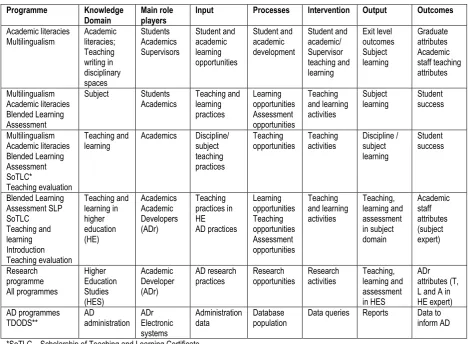
illustrated in Table 1.
As illustrated in Table 1, the knowledge domains include academic literacies, subject
specific knowledge, teaching and learning related to student success, teaching and learning
related to academic staff attributes, HE studies related to academic developers’ attributes and
Table 1: Programme Logic model to illustrate the Living AD programme system components
Programme Knowledge Domain
Main role players
Input Processes Intervention Output Outcomes
Academic literacies Multilingualism Academic literacies; Teaching writing in disciplinary spaces Students Academics Supervisors Student and academic learning opportunities Student and academic development Student and academic/ Supervisor teaching and learning Exit level outcomes Subject learning Graduate attributes Academic staff teaching attributes Multilingualism Academic literacies Blended Learning Assessment
Subject Students
Academics Teaching and learning practices Learning opportunities Assessment opportunities Teaching and learning activities Subject
learning Student success
Multilingualism Academic literacies Blended Learning Assessment SoTLC* Teaching evaluation Teaching and
learning Academics Discipline/ subject teaching practices
Teaching
opportunities Teaching activities Discipline / subject learning Student success Blended Learning Assessment SLP SoTLC Teaching and learning Introduction Teaching evaluation Teaching and learning in higher education (HE) Academics Academic Developers (ADr) Teaching practices in HE AD practices Learning opportunities Teaching opportunities Assessment opportunities Teaching and learning activities Teaching, learning and assessment in subject domain Academic staff attributes (subject expert) Research programme All programmes Higher Education Studies (HES) Academic Developer (ADr) AD research
practices Research opportunities Research activities Teaching, learning and assessment in HES
ADr attributes (T, L and A in HE expert) AD programmes TDODS** AD administration ADr Electronic systems Administration data Database population
Data queries Reports Data to inform AD
*SoTLC – Scholarship of Teaching and Learning Certificate **TDODS – Teaching Development Online Database System
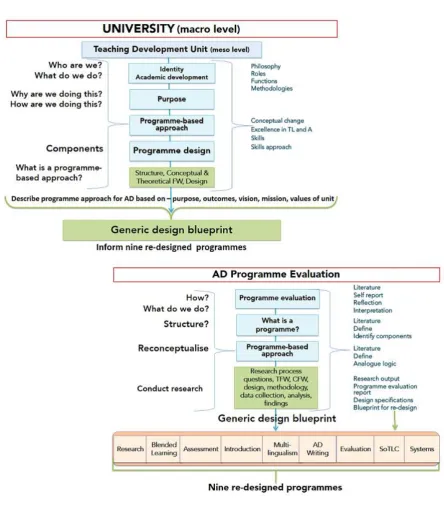
Contextualising the nine AD programmes within the Living AD Programme System shows the
system levels nested into each other, as sub-systems of the levels above, and also as the parts
of the whole, namely, the living AD Programme system (Figure 4).
Each part of the system is linked to a specific programme logic model, as well as the
characteristics, purpose, content and context of each programme. Conceptualising and
visualising linkages and pathways among the different parts of the whole, resulted in a coherent
whole, represented as a conceptual framework (Figure 5).
Figure 5: Conceptual Framework
Visible in this conceptual framework are the linkages and pathways to the research questions.
Thus, the conceptual framework provided a point of departure for the research design, and it
made the underlying structure, characteristics and elements of AD programmes for future
Programme characteristics, purpose, content and context, linked to the models of change
and of action, relevant for this study.
RESEARCH METHODOLOGIES
Following are the research questions that informed the project:
1. What is a programme-based approach for AD programmes at the University?
Q1.1 What is a programme-based approach?
Q1.2 What is the composition of AD programmes at the University (Tabled programme
components)?
2. What is the nature of the AD programmes at the University?
Q2.1 What is the nature of the nine programmes offered by the Centre (Official
programme review document)?
Q2.2 How to apply interactive evaluation to customise the review document (Analogue
thinking)
Q3 What are the design specifications for programmes, in order to reflect the purpose
of conceptual change? (Second review process)
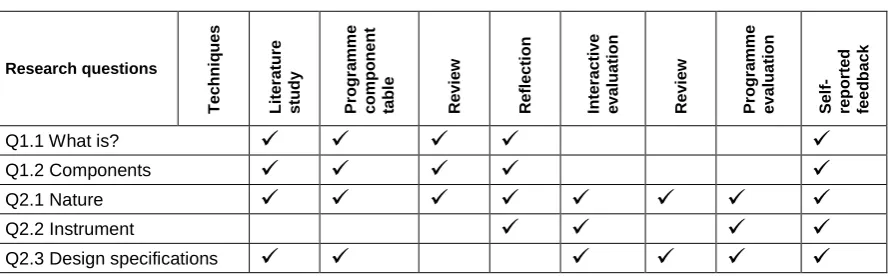
The mapping of the data-collection-research techniques to the research questions is tabled in
Table 2.
Table 2: Mapping data collection research techniques to the research questions
Research questions Tec hni q ues Li te ra ture s
tudy Progra
m m e c om po nent ta bl e R e v ie w R e fl e c ti on Int e ra c ti v e e v a luat ion R e v ie w P rogra m m e e v a luat ion S e lf -re port e d fe e dbac k
Q1.1 What is?
Q1.2 Components
Q2.1 Nature
Q2.2 Instrument
Q2.3 Design specifications
To answer the research questions, the data-collection techniques were chosen to firstly, provide
insight into answering the “what” questions about AD programmes, such as, “What is a
programme-based approach?” “What is a programme?” “What are the components,
characteristics, structure and nature of an AD programme?” Here, we drew on the literature, as
well as the programme conceptualisations and descriptions based on the AD Centre’s Indaba,
programmes, based on their experience and the implementation of their programmes. Using the
programme component framework to unpack the current practice, each programme
co-ordinator analysed the “what”, and “why” part of their AD practices and the outcomes of this
included:
A populated table and programme description for each programme, and
Evaluation reports to indicate mapping between the programme components and the programme requirements.
Reflections on each programme.
Suggestions for interventions and design modifications for programme redesign, in order
to satisfy the programme requirements.
This led to the next question, “What is the purpose of each programme?” Collective reasoning
indicates that the purpose for each programme is to effect conceptual change, to think
differently about practices, to do differently, aiming at students’ success. Secondly, a review
process using the official template for programme review was applied to each programme, to
evaluate the programme characteristics. The outcome of this process consisted of
self-evaluation reports for each programme. Interactive self-evaluation-interventions resulted in a
refined evaluation instrument, which was applied to a second round of programme reviews. The
outcomes of this process were updated self-evaluation reports, together with the interpretation
thereof, graphical-data representations, reflections and conclusions to answer the question:
“Does the programme meet the set requirements, in order to effect conceptual change?” Finally,
a synthesis process to consolidate the findings not only on the programme level, but also on the
meso level, to provide input into a data-driven generic AD programme design.
Although the research methodology and the programme evaluation steps are arranged in
an ordered list for clarification, the participatory evaluation research paradigm and the nature
of the study allowed for recurring action cycles. As the team evaluated their AD programmes,
thought about and explored their own practices, new insights and conceptions came forth. These
acted as powerful and energising drivers for the research process. The methodology and
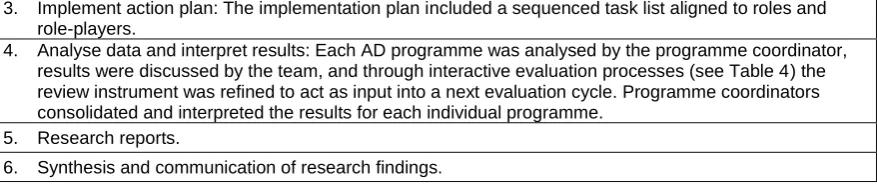
programme-evaluation steps to guide the thinking and the action plans are listed in Table 3.
Table 3: A stepped approach to guided thinking and plan actions
1. Schedule regular team meetings for action planning activities, feedback reports on study progress, collaborative work.
3. Implement action plan: The implementation plan included a sequenced task list aligned to roles and role-players.
4. Analyse data and interpret results: Each AD programme was analysed by the programme coordinator, results were discussed by the team, and through interactive evaluation processes (see Table 4) the review instrument was refined to act as input into a next evaluation cycle. Programme coordinators consolidated and interpreted the results for each individual programme.
5. Research reports.
6. Synthesis and communication of research findings.
PROGRAMME EVALUATION AND DATA COLLECTION
We developed a 15-step process (Table 4) using, what Killion (2006) refers to as, “a theory of
change-evaluation modelling and building on the logic models that define the conceptual
change process”. This encouraged evaluators to build pathways with evidence to improve the
AD programme design (Killion 2006, 5). The evaluation process started with a literature
review; and it concluded with a final report (Table 4). Programme evaluation steps, evaluation
actions and outcomes are listed in Table 4.
Table 4: Programme Evaluation Outcome
Evaluation steps Actions Output
1 Literature review to define concepts, determine scope, improve knowledge on programme evaluation
Summaries to team during meetings Team discussions
Posted in online collaboration space Online discussions
Literature study document
Online research collaborative space
2 Select evaluation frameworks
Online searches
Apply programme component framework and
Official review documents
Selected evaluation frameworks namely the Programme component framework and the University programme review template 3 Logic models Select appropriate model Logic model for programme 4 Theoretical underpinnings Select appropriate theories:
Social cultural theoretical underpinnings
System theory and system thinking Theories of change
Theoretical framework and conceptual framework
5 Select evaluation
instruments and questions
Use institutional evaluation / review instruments with pre-set questions
Review template
6 Conduct and complete programme reviews
Evaluate and review each AD programme. Complete the review template
Completed self-evaluation programme review reports
7 Reflect on self-evaluation report
Each programme coordinator critically reflects on the completed self-evaluation report
Reflective reports
8 Refine evaluation instrument Identify gaps in the evaluation instrument
Reflective team discussion Interactive evaluation and refinement of the instrument
Refined instrument
9 Re-evaluate programmes and complete self-evaluation reports
Each programme coordinator re-evaluate their programmes
Refined self-evaluation programme review reports
10 Group discussions on results Team meeting to discuss the reports and graphs
Graphical presentation of results for each programme
Consolidated summary in graphical format
11 Interpret results Each programme coordinator interpreted their programme results. The study leader consolidated findings
Consolidated report
Evaluation steps Actions Output changes proposed programme changes
13 Set design specifications for new design
Set educational outcomes Use the programme specification lists and blueprint document for new generic programme design
Blueprint document for programme design
14 Consolidate results Use the programme specifications and blueprint documents as input for a generic programme design Design generic programme for AD
Generic programme design
15 Report on findings Write final report and paper Final report and paper
From Table 4 it is evident that multiple methods of data collection were applied. These included
the application of selected evaluation frameworks, evaluation and review templates,
interactive-evaluation techniques, analysing existing and newly created document sources, team-meeting
discussions and minutes, reflective notes, and reports. The data sources included the evaluation
data and the participant feedback on eight of the nine existing AD programmes. The research
programme is new, and the current programme data are insufficient for analysis.
DATA ANALYSIS AND FINDINGS FOR THE PROGRAMME EVALUATION
Analysis of the data captured by applying the evaluation frameworks (programme component
framework and review template, steps 6 and 7) to AD programmes revealed the following
programme characteristics:
1. Programme descriptions of the programmes are based on the Centre’s Indaba, where the
programme co-ordinators of each programme proceeded to document their programmes,
based on their experience and the implementation of their programmes.
2. The programme component framework was an acceptable and useful framework to
capture the characteristics of AD programmes.
3. The framework consists of the following components:
Format, purpose, approach, alignment with other programmes, role-players and roles,
processes and procedures, programme outcomes.
The analysis of each AD programme component summarises AD programmes at the University
as various combinations of programme specific characteristics in Table 5.
Table 5: Programme Component Framework
Component AD programme characteristics
1 Format Electronic, online database platform, blended learning, interactive, formal credit bearing, informal, voluntary, developmental, individual, department and faculty levels, Short Learning Program, workshops, consultations, monitoring, mentoring, dialogue.
Component AD programme characteristics
capture, analysis, and reports. Introducing new academics into institutional and teaching and learning culture. To enhance and facilitate teaching, learning and assessment opportunities for academics and students, epistemological access.
3 Approach Developmental, needs-driven, research orientated, enabling spaces, multiliteracies approach, facilitative, humanising pedagogy, strategic, structured, systems approaches, active learning, participatory dialogue, promoting SoTL, curriculum design.
4 Alignment with other programmes
All AD programmes, selected academic programmes, administration and HR programmes.
5 Role-players and roles
Programme designer, study leader, academics, academic developers and academic departments, faculties, students, teaching and learning committees.
6 Processes and procedures
Regulated by teaching and learning policies; Vission2020; university strategic plan; Programme specific processes and procedures inter alia reflection, analysis, development, planning and implementation, evaluation, statistics and reporting, training, academic development activities.
7 Programmes
outcomes
Certification, policy development, adoption of new approaches and practices, create awareness of programme specific goals, demonstrate knowledge gained, engagement across boundaries, curriculum development, encourage reflective practice; place interventions in line with institutional culture, accelerated change implementation
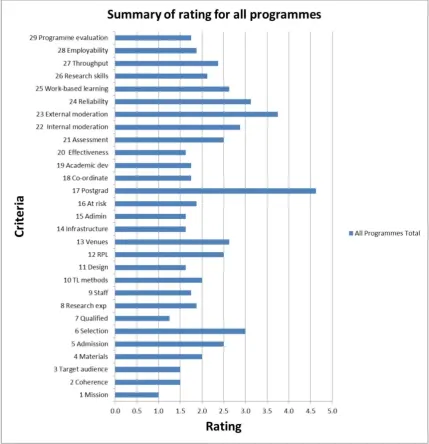
4. Review results from the self-evaluation reports were analysed, and a summary of the AD
programme review results is presented in Figure 6.
From the graph (Figure 6), it is clear that all the programmes are aligned with the institutional
mission, its strategic priorities and academic focus areas. Furthermore, the average rating was
2.02, which indicates that all the AD programmes meet the minimum standards. Exceptions
include criteria 17, 22‒24 and 26‒27, which were applicable to the Short Learning Programme
and the two formal programmes linked to a postgraduate programme, and selectively to the
others. The team discussed the results; and through a process of interactive evaluation, reached
consensus on the following:
1. Add another category for judgement, namely a rating of five to indicate a choice of “not
applicable”.
2. Change the wording of some of the questions, for example reference to students to be read
as staff (staff being the students).
3. Add descriptive titles for the criteria.
4. Apply the refined evaluation instrument to review the programmes, and compile a
Figure 6: AD Programme Ratings
Evaluation notes highlighted programme collaboration as a key enabler for building
communities of practice, for creating enabling environments, for building capacity, and for
optimising resources. Critical reflections from the programme co-ordinators were informative;
and they contributed to deepen the conceptualisations of the nature of the different programmes,
as well as giving insight into programmes’ components that need attention. Snippets from
programme co-ordinators’ reflections are listed in Table 6.
Table 6: Programme Co-ordinators’ Reflections
“The teaching and learning introduction programme lays the foundation to optimise human potential and fostering an environment that is focussed on teaching, learning, scholarship, student success and humanising pedagogy.
Refining the evaluation instrument, as described above, led to a revised review instrument,
which was applied to the AD programmes.
RESULTS FROM THE REVISED SELF-EVALUATION REPORTS
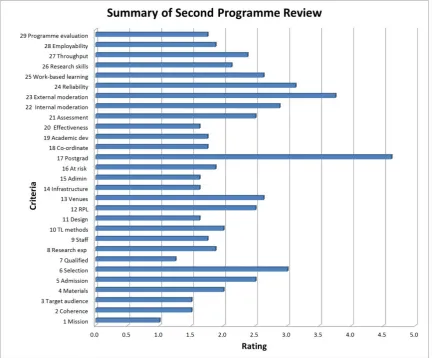
A review of the results from the revised self-evaluation reports was analysed; and a summary
of the AD programme review results is displayed in Figure 7.
From the graph (Figure 7), it is apparent that the review results concurred with the
previous review results. The criteria related to formal assessment and moderation was mostly
not applicable, as only the two formal, accredited programmes conduct formal assessments.
Each programme co-ordinator interpreted their programmes results, gave feedback and added
reflective comments. A few examples of these notes and comments are listed in Table 7.
shortcomings in the programme, based on the criterion provided. In reflecting on the initial evaluation, I realised that I would need to re-analyse the programme based on how it is positioned. It is not appropriate to evaluate the programme in isolation, as it is unmistakably connected to the Scholarship of Teaching and Learning programme.”
“Information shared increases insight into good teaching practices. Reflection on assumptions about and expectations of students, and increases ethical reflection which promotes self-improvement are highlighted as valuable in participants’ feedback. The participation in the programme and the evaluation of the programme are used to inform planning for the following year. The academics are giving us feedback through evaluations that they are satisfied with the programme as a whole and that it is relevant as it makes them improve their teaching and assessment practices. They are satisfied with the delivery and assessment practice used in the programme especially the Moodle delivery mode.”
“From the evaluation it has become apparent that one of this programme’s strengths is that it gives opportunities to lecturers to reflect on their own teaching practices as well as opportunities to improve their teaching. This improves lecturers’ employability and it has a direct impact on improving student learning. Another strength is that, while over-stretched at present, the programme has much potential and includes areas which could even be developed into separate programmes such as a fully-fledged Writing Across The Curriculum programme and a programme for researching the teaching and learning of academic writing. The weakness of this programme is the staff members are not sufficient in either number or seniority to carry out all the tasks that have been allocated to them.”
“Decisions that we make about blended learning, learning design and online assessment are embedded in our views, assumptions and perceptions that make up our philosophy of teaching with technologies within the context of university values with a strong link to the value of ‘ubuntu’.”
“From 2008, this programme’s services have been aligned with the institution’s strategic priorities of improving black and coloured students’ pass and graduation rates. For example, academics’ awareness about the Language Policy, which leads to its implementation in classrooms and the multilingual glossaries that are developed in this programme, provide teaching and learning support, particularly for the above mentioned students.”
“The SoTLC programme creates and sustains a responsive learning environment conducive to excellence in teaching and learning and fostering holistic student success. It promotes ongoing professional staff
development with respect to teaching practices. The programme strives to develop strategies to encourage academics and professional support staff to be reflective practitioners who increasingly engage in the
Scholarship of Teaching and Learning (SoTL). It provides forums for academics and professional support staff to publicly share good practices to enhance student learning and success.”
Figure 7: Summary of the Second Programme Review
Table 7: Programme Co-ordinators’ Notes and Comments
“Scholarship of Teaching and Learning Certificate (SoTLC) is a programme that offers a collaborative space for TL development at the university to explore ‘teaching for learning’. It positions the Scholarship of Teaching and Learning as a pathway to excellence. The programme’s objectives are to work collaboratively with academics, especially novice academics, to enable life-long learning and self-directed reflective practitioners.”
Suggested change implementation strategies included:
“Accelerate change implementation by creating awareness through marketing communications and also by providing structured support programmes for Blended Learning users. Also promote engagement through interactive workshops, demonstrations and presentations as well as online availability of specialised support. Foster commitment by weaving Blended Learning into the organisational culture.”
Interventions that may optimise the AD system include:
Offering structured support tools to provide scaffolding and to direct lecturers and students.
Identifying and actively involving different role players.
Developing appropriate recognition and incentive systems for academic staff to reward excellence in respect of the scholarship of engagement.
Prioritising professional development of staff through integration of internal staff development opportunities/interventions and allocating the necessary resources to various units according to transparent criteria.
SUMMARY OF CRITERIA RATINGS RELATED TO PROGRAMME DESIGN AND ACADEMIC DEVELOPMENT
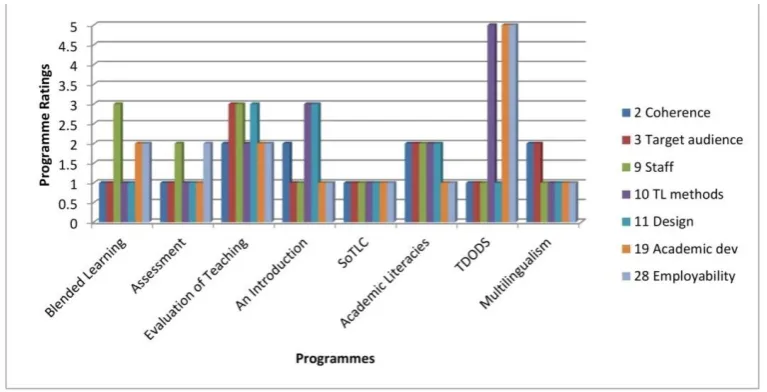
To link the review results to the programme design, the team identified the criteria ratings
related to programme design and academic development (Figure 8).
Figure 8: Criteria Ratings Important for Programme Design and AD
Ratings for these were between 1.5. and 2.0, which indicate that the minimum standards were
met. The TDODS programme was rated higher; as the programme was deliberately developed
and custom-made for the Teaching Development Unit, according to the relevant design
specifications. Criteria 2 (coherence), 3 (target audience), 9 (staff complement), 10 (teaching
and learning methods), 11 (design strategy), 19 (AD) and 28 (employability) specifically relate
to programme design and AD. The ratings for these indicate opportunities for programme
re-design and intervention. (Table 8).
Table 8: Opportunities for Programme Re-design and Intervention
Criterion number
Description Programmes for redesign
2 Coherence Evaluation of teaching and modules; Teaching and Learning: An Introduction; Multilingualism; Academic Literacies
3 Target audience Evaluation of teaching and modules; Multilingualism; Academic Literacies
9 Staff Blended Learning; Assessment of Student Learning in HET; Evaluation of teaching and modules; Academic Literacies 10 Teaching and learning
methods
Evaluation of teaching and modules; Teaching and Learning: An Introduction; TDODS; Academic Literacies
11 Design and review Evaluation of teaching and modules; Teaching and Learning: An Introduction; Academic Literacies
19 Academic development initiatives
Blended Learning; Evaluation of teaching and modules
FINDINGS AND INTERPRETATION OF THE RESULTS
Each programme co-ordinator interpreted their programme results, shared their findings with
the team to consolidate and report. General impressions, systems approaches, participant
reflections and evaluation-framework lenses, would highlight and communicate the research
findings and interpretations.
A. General impression lens
Exploring AD programmes at the University, highlighted the following profiles of the nine AD
programmes as: Research as a new programme, Electronic systems as a supportive programme
within the AD Centre, Evaluation of Teaching and Modules requires re-conceptualisation, and
Teaching and Learning: An Introduction as evolving. Two programmes, namely Blended
Learning and Assessment of Student Learning in HET are credit-bearing programmes, and three
programmes, SoTLC, Multilingualism and Academic Literacies are meeting the minimum
requirements. The evaluation underlined the importance of alignment and collaboration
between the programmes for example the linkages between the Introduction to Teaching and
Learning programme with the SoTLC, Blended Learning and Assessment programmes.
Evaluation results indicate connectedness between all the programmes, which points to
the criticality of close collaboration, holistic planning and shared action plans. All programmes
have a common purpose to effect conceptual change, resulting in reflective and changing
practices on all levels and layers of AD. Understaffed programmes, unclear roles and
responsibilities, and sometimes unmanageable workloads are common concerns. Some needs
highlighted by the evaluation of the Academic Literacies programme as supporting policies and
structures, support to staff members when trying to adapt to new identities as AD professionals,
and support and buy-in from top management.
B. Systems theory lens
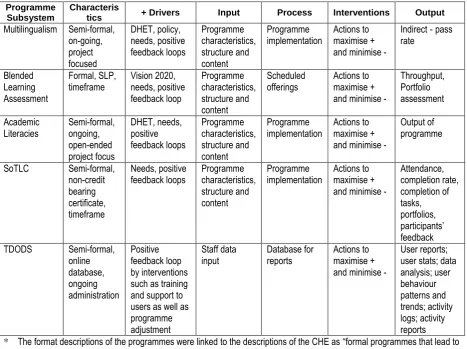
The AD system and embedded programme sub-systems show a variety of similar, unique,
blended, or overlapping input characteristics. Various processes are pushed or accelerated by
positive and negative drivers and interventions, resulting in output to feedback as the input into
the system, with positive or negative-system outcomes.
Table 9: Sub-systems of the AD Programme
*
Programme Subsystem
Characteris
tics + Drivers Input Process Interventions Output Multilingualism Semi-formal,
on-going, project focused DHET, policy, needs, positive feedback loops Programme characteristics, structure and content Programme
implementation Actions to maximise + and minimise -
Indirect - pass
rate
Blended Learning Assessment
Formal, SLP,
timeframe Vision 2020, needs, positive feedback loop Programme characteristics, structure and content Scheduled
offerings Actions to maximise + and minimise -
Throughput, Portfolio assessment
Academic
Literacies Semi-formal, ongoing, open-ended project focus DHET, needs, positive feedback loops Programme characteristics, structure and content Programme
implementation Actions to maximise + and minimise -
Output of programme
SoTLC Semi-formal,
non-credit bearing certificate, timeframe
Needs, positive
feedback loops Programme characteristics, structure and content
Programme
implementation Actions to maximise + and minimise -
Attendance, completion rate, completion of tasks, portfolios, participants’ feedback
TDODS Semi-formal,
online database, ongoing administration Positive feedback loop by interventions such as training and support to users as well as programme adjustment Staff data input Database for reports Actions to maximise + and minimise -
User reports; user stats; data analysis; user behaviour patterns and trends; activity logs; activity reports * The format descriptions of the programmes were linked to the descriptions of the CHE as “formal programmes that lead to
a range of NQF registered qualifications” (Singh 2004, 139 and 147). For example, the Blended Learning and the Assessment of Student Learning Modules linked to the PGCHET formal qualification. As in the case of the semi-formal programmes, a series of short workshops contributed to some form of certification or a well-defined outcome. Each of the programmes could be linked to one or more of the different programme modes as described by Prebble et al. (2004).
Important to note is that choices regarding the characteristics, mode, format, impact measuring
and model of the programme, determine the programme outcome (Prebble et al. 2004). They
further describe the six theoretical models proposed by Gilbert and Gibbs (1998) and highlight
that the “intended outcomes of these programmes will depend on the underlying model and
should therefore determine the way in which the programmes are assessed” (Prebble et al. 2004,
42).
C. Reflective lens
The analysis of programme evaluation reflections indicated that developing opportunities for
academics to reflect on and develop their own practices are important programme design
features. Reflective models advocating the development of reflective practitioners are widely
used as theoretical frameworks for AD programmes for example Gilbert and Gibbs (1998) and
Table 10: Analysis of Programme Evaluation Reflections
We apply the components of change (awareness, engagement and commitment) as follows:
Awareness [raising]: our communiqués to staff, the information on our website, how we help develop lecturers’ study guides according to the principles of best practice in teaching and learning, the tone of our individual face-to-face or email interactions and agreements with academics, how we respond to
collaborative assignment or module design or how we conduct collaborative classroom sessions.
Engagement: We engage with academics in the workshops for academics that we offer, when we device collaborative writing development strategies or design study guides or modules together.
[Creating opportunities for giving evidence of] Commitment: When an academic attends the Academic Literacies opportunities we create and build into their programme design the changes we suggest and/or is willing to collaborate with us in a longer term writing development strategy (e.g. for a year), we commit to providing sustained support in the classroom when needed, responding to student drafts (either face-to-face or online) as well as to having reflective sessions with the academic to discuss what worked and what did not work.
D. Evaluation-framework lens
The programme component framework captured the characteristics of AD programmes; and it
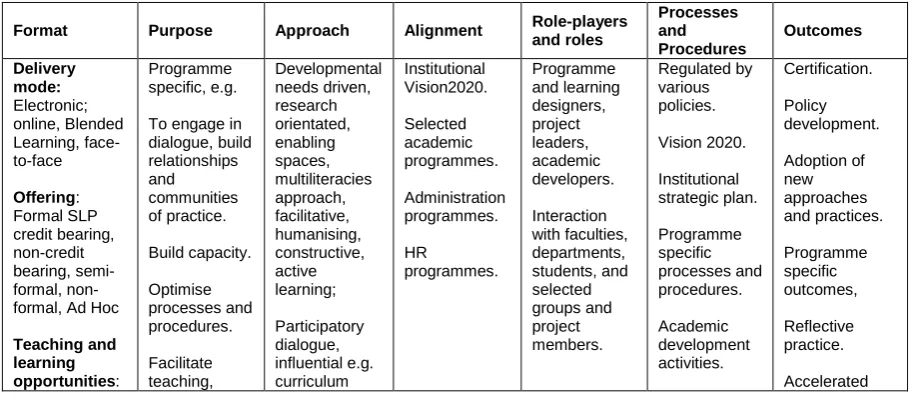
is summarised in Table 11 as, format, purpose, approach, alignment, roles and role-players,
processes and procedures, and outcomes, all of which capture the characteristics of the
programmes within a specific context. These are summarised in Table 11 and they show
elements from several of the six theoretical AD programme models proposed by Gilbert and
Gibbs (1998). The six models are summarised by Prebble et al. (2004, 42) as:
“Behavioural change models – that focus on changing the teacher’s behaviour in the classrooms. Developmental models – based on the idea that teachers change their focus of attention over the course of their career, from self to subject to student (passive) and finally to student (active). Reflective practice models – that advocate the development of reflective practitioners. Conceptual change models – that maintain teachers’ conceptions about teaching are linked to
their teaching intentions and strategies. Student learning models – that focus on students’
approaches to study, and their perceptions of their learning environment. Hybrid models – that combine elements of several models.”
Table 11: Summarised AD Programme Characteristics
Format Purpose Approach Alignment Role-players and roles Processes and Procedures Outcomes Delivery mode: Electronic; online, Blended Learning, face-to-face Offering: Formal SLP credit bearing, non-credit bearing, semi-formal, non-formal, Ad Hoc
Teaching and learning opportunities:
Format Purpose Approach Alignment Role-players and roles
Processes and Procedures
Outcomes
Presentations, demonstrations, workshops, consultations, monitoring, dialogue
Levels:
Faculty, department, group, individual
learning and assessment opportunities. Enhance academic practices. Create collaborative spaces.
design. change
implementation.
Based on our programme evaluation we support the notion that AD development and the
implementation of AD programmes remain a viable option for teaching and learning in HE. We
were also encouraged by the research report published by Prebble et al., 2004, who list 13
propositions for improving student learning outcomes based on literature analysis and research
evidence. They propose that, “Through a variety of academic development interventions,
teachers can be assisted to improve the quality of their teaching” (Prebble et al. 2004, 13).
Important propositions linked to this are that “Teachers can be assisted to improve the quality
of their teaching through obtaining feedback, advice and support for their teaching from a
colleague or academic development consultant” (Prebble et al. 2004, 37). Followed by “Student
assessments are among the most reliable and accessible indicators of the effectiveness of
teaching.” (Prebble et al. 2004, 41) and continue by proposing that “Intensive and
comprehensive staff development programmes can be effective in transforming teacher’s
beliefs about teaching and learning and their teaching practice. In particular, teachers can be
assisted to shift from a teacher-centred approach to a learner-centred approach, and to align all
the elements of the teaching situation in order to achieve positive student outcomes”. (Prebble
et al. 2004, 48).
From the evaluation data, it is evident that all our programmes, in nature, are
learner-centred, following a participatory programme development approach, supported by the hybrid
model which allows for a combination of several models (Prebble et al. 2004, 44). Our
programmes allow for a range of choices, namely, ad hoc combinations for teaching with
technology to include skills training, workshops, and learning design courses. Needs-driven
customisable, dynamic design application and flexible content in the formal programmes
contribute to achieve the set outcomes. The focus of the nine evaluated programmes is on
process where the learning is experienced as developmental, participatory with active
involvement of the learners (academic staff as students and their students when it comes to
OUTCOME: GENERIC PROGRAMME DESIGN SPECIFICATIONS
A synthesis from programme and consolidated reports, input from evaluation reports and
research findings, provided input for programme design specifications. Input variables include
the context, resources, target population, philosophical approaches, conceptual and theoretical
frameworks, educational approaches, programme components, minimum standards, academic
development opportunities, and programme structure. These contributed towards a blueprint
document for a generic AD programme design (Table 12), as an important outcome of the study
in terms of a systematic and consistent approach to data-driven programme design. The latter
facilitates not only for a focused point of departure (input elements) embedded in contextual
features as drivers to enable or restrain the process, but also for customisation and dynamic
programme changes dependant on the programme specific model, -mode and -outcomes
(Prebble et al. 2004; Guskey 2002; Chalmers and Gardiner 2015).
Table 12: Data-driven Design Specifications and Blueprint for Generic AD Programme Design
Design Specifications and Blueprint Document for Generic Academic Programme Design
Phase focus Detailed focus Choices Output
Educational philosophy Philosophical
underpinnings aligned with contextual vision and mission
Humanising pedagogy Descriptive document
Logic model Models/Theories of change
Models/Theories of action
Components of change (awareness, engagement, commitment)
Change implementation to create conceptual change
Descriptive document
Educational approach Communicational, Reflective Collaborative
Underlying educational approach for programme
Descriptive document
Programme components Field; Format; Offerings, Purpose; Approach; Alignment; Role-players; Roles; Processes and procedures; Outcomes
Programme specific Component table
Minimum standards Quality criteria Quality criteria related to contextual vision and mission; coherence; recruitment; staff; outcomes; infrastructure; administrative systems; policies; curriculum development; achievements; feedback results
Standard list
Academic development opportunities
Purpose
Programme / offering sequence and design specifications
Design specification document
Delivery mode
Reflection opportunities Learning outcomes Subject matter chunks Activities
Tasks
Feedback opportunities
Structure levels Module structure Sequence and relationship of learning units (academic development opportunities)
Explanatory notes about Table 12
Generic design specifications provide a framework for an AD programme blueprint, which
could guide programme development and implementation within the South African, HE
context. The generic AD programme design (Table 12) proposed does not espouse a generic set
of prescriptive generic skills or a random pick and mix selection of programme components to
create training and workshop opportunities for participants. On the contrary, generic in the
description refers to design specifications, which were distilled from the analysis and evaluation
activities done by the AD participants in the project. The set of generic design specifications
not only, profiles a framework application in the different AD and teaching domains, but also
enables the customisation, in terms of the specific programme requirements as per domain or
discipline. The specific context, mode, and model determine the set of design specifications
selected for a specific application. Mapping the data-driven programme design specifications,
supported by research findings, to AD programme modes (Prebble et al. 2004, 25), models
(Prebble et al. 2004, 42) and impact measuring (Guskey 2002; Chalmers and Gardiner 2015)
provide a useful matrix for decision-making.
DISCUSSION AND IMPLICATIONS FOR HIGHER EDUCATION
Quinn (2012, 6‒7) describes three paradigms in teaching development (from Light and Cox
2000) as the ad hoc paradigm where participants draw on experience and informally acquire
the required skills as they move along. The skills paradigm sees teaching development as a
skill-set that one needs to acquire by attending workshops and training sessions. Within the
professional paradigm, participants are encouraged to become reflective and critical
professionals. Analysis and evaluation of the nine AD programmes in this study applied four
lenses namely general impressions, reflection, systems theory and thinking, and evaluation
frameworks.1 Through these lenses it became evident that all programmes included elements
from all three paradigms mentioned by Quin (2012) to suit the programme nature and purpose.
The nature of the AD programme e.g. the characteristics, model, mode, approach and outcomes
would populate the programme design to create a unique blueprint for each of the programmes.
Findings informed a generic design specification list and blueprint document for AD
programme design. The importance of customizable programme blueprints for the development
of different programme modes and models is illustrated by the programme evaluation findings.
Examples are programme modes that ranged from formal credit bearing, short learning to group
or one-on-one training, consultation and student feedback and evaluation. Different programme
to Prebble et al. (2004) it is the mixture of “programme objectives that has motivated most of
the more systematic and intensive programmes of academic development” and that is adding to
“currently contributing to the international pressure to introduce accredited and mandatory
programmes in systems of higher education” (Prebble et al. 2004, 44). They also found that a
combination of the conceptual change and student learning approaches informed the outcomes
of intensive AD programmes. (Prebble et al. 2004, 91). The CHE report on “Learning to Teach
in Higher Education in South Africa” (CHE 2017, 12) highlights the importance of academic
development and mentions that universities are becoming more intentional to develop the
required competencies. AD programmes are core to these endeavours (Chalmers and Gardiner,
2015). Study findings concur that a range of informal, formal, ad hoc, group, individual,
“theoretical and practice-based learning opportunities, are important for professional growth
and development from enrolment on formal professional development programmes to
participation in informal supportive networks within the AD context” (CHE 2017, 15 and 28‒
29). Therefore, the generic AD programme design (Table 12) provides a holistic, integrated
framework, which allows for choices about theoretical approaches (e.g. humanizing pedagogy
and heutagogical approaches), linked to a continuum of different programmes modes, models,
and structural elements, within specific contexts. Analysis of our programmes highlighted
linkages as a strength in our programme system as it provides multiple opportunities for
engagement, reflection, and relevant theoretical knowledge sharing. Guskey (2002, 48 cited in
the CHE 2017 report) is of opinion that a “lack of institutional support can sabotage any
professional development effort even when the individual aspects of professional development
are done right” (CHE 2017, 28). Within the South African context we concur with the CHE
(2017, 31) report which emphasizes the importance of AD to create, enable and sustain enabling
environments for enhancing teaching and learning in Higher Education.
CONCLUSION
Programme evaluation of the nine programmes highlighted that we offer AD programmes
ranging from formal credit bearing to informal supportive networks (CHE 2017, 28). Each of
these programmes plays an important role in the HE context and it is now generally accepted
that AD programmes remain a viable option for enhancing teaching and learning in HE.
(Chalmers and Gardiner 2015, 53; CHE 2017, 31). Therefore, in the South African context
where there is a growing understanding of the broader contexts and the range of learning
opportunities for AD that impact on what teachers can achieve (CHE 2017, 31), the importance
of research-based, data-driven decision making is eminent. Through the application of an
to move toward a scholarly approach in reviewing our programmes. Outputs include a
data-driven perspective in the formulation of a generic specification template and blueprint for AD
programme design and redesign. The resulting output, in turn, feeds back as input into the
second and third cycles, which focus on establishing the suitability of the redesigned
programmes in determining the desired conceptual change in participants’ teaching practice
and consequent impact on student learning.
ACKNOWLEDGEMENTS
The University Teaching Development Innovation Fund for supporting this project.
The language editor.
NOTE
1. Some of the research findings were presented in a live presentation on 21 November 2014 at the
HELTASA Conference 2014, at the University of Free State, Bloemfontein, South Africa.
REFERENCES
Bamber, V. 2008. Evaluating lecturer development programmes: Received wisdom or self‐knowledge?,
International Journal for Academic Development 13(2): 107‒116, DOI:
10.1080/13601440802076541 To link to this article: http://dx.doi.org/10.1080/
13601440802076541 (Accessed 15 July 2014).
Berens, L. V. 2013. The self of the self-organizing system. Telos Publications. http://lindaberens.com/
resources/methodology-articles/the-self-of-the-self-organizing-system/ (Accessed 13 October 2016).
Boughey, C. 2007. Marrying equity and efficiency: The need for third generation academic
development. Perspectives in Education 25(3).
CALPRO. 1997. California Adult Literacy Professional Development Project Online. Section 4:
Evaluating Professional Development A Framework for Adult Education. A publication of building professional development partnerships for adult educators’ project. http://www.calpro-online.org/pubs/Eval4.pdf (Accessed 1 November 2014).
Capra, F. 1997. The web of life. The Schrödinger lecture series. Dublin, 9 September, 1997. http://www-users.york.ac.uk/~lsdc1/SysBiol/capra.weboflife.schrodingerlecture.1997.pdf (Accessed 14 October 2016).
CGIAR. 2013. Research program on aquatic agricultural systems. 2014. AAS 2013 Evaluating natural
resource management programs. Annual Report: AAS-2014-32. Penang, Malaysia: CGIAR. http://pubs.iclarm.net/resource_centre/AAS-2013-annual-report.pdf (Accessed November 2014).
Chalmers, D. and D. Gardiner. 2015. The measurement and impact of university teacher development programs. Educar 51(1): 53-80.
CHE see The Council of Higher Education.
Gibbs, G. and M. Coffey. 2004. The impact of training of university teachers on their teaching skills,
their approach to teaching and the approach to learning of their students. Active Learning in Higher
Education 5(1): 87‒101.
Gilbert, A. and G. Gibbs. 1998. A proposal for an international collaborative research programme to
identify the impact of initial training on university teachers. Research and Development in Higher