A F e l i n e - S p e c i fi c A n t i - N e r v e G r o w t h F a c t o r A n t i b o d y I m p r o v e s
M o b i l i t y i n C a t s w i t h D e g e n e r a t i v e J o i n t D i s e a s e
–
A s s o c i a t e d P a i n :
A P i l o t P r o o f o f C o n c e p t St u d y
M.E. Gruen, A.E. Thomson, E.H. Griffith, H. Paradise, D.P. Gearing, and B.D.X. Lascelles
Background: Neutralizing antibodies against nerve growth factor (NGF) are analgesic in rodent models, naturally occur-ring degenerative joint disease (DJD) pain in dogs, and chronic pain in humans.
Objectives: To evaluate the efficacy of a fully felinized anti-NGF antibody (NV-02) for the treatment of DJD pain and mobility impairment in cats.
Animals: Thirty-four client-owned cats with DJD-associated pain and mobility impairment.
Methods: In a placebo-controlled, pilot, masked clinical study, cats were randomized to a single treatment with NV-02 (0.4 mg/kg SC [n=11] or 0.8 mg/kg SC [n=12]) or placebo (saline, SC [n=11]). Activity was measured objectively. Addi-tionally, owners completed clinical metrology instruments (client-specific outcome measures [CSOM] and feline musculoskele-tal pain index [FMPI]) on days 0 (screening), 14 (baseline), 35, 56, and 77. A repeated-measures model was used to evaluate the objective activity data.
Results: NV-02 significantly increased objectively measured activity overall (P=.017) and at 2 (P=.035), 3 (P=.007), 4 (P=.006), 5 (P=.007), and 6 (P=.017) weeks after treatment. CSOM scores (P=.035) and pain (P=.024) showed a sig-nificant effect of treatment 3 weeks after administration. In the treatment group, 83% of the owners correctly identified the treatment administered compared with 45% of owners in the placebo group (P=.013). No treatment-related adverse effects were identified.
Conclusions: These pilot data demonstrate a 6-week duration positive analgesic effect of this fully felinized NGF anti-body in cats suffering from DJD-associated pain.
Key words: Client-specific outcome measures; Feline musculoskeletal pain index; Osteoarthritis.
M
any adult and geriatric cats have radiographic
evidence of degenerative joint disease (DJD),
1,2and a large proportion of these have associated chronic
pain, manifested as alterations in mobility and activity.
In the United States, there is no approved medication
for the long-term treatment of chronic pain in cats,
despite the clear need for such a treatment.
Currently, the nonsteroidal anti-inflammatory drug
(NSAID) meloxicam is approved in Europe for use in
treating chronic pain in cats, but has not been approved
for this use in the United States. There are concerns
about the use of NSAIDs for long periods of time in
cats, especially because the majority of cats presenting
with DJD-associated pain have evidence of chronic
kid-ney disease.
3Because of these concerns, dosages lower
than the European-approved dosage of meloxicam have
been tried, and there are several suggestions from
open-label studies that these lower dosages are effective in the
management of DJD-associated pain in cats.
4,5Only one
blinded, placebo-controlled study assessing a dosage
lower than the approved 0.05 mg/kg daily dosage has
been performed, and that study found that a dosage of
0.035 mg/kg daily produced measureable improvement
over a 3-week period of administration.
6,7Indeed, only 2
placebo-controlled, masked, clinical studies of the
effi-cacy of meloxicam in cats have been published.
6–8Neutralizing antibodies against nerve growth factor
(NGF) are analgesic in rodent models
9and in humans
10with chronic pain, although none currently are approved
for use in humans. Using a proprietary technique for
interspecies conversion of antibodies based on expressed
cDNA
sequence
analysis
(PETization
TM)
Nexvet
From the Comparative Pain Research Program, NCSU College of Veterinary Medicine, Raleigh, NC (Gruen, Thomson, Paradise, Lascelles); Comparative Medicine Institute, NCSU College of Veterinary Medicine, Raleigh, NC (Gruen, Lascelles); Department of Statistics, NC State University, Raleigh, NC (Griffith); Nexvet Australia Pty Ltd, Melbourne, VIC Australia (Gearing); and the Center for Pain Research and Innovation, UNC Dental School, Chapel Hill, NC (Lascelles).
Work was conducted at North Carolina State University, Comparative Pain Research Program, College of Veterinary Medicine.
Corresponding author: B.D.X. Lascelles, Comparative Pain Research Program, NCSU College of Veterinary Medicine, 1060 William Moore Drive, Raleigh, NC 27607; e-mails: Duncan_ [email protected]; [email protected].
Submitted February 1, 2016; Revised April 5, 2016; Accepted April 28, 2016.
Copyright © 2016 The Authors. Journal of Veterinary Internal Medicine published by Wiley Periodicals, Inc. on behalf of the American College of Veterinary Internal Medicine.
This is an open access article under the terms of the Creative Commons Attribution-NonCommercial License, which permits use, distribution and reproduction in any medium, provided the original work is properly cited and is not used for commercial purposes.
DOI: 10.1111/jvim.13972
Abbreviations:
AC activity counts AM activity monitors
CMI clinical metrology instrument CSOM client-specific outcome measures DJD degenerative joint disease FMPI feline musculoskeletal pain index
NCSU-CVM North Carolina State University College of Veterinary Medicine
Biopharma developed a novel therapeutic fully felinized
anti-NGF mAb (named NV-02) for the alleviation of
pain in cats.
11We hypothesized that a single SC dose of anti-NGF
antibody would alleviate pain and improve mobility for
up to 6 weeks. Improvements would be able to be
detected by owners and reflected in objectively
mea-sured activity. The primary objective of this pilot study
was to assess the overall
efficacy potential
of SC
admin-istered NV-02 in improving owner-evaluated mobility
and activity and increasing objectively measured activity
counts in cats with DJD as compared with placebo.
Secondary objectives were to (1) assess the overall
duration
of SC administered NV-02 in improving
owner-evaluated mobility and activity and increasing
objectively
measured
activity
in
cats
with
DJD-associated pain compared with placebo over an 11-week
period (2 weeks pretreatment baseline, 9 weeks
post-treatment); (2) to determine the relative efficacy
poten-tial and optimal dosage of NV-02 using 2 dosage
groups; and (3) to assess the adverse effects associated
with NV-02 in cats beyond preliminary investigations in
laboratory cats.
Methods and Materials
This study was approved by the Animal Care and Use Commit-tee (Protocol # 14-043-O) at North Carolina State University Col-lege of Veterinary Medicine (NCSU-CVM), and written owner consent was granted in each case after verbal discussion of the study. The reporting of data follows the CONSORT guidelines (http://www.consort-statement.org/consort-2010).
Study Design
This study was designed as a double-blind, placebo-controlled, randomized pilot study with 12 cats in each of 3 groups. Outcome measures included changes in owner ratings and changes in activ-ity (as measured by accelerometry) after treatment with the active drug or placebo. Additionally, adverse events, including changes in clinical pathology assessments, were evaluated.
Animals
Animals enrolled in the study were all client-owned cats with naturally occurring DJD-associated pain and mobility impairment. Subjects were recruited using a combination of advertising directly to owners and to veterinarians. All study-related activities were performed at zero cost to the owner. We also employed ideas on recruitment and incentives identified recently on owners’ attitudes to clinical studies involving cats.12
Prescreening
Owners either emailed or telephoned in response to advertise-ment and outreach. The study and requireadvertise-ments were explained to them, with a focus on the requirements that the cats be indoor only, able to wear a collar with the activity monitor on it, and be impaired in at least 3 activities. Owners were ques-tioned about whether they had any upcoming life changes, such as moves, new babies, new pets, or extended vacations. Suitable cases were scheduled for visits to the Veterinary Teaching Hospital.
Inclusion and Exclusion Criteria
Eligibility criteria were similar to previous DJD-associated pain studies in cats performed by our program.6Cats were eligible to participate in the study if they had a qualifying degree of owner-noted mobility or activity impairment (described in the next sec-tion), evidence of pain during manipulation of at least 2 joints or spinal segments during veterinary orthopedic evaluation (discussed in Orthopedic evaluation section), and radiographic evidence of DJD in at least 2 of the painful joints or spinal segments (discussed in Radiographic evaluation section). Cats were required to be
>1 year old and weigh more than 1 kg. Predetermined exclusion criteria for all cats included the presence of suspected or diagnosed infectious diseases, symptomatic cardiac disease, immune-mediated disease, neoplasia, inflammatory bowel disease, urinary tract infec-tion, hyperthyroidism, and diabetes mellitus. These conditions were ruled out using review of the referring veterinarian’s medical records, owner history, physical examination, CBC, serum bio-chemistry panels, T4 testing, and urinalysis. Cats with chronic kid-ney disease (CKD) up to and including IRIS stage 2 were eligible to enroll, provided the disease was stable as determined by repeated serum biochemistry panels and urinalyses. Cats with CKD of IRIS stage 3 or 4 were excluded from participating in the study.
Owner Evaluation of Mobility Impairment
During the screening interview, owners were asked to identify 3 activities that their cat showed impairment in performing as described previously.6 These 3 items then were used to construct the client-specific outcome measures (CSOM) assessment and used for subsequent study assessments. Owners rated their cat’s ability to perform each activity on a Likert scale ranging from 4 (no prob-lem) to 0 (impossible) with intermediate values of 3 (mild difficulty), 2 (moderate difficulty), and 1 (severe difficulty). Owner ratings were converted to numerical scores, and the total CSOM score was the sum of these 3 scores with a possible range of 0–12. In order to ensure that cats enrolled in this study were sufficiently impaired by the DJD-associated pain (as rated by their owners), cats were eligi-ble for inclusion if they received an owner-rated score of≤5 on day 0 (lower numbers indicating greater impairment). Owners com-pleted the CSOM without knowledge of the cutoff for inclusion.
Orthopedic Evaluation
Orthopedic evaluations were carried out as previously described6,13,14and were performed by a single veterinarian (MG), with a single assistant (AT). Joints were designated a pain score before radiographs were taken and evaluated. As previously described,6a total pain score was calculated as the sum of all the individual appendicular joint and axial skeletal segment pain scores.
Radiographic Evaluation
Cats meeting eligibility criteria for owner-noted mobility or activity impairment and pain on orthopedic evaluation were sedated, and orthogonal radiographs were taken of every joint and spinal segment. Radiographs were reviewed for the presence of DJD by a board-certified veterinary radiologist who was not aware of the presence or location of pain.
Randomization Method
of treatment or placebo was performed by pharmacy staff, with all personnel involved in data collection being masked to the treatment given. For balance, cats were stratified by higher or lower impair-ment based on CSOM score for randomization (CSOM 0, 1, 2=high impairment; CSOM 3, 4, 5=low impairment), but not analyzed separately. The randomization code and allocation of cats to NV-02 or placebo was only made known to investigators once the data had all been entered and quality control checked by per-sonnel not directly involved in the study (Clinical Studies Core).
Masking
A preloaded syringe was placed in a brown, light resistant plas-tic bag labeled with the case number, name, and instructions “Give NV-02 OR placebo by SC injection once.” The prescribing veterinarian and the quantity (mL) also were listed on the label. The syringe and contents were allowed to reach room temperature for 1 hour, and the injection was given by a veterinary technician not associated with the study (Clinical Studies Core personnel). Each cat was restrained by AT, who was required to turn her head away as the treatment or placebo was being administered. The vol-ume of placebo was balanced, so even observation of volvol-ume would not reveal the contents of the syringe.
Study Timeline
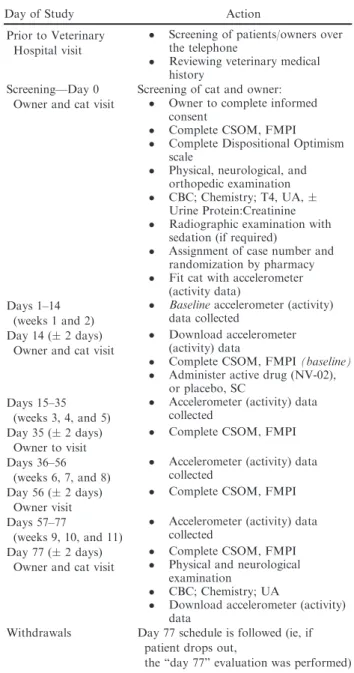
Table 1 outlines the study protocol and activities. The owner vis-ited the clinic with the cat on 3 occasions over the 11-week study (day 0, day 14, and day 77), and on 2 other occasions without the cat (day 35 and day 56). The expected duration of efficacy of NV-02, if seen, was thought to be 4–6 weeks. The study was extended beyond this time period to ensure the full profile of efficacy was captured.
Investigational Compound
A fully felinized anti-NGF mAb that is in development for the control of pain associated with DJD in cats was used in this study, referred to as NV-02.11The NV-02 was supplied by Nexvet as a sterile solution containing 1.9 mg/mL of the anti-NGF antibody in phosphate-buffered saline (pH 7.2). The treatment groups were T1: single SC dose of 0.4 mg/kg NV-02; T2: single SC dose of 0.8 mg/kg NV-02; and P: single SC dose of sterile saline, at a vol-ume of either 0.21 mL/kg or 0.42 mL/kg (randomized).
Description of Outcome Measures
Several efficacy outcome measures were chosen to fully characterize the potential response seen with NV-02.
Primary.
1 Activity measured by accelerometer counts (activity counts; objective)
2 Owner assessment using clinical metrology instruments (subjective):
a Feline musculoskeletal pain index (FMPI) b Client-specific outcome measure (CSOM)
Secondary.
1 Owner assessment of whether active treatment had been administered (subjective)
Accelerometery (Activity)
The accelerometersaused to measure activity (hereafter referred to as “Activity Monitors,” AM), and their use in cats, have both been described previously.6,8,15The AMs were mounted on a neck
collar for all cats. The AMs were programmed to collect data with an epoch duration of 1 minute.
Owner Assessments
Feline Musculoskeletal Pain Index (FMPI). The version used in this study (v10) was published recently.6The FMPI queries owners on their cat’s ability to perform each of 17 activities (rated on a Likert scale from “normal” to “not at all”) with an option to select “don’t know or not applicable.” Two additional items (pain domain questions) ask owners to rate their cat’s level of pain on a standardized 100-mm visual analog scale. Owner ratings were con-verted to scores ranging from 0 to 4 for each item with 0=not at all and 4=normal. Scores on the visual analog scale were
Table 1.
Outline of study protocol and activities at
each time point.
Day of Study Action
Prior to Veterinary Hospital visit
Screening of patients/owners over the telephone
Reviewing veterinary medical history
Screening—Day 0 Owner and cat visit
Screening of cat and owner:
Owner to complete informed consent
Complete CSOM, FMPI
Complete Dispositional Optimism scale
Physical, neurological, and orthopedic examination
CBC; Chemistry; T4, UA, Urine Protein:Creatinine
Radiographic examination with sedation (if required)
Assignment of case number and randomization by pharmacy
Fit cat with accelerometer (activity data)
Days 1–14 (weeks 1 and 2)
Baselineaccelerometer (activity) data collected
Day 14 (2 days) Owner and cat visit
Download accelerometer (activity) data
Complete CSOM, FMPI(baseline)
Administer active drug (NV-02), or placebo, SC
Days 15–35 (weeks 3, 4, and 5)
Accelerometer (activity) data collected
Day 35 (2 days) Owner to visit
Complete CSOM, FMPI
Days 36–56 (weeks 6, 7, and 8)
Accelerometer (activity) data collected
Day 56 (2 days) Owner visit
Complete CSOM, FMPI
Days 57–77
(weeks 9, 10, and 11)
Accelerometer (activity) data collected
Day 77 (2 days) Owner and cat visit
Complete CSOM, FMPI
Physical and neurological examination
CBC; Chemistry; UA
Download accelerometer (activity) data
Withdrawals Day 77 schedule is followed (ie, if patient drops out,
the “day 77” evaluation was performed)
calculated by measuring, in mm, from the start (zero point) to the owner’s mark, with 100 indicating “no pain.” The range of possi-ble scores was 0–68 for items 1–17 and 0–100 each of the final 2 questions.
Client-Specific Outcome Measures (CSOM) Questionnaire. Con-struction of the CSOM was described above. The CSOM items were each presented in the same order for each cat at each visit. Owner ratings were converted to numerical scores, and the total CSOM score represented the sum of these 3 scores with a possible range of 0–12, with higher numbers indicating less impairment.
Owner Assessment of Whether Active Treatment Had Been Administered. At the end of the study (day 77), owners were asked “Do you think your cat received the nerve growth factor anti-body?” They were required to answer “yes” or “no,” and their response was recorded.
Three approaches were taken in the assessment of safety in this pilot study:
1 Clinical assessment of cats after the administration of NV-02 or placebo, for evidence of an allergic response
2 Evaluation of changes in CBC, serum biochemistries, and urinalyses
3 Owner-reported adverse events
After administration of NV-02 or placebo, cats were observed for 4 hours for signs indicative of an allergic response, including scratching or rubbing, increased respiratory rate, tachycardia, urti-caria, and weakness. A bank of cages was positioned in the main Comparative Pain Research room where 2 technicians in the room could closely observe the cats. Respiratory rate was taken every 15 minutes.
Blood samples and urine samples were taken from all of the cats at day 0 (baseline) and day 77 to evaluate any changes in CBC or serum biochemistry results over the course of the study.
Owners were asked to report any events that were unusual for their cat as soon as they occurred, using provided contact informa-tion. If adverse events (AE) occurred, owners were instructed to take their cat immediately to the NCSU-CVM Emergency Service or their local emergency veterinary clinic. Adverse events were defined as any observations in the cat that were unfavorable and unintended and that occurred during the study, whether they were considered to be treatment related. A serious adverse event (SAE) for this study was defined as any AE that was either fatal or life-threatening, required professional intervention (by a veterinarian), and considered by the investigators to be clinically serious.
Statistical Analysis
Sample Size Estimation. This study was designed as a pilot study, and a formal power analysis was not conducted because anti-NGF antibodies had not been used in cats previously, and
the expected difference between treatment groups, therefore, could not be estimated. One aim of this study was to gather sufficient data to enable a power analysis to be conducted for a larger efficacy study.
Handling of Data. Efficacy was analyzed for all cats complet-ing the study (through day 77) unless another disease or prob-lem was discovered that could not be attributed to the test articles at the end of the study, and safety was analyzed for all cats enrolled in the study using day 0 and day 77 laboratory results and AE reported by owners. Activity data analyses were performed comparing each group (T1 and T2) to placebo. After the analysis of the objective activity data, the treatment groups were combined for the analysis of the subjective data. AP-value of .05 was considered significant. There was no adjustment of
P-value for multiple comparisons due because of the pilot nat-ure of this study.
Groups (treatment and placebo) were compared for distribution of age and weight using t-tests, sex of the cats using chi-square analysis, and body condition score using Wilcoxon rank-sum test.
Data points (counts) for activity were generated at every minute of every day throughout the study. These counts were averaged for each week to generate a single data point (mean activity per minute) for each cat over each week. Baseline activity was defined as the mean activity count per minute over the first 2 weeks of the study for each cat, before treatment. Values of mean activity count per minute were used to calculate the change from baseline for each week of the study posttreatment (weeks 3–11) for each cat. These data were analyzed using a repeated-measures ANOVA, including a week 9 week interaction because the collection of activity data continued for longer than the expected duration of efficacy of NV-02. Contrasts were used to look at differences between groups at individual weeks.
For the FMPI scores, a percentage possible score was calcu-lated as follows:
%FMPIpossScore Q117¼ sum of Q117 scores number of questions answered4
Changes from baseline (day 14) were calculated for the % FMPIposs and for CSOM scores for each cat at each assessment time point (day 35, day 56, and day 77) and used for within-group comparisons (Wilcoxon signed rank) and between-group compar-isons of change (Wilcoxon rank sum). Questions 18 and 19 on the FMPI were analyzed separately because these were visual analog scale questions.
A success-failure analysis also was performed on the CSOM data, using an increase in CSOM score of≥2, with no decrease in score for any individual activity, as the criteria for success.6,7 Success-failure analysis was performed using a Pearson chi-square approach. Effect size (Cohen’sd for treatment over placebo) was calculated using the change in score from baseline for treatment and placebo groups, and standard deviation for the change in score according to the following equation:
For the owners’ ability to identify whether anti-NGF had been administered, success was defined as correctly choosing the treat-ment given, and data were analyzed using a Pearson chi-square approach.
Any allergic responses and AEs were described. Paired t-tests were used to compare day 0 laboratory results with end of study laboratory results (day 77) for the pooled treatment group and the placebo group and also to compare pooled treatment group and placebo group at day 0 and day 77. The Wilcoxon signed-rank test was used to compare day 0 and end of study results for laboratory variables lacking a normal distribution (using a Kolmogorov-Smirnov test for normality).
Results
Recruitment
and
prescreening
occurred
between
March 31, 2014, and April 23, 2015 (approximately
56 weeks). Successful recruitment to the study occurred
at a rate of 0.61 cats/week, with a screening rate of 0.86
cats/week. Inquiries were received and 114 potential
candidates contacted either through e-mail or phone.
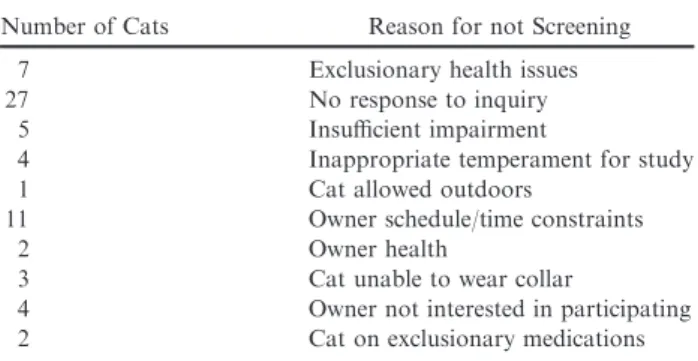
After the initial telephone contact with owners, 66 cats
were deemed ineligible for screening for reasons
out-lined in Table 2.
A total of 48 cats was screened, and 14 were deemed
unsuitable for the study because of the reasons outlined
in Table 3.
There were no differences between the cats treated
with NV-02 or placebo for age (
P
=
.63), sex (
P
=
.255), body weight (
P
=
.356), or body condition score
(
P
=
.228). These results are presented in Table 4.
Ele-ven cats received placebo, and 23 received NV-02. Of
the 23 cats that received NV-02, 11 cats received
0.4 mg/kg and 12 cats received 0.8 mg/kg.
No cats were removed from the study before day 77.
All cats enrolled were included in the safety analysis.
The flow of participants through the study is illustrated
in Figure 1. One cat (in the 0.4 mg/kg NV-02 group)
was determined to have severe renal dysfunction at day
77 (see AEs), and the data for this cat were removed
from the efficacy analysis.
Accelerometry (activity)
There was no statistical difference between activity in
week 1 and week 2 (Wilcoxon signed-rank paired test,
P
=
.768), and thus, the combination of week 1 and
week 2 (Wk1/2) data was used as the baseline period to
give the maximum amount of baseline data.
No significant differences between changes in activity
in the T1 and T2 groups were found, so T1 and T2
were pooled to examine the difference between
treat-ment and placebo for each week of the study. Using the
mean of Wk1/2 activity as the baseline and the change
in activity expressed as a percentage of Wk1/2 activity,
there was a significant Week
9
Week effect (
P
=
.0096),
a significant effect of treatment (
P
=
.0258), and a
sig-nificant Treatment
9
Week
9
Week effect (
P
=
.017).
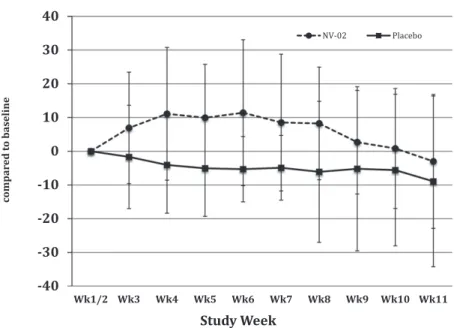
Significant treatment effects (increased activity in the
treatment group compared with placebo) were found
for week 4 (
P
=
.035), week 5 (
P
=
.007), week 6
(
P
=
.006), week 7 (
P
=
.007), and week 8 (
P
=
.018).
The percentage change in activity over time for each of
the groups is illustrated in Figure 2, and the mean
per-centage changes in activity for each group and for each
week are tabulated in Table 5.
Owner Assessments
After analysis of the activity data, the treatment
groups were combined for the analysis of the subjective
data. The CSOM scores improved (increased)
signifi-cantly within both the combined treatment group and
the placebo group at each assessment time point
(com-pared with baseline, day 14), except the day 77 time
point for the placebo group (
P
=
.051; Table 6). At day
35 (3 weeks after the administration of NV-02 or
pla-cebo), there was a significant difference between the
groups for the change in CSOM scores, with the
treat-ment group improving significantly more than the
pla-cebo group (
P
=
.035). There were no significant
differences between the groups in terms of degree of
improvement at day 56 or day 77.
At day 35 (3 weeks after treatment), the improvement
in the placebo group equated to a 22% decrease in
dis-ability/pain and the improvement in the treatment
group equated to a 55% decrease in disability/pain. The
effect size (95% CI) at day 35 for treatment over
pla-cebo was 0.74 (
0.02 to 1.5).
Using a cutoff of 2 units improvement in the CSOM
scale, there were no significant differences between the
groups with regard to success/failure, but more
suc-cesses were observed in the treatment groups compared
with the placebo group (Table 7). Using these criteria
for success/failure, the caregiver placebo response over
the first 3 weeks was 60%.
The %FMPI
possscores improved (increased)
signifi-cantly within both the combined treatment group and
Table 2.
Reasons for cats being deemed ineligible for
screening following the initial contact with the owner.
Number of Cats Reason for not Screening
7 Exclusionary health issues
27 No response to inquiry
5 Insufficient impairment
4 Inappropriate temperament for study
1 Cat allowed outdoors
11 Owner schedule/time constraints
2 Owner health
3 Cat unable to wear collar
4 Owner not interested in participating 2 Cat on exclusionary medications
Table 3.
Reasons for screening failures in the cats
screened at day 0.
Number of Cats Reason for Screening Failure
4 Insufficient radiographic evidence of DJD 3 Mass/neoplasia detected on radiographs
2 Cardiac disease
1 Lab work abnormalities suggesting systemic disease
Table 4.
Demographic summary of the cats enrolled in the study.
NV-02 (n=23) Placebo (n=11) P-Value for Comparison of Treatment Groups Age, years, mean (SD) 12.2 (3.1) 12.6 (1.94) P=.63 (t-test)
Sex 12 FS; 11 MC 8 FS; 3 MC P=.255 (Pearson chi-square test)
Weight, kg; median (SD) 6.10 (1.92) 5.55 (1.38) P=.356 (t-test)
BCS; median (range) 7 (4–9) 6 (4–9) P=.228 (Wilcoxon rank sum test)
BCS, body condition score; MC, male castrated; FS, female spayed.
Screened for eligibility (n=48)
Excluded (n=14)
♦ Not meeting inclusion criteria (n=14)
Analysed
•
Efficacy (n=10)•
Safety (n=11) Allocated to NV-02 (T1)•
Allocated to 0.4mg/kg
(n=11)
•
Received 0.4mg/kg (n=11)
Allocation
Analysis
Randomized (n=34)
Enrollment
Telephone Enquiries (n=114)
Allocated to NV-02 (T2)
•
Allocated to 0.8mg/kg
(n=12)
•
Received 0.8mg/kg (n=12)
Allocated to Placebo (P)
•
Allocated to placebo
(n=11)
•
Received placebo (n=11)
Dropped out of study (n=0) Dropped out of study (n=0) Dropped out of study (n=0)
Analysed
•
Efficacy (n=12)•
Safety (n=12)Analysed
•
Efficacy (n=11)•
Safety (n=11)(T1 and T2 groups combined for much of efficacy analysis)
Fig 2. Plot of percentage change from baseline (average of weeks 1 and 2 activity, before the antibody or placebo being administered) in mean weekly activity counts (originally expressed as average activity count per minute over the week) by group (treatment/placebo), for each week of study.
Table 5.
Mean (
SD) percentage change from baseline for mean activity counts for each week of the study, for
each group and the combined treatment group. Baseline activity was defined as the mean activity count per minute
over the first 2 weeks of the study for each cat, before treatment.
Weeks of study 3 4 5 6 7 8 9 10 11
Weeks after treatment
1 2 3 4 5 6 7 8 9
Placebo 1.7 (15.3) 4.0 (14.3) 5.0 (14.2) 5.3 (9.7) 4.9 (9.6) 6.1 (20.9) 5.2 (24.3) 5.6 (22.5) 8.9 (25.3) T1 (NV-02
0.4 mg/kg)
11.5 (21.1) 15.4 (24.7) 14.9 (18.1) 15.3 (22.1) 5.1 (26.9) 7.8 (18.4) 0.6 (17.4) 4.5 (19.2) 2.8 (20.2)
T2 (NV-02 0.8 mg/kg)
3.1 (11.1) 7.5 (14.4) 5.8 (13.0) 8.2 (21.6) 11.4 (13.2) 8.6 (16.0) 5.4 (13.6) 2.2 (16.7) 3.1 (20.4)
T1 and T2 combined
6.9 (16.5) 11.1 (19.7) 9.9 (15.9) 11.4 (21.6) 8.5 (20.3) 8.2 (16.7) 2.7 (15.3) 0.8 (17.8) 3.0 (19.8)
SD, standard deviation; “Weeks after treatment,” the number of weeks following the administration of NV-02 or placebo.
Table 6.
Summary of medians (range) and statistical comparisons for changes in CSOM scores (from day 14) at
day 35 (3 weeks following treatment), day 56 (6 weeks after treatment) and day 77 (9 weeks following treatment).
Larger values indicate greater improvement.
Within-Group Change (Wilcoxon Signed Rank)
Within-Group Change (Wilcoxon Signed Rank)
Within-Group Change (Wilcoxon Signed Rank)
Assessment time Day 35 Day 56 Day 77
T1 and T2 combined
5.5 (2 to+10) <0.0001 5 (0 to+11) <0.0001 2.5 (1 to+9) <0.0001
Placebo 2 (2 to+7) 0.023 4 (7 to+9) 0.022 2 (4 to+9) 0.051 Treatment-placebo
comparison (Wilcoxon rank sum)
the placebo group at each assessment time point
(com-pared to baseline, day 14; Table 8). No significant
dif-ferences were observed between the groups in terms of
degree of improvement at any time point.
The FMPI scores for questions 18 and 19 improved
significantly within both the combined treatment group
and the placebo group at each assessment time point
(compared with baseline, day 14). Greater improvement
occurred in the treatment group compared with the
pla-cebo group, and significantly so, at day 35 for question
18 (“pain over the last 3 weeks”;
P
=
.024) but not
question 19 (“pain today”;
P
=
.05).
Owners were able to identify cats that had received
the anti-NGF analgesic treatment more successfully
than they were able to identify cats that had received
placebo, with 83% of owners able to identify correctly
that their cat had received NV-02 versus only 45%
being able to identify correctly that their cat had
received placebo (
P
=
.013). The expected result, due to
a complete guess, would be 50% correct.
Safety and Adverse Events
No cats showed any signs of an allergic response to
the injection of NV-02.
Adverse events were reported or discovered in 6 cats.
One cat (NV-02, 0.8 mg/kg) started scratching at the
collar, and this collar was removed for 4 days and
replaced
with
a
different
collar.
Triple
antibiotic
ointment and a small amount of hydrocortisone were
applied on 2 occasions during the time the collar was
not being worn. Two cats (NV-02, 0.8 mg/kg and
pla-cebo) had similar increases in serum creatinine
concen-tration detected on day 77 (2.0 mg/dL, up from 1.7 mg/
dL; and 2.1 mg/dL up from 1.5 mg/dL, respectively).
Repeated laboratory testing 2
–
3 months later showed
stable but increased serum creatinine concentrations.
The owner of 1 cat (NV-02, 0.4 mg/kg) reported that
the cat’s preexisting mild asthma appeared to worsen
with more frequent “squeaking.” An albuterol inhaler
was prescribed and the cat appeared to improve and
remained on the study. The preexisting asthma was not
definitively diagnosed before the study. One cat (NV-02,
0.8 mg/kg) vomited after the evening meal for 3 days
after the injection of NV-02. Given our experiences in
several similar studies of therapeutics for
DJD-asso-ciated pain in cats, we did not consider any of these to
be related to NV-02 administration.
A SAE was reported in 1 cat that received NV-02,
0.4 mg/kg, but the event was deemed not be associated
with treatment. The cat was staged as IRIS stage 2
chronic kidney disease before the study. Half-way
through the study, the owner reported that a preexisting
foot deformity and thickened area was painful, but
evaluation (examination, fine needle aspiration of a
thickened area, and radiography) did not identify a
cause or show any change from the start of the study.
The deformity or mass had been present as the cat was
a kitten, was of unknown cause, and had not changed
over time. On the day 77 visit, the owner reported that
the cat had been hiding more and showing decreased
appetite progressively over the past 10 days. The cat
had lost 0.72 kg body weight since the start of the study
and showed azotemia, hyperglobulinemia, and
leukocy-tosis with a left shift on the day 77 laboratory results.
The owner elected euthanasia rather than treatment.
Full necropsy and a thorough investigation of the
kid-neys did not identify any probable link to NV-02. Data
were included for safety evaluation, but omitted from
efficacy analysis. Necropsy identified multifocal, mild,
chronic,
glomerulopathy
and
lymphoplasmacytic
Table 7.
Success-Failure summary for CSOM scores
in the placebo and treatment groups.
D35 D56 D77
T1 (NV-02 0.4 mg/kg) 90% 90% 60% T2 (NV-02 0.8 mg/kg) 75% 92% 75%
T1 and T2 combined 82% 91% 68%
Placebo 56% 64% 64%
Combined treatment-placebo comparison
(Pearson chi-square)
0.097 0.056 0.794
Table 8.
Summary of medians (range) and statistical comparisons for change in percent possible FMPI scores (from
day 14 and based on questions 1
–
17) at day 35 (3 weeks following treatment), day 56 (6 weeks following treatment),
and day 77 (9 weeks following treatment). Larger values indicate greater improvement.
Within-Group Change (Wilcoxon Signed Rank)
Within-Group Change (Wilcoxon Signed Rank)
Within-Group Change (Wilcoxon
Signed Rank)
Assessment Time
Day 35 Day 56 Day 77
T1 and T2 combined
16 (1.3 to 36) <0.0001 16 (2.6 to 34.5) <0.0001 14.5 (1.2 to+35.3) <0.0001
Placebo 7.4 (0 to 26.6) 0.002 10.6 (9.4 to+27.8) 0.010 14.4 (2.4 to 35.7) 0.001 Tx-Placebo
comparison (Wilcoxon rank sum)
interstitial nephritis, and focal, chronic, renal cortical
atrophy and fibrosis (infarct), chronic lymphohistiocytic
cholecystitis, and choledochitis considered to be due to
congenital malformation of the biliary tree; a colonic
mast cell tumor; a focal pulmonary adenocarcinoma; a
focal, well-differentiated fibrosarcoma on the hindlimb
(known preexisting hindlimb mass that had not changed
historically); moderate, multifocal, chronic,
lymphohisti-ocytic pancreatitis with dissecting fibrosis and acinar
loss; and multifocal, lymphoplasmacytic duodenitis.
Electron microscopy of the renal tissues did not identify
any evidence of immune complex glomerulonephritis.
No association was found between treatment and the
AE.
At day 0, there were no differences between the
treat-ment and placebo groups for any blood chemistry,
hematology, or urinalysis variables.
At day 77, total protein concentration was
signifi-cantly higher in the treatment group (mean
SD,
7.6
2.2 g/dL versus 7.1
1.7 g/dL;
P
=
.024;
refer-ence range, 6.4
–
8.2 g/dL). Serum globulin concentration
was significantly higher in the treatment group (mean
SD, 4.2
2.6 g/dL versus 3.7
1.98 g/dL; reference
range, 2.9
–
4.8 g/dL).
When change within groups was evaluated, there
were no significant changes within the treatment or
pla-cebo groups over time for any variable. In total, 3 cats
had serum creatinine concentrations that increased from
within to above the reference range (detailed above).
Discussion
The results of our study showed a clear positive
treat-ment effect associated with NV-02, a felinized
anti-NGF antibody, in cats with DJD-associated pain and
mobility impairment. The beneficial effect was seen for
objectively measured activity, and also, despite a large
caregiver placebo effect, for owner-assessed subjective
measures.
Objectively measured activity showed an increase in
activity between 2 and 6 weeks after treatment with
NV-02. In a recent study of meloxicam (blinded,
pla-cebo-controlled; 2-week baseline, 3-week treatment)
6conducted by our group, the mean increase in activity
compared to baseline period was 5.97% over the first
3-week period of daily treatment with meloxicam
(0.035 mg/kg daily) compared with 2.65% increase over
the same time period for cats treated with placebo. The
percentage increase in activity from baseline in the
treatment group found in the present study (9.3% over
the first 3 weeks) compares very favorably with the
0.035 mg/kg meloxicam study.
The meloxicam study was a full cross-over study, and
if both periods of meloxicam treatment are included,
the mean increase in activity above baseline (where
baseline was the period just before each treatment) for
a 3-week treatment period was 9.45%, and the
differ-ence between treatment and placebo phases for changes
in activity was 10.62%, favoring meloxicam. As noted
above, in the current NV-02 study, the mean increase in
activity from baseline in the treatment group was 9.3%
and the difference between placebo-treated and
NV-02-treated cats over the first 3 weeks after treatment was
12.9%. This comparison shows that a single injection of
NV-02 produces increases in activity in cats that is the
same or greater than the increase in activity produced
by daily administration of 0.035 mg/kg of meloxicam.
There are no other placebo-controlled studies measuring
activity in client-owned cats with which to compare the
current study.
Despite a high caregiver placebo response (60% over
the first 3 weeks after treatment, using success/failure
criteria), the owner-completed client-specific subjective
assessment system (CSOM) clearly detected a
treat-ment effect, with a significant difference between total
scores 3 weeks after treatment and also a significant
difference for change in CSOM scores over the first
3 weeks after treatment. The effect size (CI) based on
CSOM was 0.74 (
0.02 to 1.50), which compares with
0.35 (
0.98 to 0.28) seen with 0.035 mg/kg of
meloxicam.
6The FMPI scores showed similar trends,
but the delineation between placebo and treatment
groups was less obvious. The FMPI has undergone
evaluation in several studies and was found to be
readable and reliable,
12,16but it did not show
respon-siveness in 1 study using relatively small numbers of
cats.
17The FMPI did, however, show some
responsive-ness and criterion validity (using activity monitors) in
a larger study using meloxicam.
6,7The CSOM has
detected treatment effects over placebo, but only in
our most recent, larger NSAID study using
meloxi-cam,
6,7and a small pilot study using highly impaired
cats.
8More work is needed to develop owner
assess-ment outcomes or study designs that can robustly
dis-tinguish treatment from placebo and show criterion
validity. One of the frustrations in the development of
owner-completed assessment tools is that it is not
known if the analgesics (NSAIDs thus far) being used
in the development of the subjective tools actually
work. We believe that the efficacy seen in our current
study was such that it may be the best currently
avail-able treatment with which to refine the owner
assess-ment tools; however, the effect of differences in
administration routes (oral versus injectable) and
fre-quency of administration (once versus daily) must be
taken into account.
duration of action, giving us the ability to report on the
duration of efficacy. We believe that the potential
impact in veterinary medicine of an injection lasting
approximately 6 weeks for the control of long-term
pain in the cat is very positive and clinically relevant.
Toxicity is an obvious concern, especially for novel
therapeutics. In studies of humans treated with
anti-NGF antibodies, reported AEs appear to be generally
mild, but, as with efficacy, dose related.
10,20Most AEs
that seem to be related to NGF antibodies appear to be
related to transient changes in sensation.
20In our study
with dogs, no evidence of neurologic AEs was seen
17although the study was not powered to evaluate AEs.
Subsequently, we have found no effect on sensation in
dogs using quantitative sensory threshold (QST) testing
(unpublished observations). In this study, no neurologic
AEs were seen. In the 1 cat that suffered a decrease in
renal function, we found no evidence of any relationship
with the monoclonal antibody treatment, given the
cur-rent body of knowledge. There are no reports of renal
toxicity related to anti-NGF treatment in any species,
but this will obviously remain a concern in cats given the
high prevalence of chronic kidney disease in cats.
3Larger
studies, including repeated administrations of treatment,
are required to fully assess the safety of NV-02 in cats.
Since the preparation of this report, USAN have adopted
the non-proprietary name frunevetmab for anti-NGF
mAB NV-02.
Conclusions
Positive treatment effects in cats with DJD-associated
pain and mobility impairment were seen with the
administration of a single SC injection of NV-02, a
felinized anti-NGF antibody. These positive effects
lasted up to 6 weeks, measured by objective activity
evaluation. NV-02 appears to offer great promise as a
treatment for long-term pain alleviation in cats with
chronic DJD-associated pain. Further clinical studies
are warranted.
Footnote
aActicalÒ, Philips Respironics, Bend, Oregon, USA
Acknowledgments
The authors acknowledge Lyndy Harden of the
NCSU-CVM Clinical Studies Core for performing
qual-ity control on the data. The authors thank Dr Rachel
E. Cianciolo, International Veterinary Renal Pathology
Service, for the electron microscopy evaluation of the
kidney in one case.
Conflict of Interest Declaration
: ME Gruen received
funding support from the National Institutes of Health
Ruth L. Kirschstein National Research Service Award
(T32OD011130). BDX Lascelles is a paid consultant for
Nexvet. DP Gearing is an employee of Nexvet. The
study was supported by Nexvet Biopharma.
Off-label Antimicrobial Declaration
: Authors declare
no off-label use of antimicrobials.
References
1. Slingerland LI, Hazewinkel HAW, Meij BP, et al. Cross-sectional study of the prevalence and clinical features of osteoarthritis in 100 cats. Vet J 2011;187:304–309.
2. Lascelles BDX, Henry JB, Brown J, et al. Cross-sectional study of the prevalence of radiographic degenerative joint disease in domesticated cats. Vet Surg 2010;39:535–544.
3. Marino CL, Lascelles BDX, Vaden SL, et al. Prevalence and classification of chronic kidney disease in cats randomly selected from four age groups and in cats recruited for degenerative joint disease studies. J Feline Med Surg 2013;16:465–472.
4. Gunew M, Menrath V, Marshall R. Long-term safety, effi-cacy and palatability of oral meloxicam at 0.01–0.03 mg/kg for treatment of osteoarthritic pain in cats. J Feline Med Surg 2008;10:235–241.
5. Gowan RA, Lingard AE, Johnston L, et al. Retrospective case–control study of the effects of long-term dosing with meloxi-cam on renal function in aged cats with degenerative joint disease. J Feline Med Surg 2011;13:752–761.
6. Gruen ME, Griffith EH, Thomson AE, et al. Criterion vali-dation testing of clinical metrology instruments for measuring degenerative joint disease associated mobility impairment in cats. PLoS ONE 2015;10:e0131839.
7. Gruen ME, Griffith E, Thomson A, et al. Detection of clini-cally relevant pain relief in cats with degenerative joint disease associated pain. J Vet Intern Med 2014;28:346–350.
8. Lascelles BDX, Hansen BD, Roe S, et al. Evaluation of cli-ent-specific outcome measures and activity monitoring to measure pain relief in cats with osteoarthritis. J Vet Intern Med 2007;21:410–416.
9. Seidel MF, Wise BL, Lane NE. Nerve growth factor: An update on the science and therapy. Osteoarthritis Cartilage 2013; 21:1223–1228.
10. Schnitzer TJ, Marks JA. A systematic review of the efficacy and general safety of antibodies to NGF in the treatment of OA of the hip or knee. Osteoarthritis Cartilage 2015;23(Suppl 1):S8– S17.
11. Gearing DP, Huebner M, Virtue ER, et al. In vitro and in vivo characterization of a fully felinized therapeutic anti-nerve growth factor monoclonal antibody for the treatment of pain in cats J Vet Intern Med 2016. DOI: 10.1111/jvim.13985 [E-pub ahead of Print].
12. Gruen ME, Jiamachello KN, Thomson A, Lascelles BDX. Clinical trials involving cats: What factors affect owner participa-tion? J Feline Med Surg 2014;16:727–735.
13. Zamprogno H, Hansen BD, Bondell HD, et al. Item gener-ation and design testing of a questionnaire to assess degenerative joint disease-associated pain in cats. Am J Vet Res 2010;71:1417– 1424.
14. Lascelles BDX, Dong Y-H, Marcellin-Little DJ, et al. Rela-tionship of orthopedic examination, goniometric measurements, and radiographic signs of degenerative joint disease in cats. BMC Vet Res 2012;8:10.
15. Lascelles BDX, Hansen BD, Thomson A, et al. Evaluation of a digitally integrated accelerometer-based activity monitor for the measurement of activity in cats. Vet Anaesth Analg 2008;35: 173–183.
musculoskeletal pain index (FMPI) for the evaluation of degen-erative joint disease-associated pain in cats. Vet J 2013;196:368– 373.
17. Benito J, Hansen B, DePuy V, et al. Feline musculoskeletal pain index: Responsiveness and testing of criterion validity. J Vet Intern Med 2013;27:474–482.
18. Lascelles BDX, Knazovicky D, Case B, et al. A canine-specific anti-nerve growth factor antibody alleviates pain and
improves mobility and function in dogs with degenerative joint disease-associated pain. BMC Vet Res 2015;11:101.
19. Lane NE, Schnitzer TJ, Birbara CA, et al. Tanezumab for the treatment of pain from osteoarthritis of the knee. N Engl J Med 2010;363:1521–1531.