Power, distrust and the
moderating role of shared
identity
Jolanda Natte
Master thesis Psychology, specialization Social & Organizational
Department of Psychology
Faculty of Social and Behavioral Sciences – Leiden University Date: June 8, 2015
Student number: 1427563 Supervisor: M. Mooijman, MSc
Abstract
In the current study we investigated the effect of power and shared identity on trust.
Over the last years, many studies were conducted to investigate power related to (dis)trust.
One of the effects of power is that it causes distrust towards others because a high-power
position gives access to valuable resources, which are worth to defend. We conducted this
study to test the hypothesis that shared identity moderates power and (dis)trust. We found
evidence that shared identity moderates the relationship between power and distrust, in a
low power condition. These findings suggest that shared identity could be a key factor
between power and distrust, which can play an important future role in interventions but
further research is required.
Power, distrust and the role of shared identity
Stichting Buurtzorg is a Dutch organization that has become “Employer of the year
2014”. An important reason for this success may be that Buurtzorg builds a culture of trust
by removing the hierarchical power structure through the establishment of self-managing
teams. They increased team effectiveness by emphasizing team-identity by organizing
regional meetings in which vision and strategy are discussed, by training- and sports days
and “get-togethers” (Beste Werkgevers, 2014). Trust between employees and managers are
indeed vital for organizational success. Trust increases employee satisfaction and
organizational commitment, which in turn positively influence customer satisfaction,
turnover rates, employer branding and financial results (Griffeth, Hom, Gaertner, 2000).
This anecdote indicates the importance of trust and shared identity in organizations. It
suggests that power within an organization may influence people’s sense of trust and that
shared identity may play a role. In the current research we expect that identification with a
group moderate the relationship between power and (dis)trust. We propose that distrust
works as a protecting source for power holders’ beneficial position, hereby hindering the
extent to which shared identity increases trust for power holders.
We believe addressing this issue is important because trust stimulates employees’
feelings of autonomy and perceived competence. People in hierarchical power positions
have a key role in creating trust within organizations. Creating an atmosphere of trust results
in reciprocity and cooperation, which indirectly increases company’s financial results and
prevents against personnel turnover and against loss of resources (Hom, Mitchell, Lee &
Griffeth, 2012). A culture of trust makes organizations attractive for experienced and
competitive (Griffeth et al., 2000). Trust benefits companies, especially in times when
technological developments and on-going innovation are necessary to be competitive. In
other words, gaining insights into how and when power and shared identity affects distrust,
is of great importance for organizations and makes it possible to develop interventions for
promoting trust.
Power
The basic essence of power is about control. Traditionally, power has been seen as
asymmetric control over critical resources (Fiske, 1993). Here we use that definition; power
can be seen as an asymmetric control over a person’s outcome and critical resources (Depret
& Fiske, 1993; Magee & Galinksky, 2008). Power has both positive and negative
consequences. One of the positive consequences on organizational level is, that it structures
and prevents organizations against chaos and disorder. When companies become larger,
there need to be some kind of organization and hierarchy to efficiently manage the process
and the people. Having power gives people that ability; they can control others through their
control over valuable resources.
On a personal level, power can be attractive and beneficial for a power holder. First,
people in power are in the centre of attention. A high power position makes perceivers think
power holders as more competent and perceivers attribute more positive traits to power
holders. Power holders’ behaviour is often seen as dispositional (Brauer & Bourhis, 2006).
Second, having power gives control over others and over themselves, for example working
conditions, rewards and salaries, which are usually better and higher for themselves than for
their employees (Fiske, 1993). Power holders are less dependent on others (Fiske, 1993),
desires (Galinsky, Gruenfeld & Magee, 2003). In summary, it is attractive for power holders
to possess power because power gives access to resources, freedom, status, respect and
autonomy.
One of the negative consequences of power is that it causes bias and less inhibited
behaviour (Kunstman & Maner, 2011). We all know the recent example of the sexual
harassment case of IMF (ex-) chairman Strauss-Kahn. For a long time, his uninhibited
behaviour was not seen as destructive but as dispositional because it was biased by social
perception. Bias causes that people perceive less variability of individual characteristics and
are more sensitive to stereotypes, as a way to exert control (Fiske, 1993; Brauer & Bourhis,
2006). Power holders feel they are not dependent of their subordinates, so why should they
focus on them? Second, power holders are also more likely to have a negative view of their
subordinates instead of a positive view, just to maintain and justify their own behaviour
(Georgesen & Harris, 2006). For example, attributing disappointing results of their division
to the employees protect power holders’ position (Keltner, Gruenfeld & Anderson, 2003).
Another negative consequence is that asymmetric control over individuals produces social
distance (Magee & Smith, 2013). The social distance theory of power is about the
subjective perception of distance to another and about the difference between high-powers
self-concept and low-powers self-concept. High-power individuals experiencing more
distance than low-power individuals. The degree of felt closeness depends on the interplay
between motivation for affiliation and expectations of the other party. In general it is a
consequence that high-power individuals have less interest in what low-power individuals
think and feel, because low-power people have little influence on their outcomes (Magee &
feelings towards others and reducing of experiencing of emotions of others (Magee & Smith,
2013). Distrust is such an emotion. Holding a power position can arouse such a distrust
mind-set, that power holders are less likely to trust others. They create an environment of
distrust, but due to reducing experiencing others emotions, they are not really aware of the
impact (Mooijman, Van Dijk, Ellemers & Van Dijk, 2014). On the other hand, leadership
and intergroup relations moderate the effect of the sense of social distance to others. For
example, leaders might assume greater similarity with their group members than their group
members with each other and they engage in more social projection than others. In
intergroup contexts, out-group members are more socially distant that in-group members
(Magee & Smith, 2013).
To summarize, a high-power position is beneficial for power holders because
power gives access to resources and gives autonomy. These benefits are worth to defend.
Many negative destructive mechanisms appear as a result of power, like biased perceptions,
stereotyping, self-justification, social distance and reduced experiencing of others emotions.
Distrust is a mechanism that occurs in order to protect power holder’s resources. We
propose that when people are in a high power position and their benefits may be threatened,
distrust will arise.
Trust and distrust
Trust is an interpersonal construct associated with feelings of hope, safety and
certainty (Tanis & Postmes, 2005). A commonly used definition is proposed by McAllister
(1995), who defines trust as “an individual belief in, and willingness to act on the basis of
words, actions and decisions of another” (Scandura & Pellegrini, 2008). Recent trust
calculus-based trust (CBT). At the level of identification-based trust, members effectively
understand and appreciate other’s needs. It allows members to be confident that their
interests will be protected and no surveillance is necessary (Scandura & Pellegrini, 2008).
Calculus-based trust is transactional and economically based. Dyad members continually
assess the rewards and costs and weigh the outcomes associated with the relationship.
Research shows that a high quality of a relationship and a strong group identity will enhance
identification-based trust (Scandura & Pellegrini, 2008). We therefore assume that strong
identification involves a high quality relationship and will result in high levels of
identification-based trust.
Trust also trust generates expectations of others via reciprocity (Scandura &
Pellegrini, 2008). This can be regarded as an active investment in self-relevant outcomes.
For example, if a high-power employer gives the low-power employee autonomy, he
releases his control and just expects and trusts the employee doing his job as agreed. When
the employee experiences this lower control, he or she he will feel more autonomous and
competent, which often results in better performances and outcomes (Griffeth et al., 2000).
This shows that power holders’ trust actually involves relinquishing their power over
relevant outcomes that in turn can be valuable for both. On the other hand, fully relying on
the other makes a power holder also vulnerable; too much trust can result in less control and
structure and thus potential mistakes and losses, which threatens power holders’ beneficial
position. So, having trust in others can both be valuable and vulnerable.
The opposite of trust is distrust (Voci, 2001). Distrust describes people’s feeling that
someone cannot be relied upon, is not honest and therefore cannot be trusted. It reflects
threat, as well as uncertainty and lack of confidence (McKnight & Chervany, 2006).
Distrust results in more control that negatively influences the quality of a relationship
(Scandura & Pellegrini, 2008). For example when there is distrust in a work-orientated
relationship, this will lead to more control. An employee will experience this control as
reduced autonomy, which negatively influences his job satisfaction and at the end result in
decreased performances and outcomes. And in turn, decreased performances confirms
employers’ tendency to lowering trust again hereby perpetuating a cycle of distrust
(Mooijman et al., 2014). Perceptions of being under evaluative scrutiny and the desire being
in control by power holders are factors that foster distrust (Kramer, 1999). Therefore distrust
can be seen as a protecting force of potential resources of power holders.
In summary, having trust in others can both be valuable and vulnerable. For example,
when an employer forgoes his control and an employee is being trusted, he or she will feel
autonomous and competent that often results in better performances and outcomes. This can
be valuable for both (low powered) employee and (high powered) employer. On the other
hand, it makes the employer vulnerable, because the employee can make mistakes, resulting
in poor outcomes, which threatens employers’ preferred position. The desire of high powers
to remain in that preferred position and stay in control of their self-relevant outcomes
nourishes feelings of distrust. We predict that in a high power position distrust will arise
because, as a consequence, people are motivated to be and to stay in control of beneficial
resources.
Shared identity
The central assumption underlying the social identity theory of Tajfel (1978) is that in
other situations in terms of particular group membership, for example in their professional
role (Ellemers, De Gilder & Haslam, 2004). There are three underlying processes; first there
is social categorisation, which focuses on group membership of collective properties of a
group, for example a group of students and a group of teachers. Second there is social
comparison, where categorization occurs with a social meaning, for example employees and
managers. Third there is social identification, as a form of categorisation by which
information is related to the self (Ellemers et al., 2004). The individual perceives himself as
a representative of a particular group that results in perceiving characteristics as
self-descriptive and adopting group norms as rules for his own behaviour (Ellemers et al., 2004).
For instance, if there is a strong social identity and it is a group norm that all employees are
accessible for twenty-four hours a day including weekends, then people adopt this norm and
show this behaviour more easily as their own. When the social identity is salient for them,
individuals are inclined to identify and are motivated to engage in behaviour that ensures
groups welfare (Han & Harms, 2010).
A related concept is group- or team identification, which is an application of the
social identity theory in a team setting (Ashford & Mael, 1989). It considers how team
members consider team goals as their own. When members identify with their group or
team, it is more likely that they put effort in each other and cooperate with them, because
their success becomes their own personal interest. Research shows that behaviour of
members, who identify themselves with their team, is positively related to attitudes,
intentions, behaviours and goals (Han & Harms, 2010; Tyler & Blader, 2000). One of the
characteristics of group identification is that people sort themselves and others into in- and
2010). Group membership reduces the relevant interpersonal distinctions between people
and emphasizes salient group characteristics, resulting in behaviour, collective attitudes and
emotions (Tanis & Postmes, 2005).
Recent studies showed that positive and negative emotions play different roles in
in-group and out-in-group relations. Negative emotions are often related to out-in-groups. Kramer
(1999) stated that people evaluate members of salient out-groups as less honest, reliable,
open and trustworthy than members of their own group (Kramer, 1999; Voci, 2006). Insko
and Schopler (1997) came to a similar conclusion and stated that perceived differentiation
creates a climate of presumptive distrust between groups in organizations. Positive emotions
are often related to in-groups (Voci, 2006). The origin of this bias is derived from
self-categorisation. When people categorize themselves in terms of a shared group membership,
it is a general outcome that being part of a group evokes positive emotions, which can be
related towards all other in-group members (Voci, 2006).
One of these emotions is trust. In-group members are likely to be perceived as more
trust worthy than out-group members (Dovidio, Gaertner, Kawakami & Hodson, 2002; Voci,
2006). Trust towards in-group members presumably appears when the self is categorised on
in-group level. Trust is associated with in-group and not with out-group members, after they
are categorised. Han and Harms (2010) confirmed that team identification helps to boost
trust and Borgen (2001) demonstrated that identification influenced cooperativeness, which
was a significant mechanism for the development of trust. Tanis and Postmes (2005) stated
that trust is based on common membership of a salient group (i.e. identification-based trust).
In their research they showed group membership as an independent strong predictor of
This model describes underlying factors of the mechanism that trust arises as a result of
identification. The idea is that when identification with the in-group is salient,
de-individuation takes place, and the shared identity influence positive actions and behaviour of
group members which welfares the group, including trust. We argue that when individuals
experience the shared identity as salient, then they are motivated to demonstrate behaviour
that promotes the welfare of the group. We predict that this is also the case when people are
in a position of power.
Overall, as suggested above, people in a high power position tend to distrust others as
a resource-protection-strategy. We propose that when people are in position of power, they
are inclined to distrust others (hypothesis 1). On the other hand, identification with a group
will increase trust due to salient in-group characteristics and due to the irrelevance of
interpersonal distinctions between group members. Therefore, we predict that when people
are in a high power position, distrust will arise but identification with their group will be a
motivating force that reduces distrust. We expect that shared identity will moderate the
relationship between power and distrust (hypothesis 2).
Method
Participants and design
In our experiment we invited 203 participants in exchange for 5 euro or 1 credit (159
females, Mage = 21.26 years, SDage = 3.61). Participants were randomly assigned to a
2 (high power or low power) x 2 (similarity or dissimilarity) between subjects design. We
told them that they were participating in an experiment about group decisions, trust and
Procedure
Upon arrival, participants were placed in an isolated private cubicle. All subsequent
instructions were provided via the computer located in the cubicle. After answering
demographic questions, the experiment started. Participants were explained that they would
play in a business-game and be part of a five-person group in the role as a worker or as a
group leader. We informed them that they would be presented with a word-search task and
that, by doing it well, could earn some extra money. They should find words in the
word-search task and for every correctly found word the group leader rewarded them. The number
of words should be reported to the group leader.
Identity procedure. To identify the group leaders, participants had to fill out the
Management Inventory Scale (MAI). This measure consists of twenty-six items, originally
measuring leadership style (e.g., “A Leader should be able to command respect”; De
Kwaadsteniet & Van Dijk, 2010; Stouten, De Cremer & Van Dijk, 2005). After completing
the questionnaire, half of the participants were told that they become a group leader because
they had a similar leadership style comparing with the other group members (thus they were
the best representation of their group; similarity condition), whereas the other half were told
that they become a group leader because they had a dissimilar leadership style (and thus
they were the least representation of their group; dissimilarity condition), consistent with
research on prototypically, see Van Knippenberg (2011).
Similarity procedure. Confirming the validity of similarity manipulation, we used a
scale to assess the extent to which people experienced similarity with other group members,
other group members”, “I have a similar personality compared to the other group members
and “I represent the group”; M = 3.81, SD = .68, Cronbach’s α = .80).
Power procedure. Group workers could earn a total of twenty euro in the
word-search task. Group leaders were told that they controlled either seventeen-and-a-half euro
(high-power condition) or two-and-a-half euro (low-power condition). During the task,
group leaders could determine how to allocate the money amongst the group workers. The
money not controlled by them, was controlled by the experiment-researcher. The
manipulation is consistent with the definition of power as resource control over valuable
resources (Magee & Galinsky, 2008). Thus, high versus low power entails more control
over critical resources (i.e. money).
Role based power manipulation check. Power was measured on a five-item scale
to check if participant experienced their power position, both in the high power and low
power condition (sample items included “I feel powerful”, “I am in control of the other
group members and “I feel in control of others”; M = 4.44, SD = 1.39, α = .87).
Power motivation self check. To measure participants’ motivation to stay in their
power position, participants then completed a five item-scale, rated from 1 (strongly
disagree) to 7 (strongly agree). Sample items included “I don’t like to loose control over the
resources to others”, “I prefer to keep the leadership position for myself”; M = 4.58, SD =
1.29, α = .92).
Power motivation others check. Then participants completed a five item-scale,
measuring power motivation of others. The scale measured the extent to which participants
feel threatened in their resource control. Do group leaders think that their group members
Sample items included “I think others want control over the money”, “I think others desire
my position”; M = 4.64, SD = 1.10, α = .86).
Trust procedure. After that, participants completed an eight-item scale, measuring
their level of trust towards others during the group task. They were asked if they think their
group members will cooperate or behave egoistically, rated on a scale from 1 (strongly
disagree) to 7 (strongly agree). So, the higher their score, the more distrust they have.
Sample items included “I believe I can trust participants in this experiment”, “I believe
participants in this experiment strive for group profit”, “I believe participants in this
experiment are inclined as much as possible to assign coins for themselves"; M = 4.21, SD
= .22, α = .94, item 5-8 reverse-coded). After filling out all questionnaires, we told them that
they did not have to play in the business-game and that the experiment was finished.
Participants were debriefed, checked for suspicious and finally we paid them (in course
credit or monetary compensation) for their participation.
Results
Power check. A two-way between-groups ANOVA, F (2, 201) = 119.31, p <. 001
confirmed significant differences between participants in the high power condition
(controlling € 17.50) and the low power condition (controlling € 2.50). In the high power
condition, they experienced more power (M = 5.28, SD = .89) than in the low power
condition (M = 3.58, SD = 1.29). There was no significant effect of similarity, F (1,199)
= .482, p = .488 and there was also a non-significant interaction effect of power and
similarity, F (1,199) = .532, p = .467. These results suggested that giving participants
control over valuable resources in a leadership position, leads to feelings of high power.
p < .000, confirmed significant differences between participants in the similarity compared
to the dissimilarity condition. Participants in the similarity condition experienced stronger
feelings of shared identity (M = 4.73, SD = 1.15, N = 97) than participants in the
dissimilarity condition (M = 2.96, SD = 1.09, N = 106). There was no significant effect of
power, F (1,199) = 1.88, p = .171 and there was no significant interaction effect of power
and similarity, F (1,199) = .040, p = .842. These results suggested that by emphasizing
similarity, people experienced stronger feelings of shared identity.
Power motivation check. A two-way between-groups ANOVA, F (1, 199) = 7.28,
p = .008, confirmed that participants in the high power condition experienced significant
more power motivation (M = 4.82, SD = 1.25) than participants in the low power condition
(M = 4.34, SD = 1.29). These results confirmed that people in a high-power position were
more motivated to keep their power, to protect their valuable resources. There was a
non-significant effect of similarity, F (1,199) = 1.04, p = .309 and a non-significant interaction
effect of power and similarity on participants power motivation F (1,199) = 1.61, p = .206.
Power motivation by others check. Then, we conduct a two-way between-groups
ANOVA to check if participants expected that other group members were motivated to get
their power position. The analysis resulted in a non-significant effect of power on power
motivation by others F (1, 199) = 1.22, p = .271. Also there was a non-significant effect of
similarity, F (1,199) = .001, p = .972 and a non-significant interaction effect of power and
similarity on participants power motivation by others, F (1,199) = .004, p = .948. In this
experiment high-powered participants comparing to low-powered participants did not
Power, identity and (dis)trust manipulations. To investigate our main hypothesis,
whether shared identity moderated the relationship between power and distrust, we
conducted a significant two-way between-groups ANOVA, F (3, 199) = 2465.77, p = < .000.
There was a non-significant main effect of power on trust, F (1,199) = .371, p = .543,
meaning that there were no differences in (dis)trust between participants in the high power
condition (M = 4.26, SD = 1.21, N = 103) and the low power condition (M = 4.17, SD = 1.24
N = 100). There was also a non-significant main effect of similarity on (dis)trust, F (1,199)
= 1.61, p = .207. Theses results showed no differences in (dis)trust between the similar
condition, (M = 4.10, SD =1.15, N = 97) and the dissimilar condition (M = 4.32, SD = 1.28,
N = 106). There was a significant interaction effect between power and similarity on
(dis)trust, F (2, 199) = 5.78, p = .017, which indicates that trust was affected differently by
identity in the low and high power group. To explore these results, we split the data file
based on power and conducted an independent sample t-test. In the high power group,
results showed non-significant differences between (dis)trust in the similarity (M = 4.36, SD
= 1.12) and the dissimilarity condition (M = 4.16 SD = 1.29; t (101) = -.808, p = .421,
two-tailed), indicating that distrust is not systematically different comparing the both conditions.
The magnitude of the mean differences (M = -.19, 95% C: -.67 to .28) was very small (eta
squared = .006). In contrast, in the low power group results showed significant differences
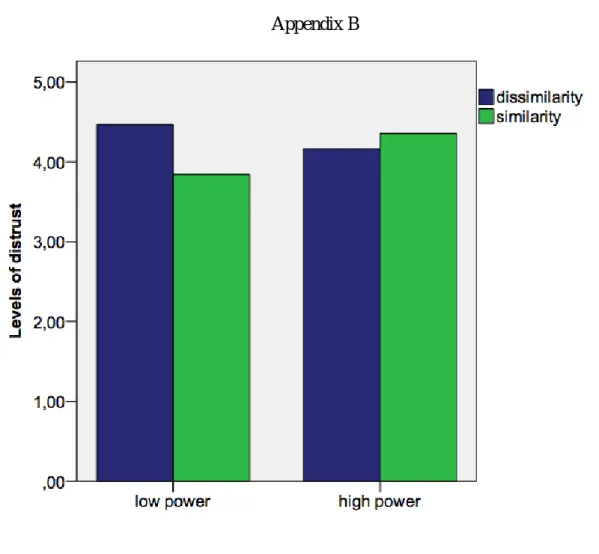
in the level of (dis)trust. In the dissimilarity condition there was significant more distrust (M
= 4.47, SD = 1.26) than in the similarity condition (M = 3.85, SD = 1.29; t (98) = -2.59, p
= .011, two-tailed). The magnitude of the mean differences (M = .62, 95% C: .15 to 1.10)
gives a moderate effect (eta squared = .074). So, in the low power condition, participants
participants experienced more trust, see also Figure 1 (appendix). Thus, we found evidence
that similarity increased trust for the low power group leaders but not for high power group
leaders. The interaction between power and similarity on (dis)trust indicates that trust was
affected different by identity in the low and high power group. Participants in the low power
group experienced more trust towards group members when they can highly identify with
them. In the high power group, shared identity did not increase their trust towards group
members. In that condition, they experienced group members as threatening, independently
their identity. These results partly confirmed our hypothesis: in low power position
similarity increase trust but not in a high power position. Shared identity does not increase
high power holders’ feelings of trust. In contrast to previous research, this study did not find
significant effects for the relation between power and distrust. We suggest that the addition
of the identity variable by manipulating power and identity at the same time influenced the
main effect between power and distrust. A better paradigm might have lead to stronger
effects, for example by manipulating the variables separate; then we might been able to find
that power and distrust were significant related.
General discussion
In the current research we tried to understand the relation between power and distrust,
and we specifically explored the influence of shared identity. Exploring knowledge of the
specific components of power makes it possible to develop applicable interventions in order
to weaken the negative effects of power. We conducted our experiment by manipulating
participants with high or low power and by manipulating similarity or dissimilarity, both at
the same time. In contradiction to our main hypothesis, we did not find a main effect of
on the relation between power, identity and (dis)trust. So, despite a non-significant main
effect of trust, there was a significant interaction effect, which indicated a relation between
power and distrust. Previous research has found that people in a high power position can
become distrust towards others; the identity manipulation might have suppressed the main
effect in the current study. Taken together, our results suggest that highlighting power in a
leadership position lead to distrust, but the findings in this study must be handled with care.
Furthermore, results showed significant differences between similarity and
dissimilarity but we did not find a main effect of identity (similarity/dissimilarity) on trust.
One of the consequences is that power causes social distance. The degree of felt closeness
of social distance between high and low powers depends on the motivation for affiliation
with the other (Magee & Smith, 2013). In this experiment, we strongly emphasized the
amount of money that participants could earn and their leadership style was determining
whether they could be a group leader or not. Participants knew that filling out the MAI
could result into getting that beneficial position (and so being in control of the money). Thus,
in the experiment, we emphasized resource control and we certainly not created a situation
that gave opportunity to affiliate and identify with others to lower social distance. We
believe that the resource protection strategy was a dominant part of the experiment and we
think now that this could overwhelm the motivation to identify with others.
In addition, recent research of Scandura and Pelligrini (2008) showed two forms of
trust: identification-based trust and calculus-based trust. At the level of identification-based
trust, members appreciate others needs, whereas calculus-based trust is transactional and
economically. In this experiment, in theory we manipulated both forms: calculus based by
However, in reality there was no possibility for participants to effectively understand others
needs and create a high quality relationship, which is the theoretical base for
identification-based trust. This approach may explain why the identity manipulation did not increase trust
in the high-power group. The research showed a significant interaction effect on the relation
between power, identity and distrust in the low power condition. This might be caused by
the salient difference between the money that group leaders could divide. In the low power
group, the value component was not relevant for group leaders because of the low amount
they could divide and therefore other arguments were becoming important. In that case,
identification may be helpful to boost trust, just as in Borgens’ (2001) study, which showed
identification as a significant mechanism to develop trust within in-groups. In contrast there
was the high power group; in that group the value component was really distinctive. We
suggest that then the resource protection strategy was becoming relevant which overruled
the identification component. Therefore we think now that there was a non-significant effect
for the high power group versus the low power group.
Theoretical implications
To our knowledge, there is no prior empirical study that investigated the role of
shared identity on the relation of power between (dis)trust. This study is of great added
value since it gives more insights in the priorities of power holders. Power is often
perceived as a one-dimensional construct in which the construct of having power, yes of no,
is important. We confirmed that shared identity is such a determinant, which influence the
power-(dis)trust relation. By adding the identity component, we showed that not only the
hierarchical component is relevant in the effects of power; also other arguments are
(dis)trust, also the salience of the resources was important. In the high power condition of
this experiment, the value of the resources was probably supressing the effect of shared
identity on trust. When participants could earn a salient amount of money, the
protecting-valuable-resource strategy was unconsciously found to be their dominant and preferential
choice.
Practical implications
A more practical implication of this study is that it gives insights in the determinants
of power. These insights make it possible to reduce distrust and reverse cultural habits due
to power within organizations. Companies often develop hierarchical structures in order to
create unified functioning and assign asymmetric control over scarce resources to a relative
small number of people (Magee & Smith, 2013). In other words, they provide these people
with power, including a certain control over rewarding- and incentive systems. Moreover,
the higher the hierarchical position, the more attractive the rewarding and incentives are.
The more hierarchical the organization is, the greater the likelihood that power fosters
distrust in that organization, which is not a desirable development. In addition, this research
showed that the resource component strongly influences power holders’ orientation and
therefore indirectly influence distrust. Therefore we propose that it will be useful to
emphasize team identity instead of the importance of hierarchical positions and that the
remuneration-system is not in the foreground.
Second application is that the findings of this study suggest designing a rewarding-
and incentive system that is based on team performance. Then, instead of the scarce
resource component, the shared identity will be emphasized, which increase feeling of trust,
example given in the introduction of this paper, by removing the hierarchical structure in
organizations for example by introducing self-managing teams, enables organizations
creating a culture of equality in which not scarce resources but shared identity is important
and as a result, trust will arise (but only when power differentials are low).
Limitations research and directions for future research
The lack of evidence supporting our main predictions indicates a number of
limitations that suggest perspectives for future research. First, our experiment was
conducted in the laboratory at Leiden University. A part of our manipulation was that
participants were assigned into a leadership role based on their identity. Then, we linked
them to other participants and told them that the other participants were in the role of
subordinate, based on their identity. Based on the difference between calculus-based trust
and identification-based trust (Scandura & Pelligrini, 2008), we now believe that this format
was too much focussed on inducing calculus-based trust and less on identification-based
trust. To get more sensitive results about the relation between power, trust and the influence
of identity, we think now that it is important to distinguish calculus-based trust and
identification-based trust. For future research we advise to examine the different effects and
types of trust and their balance, before incorporate trust and identity into the manipulations.
In addition, another point of improvement concerns salient groups identity. Tanis and
Postmes (2005) stated that trust is based on common membership of a salient group. When
identity is salient, individuals are inclined to identify (Han & Harms, 2010). We induced
identity by filling out the MAI and after that we told them if they were similar or dissimilar
relative to their group members. We did not give them any information about their
members, as a kind of reference point. For future research, we advise to emphasize
participants’ identity and give them more information about the identity, so they could get a
good idea of their identity. We now think that this is a better base to allow the formation of
identification-based trust.
Finally, we propose an improvement for the design of the study. In contradiction to
our main hypotheses, we did find an interaction effect, which indicated a relation between
power and distrust but we did not find a main effect of power on trust. Numerous studies did
find that people in a high power position showed distrust towards others, so we think that in
this study the identity manipulation suppressed the main effect. A control condition could
have given more certainty about that. For further research, we recommend to use a control
condition by only controlling power for identity without manipulating identity. Then,
researchers are able to make clear statements about the effects.
Conclusion
In the current study, across the experiments we investigated the moderating influence
of shared identity on the destructive power-distrust connection. Our study indicates that
power leads to distrust and that shared identity influence the level of (dis)trust, but that this
depends on the level of power and the associated value of the resources. More research is
required to assure these findings and to get a deeper understanding of the power-identity
connection on trust. We argued that if power increases (dis)trust and shared identity
moderates the connection, this could be important for organizations to design practical
interventions. In this study, the prediction is confirmed; shared identity is an important
determinant in the power-(dis)trust connection but the question is raised what kind of trust
needed then only designing a practical intervention. Then, we think that it is needed to
References
Ashforth, B.E & Mael, F. (1989). Social identity theory and the organization. Academy of
Management Review, 14, 20-39.
Beste Werkgevers (2014). Retrieved November 10, 2014, from
http://www.beste-werkgevers.nl/bestewerkgevers/plus1000/.
Borgen, S.O. (2001). Identification as a trust-generating mechanism in cooperatives.
Annals of Public and Cooperative Economics, 72 (2), 209-228.
Brauer, M. & Bourhis, R.Y. (2006). Social power. European Journal of Social Psychology,
36 (4), 601-616.
Depret, E.F. & Fiske, S.T. (1993). Social cognition and power: some cognitive
consequences of social structure as a source of control deprivation. In G. Weary, F.
Gleicher & K. Marsch (eEds), Control Motivation and social cognition. New York:
Springer-Verlag.
Dovidio, J. F., Gaertner, S. L., Kawakami, K., & Hodson, G. (2002a). Why can’t we just get
along? Interpersonal biases and interracial distrust. Cultural Diversity & Ethnic
Minority Psychology 8, 88–102.
Ellemers, N., De Gilder, D. & Haslam, S.A. (2004). Motivating individuals and groups at
work: a social identity perspective on leadership and group performance. Academy of
Management Review, 29 (3), 459-478.
Fiske, S.T. (1993). Controlling other people: The impact of power on stereotyping.
American Psychologist, 48 (6), 621-628.
Galinksy, A.D., Gruenfeld, D.H. & Magee, J.C. (2003). From power to action. Journal of
Georgesen, J., Harris, M.J. (2006). Holding onto power: Effects of power holders’ positional
instability and expectancies on interactions with subordinates. European Journal of
Social Psychology (36), 451-468.
Griffeth R.W., Hom P.W. & Gaertner S. (2000). A meta-analysis of antecedents and
correlates of employee turnover. Update, moderator tests, and research implications
for the next millennium. Journal of Management, 26, 463-488.
Han, G. H. & Harms, P.D. (2010). Team identification, trust and conflict: A mediating
model. International journal of conflict management, vol. 21 (1), 20-43.
Insko, C. A., & Schopler, J. (1998). Differential distrust of groups and individuals. In C.
Sedikides, J. Schopler, & C. A. Insko (Eds.),Intergroup cognition and intergroup
behavior, 75–108.
Keltner, D., Gruenfeld, D.H. & Anderson, C. (2003). Power, approach and inhibition.
Psychological Review 2003, 110 (2), 265-284.
Knippenberg, D. Van (2011). Embodying who we are: Leader group prototypicality and the
leadership effectiveness. The Leadership Quarterly, 22 (6), 1078-1091.
Kramer, R.M. (1999). Trust and distrust in organisations: emerging perspectives, enduring
questions. Annual Review Psychology, 50, 569-598.
Kunstman, J.W. & Maner, J.K. (2011). Sexual over perception: power, mating motives and
biases in social judgment. Journal of Personality and Social Psychology 11 (2),
282-294.
Kwaadsteniet. E.W. & Van Dijk, E. (2010). Social status as a cue for tactic coordination.
Magee, J.C. & Galinsky, A.D. (2008). Social hierarchy: The self-reinforcing nature of
power and status. The Academy of Management Annuals, 2, 351-398.
Magee, J.C. & Smith, K. (2013). The social distance theory of power. Personality and
Social Psychology Review 17 (2), 158-186.
Mc Knight, D.H. & Chervany, N.L. (2001). Trust and distrust definition: One bite at a time.
In C. Sedikides, J. Schopler, & C. A. Insko (Eds.), Trust in Cyber-societies. Berlin
Heidelberg: Springer-Verlag.
Mc Allister, D.J. (1995). Affect- and cognition-based trust as foundations for interpersonal
cooperation in organizations. The Academy of Management Journal, 38 (1), 24-59.
Mooijman, M., Van Dijk, W.W., Ellemers, N. & Van Dijk, E. (2014). Why leaders punish: a
power perspective, In press.
Tanis M. & Postmes, T. (2005). Short communication. A social identity approach to trust:
Interpersonal perception, group membership and trusting behaviour. European
Journal of Social Psychology, 35, 413-424.
Tyler, R.T. & Blader, S.L. (2003). The group engagement model: Procedural justice, social
identity and cooperative behaviour. Personality and Social Psychology Review,
7 (3), 349-361.
Scandura, T.A. & Pellegrini, A.K. (2008). Trust and Leader – Member Exchange. A closer
look at relational vulnerability. Journal of leadership & organisational studies,
15 (2), 101-110.
Stouten, J., De Cremer. D., & Van Dijk, E. (2005). I’m doing the best I can (for myself):
Leadership and variance of harvesting in resource dilemmas. Group Dynamics:
Voci, A. (2006). The link between identification and in-group favouritism: effects of threat
Appendix A
Interpersonal trust scale:
Ik geloof dat andere groepsdeelnemers…
1. Geneigd zijn zo veel mogelijk muntjes voor zichzelf te pakken.
2. Geneigd zijn vooral aan hun eigenbelang te denken.
3. Geneigd zijn het eigenbelang boven het groepsbelang te stellen.
4. Geneigd zijn weinig muntjes in de gezamenlijke pot te laten.
5. Te vertrouwen zijn om vooral aan het groepsbelang te denken.
6. Te vertrouwen zijn om hun eigenbelang opzij te schuiven.
7. Te vertrouwen zijn om iets goeds te doen voor de groep.
Appendix B
Figure 1. Significant mean differences of (dis)trust in the low power condition versus the
high power condition. In the low power condition, participants experienced more distrust in
the dissimilarity condition, whereas in the similarity condition, participants experienced