PARTISAN OR QUASI-PARTISAN?
John P. Lappie
A thesis submitted to the faculty of the University of North Carolina at Chapel Hill in partial fulfillment of the requirements for the degree of Master of Arts in the Department of Political Science (American Politics).
Chapel Hill 2012
Approved by: Thomas M. Carsey
Abstract
JOHN P. LAPPIE: Partisan or Quasi-Partisan? (Under the direction of Thomas M. Carsey.)
Formally non-partisan judicial elections have traditionally been more-or-less bereft of partisan-ship, with votes and results hinging upon candidate quality (Schaffner et al., 2001; Dubois, 1980, 1978). However, regulations limiting judicial candidates’ speech in formally non-partisan elec-tions have fared poorly in the federal courts in the 2000s. This has lead to the rise of what I term quasi-partisan judicial elections, or formally non-partisan elections in which at least one of the candidates runs a campaign based on partisan appeals. I examine the effects of quasi-partisan campaigns on the structure of voting and find that precinct-level partisanship is a stronger predictor of judicial vote share in quasi-partisan elections than in truly non-partisan elections.
ACKNOWLEDGMENTS
Contents
List of Tables . . . v
Introduction . . . 1
Quasi-Partisan Campaigns and Voter Response . . . 2
Citizen Knowledge in Judicial Elections . . . 3
Partisan Information in Non-Partisan Campaigns; The Available Evidence . . . . 4
A Theory of Voting Structure in Quasi-Partisan Judicial Elections . . . 4
Control Variables: The Usual Suspects . . . 6
Data and Methods . . . 6
Dependent Variable . . . 6
Independent Variables . . . 7
Case Selection and Sample Size . . . 8
Methodology . . . 10
Results . . . 10
Discussion . . . 12
Quasi-Partisan Elections: The Implications . . . 12
Applicability to Other Non-Partisan Elections . . . 13
Implications for the Study of Judicial Elections . . . 14
Speculation for Future Study . . . 14
Conclusion . . . 16
Appendix of Tables . . . 17
List of Tables
Table
2 OLS Random Effects Results, Abridged . . . 10
3 OLS Random Effects Results, Full . . . 17
4 Descriptive Statistics . . . 18
5 Diagnostic Regression, Non-Partisan Cases . . . 18
6 Diagnostic Regression, Quasi-Partisan Cases . . . 18
7 OLS Random Effects Results, excluding Blatz (MN, 2000) . . . 19
8 OLS Random Effects Results, excluding Eismann(ID, 2000) . . . 19
Introduction
Unusually, the United States elects many of its state and local level judges, but these judicial elections are not all alike. Some are retention elections, others contested; some are partisan, and others are non-partisan. The purpose of a non-partisan election is to prevent voters from making their decisions on the basis of personal partisanship; rather, voters would be forced to rely on different, normatively better cues (Scaffner et al., 2001). However, partisan cues have become available in non-partisan judicial elections. In the Republican Party of Minnesota vs. White (2002), the U.S. Supreme Court struck down judicial canon preventing judicial candidates in non-partisan elections from announcing their issue positions. Within short order, canon prohibiting judicial candidates from announcing their party affiliation also were struck down by various state courts and finally the Federal Eighth Circuit Court of Appeals (2005).1 As a result, candidates for judge have run announcing themselves to be pro-life (for instance), or even calling themselves Republicans or Democrats.
There has been much empirical study of these “new style” judicial elections, and also an extensive normative debate (see Bonneau and Hall, 2009; and Geyh, 2003). In this paper, I examine the effects of what I term quasi-partisan judicial elections on the behavior of voters. By quasi-partisan, I mean a formally non-partisan election wherein one or more judicial candidates run a clearly partisan campaign.
The defense of judicial elections, particularly those that have arisen sinceWhite, has rested on the proposition that voters will be better able to cast relatively informed ballots, and thus hold the judiciary accountable (see Rock and Baum, 2010; Hall and Bonneau, 2009). Essentially, the thinking is that citizens will be able to cast more informed ballots if they have a partisan cue to rely upon. Since non-partisan judicial elections obviously lack a party label on the ballot, this would require that at least some voters hear and understand the partisan campaign messages coming from candidates, and that those voters respond accordingly. Notably, there is a literature that considers the possibility that judicial elections, particularly the quasi-partisan or otherwise increasingly bitter type that have arisen since White are undermining judicial independence and public confidence in the judiciary (see Gibson, 2009; Schotland, 2003). The results of these studies have been mixed. But if quasi-partisan elections promote accountability, then this is a potential positive to weigh against the potential negatives noted by Gibson and Schotland, among others.2
1The U.S. Supreme Court declined to hear an appeal, effectively upholding the Eighth Circuit’s ruling.
2There are those who would disagree that increased accountability in the judiciary is positive; the argument
Quasi-Partisan Campaigns and Voter Response
Political science has mostly rejected the notion that the partisan structure to voting is a function of citizens studying the issues in depth and just tending to agree with candidates from their party. After all, the average citizen knows very little about politics (see Campbell et al, 1960.), and really has little incentive to learn (see Downs, 1957). The probability that a single vote will be decisive is infinitesimally small, and yet, despite the fact that citizens on average are politically ignorant, they do tend to vote in line with their preferences. The accepted explanation is that citizens utilize the party heuristic (see Lau and Redlawsk, 2001; Aldrich, 1995). To cast a reasonably intelligent ballot, a voter does not need to gather information about the candidates in an election. A voter need only know which political party the voter’s positions are closest to, and which candidate belongs to that party. The United States lacks the strict party discipline common to most democracies, so this is not a universally successful strategy. Still, if citizens were to cast all their votes for their preferred party’s candidate, they would vote in line with their preferences the vast majority of the time (Lau and Redlawsk, 2001).
However, there are dangers in using simple heuristics. For the partisan voter to actually cast a ballot in line with his or her preferences, he or she would have to actually know what the party stands for. Ellis and Stimson (2012) argue that in fact, voters often do not know what parties stand for or what ideological labels mean. They find that many voters are conflicted; most common are symbolic conservatives who actually hold liberal issue positions. Coupled with polarization, this ignorance of what ideology and partisanship actually mean could result in party-line voters casting ballots incongruent with their actual issue positions.
There are dangers to not having a party heuristic as well. In the era of Democratic dominance in the South, the Democratic primary was tantamount to election; but while the candidates stood for differing positions and interests, most voters could not discern them. This meant that the electorate could not hold its elected officials accountable for failure, leaving the Southern states poorly governed (see Key, 1950). Key asserts that the best governed Southern state was North Carolina, attributable to the state’s relatively viable Republican party.
not find any evidence of a partisan structure to voting. Instead, the most important predictors of vote share were ABA (American Bar Association) ratings of candidates and incumbency (see also Goldstein, 1979). So in the case of judicial elections, non-partisan elections achieved their purpose. This was not without a cost; faced with uncertainty about what the candidates stand for, fewer citizens participate in non-partisan than partisan judicial elections (Hall and Bonneau, 2009).
Citizen Knowledge in Judicial Elections
The average citizen does not know the ABA ratings of State Supreme Court candidates. How then to explain the results of Dubois and Goldstein? First, there is the subset of the population for whom the names of the incumbent justices are familiar. Second, certain subsets of the population, such as legal professionals, are liable to know and care about ABA ratings. Since there is considerable ballot roll-off in non-partisan judicial elections (see Hall and Bonneau, 2009; Hall, 2007), these groups may well have an effect beyond their numbers. Dubois (1980) suggested that uninformed voters may vote more or less at random; if true, this would tend to give even greater importance to those segments of the population who are informed and persuadable (see Erikson et al., 2002).
It is possible that some voters will still cast ballots based on partisanship even in low-information non-partisan elections. Judicial candidates have personal partisanships, and in-quisitive citizens may be able to discern them. There is some evidence that this is the case. Rock and Baum’s (2010) study of state supreme court elections in Ohio found that even in low-visibility campaigns there was some partisan voting, particularly among the higher educated.3
This is not to say that Dubois was wrong. Ohio has partisan primaries (though non-partisan general elections), which means that the partisan leanings of judicial candidates are not hidden. Rock and Baum did note that their findings did not necessarily transfer to truly non-partisan judicial election systems, though they speculated that visibility might matter even more in those cases than in Ohio.4
3Education is not the same thing as political sophistication; it is merely a correlate. However, with aggregate
data education is the best available proxy.
4Rock and Baum’s argument centers around the idea that in Ohio, citizens are used to considering their
judges as partisans and are typically aware of judicial partisanships, and that more visible campaigns tend to make citizens aware of information other than party affiliation. However in truly non-partisan states, more visible campaigns would tend to result in making voters aware of judicial partisanship. This study considers a similar effect, though based less on visibility of the election than the mere fact that candidates are openly promoting their partisanship.
Partisan Information in Non-Partisan Campaigns; The Available Evidence
The lack of a party label on the ballot does not in itself prevent openly partisan campaigns. Thus, advocates of non-partisan elections encouraged states to adopt regulations preventing judicial candidates from announcing their partisanship, their political beliefs, or how they would rule on potential cases. However, the White decisions did away with these regulations, and it is now possible for candidates in non-partisan systems to run partisan, ideological, or at least issue-based campaigns.
For a quasi-partisan campaign to actually have an effect on voting, citizens have to actually consume information from judicial campaigns. Looking at Ohio Supreme Court general elections, which are non-partisan, Rock and Baum (2010) determined that partisan voting is greater, especially among the educated, when the election is relatively more visible. Rock and Baum attributed this to citizens learning more when the campaign is more visible. As previously noted, Ohio is a rather special case because the non-partisan general elections for the Supreme Court are preceded by partisan primaries. Rock and Baum suggest that visible partisan general election campaigning might matter even more in states that do not have partisan primaries. However, Rock and Baum did not have data from purely non-partisan states, and thus could not provide evidence for this speculation.
It is theoretically possible that the public would not care about partisan information, and that they might in fact be repulsed by it (Schotland, 2003). After all, Americans are taught in civics courses that the judges are neutral, apolitical figures; so they theoretically could find it unbecoming for judicial candidate to talk about personal partisanship. This idea is not borne out empirically. Squire and Smith (1988) made use of a unique 1982 poll by California Polling in which the pollsters asked respondents about their voting intentions in the various California Supreme Court retention elections being held that year. Half of the respondents were simply asked if they would vote to retain a particular justice, while the other half of the sample were also told which Governor, Reagan or Brown, had appointed that justice; this served as a partisan cue. Squire and Smith found that respondents who were told which governor had appointed which justices were much more likely to state a voting intention in line with their personal partisanship.
A Theory of Voting Structure in Quasi-Partisan Judicial Elections
systems.
In contrast to the findings of Dubois (1980, 1978), it is expected that there will be some partisan structure to voting even when there is no quasi-partisan campaigning. That is, when candidates really are running campaigns emphasizing personal experience rather than issues, I expect some partisan cues to seep through to at least some voters. Some voters actually care about judicial elections, and it stands to reason that this number has increased since Dubois’s study. Many inherently political issues, especially social issues, have been fought over in the courts. Lawyers and legal professionals have always been attentive to state Supreme Court elections. Now, ideological activists have also become involved, and we might reasonably expect those persons to be attentive enough to cast partisan ballots. In addition, the role of technology should not be overlooked. With the rise of the internet, the common citizen now has access to much more information than in the past. In all likelihood, most citizens will not make the effort; but it is much easier to find evidence of a judicial candidate’s partisanship today than it was when Dubois did his research.
H1: Partisanship will structure voting in formally non-partisan state Supreme Court elections
even when none of the candidates run a partisan or ideologically oriented campaign.
Most citizens are not lawyers or party activists. They generally lack the skills to discern the true partisan and/or ideological leanings of the candidates. Further, most citizens are unlikely to make the effort. What if the election were not truly non-partisan, but rather quasi-partisan? Then partisan cues becomes an active part of the campaign, not something voters need to dig deeply to find.
It is possible, as Rock and Baum (2010) suggest, that particularly partisan judicial elections in non-partisan states would draw more media attention, thus raising their visibility. However, the key element is not the potential for a more visible contest, but rather the fact that the judicial candidates, or at least some of them, will be offering a very easy cue: “I am a Republican” or “I am a conservative”, for instance. The common citizen does not have to be very proactive or very sophisticated to receive and process these types of cues.
If more citizens receive partisan information in quasi-partisan elections, it is reasonable to expect that more citizens will cast their ballots in line with their partisan preferences. It is important to note that not all citizens would do this; some citizens do not pay attention at all to the campaigns, tuning them out until it comes time to vote. Others may simply forget which candidate was their co-partisan, since judicial elections are so low profile. So, while this is not tested here, the partisan structure of voting would likely be greater in the openly partisan judicial election systems than in quasi-partisan elections.
H2: The partisan structure to voting in formally non-partisan state Supreme Court elections
will be stronger when the election is quasi-partisan.
Control Variables: The Usual Suspects
Other variables may have an influence on the structure of voting in judicial elections, with or without a quasi-partisan campaign. These variables are not the primary focus of this paper, but must be controlled for in order to ensure confidence in the results.
The first variable is education. Higher education is generally correlated with greater liberalism (Katz, 2007) which in this era can be more or less equated with support for the Democratic party. Thus, higher education would tend to correlate negatively with voting for Republican candidates. The second variable is income. Higher earners are more likely to be Republicans, since the Republican party tends to favor the interests of wealthier citizens (Gelman, 2008; Gross and Goidel, 2003). Similarly, lower income persons tend to favor the Democratic party, since the Democrats promote policies intended to aid those with lower incomes (Katz, 2007). Thus, income would tend to correlate positively with voting for Republican candidates.
The third variable is race. The largest non-Caucasian groups in the U.S. are African-Americans and Hispanics, both of whom tend to favor the Democratic party, though less so for Hispanics (Luks and Elms, 2005; Alvarez and Bedolla, 2003). Thus, even disregarding other variables, racial minorities would tend to support Democratic rather than Republican candidates for state supreme court.
The fourth variable is population. More urban, densely populated areas tend to be more supportive of Democratic candidates then are rural voters (Gimpel and Shuckneckt, 2002).
Data and Methods
Dependent Variable
The dependent variable for this study is the percentage of the vote at the precinct level for the ’Republican’ candidate for State Supreme Court (see the section on case selection). The data sources are the various Secretaries of State, Divisions of Elections, or equivalent offices from the cases used in this study.
level.
Independent Variables
One of the key independent variables is the partisanship of the precinct, as measured by the percentage of the vote for the Republican candidate in the most recent presidential election. The ideal measure of this concept would be the percentage of residents in a precinct who identified as Republicans, but such data at the precinct level does not exist. Another potential measure would be party registration at the precinct level, but many states (such as Minnesota) do not have partisan registration. Thus, Republican presidential vote is used as the best available substitute. This is in line with the methodology of Schaffner et al. (2007), who, when studying non-partisan elections, utilized the vote share for Gore in 2000 as their measure of precinct-level Democratic partisanship.
An alternative measure would have been to use gubernatorial vote; however, such a measure could be misleading. Every gubernatorial election has idiosyncrasies. So, of course, do presiden-tial elections. However every state is in involved in the same presidenpresiden-tial election, while every state is involved with a different gubernatorial election. For instance, if one state’s gubernatorial election featured a moderate Republican and a moderate Democrat, that would be much differ-ent from an election in a state featuring two polarized candidates. The latter state would give a sharper measure for partisanship than the first, which would distort the results of my analysis. Thus, presidential vote is used.
The other key feature to measure is whether or not the Supreme Court election was quasi-partisan, (coded 1 if yes, 0 if no). There is a lengthy discussion of the criteria for this designation in the next section.
The key independent variable is the interaction of precinct-level partisanship and the quasi-partisan dummy. If the hypotheses presented earlier are correct, I would expect this interaction to be of substantive importance well beyond that of partisanship on its own.
I measure the four precinct-level control variables as follows: (1) education, measured as the percentage of the population in the precinct with a Bachelor’s degree or higher; (2) income, measured as the median household income of the precinct in question; (3) non-white population, measured by the percentage of the population in each precinct that are not non-Hispanic whites; (4) population, as measured by the total number of persons living in that precinct.5
Dummies for each individual contest were also included in the model. These dummies account 5The source for all these data is the American Community Survey, though mediated through David Bradlee
in the case of race.
both for idiosyncrasies in the contest, but also for the effects of state and the effects of year.
Case Selection and Sample Size
Due to limitations in the available data, it is not possible to include every state Supreme Court election since the White decisions. Due to limitations in resources, this project is also unable to include every precinct in those elections that are sampled as cases. Rather, a random sample of precincts is taken from each selected election. This sample has five contests from Minnesota, three from Montana, two from North Carolina, and one from Idaho.
The quasi-partisan contests were selected on a simple basis: namely, did one or more of the candidates involved in the race make blatantly partisan appeals to the electorate? This could be demonstrated via advertisements, public speaking engagements, or through giving the party label a prominent place on the candidate’s website. Furthermore, the Brenann Center, which is opposed to the style of judicial elections that has arisen post-White, will often comment on such campaigns. Generally, a candidate running a blatantly partisan campaign in a non-partisan election system is news, and will receive press coverage. This is not necessarily the case however; Barbara Jackson’s 2010 run for the North Carolina Supreme Court was quasi-partisan, but received only three mentions in theRaleigh News and Observer in the year before her election.
Barbara Jackson’s successful bid for the North Carolina Supreme Court is a good example of a quasi-partisan campaign. Jackson ran commercial advertisements in which she proclaimed herself the conservative choice for the Supreme Court.6 Jackson also appeared in television ads with the state’s leading elected Republican, U.S. Senator Richard Burr. Jackson even shared Senator Burr’s campaign infrastructure: a Burr speaking engagement would be immediately followed by a Jackson speaking engagement. At these speeches, Jackson would refer to herself as the only Republican candidate for the North Carolina Supreme Court.7
The truly non-partisan cases have more stringent standards. If a candidate declines to an-nounce his or her partisanship, it can be hard, years after the fact, to discover what it was. Furthermore, the absence of evidence of a quasi-partisan campaign is not proof that there was no quasi-partisan campaign. It was possible, though not likely, that a scholar looking for evi-dence of a quasi-partisan campaign might just miss it, an unacceptable risk when selecting only eleven cases for a study. Thusly, direct evidence of the campaign actually being non-partisan was needed for a contest to be included in this analysis. However, this creates a practical problem: a candidate running a non-partisan campaign in a state with non-partisan elections is not normally 6“Judge Barbara Jackson: True Conservative for Supreme Court.”’ Paid for by Citizens for Judge Barbara
Jackson
7Barbara Jackson, speech to the Franklin County (NC) Republicans, Oct. 2, 2010. In this speech, Justice
newsworthy. When it becomes newsworthy, it is often to note the contrast with quasi-partisan elections.
For example, consider Minnesota Justice Lori Gildea’s re-election campaign in 2008. Jus-tice Gildea was coded as a Republican because she was appointed to the court by Republican Governor Tim Pawlenty, and because of Democrats later criticizing Gildea’s promotion to Chief Justice by Pawlenty (Dunbar and Nelson, 2010). Justice Gildea’s campaign was easily labeled as non-partisan because the press and professional associations (namely Lawyers of Hennepin County) noted that both her campaign and that of her opponent were truly non-partisan. This was contrasted to judicial elections in nearby Wisconsin which were quasi-partisan (Soule, 2008).
The selected cases constitute a convenient sample, not a random sample; as such, there are potential issues worth noting. A large portion of the cases (5/11) are from Minnesota. Further, of the five truly non-partisan cases, four are from Minnesota. It is technically possible that the results of this study could be driven by an idiosyncrasy within Minnesota itself. To this, I offer three defenses. The first is a practical one: this is the best sample that could be attained given the limitations in the data sources. The second is that, excepting the North Carolina cases, Minnesota is reasonably close, in a cultural sense, to the other cases. For instance, just as Minnesotans were surprised by Greg Wersal’s decision to run as an open Republican in 2000 and in 2010 (see theWhite decisions, and Karnowski, 2010), Don Eismann’s blatantly partisan campaign against incumbent Chief Justice Cathy Silak was considered a surprise in 2000 (Brennan Center, 2000). In short, these states (excepting North Carolina) have a tradition of truly non-partisan judicial elections. Finally, I tested for this possibility by running diagnostic regressions, and the results lead me to believe that my analysis is not driven by Minnesota (see Appendix).
It is worthwhile to note why other states with non-partisan judicial election systems are not included in this analysis. Ohio and Michigan are rejected because of their partisan primaries. Arkansas and Georgia are rejected because the precinct designation for election results did not comport with the precinct designations at the University of Missouri’s GEOCORR project, meaning that those precincts could not be matched to census tracts. Washington state is rejected as it does not report precinct level results at all. Kentucky and Mississippi are rejected due to having districts rather than statewide elections, and Wisconsin is rejected for having odd-year elections.
This study does not control for the unique effects of media exposure and campaign spending. This is not to say that those variables are unimportant, but there are no available measures at the precinct level, only at the state level. Thus, any measure for these concepts would correlate
perfectly with the contest-level dummies. Thus, the contest dummies capture these (and any other) un-modeled effects at the contest, year, and state level. I am merely unable to report the unique effects of these variables.
Methodology
In all states except Idaho8, the same precincts are re-sampled for every contest. The depen-dent variable, and possibly the partisanship variable (if a different presidepen-dential election is more proximate) may vary, but the controls do not. However, there are also idiosyncrasies within these precincts that can affect the dependent variable. Since these precincts appear multiple times in the data set, these effects must be controlled for. This analysis is done via an OLS Multi-Level Random Effects Model, with the random effects being at the precinct level. The coefficients are interpreted the same way as in the basic OLS model.
Results
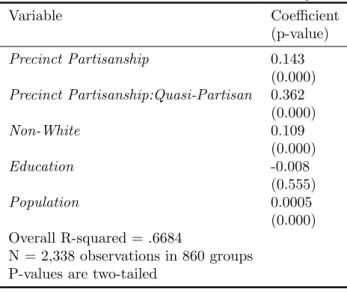
Table 2: OLS Random Effects Results, Abridged
Variable Coefficient
(p-value)
Precinct Partisanship 0.143
(0.000) Precinct Partisanship:Quasi-Partisan 0.362
(0.000)
Non-White 0.109
(0.000)
Education -0.008
(0.555)
Population 0.0005
(0.000) Overall R-squared = .6684
N = 2,338 observations in 860 groups P-values are two-tailed
Note that in Table 2, only the theoretically interesting results are included (i.e., the contest dummies are not reported here). For the full results, see the appendix.
Precinct-level Republican partisanship exerts a statistically significant and positive effect on the percentage of the vote won by the Republican candidate for Justice. Mathematically, this coefficient represents the effect of Republican partisanship when there is no quasi-partisan election. Thus, for an increase of one percent in Republican partisanship there is,ceteris paribus,
an estimated increase of .143 percent in the dependent variable when the election is truly non-partisan. This lends further credence to the findings of Rock and Baum (2010). Precinct-level partisanship exerts an effect on Republican judicial vote even in the absence of a quasi-partisan election. It should be noted that while this effect is statistically significant, it is not very large compared to the effect of partisanship when there is a quasi-partisan campaign.
The interaction of quasi-partisan election and precinct-level partisanship is statistically sig-nificant and positive. Mathematically, the coefficient for the interaction should be added to the coefficient of the precinct partisanship variable; this sum yields the average effect of precinct partisanship when there is a quasi-partisan election. Thus, the marginal effect of precinct par-tisanship on Republican judicial vote is .505 when there is a quasi-partisan election, ceteris paribus.9
The education measure is not statistically significant or substantively important. Income was left out of the model due to co-linearity with education.10 Non-white population is statistically
significant and positively associated with the dependent variable. This appears to be an artifact of the analysis; race becomes significant and negatively associated with Republican judicial vote (as predicted) if partisanship is left out of the model. Precinct population is statistically significant and positively related to Republican judicial vote. The coefficient indicates that for a one unit increase in population (which is to say, an increase of one person), on average the Republican candidate will receive an increase of .0005 percent in his or her vote share, ceteris paribus.11 The effect is real but not really substantial; it would indicate that for the Republican candidate to receive a one percent increase in his or her vote share from the effects of population, there would need to be an increase of 2,000 persons in precinct population.
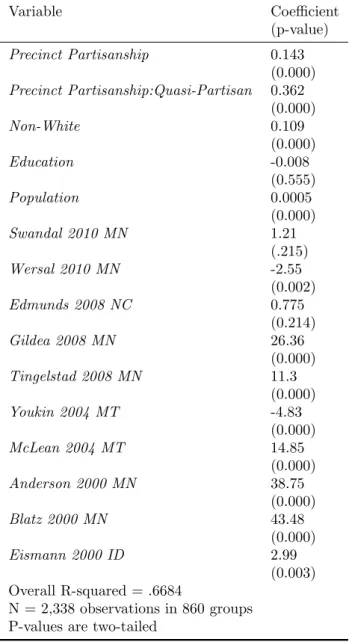
The contest variables are not theoretically interesting; the baseline category is Barbara Jack-son’s 2010 campaign for the North Carolina Supreme Court.
To show the substantive importance of the partisanship coefficients in a more intuitive fashion, I multiply the coefficients by one standard deviation of partisanship (17.6). In a truly non-partisan contest, for a 17.6 percent increase in Republican non-partisanship, there would be an estimated 2.51 percent increase in Republican judicial vote share (at the precinct level). Similarly, for a 17.6 percent decrease in Republican partisanship, we would expect a corresponding 2.51 percent decrease in Republican judicial vote. While the effect is real, it is relatively small.
9To give an idea of the substantive importance of this, the mean of precinct level Republican partisanship is
50.6; one standard deviation is 17.6. The maximum is 90, and the minimum 0.6.
10However, in models run with income instead of education, income was also non-significant and insubstantial.
Changing which of the two, education or income, is present has no substantial impact on the other variables
11To give an idea of the substantive importance, the mean of precinct population is 2,074.9; one standard
deviation is 1,618. The maximum is 15,216; the minimum is 39.
The effect is larger when a quasi-partisan campaign is run.12 For an increase of 17.6 percent in precinct-level Republican partisanship, it is estimated that the Republican judicial candidate would receive an increased vote share of 8.88 percent. Similarly, for a decrease of 17.6 percent in precinct-level Republican partisanship, it is estimated that the Republican judicial candidate would see a decrease of 8.88 percent in vote share.
This indicates that there is a substantive difference in the effect of precinct-partisanship on the dependent variable based on the type of election. The structure of voting at the precinct level appears to become more partisan when the election is quasi-partisan. Of course, the effect works both ways. If the election is quasi-partisan, Republican areas give more of their votes to Republican candidates, but Democratic areas also give less of their votes to Republican candidates.
Discussion
Quasi-Partisan Elections: The Implications
This study has provided evidence that the structure of voting at the precinct level becomes more partisan when there is a quasi-partisan judicial election. The analysis is at the aggregate level. I have not, in a technical sense, demonstrated that a quasi-partisan election results in individual voters casting their ballots in a partisan fashion. Still, if the structure of precinct-level voting has become more partisan in quasi-partisan elections, the most likely explanation is that more Republicans are voting for the Republican candidate and more Democrats are voting for the Democratic candidate.
These findings appear to be the result of campaign effects. In a quasi-partisan campaign, at least one of the candidates makes a clear appeal based on their partisan and/or ideological leanings. This in essence a partisan message: “I am a Republican”, for instance. At least some citizens receive this message and respond to it when they go to cast their ballots. Not all citizens of course; there is not a 1-to-1 correspondence between precinct partisanship and Republican judicial vote. A Republican running a quasi-partisan election could expect 8.88 percent of the vote more in a 67 percent Republican precinct than in a 50 percent Republican precinct, not 17 percent more.
From one perspective, this is a positive development. Were this paper discussing presidential, congressional, or mayoral elections, few would dispute if I said a Republican identifier voting for 12Since this is an interaction, I multiply the standard deviation change (17.6) by the sum of the coefficient for
the Republican candidate was rational13 . A major concern in formally non-partisan judicial elections is how citizens can cast meaningful, or at least informed, ballots in line with their preferences (see Dubois, 1980, 1978). This paper provides evidence that the electorate’s vote falls more predictably in line with their partisan preferences when the election is actually quasi-partisan.
The critic may argue that in fact this is not rational; that judges are in some way inherently different from other elected officials. However, if we accept that judges essentially make policy and also have policy goals (see Collins, 2007; Segal and Spaeth, 1993), then the electorate’s reaction to quasi-partisan elections is perfectly rational. If judges are going to be policymakers, it is perfectly reasonable for a Republican voter to want Republican judges. Hall and Bonneau, in particular, have defended judicial elections on the basis that the judiciary should be responsive and accountable to the public. In a partisan election this is relatively easy; if the electorate becomes more Republican, they can throw out their Democratic judges and put in Republican ones. In a truly partisan election it can be somewhat harder. After all, the goal of non-partisan elections is to force citizens to rely on better cues than party affiliation (Schaffner et al., 2001).
The purpose of holding a non-partisan judicial election is to force voters to rely on cues other than party. Before White, the party heuristic truly was suppressed. However, the advent of quasi-partisan elections prevents formally non-partisan election systems from attaining this goal. Quasi-partisan elections were not unknown pre-White, but they have become more prevalent since the regulations of judicial candidate conduct were struck down. American politics have become increasingly polarized, and weighty political issues are often decided in the courts. Given this, it is probable that there will be more, not fewer, quasi-partisan elections in the future. By definition then, for good or ill,White has undermined non-partisan judicial election systems.
Applicability to Other Non-Partisan Elections
This study has examined non-partisan judicial elections, but there are other non-partisan elections in the United States. While it is possible that there is something special about judicial elections, it seems likely that these findings can be applied to other non-partisan elections. If the structure of voting becomes more partisan in reaction to quasi-partisan judicial elections, the same will likely occur in non-judicial non-partisan elections. It is possible that the effect will be even greater. In civics courses, American students have been taught the benefits of an 13Two persons who might dispute this contention are Ellis and Stimson (2012), who argue that many
Ameri-cans (in particular RepubliAmeri-cans) have partisan and ideological identifications out of step with their actual issue positions. This is an area worthy of further research, but is beyond the scope of this project.
independent and neutral judiciary. Thus, some citizens may have qualms about voting for judges on the basis of partisanship. Those same people, however, may be less likely to feel an aversion to voting for mayor, city councilor, or the Nebraska Legislature based on partisanship. This is speculation; further study is warranted.
Implications for the Study of Judicial Elections
As noted by Bonneau and Cann (2011), judicial elections are interesting in part because of the variability in the election process. Members of Congress are all chosen in the same fashion; the vast majority of governors and state legislators are chosen in the same fashion. Part of the interest in judicial elections stems from our ability to analyze the effect of the various electoral institutions. The findings presented here show that studies of judicial elections should go beyond the differing electoral institutions. As a result of overturning the regulations on judicial candidate speech, not all non-partisan judicial elections are really non-partisan. These quasi-partisan elections were not unknown pre-White, but are now more prevalent. Because they are now prevalent and have an effect on voting, they should be treated as a distinct category of judicial election.
Speculation for Future Study
While there is evidence that quasi-partisan elections matter, there are a few questions about which to speculate. How do voters receive this message? While many scholars have studied and criticized increased spending in judicial elections (see Geyh, 2003; Chemerinsky, 1998), these elections remain relatively low budget and low profile compared to other state elections. A judicial candidate may run television advertisements, but unless they’re spending a particularly large amount of money14 , they probably will not air many, or at least not air many at prime
times in prime locations. After all, according to a 2009 Elon University Poll,forty percent of North Carolinians did not even realize their state has judicial elections (Elon, 2009).15 If the
respondents did not realize their state has judicial elections, they must not recall having seen the judicial campaign.
This explains why there is not a perfect, or near-perfect, correspondence of precinct parti-sanship and Republican judicial vote. Some citizens never hear the campaign, and so cannot respond to it. It seems probable that those who respond to the quasi-partisan campaigns are neither high-sophisticates nor low-sophisticates.16 High sophisticates are more likely to take
14None of the candidates in my sample, nor their opponents, spent particularly large amounts of money.
15Elon University Poll conducted November 16-19, 2009. Survey of 563 North Carolina adult residents.
the time to learn about the candidates even in truly non-partisan contests. Low sophisticates simply pay no attention at all, figuratively and possibly literally tuning out the campaign.
More work is needed. However, it is worth noting that citizens do not need to be at a loss when voting in elections without party labels on the ballot. Typically, if there is no party cue, then citizens become confused by the ballot, not knowing who stands for what, limiting accountability and leading to poor governance (see Key, 1950). The positive of this study is that behavior by candidates can lead to more informed voting in non-partisan elections; however, this seems to require a quasi-partisan campaign. The question then is whether or not campaigns can get large numbers of citizens to cast rational ballots without making partisan or ideological appeals. If they cannot do so, then truly non-partisan and even quasi-partisan elections are different in only one regard from formally partisan elections: the former discriminate against the less sophisticated voter.
Given the low profile of judicial campaigns, it is possible that it is not just exposure to the campaigns themselves that explains the increased partisan structure of voting. There are other explanations. Perhaps the political parties themselves become more active when a candidate is willing to run under their banner. Party leaders are high-sophisticates who probably know which party judicial candidates are affiliated with. When a judicial candidate actually runs under their party’s banner, party leaders may feel obligated to provide support similar to what they would provide for any other candidate of their party. For instance, one might imagine a word-of-mouth campaign to the party rank-and-file, or the parties become willing to include the judicial candidate on the party voting guide. It is unknown whether or not this happens, but it is possible and warrants further research.
It is probable that there is at least some direct effect of the judicial campaign on voters, even if it is in conjunction with party activities. Still, even politically attentive citizens are not likely to be exposed to the judicial campaign more than a handful of times. Do these citizens actually remember the name of the candidate and to which party that candidate belongs, or do citizens engage in on-line processing? For example, perhaps Republican voters have forgotten the advertisement where a judicial candidate touted herself as a Republican, but they still have a positive feeling towards the name when they go to vote.17
Finally, when a quasi-partisan campaign is run is likely to be non-random. Judicial candidates probably act strategically. It is worth noting that the Minnesota Republican party, despite being the litigant in theWhite decisions, did not take advantage of their hard-won right to endorse judicial candidates until 2010. At first glance this is odd, but it makes sense when the specific 17One might recall the large number of respondents in Campbell et al.’s (1960) study who could only respond
that they ’just liked’ Eisenhower or Stevenson, without being able to explain why.
electoral contexts involved are considered. White was decided in June of 2002, too late for the party to really begin to push candidates for the Minnesota Supreme Court. The next three elections were not good years for Minnesota Republicans; Kerry captured the state in 2004, and Democrats enjoyed two very good years in 2006 and 2008. Given that the time period was a bad one for Minnesota Republicans, it is no surprise that the Minnesota Republican party decided not to burden their preferred candidates with the party’s endorsement. Greg Wersal, the Minnesota lawyer whose desire to run for the bench as a Republican precipitated the fall of judicial speech regulations, declined to run from 2004 to 2008. However, Wersal did run in 2010, and he ran an openly quasi-partisan campaign (Karnowski, 2010). It seems likely that when a quasi-partisan election occurs is not random, but systematic due to candidates and parties acting in a strategic fashion. Further study is needed to determine precisely when candidates choose to run quasi-partisan campaigns.
Conclusion
This study has provided evidence that when a quasi-partisan election occurs, the structure of voting at the precinct level becomes more partisan. This study has also provided evidence that this effect is relatively substantial, especially compared to the effect of partisanship in truly non-partisan elections.From one perspective this is a positive development; more citizens are able to cast rational ballots in quasi-partisan elections than truly non-partisan ones.18
Justice Sandra Day O’Connor was the decisive vote in White. Since, Justice O’Connor has come to regret her vote. She has expressed concerns that the decision has undermined non-partisan judicial election systems as well as judicial independence. Justice O’Connor, in reference to theWhitedecision, reportedly stated that “Sometimes we [the Supreme Court] just don’t get it right”(Hirsch, 2006). This study cannot answer whether or notWhitewas correctly decided in a constitutional sense, but Justice O’Connor’s concerns are valid in at least one respect. White opened the door for quasi-partisan judicial elections. And quasi-partisan elections, for better or worse, undermine non-partisan judicial election system.
Appendix
Appendix of Tables
Table 3: OLS Random Effects Results, Full
Variable Coefficient
(p-value)
Precinct Partisanship 0.143
(0.000) Precinct Partisanship:Quasi-Partisan 0.362
(0.000)
Non-White 0.109
(0.000)
Education -0.008
(0.555)
Population 0.0005
(0.000)
Swandal 2010 MN 1.21
(.215)
Wersal 2010 MN -2.55
(0.002)
Edmunds 2008 NC 0.775
(0.214)
Gildea 2008 MN 26.36
(0.000)
Tingelstad 2008 MN 11.3
(0.000)
Youkin 2004 MT -4.83
(0.000)
McLean 2004 MT 14.85
(0.000)
Anderson 2000 MN 38.75
(0.000)
Blatz 2000 MN 43.48
(0.000)
Eismann 2000 ID 2.99
(0.003) Overall R-squared = .6684
N = 2,338 observations in 860 groups P-values are two-tailed
Table 4: Descriptive Statistics
Variable Mean/Median One Std. Dev. Maximum Minimum
GOP Judicial Vote 53.9 13.7 96 11.9
Precinct Partisanship 50.6 17.6 93 0.6
Precinct Partisanship:Quasi-Partisan 30.7 29.5 93 0
Non-White 21.03 23.3 98.99 0
Education 26.5 15.4 87.2 1.9
Population 2,074.9 1,618 15,216 39
Quasi-Partisan 1 (Median) NA 1 0
Note that 59.05 percent of all observations have a value of 1 for the quasi-partisan variable (indicating that the contest the observation is from is quasi-partisan). Conversely, 40.95 percent of all observations had a value of 0 for the quasi-partisan variable.
Table 5: Diagnostic Regression, Non-Partisan Cases
Candidate State Year Coefficient P-Value
McLean Montana 2004 .28 0.000
Tingelstad Minnesota 2008 .16 0.000
Anderson Minnesota 2000 .92 0.300
Gildea Minnesota 2008 -.01 0.500
Blatz Minnesota 2000 -.19 0.000
P-values are two-tailed
The coefficients represent the direct effect of partisanship on the dependent variable when the regression is run with data from only that contest.
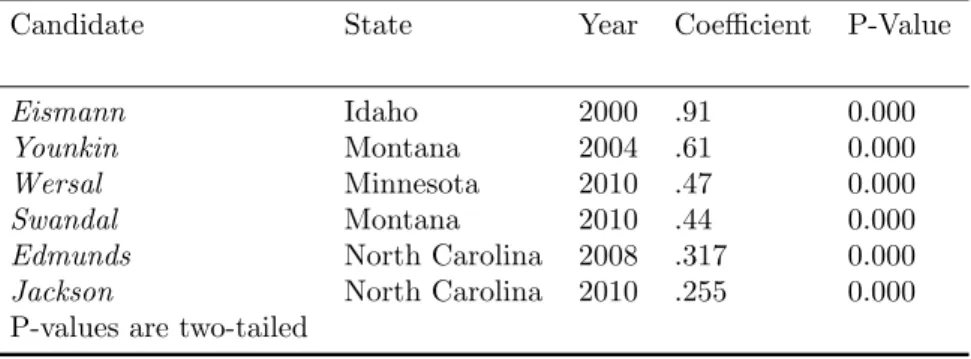
Table 6: Diagnostic Regression, Quasi-Partisan Cases
Candidate State Year Coefficient P-Value
Eismann Idaho 2000 .91 0.000
Younkin Montana 2004 .61 0.000
Wersal Minnesota 2010 .47 0.000
Swandal Montana 2010 .44 0.000
Edmunds North Carolina 2008 .317 0.000
Jackson North Carolina 2010 .255 0.000
P-values are two-tailed
Table 7: OLS Random Effects Results, excluding Blatz (MN, 2000)
Variable Coefficient
(p-value)
Precinct Partisanship 0.13
(0.000) Precinct Partisanship:Quasi-Partisan 0.40
(0.000) Non-White 0.10 (0.000) Education -0.01 (0.289) Population 0.0005 (0.317) Overall R-squared = .7018
N = 2,073
P-values are two-tailed
Table 8: OLS Random Effects Results, excluding Eismann(ID, 2000)
Variable Coefficient
(p-value)
Precinct Partisanship 0.98
(0.000) Precinct Partisanship:Quasi-Partisan 0.30
(0.000) Non-White 0.05 (0.000) Education 0.02 (0.126) Population 0.0005 (0.007) Overall R-squared = .687
N = 2,151
P-values are two-tailed
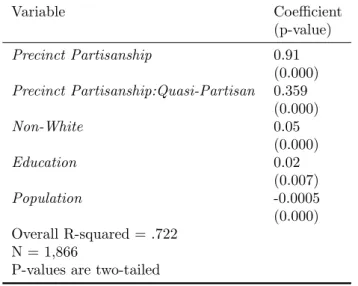
Table 9: OLS Random Effects Results, excluding Eismann and Blatz
Variable Coefficient
(p-value)
Precinct Partisanship 0.91
(0.000) Precinct Partisanship:Quasi-Partisan 0.359
(0.000) Non-White 0.05 (0.000) Education 0.02 (0.007) Population -0.0005 (0.000) Overall R-squared = .722
N = 1,866
P-values are two-tailed
REFERENCES
Abramowitz, Alan and Saunders, Kyle (2006). “Exploring the Bases of Partisanship in the American Electorate: Social Identity vs. Ideology.” Political Research Quarterly59(2): 175-87 Aldrich, John (1995). Why Parties? The Origin and Transformation of Party Politics in America Chicago: University of Chicago Press
Alvarez, Michael and Bedolla, Lisa (2003). “The Foundations of Latino Voter Partisanship: Evidence from the 2000 Election.” Journal of Politics 65(1): 31-49
American Community Survey (2005, 2009)
Bonneau, Chris (2005). “Electoral Verdicts.” American Politics Research. 33(6): 818-41 Bonneau, Chris and Hall, Melinda (2009). In Defense of Judicial Elections. New York: Rout-ledge.
Bonneau, Chris and Cann, Damon (2011). “Campaign Spending, Diminishing Marginal Re-turns, and Campaign Finance Restrictions in Judicial Elections”Journal of Politics. 73: 1267-80 Bradlee, David and Gardow, Kathryn (2011). Redistricting Data 2010
Briffault, Richard (2004). “Judicial Campaign Codes after Republican Party of Minnesota vs. White.” University of Pennsylvania Law Review. 153: 181-238
Caldarone, Richard; Canes-Wrone; Brandice; Clark, Tom (2009) “Partisan Signals and Demo-cratic Accountability: An Analysis of State Supreme Court Abortion Decisions.” Journal of Politics. 61: 560-73
Caulfeld, Rachel (2005). “In the Wake of White: how states are Responding to the Repub-lican party of Minnesota v. White and How Judicial Elections are Changing.” Akron Law Review. 38: 625-48
Caulfeld, Rachel (2007). “The Changing Tone of Judicial Election Campaigns as a Result of White.” InRunning for Judge (Streb, Matthew, ed.). New York: New York University Press Campbell, Angus; Converse, Phillip; Miller, Warren; and Stokes, Donald (1960). The American Voter. Chicago: University of Chicago Press.
Champagne, Anthony (2000). “Interest Groups and Judicial Elections.” Loyala Law Review. 34: 1391-410
Chemerinsky, Erwin (1998). “Preserving an Independent Judiciary: The Need for Contribu-tion and Expenditure Limits in Judicial elecContribu-tions.” Chicagon-Kent Law Review. 73: 133-51 Collins, Paul (2007). “Lobbyists before the U.S. Supreme Court.” Political Research Quar-terly. 60(1): 55-71
Dahl, Robert (1961). “The Behavioral Approach in Political Science: Epitath for a Monu-ment to a Successful Protest.” American Protest Science Review. 55(4) 763-72.
Dubois, Philip (1980). From Ballot to Bench. Austin: University of Texas Press.
Dunbar, Elizabeth and Nelson, Timothy (2010). “Gildea Named to Magnuson’s Place on High Court.” Minnesota Public Radio. May 13, 2010
Egelko, Robert (2006). “Former Justice Warns of Threat to Judiciary.” San Francisco Chroni-cle. November 4, 2006
Ellis, Christopher and Stimson, James (2012). Ideology in America. Cambridge: Cambridge University Press
Erikson, Robert; MacKuen, Michael, and Stimson, James (2002). The Macro Polity. New York: Cambridge University Press.
Gelman, Andrew (2008). Red State, Blue State, Rich State, Poor State: Why Americans Vote the Way They Do. Princeton: Princeton University Press
Geyh, CG (2003). “Why Judicial Elections Stink.” Ohio State Law Journal. 64: 43-80
Gibson, James (2009). “New Style Judicial Campaigns and the Legitimacy of state High Courts.” Journal of Politics. 71: 1285-304
Gimpel, Jason and Shucknekt, Jason (2002). “Reconsidering Political Regionalism in the Amer-ican States.” State Politics and Policy Quarterly. 2: 325-52
Goldstein, Joel (1979). “Bar Ratings as the Leading Influence on Non-Partisan Judicial Elec-tions.” Judicature. 63: 377-89
Gross, Donald and Goidel, Robert (2003). The States of Campaign Finance Reform. Columbus: Ohio State University Press.
Hall, Melinda (2001). “State Supreme Courts in American Democracy: Probing the Myths of Judicial Reform.” American Political Science Review. 95(2): 315-30
Hall, Melinda and Bonneau, Chris (2003). “Does Quality Matter? Challenger Emergence in State Supreme Court Elections.” American Journal of Political Science. 50(1): 20-33 Hall, Melinda (2007). “Voting in State Supreme Court Elections.” Journal of Politics. 69(4): 1147-59
Hirsch, Matthew (2006). “Swing Voter’s Lament: At Least One Case Still Bugs O’Connor.” The Recorder. November 8, 2006
Idaho Secretary of State’s Office
Karnowswki, Steve (2010). “GOP Supreme Court candidate tests new freedoms.” The Recorder. Katz, Richard (2007). Political Institutions in the United States. Oxford and New York: Oxford University Press.
Key, V.O. (1949). Southern Politics in State and Nation. New York: Knopf
Klein, David and Baum, Lawrence (2001). “Ballot Information and Voting Decisions in Ju-dicial Elections.” Political Research Quarterly. 54(4): 709-28
Lappie, John (2011). ’“Electoral Verdicts: Sustained in Part.”’ Unpublished Manuscript Lau, Richard and Redlawsk, David (1997). “Voting Correctly.” American Political Science Review. 91(3): 585-98
Lau, Richard and Redlawsk, David (2001). “Advantages and Disadvantages of Cognitive Heuris-tics in Political Decision Making.” American Journal of Political Science. 45(4): 951-71 Lovrich, Nicholas; Pierce, John; and Sheldon, Charles (1989). “Citizen Knowledge and Vot-ing in Judicial Elections.” Judicature. 73(28-39).
Luks, Samantha and Elms, Laurel (2005). “African-American Partisanship and the Legacy of the Civil Rights Movement.” Political Psychology. 26(5): 735-54.
Minnesota Secretary of State’s Office
Montana Secretary of State’s Office: Elections and Government Services North Carolina State Board of Elections
Republican Party of Minnesota vs. White, 2002; before the Supreme Court of the United States. Decision 536, U.S. 765
Republican Party of Minnesota vs. White, 2002; before the Eight Circuit Court of Appeals. Nos. 99-4021, 99-4025, 99-4029
Rock, Emily and Baum, Lawrence (2010). “The Impact of High Visibility Contests for U.S. State Court Judgeships: Partisan Voting in Non Partisan Elections.” Politics and Policy Quar-terly. 10: 368-98
Schaffner, Brian; Streb, Matthew; and Wright, Gerald (2001). “Teams Without Uniforms: The Nonpartisan Ballot in State and Local Elections.” Political Research Quarterly. 54(1): 7-30 Schaffner, Brian; Streb, Matthew; and Wright, Gerald (2007). “A New Look at the Repub-lican Bias in Nonpartisan Elections.” Political Research Quarterly. 60(2)
Schotland, Roy (2003). “To the Endangered Species List, Add: Nonpartisan Judicial Elec-tions.” Williamette Law Review. 39: 1397-425
Seagal, Jeffrey and Spaeth, Harold (2002). The Supreme Court and the Attitudinal Model Revisited. Cambridge: Cambridge University Press.
Soule, George (2008). “Minnesota’s 2008 Judicial Elections: Calm Before the Storm?”. The Hennepin Lawyer.
Squire, Peverill; Smith, Eric (1988). “The Effects of Partisan Information on Voters in Nonpar-tisan Elections.” Journal of Politics. 50: 168-79
United States Census Bureau: 2010 United States Census University of Missouri GEOCORR Project (2010).