ARTIGO ORIGINAL
556
Revista Científica da Ordem dos Médicos www.actamedicaportuguesa.com ABSTRACT
Introduction: Infection by Cambylobacter occurs worldwide and represents the main cause of acute bacterial gastroenteritis within the
European Union.
Aims: Determine the prevalence of Campylobacter in stool cultures from patients with gastroenteritis and study their microbiological,
epidemiological, clinical, and therapeutic profiles, as well as associated complications.
Material and Methods: Review of clinical files of patients presenting to the paediatric emergency department of a general district hos
-pital over a 30 month period with an acute gastroenteritis and a Campylobacter isolated in a stool specimen.
Results: Out of 216 stool cultures, 98 (45%) were positive. We identified Campylobacter in 49 (50%) cases; 30 (61%) were female.
Median age was 23 months. Fourteen patients were under one year of age, 25 between one and five years old and 10 patients were over five years old. Watery diarrhea was identified in 5 (10%) patients, bloody diarrhea in 44 (90%) and mucosanguineous in 14 (29%), while 23 (47%) had fever, 14 (29%) complained of abdominal pain and 11 (22%) presented with vomiting. One patient was septic. Five patients were admitted as inpatients. Eight patients were treated with azithromycin.
Discussion: This is the largest published national series on gastroenteritis by Campylobacter in children and the first in the south re
-gion. Campylobacter was the main bacteria isolated. Infection was self-resolving in the majority of cases. Nevertheless, severe forms
of this infection should be considered. Increased resistance to quinolones is worrisome.
Conclusion: Judicious use of stool cultures allows etiological identification of bacterial gastroenteritis. The increase in Campylobacter
cases reinforces the need for better control of hygiene measures in handling food products.
Keywords: Campylobacter; Child; Gastroenteritis; Campylobacter Infections; Emergency Service, Hospital; Portugal.
Acute Gastroenteritis by
Campylobacter Spp
:
a Retrospective Study of a Paediatric
Emergency Department
Gastroenterite Aguda por
Campylobacter Spp
: Casuística de uma Urgência
Pediátrica
1. Serviço de Pediatria. Hospital Garcia de Orta. Almada. Portugal.
2. Departamento de Pediatria. Hospital de Santa Maria. Centro Hospitalar Lisboa Norte. Lisboa. Portugal. 3. Serviço de Patologia Clínica. Laboratório de Microbiologia. Hospital Garcia de Orta. Almada. Portugal. Recebido: 30 de Dezembro de 2013 - Aceite: 19 de Maio de 2014 | Copyright © Ordem dos Médicos 2014
Ana Teresa SOARES1, Catarina COUTO1, Patrícia ROMÃO2, Isabel Saraiva de MELO1, Manuela BRAGA1, José
DIOGO3, Paulo CALHAU1
Acta Med Port 2014 Sep-Oct;27(5):556-560
RESUMO
Introdução: A infeção por Campylobacter é a principal causa de gastroenterite aguda bacteriana pediátrica na União Europeia. Objetivos: Conhecer a prevalência de isolamento deste agente nas crianças admitidas na urgência com gastroenterite aguda que realizaram coprocultura, caracterizando a microbiologia, epidemiologia, clínica, terapêutica e complicações associadas.
Material e Métodos: Casuística por consulta dos processos dos doentes admitidos na Urgência Pediátrica dum hospital distrital, du
-rante 30 meses, com o diagnóstico de gastroenterite aguda e isolamento em coprocultura de Campylobacter.
Resultados: Das 216 coproculturas efetuadas, 98 (45%) foram positivas. Identificámos Campylobacter spp. em 49 (50%) doentes.
Destes, 30 (61%) eram do género feminino. A mediana de idades foi 23 meses. Catorze doentes tinham idade inferior a um ano, 25 entre um e cinco anos e 10 idade superior a cinco anos. Verificámos diarreia aquosa em cinco (10%) doentes, diarreia com sangue em 44 (90%), sangue e muco em 14 (29%), febre em 23 (47%), dor abdominal em 14 (29%) e vómitos em 11 (22%). Registámos um caso de sépsis. Internámos cinco doentes. Oito doentes foram medicados com azitromicina.
Discussão: Esta é a maior casuística nacional publicada de gastroenterite aguda a Campylobacter em idade pediátrica e a primeira
no sul do país. Campylobacter foi a principal bactéria identificada, associada maioritariamente a doença auto-limitada. Contudo, há a
considerar formas de infeção graves. O aumento da resistência às quinolonas é preocupante.
Conclusão: A utilização criteriosa da coprocultura permite a identificação etiológica na gastrenterite aguda bacteriana. O crescente aumento dos casos de Campylobacter diagnosticados reforça a necessidade de maior controlo das medidas de higiene na manipula
-ção dos alimentos.
Palavras-chave: Campylobacter; Criança; Gastroenterite; Infecções por Campylobacter; Serviço de Urgência Hospitalar; Portugal.
INTRODUCTION
Infection caused by Campylobacter spp. has a
worldwide distribution1,2 and is the main cause of acute bacterial gastroenteritis (ABG) in children in the European Union, with a higher prevalence than infection caused by Salmonella spp., Shigella spp. and enteropathogenic Escherichia coli.3,4 A significant increase in the number of patients diagnosed with ABG caused by Campylobacter spp. has been found in Europe over the last few years.3,5,6 In
Portugal, recent prevalence data also shows an increasing
number of confirmed cases over the last few years. A higher prevalence in the 1-5 year age group has been observed, as well as a significant number in newborn and infant babies where Campylobacter jejuni has been the most frequently identified species.5
Although more than 20 species have been identified, Campylobacter jejuni and Campylobacter coli are the more frequently involved in human infection.1,5,6 As regards pathogenic mechanisms involved in ABG, it is generally
anos
35
35 anos
a p
rom o
ve
r a
s
c
iê
n cia
s b
iom
éd
ic
as
A
CT A
M
É
D
IC
A
P
OR
TU
GU
ESA
ARTIGO ORIGINAL
35
35 anos
a p
rom ov e r a s c A PO RT UG UES A
considered that this bacteria is pathological to gut epithelia by direct invasion, induction of an inflammatory process and through toxin production.1,6-9,12,13
It is usually associated to an animal reservoir (birds, cattle, sheep and goats) and is mostly transmitted by undercooked meat (mainly birds), non-pasteurized milk, other contaminated food and untreated water.3,5-7,10-13 It has a two-to-five day incubation period.3,6,9
Clinical presentation includes mainly acute watery diarrhoea, with blood and/or mucus associated to systemic symptoms such as fever, vomiting, abdominal pain and headache. It is mostly an auto-limited disease (mainly occurring in previously healthy children) and complications including reactive arthritis, sepsis, Guillain-Barré syndrome and haemolytic anaemia have been described.3,5-7,11-14 It is usually diagnosed by bacterial isolation in stool culture and identification is achieved by biochemical, mass spectometry or molecular-based methods. It may be complemented by stool direct microscopic examination, by dark-field microscopy, specific antigen detection, bacterial DNA identification by PCR (Polymerase Chain Reaction) or Elisa.7,8,11,13
In most cases treatment involves fluid and electrolyte replacement. Antibiotic treatment is recommended in selected cases: bloody diarrhoea, persistent symptoms for 1 week or longer, high fever, extra-intestinal disease, ABG affecting immuno-depressed patients or patients with chronic pathology and in outbreak situations. Macrolide are considered as first-line drugs.1,6,8
Our study aimed to determine 1) Campylobacter spp. isolation prevalence in patients admitted to a Paediatrics Emergency Department with an ABG diagnosis following stool culture 2) microbiologic, epidemiologic, clinical and therapeutic characteristics and 3) associated complications.
MATERIAL AND METHODS
Our study included a case review based on clinical records of patients aged less than 15 years-old admitted to the Paediatrics Emergency Department at a Portuguese district hospital between January 2011 and June 2013 (30 months).
Our study included patients diagnosed with ABG by isolation of Campylobacter spp in stool culture. Microbiological diagnosis was obtained by stool culture in a selective medium for Campylobacter spp. (columbia agar supplemented with sheep blood and four antimicrobial agents: cephoperazone, vancomycin, colistin and amphotericin B) incubated in a microaerophilic atmosphere (48 hours at 42ºC). Bacterial identification was obtained by MALDI-TOF mass spectrometry through the determination of the molecular weight of specific ribosomal protein fragments. Samples were sent to the reference laboratory Laboratório Nacional de Referência das Infeções Gastrintestinais, INSA, where resistances of a subgroup of randomly selected strains were studied among those received from different healthcare institutions. Mueller Hinton Agar supplemented with 5% defibrinated horse blood and 20 mg/L of beta-NAD was used in antimicrobial susceptibility testing (AST) by the disk diffusion method. Microaerophilic incubation was carried out for 24 hours at 37ºC. The discs were loaded with the following antibiotics: ciprofloxacin (5 μg), tetracycline (30 μg), erythromycin (15 μg) and gentamicin (10 μg). Strains were classified
according to EUCAST 2014 cut-offs.
Demographic (age, gender), epidemiologic (other family cases, bird meat ingestion) and clinical data (frequency and characteristics of stools, other symptoms) were collected, as well as data regarding associated clinical complications and therapy.
Stool culture is a routine procedure in Paediatrics Emergency at our hospital in “in-patients” and in those that are immunosuppressed or present with long-lasting bloody/ mucous diarrhoea, high fever or suffer from a chronic disease.
RESULTS
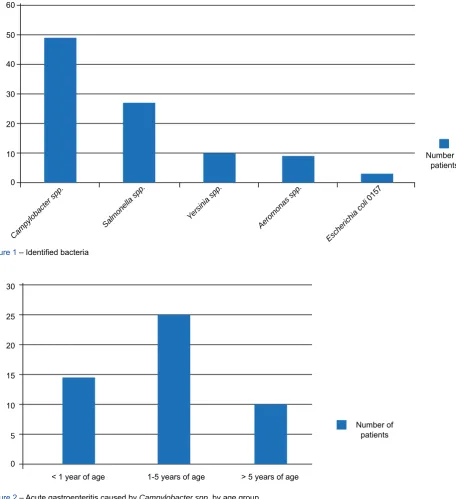
During our study period, 6,242 patients were admitted to the Paediatrics Emergency Department diagnosed with acute gastroenteritis. A total of 216 stool cultures (3.5%) were performed, from which 98 (45%) were positive. Campylobacter spp. was identified in 49 patients (50%), followed by Salmonella in 27 (28%), Yersinia enterocolitica in ten (10%), Aeromonas spp. in nine (9%) and Escherichia coli 0157 in three (3%) (Fig. 1). Campylobacter jejuni was the main species, identified in 48 patients (98%) followed by Campylobacter coli in one patient (2%).
Thirty (61%) from the 49 patients with Campylobacter
spp. isolated in stool culture were female. The median age was 23 months (minimum – one month and six days, maximum 12 years).
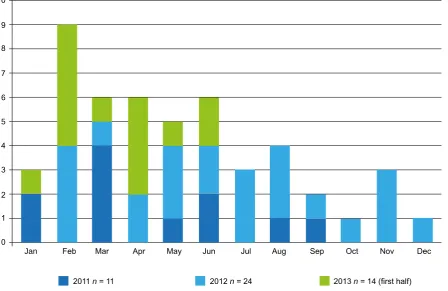
As regards age distribution, 14 patients were recorded in the group aged less than one year, 25 in the 1 to 5 year age group and 10 patients were aged above five (Fig. 2). An increase in the number of diagnosed patients was observed along the study period, with 11 patients in 2011, 24 in 2012 and 14 in the first half of 2013 (Fig. 3). Regarding this species, a higher number of positive stool cultures was observed in 2011 and 2012 in the first half of the year when compared to the second half (n = 21, 68% versusn = 14, 32%).
Clinical presentations included: watery (n = 5, 10%); bloody (n = 44, 90%) and bloody-mucous diarrhoea, (n = 14, 29%); fever (n = 23, 47%); abdominal pain (n = 14, 29%); vomiting (n = 11, 22%) and rash (n = 2, 4%). On their first year of life, four patients presented with fever while above one year of age, 19 patients (54%) presented with fever (Table 1). Five patients were admitted (10%), three of which aged less than 1 year, with an average 1.8 days of hospital staying. Two patients underwent intravenous hydration. One 1 month old baby presented with sepsis.
A total of 18 patients (37%) were re-admitted with long-lasting and bloody diarrhoea.
A total of 18 samples were randomly selected for analysis at the reference laboratory (37% of our group of patients) for AST. We found an 88% quinolone, 61% tetracycline and 22% macrolide resistance; we did not find any aminoglycoside resistance. As regards therapy, eight patients were treated with oral azithromycin due to long-lasting bloody diarrhoea.
DISCUSSION
ABG is a frequent paediatric disease, usually with a benign and self-limiting clinical evolution. It usually has a viral origin but there is a significant prevalence of bacterial aetiology.4,15,16
ARTIGO ORIGINAL
558
Revista Científica da Ordem dos Médicos www.actamedicaportuguesa.com main isolated bacteria, in 50% of positive stool cultures.
There are two Portuguese studies involving paediatric patients with a similar methodology: one carried out in 2005 in Portugal’s Central region, also in urban areas and obtaining similar results;11 another carried out in 2006 also in the Central region but involving urban and rural areas, in
which Salmonella spp was the most prevalent agent (54%
of positive stool cultures) followed by Campylobacter spp (23%).14 In another more recent study carried out in 2013 in Lisbon area, Escherichia coli was the most frequent bacterial agent found (43%), followed by Campylobacter spp (37%); however, it is a study involving only admitted patients and as such its results cannot be comparable to our own.17
In what concerns the different Campylobacter species,
Campylobacter jejuni was the most frequently bacteria in ABG patients, with an increase in patients diagnosed over the years, in line with other studies.3,5
We found a higher number of patients aged one to five, a high number of patients aged less than 1 year, similarly to a recently published national report 4 and to one of the national studies already referred.14 In the study involving “in-hospital” patients17 this bacteria was more frequently isolated in patients aged above 1 year and particularly above five. However, the latter was a small sample, only involving patients who have been admitted to hospital, therefore with different clinical characteristics to our own. As regards clinical symptoms, these were similar to those presented in one of the national studies.14
Clinical presentation in the first year of life was similar to
Figure 1 – Identified bacteria
0
Campylobacter spp.
Salmonella spp.
Yersinia spp.
Aeromonas spp.
Escherichia coli 0157
10 Number of
patients 20
30 40 50 60
Figure 2 – Acute gastroenteritis caused by Campylobacter spp. by age group.
0
5
Number of patients
< 1 year of age 1-5 years of age > 5 years of age
ARTIGO ORIGINAL
Table 1 - Symptoms associated to acute gastroenteritis caused by Campylobacter spp
Clinical presentation nTotal = 49
n (%)
< 1 year of age
n = 14 (n)
≥ 1 year of age n = 35 (n)
Diarrhoea Watery Bloody Mucous
5 (10%) 44 (90%) 14 (29%)
2 12 4
3 32 10
Fever 23 (47%) 4 19
Abdominal pain 14 (29%) 0 14
Vomiting 11 (22%) 3 8
Rash 2 (4%) 1 1
the remaining age groups, except for a one month-old baby diagnosed with sepsis.
The high frequency of patients presenting with bloody/ mucous diarrhoea in our group could be a reflection of the clinical practice and criteria for stool culture followed at our hospital. As previously described, approximately half of the patients evolve with watery instead of bloody diarrhoea, as shown in our group of patients.3,8,13
Although it is epidemiologically important, aetiological research is recommended in patients with an indication for targeted antimicrobial therapy: outbreak situations, bloody/ mucous diarrhoea, symptoms lasting over one week, high fever, extra-intestinal disease, immunosuppressed patients, patients with chronic diseases, patients coming from tropical regions or as part of the work-up for a differential diagnosis.4 We obtained a 45% isolation rate in stool cultures carried out in our group of patients, a frequency reported by others
to occur between 21 and 36%.11,14,17
In the group of patients where AST was obtained we found an antibiotic resistance pattern in line with what has been described in literature, although with a higher quinolone resistance rate. This data is confirmed by the progressive increase in quinolone resistance rate over the last few years, representing an epidemiological concern.2,8,9 Following recommendations, we prescribed an antimicrobial treatment in selected cases. In our group, only eight patients were treated with five-day oral azithromycin due to long-lasting bloody diarrhoea.
We should stress that only five patients (10%) were admitted and that two underwent intravenous hydration, in contrast to another national study where the number of patients in need of admission was significantly higher.11 At the time of discharge from the Emergency Room, the need for continuous alarm sign monitoring was explained
Nov Dec
Figure 3 – Number of diagnosed patients over the months
Jan Feb
2011 n = 11 2012 n = 24 2013 n = 14 (first half)
Mar Apr May Jun Jul Aug Sep Oct
0 1 2 3 4
5 6
ARTIGO ORIGINAL
560
Revista Científica da Ordem dos Médicos www.actamedicaportuguesa.com to children’s carers and re-evaluation was performed
whenever necessary. We consider that the clinical evolution of our patients was generally favourable, as shown by the small number of complications and the low admission rate. As this has been a retrospective study, we were not able to identify the possible source of infection or the presence of other infected relatives.
CONCLUSION
Infection by Campylobacterspp. is the main cause of
ABG in the European Union. An increase in new diagnosed cases has been found over the last few years, as yet for undetermined reasons. Although most patients present a self-limiting disease with a favourable clinical outcome, we must consider the presence of complications as well as other more severe and potentially lethal forms of infection. Stool culture allows for an aetiological identification, which
is crucial in situations where targeted antimicrobial therapy is recommended.
The increase in the number of diagnosed new cases over the years suggest the need for further encouragement and awareness in primary healthcare to adequate hygiene measures in food handling and preparation.
This is currently the larger national group of patients in paediatric age of ABG by Campylobacterspp. and the first of its kind carried out in the south of Portugal.
CONFLICTS OF INTEREST
The authors declare there were no conflicts of interest in writing this manuscript.
FINANCIAL SOURCES
The authors declare there was no financial support in writing this manuscript.
REFERENCES
1. Heresi GP, Murphy JR, Cleary TG. Campylobacter jejuni. In: Feigin RD, Cherry JD, Demmler-Harrioson GJ, Kaplan SL, editors. Feigin and Cherry´s textbook of pediatric infectious diseases. Philadelphia: Saunders Elsevier; 2009. p. 1612-8.
2. Lengerh A, Moges F, Unakal C, Anagaw B. Prevalence, associated risk factors and antimicrobial susceptibility pattern of Campylobacter spe-cies among under five diarrheic children at Gondar University Hospital, Northwest Ethiopia. BMC Ped. 2013;13:82.
3. EFSA (European Food Safety Authority), ECDC (European Centre for Disease Prevention and Control). The European Union summary report on trends and sources of zoonoses, zoonotic agents and food-borne outbreaks in 2011. EFSA J. 2013;11:3129-250.
4. Guarino A, Albano F, Ashkenazi S, Gendrel D, Hoekstra JH, Shamir R, et al. European Society for Paediatric Gastroenterology, Hepatology, and Nutrition/European Society for Paediatric Infectious Diseases evidence-based guidelines for the management of acute gastroenteritis in children in Europe. J Pediatr Gastroenterol Nutr. 2008;46:S81-122.
5. Duarte A, Santos A, Benoliel J, Domingues F, Oleastro M. A infeção hu-mana por Campylobacter em Portugal: alguns dados epidemiológicos. Instituto Nacional de Saúde Doutor Ricardo Jorge. Infeções Gastroin-testinais. Artigos breves No.7. 2013.
6. Heresi GP, Baqar S, Murphy JR. Campylobacter. In: Kliegman RM, Stanton BF, Schor NF, Geme JW, Behrman RE, editors. Nelson Text-book of Pediatrics. Philadelphia: Elsevier Saunders; 2011. p. 968-70. 7. Tamborini AL, Casabona LM, Viñas MR, Asato V, Hoffer A, Farace MI,
et al. Campylobacter spp.:prevalência y caracterización feno-genotípica
de aislamientos de pacientes com diarrea y sus mascotas en la pro-vincia de La Pampa, Argentina. Rev Argent Microbiol. 2012;44:266-71. 8. Adedayo O, Kirkpatrick BD. Campylobacter jejuni infections: update on
presentation, diagnosis, and management. Hosp Physician. 2008;44:9-15.
9. Crushell E, Harty S, Sharif F, Bourke B. Enteric Campylobacter: purging its secrets? Pediatr Res. 2004;55:1.
10. Sellu DP. Campylobacter enterocoloitis: general and surgical aspects. Postgrad Med J. 1986;62:719-26.
11. Borges AC, Pedrosa C, Santos A, Vitorino M, Costa M, Godinho C. Campylobacter jejuni: gastrenterites agudas e infecções extra-intesti-nais. Acta Pediatr Port. 2005;36:191-3.
12. Ketley JM. Pathogenesis of enteric infection by Campylobacter. Micro-biology. 1997;143:5-21.
13. Murray PR, Rosenthal KS, Pfaller, MA. Medical microbiology. 5th ed. Philadelphia: Mosby Elsevier; 2005.
14. Rodrigues F, Calvino J, Alves AF, Lemos L. Diarreia aguda por Campylo-bacter spp. Acta Pediatr Port. 2006;37:91-4.
15. Paiva M, Santos F, Amaral JMV. Gastrenterite Aguda. In: Amaral JV, editor. Tratado de Clínica Pediátrica. Lisboa: Abbott Lda; 2008. p. 532-6. 16. Bhutta ZA. Acute gastroenteritis in children. In: Kliegman RM, Stanton
BF, Schor NF, Geme JW, Behrman RE, editors. Nelson Textbook of Pe-diatrics. Philadelphia: Elsevier Saunders; 2011. p. 1323-38.