Proceedings of the
Eighth International Workshop on
Graph Transformation and Visual Modeling Techniques
(GT-VMT 2009)
Refactoring of Model Transformations
Hartmut Ehrig, Karsten Ehrig and Claudia Ermel19 pages
Guest Editors: Artur Boronat, Reiko Heckel
Managing Editors: Tiziana Margaria, Julia Padberg, Gabriele Taentzer
Refactoring of Model Transformations
Hartmut Ehrig, Karsten Ehrig and Claudia Ermel
Institut f¨ur Softwaretechnik und Theoretische Informatik Technische Universit¨at Berlin, Germany
[email protected], [email protected], [email protected]
Abstract: Model-to-model transformations between visual languages are often de-fined by typed, attributed graph transformation systems. Here, the source and target languages of the model transformation are given by type graphs (or meta models), and the relation between source and target model elements is captured by graph transformation rules. On the other hand, refactoring is a technique to improve the structure of a model in order to make it easier to comprehend, more maintainable and amenable to change. Refactoring can be defined by graph transformation rules, too. In the context of model transformation, problems arise when models of the source language of a model transformation become subject to refactoring. It may well be the case that after the refactoring, the model transformation rules are no longer applicable because the refactoring induced structural changes in the models. In this paper, we consider a graph-transformation-based evolution of model trans-formations which adapts the model transformation rules to the refactored models. In the main result, we show that under suitable assumptions, the evolution leads to an adapted model transformation which is compatible with refactoring of the source and target models. In a small case study, we apply our techniques to a well-known model transformation from statecharts to Petri nets.
Keywords: model transformation, graph transformation, model refactoring
1
Introduction
Model-driven software development (MDD) is a discipline that relies on models and that aims to develop, maintain and evolve software by performing model transformations [BBG05]. The basic idea of model transformations is to more or less automatically derive models of a certain target language from models of a source language, e.g. by mapping the source language com-ponents of a domain specific language to Petri nets, where model properties can be analyzed formally.
supporting in particular the refactoring of UML diagrams like class diagrams, statecharts and activity diagrams [BSF02,SPLJ01].
In this paper we tackle the problem which arises when model refactoring operations are ap-plied to a model (or a modelling language) which is transformed by a model transformation. Problems arise if the refactoring operations induce structural model changes which cannot be handled by the model transformation. In order to solve this problem, we propose a strategy for a systematic evolution of model transformation specifications in accordance to the refactoring operations.
Model transformations between visual languages are conveniently defined in a formal way by typed, attributed graph transformation [EEPT06,MVVK05, K¨on05,EE05]. To execute model transformation rules and to check functional properties of model transformations (termination and confluence), the graph transformation engine AGG [AGG09] is available.
On the other hand, various approaches exist using graph transformation to provide a formal specification of model refactorings [MTM05,MTR07,GGZ+05]. Basically, a refactoring oper-ation is defined by a set of graph transformoper-ation rules typed over the modelling language of the models to be refactored.
In our approach, we consider a construction allowing us to apply the refactoring operation not only to models of the source or target language of a model transformation, but also to the model transformation rules. The approach is based on the work of Parisi-Presicce who defined the transformation of graph grammars in [PP96]. In our main result, we show that under suitable assumptions, such an evolution of the model transformation rules leads to an adapted model transformation which is compatible with refactoring of the source and target models. In a small case study, we apply our techniques to a well-known model transformation from statecharts to Petri nets, when the statechart becomes subject to a refactoring.
The paper is structured as follows: After introducing our case study for refactoring and model transformation inSection 2, we consider the notion of consistency of a model transformation step and a refactoring step inSection 3, where the steps are defined as single rule applications of the respective graph rules to a model state. InSection 4, we extend this basis to sequences of rule applications and state our main result for the consistent evolution of model transformations. We give an overview over extension of our main results inSection 5, and look into some further refactorings inSection 6.Section 7compares our approach to related work, and inSection 8we conclude the paper with an outlook to future work.
2
Example: Transforming and Refactoring Statecharts
2.1 Model TransformationState2PN from Statecharts to Petri Nets
In this section, we review the model transformation from a simple version of statecharts into Petri nets, given in [EEPT06].
Example1 (Type Graph of theSC2PN Model Transformation) The statechart type graphT GS
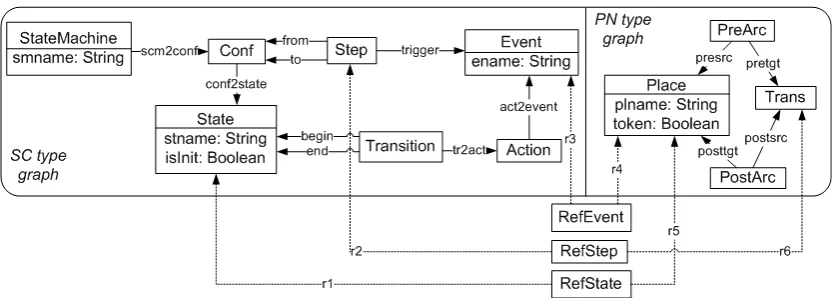
captures the behavior of any object of a specific class by flattening the state hierarchy into state configurationsand grouping parallel transitions intosteps. AConfiguration is composed of a set ofStates that can be active at the same time. AStepis composed of non-conflictingTransitions (which are, in turn, binary relations between states) that can be fired in parallel. A step between two configurations istriggered by a commonEventfor all its transitions. The effect of a step is a set ofActions.
Figure 1: Integration of Attributed Type Graphs for the Model TransformationSC2PN
The target modelling language are Petri nets. The Petri net type graph T GT is shown in
the right part of Figure 1. In fact, we use elementary net systems [Rei85], where each place contains at most onetoken. In order to interrelate the source and target modeling languages, we use reference types to construct an integrated attributed type graph, as shown inFigure 1. For instance, the reference node typeRefStaterelates the source typeStateto the target typePlace.
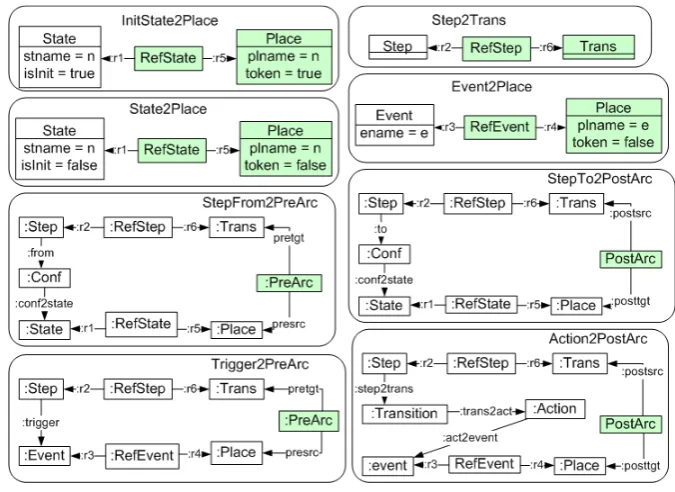
The model transformation from statecharts into Petri nets is fully given by the transformation rules defined in [EEPT06]. In this paper, we concentrate on the rules constructing the integrated model which contains elements of both source and target language, and do not consider explicitly the restriction of the integrated model to the target language of Petri nets.
The main model transformation rules are shown in Figure 2. Note that we use a shortcut notation for our rules where the left- and right-hand sides of each rule are depicted in one graph. Nodes which exist only in the right-hand side (i.e. they are generated by the rule) are coloured, and their adjacent arcs are also generated by the rule. Moreover, all model transformation rules are non-deleting, and each rule has a negative application condition (NAC) which equals the right-hand rule side and prevents the rule to be applied more than once at the same match as before.
Figure 2: Model Transformation Rules forSC2PN
be generated accordingly (see rulesStepFrom2PreArcandStepTo2PostArc). Furthermore, firing a transition should consume the token of the trigger event (ruleTrigger2PreArc), and should generate tokens on (the places related to) the target event indicated as the action (Action2PostArc).
2.2 Refactoring Operation for Statecharts
Not all possible model refactorings make it necessary to adapt the model transformation rules. One well-known refactoring is the so-calledPull-Up-Attributewhich removes an attribute type from all subtypes of a supertype and adds the attribute type to the common supertype, instead. This kind of refactoring (changing only the inheritance relation of a meta model) does not induce changes on the instance models which remain valid as they are. Hence, model transformation rules remain applicable after the refactoring, too. On the other hand, there are refactorings which induce structural changes of the instance models. This kind of critical refactorings make an adaption of the model transformation rules necessary and are considered here. Figure 3shows an overview of changes in the type graph and the necessity of changing (migrating) the corre-sponding models and/or model transformation rules, as well.
Figure 3: Relation between Refactorings at Meta-Model and at Model Level
been renamed or violate constraints after they have been modified, depending on the character of the modification.
As running example, we present a refactoring operation for statecharts, where the representa-tion of initial states is changed from an attribute to a new node type. This involves the delerepresenta-tion of an attribute type which is a critical refactoring according toFigure 3. The motivation for this statechart refactoring is to simplify the definition of a concrete syntax for statecharts, where node types are mapped to figures. We use this example later on to illustrate the evolution of a model transformation from statecharts to Petri nets when such a model refactoring on statecharts has taken place.
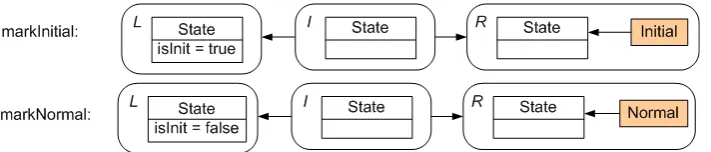
Example3 (Refactoring Operation for Statecharts) Let the type graph for statecharts be the one depicted in the left part ofFigure 1. For the definition of our refactoring operation, this type graph is extended by two new node typesInitialandNormal, which are linked to theState node type. The refactoring operationmarkStateis modelled by the two graph rules inFigure 4, where anInitialnode is added to a state whoseisInitattribute is true (rulemarkInitial), and, vice versa, a Normalnode is added to a state whoseisInitattribute is false (rulemarkNormal). Note that theisInit attribute is deleted by the refactoring rules.
3
Consistency of Stepwise Model Transformation and Refactoring
In this section, we give the formal definition how to adapt a model transformation to a refactoring operation (Definition 1) and consider the relation of a model transformation step and a refactoring step inLemma 1.
A model transformation rule p1 ∈P is adapted to a refactoring (given by refactoring rule q∈Q), by applying refactoring ruleqto all rule graphs of model transformation rulep1, resulting in the adapted model transformation rulep2. Note that the construction of applying rules to rules is based on [PP96] and extended to rules with NACs in [EE08].
Definition 1(Application ofQ-Productions toP-Productions) Productionq= (Lq←Iq→Rq)
is applicable top1:L1→R1withnac1:L1→N1leading top2:L2→R2withnac2:L2→R2if
we havem:Lq→L1leading to the following DPOs, written p1
q,m_*4
p2 , where all morphisms are injective:
Lq m
(1) Iq
o
o //
(2) Rq
L1oo D //L2
L1
p1
(3) D
o
o //
(4) L2
p2
R1 oo E //R2
L1
nac1
(5) D
o
o //
(6) L2
nac2
N1 oo F //N2
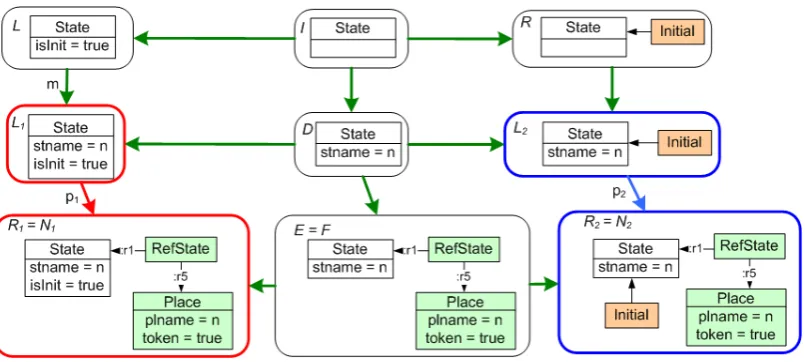
Example 4 (Applying a Refactoring Rule to a Model Transformation Rule) Figure 5 shows the application of refactoring rule markInitial from Figure 4 to model transformation rule Init-State2PlacefromFigure 2, according toDefinition 1.
Figure 5: Applying Refactoring RulemarkInitialto Model Transformation RuleInitState2Place
com-mon type graphT Gwhich includes the type graphs for the source and the target languages of the model transformation, as well as the extended type graph for the refactoring. Let(MT,P): V L1→V L2be a model transformation (withPnon-deleting with NACs),(MR1,Q):V L1→V L∗1 be a model refactoring (withQbijective on nodes, without NACs), and(MR,Q):P→P∗be a model refactoring of rules according to Definition 1, and let T G be the common type graph forV L1,V L2,V L1∗,PandQ. All over, we assume injective rules and injective matches. For sim-plicity, we do not handle the corresponding refactorings of the different type graphs in this paper.
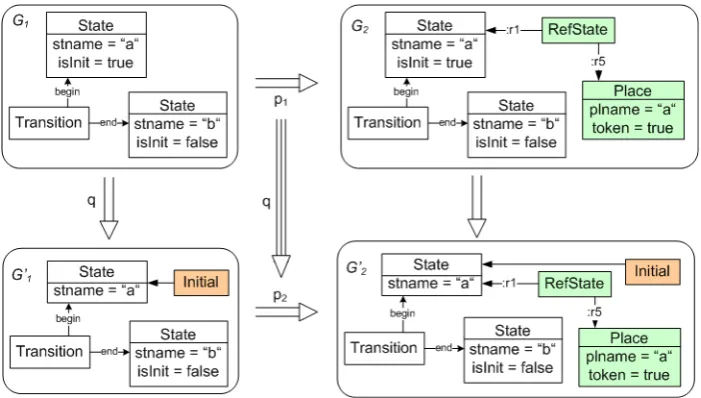
The following lemma shows the compatibility of a model transformation step transforming source modelG1∈V L1into target modelG2∈V L2 by applying rule p1∈P, and a refactoring step, changingG1∈V L1toG10 ∈V L∗1by applying ruleq∈Q, where the refactored source model G01is transformed by the refactored model transformation rulep2∈P∗, resulting in modelG02.
Lemma 1(Direct Transformation and Refactoring Steps)
Given G1
p1,m1
=⇒G2with p1∈P and p1
q,m_*4
p2 with q∈Q,
we have G1
q
=⇒G01,G2
q
=⇒G02and G01=p⇒2 G02.
G1
p1,m1 +3
q
q,m
G2
q
G01 p
2 +3G
0
2
Proof. Given p1:L1→R1 withnac1:L1→N1, we obtain p2:L2→R2 withnac2:L2→N2 with pushouts(1)−(6)as inDefinition 1.
Furthermore, we obtain fromG1
p1,m1
=⇒ G2the pushout in the left square in the diagram below, with pushouts(1)−(4), as shown inDefinition 1. Next, we constructD1as pushout complement in the left back square – using thatIq→Lqand henceD→L1is bijective on nodes, which implies that the gluing condition is satisfied – and then G01 as pushout in the right back square. Then, D2 andG02 are constructed as pushouts in the middle and right square, respectively, leading to induced morphismsD2→G2andD2→G02such that all squares commute.
In the left cube, the left, right, back and top squares are pushouts by construction. This implies that also the front and bottom squares are pushouts by pushout composition and decomposition. Hence, all squares of the left cube and, similarly, also of the right cube are pushouts. This leads to the DPOs of the direct transformationsG1
q
=⇒G01,G2
q
=⇒
G20 andG01p=2⇒,m2G02.
Lq m (1)
Iq / / o o
(2)
Rq L1 p1 m1
(3)
D o o / /
(4)
L2 p2 R1 E o o /
/R2
G1 D1 o o /
/G01
G2oo D2 //G02
It remains to show thatm2:L2→G01satisfiesnac2:L2→ N2, defined by pushouts(5)and(6)inDefinition 1, using thatm1:L1→G1 satisfiesnac1:L1→N1. Assume that m26|=nac2, then we have injectiveq2:N2→G01withm2= q2◦nac2. Pushout-pullback decomposition allows us to construct pushouts(7)and(8)from the outer DPO, leading to an injective q1 with q1◦nac1 =m1. This contradicts m1|=nac1. Hence, we havem2|=nac2.
L1 nac1 m1 # #
(5)
D
o
o //
(6) L2 nac2 m2 { { N1 q1
(7) F
o
o //
(8) N2
q2
Example 5 (Model Transformation Step and Refactoring Step) Figure 6 shows the diagram relating the source and target model of the model transformation step and the changed source and target models of the refactoring step wherep1andp2are given inFigure 5.
Figure 6: Relating Refactoring and Model Transformation Step
4
Sequences of Rule Applications
In this section, we extend our result fromLemma 1on the compatibility of model transformation and refactoring steps to sequences with rule setsQ,PandP∗according to the general assumption inSection 3. Our main result inTheorem 1states that under certain compatibility assumptions which can be decided at rule level, a complete model transformation sequence can be refactored, leading to a compatibility diagram similar to the one inLemma 1, but where now sequences of rule applications are considered instead of single steps. For the proof of Theorem 1, we require compatibility of model transformation and refactoring rules, defined in Definition 2. Furthermore, we use a lemma stating that a terminating transformation at rule level leads to a terminating transformation at model level, as well (Lemma 2). We say that graphG(resp. rule p∗) is terminal wrt.Qif no ruleq∈Qcan be applied toG(resp. p∗).
Definition 2(Q– (P, P∗)– Compatibility) Qis(P,P∗)-compatible if we have:
1. Independence Compatibility:
Given terminal p∗ wrt. Q, G1 p
∗
=⇒G2 andG1=q⇒G01 (resp. G2=q⇒G02) with p∗∈P∗ andq∈Q, we have parallel (resp. sequential) independence including NACs ofG2
p∗
⇐=
G1=q⇒G01(resp.G1 p
∗
2. Termination Compatibility:
For eachGterminal wrt.PandG=Q⇒! G∗, alsoG∗is terminal wrt.P∗, whereQ! means to apply rules inQas long as possible.
Example6 (Compatibility of theSC2PNModel Transformation and themarkStateRefactoring) We continue our case study introduced inExample 1–Example 5.Figure 7shows the refactored model transformation rulesInitState2PlaceandState2Place. Note that all other model transforma-tion rules fromFigure 2 remain unchanged because the refactoring rules cannot be applied to them.
Figure 7: Refactored Model Transformation Rules forSC2PN
We now show that we have independence and termination compatibility as defined in Defini-tion 2:
1. Independence compatibility: Given terminalp∗wrt.Qandq∈QwithG01⇐q=G1
p∗
=⇒G2,
we have parallel independence because the matches can only overlap inState which is a gluing point for both rules. Moreover, we have NAC compatibility because the nodes and edges generated by the rules inQare of different types from those generated by p∗. Analogously, we can show sequential independence.
2. Termination compatibility: Given terminal Gwrt. P andG=Q⇒! G∗, then the markState refactoring rules have been applied to all initial state nodes occuring in a rule inP, and to all initial state nodes inG. So there is no match from a rule p∗∈P∗toG∗where the NAC ofp∗would not prevent its application, and hence,G∗is terminal wrt.P∗.
The following lemma states that a terminating transformation at rule level leads to a terminat-ing transformation at model level.
Lemma 2(Direct Transformation and Terminating Refactoring) Given G1
p1,m1
=⇒G2with p1∈P
and p1
Q!_*4
p∗1 terminating, we construct G∗1 p
∗
1
=⇒G∗2and terminating G1
Q!
=⇒G1∗and G2
Q!
=⇒
G∗2, provided that we have termination of(MR1,Q)and independence compatibility (see Defini-tion 2.1).
Proof. Let p1
Q!_*4
p∗1 terminate via (q1, ..,qn) andG1
p1
G1 q1 +3
p1
(1)
G11 q2 +3
p11
(2) G12
p12
qn +3
p1n−1
(n)
G1n qn+1+3
p1n p∗1
(n+1) G1n+1
p∗1
qn+m+3
p∗1
(n+m)
G∗1
p∗1
G2 q 1
+
3G21 q 2
+
3G22 q
n
+
3G2n q
n+1
+
3G2n+1 q
n+m
+
3G∗2
IfG1n is not yet terminal wrt.Q, we can extendG1
∗
=⇒G1n byG1n
Q!
=⇒G∗1via(qn+1, ..,qn+m)
with terminal G∗1 wrt. Q, using termination of(MR1,Q). Parallel independence of G1n
p∗1
=⇒
G2n
qn+1
=⇒G1n+1 according to independence compatibility allows us to construct diagram(n+1)by the Local Church-Rosser Theorem with NACs, and, similarly, diagrams(n+2), ..,(n+m). But now alsoG2
∗
=⇒G∗2via(q1, ..,qn+m)is terminating becauseG∗2
q
=⇒G∗∗2 would implyG∗1=q⇒G∗∗1 by sequential independence ofG∗1 p
∗
1
=⇒G∗2=q⇒G∗∗2 according to independence compatibility.
Now we state our main result saying that under certain compatibility assumptions which can be decided at rule level, a complete model transformation sequence can be refactored, leading to a compatibility diagram similar to the one in Lemma 1, but where now sequences of rule applications are considered instead of single steps.
Theorem 1(Evolution of Model Transformations by Model Refactoring) Given a model trans-formation(MT,P):V L1→V L2(with P nondeleting with NACs), a model refactoring(MR1,Q): V L1→V L∗1(with Q bijective on nodes, without NACs), and a model refactoring(MR,Q):P→ P∗according toDefinition 1with common type graph T G for V L1,V L2,V L∗1,P and Q, such that
1. (MT,P),(MR1,Q)and(MR,Q)are terminating,
2. Q is locally confluent,
3. Q is(P,P∗)-compatible (seeDefinition 2),
then we have V L∗2typed over T G with extended
4. terminating model refactoring (MR2,Q):V L2→V L∗2, and
5. terminating model transformation
(MT∗,P∗):V L∗1→V L∗2with
6. commutativity of the diagram to the right.
V L1
(MT,P) //
(MR1,Q)
V L2
(MR2,Q)
V L∗1
(MT∗,P∗)
/
/V L∗2
Proof. GivenG1∈V L1,G1=Q⇒! G∗1,G1=P⇒! G2via(p1, ..,pn), and pi Q!_*4
G1 p1 +3
Q!
(1)
G11 p2 +3
Q!
Q!
(2)
G12 +3
Q! Q!
pn+3
(n)
G1n =G2
Q!
G∗1
p∗1+3G
∗
11=G
+
11 p∗
2
+
3G∗12=G+12 +3
p∗n+3G
∗
1n=G
∗
2
Note thatG11=Q⇒! G∗11andG11=Q⇒! G+11are in general defined by differentQ-sequences induced by p1
Q!_*4
p∗1 and p2
Q!_*4
p∗2, respectively. But termination and local confluence ofQby
assumptions 1 and 2 implies unique normal forms and hence,G∗11=G+11(up to isomorphism), and similarlyG∗12=G+12, ..,G∗1
n−1 =G
+
1n−1.
Finally, G∗1=⇒G∗2 via (p∗1, ..,p∗n) is terminating by termination compatibility according to assumption 3. Hence, we have diagram(A)for eachG1∈V L1, withG2∈V L2,G∗1∈V L∗1 and
G2∗∈V L∗2, whereV L2∗={G∗2|∃G2∈V L2:G2=Q⇒! G∗2}, which implies terminating(MR2,Q): V L2→V L∗2and(MT∗,P∗):V L∗1→V L2∗with commutativity of diagram(B):
G1
P! +3
Q!
(A) G2
Q!
G∗1
P∗! +3G
∗
2
V L1
(MR1,Q)
(MT,P) //
(B)
V L2
(MR2,Q)
V L∗1
(MT∗,P∗) //V L
∗
2
Remark 1 If(MT,P) and(MT∗,P∗) are not functional, then commutativity of diagram (B)
means that for eachG1=P⇒! G2 exists a correspondingG∗1 P
∗!
=⇒G∗2 such that diagram(A) com-mutes.
Example7 (Refactoring of the SC2PN Model Transformation) In order to applyTheorem 1, we have to show therequired properties:
1. The original model transformation(MT,P) =SC2PN is terminating by [EEPT06]. The refactoring operation markState is terminating, because rules markInitial and markNormal delete one attribute each, and therefore each rule is only applicable once at a match to aState node. The refactoring of the model transformation rules(MR,Q) is terminating, because at most one ruleq∈QwithQ={markInitial,markNormal}is applicable once.
2. The refactoring rules inQare locally confluent: rulesmarkInitialandmarkNormalare parallel independent because their left-hand sides overlap in gluing pointState only. Moreover, there is at most one match ofmarkInitialresp.markNormalat the sameState.
3. Qis(P,P∗)-compatible as shown inExample 6.
which is transformed to a Petri net using(MT,P), i.e. the rules inP, and which is refactored using the refactoring(MR1,Q), i.e. the rules inQ. As result we have the commutative diagram below, whereV L1is the visual language of statecharts,
V L∗1 is the statechart language, extended by the new node typesInitial and Normalfor themarkState refactoring,V L2 is the integrated language of statecharts and Petri nets (de-fined by the type graph inFigure 1), andV L∗2 is the inte-grated language of extended statecharts and Petri nets.
V L1
(MT,P) //
(MR1,Q)
V L2
(MR2,Q)
V L∗1
(MT∗,P∗) //V L
∗
2
5
Extensions of Main Results
5.1 General Model Refactoring RulesQ
We have assumed that Q-rules are nondeleting (bijective) on nodes. This was essential in
Lemma 1to construct the transformationG1
q
=⇒G01.
In a direct proof of the main result, this can be avoided if we have parallel independence (with NACs) of allP- and Q-rules. By the Local Church-Rosser Theorem, this would lead to the diagram to the right, withP∗=P, whereQ-rules are not applied toP.
V L1
(MT,P) //
(MR1,Q)
V L2
(MR2,Q)
V L∗1
(MT∗,P)
/
/V L∗2
In our example, however, we do not have parallel independence ofP- andQ-rules, but ofP∗ -andQ-rules, as required byQ-(P,P∗-) compatibility. In fact, our refactoring ruleqis not parallel independent of the model transformation rulep1but parallel independent of the refactored model transformation rule p∗1. This is also the case for all other refactored model transformation rules p∗i becauseL∗i does not contain the attribute ”IsInit = true”.
5.2 Model Refactoring Rules with NACs
We have assumed thatQ-rules have no NACs. Now, we considerQ-rules which are still
nondelet-ing on nodes, but with NACs. InLemma 1, we assume to have p1 q,m_4*p2 withm|=nacqand
have to show forG1
q,m1◦m
=⇒ G01andG2
q,g1◦m1◦m
=⇒ G02thatm1◦m|=nacqimpliesg1◦m1◦m|=nacq.
This means, we have to require that m|=nacq implies g1◦m1◦m|=nacq because this also
impliesm1◦m|=nacq.
InLemma 2, we need the following more general NAC-compatibility ofQ: WheneverG1i
p1i
=⇒
G2i is derivable from G1
p1
=⇒ G2 with p1∈P and p1i
qi,mi
=⇒ p1i+1 satisfies nacqi, then also the extension of matchmi :Lqi →L1i toG1i andG2i satisfiesnacqi fori=1, ..,n. Moreover, we need independence compatibility for rulesQ,PandP∗ with NACs. For the last step, we need local confluence of rulesQ with NACs. Both can be obtained from the corresponding Local Church-Rosser Theorem and the Local Confluence Theorem with NACs [LEPO08].
5.3 Extended Application of Refactoring Rules to Model Transformation Rules
If this is not possible, we can also consider the case that we have a match m:Lq→ R1 satisfying nacqand no L1-deletion, i.e. we have the pushout-complementE in(1)andd:L1→E, such that(3) commutes (see the diagram to the right).
Lq
(1)
m
Iq
(2)
o
o //Rq
L2=L1
(3)
d
=
=
p1 //
R1 E
r1
o
o r2 //
R2
In this case, the resulting rule p2 is given by p2:L2=L1
d
−→E−→r2 R2, wherer2 is defined by pushout(2). In this case we need more restrictive assumptions to obtain the main result.
6
Additional Refactoring Rules
In this section, we consider a few more refactorings for our example and validate the compati-bility criteria discussed inSection 4.
6.1 RefactoringState2SimpleState
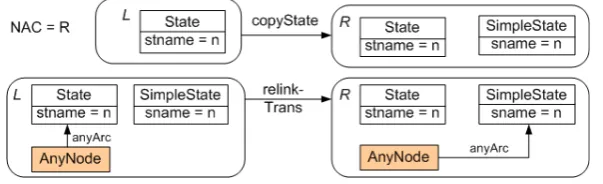
Figure 8shows refactoring rules for renamingStatenodes intoSimpleStatenodes which may be applied after the refactoring inSubsection 2.2.
Figure 8: Refactoring Rules forState2SimpleState
First, rulecopyStatecreates newSimpleStatenodes while the attribute value ofstnameis copied tosname. This rule is applied only once for eachState with NAC=R. Secondly, rule relinkTrans removes any incoming arc from State and links it to the previously inserted SimpleStatenode. AnyNode should be treated as superclass of all nodes of the extended SC2PN type graph (i.e. replaced withTrans, Initial, NormalandRefState).
Figure 9shows two of the refactored model transformation rules after applying theState2SimpleState refactoring to the model transformation rules resulting of themarkStaterefactoring.
Finally, all isolatedStatenodes should be removed by restriction to the adapted type graph. We first show that we have Q– (P, P∗)– compatibility (i.e. independence and termination compatibility) as defined inDefinition 2:
• Independence compatibility: Given terminalp∗1wrt.Qandq∈QwithG01⇐q=G1
p∗
=⇒G2,
we must show that we have parallel independence. Forq=copyState, we have the sit-uation that there cannot be a graphGwhereq and any refactored model transformation rule p∗i (see e.g.Figure 9) are both applicable: On the one hand, anyp∗i is applicable only when a Stateand the corresponding SimpleStatewith the same value for their name at-tributes exist in the graph. On the other hand, the NAC ofcopyStateforbids its application in this case.
Forq=relink, we have parallel independence for all rulep∗i, as no rule deletes elements that are needed by the other rule. We do not have to consider NACs here.
• Termination compatibility: Given terminalGwrt.PandG=Q⇒! G∗, then theState2SimpleState refactoring rules have been applied to all state nodes occuring in a rule inP, and to all state nodes inG. So there is no match from a rulep∗∈P∗ toG∗where the NAC of p∗ would not prevent its application, and hence,G∗is terminal wrt.P∗.
We now can show the required properties for applyingTheorem 1:
1. We already know that the original model transformation SC2PN is terminating [EEPT06]. The refactoring operation State2SimpleState is terminating because of the NAC of rule copyState, and the arc replacement operation defined by rulerelink, which can be applied exactly once for each existing arc pointing to aStatenode.
2. The refactoring rules in Q are locally confluent since they are parallel independent for non-overlapping matches. For overlapping matches, rulerelinkcan only be applied when rulecopyStatehas been applied before.
3. Qis(P,P∗)-compatible as shown above.
6.2 RefactoringUnifyNames
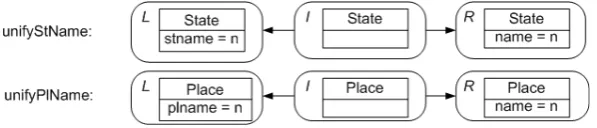
Figure 10 shows refactoring rules for unifying the name attributes (stname and plname) from nodesStateandPlacetoname. The old attribute name is deleted in the left-hand side of the rule while the new name is inserted on the right-hand side.
Figure 11 shows two of the refactored model transformation rules after applying the Unify-Namesrefactoring to the model transformation rules resulting of themarkStaterefactoring.
Figure 11: Refactored Model Transformation Rules ofSC2PN aftermarkStateandUnifyNames
Again, we first show that we haveQ– (P, P∗)– compatibility (i.e. independence and termina-tion compatibility) as defined inDefinition 2:
• Independence compatibility: Given terminalp∗1wrt.Qandq∈QwithG01⇐q=G1 p
∗
=⇒G2,
we must show that we have parallel independence. For q=unifySName, we have the situation that there cannot be a graphGwhereqand any refactored model transformation rule p∗i (see e.g. Figure 11) are both applicable: On the one hand, any p∗i is applicable only to aStatewith an attributenameassigned tonand without an attributestname. On the other hand, ruleuni f ySName is applicable only to a Statewith an attribute stname assigned to n. Analogously, q= unifySName is parallel independent of all refactored model transformation rulep∗i.
Forq=relink, we have parallel independence for all rulep∗i, as no rule deletes elements that are needed by the other rule. We do not have to consider NACs here.
• Termination compatibility: Given terminalGwrt. PandG=Q⇒! G∗, then theunifySName refactoring rules have been applied to all state and place nodes occuring in a rule inP, and to all state and place nodes inG. So there is no match from a rulep∗∈P∗toG∗where the NAC ofp∗would not prevent its application, and hence,G∗is terminal wrt.P∗.
We now can show the required properties for applyingTheorem 1:
1. We already know that the original model transformation SC2PN is terminating [EEPT06]. The refactoring operationUnifyNameis terminating because both rules are applicable as many times as there areStateattributes of typestnameandPlaceattributes of typeplname.
2. The refactoring rules inQare locally confluent since they are parallel independent.
3. Qis(P,P∗)-compatible as shown above.
7
Related Work
Refactoring of information systems is a common technique for software evolution through trans-formation [LKPS06,MT04]. Automated transformation within domain specific languages in-cluding version support has been considered in [Bel07,GSA07].
for analyzing refactoring dependencies [MTR07] and to assure behavior preservation in model refactoring using transformations with borrowed contexts [RLK+08]. Moreover suitable verifi-cation techniques are available, e.g. architectural refactoring by rule extraction [BHE08].
From a technical point of view, in this paper we apply model refactoring rules Q deleting (on edges) to non-deleting transformation rules P, which is in some sense dual to the S2A -construction of animation rulesPAfrom simulation rulesPSin [EE08], where non-deleting rules
Qare applied to deleting rulesPS. Both kinds of rule transformations are based on the
construc-tion in [PP96] but have been extended by NACs and by the possibility to transform generated or deleted rule objects, as well.
Within the Eclipse Modeling Framework [EMF08] model refactoring has already been imple-mented using graph transformation concepts [BEK+06]. While software refactoring is a com-mon technique, a general theory for refactoring of model transformations has still been missing.
8
Conclusion
In this paper, we consider a graph-transformation-based evolution of model transformations which adapts model transformation rules to refactored models. In the main result, we show that under suitable assumptions, the evolution leads to an adapted model transformation which is compatible with refactoring of the source and target models. In a small case study, we apply our techniques to refactor a model transformation from statecharts to Petri nets.
As future research, we intend to consider refactoring operations at type graph level based on our approach on transformations of type graphs with inheritance [EEH09]. Moreover, up to now, we have studied model transformations resulting in an integrated model which contains both source and target language elements. A restriction to the target model presently means that we get the same target model as before refactoring the source model and the model transformation rules. Additionally, we plan to handle target language refactorings analogously to refactorings of the source language.
Bibliography
[AGG09] AGG. 2009.http://tfs.cs.tu-berlin.de/agg.
[BBG05] S. Beydeda, M. Book, V. Gruhn (eds.). Model-Driven Software Development. Springer-Verlag, Heidelberg, 2005.
[BEK+06] E. Biermann, K. Ehrig, C. K¨ohler, G. Kuhns, G. Taentzer, E. Weiss. Graphical Def-inition of In-Place Transformations in the Eclipse Modeling Framework. In Nier-strasz et al. (eds.),Proc. 9th International Conference on Model Driven Engineering Languages and Systems (MoDELS’06). lncs 4199, pp. 425–439. springer, 2006.
http://tfs.cs.tu-berlin.de/publikationen/Papers06/BEK+06a.pdf
System Reports, Technical Reports, University of Jyvskyl, Finland, 2007.
http://www.dsmforum.org/events/DSM07/papers/bell.pdf
[BHE08] D. Bisztray, R. Heckel, H. Ehrig. Verification of Architectural Refactorings by Rule Extraction. In Fiadeiro and Inverardi (eds.),Proc. Fundamental Approaches to Soft-ware Engineering (FASE’08). LNCS 4961, pp. 347–361. Springer Verlag, 2008.
doi:10.1007/978-3-540-78743-3
http://www.springerlink.com/content/gk5m632668x42295/
[BSF02] M. Boger, T. Sturm, P. Fragemann. Refactoring Browser for UML. InProc. 3rd Intl Conf. on eXtreme Programming and Flexible Processes in Software Engineering, Alghero, Sardinia. Pp. 77–81. 2002.
[EE05] H. Ehrig, K. Ehrig. Overview of Formal Concepts for Model Transformations based on Typed Attributed Graph Transformation. In Proc. International Workshop on Graph and Model Transformation (GraMoT’05). ENTCS 152. Elsevier Science, Tallinn, Estonia, September 2005.
http://tfs.cs.tu-berlin.de/publikationen/Papers05/EE05.pdf
[EE08] H. Ehrig, C. Ermel. Semantical Correctness and Completeness of Model Transfor-mations using Graph and Rule Transformation. InProc. International Conference on Graph Transformation (ICGT’08). LNCS 5214, pp. 194–210. Springer Verlag, Heidelberg, 2008.
http://tfs.cs.tu-berlin.de/publikationen/Papers08/EE08a.pdf
[EEH09] H. Ehrig, C. Ermel, F. Hermann. Transformation of Type Graphs with Inheritance for Ensuring Security in E-Government Networks. In Wirsing and Chechik (eds.), Proc. International Conference on Fundamental Aspects of Software Engineering (FASE’09). LNCS. Springer Verlag, Heidelberg, 2009. To appear.
http://tfs.cs.tu-berlin.de/publikationen/Papers08/EEH09.pdf
[EEPT06] H. Ehrig, K. Ehrig, U. Prange, G. Taentzer. Fundamentals of Algebraic Graph Transformation. EATCS Monographs in Theoretical Computer Science. Springer Verlag, 2006.
http://www.springer.com/3-540-31187-4
[EMF08] Eclipse Consortium. Eclipse Modeling Framework (EMF) – Version 2.4. 2008.http: //www.eclipse.org/emf.
[Fow99] M. Fowler. Refactoring: Improving the Design of Existing Code. Addison-Wesley, 1999.
[GSA07] G. de Geest, A. Savelkoul, A. Alikoski. Building a framework to support Do-main Specific Language evolution using Microsoft DSL Tools. In Sprinkle et al. (eds.), Proceedings of the 7th OOPSLA Workshop on Domain-Specific Modeling. Volume TR-38. Computer Science and Information System Reports, Technical Re-ports, University of Jyvskyl, Finland, 2007.
http://www.dsmforum.org/events/DSM07/papers/geest.pdf
[K¨on05] A. K¨onigs. Model Transformation with Triple Graph Grammars. In Model Transformations in Practice Satellite Workshop of MODELS 2005, Montego Bay, Jamaica. 2005.
http://sosym.dcs.kcl.ac.uk/events/mtip05/submissions/konigs model transformation with triple graph grammars.pdf
[LEPO08] L. Lambers, H. Ehrig, U. Prange, F. Orejas. Embedding and Confluence of Graph Transformations with Negative Application Conditions. In Ehrig et al. (eds.), Proc. International Conference on Graph Transformation (ICGT’08). LNCS 5214, pp. 162–177. Springer Verlag, Heidelberg, 2008.
http://tfs.cs.tu-berlin.de/publikationen/Papers08/LEPO08.pdf
[LKPS06] M. L¨owe, H. K¨onig, M. Peters, C. Schulz. Refactoring Information Systems. In Favre et al. (eds.), Proceedings of the Third Workshop on Software Evolution through Transformations: Embracing the Chance (SeTra 2006). Volume 3. Elec-tronic Communications of the EASST, Natal, Brazil, September 2006.
[MT04] T. Mens, T. Tourw´e. A Survey of Software Refactoring.Transactions on Software Engineering30(2):126–139, February 2004.
[MTM05] T. Mens, G. Taentzer, D. M¨uller. Model-Driven Software Refactoring. In Rech and Bunse (eds.),Model-Driven Software Development: Integrating Quality Assurance. Pp. 170–203. Idea Group Inc., 2005.
[MTR07] T. Mens, G. Taentzer, O. Runge. Analysing Refactoring Dependencies Using Graph Transformation.Software and System Modeling6(3):269–285, September 2007.
http://tfs.cs.tu-berlin.de/publikationen/Papers07/MTR07.pdf
[MVVK05] T. Mens, P. Van Gorp, D. Varr`o, G. Karsai. Applying a Model Transformation Taxonomy to Graph Transformation Technology . InProc. International Workshop on Graph and Model Transformation (GraMoT’05). ENTCS 152, pp. 143–159. Elsevier Science, 2005.
[PP96] F. Parisi-Presicce. Transformation of Graph Grammars. In 5th Int. Workshop on Graph Grammars and their Application to Computer Science. LNCS 1073. Springer, 1996.
[RLK+08] G. Rangel, L. Lambers, B. K¨onig, H. Ehrig, P. Baldan. Behavior Preservation in Model Refactoring using DPO Transformations with Borrowed Contexts. In Proc. International Conference on Graph Transformation (ICGT’08). LNCS 5214. Springer Verlag, Heidelberg, 2008.
http://tfs.cs.tu-berlin.de/publikationen/Papers08/RLK+08.pdf