ARTIGO ORIGINAL
ABSTRACT
Introduction: The urinary tract infections, after respiratory infections, are the most common in the community. The knowledge about the prevalence of microbial strains and their antibiotic susceptibility is crucial to establish an effective empirical therapy. The aim of this study was to determine the antibiotic susceptibility patterns of bacterial strains isolated from positive urine cultures performed in patients from the central region of Portugal.
Material and Methods: We carried out a documental analysis of 6008 urine bacteriological exams, to be made available to physicians, most of which run through the automated system VITEK 2, bioMérieux. The majority (80%) of the urine bacteriological exams were from female. Escherichia coli was the most prevalent bacterial pathogen (65.9%), followed by Klebsiella spp (12%).
Results: Nitrofurantoin showed high levels of activity (96%) for Escherichia coli, as well as Fosfomycin (96.6%). Amoxicillin-clavulanic acid presents an activity level of only 81.1% for the same germ. Quinolones exhibit efficacy to only 78% of the strains of Escherichia coli, below the Fosfomycin and Nitrofurantoin. Nitrofurantoin showed high levels of activity (96%) for E. coli as well as Fosfomycin (96.6%). Amoxicillin-Clavulanic Acid presents a level of activity of only 81.1% for the same germ. The quinolones have a efficacy for only 78% of strains of E. coli, lower than Fosfomycin.
Discussion: Escherichia Coli was the most prevalent uropathogen (65.9%). High efficacy against this pathogenic agent was found for Fosfomycin (96.6%) and Nitrofurantoin (96%).
Conclusion: Further antimicrobial surveillance studies should be developed, in order to formulate local empirical therapy recommendations for optimized therapeutical choices.
Keywords: Urinary Tract Infections; Drug Resistance, Bacterial; Anti-Bacterial Agents; Community-Acquired Infections.
Evaluation of the Antimicrobial Susceptibility of
Community-Acquired Urinary Tract Infection
Avaliação do Perfil de Sensibilidade aos Antibióticos na Infeção Urinária da
Comunidade
1. Unidade de Saúde Pública. Agrupamento de Centros de Saúde do Pinhal Litoral. Leiria. Portugal.
2. Departamento de Neurociências Clínicas e Saúde Mental. Faculdade de Medicina. Universidade do Porto. Porto. Portugal. 3. Faculdade de Psicologia e Ciências da Educação. Universidade de Coimbra. Coimbra. Portugal.
4. Núcleo de Planeamento. Agrupamento de Centros de Saúde do Pinhal Litoral. Leiria. Portugal. 5. Comissão de Controlo de Infeção. Agrupamento de Centros de Saúde do Pinhal Litoral. Leiria. Portugal. Recebido: 18 de Março de 2014 - Aceite: 29 de Julho de 2014 | Copyright © Ordem dos Médicos 2014
Rui PASSADOURO1, Raquel FONSECA2, Felícia FIGUEIREDO3, Andreia LOPES4, Cristina FERNANDES5 Acta Med Port 2014 Nov-Dec;27(6):737-742
RESUMO
Introdução: As infeções do trato urinário, depois das infeções respiratórias, são as mais comuns na comunidade. O conhecimento sobre a prevalência das estirpes microbianas e a sua suscetibilidade aos antibióticos é fundamental para instituir uma terapêutica empírica eficaz. O objetivo deste estudo foi determinar os padrões de suscetibilidade aos antibióticos das estirpes bacterianas isoladas em uroculturas positivas efetuadas em doentes da região centro de Portugal.
Material e Métodos: Procedemos a uma análise documental dos 6008 resultados de uroculturas, a disponibilizar aos médicos no ano de 2013, a maioria das quais executadas através do sistema automatizado VITEK 2 da bioMérieux. A análise dos dados foi efetuada através do SPSS versão 21.
Resultados: A maioria (80%) das 6008 uroculturas positivas foi efetuada no sexo feminino. A Escherichia coli foi a bactéria mais preva-lente na amostra (65,9%), seguida pela Klebsiella spp (12%). A Nitrofurantoína apresentou elevada eficácia (96%) para as estirpes de
E. coli, bem como a Fosfomicina (96,6%). A Amoxicilina-Ácido Clavulânico apresentou um nível de eficácia de apenas 81,1%, para o mesmo gérmen. As quinolonas apresentaram eficácia para 78% das estirpes de E. coli, sendo inferior à registada para a Fosfomicina e para a Nitrofurantoína.
Discussão: O presente estudo revelou que a E. coli foi o agente patogénico predominante nas infeções do trato urinário da comuni-dade (65,9%) apresentando percentagens de sensibilicomuni-dade elevadas à Fosfomicina (96,6%) e à Nitrofurantoína (96%).
Conclusão: Recomenda-se a monitorização do perfil sensibilidade dos microrganismos aos antibióticos, de modo a otimizar a terapêutica empírica das ITU.
Palavra-chave: Infeções Urinárias; Resistência aos Antibióticos; Agentes Bacterianos; Infeções Comunitárias Adquiridas.
INTRODUCTION
Antimicrobial resistance (AR) is a natural phenomenon that represents a major threat to Public Health, leading to an increase in healthcare costs, to therapeutic failure and sometimes to death.1 Its increasing frequency is associated
to multiple factors, among which is the indiscriminate use of antibiotics. It is a serious worldwide problem affecting both developed and developing countries.2
AR progression promotes multi-drug resistant infections,
with a difficult and costly treatment, particularly worrying due to their irreversibility or very low reversibility.
AR was considered by the World Health Organization (WHO) as a priority and therefore, since 2001, global measures have been taken regarding its control, mainly through resistance monitoring, prescriber, health professional and wider public education as well as regulation on antibiotic promotion by the drug industry.2
35
35 ano
s a p
rom ov
er
as
ciê
CA
P
ORT
UGUE
SA
ARTIGO ORIGINAL In Europe, antimicrobial consumption in community patients shows large variations between different countries,
with a lower consumption in the North, moderate in the East and high in the South.3 Consumption is assessed by the
defined daily doses (DDD) per 1,000 inhabitants per day (DID).4 In 2002, France had the highest consumption (32.2
DID) while The Netherlands had the lowest (10.0 DID). Portugal was in third place, with approximately 27 DID.3
Between 2000 and 2009, the antibiotic consumption in Continental Portugal declined from 24.12 to 22.03 DID.5
Quinolone consumption in community patients varied, in 2002, between 3.76 DID in Italy, 3.6 in Portugal and 0.17 in Denmark.3 However, tetracycline, cephalosporin,
sulphonamide and quinolone consumption decreased between 2000 and 2009, with an increase on the use of penicillin associated to beta-lactamase inhibitor.5
According to the same study, in 2009, a 22.56 DID antibiotic consumption was found in the central region of Portugal. Urinary tract infections (UTI), following respiratory infections, are the most frequent in community setting, with a higher female incidence.6
Bacteria are the major microbial agents responsible for UTI. Aerobic Gram-negative bacteria are most prevalent and
Escherichia coli (E. coli) are responsible for approximately 75 to 90% of acute urinary tract infections, followed by Staphylococcus, Proteus, Klebsiella pneumoniae
and Pseudomonas. E. coli is also the major infectious agent responsible for complicated and uncomplicated pyelonephritis.7
A 1997 study involving urine culture data6 found that
E. coli was involved in 76.6% of UTI, Proteus mirabilis (P. mirabilis) in 15.6% and Klebsiella pneumoniae in 3.7%. In 2006, the same author found E. coli (64.0%) to be the most frequent, followed by P. mirabilis (9.3%) and Enterococcus
(7.4%). Another study by Martins8 found E. coli in 73.3%
of UTI, P. mirabilis in 7.6%, Klebsiella pneumoniae in
10%, Enterococcus faecalis in 3.5% and Pseudomonas aeruginosa in 3.1%. Another hospital-based study9
involving 572 samples (144 from in-patients and 428 from out-patients) reported a 68.8% Escherichia coli prevalence,
7.9% for Klebsiella pneumoniae, 6.1% for Pseudomonas aeruginosa and 5.2% for Proteus mirabilis. In a study by Linhares et al.10 involving 18,797 positive urine cultures, E.
Coli was found in 64.5% of the samples, Staphylococcus aureus in 6.0%, P. mirabilis in 4.7%, Klebsiella spp in 4.3%,
Enterococcus faecalis in 3.6%, Proteus vulgaris in 2.7% and Pseudomonas aeruginosa in 2.4%.
In a 2009 study6 involving 2,676 urine cultures, 37.2%
of E. coli strains were found to be resistant to Tobramycin, 24.7% to Norfloxacin, 20.7% to Ciprofloxacin and 12.7% to Amoxicillin-Clavulanic Acid. P. mirabilis showed 21.9% of Ampicillin-resistant strains, 15.6% to Trimethoprim-Sulfamethoxazole, 6.1% to Amoxicillin-Clavulanic Acid and 3% to Nitrofurantoin. Klebsiella showed a 12.5% resistance to Cephalexin, 0% to Cefuroxime, 38.5% to Nitrofurantoin and 15.6% to Trimetoprim-Sulfamethoxazole. Linhares et al.10 found a 3.0 % E. coli strains resistant to Tobramycin,
14.2% to Norfloxacin, 13.9% to Ciprofloxacin, 7.5% to Amoxicillin-Clavulanic Acid and 6% to Nitrofurantoin. Antimicrobial resistance increases with consumption. Not unexpectedly, a lower resistance rate is found in the Northern European countries, where consumption is lower.3
It is estimated that between 50 to 70% of women present with at least one UTI episode during lifetime and 20 to 30% present recurrent episodes with an indication for empirical antimicrobial therapy11 UTI therapy is associated
to microbiological eradication rates of 90% or above12
when the decision to prescribe an antibiotic is based in the knowledge of which microbial agents are involved and known sensitivity profile.
Therefore, monitoring of antibiotic sensitivity profile is crucial in order to define empirical antimicrobial therapy.13
The scarcity of studies gives support to epidemiological research on antimicrobial resistance of most frequent infectious agents to be carried out in community-acquired UTI.
Our study aimed to determine antimicrobial sensitivity profile of major bacteria involved in community-acquired UTI within the geographical community of the ACES Pinhal Litoral.
MATERIAL AND METHODS
This is a retrospective, descriptive study based on the results of urine cultures carried out during the year 2013 by the main laboratories in the geographical area of Pinhal Litoral. Our sample included 6,008 positive urine cultures (> 100,000 colony forming units - CFU). Strain identification and antibiogram was carried out using a bioMérieux VITEK 2 compact system, with different adequate cards. The bioMérieux mini-API system and the Kirby & Bauer disk diffusion method were used in 10% of the samples.
According to Clinical and Laboratory Standards Institute guidelines,14 the results were ranked as sensitive (S),
intermediate (I) and resistant (R). ‘Intermediate’ samples were subsequently reclassified as resistant. Patient’s gender and age data for each urine culture were also collected.
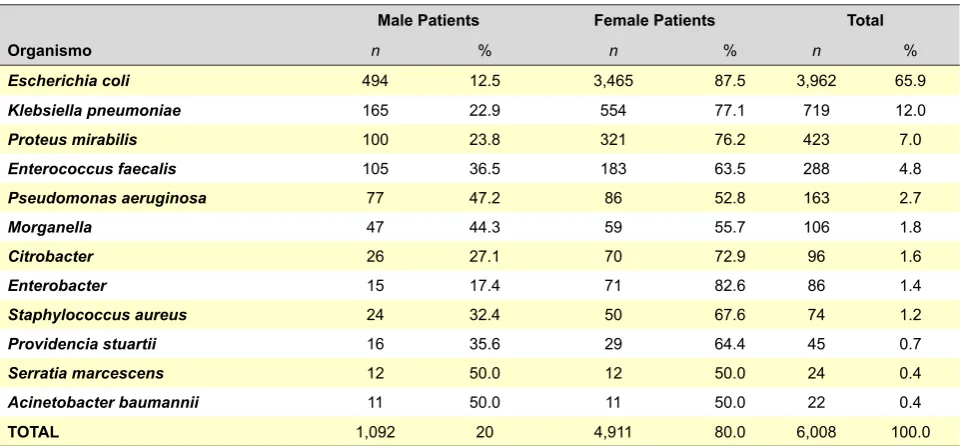
Antimicrobial sensitivity was evaluated for samples with an overall isolated number of germs above 150. Five microorganisms met this criterion (Table 1).
Statistical analysis used the Statistical Package for the Social Sciences (SPSS) software, version 21 for Windows.
RESULTS
Our sample involved 6,008 positive urine cultures (80% from female patients, 4,911 positive urine cultures). Average age of patients was 62.8, (± 20.7; 6 months-107 years of age).
UTI distribution by age group shows a higher prevalence above 75 years of age (34.9%), followed by 56 to 75 (30%) and the group above 55 years of age corresponded to 65% of our sample, while the group below 16 corresponded to 1.6% (Fig. 1).
ARTIGO ORIGINAL
Klebsiella pneumoniae (12%), P. mirabilis (7%), E. faecalis
(4.8%), Pseudomonas aeruginosa (2.7%), Morganella
(1.8%) and others (5.7%). Acinetobacter baumannii was isolated in 11 samples (0.4%) (Table 1).
Considering the distribution of the three most prevalent strains (E. coli, Klebsiella pneumoniae and Proteus mirabilis) corresponding to 84.9% of our sample, we found that their prevalence is variable according to the patient’s age group.
E. coli remains the most prevalent, with 72.4% and 74.6% of strains in the 16-35 and 36-55 age groups, respectively. In the age group above 75, it was present in 55.4% of the samples. Klebsiella pneumoniae had 16.3% prevalence in the same age group.
Proteus mirabilis, with overall 7% prevalence, showed 21.6% prevalence in the age group below 16 years of age (Table 2).
Antimicrobial sensitivity was evaluated for the five most prevalent microorganisms, according to the established
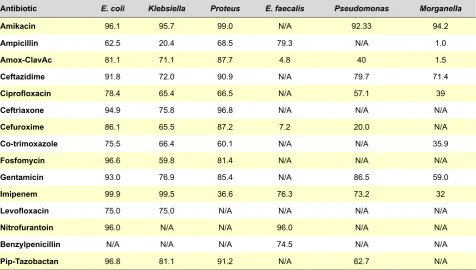
criteria. The E. coli strains were sensitive to Fosfomycin in 96.6% of the samples, 96.0% to Nitrofurantoin, 93.0% to Gentamicin, 99.0% to Imipenem, 96.1% to Amikacin, 94.9% to Ceftriaxone and 91.8% to Ceftazidime. As regards the Amoxicillin-Clavulanic Acid and Ciprofloxacin, 81.1% and 78.4% sensitivity was found, respectively (Table 3).
Klebsiella pneumoniae shows a high percentage of sensitivity to Amikacin (95.7%) and Imipenem (99.5%), with 76.9% sensitivity to Gentamicin and 75.8% to Ceftriaxone.
Proteus shows a high percentage of sensitivity to Ceftriaxone (96.8%), to Amoxicillin-Clavulanic Acid (87.7%) and to Cefuroxime (87.2%). Enterococcus faecalis showed 96% sensitivity to Nitrofurantoin, 79.3% to Ampicillin and 74.5% to Benzilpenicillin. Pseudomonas showed 92.3% sensitivity to Amikacin, 86.5% to Gentamicin and 57.1% to Ciprofloxacin. As regards Morganella, it showed 94.2% sensitivity to Amikacin and 71.5% to Ceftazidime (Table 3).
The E. coli strains showed a high percentage of sensitivity
to Fosfomycin in all age groups, lowest in the group above
Figure 1 – UTI frequency per age group
Table 1 - Prevalence of bacterial strains
Male Patients Female Patients Total
Organismo n % n % n %
Escherichia coli 494 12.5 3,465 87.5 3,962 65.9
Klebsiella pneumoniae 165 22.9 554 77.1 719 12.0
Proteus mirabilis 100 23.8 321 76.2 423 7.0
Enterococcus faecalis 105 36.5 183 63.5 288 4.8
Pseudomonas aeruginosa 77 47.2 86 52.8 163 2.7
Morganella 47 44.3 59 55.7 106 1.8
Citrobacter 26 27.1 70 72.9 96 1.6
Enterobacter 15 17.4 71 82.6 86 1.4
Staphylococcus aureus 24 32.4 50 67.6 74 1.2
Providencia stuartii 16 35.6 29 64.4 45 0.7
Serratia marcescens 12 50.0 12 50.0 24 0.4
Acinetobacter baumannii 11 50.0 11 50.0 22 0.4
TOTAL 1,092 20 4,911 80.0 6,008 100.0
< 16
16 81 38
632
146
384 504
1,141
1,462 1,593
16 - 35 36 - 55 56 - 75 > 75
M
F
ARTIGO ORIGINAL 75 years of age (93%) (Table 4). The sensitivity test was not performed for this drug during the first trimester of 2013.
Cefuroxime showed a 92.9% efficacy against E. coli in
patients aged below 55, decreasing to 88% and 79.4% in the 56-75 and > 75 age groups, respectively.
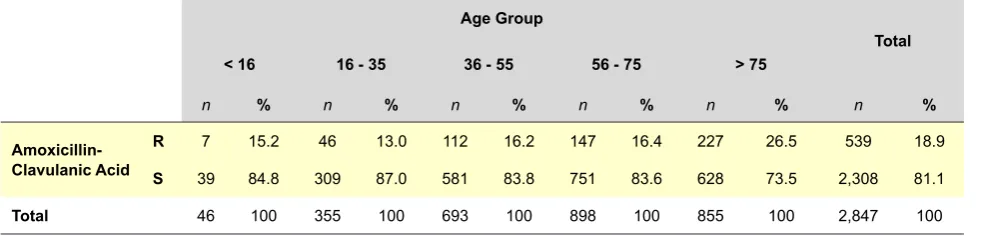
Amoxicillin-Clavulanic Acid showed a 84.8% efficacy against E. coli in patients aged below 16 and 87% in patients 16-35, while a 73.5% efficacy was found in patients above 75 years of age (Table 5).
Nitrofurantoin showed high levels of activity against E. coli, with approximately 97% sensitivity in patients aged above 75, while above this age it maintained a 92.4% efficacy.
DISCUSSION
Positive cultures were mostly from female patients (80%), in line with other studies.7-9E. coli, Klebsiella pneumoniae
and Proteus were the three most common strains found in our study, also in line with other findings.6,8-10 However, the
E. coli prevalence (65.9%) was below what was estimated
in the described studies, between 75 and 90%.7 Patients
aged above 75, corresponding to 34.5% of our sample, showed a decrease in the prevalence of this strain (55.4%). In-hospital patients had a lower E. coli prevalence (61.8%) than Out-patients (70.6%),9 emphasizing the effect of
institutionalisation on isolate prevalence.
Klebsiella pneumoniae was found in 12% of all urine cultures, corresponding to a higher prevalence than in the abovementioned studies, where it varied between 3.7%6
and 10%.8 We found a 16.3% prevalence in the age group
above 75, again higher than what was described in other studies.
UTI empirical therapy should be based on the knowledge of major involved microbial agents and on their antimicrobial sensitivity profile.11E. coli showed high sensitivity percentage
to Fosfomycin (96.6%) which, according to the Portuguese Health Directorate General,12 allows for an efficient empirical
use of this antibiotic. Sensitivity to quinolone, represented by Ciprofloxacin (78.4%) and Levofloxacin (75%), is in line with what was found in other studies,6 being considered
Table 2 - Prevalence of bacterial strains per age group
Age Group
Total
< 16 16 - 35 36 - 55 56 - 75 > 75
n % n % n % n % n % n %
E. coli 65 67.0 485 72.4 961 74.6 1,282 69.4 1,163 55.4 3,956 65.9
Klebsiella P. 7 7.2 63 9.4 110 8.5 197 10.7 342 16.3 719 12.0
P. mirabilis 21 21.6 43 6.4 62 4.8 123 6.7 172 8.2 421 7.0
Total 93 95.9 513 88.2 1,133 88.0 1,454 86.8 1,677 79.9 4,470 84.9
n = absolute frequency; % = relative frequency; Klebsiella P. = Klebsiella pneumoniae; P. mirabilis = Proteus mirabilis.
Table 3 - Antimicrobial sensitivity profile (%)
Antibiotic E. coli Klebsiella Proteus E. faecalis Pseudomonas Morganella
Amikacin 96.1 95.7 99.0 N/A 92.33 94.2
Ampicillin 62.5 20.4 68.5 79.3 N/A 1.0
Amox-ClavAc 81.1 71.1 87.7 4.8 40 1.5
Ceftazidime 91.8 72.0 90.9 N/A 79.7 71.4
Ciprofloxacin 78.4 65.4 66.5 N/A 57.1 39
Ceftriaxone 94.9 75.8 96.8 N/A N/A N/A
Cefuroxime 86.1 65.5 87.2 7.2 20.0 N/A
Co-trimoxazole 75.5 66.4 60.1 N/A N/A 35.9
Fosfomycin 96.6 59.8 81.4 N/A N/A N/A
Gentamicin 93.0 76.9 85.4 N/A 86.5 59.0
Imipenem 99.9 99.5 36.6 76.3 73.2 32
Levofloxacin 75.0 75.0 N/A N/A N/A N/A
Nitrofurantoin 96.0 N/A N/A 96.0 N/A N/A
Benzylpenicillin N/A N/A N/A 74.5 N/A N/A
Pip-Tazobactan 96.8 81.1 91.2 N/A 62.7 N/A
ARTIGO ORIGINAL
as low, which may be explained by its excessive use and Portugal is among the countries with higher consumption of this medication.3,15
Klebsiella pneumoniae, which represented 12% of the isolated bacteria, shows a low percentage of sensitivity to the Amoxicillin-Clavulanic Acid (71.1%), Cefuroxime (65.5%) and Cotrimoxazole (66.6%), in line with a previous Portuguese study carried out in 2007.9 This fact prevents
empirical Out-patient therapy for infections related to this strain.
Proteus mirabilis only represented 7% of all the isolates although, from these, 21.6% were a cause for UTI in the age group below 16 years of age. It showed a low percentage of sensitivity to quinolone (Ciprofloxacin 65.4% and Levofloxacin 75%) and therefore these should not be a first-line therapeutic option. It only showed a high sensitivity to Imipenem (99.5%) and Amikacin (95.7%), two drugs not being available in an Out-patient setting. Proteus mirabilis is
sensitive to Ceftriaxone in 96.8% of the samples.
Nitrofurantoin shows a high efficacy against E. coli
(96%) and E. faecalis (96%), which may be related to having been disused over the last few years. The need for a long-term regimen (at least seven days), four times per day, associated to its toxicity, determines that it should be used carefully in an outpatient regimen.7
Amikacin showed a high sensitivity against the five major agents (E. coli, Klebsiella, Proteus, Pseudomonas
and Morganella), corresponding to 90% of all the samples in our study.
Second-generation cephalosporin, represented by Cefuroxime, showed a lower efficacy against E. coli (86.1%) and Proteus mirabilis (87.2%), when compared to
third-generation’s (Ceftazidime and Ceftriaxone), which is above 90%.
The 15/2011 Portuguese guideline12 recommends
Nitrofurantoin, Fosfomycin or Amoxicillin-Clavulanic Acid in treatment of uncomplicated acute cystitis. The results of our study give support to these guidelines regarding Nitrofurantoin or Fosfomycin, both with efficacy against
E. coli, the most prevalent bacteria found (66% of the samples). The same does not apply to the Amoxicillin-Clavulanic Acid, which shows a 84.8% and 87% sensitivity in patients aged below 16 and 16-35, respectively, dropping to 73.5% in patients aged above 75. Our study does not allow for definitive conclusions because it was based on the analysis of urine culture results alone and did not take into consideration the patient’s clinical situation, the main limitation of our study. .
CONCLUSION
UTI empirical therapy should be based on consensual recommendations;7-12 however, a knowledge of strain
prevalence and antimicrobial sensitivity is required.. Most frequent bacterial strains involved in community-acquired UTI are Escherichia coli (65.9%), followed by
Klebsiella pneumoniae (12%) and Proteus mirabilis (7%). In all age groups, Escherichia coli strains demonstrate 93% sensitivity to Fosfomycin and 96% to Nitrofurantoin. As such, these therapies are recommended in uncomplicated acute cystitis in the female patients. However, they should be used with special care in patients aged above 75, in whom sensitivity prevalence is just 55.4%.
Amoxicillin-Clavulanic Acid, with lower efficacy against
E. coli (81.1%), does not show any advantage when
Table 4 -E. coli sensitivity profile to Fosfomycin per age group
Age Group
Total
< 16 16 - 35 36 - 55 56 - 75 > 75
n % n % n % n % n % n %
Fosfomycin R 0 0.0 5 1.5 11 1.6 23 2.6 55 6.6 94 3.4
S 44 100.0 334 98.5 668 98.4 859 97.4 784 93.4 2,689 96.6
Total 44 100.0 339 100.0 679 100.0 882 100.0 839 100.0 2,783 100.0
R = Resistant; S = Sensitive; n = absolute frequency; % = relative frequency.
Table 5 - E. coli sensitivity profile to Amoxicillin-Clavulanic Acid per age group
Age Group
Total
< 16 16 - 35 36 - 55 56 - 75 > 75
n % n % n % n % n % n %
Amoxicillin-Clavulanic Acid
R 7 15.2 46 13.0 112 16.2 147 16.4 227 26.5 539 18.9
S 39 84.8 309 87.0 581 83.8 751 83.6 628 73.5 2,308 81.1
Total 46 100 355 100 693 100 898 100 855 100 2,847 100
ARTIGO ORIGINAL compared to Fosfomycin.E. coli strains show 78% sensitivity to quinolone, below
Fosfomycin and Nitrofurantoin. We should also mention that both have no parenchymal penetration and therefore are not appropriated for upper urinary tract infections (pyelonephritis) or prostate infections.
Further similar studies are recommended in order to follow the evolution of microbial sensitivity profile and to optimize UTI empirical therapy.
ACKNOWLEDGMENTS
We wish to acknowledge Maria Beatriz Santos and Beatriz Godinho Laboratory, Cristina Cruz and Susan Rosas Laboratory and Marisa Lázaro and Torres Laboratory for providing the results on urine cultures.
We also wish to acknowledge Gina Marrão for her technical support.
CONFLICTS OF INTEREST
The authors declare that there was no conflict of interests in writing this manuscript.
FINANCIAL SOURCES
The authors declare that there were no financial sources for writing this manuscript.
REFERENCES
1. ECDC. Antimicrobial resistance surveillance in Europe. Sweden; 2012. [consultado 2014 Mar 02]. Disponível em: http://ecdc.europa.eu/en/ publications/Publications/antimicrobial-resistance-surveillance-euro-pe-2012.pdf.
2. World Health Organization. Global strategy for containment of antimicro-bial resistance. Geneve: WHO; 2001.
3. Goossens H, Ferech M, Vander Stichele R, Elseviers M. Outpatient an-tibiotic use in Europe and association with resistance: a cross-national database study. Lancet. 2005;365:579-87.
4. World Health Organization. Collaborating Centre for Drug Statistics Methodology. Guidelines for ATC classification and DDD assignment 2014. Oslo; 2013. [consultado 2014 Mar 05]. Disponível em: http://www. whocc.no/atc_ddd_publications/guidelines/.
5. Ramalhinho I, Ribeirinho M, Vieira I, Cabrita J. A evolução do consumo de antibióticos em ambulatório em Portugal continental 2000-2009. Acta Med Port. 2012;25:20-8.
6. Costa MC, Pereira PM, Bolotinha C, Ferreira A, Cardoso R, Monteiro C, et al. Frequência e susceptibilidade bacteriana em infecções urinárias: dados de um laboratório de Lisboa. Parte II. Rev Lusófona Ciên Tecnol Saúde. 2009;6:87-103.
7. Longo D, Fauci A, Dennis K, Hauser S, Jameson J, Loscalzo J, editors. Harrison’s principles of internal medicine. 8th ed. London: McGraw-Hill Professional; 2011.
8. Martins F, Vitorino J, Abreu A. Avaliação do perfil de susceptibilidade
aos antimicrobianos de microrganismos isolados em urinas na região do Vale do Sousa e Tâmega. Acta Med Port. 2010;23:641-6.
9. Correia C, Costa E, Peres A, Alves M, Pombo G, Estevinho L. Etiologia das infecções do tracto urinário e sua susceptibilidade aos antimicrobia-nos. Acta Med Port. 2007;20:543-50.
10. Linhares, I, Raposo, T, Rodrigues, A, Almeida, A. Frequency and antimi-crobial resistance patterns of bacteria implicated in community urinary tract infections: a ten-year surveillance study (2000-2009). BMC Infect Dis. 2013;13:1-14.
11. Gupta K, Hooton TM, Roberts PL, Stamm WE. Patient-initiated treat-ment of uncomplicated recurrent urinary tract infections in young wom-en. Ann Intern Med. 2001;135:9-16.
12. Direcção Geral da Saúde. Terapêutica de infeções do aparelho urinário (comunidade). Departamento da Qualidade na Saúde. 2011(Norma 15/2011). Lisboa: DGS; 2011.
13. Baerheim A. Empirical treatment of uncomplicated cystitis. BMJ. 2001;323:1197-8.
14. Clinical and Laboratory Standards Institute. Performance standards for antimicrobial susceptibility testing: Nineteenth Informational Supple-ment M100-S19. Wayne: CLSI; 2009.