Research Article
August
2017
Computer Science and Software Engineering
ISSN: 2277-128X (Volume-7, Issue-8)
Efficient Path Establishment Algorithm in MANETs using
Bio-Inspired Techniques
Navneet Kaur, Amandeep Verma
Punjabi University Regional Centre for IT and Management, Mohali, Punjab, India
DOI: 10.23956/ijarcsse/V7I8/0154
Abstract-The network in which the nodes can enter or leave the network as per their need is known as mobile ad-hoc network. This is a self-configuring type of network and so the routing in this type of network is very difficult. Numerous routing protocols are involved here which are classified on the basis of their properties into reactive, proactive and hybrid protocols. There are several important parameters such as delay, packet loss and throughput. These parameters are utilized for checking the performance of three routing protocols namely AODV, DSR and DSDV within this research. In comparison to the other protocols, the AODV routing protocol provides better results. In order to provide efficient path establishment from source to destination, enhancement has been proposed here within the AODV protocol which includes the utilization of cuckoo search and bee colony named bio-inspired techniques in it. The nodes that are found to be common in the selected paths are chosen to be the best nodes for the path. The NS2 tool is used for performing the simulations. As per the results achieved it can be seen that the AODV protocol provides better results in terms of the above mentioned parameters.
Keywords- MANET, Reactive, Proactive, Hybrid, ADOV, DSDV, DSR
I. INTRODUCTION
The wireless networks are being prominently utilized nowadays within the day-to-day communication systems. Numerous applications within the fields such as industrial field, military areas and applications involving personal usage include the wireless networks within them. These networks are easy to install, are scalable and flexible and thus are growing popularity with time. The self-configuring type of network that has dynamic topology is known as the mobile ad-hoc network [1]. In order to provide the facilities that can handle the radio communication channels, multi-user interference and other effects, the nodes present within MANETs find their own ways. It is not easy to find an efficient routing protocol for MANETs. Due to their independent nature which provides the nodes to enter or leave the network as per their own requirements, these networks are deployed within numerous applications. There is a dynamic change of the topology of network due to the continuous mobility of nodes. There is a specific area which is covered for providing network communication. The scalability of infrastructure-less networks is better as they are decentralized in nature [2]. The performance of the ad hoc networks is better within various emergency applications as they have operations that can be executed faster and also the configuration is less. An optimal path is to be generated which must involve least number of intermediate nodes from source to destination by the chosen protocol. It is also to be ensured that there is very less overhead and limited consumption of bandwidth within the route [3]. This helps in transmitting the message as per the time duration given across the network. The updated state of the topology of network is obtained with the help of these types of protocols. The routing table is generated here which helps in updating the predefined information which can further help in generating a path that can lead from source to destination. The source-initiated on-demand routing protocols which are demand driven are known as the reactive routing protocols. There is no creation or updating of routing tables at several intervals within these types of protocols. Only when there is a need to discover a route, the route discovery process is initiated here. On demand distance vector routing protocol (AODV) is efficient routing protocol that utilizes single source and destination routing is known as the AODV [4]. The route request packets are flood within the network. Further, the nodes that are adjacent to destination which will reply back with the help of route reply packets which will also be sent across the network to the source node. The selection of path as per the requirement from source to destination is done with the utilization of DSR protocol. The route request packets are flood within the network by the source node [5]. The route reply packets are sent back as response by the intermediate nodes that have route to the destination available. DSDV protocol is derived from the classical Bellman-Ford Routing Algorithm along with some changes that help in its advancement. It is also known as a table-driven type of routing protocol in which the routing tables of every node are maintained after certain time duration.
ISSN(E): 2277-128X, ISSN(P): 2277-6451, DOI: 10.23956/ijarcsse/V7I8/0154, pp. 233-238
II. LITERATURE REVIEW
Helge Wiemann et.al [7] presented in this paper the genuine properties and objectives of geo-based routing protocols. The utilization of geographical addresses is to be done within these protocols and the other link-specific addressed such as IP addresses are to be avoided. This helps in providing more scalable results in comparison to the other protocols being applied. The most important thing that is to be mentioned here is that the destination position of the packet which is to be transmitted is to be known before. Further, the various properties and characteristics of protocols are to be studied in the work mentioned in this paper.
Dr. R.K Singh et al. [8] presented in this paper a survey that provides study related to energy efficient routing protocols applied in wireless ad hoc networks. The routing protocols can be classified or categorized on the basis of various analyses being done. On the basis of various parameters, the properties of these protocols are compared with the help of experiments being conducted in NS2. On the basis of these experiments the various results have been shown which provide details of which protocol is suitable for particular application.
Surendran. S, Prakash. S et.al [9] proposed in this paper that the before any node is about to leave the network has to make routing decisions. A survey has been proposed which is related to the fault tolerance of ant colony optimization algorithm being applied to the various routing protocols within the network. The valid route and look-ahead route pairs are to be identified within this paper which can help in providing the QoS constraint of the overall network. As per the various simulations achieved it can be seen that the proposed algorithm provides better results in comparison to the existing approached which include the ACO algorithm.
Amith Khandakaret.al [10] proposed in this paper that the movement of nodes across the network is not restricted. In order to exchange the data within the network, numerous hop paths can be used. In order to deliver the data in appropriate time and in an efficient manner, there is a need to provide routing protocols within the network. The most prominently being utilized protocols which are AODV, DSR and DSDV have been studied in this paper with respect to certain parameters such that their performance can be analyzed.
CH. V. Raghavendran et.al [11] proposed in this paper that in order to provide routing within the network the Swarm intelligence algorithms can also be used. The natural behaviors of various animals such as fish, ants, bees and other insects are studied and on the basis of them the algorithms are generated. These algorithms are known as the bio -inspired algorithms which are to be studied in this paper and the performance metrics are to be analyzed.
Jagdeep Kaur, et.al [12] presented in this paper that the network in which the nodes can join or leave the network in a free manner is known as the mobile ad hoc network. The performance of the network decreases as there is change in topology of network at frequent times. In order to develop efficient routing protocols within these networks, the cuckoo search optimization algorithm is introduced in this paper. In order to identify the best optimal path that involves shortest routing for transmitting the data across the network, the CSO technique is utilized. The implementation of AODV and DYMO routing protocols is to be studied in this paper along with the usage of CSO algorithm.
III. RESEARCH METHODOLOGY
The combinations of ant colony and bee colony optimization algorithms are used within the proposed work. In order to establish a path from source to destination, these algorithms are used with AODV routing protocol. For instance, within the proposed method the AODV protocol is applied to establish a path from source to destination. There are 1,3,5,7 hops present within the established path. Further, the hybrid ant and bee colony optimization algorithms are applied within this process of path established. Here, the path now established in the path including 1,3,8,7 hops within it. The nodes that are common within the paths and have same distance from the source node are chosen by the source node. The hop node is selected on the basis of minimum distance of the node.
Algorithm:
1. Input: Number of Mobile nodes
2. Output: Path establishment from Source to destination 3. AODV Protocol ()
3.1 While (route request packets send in the network) 3.2 Receive route reply from each node
3.3. Check distance () 3.4 If (distance (i) is small)
3.4.1 If (Sequence (i) is high) 3.5 Select best path i
4. Apply Bee Colony ()
4.1. Repeat While distance of each node 4.2 if (Distance (i)> Distance (i+1) 4.3 Select (i+1) node as best node 5. Apply Cuckoo search ()
5.1 Repeat While distance of each node I 5.2 if (distance (i)< distance (i+1)) 5.3 Select node i as best node 5.4 Check common Nodes ()
ISSN(E): 2277-128X, ISSN(P): 2277-6451, DOI: 10.23956/ijarcsse/V7I8/0154, pp. 233-238 5.4.2 If (node(i) exists in the second path )
5.4.3. new Path =node (i)
5.5. Repeat step 5.4 untill path established
Figure 1: Flowchart of Proposed Work
IV. EXPERIMENTAL RESULTS
The proposed work is implemented in NS2 and the results are calculated in terms of delay, packet loss and throughput parameters.
START
Deploy the wireless adhoc networks with the finite number of mobile nodes
The source and destination nodes are define in the network
AODV protocol will be used to
establish path from source to destination
Apply Bee colony algorithm to establish path from source to destination
If nodes are common
Select common nodes and also nodes which have least distance
Establish path using cuckoo search algorithm
Establish path from source to destination based on common nodes and distance
STOP
Yes
ISSN(E): 2277-128X, ISSN(P): 2277-6451, DOI: 10.23956/ijarcsse/V7I8/0154, pp. 233-238
Figure 2: Delay graph
As shown in figure 2, comparisons are made amongst the AODV, DSR, DSDV and hybrid routing protocols. Amongst all these protocols, the hybrid routing protocol has the least delay within the network.
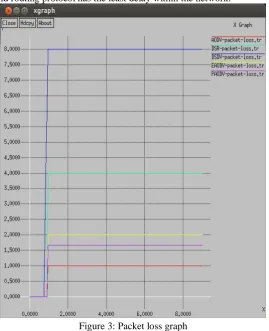
Figure 3: Packet loss graph
ISSN(E): 2277-128X, ISSN(P): 2277-6451, DOI: 10.23956/ijarcsse/V7I8/0154, pp. 233-238
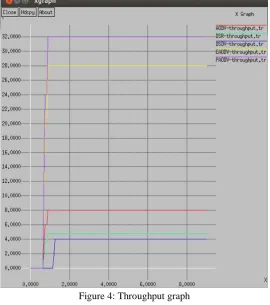
Figure 4: Throughput graph
As shown in figure 4, a comparison is made on the basis of throughput achieved with the application of various routing protocols such as AODV, DSR, DSDV and hybrid routing protocols. As per the results achieved it is seen that there is maximum throughput values achieved with the utilization of hybrid routing protocol in the network.
V. CONCLUSION
In this research, the most important issue identified is the routing within the mobile ad hoc networks. This is mainly due to the self-configuring nature of the nodes within these networks. There are three types of routing protocols namely reactive, proactive and hybrid which are all decentralized in nature. With respect to the parameters such as throughput, delay and packet loss the comparisons are made amongst various protocols. In comparison to all the routing protocols studied within this work, the AODV routing protocol performs better as per the results achieved. In order to establish path from source to destination, enhancement is proposed within the AODV routing protocols in this research work. The enhancements are made with the help of bio-inspired techniques such as cuckoo search and bee colony methods. With the help of NS2 simulation, comparisons are made amongst the various protocols. In terms of various parameters such as throughput, delay and packet loss, the AODV routing protocol performs better in comparison to other routing protocols.
REFERENCES
[1] Charu Sharma and Jaspreet Kaur, “Simulative Analysis of AODV Routing Protocol of MANET Using OPNET
Modeler 14.0”, 2015, International Research Journal of Engineering and Technology (IRJET) eISSN: 2395 -0056 Volume: 02 Issue: 03
[2] Prof. B.N. Jagdale, Prof. Pragati Patil, Prof. P. Lahane , Prof. D. Javale, “Analysis and Comparison of Distance Vector, DSDV and AODV Protocol of MANET”, 2012, International Journal of Distributed and Parallel Systems (IJDPS) Vol.3, No.2, pp- 2949-3853
[3] Gurpinder Singh, Jaswinder Singh, “MANET: Issues and Behavior Analysis of Routing Protocols”, 2012,
International Journal of Advanced Research in Computer Science and Software Engineering, Volume 2, Issue 4, pp- 679-728
[4] Mandeep Kaur Bedi, Sheena Singh, “Comparative study of two natural phenomena based optimization
techniques”, 2013, International Journal of Scientific & Engineering Research, volume 12, Issue 4, pp- 562-591 [5] Sangita Roy and Sheli Sinha, “Cuckoo Search Algorithm using Levy Flight: A Review”, 2013, I.J. Modern
Education and Computer Science, volume 12, issue 2, pp-10-15
[6] Dr. Arvinder Kaur, Shivangi Goyal, “A Bee Colony Optimization Algorithm for Fault Coverage Based
Regression Test Suite Prioritization”, 2011, International Journal of Advanced Science and Technology, volume 5, issue 29, pp- 1028-1158
[7] H. Wiemann, “Mobile Ad hoc Networks 2: Geo-based routing”, 2010, IEEE, Vol. 2, pp. 1-18
ISSN(E): 2277-128X, ISSN(P): 2277-6451, DOI: 10.23956/ijarcsse/V7I8/0154, pp. 233-238
[9] Surendran. S, Prakash. S, “An ACO Look-Ahead Approach to QOS Enabled Fault Tolerant Routing in
MANETs”, 2015, China Communications, volume 9, issue 4, pp.- 167-185
[10] Amith Khandakar, “Step by Step Procedural Comparison of DSR, AODV and DSDV Routing protocol”, 2012
4th International Conference on Computer Engineering and Technology (ICCET 2012) IPCSIT vol.40 (2012) © (2012) IACSIT Press, Singapore
[11] CH. V. Raghavendran, G. Naga Satish and P. Suresh Varma Prof, “Intelligent Routing Techniques for Mobile
Ad hoc Networks using Swarm Intelligence”, 2013, I.J. Intelligent Systems and Applications, volume 01, issue 7, pp- 81-89
[12] Jagdeep Kaur, Rupinder Kaur Gurm, “Performance Analysis of AODV and DYMO Routing Protocols in