Available online throug
ISSN 2229 – 5046MIXED CONVECTIVE FLOW OF A NEWTONIAN FLUID WITH PERMEABLE WALLS
BY CONSIDERING THE INFLUENCE OF ACCELERATION DUE TO GRAVITY
S. KALPANA
1AND CH. V. RAMANAMURTHY*
21Research Scholar, Department of Mathematics,
Krishna University, Machilipatnam – 521001, (A.P.), India.
2Department of Applied Mathematics,
Sri Vasavi Institute of Engineering and Technology, Pedana – 521361, (A.P.), India.
(Received On: 04-10-18; Revised & Accepted On: 07-04-19)
ABSTRACT
I
n this paper, the situation of Mixed Convective Flow of A Non-Newtonian Fluid with permeable walls by considering the influence of acceleration due to gravity has been examined in detail. It is noticed that, as Prandtl number increases the temperature also increases. Not much of significant change is observed when the radiation parameter (R) is slightly decreased. However, a drastic change is seen when the Prandtl number changes considerably along with the radiation parameter (R). Further, it is noticed that, as the radiation parameter (R) increses the temparature in the fluid also increases. However, not much of significant change is noticed for a small change in the Prandtl number.But, there is a significant change in the profiles for larger values of Prandtl number (Pr). It is seen that, as we move far away from the lower boundary then the temperature is found to be decreasing. Further, it is observed that, as the radiation parameter (R) increases the temperature of the fluid decreases.Key words: Newtonian fluid, Reynolds Number, Prandtl Number, Radiation Parameter.
INTRODUCTION
During the last several years fluid mechanics had made significant process in several areas of engineering, science and technology. An attempt has been made in this paper to explain the possibility of supporting thermal transfer in several areas of engineering, science and technology. Generally engineering systems are more complicated and experimentally confusing. It is characterized by complex systems where the fluid stream currents have a sudden change with reference to the geometry of the systems, which is not uncommon, but needs to be examined in detail.
For the last many years, extraction of geothermal energy from the deep part of the earth, oil extraction, heat removal from the nuclear debris, flow of liquids through ion exchange beds, drug permeation through human skin and glands are few such wide applications. In view of several applications in physics, chemistry and chemical technology, the problem has gained more importance, where the transfer of liquid from one container to another container is involved, the rate at which such transfer takes place at the thin film adhering to the surface of the containers needs to be taken into account. Generally in the chemical processing industry the walls of the reactor are subjected to the corrosion due to the reaction with in the vessels. Such a phenomena causes loss of production and then consuming more reaction time for the next cycle of chemical processing.
The porous medium can be considered as an ordered flow in a disordered geometry. The porous medium may be either an aggregate of large number of particles such as sand or a solid containing more capillaries such as a porous rock. When the fluid percolates through a porous material, because of the complexity of microscopic flow in the pores, the actual part of an individual fluid particle cannot be analytically analysed. However, the process can be defined in terms of equilibrium forces.
Corresponding Author: Ch. V. Ramanamurthy*2
2Department of Applied Mathematics, Sri Vasavi Institute of Engineering and Technology,
The resistance force is characterised by Darcy's semi-empirical law set up by Darcy [1]. The simplest model for flow through a porous medium in one dimensional model derived by Darcy [1]. Heat transfer in the porous media has become most prominent due to the exploitation of geothermal energy, nuclear waste disposal, fossil fuel identification, regenerator bed, etc. Using the method of similarity solution, Murthy and Singh [2] studied the effect of lateral mass and thermal penetration in porous media. Later, Cheng and Minkowycz [3] analyzed sustainable free convection of vertical plates on porous dynamics in the form of dissipative inequality (Clausius – Duhem), and generally accepted idea of the specific Helmholtz free power balance must be minimum in the equilibrium state. Subsequently, Dupit and Frochheimer presented empirical evidence, MacDonald et.al [4] and others presented the balance between speed and pressure variations, breaks down for large enough flow speed (compilation of many experimental results). This was subsequently emphasized by Joseph et.al [5] who stressed that Frochheimer’s actions were forced to work in the opposite direction to the velocity vector. In a multi-stream flow, it follows that the momentum equations are at least predictable for each speed component derived by Frochheimer's expanded Darcy equation. The effects of the existence of solid boundary and the presence of initial forces on mass transfer in Porous Media were submitted by Vafai and Tien [6]. Later, Knupp and Lage [7] analyzed the theoretical generalization to the tensor permeability case of emphatically obtained Frochheimer's extended Darcy’s unidirectional flow model. Thereafter, MacDonald et al. [8] presented the balance between speed and pressure contradictions - a large enough flow rate (compilation of many experimental results). Further, they had discussed the combined effect of heat exchanges and liquid injection on Darcy mixed transfer. Hussain et al [9]studied the effects of heat dissemination and side effects on mixed synthesis problems and established the trend of heat transfer rate from a vertical plate in porous medium and researched in drain and temperature sectors. Later, Kuznetsov [10] examined the effect of transverse thermal dispersion on forced convection in porous media and found favourable conditions for heat transfer with dispersion effects. Mohahammadien and El-Amin [11] studied the dispersion and radiation effects in fluid saturated porous medium and the effects of radiation on the heat transfer rate for both Darcy and non- Darcy Medium. Cheng and Lin [12] in their observation pointed out that the rate of unsteady heat transfer can be accelerated by thermal dispersion. Without taking MHD into consideration Chamka and Quadri [13] examined the heat and mass transfer properties in mixed convective conditions. Wang et al
[14] applied in explicit analytical techniques namely homotopy analysis to solve the Non-Darcy natural convection over a horizontal plate with surface mass flux and thermal diffusion and obtained a totally analytic and uniformly valid solution.
In all above said examinations, several researchers have employed different techniques viz, nearly approximate solution, mixed perturbation technique and even some times the traditional methods of solving the differential equations. The novelty of the present method is to re-examine the problem by employing a simple and regular perturbation method. The results obtained when compared to the earlier investigations are found to be more accurate and sometimes even matching with their results.
FORMULATION OF THE PROBLEM
We consider the laminar mixed convection flow of a Newtonian fluid through a porous medium in a vertical permeable channel, the space between the plates h being the same. It is expected that the rate of injection at a wall is equal to the suction rate at the other wall. A rectangular coordinate system (x, y) x - axis is parallel to the gravitational acceleration vector 𝑔, the y-axis is perpendicular to the x – axis. The left wall (i.e. y = 0) is maintained at constant temperature
𝑇1and the right wall (at y = h) is maintained at constant temperature𝑇2. It is always maintained that𝑇1>𝑇2. The flow
is assumed to be laminar, steady and is fully developed, i.e. the transverse velocity is zero. Then the equation of continuity drops down to 𝜕𝑢
𝜕𝑥= 0.
The basic equations of momentum and energy governing such a flow, subject to the Boussinesq approximation, are
𝜌𝑉0𝑑𝑢𝑑𝑦=−𝑑𝑝𝑑𝑥+𝜇𝑑
2𝑢 𝑑𝑦2+𝛼1𝑉0
𝑑3𝑢 𝑑𝑦3−
𝜇
𝑘0𝑢+𝜌𝑔𝛽(𝑇 − 𝑇0) (1)
𝑉0𝑑𝑇𝑑𝑦=𝛼𝑑
2𝑇
𝑑𝑦2 (2)
Where 𝑝 is the pressure, 𝜌 is the density, 𝜇 is the dynamic viscosity of the fluid, 𝑔 is the acceleration due to gravity, 𝛽 coefficient of thermal expansion, ,𝛼1 is the viscoelastic parameter, 𝑘0 is the permeability of the porous medium and 𝑉0 is the transpiration cross flow velocity. Further, here 𝑑𝑝
𝑑𝑥 is a constant.
The boundary conditions are given by
𝑢(0) =𝑢(ℎ) = 0 ,𝑇(0) =𝑇1 and 𝑇(ℎ) =𝑇2 (3)
Introducing the following non-dimensional variables
𝑦=ℎ𝑦 , 𝑢=ℎ𝑢2 and 𝜃= 𝑇−𝑇0
into the equations (1) and (2), we obtain
𝑘𝑅𝑑𝑑𝑦3𝑢3+
𝑑2𝑢 𝑑𝑦2− 𝑅
𝑑𝑢
𝑑𝑦−
1
𝐷𝑎𝑢+
𝐺𝑟
𝑅𝑒𝜃+𝐴+𝐺sin∅= 0 (4) 𝑑2𝜃
𝑑𝑦2− 𝑅𝑃𝑟
𝑑𝜃
𝑑𝑦= 0 (5)
where k = 𝛼1
𝜌ℎ2 is the viscoelastic parameter , 𝑅= 𝜌𝑉0ℎ
𝜇 is the cross flow Reynolds number, 𝐺𝑟=
𝑔𝛽(𝑇2−𝑇1)ℎ3 𝑉2 is the
Grashof number, 𝑅𝑒=𝜌𝑈0ℎ
𝜇 is the Reynolds number, 𝑃𝑟= 𝑉
𝛼 is the Prandtl number, 𝛾𝑇= 𝑇1−𝑇0
𝑇2−𝑇0 is the wall
temperature parameter, 𝐴=−(𝑑𝑝
𝑑𝑥) 𝑈0𝑉
ℎ2 is the constant pressure gradient.
The corresponding dimensionless boundary conditions are given by
𝑢(0) =𝑢(1) = 0 ; 𝜃(0) =𝛾𝑇 and 𝜃(1) = 1 (6)
Solution of the problem
We consider the first – order perturbation solution of the BVP (1) – (2) for small𝜖. The perturbation solution obtained by retaining the terms up to the same order of smallness of 𝜖 must be quite logical and reasonable. We write
𝑢=𝑢0+𝜖𝑢1 (7)
and 𝜃=𝜃0+𝜖𝜃1 (8)
Using equations (7) and (8) into equations (4) and (5) and boundary conditions (6) and then equating the like powers of
𝜖, we then get
Zeroth-Order system (𝝐𝟎) :
𝑘𝑅𝑑3𝑢0
𝑑𝑦3 + 𝑑2𝑢0
𝑑𝑦2 − 𝑅 𝑑𝑢0
𝑑𝑦 −
1
𝐷𝑎𝑢0=− 𝐺𝑟
𝑅𝑒𝜃0− 𝐴 − 𝐺sin𝜑
Under the assumption that 𝑑3
𝑑𝑦3 is negligible the above equation reduces to 𝑑2𝑢0
𝑑𝑦2 − 𝑅 𝑑𝑢0
𝑑𝑦 −
1 𝐷𝑎𝑢0=
𝐺𝑟
𝑅𝑒𝜃0− 𝐴 − 𝐺sin𝜑 (9)
𝑑2𝜃0
𝑑𝑦2 − 𝑅𝑃𝑟𝑑𝜃𝑑𝑦0= 0 (10)
Together with the set of boundary conditions
𝑢0(0) =𝑢0(1) = 0; 𝜃0(0) =𝛾𝑇𝑎𝑛𝑑𝜃0(1) = 1 (11)
First-Order system (𝝐𝟏) :
𝑘𝑅𝑑3𝑢1
𝑑𝑦3 + 𝑑2𝑢1
𝑑𝑦2 − 𝑅 𝑑𝑢1
𝑑𝑦 −
1 𝐷𝑎𝑢1=
𝐺𝑟 𝑅𝑒𝜃1
Under the assumption that 𝑑3
𝑑𝑦3 is negligible the above equation reduces to 𝑑2𝑢1
𝑑𝑦2 − 𝑅 𝑑𝑢1
𝑑𝑦 −
1 𝐷𝑎𝑢1=
𝐺𝑟
𝑅𝑒𝜃1 (12) 𝑑2𝜃1
𝑑𝑦2 − 𝑅𝑃𝑟
𝑑𝜃1
𝑑𝑦 = 0 (13)
Together with the set of boundary conditions
𝑢1(0) =𝑢1(1) = 0; and 𝜃1(0) =𝜃1(1) = 0 (14)
Zeroth-Order solution:
Solving equations (9) and (10) using the boundary conditions (11), we get
𝜃0=�1−𝛾𝑇𝑒
𝑅𝑃𝑟�+(𝛾𝑇−1)𝑒𝑅𝑃𝑟𝑦
(1−𝑒𝑅𝑃𝑟) (15) 𝑢0=𝑐1𝑒𝑎𝑦+𝑐2𝑒𝑏𝑦+𝐺𝑟𝑅𝑒(𝑓1− 𝑓2𝑒𝑅𝑃𝑟𝑦)+𝐴𝐷𝑎+𝐺𝐷𝑎sin𝜑 (16)
Where 𝑎=𝑅+�𝑅2+4 𝐷𝑎⁄
2 𝑏=
𝑅−�𝑅2+4 𝐷𝑎⁄ 2 𝑓1=
�1−𝛾𝑇𝑒𝑅𝑃𝑟�𝐷𝑎
(1−𝑒𝑅𝑃𝑟)
𝑓2=�1−𝑒𝑅𝑃𝑟�(𝑅(2𝛾𝑃𝑟𝑇−12−𝑅) 2𝑃𝑟−1 𝐷𝑎⁄ , 𝑓3=𝐺𝑟𝑅𝑒(𝑓1− 𝑓2) +𝐴𝐷𝑎+𝐷𝑎𝐺sin𝜑
𝑓4=𝐺𝑟𝑅𝑒(𝑓1− 𝑓2𝑒𝑅𝑃𝑟) +𝐴𝐷𝑎+𝐷𝑎𝐺sin𝜑 , 𝐶1=𝑓4−𝑓3𝑒
𝑏
𝑒𝑏−𝑒𝑎 , 𝐶2=𝑓3𝑒 𝑎−𝑓4 𝑒𝑏−𝑒𝑎 .
First Order solution:
Solving equation (13) with boundary conditions, we obtain
Using equation (17) in the equation (12) and then solving the resulting equation with the corresponding conditions, we get
𝑢1= 0.
RESULTS AND DISCUSSIONS
Figure 1, figure 2, figure 3 and figure 4 illustrates the variation of temperature with respect to Prandtl number for different values of radiation parameter. In each of these observations it is noticed that, as a Prandtl number increases, the temperature also increases. Not much of significant change is observed when the radiation parameter (R) is slightly decreased. However, a drastic change is noticed when the Prandtl number changes considerably along with the radiation parameter (R). The result is in agreement with Cheng et.al [3] and Vafai [6].
Figure-1: Temperature Profiles Along The Width Of The Channel
Figure-2: Variation Of Temperature Along The Width Of The Channel
Figure-3: Distribution Of Temperature Profiles Along The Width Of The Channel
0 0.1 0.2 0.3 0.4 0.5 0.6 0.7 0.8 0.9 1
0.5 1 1.5 2 2.5 3 3.5
WIDTH OF THE CHANNEL
T
EM
PER
AT
U
R
E
Pr = 0.25 Pr = 1.00 Pr = 1.75 Pr = 2.50 R = 1.00
0 0.1 0.2 0.3 0.4 0.5 0.6 0.7 0.8 0.9 1
0.5 1 1.5 2 2.5 3 3.5
WIDTH OF THE PLATE
T
EM
PER
AT
U
R
E
Pr = 0.25 Pr = 1.00 Pr = 1.75 Pr = 2.50 R = 0.75
0 0.1 0.2 0.3 0.4 0.5 0.6 0.7 0.8 0.9 1
0.5 1 1.5 2 2.5 3 3.5
WIDTH OF THE PLATE
TEM
PER
AT
U
R
E
Figure-4: Variation Of Temperature Profiles Along The Width Of The Channel
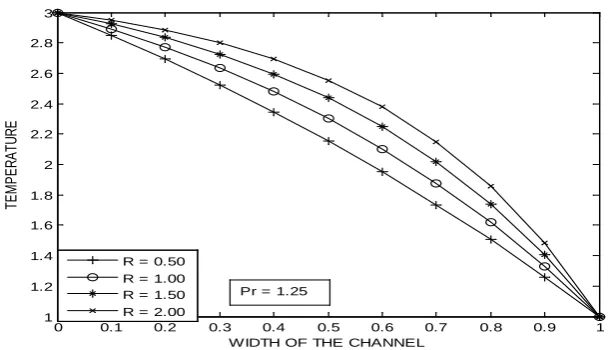
The nature of temperature distribution along the width of the channel for different values of the Prandtl number with respect to the radiation parameter has been shown graphically in figure 5, figure 6, figure 7, figure 8 and figure 9. In each of these illustrations it is observed that, as the radiation parameter (R) increses the temparature in the fluid also increases. Not much of significant change is noticed for a small change in the Prandtl number. However, there is a considerable change in the profiles for larger values of Prandtl number (Pr). The illustations are in good agreement with the results obtained by Cheng et al [12] and Chamka et al [13].
Figure-5: Temperature Profiles Along The Width Of The Channel
Figure-6: Temperature Profiles Along The Width Of The Channel
0 0.1 0.2 0.3 0.4 0.5 0.6 0.7 0.8 0.9 1
0.5 1 1.5 2 2.5 3 3.5
WIDTH OF THE PLATE
TEM
PER
AT
U
R
E
Pr = 0.25 Pr = 1.25 Pr = 2.25 Pr = 3.25 R = 1.50
0 0.1 0.2 0.3 0.4 0.5 0.6 0.7 0.8 0.9 1
1 1.2 1.4 1.6 1.8 2 2.2 2.4 2.6 2.8 3
WIDTH OF THE CHANNEL
T
EM
PER
AT
U
R
E
R = 0.25 R = 0.50 R = 0.75 R = 1.00
Pr = 2.50
0 0.1 0.2 0.3 0.4 0.5 0.6 0.7 0.8 0.9 1
1 1.2 1.4 1.6 1.8 2 2.2 2.4 2.6 2.8 3
WIDTH OF THE CHANNEL
T
EM
PER
AT
U
R
E
R = 0.50 R = 1.00 R = 1.50 R = 2.00
Figure-7: Temperature Profiles Along The Width Of The Channel
Figure-8: Temperature Profiles Along The Width Of The Channel
Figure-9: Temperature Profiles Along The Width Of The Channel
Figure 10 and figure 11 demonstrates the distribution of temperature profiles in the fluid medium for different values of Prandtl number (Pr). In both of these illustrations it is observed that as we move far away from the lower boundary the temperature decreases. Further it is observed that as the radiation parameter (R) increases the temperature of the fluid decreases.
0 0.1 0.2 0.3 0.4 0.5 0.6 0.7 0.8 0.9 1
1 1.2 1.4 1.6 1.8 2 2.2 2.4 2.6 2.8 3
WIDTH OF THE CHANNEL
TEM
PER
AT
U
R
E
R = 0.50 R = 1.00 R = 1.50 R = 2.00
Pr = 3.25
0 0.1 0.2 0.3 0.4 0.5 0.6 0.7 0.8 0.9 1
1 1.5 2 2.5 3 3.5
WIDTH OF THE CHANNEL
T
EM
PER
AT
U
R
E
R = 0.50 R = 1.00 R = 1.50 R = 2.00
Pr = 2.25
0 0.1 0.2 0.3 0.4 0.5 0.6 0.7 0.8 0.9 1
1 1.2 1.4 1.6 1.8 2 2.2 2.4 2.6 2.8 3
WIDTH OF THE CHANNEL
TEM
PER
AT
U
R
E
R = 0.50 R = 1.00 R = 1.50 R = 2.00
Figure-10: Variation Of Temperature Profiles
Figure-11: Distribution Of Temperature Profiles
REFERENCES
1. H. Darcy Les Fountaines Publiques de la ville de Dijon, Victor Dultmont, paris (1856)
2. P.V.S.N.Murthy and P.Singh, Thermal dispersion effects on non –Darcy natural convection with lateral mass flux. Heat and Mass Transfer 33, 1-5, (1977).
3. P. Cheng and W.Minkowycz, Free convection about a vertical plate embedded inporous with application to heat transfer from a dike. Journal of Geophysical Research 82, 2040-2049, (1977)
4. Mac Donald, I F EI-Sayed, M. S. Mow and Dullien, Flow through porous medium the Ergun equation revisited. Indust. Chem. Fundam. 18,199 – 208, (1979).
5. D. D. Joseph, D. A. Nield and G. Papanicolaou, Non – Linear equation governing flow in a saturated porous medium. Water Resources Res. 18, 1049 – 1052, (1982).
6. K. Vafai and C. L. Tien, Boundary and inertia effects on convective mass transfer in porous media. Int. J. of Heat and Mass Transfer 25, 1183 – 1190, (1982).
7. P. M. Knupp and J. L. Large, Generali-zation of the Forchheimer- extended Darcy flow model to the tensor permiability case via a variational principle. J. Fluid Mech. 299, 97 – 104, (1995).
8. P. V. S. N. Murthy, Thermal dispersion and viscous dissipation effects on non- Darcy mixed convection in a fluid saturated porous medium. Heat and Mass Transfer 33, 295 – 300, (1998).
9. I. A. Hussanien, A. Y. Bakier and R. S. R. Gorla, Effects of thermal dispersion and stratification on non-Darcy mixed convection from a vertical plate in porous medium. Heat and Mass Transfer 34, 209 – 212, (1998). 10. A. V. Kuznetsov, Investigation of the effect of transverse thermal dispersion on forced convection in porous
media. Acta Mechania 145, 35 – 43, (2000).
11. A.A. Mohammadien and M. F. El-Amin, Thermal dispersion – radiation effects on non-Darcy natural convection in a fluid saturated porous medium. Transport in porous media 40, 153 – 163, (2000).
12. Wen T. Cheng and Hasio T. Lin, unsteady forced convection heat transfer on a flat plate embedded in the fluid saturated porous medium with inertia effect and thermal dispersion .Int. J. of Heat and Mass Transfer 45, 1563-1569, (2002).
0 0.1 0.2 0.3 0.4 0.5 0.6 0.7 0.8 0.9 1
1 1.5 2 2.5 3 3.5
WIDTH OF THE CHANNEL
T
EM
PER
AT
U
R
E
R = 0.50 R = 1.00 R = 1.50 R = 2.00
Pr = 2.25
0 0.1 0.2 0.3 0.4 0.5 0.6 0.7 0.8 0.9 1
1 1.5 2 2.5 3
WIDTH OF THE CHANNEL
T
EM
PER
AT
U
R
E
R = 0.50 R = 1.00 R = 1.50 R = 2.00
13. Ali.J.Chamkha, Mir Mujtaba and A. Quadri, Simultaneous heat and mass transfer by natural convection from a plate embedded in a porous medium with thermal dispersion effects. Heat and Mass Transfer 39,561-569, (2003).
14. C.Wang, S.J.Liao and J.M.Zhu, An explicit analytic solution for non-Darcy natural convection over horizontal plate with surface mass flux and thermal dispersion effects. Acta Mechania 165, 139 – 150, (2003).
Source of support: Nil, Conflict of interest: None Declared.