Available online throug
ISSN 2229 – 5046
International Journal of Mathematical Archive- 10(12), Dec.--2019 25
NOTES ONINTUITIONISTICMULTIFUZZY GRAPH
A. MARICHAMY*
1, K. ARJUNAN
2AND K. L. MURUGANANTHA PRASAD
3*Department of Mathematics,
Pandian Saraswathiyadav Engineering College, Sivagangai-630561, Tamilnadu, India.
Department of Mathematics,
Alagappa Government Arts College, Karaikudi-630003, Tamilnadu, India.
Department of Mathematics,
H.H. The Raja’s College, Pudukkottai-622001, Tamilnadu, India.
(Received On: 12-11-19; Revised & Accepted On: 09-12-19)
ABSTRACT
In this paper, some properties of intuitionisticmultifuzzy graph are studied and proved. Fuzzy graph is the
generalization of the crisp graph, intuitionisticfuzzy graph is the generalization of fuzzy graph and intuitionisticmulti
fuzzy graph is the generalization of intuitionisticfuzzy graph. A new structure of an intuitionisticmulti fuzzy graph is
introduced.
2010Mathematics subject classification: 03E72, 03F55, 05C72.
Key Words: Intuitionisticfuzzy subset, intuitionisticmulti fuzzy relation, Strong intuitionisticmulti fuzzy relation,
intuitionisticmulti fuzzy graph, intuitionisticmulti fuzzy loop, intuitionisticmulti fuzzy pseudo graph, intuitionisticmulti
fuzzy spanning subgraph, intuitionisticmulti fuzzy induced subgraph, intuitionisticmulti fuzzy underling graph, Level
set, Degree of intuitionisticmultifuzzy vertex, order of the intuitionisticmultifuzzy graph, size of the
intuitionisticmultifuzzy graph, intuitionisticmultifuzzy regular graph, intuitionisticmulti fuzzy strong graph,
intuitionisticmulti fuzzy complete graph.
INTRODUCTION
In 1965, Zadeh [13] introduced the notion of fuzzy set as a method of presenting uncertainty. Since complete
information in science and technology is not always available. Thus we need mathematical models to handle various
types of systems containing elements of uncertainty. After that Rosenfeld [10] introduced fuzzy graphs. Fuzzy graphs
are useful to represent relationships which deal with uncertainty and it differs greatly from classical graph. It has
numerous applications to problems in computer science, electrical engineering system analysis, operations research,
economics, networking routing, transportation, etc. Nagoor Gani.A [7, 8] introduced a fuzzy graph and regular fuzzy
graph. Multi fuzzy set was introduced by Sabu Sebastian, T.V.Ramakrishnan[11].After that the fuzzy sets have been
generalized with fuzzy loop and fuzzy multiple edges, this type of concepts was introduced by K.Arjunan and
C.Subramani[1,2]. The intuitionistic fuzzy graph with multiple edges and selfloops has been introduced by K.Arjunan
and C.Subramani[3]. In this paper a new structure is introduced that is intuitionistic multi fuzzy graph with selfloop and
multiple edges and some results of intuitionistic multi fuzzy graph are stated and proved.
Corresponding Author: A. Marichamy*
1, *Department of Mathematics,
© 2019, IJMA. All Rights Reserved 26
1. PRELIMINARIES
Definition 1.1[4]: An intuitionistic fuzzy set (IFS)A in X is defined as an object having the form A ={(x, µA(x), γA(x))
/x
∈
X},where µA: X→
[0,1] and γA: X→
[0,1]define the degree of membership and the degree of non-membership ofthe element x
∈
X respectively and every x in X satisfying 0 ≤ µA(x) + γA(x) ≤ 1.Example 1.2: An intuitionisticsubset A= {(a, 0.3, 0.6), (b, 0.3, 0.5), (c, 0.2, 0.5)} of a set X= {a, b, c}.
Definition 1.3[12]: Anintuitionisticmulti fuzzy subset A of a set X is defined as an object of the form
A = {(x, µA1(x), µA2(x), .., µAn(x), γA1(x), γA2(x),..,γAn(x))/ x∈X}, where µAi : X→[0, 1] and γAi : X→[0, 1] for all
i, define the degrees of membership and the degrees of non-membership of the element x
∈
X respectively and every xin X satisfying 0 ≤ µ Ai(x) + γAi(x) ≤ 1 for all i. It is denoted as A = (µA, γA), where µA = (µA1, µA2… µAn) and
γA= (γA1, γA2,…,γAn).
Example 1.4: Let X = {a, b, c} be a set. Then A = {(a, (0.4, 0.3, 0.2), (0.2, 0.4, 0.4)), (b, (0.2, 0.4, 0.3), (0.3, 0.5, 0.7)),
(c, (0.4, 0.1, 0.5), (0.5, 0.6, 0.4)} is a intuitionisticmulti fuzzy subset of X with the dimension three.
Definition 1.5: Let A and B be any two intuitionisticmulti fuzzy subset of X. We define the following relations and
operations:
(i) A
⊆
B if and only if µAi(x) ≤ µBi(x) and γAi(x) ≥ γBi(x) for all x∈
X and for all i.(ii) A = B if and only if µAi(x) = µBi(x) and γAi(x) = γBi(x) for all x
∈
X and for all i.(iii)A
∩
B if and only if (A∩
B) (x) = {min{µAi(x), µBi(x)},max{γAi(x), γBi(x)}}for all x∈
X and for all i.(iv)A
∪
B if and only if (A∪
B) (x) = {max{µAi(x), µBi(x)},min{γAi(x), γBi(x)}}for all x∈
X and for all i.Definition 1.6: Let A be aintuitionisticmulti fuzzy subset in a set S, the strongest intuitionistic multi fuzzy relation
on S, that is an intuitionisticmulti fuzzy relation with respect to A given by µVi(x,y) = min {µAi(x), µAi(y)} and
γVi(x, y) = max{γAi(x), γAi(y)} for all x and y in S and for all i.
Definition 1.7: Let V be any nonempty set, E be any set and f: E
→
V×V be any function. Then A is aintuitionisticmulti fuzzy subset of V, Sis anintuitionisticmulti fuzzy relation on V with respect to A and B is an intuitionisticmulti
fuzzy subset of E such that
(
,
)
) , (
1
)
(
x
y
i
s
e
y x f e
Bi
µ
µ
≤
−
∈
and
(
,
)
) , (
1
)
(
x
y
i
s
e
y x f e
Bi
γ
γ
≥
−
∈
for all i. Then the ordered triple F= (A, B, f)
is called an intuitionistic multi fuzzy graph, where the elements of A are called intuitionisticmultifuzzy points or
intuitionistic multifuzzy vertices and the elements of B are called intuitionistic multifuzzy lines or intuitionistic
multi fuzzy edges of the intuitionisticmulti fuzzy graph F. Iff(e) = (x, y), then the intuitionistic multi fuzzy points
(x, µA(x), γA(x)), (y, µA(y), γA(y)) are called intuitionistic multi fuzzyadjacent points and intuitionisticmulti fuzzy
points (x, µA(x), γA(x) ), intuitionisticmulti fuzzy line (e, µB(e), γB(e)) are called incident with each other. If two district
intuitionisticmulti fuzzy lines (e1, µB(e1),γB(e1)) and (e2, µB(e2), γB(e2)) are incident with a common intuitionisticmulti
fuzzy point, then they are called intuitionisticmultifuzzy adjacent lines.
Definition 1.8: Anintuitionistic multi fuzzy line joining anintuitionisticmulti fuzzy point to itself is called an
intuitionistic multi fuzzy loop.
Definition 1.9: Let F= (A, B, f) be an intuitionisticmulti fuzzy graph. If more than one intuitionisticmulti fuzzy line
joining two intuitionisticmulti fuzzy vertices is allowed, then the intuitionisticmulti fuzzy graph F is called an
© 2019, IJMA. All Rights Reserved 27
Definition 1.10: F= (A, B, f) is called anintuitionisticmulti fuzzy simple graph if it has neitherintuitionisticmulti
fuzzy multiple lines nor intuitionistic multifuzzy loops.
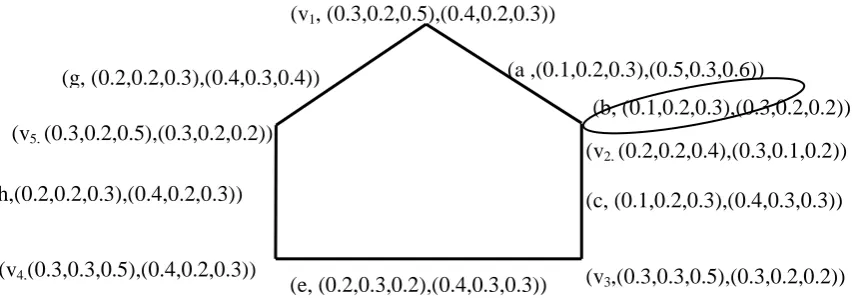
Example 1.11: F = (A, B, f), where V ={v1,v2,v3,v4,v5}, E={a, b, c, d, e, h, g} and f:E
→
V×V is defined by f(a) = (v1,v2), f(b) = (v2, v2), f(c) = (v2, v3), f(d)= (v3, v4), f(e) = (v3, v4), f(h) = (v4, v5), f(g)= (v1, v5). An Intuitionisticfuzzy
subsetA = {(v1, (0.3, 0.2,0.5), (0.4,0.2,0.3) ), (v2, (0.2,0.2,0.4),(0.3,0.1,0.2)),
(v3,(0.3,0.2,0.5),(0.3,0.2,0.2)),(v4,(0.3,0.3,0.5),(0.4,0.2,0.3)),(v5,(0.3,0.2,0.5),(0.3,0.2,0.2))}of V. An intuitionistic multi
fuzzy relation S={ ( (v1,v1), (0.3, 0.2, 0.5), (0.4, 0.2, 0.3) ),((v1,v2),(0.2, 0.2, 0.4), (0.4, 0.2, 0.3) ),((v1,v3),(0.3, 0.2, 0.5),
(0.4, 0.2, 0.3) ),((v1,v4),(0.3,0.2,0.5),(0.4,0.2,0.3)),((v1,v5),(0.3,0.2,0.5),(0.4,0.2,0.3)),((v2,v1),(0.2,0.2,0.4),(0.4,0.2,0.3)
),((v2,v2),(0.2,0.2,0.4),(0.3,0.1,0.2) ),((v2,v3),(0.2,0.2,0.4),(0.3,0.2,0.2)),((v2,v4),(0.2,0.2,0.4),(0.4,0.2,0.3)),
((v2,v5),(0.2,0.2,0.4), (0.3,0.2,0.2)), ((v3,v1), (0.3,0.2,0.5), (0.4,0.2,0.3)), ((v3,v2), (0.2,0.2,0.4), (0.3,0.2,0.2)),
((v3,v3),(0.3,0.2,0.5),(0.3,0.2,0.2)),((v3,v4),(0.3,0.2,0.5),(0.4,0.2,0.3)),((v3,v5),(0.3,0.2,0.5),(0.3,0.2,0.2) ), ( (v4,v1),
(0.3,0.2,0.5), (0.4,0.2,0.3) ),((v4,v2),(0.2,0.2,0.4),(0.4,0.2,0.3) ), ((v4,v3),(0.3,0.2,0.5),(0.4,0.2,0.3)), ((v4, v4),
(0.3,0.3,0.5), (0.4,0.2,0.3)), ((v4, v5),(0.3,0.2,0.5),(0.4,0.2,0.3)), ((v5,v1),(0.3,0.2,0.5),(0.4,0.2,0.3) ),((v5, v2),
(0.2,0.2,0.4), (0.3,0.2,0.2)), ((v5,v3),(0.3,0.2,0.5),(0.3,0.2,0.2)), ((v5, v4),(0.3,0.2,0.5),(0.4,0.2,0.3)), ((v5, v5),
(0.3,0.2,0.5), (0.3,0.2,0.2))} on V with respect to A and an intuitionisticmulti fuzzy subset B = {(a,(0.1, 0.2, 0.3), (0.5,
0.3, 0.6)), (b, (0.1, 0.2, 0.3), (0.3, 0.2, 0.2) ),(c,(0.1,0.2,0.3),0.4,0.3,0.3)),(d,(0.1,0.2,0.3),(0.4,0.2,0.3)), (e,(0.2,0.1,0.2),
(0.4,0.3,0.3)), (h,(0.2,0.2,0.3),(0.4,0.2,0.3)),(g,(0.2,0.3,0.3),(0.4,0.3,0.4))}of E.
Fig.-1.1
In figure 1.1, (i) (v1, (0.3,0.2,0.5),(0.4,0.2,0.3)) is an intuitionisticmulti fuzzy point.(ii) (a,(0.1,0.2,0.3),(0.5,0.3,0.6)) is
an intuitionisticmulti fuzzy edge.(iii) (v1, (0.3, 0.2, 0.5), (0.4, 0.2, 0.3)) and (v2,(0.2,0.2,0.4), (0.3,0.1,0.2)) are
intuitionisticmulti fuzzy adjacent points.(iv) (a, (0.1, 0.2, 0.3), (0.5, 0.3, 0.6) ) join with (v1, (0.3, 0.2, 0.5), (0.4, 0.2,
0.3)) and (v2, (0.2,0.2,0.4),0.3,0.1,0.2) and therefore it is incident with (v1, (0.3, 0.2, 0.5), (0.4, 0.2, 0.3) ) and (v2, (0.2,
0.2, 0.4), (0.3, 0.1, 0.2) ).(v) (a, (0.1, 0.2, 0.3), (0.5, 0.3, 0.6) ) and (g,(0.2,0.2,0.3),(0.4,0.3,0.4)) are intuitionisticmulti
fuzzy adjacent lines. (vi) (b,(0.1,0.2,0.3),(0.3,0.2,0.2)) is an intuitionisticmulti fuzzy loop.(vii) (d,(0.1,0.2,0.3),
(0.4,0.2,0.3)) and (e,(0.2,0.1,0.2),(0.4,0.3,0.3)) are intuitionisticmulti fuzzy multiple edges. (viii) It is not an
intuitionisticmultifuzzy simple graph.(ix)It is an intuitionisticmulti fuzzy pseudo graph.
Definition 1.12: The multi fuzzy graph H= (C, D, f) where C = <µC ,γC> and D = <µD,γD> is called an intuitionisticmultifuzzy subgraph of F = (A, B, f) if C⊆ A and D⊆ B.
Definition 1.13: The intuitionisticmultifuzzy subgraph H = (C, D, f) is said to be an intuitionisticmultifuzzy spanning
subgraph of F= (A, B, f) if C= A.
(v
2,(0.2,0.2,0.4),(0.3,0.1,0.2))
(b, (0.1,0.2,0.3),(0.3,0.2,0.2))
(v
3,(0.3,0.2,0.5),(0.3,0.2,0.2))
(v
4,(0.3,0.3,0.5),(0.4,0.2,0.3))
(v
5,(0.3,0.2,0.5),(0.3,0.2,0.2))
(v
1, (0.3,0.2,0.5),(0.4,0.2,0.3))
(h,(0.2,0.2,0.3),(0.4,0.2,0.3))
(d,(0.1,0.2,0.3),(0.4,0.2,0.3))
(e, (0.2,0.1,0.2),(0.4,0.3,0.3))
(c, (0.1,0.2,0.3),(0.4,0.3,0.3))
(a ,(0.1,0.2,0.3),(0.5,0.3,0.6))
© 2019, IJMA. All Rights Reserved 28
Definition 1.14: The intuitionisticmulti fuzzy subgraph H = (C, D, f) is said to be anintuitionisticmulti fuzzy induced
sub graph of F = (A, B, f) if H is the maximal intuitionisticmulti fuzzy subgraph of F with intuitionisticmulti fuzzy
point set C.
Definition 1.15: Let F = (A, B, f) be anintuitionisticmulti fuzzy graph with respect to the sets V and E. Let C be an
intuitionistic multifuzzy subset of V, the intuitionisticmulti fuzzy subset D of E is defined as µDi(e) = min{µCi(u),
µCi(v), µBi(e)}, γDi(e) = max{γCi(u),γCi(v),γBi(e)}for all i, where f(e)= (u, v)for all e in E. Then H=(C, D, f) is called intuitionisticmulti fuzzy partial subgraph of F.
Definition 1.16: Let F = (A, B, f) be anintuitionisticmulti fuzzy graph. Let A is a intuitionisticmulti fuzzy sub graph of
F obtained by removing the intuitionisticmulti fuzzy point (x, µA(x), γA(x)) and all the intuitionisticmulti fuzzy lines
incident with (x, µA(x), γA(x)) is called the intuitionisticmulti fuzzy subgraph obtained by the removal of the
intuitionistic multi fuzzy point (x, µA(x), γA(x)) and is denoted F−(x, µA(x), γA(x)). Thus if F−(x, µA(x), γA(x)) = (C, D, f)
then C = A−{(x, µA(x),γA(x))} and D={(e, µB(e), γB(e))/ (e, µB(e),γB(e))
∈
B and(x, µA(x), γA(x)) is not incident with(e, µB(e), γB(e))}. Clearly F−(x, µA(x), γA(x)) is intuitionisticmulti fuzzy induced subgraph of F. Let (e, µB(e),
γB(e))
∈
B. Then F −(e, µB(e), γB(e)) = (A, D, f) is called intuitionisticmulti fuzzy sub graph of F obtained by theremoval of the intuitionistic multifuzzy line (e, µB(e), γB(e)), where D =B−{(e, µB(e),γB(e))}. Clearly F−(e, µB(e), γB(e))
is an intuitionisticmulti fuzzy spanning sub graph of F which contains all the lines of F except (e, µB(e),γB(e)). Here
µB(e) = (µB1(e), µB2(e),…, µBn(e)) and γB(e) = (γB1(e), γB2(e),…..,γBn(e)).
Definition 1.17: By deleting from a intuitionistic multi fuzzy graph F all intuitionistic multifuzzy loops and in each
collection of intuitionisticmulti fuzzy multiple edges all intuitionisticmulti fuzzy edge but one intuitionisticmulti fuzzy
edge in the collection we obtain an intuitionisticmulti fuzzy simple spanning subgraph F, called
intuitionisticmultifuzzy underling simple graph of F.
Example 1.18:
Fig.-1.2: Anintuitionisticmulti fuzzy pseudo graph F = (A, B, f)
Fig.-1.3: An intuitionisticmulti fuzzy subgraph of F
(v
2(0.2,0.2,0.4),(0.3,0.1,0.2))
(b, (0.1,0.2,0.3),(0.3,0.2,0.2))
(v
3,(0.3,0.3,0.5),(0.3,0.2,0.2))
(v
4(0.3,0.3,0.5),(0.4,0.2,0.3))
(v
5(0.3,0.2,0.5),(0.3,0.2,0.2))
(v
1, (0.3,0.2,0.5),(0.4,0.2,0.3))
(h,(0.2,0.2,0.3),(0.4,0.2,0.3))
(d,(0.1,0.3,0.3),(0.4,0.2,0.3))
(e, (0.2,0.3,0.2),(0.4,0.3,0.3))
(c, (0.1,0.2,0.3),(0.4,0.3,0.3))
(a ,(0.1,0.2,0.3),(0.5,0.3,0.6))
(g, (0.2,0.2,0.3),(0.4,0.3,0.4))
(j ,(0.2,0.2,0.3),(0.5,0.3,0.6))
(i ,(0.1,0.2,0.4),(0.5,0.3,0.4))
(e, (0.2,0.2,0.2),(0.4,0.2,0.3))
(v
2(0.2,0.2,0.3),(0.3,0.1,0.2))
(b, (0.1,0.2,0.3),(0.3,0.2,0.2))
(v
3,(0.3,0.2,0.3),(0.3,0.1,0.2))
(v
4(0.3,0.2,0.4),(0.4,0.2,0.3))
(v
5(0.3,0.2,0.4),(0.3,0.1,0.2))
(v
1, (0.3,0.2,0.5),(0.4,0.2,0.3))
(h,(0.2,0.2,0.3),(0.4,0.2,0.3))
© 2019, IJMA. All Rights Reserved 29
Fig.-1.4: An intuitionisticmulti fuzzy spanning subgraph of F
Fig.-1.5: An intuitionisticmultifuzzy subgraph Induced by P = {v1, v3, v4,v5}
Fig.-1.6: A partialintuitionistic multi fuzzy subgraph induced by C,
where C(v1) = ((0.3, 0.2, 0.4), (0.4, 0.5, 0.3)), C(v3) = ((0.3, 0.4, 0.3), (0.4, 0.4, 0.6)), C(v4) = ((0.2, 0.4, 0.3), (0.4, 0.5,
0.4)), C(v5) = ((0.4, 0.3, 0.4), (0.3, 0.6, 0.5)).
Fig. -7: F − ((v2 , 0.2,0.2, 0.4), 0.3, 0.1, 0.2) )
(v
2,(0.2,0.2,0.4),(0.3,0.1,0.2))
(b, (0.1,0.2,0.3),(0.3,0.2,0.2))
(v
3,(0.3,0.3,0.5),(0.3,0.2,0.2))
(v
4,(0.3,0.3,0.5),(0.4,0.2,0.3))
(v
5,(0.3,0.2,0.5),(0.3,0.2,0.2))
(v
1, (0.3,0.2,0.5),(0.4,0.2,0.3))
(h,(0.2,0.2,0.3),(0.4,0.2,0.3))
(e, (0.2,0.3,0.2),(0.4,0.3,0.3))
(c, (0.1,0.2,0.3),(0.4,0.3,0.3))
(a ,(0.1,0.2,0.3),(0.5,0.3,0.6))
(g, (0.2,0.2,0.3),(0.4,0.3,0.4))
(v
3,(0.3,0.3,0.5),(0.3,0.2,0.2))
(v
4,(0.3,0.3,0.5),(0.4,0.2,0.3))
(v
5,(0.3,0.2,0.5),(0.3,0.2,0.2))
(v
1, (0.3,0.2,0.5),(0.4,0.2,0.3))
(h,(0.2,0.2,0.3),(0.4,0.2,0.3))
(d,(0.1,0.3,0.3),(0.4,0.2,0.3))
(e, (0.2,0.3,0.2),(0.4,0.3,0.3))
(g, (0.2,0.2,0.3),(0.4,0.3,0.4))
(v
3,(0.3,0.4,0.3),(0.4,0.4,0.6))
(v
4,(0.2,0.4,0.3),(0.4,0.5,0.4))
(v
5,(0.4,0.3,0.4),(0.3,0.6,0.5))
(v
1, (0.3,0.2,0.4),(0.4,0.5,0.3))
(h,(0.2,0.2,0.3),(0.4,0.6,0.5))
(d,(0.1,0.3,0.3),(0.4,0.5,0.7))
(e, (0.2,0.3,0.2),(0.4,0.6,0.7))
(g, (0.2,0.2,0.3),(0.4,0.7,0.5))
(v
3,(0.3,0.3,0.5),(0.3,0.2,0.2))
(v
4,(0.3,0.3,0.5),(0.4,0.2,0.3))
(v
5,(0.3,0.2,0.5),(0.3,0.2,0.2))
(v
1, (0.3,0.2,0.5),(0.4,0.2,0.3))
(h,(0.2,0.2,0.3),(0.4,0.2,0.3))
(d,(0.1,0.3,0.3),(0.4,0.2,0.3))
© 2019, IJMA. All Rights Reserved 30
Fig.-1.8: F− (b ,(0.1, 0.2, 0.3), (0.3, 0.2, 0.2) )
Fig.-1.9: Underling intuitionisticmultifuzzy simple graph of F.
Definition 1.19: Let A be a intuitionisticmulti fuzzy subset of X then the level subset or (
α
,β)-cut of A is A(α, β) = {x∈
A/µAi(x)≥
α
iand γAi(x)≤
βi}, whereα
i,βi∈
[0,1] for all i andα
i + βi≤ 1. Here α means (α1, α2, ...,αn).Note: αmeans (α1, α2, ..., αn) and β means (β1, β2, ..., βn) .
Theorem 1.20: Let F = (A,B, f) be aintuitionistic multi fuzzy graph with respect to the set V and E.Letα, β, λ,η
∈
[0,1]and
α
≤
β
andλ≥ η.Then(
A
(β,η),
B
(β,η),
f
)
is a subgraphof(
A
(α,λ),
B
(α,λ),
f
)
.Proof: The proof follows from definition 1.19.
Theorem 1.21: Let F = (A, B, f) be a intuitionistic multi fuzzy graph with respect to the set V and E, the level subsets
) , (αλ
A
,B
(α,λ)of A and B subset of V and E respectively. ThenF
(α,λ)=
(
A
(α,λ),
B
(α,λ),
f
)
is a subgraph ofG = (V, E, f).
Proof: The proof follows from definition 1.19 and Theorem 1.20.
(v
2,(0.2,0.2,0.4),(0.3,0.1,0.2))
(v
3,(0.3,0.3,0.5),(0.3,0.2,0.2))
(v
4,(0.3,0.3,0.5),(0.4,0.2,0.3))
(v
5,(0.3,0.2,0.5),(0.3,0.2,0.2))
(v
1, (0.3,0.2,0.5),(0.4,0.2,0.3))
(h,(0.2,0.2,0.3),(0.4,0.2,0.3))
(d,(0.1,0.3,0.3),(0.4,0.2,0.3))
(e, (0.2,0.3,0.2),(0.4,0.3,0.3))
(c, (0.1,0.2,0.3),(0.4,0.3,0.3))
(a ,(0.1,0.2,0.3),(0.5,0.3,0.6))
(g, (0.2,0.2,0.3),(0.4,0.3,0.4))
(j ,(0.2,0.2,0.3),(0.5,0.3,0.6))
(i ,(0.1,0.2,0.4),(0.5,0.3,0.4))
(v
2,(0.2,0.2,0.4),(0.3,0.1,0.2))
(v
3,(0.3,0.2,0.5),(0.3,0.2,0.2))
(v
4,(0.3,0.3,0.5),(0.4,0.2,0.3))
(v
5,(0.3,0.2,0.5),(0.3,0.2,0.2))
(v
1, (0.3,0.2,0.5),(0.4,0.2,0.3))
(h,(0.2,0.2,0.3),(0.4,0.2,0.3))
(e, (0.2,0.1,0.2),(0.4,0.3,0.3))
(c, (0.1,0.2,0.3),(0.4,0.3,0.3))
(a ,(0.1,0.2,0.3),(0.5,0.3,0.6))
© 2019, IJMA. All Rights Reserved 31
Theorem 1.22: Let H = (C, D, f) be a intuitionistic multi fuzzy subgraph of F = (A, B, f) and α, λ
∈
[0,1]. Then)
,
,
(
( , ) ( , )) ,
(
C
D
f
H
αλ=
αλ αλ is a subgraphofF
(α,λ)=
(
A
(α,λ),
B
(α,λ),
f
)
.Proof: Let H = (C, D, f) be a intuitionistic multi fuzzy subgraph of F = (A, B, f). Therefore µCi(v) ≤ µAi(v) and
γCi(v) ≥ γAi(v) for all u in V and for all i. µDi(e) ≤ µBi(e) and γDi(e) ≥ γBi(e) for all e in E and for all i. We have to prove
that (C(α, λ), D(α, λ), f ) is a subgraph of (A(α, λ), B(α, λ), f ). It is enough to prove that C(α, λ)⊆ A(α, λ) and D(α, λ)⊆ B(α, λ). Let
u∈ C(α, λ)
⇒
μCi(u) ≥ αiand γCi(u) ≤λi⇒
μAi(u) ≥ μCi(u) ≥ αiand γAi(u) ≤ γCi(u) ≤λI⇒
μAi(u) ≥ αiand γAi(u) ≤λI for alli
⇒
u∈
A(α, λ). Therefore C(α, λ)⊆ A(α, λ). Let e∈
D(α, λ)⇒
μDi(e) ≥ αi and γDi(e) ≤λI⇒
μBi(e) ≥ μDi(e) ≥ αi andγBi(e) ≤ γDi(e) ≤λi
⇒
μBi(e) ≥ αiand γBi(e) ≤λi⇒
e∈
B(α, λ). Therefore D(α, λ)⊆ B(α, λ) . Hence H(α, λ) is a subgraph ofF(α, λ) .
Definition 1.23: Let A be a intuitionistic multi fuzzy subset of X. Then the strong level subset or strong(
α
,β)-cut ofA is A(α+, β+)= {x∈A /µAi(x)>
α
I and γAi(x)<βi} for all i andα
i + βi< 1 whereα
i , βi∈[0,1] for all i.
Theorem 1.24: Let F=(A,B,F) be a intuitionisticmulti fuzzy graph with respect to the set V and E. Let α, β, λ,η
∈
[0,1]and
α
≤
β
and λ≥ η then(
A
(β+,η+),
B
(β+,η+),
f
)
is a subgraph of(
A
(α+,λ+),
B
(α+,λ+),
f
)
.Proof: The proof follows from definition 1.23 and Theorem 1.22.
Theorem 1.25: Let F = (A, B, f) be a intuitionisticmulti fuzzy subgraph with respect to the set V and E, the level
subsets
A
(α+,λ+),
B
(α+,λ+)of A and B subset of V and E respectively. ThenF
(α+,λ+)=
(
A
(α+,λ+),
B
(α+,λ+),
f
)
is asubgraph of G = (V, E, f).
Proof: The proof follows from definition 1.23 and Theorem 1.24.
Theorem 1.26: Let H = (C, D, f) be a intuitionisticmulti fuzzy subgraph of F = (A, B, f) and α,λ
∈
[0,1]. ThenHα+ = (Cα+, Dα+, f) is a subgraph of
F
(α+,λ+)=
(
A
(α+,λ+),
B
(α+,λ+),
f
)
.Proof: The proof follows from definition 1.23 and Theorem 1.25.
Theorem 1.27: Let F = (A, B, f) be a intuitionisticmulti fuzzy subgraph with respect to the set V and E, let α, β, λ,η
∈
[0,1] and F(α ,λ) and F(β ,η) be two subgraphs of G. Then (i) F(α ,λ)∩F(β ,η) is a subgraph of G. (ii) F(α ,λ)∪F(β ,η)is a subgraph
of G.
Proof: Since A(α ,λ) and A(β ,η) are subset of V. Clearly F(α ,λ)∩F(β ,η) is a subgraph of G. Also F(α ,λ)∪F(β ,η) is a subgraph of
G.
Definition 1.28: Let F = (A, B, f) be an intuitionisticmulti fuzzy graph. Then the degree of an intuitionisticmulti
fuzzy vertex is defined by d(v) = (dµ(v), dγ(v)) where
.
)
(
2
)
(
)
(
)
(
2
)
(
)
(
) , ( )
, ( )
, ( )
,
( 1 1 1
1
∑
∑
∑
∑
− − − −∈ ∈
∈ ∈
+
=
+
=
v v f e
B v
u f e
B v
v f e
B v
u f e
B
e
e
and
d
v
e
e
v
d
µµ
µ
γγ
γ
Defination 1.29: The minimum degree of the intuitionisticmulti fuzzy graph F=(A, B, f) is δ(F) =(δµ(F), δγ(F) ) where
δµ(F)=∧{dµ(v)/v∈V} and δγ(F) =∧{dγ(v)/ v∈V} and the maximum degree of F is ∆(F) = (∆μ(F), ∆γ(F)) where
© 2019, IJMA. All Rights Reserved 32
Definition 1.30: Let F = (A, B, f) be an intuitionisticmulti fuzzy graph. Then the order of intuitionisticmultifuzzy
graph F is defined to be o(F) = (oµ(F),oγ(F) ) where
(
)
∑
(
)
(
)
∑
(
)
.
∈ ∈
=
=
V v
A V
v
A
v
and
o
F
v
F
o
µµ
γγ
Definition 1.31: Let F= (A, B, f) be an intuitionistic multi fuzzy graph. Then the size of theintuitionisticmulti fuzzy
graph F is defined to be S(F) = (Sμ(F), Sγ(F)) where
(
)
(
)
(
)
(
)
.
) , ( )
,
( 1
1
∑
∑
− −∈ ∈
=
=
v u f e
B v
u f e
B
e
and
S
F
e
F
S
µµ
γγ
Example 1.32:
Fig.-1.10: Intuitionisticmulti fuzzy graph F
Here d(v1) = ((0.2, 0.5, 0.5), (0.8, 0.9, 0.6)), d(v2) = ((0.7, 1.1, 0.9), (1.6, 1.7, 1.2)), d(v3) = ((0.6, 0.6, 0.7), (1.2, 1.4,
0.9)), d(v4)=((0.5, 0.6, 0.7), (1.2, 1.6, 0.9)),δ(F) = ((0.2, 0.5, 0.5), (0.8, 0.9, 0.6)),∆(F) = ((0.7, 1.1, 0.9), (1.6, 1.7, 1.2)),
o(F) = ((1.0, 1.0, 1.8), (1.4, 1.3, 1.0)),S(F) = ((1.0, 1.4, 1.4), (2.4, 2.8, 1.8)).
Theorem 1.34:
(i)The sum of the degree of membership value of all intuitionisticmulti fuzzy vertices in an intuitionisticmulti fuzzy
graph is equal to twice the sum of the membership value of all intuitionisticmulti fuzzy edges .i.e.,
.
)
(
2
)
(
v
S
F
d
V v
µ
µ
=
∑
∈
(ii)The sum of the degree of non membership value of all intuitionisticmulti fuzzy vertices in
an intuitionisticmulti fuzzy graph is equal to twice the sum of the non membership value of all intuitionisticmulti fuzzy
edges. i.e.,
d
(
v
)
2
S
(
F
)
.
V v
γ
γ
=
∑
∈
(iii) The sum of the degree of all intuitionisticmulti fuzzy vertices in an intuitionisticmulti fuzzy graph is equal to twice
the sum of the all intuitionisticmulti fuzzy edges. i.e., v V
d(v)
2S(F)
∈
=
∑
.Proof:
(i) Let F = (A, B, f) be an intuitionistic multi fuzzy graph with respect to the set V and E. Since degree of an
intuitionisticmulti fuzzy vertex denote sum of the membership values of all intuitionisticmulti fuzzy edges incident on
it. Each intuitionistic multifuzzy edge of F is incident with two intuitionisticmulti fuzzy vertices. Hence
membershipvalue of each intuitionisticmulti fuzzy edgecontributes two to the sum of degrees of intuitionisticmulti
fuzzy vertices. Hence the sum of the degree of all intuitionisticmulti fuzzy vertices in an intuitionisticmulti fuzzy graph
is equal to twice the sum of the membership value of all intuitionistic multifuzzy edges. i.e.,
d
(
v
)
2
S
(
F
)
.
V v
µ
µ
=
∑
∈
(ii) Let F = (A, B, f) be an intuitionisticmulti fuzzy graph with respect to the set V and E. Since degree of an
intuitionisticmulti fuzzy vertex denote sum of the non membership values of all intuitionisticmulti fuzzy edges incident
on it. Each intuitionisticmulti fuzzy edge of F is incident with two intuitionistic multi fuzzy vertices. Hence non
membership value of each intuitionistic multi fuzzy edge contributes two to the sum of degrees of intuitionisticmulti
fuzzy vertices. Hence the sum of the degree of all intuitionistic multi fuzzy vertices in an intuitionisticmulti fuzzy graph
is equal to twice the sum of the nonmembership value of all intuitionisticmulti fuzzy edges. i.e.,
(v
2, (0.2,0.3,0.4),(0.4,0.2,0.3))
(b, (0.2,0.3,0.2),(0.4,0.5,0.3))
(v
3, (0.3,0.2,0.5),(0.4,0.2,0.3))
(v
4, (0.3,0.2,0.5),(0.3,0.5,0.2))
(v
1,(0.2,0.3,0.4),(0.3,0.4,0.2)))
(f, (0.1,0.2,0.3),(0.4,0.5,0.3))
(e, (0.1,0.2,0.2),(0.4,0.6,0.3))
(d,(0.3,0.2,0.2),(0.4,0.5,0.3))
© 2019, IJMA. All Rights Reserved 33
.
)
(
2
)
(
v
S
F
d
V v γ γ=
∑
∈(iii) From (i) and (ii)
The sum of the degree of all intuitionistic multi fuzzy vertices in an intuitionisticmulti fuzzygraph is equal to twice the
sum of the all intuitionisticmulti fuzzy edges.
i.e., v V
d(v)
2S(F)
∈
=
∑
.Theorem 1.35: Let F = (A, B, f) be anintuitionisticmulti fuzzy graph with number of intuitionisticmulti fuzzy vertices
n, all of whose intuitionistic multifuzzy vertices have degree s=(sμ, sγ) or t=(tμ, tγ). If F has pintuitionisticmulti fuzzy
vertices of degree s and (n−p) intuitionistic multifuzzy vertices of degree t, then 2S(F) = ps + (n−p)t.
Proof: Let V1 be the set of all intuitionisticmulti fuzzy vertices with degree s. Let V2 be the set of all intuitionisticmulti
fuzzy vertices with degree t. Then v V
d(v)
∈∑
= 1 v Vd(v)
∈∑
+ 2 v Vd(v)
∈
∑
which implies that2S(F) =
1 1
(
( ) ,
( ) )
v V v V
d v
µd v
γ∈ ∈
+
∑
∑
(
(
)
,
(
)
)
2 2∑
∑
∈∈V v V
v
v
d
v
d
µ γ which implies that 2S(F) = p(sμ ,sγ)+ (n−p)(tμ, tγ) whichimplies that 2S(F) = ps + (n−p)t.
2. INTUITIONISTIC MULTI FUZZYREGULAR GRAPH:
Definition 2.1: An intuitionistic multi fuzzy graph F=(A, B, f) is called intuitionistic multi fuzzy regular graph if
d(v)=(s, k) for all v in V, where s = (s1, s2, ….,sn) and k = (k1,k2, …..,kn).
Remark 2.2: F is an intuitionisticmultifuzzy (s, k)-regular graph if and only if δ(F) = ∆(F) = (s, k).
Example 2.3:
Fig.-2.1
Here d(vi) = ((0.6, 0.8, 1.0), (1.2, 1.2, 0.8)) for all i, δ(F)=( (0.6, 0.8, 1.0), (1.2, 1.2, 0.8) ), Δ(F)=( (0.6, 0.8, 1.0), (1.2,
1.2, 0.8) ). Clearly it is an intuitionisticmultifuzzy ((0.6, 0.8, 1.0), (1.2, 1.2, 0.8) )-regular graph.
Definition 2.4: An intuitionistic multi fuzzy graph F = (A, B, f) is called an intuitionisticmultifuzzy complete graph
if every pair of distinct intuitionisticmulti fuzzy vertices are fuzzy adjacent and
) , ( ) , ( 1 1
)
,
(
)
(
)
,
(
)
(
y x f e s i B y x f e s iB
e
ix
y
and
e
ix
y
−
− ∈
∈
=
=
µ
γ
γ
µ
for all x,y in V and for all i.Definition 2.5: An intuitionistic multi fuzzy graph F = (A, B, f) is an intuitionisticmultifuzzy strong graph if
) , ( ) , ( 1 1
)
,
(
)
(
)
,
(
)
(
y x f e s i B y x f e s iB
e
ix
y
and
e
ix
y
−
− ∈
∈
=
=
µ
γ
γ
µ
for all e in E and for all i.(v
1, (0.3,0.4,0.5),(0.3,0.2,0.1))
(v
3,(0.3,0.4,0.5),(0.3,0.2,0.1))
(v
2,(0.2,0.3,0.4),(0.3,0.2,0.2))
(a, (0.2,0.2,0.4),(0.3,0.4,0.2))
(b,(0.2,0.3,0.3),(0.4,0.4,0.2))
(c, (0.2,0.3,0.3),(0.5,0.4,0.4))
© 2019, IJMA. All Rights Reserved 34
Example 2.6:
Fig.-2.2: An intuitionistic multi fuzzy strong graph
Fig.-2.3: An intuitionisticmulti fuzzycomplete graph
Theorem 2.7: If F is an intuitionisticmulti fuzzy (s, k)-regular graph with p-intuitionisticmulti fuzzy vertices. Then
2S(F) = (ps,pk) .
Proof: Given that the intuitionisticmulti fuzzy graph is an intuitionisticmulti fuzzy (s, k)-regular graph, so d(v) = (s, k)
for all v in V. Here there are p-intuitionisticmulti fuzzy vertices, so
∑
(
)
(
∑
,
∑
)
∈ ∈ ∈
=
V v V v V vk
s
v
d
= (ps, pk) which impliesthat 2S(F) = (ps, pk).
Theorem 2.8: Let F = (A, B, f) be intuitionisticmulti fuzzy complete graph and A= (s, k) is constant function. Then F is
an intuitionisticmulti fuzzy regular graph.
Proof: Since A is a constant function, so A(v) =(s, k) (say) for all v in V and F is an intuitionisticmulti fuzzy complete
graph, so ) , ( ) , ( 1 1
)
,
(
)
(
)
,
(
)
(
y x f e s i B y x f e s iB
e
ix
y
and
e
ix
y
−
− ∈
∈
=
=
µ
γ
γ
µ
for all x and y in V, for all I and x≠y. Therefore membershipand non membership value of all intuitionisticmulti fuzzy edges are s,k respectively. Hence d(v) = ((p−1) s,(p−1)k) for
all v in V.
Theorem 2.9: If F = (A, B, f) is intuitionisticmulti fuzzy complete graph with p-intuitionisticmulti fuzzy vertices and A
is constant function then S(F) = (pC2 μA(v),pC2 γA(v)), for all v in V.
Proof: Suppose F is an intuitionisticmulti fuzzy complete graph and A= (μA, γA) is a constant function.
Let A(v) = (s, k) for all v in V and d(v) = ((p−1)s,(p−1)k) for all v in V. Then
)
)
1
(
,
)
1
(
(
)
)
1
(
,
)
1
(
(
)
(
v
p
s
p
k
p
p
s
p
p
k
d
V v V v V v−
−
=
−
−
=
∑
∑
∑
∈ ∈ ∈which implies that
(v
1,(0.2,0.2,0.4),(0.4,0.5,0.2))
(e, (0.2,0.3,0.4),(0.4,0.2,0.2))
(v
2, (0.3,0.2,0.5),(0.4,0.2,0.2))
(v
3,(0.3,0.2,0.5),(0.3,0.2,0.2))
(v
4, (0.2,0.3,0.4),(0.4,0.2,0.2))
(c, (0.2,0.3,0.4),(0.4,0.2,0.2)) (b, (0.2,0.2,0.4),(0.4,0.5,0.2)) (a, (0..2,0.2,0.4),(0.4,0.5,0.2))
(d, (0.2,0.2,0.4),(0.4,0.5,0.2))
(v
1, (0.3,0.2,0.5),(0.4,0.2,0.3))
(v
3,(0.3,0.4,0.5),(0.3,0.5,0.3))
(v
2,(0.2,0.4,0.4),(0.3,0.4,0.2))
(a, (0.2,0.2,0.4),(0.4,0.4,0.3))
(c, (0.2,0.3,0.4),(0.3,0.5,0.5))
© 2019, IJMA. All Rights Reserved 35
2S(F) = (p(p−1)s,p(p−1)k). Hence S(F) = (pC2 s,pC2 k).
i.e., S(F) = (pC2 μA(v),pC2 γA(v)) for all v in V.
Definition 2.10: Let F = (A, B, f) be an intuitionistic multi fuzzy graph. The total degree of intuitionisticmulti fuzzy
vertex vis defined by dT(v)=(dTμ(v),dTγ(v) )
Where
)
(
)
(
)
(
)
(
2
)
(
)
(
) , ( ) , ( 1 1v
v
d
v
e
e
v
d
A Av v f e B v u f e B
Tµ
=
∑
µ
+
∑
µ
+
µ
=
µ+
µ
− − ∈ ∈ and
)
(
)
(
)
(
)
(
2
)
(
)
(
) , ( ) , ( 1 1v
v
d
v
e
e
v
d
A Av v f e B v u f e B
Tγ
=
∑
γ
+
∑
γ
+
γ
=
γ+
γ
−
− ∈
∈
for all v in V.
Definition 2.11: An intuitionisticmulti fuzzy graph F is intuitionisticmulti fuzzy (s, k)-totally regular graph if each
intuitionistic multi fuzzy vertex of F has the same total degree(s, k).
Example 2.12:
Fig.-2.4
Here dT(v1) = ( (1.0, 1.3, 1.5),(1.5, 1.2, 1.2) ), dT(v2) = ( (1.0, 1.3, 1.5),(1.5, 1.2, 1.2) ),dT(v3) = ( (1.0, 1.3, 1.5), (1.5, 1.2,
1.2) ), it isintuitionisticmulti fuzzy ( (1.0, 1.3, 1.5), (1.5, 1.2, 1.2) )-totally regular graph.
Example 2.13: Fig.2.1 it is an intuitionisticmulti fuzzy regular graph, but it is not an intuitionisticmulti fuzzy totally
regular graph since dT(v1) = ((0.9, 1.2, 1.5), (1.5, 1.4, 0.9), dT(v2) = ((0.8, 1.1, 1.4), (1.5, 1.4, 1.0)) and dT(v1) ≠ dT(v2).
Example 2.14: Fig 2.4, it is an intuitionisticmulti fuzzy totally regular graph but it is not an intuitionisticmulti fuzzy
regular graph since d(v1) = ((0.6, 0.8, 1.0), (1.2, 1.0, 1.0)), d(v2) = ((0.7, 0.9, 1.0), (1.2, 1.0, 0.9)) and d(v1) ≠ d(v2).
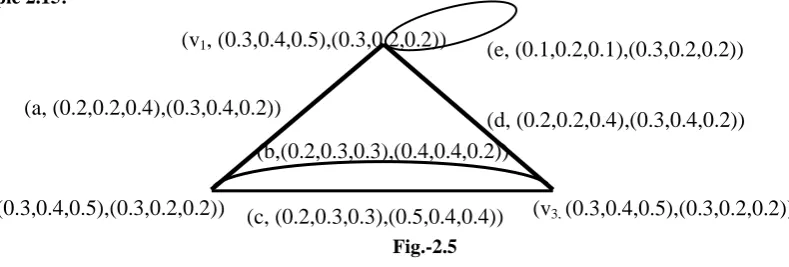
Example 2.15:
Fig.-2.5
Here d(vi) = ((0.6, 0.8, 1.0), (1.2, 1.2, 0.8)) for all i,dT(vi) = ((0.9, 1.2, 1.5), (1.5, 1.4, 1.0)) for all i. It is both
intuitionisticmulti fuzzy regular graph and intuitionisticmulti fuzzy totally regular graph.
(v
1, (0.3,0.4,0.5),(0.3,0.2,0.2))
(v
3,(0.3,0.4,0.5),(0.3,0.2,0.2))
(v
2,(0.3,0.4,0.5),(0.3,0.2,0.2))
(a, (0.2,0.2,0.4),(0.3,0.4,0.2))
(b,(0.2,0.3,0.3),(0.4,0.4,0.2))
(c, (0.2,0.3,0.3),(0.5,0.4,0.4))
(d, (0.2,0.2,0.4),(0.3,0.4,0.2))
(e, (0.1,0.2,0.1),(0.3,0.2,0.2))
(v
1, (0.4,0.5,0.5),(0.3,0.2,0.2))
(v
3,(0.3,0.4,0.5),(0.3,0.2,0.3))
(v
2,(0.3,0.4,0.5),(0.3,0.2,0.3))
(a, (0.2,0.2,0.4),(0.3,0.2,0.3))
(b, (0.2,0.4,0.3),(0.4,0.4,0.3))
(c, (0.3,0.3,0.3),(0.5,0.4,0.3))
© 2019, IJMA. All Rights Reserved 36
Example 2.16:
Fig.-2.6
Here d(v1)=((1.0, 0.8, 1.0), (1.2, 1.2, 0.8)), d(v2) =((0.6, 0.8, 1.0), (1.2, 1.1, 0.7)),d(v3) = ((0.6, 0.8, 1.0), (1.2, 1.1, 0.7)),
dT(v1) = ((1.3, 1.2, 1.5), (1.5, 1.4, 0.9)), dT(v2) = ((0.8, 1.1, 1.4), (1.5, 1.3, 0.9)),dT(v3) = ((0.9, 1.2, 1.5), (1.5, 1.3, 0.9)),
it is neither intuitionisticmulti fuzzy regular graph nor intuitionisticmulti fuzzy totally regular graph.
Theorem 2.17: Let F= (A, B, f) be intuitionisticmulti fuzzy complete graph and A=(s, k) is constant function. Then F is
an intuitionisticmulti fuzzy totally regular graph.
Proof: By theorem 2.8, clearly F is intuitionisticmulti fuzzy regular graph. i.e., d(v) = ((p−1)s, (p−1)k) for all v in V.
Also given A is constant function. i.e., A(v) = (s, k) for all v in V. Then dT(v) = (dμ(v) + μA(v), dγ(v) + γA(v)) = ((p−1)s
+ s,(p−1)k + k) = (ps, pk) for all v in V. Hence F is intuitionisticmulti fuzzy totally regular graph.
Theorem 2.18: Let F = (A, B, f) be an intuitionisticmulti fuzzy regular graph. Then H = (C, B, f) is an
intuitionisticmulti fuzzy totally regular graph if
C(v) = (
∑
∑
= =n i A n
i
A
v
v
1 1 1
1
)
(
,
)
(
γ
µ
) ≤ 1for all vi in V.Proof: Assume that F = (A, B, f) is an intuitionisticmulti fuzzy (s, k)- regular graph. i.e., d(vi) = (s, k) for all vi in V.
Given C(v) = (
∑
∑
= =n i A n
i
A
v
v
1 1 1
1
)
(
,
)
(
γ
µ
) ≤ 1for all vi in V. Then C(v) = (c1,c2) (say) for all vi in V and dT(H)(vi) = (dμ(vi)+ μC(vi), dγ(vi) + γC(vi)) = (s + c1,k+c2) for all vi in V. Hence H is intuitionisticmulti fuzzy totally regular graph.
Theorem 2.19: Let F = (A, B, f) be an intuitionisticmulti fuzzy graph and A is a constant function (ie. A(v) = (c1,c2)
(say) for all v∈V). Then F isintuitionisticmulti fuzzy (s, k)-regular graph if and only if F is intuitionisticmulti fuzzy
(s+c1,k+c2)-totally regular graph.
Proof: Assume that F is an intuitionisticmulti fuzzy (s, k)-regular graph and A(v) = (c1,c2) for all v in V, so d(v) = (s, k)
for all v in V. Then dT(v) = (dμ(v) + μA(v), dγ(v) + γA(v)) = (s + c1, k+c2) for all v in V. Hence F is intuitionistic
multifuzzy (s +c1, k+c2)-totally regular graph. Conversely, Assume that F is intuitionisticmulti fuzzy (s+c1,k+c2)-totally
regular graph. ie., dT(v) = (s + c1, k+c2) for all v in V which implies that (dμ(v) + μA(v), dγ(v) + γA(v)) = (s + c1, k+c2)
for all v in V implies that (μA(v), γA(v)) = (c1, c2) for all v in V implies that dμ(v) + c1 = s + c1 and dγ(v) + c2 = k+c2 for
all v in V. Therefore dμ(v) = s and dγ(v) =k for all v in V. ie., d(v) = (s, k) for all v in V. Hence F is intuitionisticmulti fuzzy (s, k)-regular graph.
(v
1, (0.3,0.4,0.5),(0.3,0.2,0.1))
(v
3,(0.3,0.4,0.5),(0.3,0.2,0.2))
(v
2,(0.2,0.3,0.4),(0.3,0.2,0.2))
(a, (0.2,0.2,0.4),(0.3,0.4,0.2))
(b,(0.2,0.3,0.3),(0.4,0.3,0.2))
(c, (0.2,0.3,0.3),(0.5,0.4,0.3))
© 2019, IJMA. All Rights Reserved 37
Theorem2.20: If F = (A, B, f) is bothintuitionisticmulti fuzzy regular graph and intuitionisticmulti fuzzy totally regular
graph then A is a constant function.
Proof: Assume that F is a both intuitionisticmulti fuzzy regular graph and intuitionisticmulti fuzzy totally regular
graph.
Suppose that A is not constant function. Then μA(u) ≠ μ A(v) or γA(u) ≠ γ A(v) for some u, v in V. Since F is an
intuitionisticmulti fuzzy (s, k)-regular graph. Then d(u) = d(v) = (s, k).Then dT(u) ≠ dT(v) which is a contradiction to
our assumption. Hence A is a constant function.
Remark 2.21: Converse of the above theorem need not be true.
Fig.-2.7
Here A(vi)=((0.3, 0.4, 0.5), (0.3, 0.2, 0.2)) for all i, d(v1)=((0.4, 0.5, 0.8), (0.6, 0.8, 0.5)),d(v2)=((0.6, 0.8, 1.1),
(1.2, 1.2, 0.8)), d(v3) = ((0.6, 0.9, 1.1), (1.2, 1.2, 0.9)), dT(v1) = ((0.7, 0.9, 1.3), (0.9, 1.0, 0.7)), dT(v2) = ((0.9, 1.2, 1.6),
(1.5, 1.4, 1.0)), dT(v3) = ((0.9, 1.3, 1.6), (1.5, 1.4, 1.1)). Hence F is neitherintuitionisticmulti fuzzy regular graph nor
intuitionisticmulti fuzzy totally regular graph.
Theorem 2.22: If F = (A, B, f) is an intuitionisticmulti fuzzy (c1, c2)-totally regular graph with p-intuitionisticmulti
fuzzy vertices. Then 2S(F) + o(F) = p(c1, c2).
Proof: Assume that F is an intuitionisticmulti fuzzy (c1, c2)-totally regular graph with p-intuitionisticmulti fuzzy
vertices.
Then dT(v) = (c1,c2) for all v in V implies that (dμ(v) + μA(v), dγ(v) + γA(v)) = (c1, c2) for all v in V which implies that
(∑dμ(v)+∑μA(v), ∑dγ(v)+∑γA(v))=(∑c1,∑c2) for all v in V which implies that (2Sμ(F)+oμ(F), 2Sγ(F)+oγ(F)) = (pc1, pc2)
for all v in V implies that (2Sμ(F), 2Sγ(F)) + (oμ(F), oγ(F)) = (pc1,pc2). Hence 2S(F) + o(F) = p(c1, c2).
Theorem 2.23: If F = (A, B, f) is both intuitionisticmulti fuzzy k=(s, k)-regular graph and intuitionisticmulti fuzzy
c = (c1, c2)-totally regular graph with p-intuitionisticmulti fuzzy vertices. Then o(F) = pc−pk.
Proof: Assume that F is intuitionisticmulti fuzzy k-regular graph with p-intuitionisticmulti fuzzy vertices. Then
2S(F) = pk. By theorem 2.22, 2S(F) + o(F) = pc implies that o(F) = pc−pk.
(v
1, (0.3,0.4,0.5),(0.3,0.2,0.2))
(v
3,(0.3, 0.4,0.5), (0.3,0.2,0.2))
(v
2,(0.3,0.4,0.5),(0.3,0.2,0.2))
(a, (0.2,0.2,0.4),(0.3,0.4,0.2))
(b,(0.2,0.3,0.4),(0.4,0.4,0.2))
(c, (0.2,0.3,0.3),(0.5,0.4,0.4))
© 2019, IJMA. All Rights Reserved 38
REFERENCES
1. Arjunan.K&Subramani.C, “Notes on fuzzy graph”, International Journal of Emerging Technology and
Advanced Engineering, Vol.5, Iss.3 (2015), 425−432.
2. Arjunan.K& Subramani.C, “A study on I-fuzzy graph”, International Journal of Mathematical Archive 6(4)
(2015), 222−233.
3. Arjunan.K&Subramani.C, “Notes on intuitionistic fuzzy graphs”, Shanlax International Journal of Arts,
Science and Humanities Vol. 5 (2017), 35−46.
4. Atanassov K.T, “Intuitionistic fuzzy sets”, Fuzzy Sets and Systems, 2087- 96 (1986).
5. Atanassov. K.T, “Intuitionistic fuzzy sets: Theory and applications, Studies in fuzziness and soft computing”,
Heidelberg, New York, Physica-Verl., (1999).
6. Mardeson.J.N and C.S.Peng, “Operation on Fuzzy graph”, Information science 19 (1994), 159 −170.
7. NagoorGani, A. and BasheerAhamed.M., “Order and Size in Fuzzy Graphs”, Bulletin of Pure and Applied
Sciences, Vol 22E (No.1) (2003), 145−148.
8. NagoorGani.A and Radha.K., “On Regular Fuzzy Graphs”, Journal of Physical sciences, Vol. 12 (2008),
33−40.
9. NagoorGani.A and ShajithaBegum.S, “Degree, Order and Size in Intuitionistic FuzzyGraphs”, International
Journal of Algorithms and mathematics, Vol. 3, 2010, 11 – 16.
10. Rosenfeld,A., “Fuzzy Graphs, In:L.A.Zadeh,K.S.Fu, M.Shimura, Eds., Fuzzy Sets and their Applications”,
Academic press (1975), 77−95.
11. Sabu Sebastian, T.V.Ramakrishnan, “Multi fuzzy sets”, International Mathematical Forum, 5, no.50 (2010),
2471−2476.
12. Shinoj T K, Sunil Jacob John, “Intuitionistic Fuzzy Multi set and its application in Medical Diagnosis”,
International Journal of Mathematical and Computational Sciences, WASET 6, 2012 , 34-38
13. L. A. Zadeh, “Fuzzy sets”, Information and Control, 8 (1965) 338 −353.
Source of support: Nil, Conflict of interest: None Declared.