737
© 2018 by the Serbian Biological Society How to cite this article: Mojib-Haghghadam Z, Jalali Sendi J, Zibaee A, Mohaghegh J. Suitability of Aphis gossypii Glover, Aphis fabae Scop. and Ephestia kuehniella Zeller eggs for the biology and life-table parameters of Adalia decempunctata (L.) (Coleoptera: Coccinellidae). Arch Biol Sci. 2018;70(4):737-47.
Suitability of
Aphis gossypii
Glover,
Aphis fabae
Scop. and
Ephestia kuehniella
Zeller
eggs for the biology and life-table parameters of
Adalia decempunctata
(L.) (Coleoptera:
Coccinellidae)
Zahra Mojib-Haghghadam1,4, Jalal Jalali Sendi1,2,*, Arash Zibaee1,2 and Jafar Mohaghegh3
1Department of Plant Protection, University Campus 2, University of Guilan, Rasht, Iran
2Department of Plant Protection, Faculty of Agricultural Sciences, University of Guilan, Rasht, Iran
3Iranian Research Institute of Plant Protection, Agricultural Research, Education and Extension Organization (AREEO),
Tehran, Iran
4Plant Protection Research Department, Guilan Agricultural and Natural Resources Research Center, Agricultural Research,
Education and Extension Organization (AREEO), Rasht, Iran
*Corresponding author: [email protected]
Received: June 20, 2018; Revised: August 18, 2018; Accepted: August 28, 2018; Published online: September 20, 2018
Abstract: Adalia decempunctata (L.) is a common predator in agroecosystems and the natural environment. Its biology
and life table were studied in nymph/adult hosts of Aphis gossypii Glover, Aphis fabae Scop. and on the eggsof Ephestia
kuehniella Zeller. Raw data of all individuals of A.decempunctata were analyzed using the age-stage, two-sex, life-table
theory. The results of this study indicate a shortest immature developmental period (IDP) of A. decempunctata feeding
on eggs of E. kuehniella (18.33 days) and the longest on A. fabae (21.82 days).The longest longevity was, however, after
feedingon A. gossypii. The fecundity rate of females on E. kuehniella was the highest (2405.12 eggs/female). The intrinsic
rates of increase of A. decempunctata were 0.177, 0.171 and 0.155 day-1 when feeding on A. gossypii,E. kuehniella eggs and
A. fabae, respectively. The highest finite rates of increase (λ) were 1.193 and 1.187 day-1 when reared on A. gossypii and E.
kuehniella, respectively. The mean generation time for A. fabae (41.40 days) was significantly higher compared to other hosts. The results of this study showed that the quality of the host influenced to a great extent the rate of energy reserves in emerged females. We conclude that all three host species can be considered as essential preys. These hosts influence the
larval developmental period and reproduction in adult A. decempunctata; however, the results of the biochemical assays
pointed to A. gossypii and E. kuehniella eggs as preferred hosts.
Key words: Adalia decempunctata; biological control; aphid; population growth parameters
INTRODUCTION
The ten-spotted lady beetle Adalia decempunctata (L.) originated in the Palaearctic region and it has been reported in Europe, North Africa and West Asia [1, 2]. This eurytopic species inhabits broadleaf forest trees [3] and orchards infested with aphids [1, 4]. The insect is a common predator of aphids in agroecosystems and natural habitats. A. decempunctata is mostly con-centrated on trees and is rarely observed in shrubs and grasses [5]. The host range of A. decempunctata includes aphids [1, 2], mealybugs and psyllids [6,7]. Thereare reports on the presence of this predator on pest-infected fruit and forest trees in Iran [8-10].
scien-tists select the proper food sources for them in order to implement the results for practical applications. Based on quantitative data such as developmental parameters, survival in larvae and reproduction of adults, the prey can be categorized as either essential or alternative [1,16-18]. Essential prey satisfies all of the requirements for growth, development and repro-duction of predators, whereas alternative prey acts as an energy source for the survival of the predator in the absence of essential prey [1,19]. Studying the range of essential prey for lady beetles is an important step in understanding their potential as biological control agents against specific pests [20].
Mass rearing of aphidophagous predators is usu-ally done on aphids that require a tritrophic system to produce the predators, prey and the prey’s host plants. Problems of discontinuity that can occur at one of these levels hinders production and can lead to high market prices of predators [15]. Hence, the selection of suitable food sources for mass production of natural enemies is very important. Eggs of lepidopterans such as Ephestia kuehniella Zeller (Lepidoptera: Pyralidae), the Mediterranean flour moth, are commonly used as food sources in mass production of some predators, including lady beetles [21,22]. Demographic studies have been used to determine the potential of natural enemies in biological control programs [23-25]. The intrinsic rate of increase of a population is the best descriptive parameter for population growth of certain species. Using this parameter, one host can be selected as the most suitable prey for a chosen lady beetle spe-cies to initiate a biological control program [26].
Using dominant native species in biological con-trol programs are greatly appreciated. Being an im-portant predator of aphids on forest and fruit trees, A. decempunctata was considered for this study. Ex-amination of current literature indicates there have been no studies that cover the various biological characteristics of this important predator. Therefore, the current study was undertaken in order to throw some light on the life-table traits after rearing on three different hosts. We also attempted to find a possible relationship that may exist with energy reserves in the hosts. These results may contribute to an improve-ment to rearing methods of A. decempunctata, as well as to our better understanding of its predatory poten-tials as an effective biological control agent.
MATERIALS AND METHODS Stock culture
Fava beans (Vicia fabae L.) and cucumber (Cucumis sativus L.) seeds were separately sown in pots 20 cm in diameter and were maintained in a greenhouse at 24±4°C, 70±10% relative humidity (RH) and a 14:10 h light:dark (L:D) photoperiod. The adults of A. fabae and A. gossypii that were free of parasitoids were col-lected from the cucumber and fava bean farms of Pir Bazar village (37°21’16.08’’ N, 49°25’54.72’’ E) in Gui-lan province, Iran. The aphids were released separately onto plants growing under the conditions described above. After initial release, the development of the aphids was monitored daily. The aphid nymphs were transferred to new plant cultures with a fine brush before flying forms appeared. After onset of parthe-nogenesis, the released adults were removed from the colony and aphids of cohort age were obtained.
To initiate A. decempunctata colonies, adults were directly collected from the pomegranate trees infested with Aphis punicae Passerini during spring. They were then placed in transparent plastic culture containers (12×10×6 cm3) and maintained in a growth chamber set at 24±1°C, 65±5% RH and 16:8h L:D photoperiod. A hole (3 cm in diameter) was made on the lid of each container and was covered with a piece of mesh for ventilation. Egg clusters obtained from this population were separately reared on A. gossypii, A. fabae and E. kuehniella eggs. The adults emerging from these eggs were used to initiate the colony in the laboratory. Fresh eggs (less than 24 h in age) of the flour moth were stored at -18°C for a maximum of 2 months until use. They were obtained (in 30 g packs) every two months from an insectarium in the city of Gorgan (36°50΄19˝N 54°26΄05˝E) in Golestan province, Iran.
Life table of A. decempunctata
fourth-instar larvae of A. decempunctata were separately reared on their specific host up to the pupal stage. The emerged adults were weighed and then transferred to Petri dishes (10 cm in diameter) in order to mate. The mated females were placed in new containers (12×10×6 cm3). Each container contained the host, E. kuehniella eggs under the age of 24 h, or the third-instar nymphs of A. fabae or A. gossypii. The oviposi-tion rate of the new generaoviposi-tion females was recorded until the death of individual A. decempunctata adults.
Biochemical assays
The energy reserves of food sources (i.e. A. gossypii, A. fabae and E. kuehniella eggs) and of A. decempunctata females were evaluated by biochemical assays. About 0.1 g of each host and three individuals of A. decem-punctata adults (with clipped wings) were homog-enized in 300 µL of distilled water in a homogenizer. The samples were centrifuged at 10000 x g for 30 min at 4ºC and the supernatants were maintained at -18ºC until use. Each assay was repeated three times.
Protein determination
Protein was determined according to Lowry et al. [27] using a protein kit procured from Zist Chemical (Iran). Fifty µL of reagent was added to 20 µL of the supernatant of each sample and incubated for 15 min prior to reading the absorbance at 545 nm.
Determination of triglyceride concentration
Triglyceride concentrations were determined using a diagnostic kit (Pars Azmoon; Iran), with phosphate buffer (50 mM, pH 7.2), 4 mM 4-chlorophenol, 2 mM adenosine triphosphate, 15 mM Mg2+, 0.4 kU/L glycer-okinase, 2 kU/L peroxidase, 2 kU/L lipoprotein lipase, 0.5 mM 4-aminoantipyrine and 0.5 kU/L glycerol-3-phosphate-oxidase as the reagents. Twenty µL of super-natant were incubated with 50 µL of reagent for 15 min at 25°C [28]. The optical density (OD) of the samples and standards was read at 546 nm. The following equa-tion was used to calculate the amount of triglyceride:
mg/dL = × 0.01126OD of sample
OD of standard
Glycogen assay
The glycogen assay was carried out according to the method of Chun and Yin [29]. All three hosts (0.1 g) and three individuals of A. decempunctata adults that fed on these hosts (with clipped wings) were immersed in tubes containing 1 mL of 30% KOH in Na2SO. The samples were covered with aluminum foil to avoid evaporation and were then boiled in a water bath for 20-30 min. Then, the tubes were shaken and cooled on ice. Glycogen was precipitated from the solution by adding 2 mL of 95% EtOH to the solutions. The sam-ples were shaken and incubated on ice for 30 min. The tubes containing the samples were then centrifuged at 10000 x g for 30 min. The supernatant was discarded and the pellets (glycogen) were redissolved in 1 mL of distilled water before shaking. The glycogen standard (0, 25, 50, 75 and 100 mg/mL) was prepared before adding 5% phenol. The samples were incubated in an ice bath for 30 min. The standards and samples were read at 492 nm with distilled water serving as blank.
Statistical analysis
The life-table data of all individuals of A. decempunc-tata (males, females and individuals that did not reach the adult stage) were analyzed using age-stage, two-sex, life table theory [30] and the method described by Chi [31]. Data analysis and population parameters were calculated using the TWOSEX-MSChart .
The age-stage-specific survival rate (Sxj) (where x=age in days and j=stage; the first stage is the egg-larva stage, the second stage is the pupal stage, the third and fourth stages are the female and male, re-spectively), the age-specific survival rate (lx), the age-specific fecundity (mx) and the population parameters (r is the intrinsic rate of increase; λ is the finite rate of increase, λ= er; R
0 is the net reproductive rate; T is the mean generation time) were calculated according to Chi and Liu [30].
The intrinsic rate of increase was estimated using the iterative bisection method from the Euler-Lotka formula, with the age indexed from 0 to ∞ [32]:
1) e-r(x + 1) l
xmx = 1
Σ
∞The age-specific survival rate (lx), which is the survival from age 0 to age x, was measured using the following formula:
2) lx=∑β j=1 Sxj
where β is the number of stages. The age-specific fe-cundity (mx), which is the average number of eggs produced by any individual at age x, was measured using the following formula:
The product of lx and mx is the age-specific net maternity (lxmx). The sum of lxmx gives the net re-productive rate (R0), and the number of offspring produced by an individual during its lifespan was measured based on the following formula:
The average generation time (T) is the duration that a population needs to multiply R0-fold when the stable increase rate r and λ are reached, e rT=R
0 or
λT=R
0, and was calculated using the following formula:
5) T = InR0/
r
The life expectancy (exj), which represents the duration that an individual of age x and stage j is ex-pected to survive, was measured according to Chi and Su [33] as:
where Śiyis the probability that an individual of age
x and stage y will survive to age i and stage y by as-suming Śxj = 1.
The reproductive value (Vxj) denotes the
contri-bution an individual of age x and stage j provides to the future population, and was calculated by the fol-lowing formula:
The means and SEs of the biological traits and life-table parameters were estimated using the bootstrap
procedure with 100000 resamplings. To detect the dif-ferences, a paired bootstrap test procedure was used based on the confidence interval of the differences . Sigma Plot ver. 12.0 was used to draw the figures [34].
The normality of the biochemical assay and the adult weight data were checked using the Kolmogorov-Smirnov test (SPSS 17.0.1). All comparisons were ana-lyzed by one-way ANOVA, followed by Tukey’s post-hoc test and accepted as significant at p<0.05 (SAS 9.3 2010). The nonparametric Kruskal-Wallis test was used to analyze the adult weight data (SPSS 17.0.1).
RESULTS
Biochemical parameters of hosts
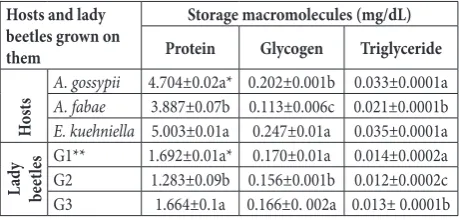
The results of one-way ANOVA revealed differences in the total protein content of various food sources (p<0.01) (Table 1). E. kuehniella eggs and A. gossypii had higher total protein contents than A. fabae. How-ever, A. fabae, with the lowest triglyceride content (0.021±0.0001 mg/dL), showed statistically significant differences compared to the other two hosts (p<0.01). Generally, the E. kuehniella eggs had significantly high-er glycogen contents than the aphids (p<0.01) (Table 1).
Biochemical parameters of Adalia decempunctata
reared on three host species
The total protein content of A. decempunctata reared on different food sources were significantly different
Table 1. The mean (±SE) values of storage macromolecules in
different hosts and in A. decempunctata females reared on hosts at 24°C.
Hosts and lady beetles grown on them
Storage macromolecules (mg/dL)
Protein Glycogen Triglyceride
Hos
ts A. gossypiiA. fabae 4.704±0.02a* 0.202±0.001b 0.033±0.0001a3.887±0.07b 0.113±0.006c 0.021±0.0001b
E. kuehniella 5.003±0.01a 0.247±0.01a 0.035±0.0001a
Lady beetl
es G1** 1.692±0.01a* 0.170±0.01a 0.014±0.0002a
G2 1.283±0.09b 0.156±0.001b 0.012±0.0002c
G3 1.664±0.1a 0.166±0. 002a 0.013± 0.0001b
*Means followed by different letter in each column (for three hosts and lady beetles) are significantly different Tukey test, P<0.05). **G1-G3 (Groups 1-3 of females A. decempunctata reared on A. gossypii, A. fabae,
(p<0.05). The highest total protein contents were re-corded for females reared on A. gossypii (1.692±0.01 mg/dL) and E. kuehniella eggs (1.664±0.01 mg/dL). The lowest total protein content was recorded for females reared on A. fabae (1.283±0.09 mg/dL) (Table 1). Our results also revealed significant differences in triglycer-ide (p<0.01) and glycogen contents (p<0.01) (Table 1). In contrast to A. fabae, the females reared on A. gossypii and E. kuehniella eggs showed higher glycogen contents (0.170±0.01 and 0.166±0.002, respectively) (Table 1).
Biological indices of Adalia decempunctata
Development, survival and oviposition of A. decempunctata
The mean durations of the developmental stages of A. decempunctata bred on A. fabae, A. gossypii and E. kuehniella eggs are presented in Table 2. The results showed that the incubation and prepupal duration was not significantly affected by the host on which lady beetle larva fed (p>0.05). However, the mean developmental period of the fourth-instar and of pre-adult stages in A. decempunctata bred on three host
species differed significantly (p<0.05). The duration of the pre-adult stage was the shortest (18.33±0.19 days) in A. decempunctata beetles fed on E. kuehniella eggs, and the longest (21.82±0.20 days) in lady beetles fed on A. fabae (p<0.05) (Table 2). A paired bootstrap test revealed that A. decempunctata reared on A. gossypii lived longer (96.69±1.72 days for females and 89.1±1.85 days for males), while those fed on A. fabae had shorter longevity (86.96±1.05 days for females and 79.64±1.21 days for males) (p<0.05) (Table 2). Adults of A. decem-punctata fed on different hosts displayed statistically significant differences in their longevities. So, in con-trast to the adults that fed on A. fabae, feeding on A. gossypii resulted in the longest longevity (p<0.05) (Ta-ble 2). The results of the nonparametric Kruskal Wallis test showed statistically significant differences in the weights of emerging females reared on hosts (p=0.0001, x2=17.26). Females that fed on A. gossypii and E. kueh-niella eggs were heavier than those that fed on A. fabae (Table 2). On the other hand, males showed no statisti-cally significant differences in weight between the three hosts (p=0.052, x2=5.899) (Table 2).
Our results also indicated that the host significantly influenced the reproductive attributes of A.
decempunc-Table 2. Means ( ±SE) of development time of different immature
stages, adult longevity (days) and adult weight (mg±SE) of A. decempunctata fed on three hosts at 24ºC.
parameter A. gossypii A. fabae E. kuehniellaeggs
Egg 2.59±0.06a* 2.6±0.06a 2.44±0.06a
First instar 2.41±0.09b 2.75±0.07a 2.27±0.06b
Second instar 2.31±0.12ab 2.56±0.08a 2.05±0.11b
Third instar 2.09±0.10b 2.46±0.07a 1.98±0.07b
Fourth instar 4.53±0.07b 4.9±0.08a 4±0.08c
Prepupa 1.02±0.01a 1.04±0.02a 1a
Pupa 4.83±0.09b 5.51±0.08a 4.64±0.09b
Pre-adult 19.79±0.28b 21.82±0.20a 18.33±0.19c
Adult longevity (all) 93.92±1.37a 83.63±0.93c 88.81±1.61b
Adult (female) 96.69±1.72a 86.96±1.05b 94.09±1.79a
Adult (male) 89.10±1.85a 79.64±1.21b 82.61±2.32b
Female weight 8.8±0.08No. 33 8±0.17No.30 8.5±0. 1No.33
Male weight 7.3±0.17No.19 7±0.11No.25 7.5±0.13No.28
*Means in each row followed by the same letter are not significantly different (paired bootstrap test, P<0.05)
No.=numbers of replicates, adults weights were analyzed by Kruskal-Wallis nonparametric procedure.
Table 3. Reproductive attributes of A. decempunctata females fed
on three hosts at 24ºC.
Biological
parameters A. gossypii A. fabae E. kuehniellaeggs
TPOP (days) 22.12±0.37a* 24.63±0.26b 22.7±0.29a
APOP (days) 2.58±0.10b 2.88±0.11b 4.55±0.11a
Oviposition
period (days) 88.72±1.6a 77.66±1.15c 82.70±1.81b
Fecundity
(eggs/female) 2382.60±50.3a 1876.8±49.71b 2405.12±76.92a
*Means in each row followed by the same letter are not significantly different (paired bootstrap test, P<0.05)
Table 4. Life table parameters (means±SE) of A. decempunctata
fed on three hosts at 24ºC.
Parameters A. gossypii A. fabae E. kuehniella eggs
r (day-1) 0.177±0.005a* 0.155±0.004b 0.171±0.004a
λ (day-1) 1.193±0.006a 1.168±0.005b 1.187±0.005a
R0 (offspring) 873.622±122.16a 632.625±94.67a 881.87±124.39a
T (day) 38.23±0.59b 41.40±0.43a 39.53±0.44b
tata beetles. Similarly, the adult preoviposition period (APOP), the total preovipositional period (TPOP), the oviposition period and fecundity were also influenced (Table 3). The average APOP duration was significantly longer in the lady beetles that fed on E. kuehniella eggs. The females of A. decempunctata bred on A. gossypii and E. kuehniella eggs had a shorter TPOP duration pe-riod than those reared on A. fabae (Table 3). The long-est oviposition period (88.72±1.6 days) was recorded for A. decempunctata beetles fed on A. gossypii, and the shortest oviposition period (77.66±1.15 days) was ob-served for those fed on A. fabae. A lower fecundity was observed in females that fed on A. fabae (1876.8±49.71 eggs/female), while the fecundity rate was higher in females that were reared on A. gossypii (2382.60±50.3 eggs/female) and on E. kuehniella eggs (2405.12±76.92 eggs/female) (p<0.05) (Table 3).
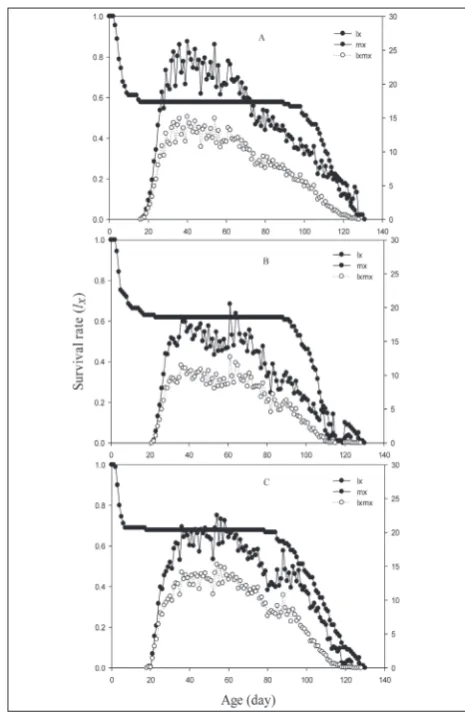
The survival rate (Sxj) of all individuals of A. de-cempunctata fed on three hosts are presented in Fig. 1. Due to variable developmental rates among indi-viduals, the survival rate (Sxj) curves showed overlap. Females exhibited higher survival rates than males on all studied hosts. However, when only females were compared, females that fed on A. gossypii and E. kueh-niella eggshad higher survival rates than those fed on A. fabae (Fig. 1). The lx , mx and lxmx of A. decem-punctata beetles according to the host are presented in Fig. 2. The lx curve indicates that the longest survival rate was 130 days and was recorded for lady beetles that fed on A. gossypii and E. kuehniella eggs versus individuals that fed on A. fabae (Fig. 2). Also, the mx and lxmx curves confirmed that the population of the predator that was reared on A. gossypii and E. kuehn-iella eggs had a higher fecundity. Our results showed
Fig. 1. Age-stage-specific survival rate (Sxj) of A. decempunctata
fed on A. gossypii (A), A. fabae (B) and E. kuehniella eggs (C) at 24ºC.
Fig. 2. Age-specific survival rate (lx), age-specific fecundity (mx)
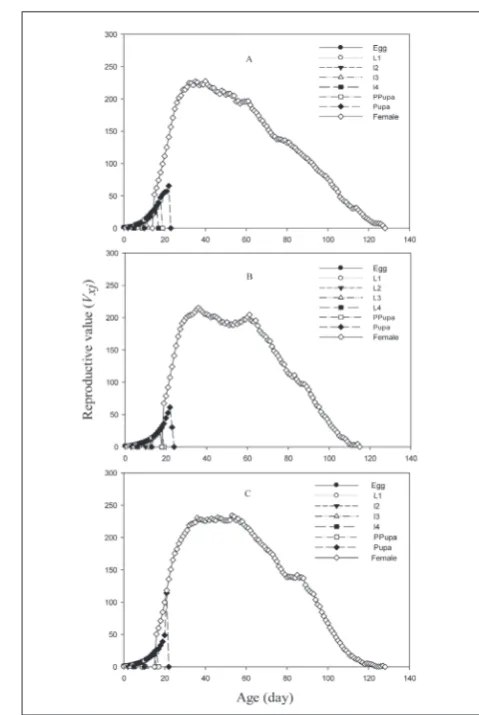
that the highest peak of egg laying by females feeding on A. gossypii (26.28) was at 40 days, for E. kuehniella eggs(22.52) it was at 54 days, and for A. fabae (20.52) it was at 61 days (Fig. 2). Males and females of A. de-cempunctata feeding on A. gossypii had a life expect-ancy of 93.32 and 101.24 days, respectively. However, males and females feeding on E. kuehniella eggs had a life expectancy of 85.14 and 96.24, respectively, and those that fed on A. fabae had a life expectancy of 82.44 and 89.8 days, respectively (Fig. 3). The results of reproductive value (Vxj) showed that females of A. decempunctata contributed immensely to the growth of the population at 40, 53 and 36 days. The reproduc-tive rate increased significantly after commencement of reproduction (Fig. 4).
Population growth parameters
Table 4 summarizes the population growth parameters of A. decempunctata according to the host. The results of the paired bootstrap test showed that the r and λ values were higher for A. decempunctata beetles fed on A. gossypii and E. kuehniella eggs than for those fed on A. fabae. The r value for A. decempunctata beetles varied from 0.177 day-1 for individuals bred on A. gossypii, to 0.155 day-1 for individuals bred on A. fabae. The λ value varied from 1.193 day-1for A. decempunctata beetles that fed on A. gossypii to 1.168 day-1 for those that fed on A. fabae (p<0.05) (Table 4).
It is evident from Table 4 that the T values of A. decempunctata beetles feeding on A. gossypii and E. kuehniella eggs were similar, but they differed
signifi-Fig. 3. Age-stage-specific life expectancy (exj) of A. decempunctata
fed on A. gossypii (A), A. fabae (B) and E. kuehniella eggs (C) at 24ºC.
Fig. 4. Age-stage-specific reproductive value (Vxj) of A.
cantly from those feeding on A. fabae. This parameter was higher for A. decempunctata beetles reared on A. fabae than those reared on the other two hosts. How-ever, the net reproductive rate (R0) of the females of A. decempunctata did not differ significantly according to the host (Table 4).
DISCUSSION
Our findings indicate that A. decempunctata was able to complete its life cycle, reach the adult stage and reproduce successfully in all the three studied hosts. However, the different qualities of food sources sig-nificantly influenced population growth parameters and biology. The shortest total developmental period was recorded in A. decempunctata individuals that were bred on E. kuehniella eggs. The longest period was found in those insects that were bred on A. fabae. Blackman [35] studied various species of aphid in order to choose the most appropriate food source for Adalia bipunctata (L.). The results of that study revealed that different aphids affected the survival rate and growth period of their predator. The short-est and the highshort-est durations of immature develop-mental were recorded on Aulacorthum circumflexum (Buckton) (9.5 days) and Aphis sambuci L. (13.4 days), respectively. Golizadeh and Jafari-Behi [26] also found impacts of three different aphid species (Macrosiphum rosae (L.), A. fabae and A. gossypii) on the biological traits of Hippodamia variegata (Goeze). These results indicated that the total developmental period was the shortest for H. variegata fed on A. gossypii (15.2 days), and the longest in individuals fed on A. fabae (18.9 days). De Clercq et al. [15] and Bonte et al. [36] demonstrated that E. kuehniella eggs were a more ap-propriate host for A. bipunctata than Acyrthosiphon pisum (Harris). The authors arrived at this conclusion based on the better development and lower mortality rates in the lady beetles they studied. Likewise, Wu et al. [37] reported that the type of prey had a significant influence on the developmental period of H. variegata. The same authors even reported a significant effect of host plants on which the aphid A. gossypii was reared. Thus, the developmental period varied from 15.2 to 18.9 days in different host plants.
Host quality is of great importance to female adults. The weight of A. decempunctata females that
fed on A. gossypii was higher than in those that fed on A. fabae. Contrary to our study [21], it was dem-onstrated that male and female adults of H. axyridis reared on E. kuehniella eggs were heavier than those that were reared on A. pisum. The effect of diet on the weight of the females was also reported in A. bipunc-tata fed on different food regimes [36].
Adult longevity was another issue we examined. We found that the diet affected A. decempunctata longevity. Adults that fed on A. fabae showed shorter longevity than those fed on E. kuehniella eggsand on A. gossypii. The influence of the diet on the predators’ longevity was also previously described in H. vari-egata [26].
The results of this study revealed the relationship between the fecundity of A. decempunctata females and a particular host. We report a higher rate of fe-cundity for two hosts, A. gossypii and E. kuehniella eggs, and slightly lower for A. fabae. The higher rate of fecundity could be related to the indirect effect of the plant source that the prey feeds on. Bonte et al. [36] also reported >1800 eggs per A. bipunctata females fed on E. kuehniella eggs. Our results are in agreement with the results of Cabral et al. [38] who determined that Myzus persicae (Sulzer) was a better host than Aleyrodes proletella (L.) for Coccinella undecimpunc-tata (L.) because of the higher fertility, fecundity and longevity. Similarly, De Clercq et al. [15] demonstrated a higher fecundity in A. bipunctata females that fed on E. kuehniella eggs compared to those that fed on A. pisum.
Again the influence of host on shorter TPOP and longer APOP are characteristics of females that fed on E. kuehniella eggs. These results are in agreement with the results of Jalali et al. [39] on A. bipunctata.
The highest r value was recorded for A. decempunc-tata fed on A. gossypii and E. kuehniella eggs, which indicates that these hosts enhanced the growth of this predator’s population. The R0 value of A. decempunc-tata did not significantly vary in different hosts. Also, the significantly high λ value and the lowest T value represent specific parameters for A. decempunctata beetles that fed on A. gossypii and E. kuehniella eggs. Similar results have been reported for other predators [26,38,42]. Phoofolo and Obrycki [43] found that prey quality is of major importance for the reproductive capacity of lady beetles. Females fed on Ostrinia nu-bilalis (Hubner) eggs had the highest r and R0 rates. Thus, O. nubilalis was recognized as an appropriate host for growth and oviposition of female Coleomegilla maculata (De Geer) lady beetles. Our findings are in agreement with several other studies [40,44].
The results of the biochemical assay showed that A. gossypii and E. kuehniella eggs had higher protein, triglyceride and glycogen contents than A. fabae. The quality of the host type affected the energy reserves of emerging females. Females fed on A. gossypii and E. kuehniella eggs during the larval stage contained more total protein, triglycerides and glycogen than those fed on A. fabae. Proteins are essential for re-production, metamorphosis and general maintenance of insects [45]; likewise, glycogen and lipids are also necessary for reproduction, survival, distribution and diapause of insects [46]. Thompson [47] has argued that the quality of food directly affects the pre-adult period and the reproductive capacity in predatory in-sects. Therefore, food sources that are rich in energy reserves have a higher quality and are beneficial for insect growth, development and reproduction. Ac-cording to these data, we conclude that the shorter developmental period, higher r and λ values, fecundity and adult longevity of A. decempunctata fed on A. gos-sypii and E. kuehniella eggs were related to the higher quality of the food sources. It was shown [21] that a low mortality rate in the pre-adult stage of H. ax-yridis fed on E. kuehniella eggs was influenced by the quality of the prey. Chemical assays also confirmed our finding that variations in the protein and lipid contents of E. kuehniella eggs were higher than for A. pisum. The same group of authors also established that females fed on E. kuehniella eggs had higher pro-tein contents than to those fed on A. pisum, which
affected the reproductive capacity (fecundity and fer-tility) of females. Lundgren and Seagraves [48] showed the benefits of food (nectar) on the physiology of C. maculata. They reported a 50% increase in survival and a 30% increase in the fecundity, size and glycogen content of oocytes.
CONCLUSION
In the present study, all hosts were characterized as essential prey species for A. decempunctata beetles by comparing the biological and life-table parameters. This conclusion is based on the observation that feed-ing on A. gossypii, A. fabae and E. kuehniella eggs had positive effects on developmental stages and adult lon-gevity and fecundity. However, because of the higher protein, lipid and glycogen contents, A. gossypii and E. kuehniella eggs were better hosts. Further investiga-tions are necessary in order to evaluate the predatory potential of A. decempunctata beetles for the control of aphids in agroecosystem and natural environment.
Funding: This research did not receive any specific grant from
funding agencies in the public, commercial or not for profit sec-tors.
Acknowledgments: This study is a part of PhD dissertations in
the University of Guilan. We would like to thank the authorities of the Department of Plant Protection, the Faculty of Agricultural Sciences, University of Guilan and the Iranian Research Institute of Plant Protection, Tehran, Iran for providing us with research facilities and for their financial support.
Author contributions: ZM-H and JJS designed the study, ZM-H
performed the experiments and analyzed the data. All authors wrote the manuscript and approved the final version.
Conflict of interest disclosure: All authors of the present paper
confirm no actual or potential conflicts of interest, including any financial, personal, or other relationships with people or organi-zations.
REFERENCES
1. Hodek I. Biology of Coccinellidae. Praha: Academia publish-ing house of the Czechoslovak Academy of Sciences; 1973. 260 p.
2. Nikitsky NB, Ukrainsky AS. The ladybird beetles (Cole-optera, Coccinellidae) of Moscow Province. Entomol Rev. 2016;96:710-35.
popula-tion fluctuapopula-tions and the effect of competipopula-tion from an inva-sive non-native species. Insect Conserv Diver. 2016;9:202- 9. 4. Magro A, Araujo J, Hemptinne JL. Coccinellids (Coleop-tera: Coccinellidae) in citrus groves in Portugal: listing and analysis of geographical distribution. Bol San Veg Plagas. 1999;25:335-45.
5. Honek A. Habitat preferences of aphidophagous Coccinel-lids (Coleoptera). Entomophaga. 1985;30(3):253-64. 6. Prodanović DJ, Protić L, Mihajlović L. Predatori i parazitoidi
Cacopsylla pyri (L) (Hemiptera: Psyllidae) u Srbiji. Pestic Phytomed. 2010;25:29-42. Serbian
7. Kacar G. Survey of coccinellid species and their preys in olive groves in Turkey. Egypt J Biol Pest Control. 2015;25:157-61. 8. Salehi T, Pashaei Rad SH, Mehrnejad MR, Shokri MR. Lady-birds associated with pistachio trees in part of Kerman prov-ince, Iran (Coleoptera: Coccinellidae). Iran J Anim Biosyst. 2011;7:157-69.
9. Mohamadpoor A, Jafari R, Biranvand A, Zare M, Rafiei Karahrudi Z. Ladybirds associated with pomegranate trees in Lorestan province of Iran (Coleoptera: Coccinellidae). Int J Appl Basic Sci. 2013;5:1585-89.
10. Pahlavanyali K, Pashai rad S, Zare Khormizi M, Mojib-Haghghadam Z, Heidari Latibari M, Hanly YG. Research on Coccinellidae (Coleoptera) fauna in Mazandarn province. Iran J Biol Control. 2017;31:123-7.
11. Nelson EH, Rosenheim JA. Encounters between aphids and their predators: the relative frequencies of disturbance and consumption. Entomol Exp Appl. 2006;118:211-9.
12. Blackman RL, Eastop VF. Aphids on the world’s crops: an identification and information guide. John Wiley & Sons; 2000. 476 p.
13. Cabral S, Soares AO, Garcia P. Predation by Coccinella undecimpunctata L. (Coleoptera: Coccinellidae) on Myzus persicae Sulzer (Homoptera: Aphididae): effect of prey den-sity. Biol Control. 2009;50:25-9.
14. Simberloff D, Stiling P. How risky is biological control? Ecol-ogy. 1996;77:1965-74.
15. De Clercq P, Bonte M, Van Speybroeck K, Bolckmans K, Deforce K. Development and reproduction of Adalia bipunc-tata (Coleoptera: Coccinellidae) on eggs of Ephestia kuehni-ella (Lepidoptera: Phycitidae) and pollen. Pest Manag Sci. 2005;61:1129-32.
16. Kalushkov P, Hodek I. New essential aphid prey for Anatis ocellata and Calvia quatuordecimguttata (Coleoptera: Coc-cinellidae). Biocontrol Sci Technol. 2001;11:35-9.
17. Obrycki JJ, Orr CJ. Suitability of three prey species for Nearctic populations of Coccinella septempunctata, Hippo-damia variegata, and Propylea quatuordecimpunctata (Cole-optera: Coccinellidae). J Econ Entomol. 1990;83:1292-7. 18. Michaud JP. On the assessment of prey suitability in
aphi-dophagous Coccinellidae. Eur J Entomol. 2005;102:385-90. 19. Hodek I, Honêk A. Ecology of Coccinellidae. Kluwer
Aca-demic Publishers, Netherlands; 1996. 464 p.
20. Dixon AFG. Insect predator-prey dynamics: ladybird beetles and biological control. Cambridge University Press; 2000. 257 p.
21. Specty O, Febvay G, Grenier S, Delobel B, Piotte C, Pageaux JF, Guillaud J. Nutritional plasticity of the predatory lady-beetle Harmonia axyridis (Coleoptera: Coccinellidae):
com-parison between natural and substitution prey. Arch Insect Biochem Physiol. 2003;52:81-91.
22. Hamasaki K, Matsui M. Development and reproduction of an aphidophagous coccinellid, Propylea japonica (Thunberg) (Coleoptera: Coccinellidae), reared on an alternative diet, Ephestia kuehniella Zeller (Lepidoptera: Pyralidae) eggs. Appl Entomol Zool. 2006;41:233-7.
23. Bellows Jr TS, Van Driesche RG, Elkinton JS. Life-table con-struction and analysis in the evaluation of natural enemies. Annu Rev Entomol. 1992;37:587-612.
24. Carey JR, Vargas RI. Demographic analysis of insect mass rearing: a case study of three tephritids. J Econ Entomol. 1985;78:523-7.
25. Lido P, Carey JR. Mass rearing of Anastrepha (Dip: Tephri-tidae). Fruit flies: a demographic analysis. J Econ Entomol. 1994;87:176-80.
26. Golizadeh A, Jafari-Behi V. Biological traits and life table parameters of variegated lady beetle, Hippodamia variegata (Coleoptera: Coccinellidae) on three aphid species. Appl Entomol Zool. 2012;47:199-205.
27. Lowry OH, Rosebrough NJ, Farr AL, Randall RJ. Protein measurement with the Folin phenol reagent. J Biol Chem. 1951;193:265-75.
28. Fossati P, Prencipe L. Serum triglycerides determined colori-metrically with an enzyme that produces hydrogen peroxide. Clin Chem. 1982;28:2077-80.
29. Chun Y, Yin ZD. Glycogen assay for diagnosis of female genital Chlamydia trachomatis infection. J Clin Microbiol. 1998;36:1081-2.
30. Chi H, Liu H. Two new methods for the study of insect population ecology. Bull Inst Zool Acad Sin. 1985;24:225-40. 31. Chi H. Life-table analysis incorporating both sexes and vari-able development rates among individuals. Environ Ento-mol. 1988;17:26-34.
32. Goodman D. Optimal life histories, optimal notation, and the value of reproductive value. Am. Nat. 1982;119:803-23. 33. Chi H, Su HY. Age-stage, two-sex life tables of Aphidius
gifuensis (Ashmead) (Hymenoptera: Braconidae) and its host Myzus persicae (Sulzer)(Homoptera: Aphididae) with mathematical proof of the relationship between female fecundity and the net reproductive rate. Environ. Entomol. 2006;35:10-21.
34. Polat Akköprü E, Atlıhan R, Okut H, Chi H. Demographic assessment of plant cultivar resistance to insect pests: a case study of the dusky-veined walnut aphid (Hemiptera: Callaphididae) on five walnut cultivars. J Econ Entomol. 2015;108:378-87.
35. Blackman RL. The effects of different aphid foods on Adalia bipunctata L. and Coccinella 7-punctata L. Ann Appl Biol. 1967;59:207-19.
36. Bonte M, Samih MA, De Clercq P. Development and repro-duction of Adalia bipunctata on factitious and artificial foods. BioControl. 2010;55:485-91.
37. Wu XH, Zhou XR, Pang BP. Influence of five host plants of Aphis gossypii Glover on some population parameters of Hip-podamia variegata (Goeze). J Pest Sci. 2010;83:77-83. 38. Cabral S, Soares AO, Moura R, Garcia P. Suitability of Aphis
Coc-cinella undecimpunctata (Coleoptera: Coccinellidae). Biol Control. 2006;39:434-40.
39. Jalali MA, Tirry L, De Clercq P. Effects of food and tem-perature on development, fecundity and life table parameters of Adalia bipunctata (Coleoptera: Coccinellidae). J Appl Entomo. 2009;133:615-25.
40. Zohdi H, Hossiani R, Sahraghard A, Mohammadi AH. The effect of different diets on the parameters of the life table ladybeetle Oenopia conglobata contaminate (Menteries). J Plant Protect. 2017;31:74-80.
41. Southwood TRE, Henderson PA. Ecological methods. Oxford, UK: John Wiley & Sons; 2000. 575 p.
42. Abdel–Salam AH, Abdel–Baky NF. Life table and biologi-cal studies of Harmonia axyridis Pallas (Col., Coccinellidae) reared on the grain moth eggs of Sitotroga cerealella Olivier (Lep., Gelechiidae). J Appl Ent. 2001;125:455-62.
43. Phoofolo MW, Obrycki JJ. Comparative prey suitabil-ity of Ostrinia nubilalis eggs and Acyrthosiphon pisum for Coleomegilla maculata. Biol Control. 1997;9:167-72. 44. Parizi EM, Madadi H, Alahyari H, Mehrnejad MR. A
Com-parison of life history parameters of Hippodamia variegata feeding on either Aphis gossypii Glover or Acyrthosiphon pisum. Iran J Plant Protect Sci. 2012;43:73-81.
45. Klowden MJ. Physiological systems in insects. 2nd ed. New York: Academic Press; 2007. 688 p.
46. Arrese EL, Soulages JL. Insect fot body: Energy metabolism and regulation. Annu Rev Entomol. 2010;55:207-25. 47. Thompson SN. Nutrition and culture of entomophagous
insects. Annu Rev Entomol. 1999;44:561-92.