PLEASE CITE AS: van Straaten, D., Wilschut, A., & Oostdam, R. (2018). Exploring pedagogical approaches for connecting the past, the present and the future in history teaching. Historical Encounters: A journal of historical consciousness, historical cultures, and history education, 5(1), 46-67.
ISSN 2203 7543 | © Authors | This work is licensed under a Creative Commons Attribution 3.0 Unported License
Publication Date: 28 June 2018 | Available Online: http://hej.hermes-history.net
Exploring pedagogical approaches for
connecting the past, the present and the future
in history teaching
Dick van Straaten
University of Amsterdam & Amsterdam University of Applied Sciences
Arie Wilschut
Amsterdam University of Applied Sciences
Ron Oostdam
University of Amsterdam & Amsterdam University of Applied Sciences
ABSTRACT: Using the past to orientate on the present and the future can be seen as one of history’s
main contributions to educating future citizens of democratic societies. Because tools for pursuing this goal are scarce, this study explores three pedagogical approaches that may help teachers and students to make connections between the past, the present and the future: working with longitudinal lines, with enduring human issues and with historical analogies. The efficacy of these approaches was examined in three case studies conducted in two Dutch secondary schools with eighth- to tenth-grade students (N=135) and their teachers (N=4) as participants. Explorations took place within the boundaries of the existing history curriculum and in close collaboration with the teachers who participated because they felt a need to motivate their students by means of a pedagogy to make history more useful. Findings suggest that working with longitudinal lines and enduring human issues in a traditional history curriculum with chronologically ordered topics is more complicated than working with historical analogies. The historical analogy approach appears to have most potential to encourage students to use the past to reflect on present-day affairs. In terms of students’ appraisals of the relevance of history, the application of the enduring human issue approach showed positive effects.
KEYWORDS: History Teaching; School Subject Relevance; Curriculum Innovation; Secondary
School Education.
Introduction
past and mastering historical thinking skills as aims in themselves. Standards specify which historical knowledge students should learn without exemplifying possible relationships with meaningful contemporary contexts. The compilers of curriculum documents apparently assume that learning about the past yields insights into the present and future as a matter of course, taking knowledge transfer beyond subject-specific contexts for granted without any explicit learning activities directed at achieving this aim.
Such expectations may not be justified. In the wake of philosophical studies about historical consciousness and the temporal dimension of the human condition, an increasing body of empirically based knowledge is available about ways in which students (and people in general) use the past to orient on the present and the future. For example, a survey conducted by Rosenzweig (2000) showed that although the past had a strong influence on the way people think, very few people derived meaning from history taught at school. Findings from the project Usable Historical Pasts, conducted by Foster, Ashby and Lee (2008), revealed that only a small number of students referred to history while reflecting on contemporary issues. In Germany, Denmark and the Netherlands, a large proportion of 14-year-olds in the 1990’s thought that history is ‘dead and gone and has nothing to do with my present life’ (Angvik & Von Borries, 1997, p. B26). Studies in England and North America suggest that students have limited views on the purposes and benefits of history and have difficulty to articulate why studying the past matters (Barton & Levstik, 2011; Biddulph & Adey, 2003; Harris & Reynolds, 2014; Haydn & Harris, 2010; Zhao & Hoge, 2005). In short, there are ample reasons for actively linking the past to the present and the future to enable students to construct narratives that make sense to them. ‘Usable historical pasts’ may enhance student motivation as well, as recognising the utility of classroom tasks in terms of applicability in ‘real life’ is what encourages students to learn and what they deem important in valuing the usefulness of school subjects (Brophy,1999; Pintrich, 2003).
Given the fact that students are not inclined to attribute meaning to history of their own accord and therefore need guidance, the question arises how teachers may help them pursuing this goal. In earlier work, we have distinguished three pedagogical approaches for making connections between the past, present and future (Van Straaten, Wilschut, & Oostdam, 2016). In this study, we explore the efficacy of these approaches in a traditional history curriculum with chronologically ordered topics and a strong focus on memorising historical data. Our aim is to find out whether the approaches can be applied effectively in existing educational settings or whether major curriculum revisions are required. We use three indicators to examine this issue: (1) the extent to which students apply historical content knowledge while reasoning about current affairs; (2) teacher’s experiences with the approaches in view of student learning and meeting curriculum demands; and (3) students’ beliefs and attitudes vis-à-vis the relevance of history.
Obstacles to connecting the past, present and future
Several factors may explain why students are not inclined to link the past to the present and the future. First, a lack of readily available knowledge probably plays an important role. Discerning long-term historical developments that have shaped the present, for example, puts high demands on the amount of historical knowledge that students have at their disposal.
the last 2000 years. One student commented: ‘I can’t do this. My knowledge does not stretch out as far as 2000 years’ (Foster, Ashby, & Lee, 2008, p. 6).
Second, linking the past to the present and future requires thinking in long-term patterns of continuity and change and the ability to generalize, for example by comparing what people in the past and people in the present have in common. There is abundant evidence showing that students’ epistemological beliefs about the past may present an obstacle for this kind of mental operations (e.g. Barton, 2008; Blow, 2009; Lee, 2005; Maggioni, Alexander & VanSledright, 2004; Sandahl, 2015; Shemilt, 2009; Stoel, Logtenberg, Wansink, Huijgen, Van Boxtel, & Van Drie 2017). For example, students perceive images of the past as ‘fixed’, i.e., as a closed entity of given dates and facts about a world ‘out there’ that bears little relation with the ‘real’ world; it seems difficult for them to grasp the notion that history is the product of constructing narratives that serve contemporary needs and interests. Their historical thinking is hallmarked by events following each other in a causal chain without alternatives, not by the interplay of change and continuity. They look for historical explanations in people’s actions, not in conditions, developments or changes.
Third, many history curricula are based upon chronologically ordered topics which are usually separately taught, leaving little room for teaching developmental lines from the past to the present or comparative, generalizing learning activities that may help students to attribute meaning to the past (Carroll, 2016). Blow (2009), among others, propagates a radical reshaping of existing history curricula aiming at teaching large spans of time (‘big pictures’) rather than single topics offering a mass of details which are inapplicable in multiple contexts and impede students’ ability to generalise. Useful tools in teaching ‘big pictures’ are, according to Blow (2009) and Lee (2005), a well-developed vocabulary of second order concepts (e.g., change, continuity, cause and effect) and the deployment of historical analogies as a means to empower abstract thinking (Blow, 2009; Lee, 2005).
Pedagogical approaches for connecting the past, present and future
Based on the problem analysis described above and on research literature in the field of history education, we have identified three pedagogical approaches that may help students and teachers to use the past to orientate on the present and the future (Van Straaten, Wilschut, & Oostdam, 2016):
- Working with enduring human issues (EHI) that have been addressed by people in past and present times either in similar or different manners, such as social inequality or issues of crime and punishment.
- Working with longitudinal lines (LL) describing long-term political, socio-economical or cultural developments, for example, the emergence of national states or the process of secularization and scientification leading to the ‘disenchantment of the world’ (MacKinnon, 2001).
- Working with historical analogies (HA) between the past and the present, for example, in the context of European unification, an analogy between the Roman Empire and the European Union.
Enduring human issues
History is about mankind in other times: very different from today, but also similar because people have always shared fundamental aspects of being human. Dressel (1996) distinguishes eleven basic human experiences: space and time, religion, family, food, dealing with nature, the human body, sexuality, labor, conflicts, gender and encounters with strangers. Such issues are common to all human beings, but the way in which people have dealt with them differs from time to time. Studying contrasting examples of dealing with the same enduring issue may expand students’ frames of reference.
There have been several proposals for designing a curriculum based on enduring human issues. For example, Hunt (2000) put forward a curriculum based on ‘ageless social, moral and cultural issues’ (p. 39) to be studied with key concepts and key questions, such as why people obey laws or why governments levy taxes. Barton and Levstik (2011) suggest that history education may become meaningful if students are confronted with ‘enduring themes and questions’ (p. 3), such as the interaction between man and his environment, or the development of cultures and societies. Obenchain, Orr, and Davis (2011) developed teaching about ‘essential questions’ in cooperation with teachers – for example: the question of the grounds on which freedom may be curtailed. In similar projects, teachers and researchers have designed curricula based on ‘big ideas’ (Grant & Gradwell, 2010) or ‘persistent issues’ (Brush & Saye, 2014). In English history teaching it has become increasingly common to build lesson units around ‘enquiry questions’ that can promote the study of problems instead of periods (Carroll, 2016). What all these examples have in common is the use of the past in reflections on enduring human issues.
Longitudinal lines
Longitudinal lines should not be confused with historical overview knowledge without any explicit organizing principle or specific question to the past. Overview knowledge without an explicit narrative structure probably does not serve the purpose of making connections between past, present and future. Shemilt (2009) proposes synoptically described, millennia-wide lines of change under themes such as modes of production, or political and social organization. Lee and Howson (2009) also argue for diachronic narratives about certain themes or topics. They assume that by using these kinds of frameworks, students will not only be able to extrapolate long lines of developments into the future, but also reflect upon their own future role as (e.g.) an office employee compared to a stone age hunter, a medieval farmer, a 16th-century craftsman or a 19th-century factory worker.
While Nuttall’s experiment only encompassed the history of the 20th-century, Carroll (2016) designed a lesson unit focusing on the topic of slavery from the beginnings of humanity to the present. Students first took notice of the ‘whole story’ of slavery and then studied the Haitian Revolution in depth driven by the question whether this revolution should be remembered of forgotten. This procedure, combining a millennia-wide framework with attributing significance to a specific historical event, allowed investigations on how students tend to use a pre-taught framework. It appeared that students were able to construct coherent long-termed narratives of slavery, although some were distracted by specific topics and details. Relying on their overview knowledge, students considered the Haitian Revolution significant because in the 5000-year history of slavery, it was one of the unique occasions in which a slave rebellion succeeded. Furthermore, they drew lines from the Haitian Revolution to later historical episodes and their own life, for example by stating that the revolution had paved the way for the 18th century abolitionist movement or for present-day human rights which they deemed to be of great value.
Historical analogies
Analogic thinking can be described as the ability to identify similar features and connections between them across cases or examples (Gentner, 2010). Analogic thinking has proven to be a powerful learning tool and an effective way to facilitate transfer of knowledge to novel situations (Alfieri, Nokes-Malach, & Schunn, 2013); it may therefore be a useful teaching strategy for making connections between the past, the present and the future.
If analogies are drawn between something comparatively known and something comparatively unknown, the first is called ‘source’ or ‘base’ and the second ‘target’ (Holyoak & Taggart, 1997). Three types of analogies are usually applied in history classes: (1) something mundane from the present as base and a historical phenomenon as target, for example, a marriage of interests and the Concordat between Mussolini and the Pope (Laffin & Wilson, 2005); (2) historical events that show similarities, such as the failed attempts of Charles XII of Sweden, Napoleon and Hitler to conquer Russia (Mugleston, 2000); and (3) something from the past as base and something from the present as target, for example, Japanese kamikaze pilots during World War II and the terrorists who committed the attack on New York in 2001 (Robbins, 2004). The limited number of studies available suggests that teachers prefer using the first two of these types (Ata, 2009; Myson, 2006). The third type seems to be less common than the other two types, probably because it is more complicated.
If using the past to orientate on the present and future is what history education should pursue, making analogies of the first two types may be useful if they reveal general features of phenomena. For example, Boix-Mansilla (2000) made students compare the history of the Holocaust with the history of the genocide in Rwanda in 1994. This comparison induced students to think about human nature and the circumstances in which atrocities like these can occur. In their zeal to find an explanation for the genocide in Rwanda, many students disregarded the differences between the two genocides. Therefore, it should be pointed out that in making analogies not only the similarities may be illuminating, but also the differences. Taking differences into account may prevent students from generalizing in a simplistic way.
human issues entail developing moral opinions, whereas historical analogies foster the understanding of phenomena.
Study design and research questions
Implementing the three pedagogical approaches may require profound curriculum revisions. For example, drawing longitudinal lines calls for a diachronically ordered curriculum rather than a curriculum of separate chronologically ordered topics. Enduring human issues may require the use of generic concepts instead of learning factual knowledge specifically confined to topical contexts. For this study, however, we decided not to reshape the curriculum for the sake of research purposes only. We wanted to stay close to daily teaching practices and took the extant Dutch history curriculum as a starting point. Teachers have to operate within the limits of this curriculum and will be interested in research results applicable to existing educational settings. We applied a design research approach (McKenney & Reeves, 2012) implying that lesson interventions were constructed in close collaboration with teachers. To be able to reach a maximum of ecologically realistic exploration, the interventions were conducted within the boundaries of existing lesson programs with a minimum of changes and adapted to specific classroom settings after extensive consultations with the teachers. This practice-orientated approach in which researchers and teachers collaborate in authentic school settings may contribute to narrowing the gap between educational research and practice (Broekkamp & Van Hout-Wolters, 2007).
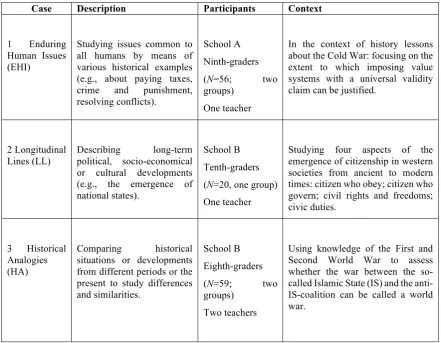
Table 1 specifies the assignment of the pedagogical approaches to the student groups. Because the groups varied in grade and were taught different topics, explorations of the approaches took place in different classroom settings. Therefore, contextual conditions being relevant, the explorations are to be understood as case studies. Analysing data across settings was not possible in the way it would have been in a multiple case study because of the difference in classroom settings (Yin, 2014). Taking this into account, we formulated research questions that were identical for all three case studies:
1. To what extent do students apply knowledge about the past in their orientation on current affairs?
2. How do teachers experience applying the approach in their daily teaching practice, i.e., within a traditional history curriculum organized around chronologically ordered topics and focusing primarily at memorising historical data?
3. Does application of the approach affects students’ appraisals of the relevance of history?
These questions serve the main purpose of this study, i.e., to explore whether employing the three pedagogical approaches within the boundaries of existing programs is feasible without major curriculum revisions. They can be seen as indicators of effectiveness. If students hardly refer to historical knowledge while contemplating present-day issues or if teachers notice serious implementation problems, for example, we assume limited effects and take major curriculum adaptations into consideration. The third question seems to be less imperative in this respect. ‘Relevance’ is conceived here as recognising what history has to do with oneself, with today’s society and with a general understanding of human existence (Van Straaten, Wilschut, & Oostdam, 2016). Based on educational philosophical and constructive learning theories on meaningful learning elaborated in earlier work, we assume that through connecting the past to the present and the future, students might see the relevance of history more clearly (Van Straaten, Wilschut, & Oostdam, 2016). In other words, students’ appraisals of the relevance of history are indicative for the effectiveness of the applied approaches.
Case Description Participants Context
1 Enduring Human Issues (EHI)
Studying issues common to all humans by means of various historical examples (e.g., about paying taxes, crime and punishment, resolving conflicts).
School A Ninth-graders
(N=56; two groups)
One teacher
In the context of history lessons about the Cold War: focusing on the extent to which imposing value systems with a universal validity claim can be justified.
2 Longitudinal Lines (LL)
Describing long-term political, socio-economical or cultural developments (e.g., the emergence of national states).
School B
Tenth-graders (N=20, one group) One teacher
Studying four aspects of the emergence of citizenship in western societies from ancient to modern times: citizen who obey; citizen who govern; civil rights and freedoms; civic duties.
3 Historical Analogies (HA)
Comparing historical situations or developments from different periods or the present to study differences and similarities.
School B Eighth-graders (N=59; two groups)
Two teachers
Using knowledge of the First and Second World War to assess whether the war between the so-called Islamic State (IS) and the anti-IS-coalition can be called a world war.
Table 1. Three case studies on pedagogical approaches for connecting the past, present and future.
Method
Educational context
The case studies were conducted in three tracks of Dutch secondary education. i.e., lower secondary pre-vocational education (VMBO), middle level general secondary education (HAVO) and pre-university secondary education (VWO). Pivotal to the Dutch history curriculum in these tracks is a frame of reference knowledge organized around ten eras, beginning with the ‘era of hunters and farmers’ and ending with the ‘era of television and computer’ (Wilschut, 2009, 2015). Each era has its characteristic features, e.g., ‘feudalism’ for ‘the era of monks and knights’ (early Middle Ages), or ‘industrial revolution’ for ‘the era of citizens and steam engines’ (19th century). This frame of reference knowledge is designed to enable students to orientate in time and space, i.e., to contextualize historical data. Aspects of historical thinking, such as causation, empathy and change, are also part of the curriculum.
educational conditions, this study’s pedagogical approaches for connecting past, present and future were innovative practices for both students and teachers.
Participants and settings
Because the interventions consisted of additions to the regular curriculum, we only describe the alterations that were made in the context of this research. Students used their history textbooks in all three case studies. Additional lesson materials were written by the first author, who also formulated the statements students had to comment on in order to measure the extent to which they used historical knowledge (RQ1). All statements are presented in Appendix A.
Case study 1 was conducted in two student groups from a secondary school located in a mid-sized city in the eastern part of the Netherlands. The participants were 56 ninth-graders from middle level and pre-university education (18 males, 38 females; mean age 14.20 years, SD = .45). In this group we explored the enduring human issues approach. In accordance with the era framework, students studied the history of the Cold War (with standard topics such as the Truman Doctrine, the Korean War and the nuclear arms race) in eight textbook lessons of 50 minutes each. To this standard programme we added teaching instructions, texts and tasks about an enduring human issue related to the Cold War, i.e., the extent to which imposing by the authorities of value systems with a universal validity claim can be justified. After all, the Cold War can be seen in terms of a clash between two inherently expansionistic value systems (Gaddis, 2005). The issue of imposing value systems has played a role throughout history and has lost none of its significance, which makes it an enduring human issue.
In the first six regular lessons about the Cold War subject matter related to the enduring issue was highlighted, for example, Truman’s motives to announce his ‘doctrine’, McCarthy’s to prosecute communists or Ulbricht’s to fence East Germany. Prior to these lessons, the issue was introduced to the students with a brief text (specifically written for this purpose) about covert CIA-operations during the so-called War on Terror. After reading this text, students were instructed to execute a writing task that consisted of commenting on statements related to the enduring issue. After completing the lessons, they had to reconsider their initial comments. To see whether they would use historical knowledge spontaneously, students were not prompted to refer to content knowledge. The remaining two lessons addressed the rise of communist China and the collapse of the Soviet Union. After completing these lessons, students had to consider the viability of communism in China. They had to write a comment of approximately 250 words on the statement that 10 years from now China would no longer be a communist state. In preparation for this writing task, they read a text about current socio-economic and political affairs in China. The students were explicitly instructed to refer to historical content knowledge to see if that would make any difference.
Case study 2 was conducted in a secondary school located in a suburbanized area in the western part of the Netherlands. In this study, we examined the application of the longitudinal lines approach in a group of tenth-grade students from the middle level track (N = 20; 7 males, 13 females; mean age 15.85 years, SD = .81). These students had completed the reference knowledge frame (from ‘hunters and farmers’ to ‘television and computer’), so working with longitudinal lines enabled them to review overview knowledge. In 12 lessons of 50 minutes each, they focused on four aspects of the development of citizenship in western history (Isin & Turner, 2002): subjects who obey; citizens who govern; civil rights and freedoms; and civic duties. For example, ‘citizens who govern’ addressed the development of ideas about self-government from ancient Greece to Western Europe in the 18th and 19th century. ‘Subjects who
Mesopotamian city states, in France during the reign of Louis XIV or in Germany during Nazi rule. For each of the four aspects, the focus was on long-term developments and patterns of change and continuity in history. These developments were described for the purpose of this study in order to enable the teacher to support her lecturing. Students were given worksheets with chronologically ordered writing spaces (one worksheet for each aspect of citizenship). During the teacher’s lectures, the worksheets enabled students to arrange their notes in such a way that it became possible for them to identify long-term developments of citizenship. The students used the regular textbook as a reference work, for example, to retrieve historical knowledge needed to understand the lectures. They were given the task to write comments on general issues related to the four aspects of citizenship. They were explicitly instructed to refer to historical content knowledge.
Case study 3 was carried out in the same school as the one for case study 2 but with different teachers and different students. In this study the historical analogy approach was explored in two groups of eighth-grade students from the lower pre-vocational track (N = 59; 32 males, 27 females; mean age 13.57 years, SD = .68). These students studied the First and Second World War in regular history classes (eight lessons of 50 minutes each). Under supervision of their teachers, they drew several analogies between the World Wars and present-day phenomena. Our data consist of analogies made by students between the World Wars and the war of the US-led coalition forces against the so-calUS-led Islamic State (IS) which began in 2014. Students had to decide if the war against IS can be considered a world war and if knowledge of the military ending of the Second World War can be useful for contemplating how the war against IS might end. In addition to their textbooks, they read a text (specially written for this study) about the contemporary situation of the Middle East conflict.
Data collection and analysis
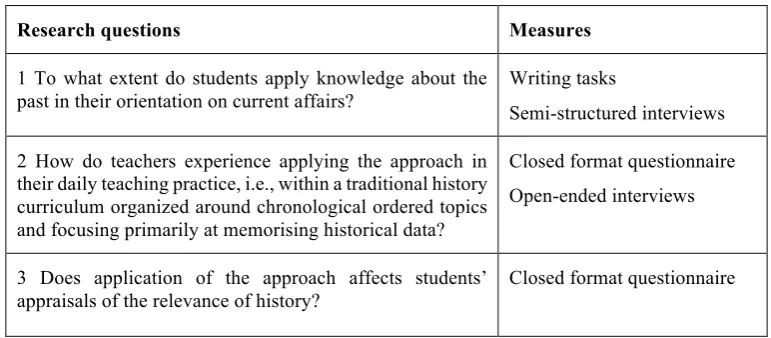
We used mixed methods combining quantitative data collected by means of closed format questionnaires and qualitative data collected from writing tasks and semi-structured and open-ended interviews (see Table 2).
Research questions Measures
1 To what extent do students apply knowledge about the past in their orientation on current affairs?
Writing tasks
Semi-structured interviews
2 How do teachers experience applying the approach in their daily teaching practice, i.e., within a traditional history curriculum organized around chronological ordered topics and focusing primarily at memorising historical data?
Closed format questionnaire Open-ended interviews
3 Does application of the approach affects students’ appraisals of the relevance of history?
Closed format questionnaire
Table 2. Research questions and measures.
completion took approximately 20 minutes and was guided by the teacher. In the post-test, the teacher returned the pre-test writings to the students and asked them whether they wanted to make any changes to their initial comments. Both students who made changes and students who stuck to their comments had to explain their choices. These explanations were analysed by counting the number of students who referred to content knowledge. The same method was applied in case study 3 in which the writing task was used in a post-test setting only. For determining whether or not students referred to historical knowledge, we looked for explicit wordings of content knowledge. For example, in case study 1 only comments which contained substantive concepts pertaining to the history of the Cold War were counted as historical knowledge references. Thus, the comment ‘[…] you have to do it without violence otherwise you will get a Cold War again’ on the statement whether countries have the right to defend their own way of life was considered as a reference whereas ‘everyone is entitled to their own way of living and thinking […]’ was not.
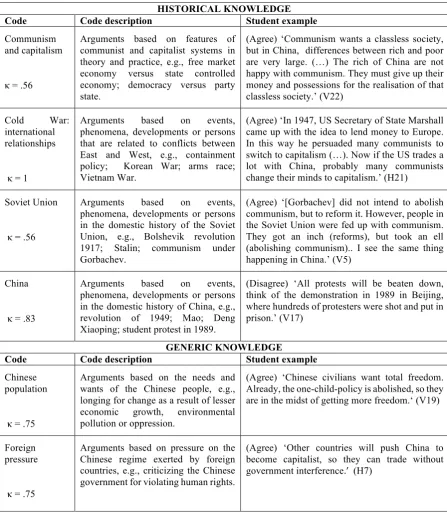
A coding scheme was used to analyse the writing task about the viability of communism in China (see Table 3). Two main categories (‘historical knowledge’ and ‘generic knowledge’) were divided into subcategories arising from the contents of the writings, which enabled us to analyse student reasoning in more detail. Two raters, being the first two authors, coded a randomly selected set of 12 writing tasks. With Cohen’s Kappa varying from .56 to 1, interrater reliability was between moderate and very strong (Landis & Koch, 1977). Agreement was reached by deliberation in cases where the assignments of the raters did not correspond.
Finally, 14 randomly selected students participating in case study 1 were interviewed. They were asked to explain why they had or had not referred to the Cold War in their comments. The students were interviewed in groups (three groups of four and one group of two) to make them feel at ease and to encourage engagement and stimulate a richer response (Frechtling & Sharp, 1997). Each interview took approximately 20 minutes. The interviews were recorded, transcribed verbatim and analysed bearing the key question in mind.
RQ 2 | A closed format questionnaire (see Appendix B) was used to find out what motivated the teachers to join the research project and whether they thought participation was useful in view of their daily teaching practice. The questionnaire was implemented anonymously by means of an online survey tool. All teachers responded. The teachers who participated in case studies 2 and 3 were interviewed. The teacher involved in case study 1 reported in writing on her findings with the lesson intervention. The teacher interviewees were asked to respond to the research findings that were presented to them. We assumed that by explaining these findings, they would be triggered to talk frankly about students’ performances and motivation during the intervention lessons. The second part of the interviews addressed teachers’ experiences with the pedagogical approaches. The guiding question was whether they thought implementing these approaches in the regular curriculum was desirable and feasible. Each interview lasted 50 minutes. The interviews were recorded and transcripts were analysed, keeping in mind the above-mentioned topics.
‘completely disagree’ to ‘completely agree’. The RHMS has been validated in a large-scale study involving 1459 Dutch students (Van Straaten, Wilschut, & Oostdam, 2018).
HISTORICAL KNOWLEDGE Code Code description Student example
Communism and capitalism
κ = .56
Arguments based on features of communist and capitalist systems in theory and practice, e.g., free market economy versus state controlled economy; democracy versus party state.
(Agree) ‘Communism wants a classless society, but in China, differences between rich and poor are very large. (…) The rich of China are not happy with communism. They must give up their money and possessions for the realisation of that classless society.’ (V22)
Cold War: international relationships
κ = 1
Arguments based on events, phenomena, developments or persons that are related to conflicts between East and West, e.g., containment policy; Korean War; arms race; Vietnam War.
(Agree) ‘In 1947, US Secretary of State Marshall came up with the idea to lend money to Europe. In this way he persuaded many communists to switch to capitalism (…). Now if the US trades a lot with China, probably many communists change their minds to capitalism.’ (H21)
Soviet Union
κ = .56
Arguments based on events, phenomena, developments or persons in the domestic history of the Soviet Union, e.g., Bolshevik revolution 1917; Stalin; communism under Gorbachev.
(Agree) ‘[Gorbachev] did not intend to abolish communism, but to reform it. However, people in the Soviet Union were fed up with communism. They got an inch (reforms), but took an ell (abolishing communism).. I see the same thing happening in China.’ (V5)
China
κ = .83
Arguments based on events, phenomena, developments or persons in the domestic history of China, e.g., revolution of 1949; Mao; Deng Xiaoping; student protest in 1989.
(Disagree) ‘All protests will be beaten down, think of the demonstration in 1989 in Beijing, where hundreds of protesters were shot and put in prison.’ (V17)
GENERIC KNOWLEDGE
Code Code description Student example
Chinese population
κ = .75
Arguments based on the needs and wants of the Chinese people, e.g., longing for change as a result of lesser economic growth, environmental pollution or oppression.
(Agree) ‘Chinese civilians want total freedom. Already, the one-child-policy is abolished, so they are in the midst of getting more freedom.‘ (V19)
Foreign pressure
κ = .75
Arguments based on pressure on the Chinese regime exerted by foreign countries, e.g., criticizing the Chinese government for violating human rights.
(Agree) ‘Other countries will push China to become capitalist, so they can trade without government interference.’ (H7)
Results
RQ 1 | Application of historical knowledge by students
Case study 1. In the pre-test comments on statements related to the applied enduring human issue (imposing value systems with a universal validity claim), many students formulated general considerations of a moral kind, for example, condemning the use of violence or upholding personal freedoms. In the post-test, 36 students (n = 54; 67%) stuck to their initial comments without referring to historical content knowledge in their explications. Sixteen students (29%) wrote new comments that were not very different from the comments they had written in the pre-test. They just added a few words or stronger wordings to their initial comments to confirm what they had been thinking in the first place. Two students (4%) referred to the Cold War in general terms. For example, one of them said that ‘if you want to impose things you will easily use violence and then it might go wrong, like with communism and capitalism’.
Table 4 shows the results of the coding procedure of students’ writings (n = 51) about the viability of communism in China. In total, 163 propositions were identified by means of the coding scheme. Out of this total, 109 propositions (67%) were ‘historical’, which may not come as a surprise because students were explicitly asked to use their knowledge of the Cold War. In spite of this instruction, 54 propositions (33%) were labelled as ‘generic knowledge’. Most of these (74%) related to political and socio-economic stability as predictors of the viability of communism in China.
Historical knowledge Propositions Percentage
Communism/capitalism 34 31%
Soviet Union 32 29%
China 28 26%
Cold War 15 14%
Total 109 100%
Generic knowledge Propositions Percentage
Chinese population 40 74%
Foreign pressure 14 26%
Total 54 100%
points of view. Talking about the expansion of communism, one student put forward how the Cold War had altered his opinions about Russia:
I always think Russia is bad and the United States is good, but that’s not always true. They [United States] say “yes, all countries must be democratic”. But when communism is democratically elected, then they forbid it. Regarding the Ukraine it seems clear that Russia is bad, perhaps it is true, but you can’t take that for granted. The Russians are not always to blame.
Many interviewees thought that history teaches us lessons. For example, four students talked about Stalin expanding communist rule at the expense of millions of victims. One student explained that he would be more aware of the risk of violence ‘next time someone tries to impose an ideology’. Another student put forward that ‘people in politics’ are aware of this because ‘they look at what happened in the past’. Elaborating on this issue, two students said history could be useful ‘to make the right decisions to solve problems’ and ‘to know what the future will look like’.
Case study 2. In spite of instructions to use historical content knowledge in their post-test writings, seven students (n = 16; 44%) did not make any reference to it and more or less copied the comments they gave in the first round. Some gave clear reasons for not using historical content knowledge: ‘I did not learn things that could help me to respond to this question differently', ‘The lessons do not play a role here’ and ‘Just some lessons will not change my opinion about this.’ The other nine students (56%) referred to content knowledge in a very general way. None of them mentioned historical events, persons, phenomena or developments. For example, regarding statement 2 (‘people cannot handle too much freedom and need authority: a strong government that tells them what to do’), one student changed from ‘neutral’ to ‘agree’ because ‘you see in history too much freedom, which is not good. Everyone needs a little leadership so there is structure.’
Case study 3. Out of a total of 57 students, 26 students (46%) agreed and 31 disagreed (54%) with characterizing the war against so-called IS as a world war. Most students (65%) explained their choice by referring to the First and Second World Wars. For example, students who agreed came up with comments such as ‘countries from different continents participate’ and ‘people from all over the world have joined IS’. Students who did not refer to the First and Second World Wars (35%) produced less articulate answers like: ‘I think the war against IS is not a world war because it is never good to wage war’ or ‘I think it is not a world war because there is no quarrel, they only want IS to stop.’ A majority of students (54%) believed that knowledge of the military ending of the Second World War was not helpful in predicting how the war against IS would unfold. Their comments contained expressions like: ‘IS is just a new group’, ‘it is a totally different war’ and ‘it is a very different time’. Students who believed that historical content knowledge was useful derived general lessons from history, e.g., with comments like: ‘I agree. Alliances are very important in a war. Usually you cannot succeed if you are alone. You can also learn things from each other like fighting tactics or exchange weapons and technology.’ Students who reasoned more straightforwardly came up with explanations like: ‘I agree, because the US and Great Britain bombed Germany and that is what they are doing now with IS (bombard the enemy)’.
RQ 2 | Teachers’ experiences
teachers found participation in this project useful in view of their teaching practice. Three teachers indicated that because of the project they were better able linking the past to the present and the future. The project inspired one teacher to continue to make these types of linkages.
The teacher involved in case study 1 was pleased to note that the selected enduring human issue suited the regular lesson content well. According to her, the students had no difficulty with the additional texts and tasks, except with commenting on the viability of communism in China, apparently because they were not used to arguing about possible futures in history lessons. The teacher noted major differences between her two student groups. Students of the (higher) pre-university track were more inclined to relate past events to the present while discussing about the enduring issue than students of the (lower) middle level track, who focused more on mastering the historical content as an aim in itself. In this group, the teacher experienced a tension between complying with curriculum demands and her wish to make meaningful connections between the past, present and future. Furthermore, these students seemed to have difficulty relating factual historical knowledge to the applied generic issue.
The teacher of case study 2 (longitudinal lines approach) put forward that her students had difficulty in addressing long-term developments and jumping from event to event over large spans of time (‘from Egyptian pharaohs to Louis XIV and then to Hitler’). She believed this was due to a lack of knowledge, which came as a bit of a surprise to her, because students had just completed a curriculum which had mainly been focussing on overview knowledge. Some students had difficulty understanding that ‘good’ developments in the course of history (19th century democratization) can be followed by ‘bad’ developments (20th century totalitarianism). According to the teacher, these students were struggling with ‘decline’ and ‘setbacks’ in history. This was a bit disappointing to her, because she considered this kind of fluctuations one of the most attractive aspects of the longitudinal lines approach. She challenged students to extrapolate long-term political developments to the present and the future, but without much success. She surmised that teaching longitudinal lines might have been too abstract and not inspiring enough to motivate students. They were not used to this type of history teaching:
These students like to have topics which are firmly anchored in a short period of time and organized in an event-based storyline, one with a beginning and an end. Just a real story in one line. With a head and a tail, they like it […]. They found it very difficult and were really happy when we started with a regular theme.
According to the teacher, working with longitudinal developments stretching from ancient to modern times fitted well with the national curriculum which was after all chronologically organized around ten eras. However, she had to spend a considerable amount of time on regular subject matter, because students appeared to have knowledge deficits and had to prepare themselves for tests. Hence, she noted that curriculum demands affected proper application of the longitudinal lines approach.
The two teachers involved in case study 3 (historical analogy approach) declared that making analogies motivated their eighth-grade students. The students were eager to compare past and present events and to elaborate on meanings of content knowledge. One teacher said:
These students are difficult to motivate, but they just started to work […]. They thought it was really fun to draw these parallels. Yeah, they really had fun in doing these tasks, it surprised me even a little bit. I did not expect that they would work so enthusiastically. They worked in silence and students asked me to do this more often.
Both teachers noticed that the historical analogy approach made students spontaneously discuss meanings and applications of general concepts (e.g., world war, propaganda). One teacher said:
actually is and discussed the definition of the concept of war. Debates arose out of drawing analogies and students referred to what they had learned in other school subjects. I liked this very much.
The teachers did not experience any problems with implementing historical analogies in a sequence of eight regular lessons. Because of the positive effects on students’ involvement and motivation in class, they intended to apply this teaching strategy more often but were afraid to be impeded by tight time schedules. One of them said:
Actually, we focus on current affairs quite often, but these lessons were obviously much better prepared, I would like to do this more often. The problem is proper planning, that remains difficult. Even now I was running out of time. These were ready-made analogy tasks, but it takes time to design tasks suitable for this purpose ourselves. It can be done, but it requires different ways of planning and teaching.
RQ 3 | Students’ appraisals of the relevance of history
Case study 1 (n=51) Case study 2 (n=20) Case study 3 (n=47)
pre post pre post pre post
M (SD)
M (SD)
t df M
(SD) M (SD)
t df M
(SD) M (SD)
t df
building a personal identity 3.29 (.76) 3.66 (.79)
3.061** 50 3.30
(.76)
3.34
(.62)
0.267 19 3.47
(.76)
3.61
(.85)
0.815 87
becoming a citizen 3.52 (.77) 3.86 (.83)
3.926*** 50 3.56
(.75)
3.55
(.62)
0.076 19 3.22
(.66)
3.41
(.64)
1.391 87
under- standing the human condition
3.55 (.95)
4.08 (.85)
4.235*** 50 3.51 (.86)
3.50 (.73)
0.068 19 3.19 (.88)
3.44 (.99)
1.256 87
Note: Scores in case study 3 based on independent samples t-test calculations. ** p < .01
*** p < .001
Table 5. RHMS-scores for students’ appraisals of the relevance of history, pre- and post-test. Six-point Likert scale: 1= completely disagree; 2=disagree; 3= a little disagree; 4= a little agree; 5 agree; 6= completely agree.
significant for all three domains, this positive effect may be attributed to the application of the enduring human issues approach. Apparently, making connections between past, present and future by considering an enduring issue in the context of the Cold War allowed students to recognize ways in which history can be relevant. Students in case study 2 hardly changed their relevance perceptions as a result of working with longitudinal lines pertaining to the historical development of citizenship. Mean scores differences for all three domains are minimal and statistically insignificant. In study 3, post-test scores were higher than pre-test scores, implying that students became more positive about the relevance of history. However, as the mean score differences are not statistically significant (which may have been due to the impossibility to apply a paired-sampled t-test), this positive effect cannot be attributed with certainty to the implementation of the historical analogy approach.
Conclusion and discussion
The extent to which students used historical knowledge in their orientating on current affairs appeared to be influenced in the first place by whether they were explicitly instructed to do so. Their spontaneous inclination to apply historical knowledge was negligible, and even when prompted, not all students did so. However, the picture is mixed. During the interviews, some students declared that content knowledge had reaffirmed or changed their initial responses to the statements. When asked directly and after rephrasing the question, students came up with different examples of ways in which they thought historical knowledge could be useful. Furthermore, the type of pedagogical approach seems to be influential. Enduring human issues and longitudinal lines are usually abstract and generic in nature, which probably makes knowledge transfer more difficult, as is, above all, apparent from our results in case study 2. In case study 3, on the other hand, 37 out of 57 students (65%) explicitly referred to knowledge of the World Wars. This may be explained by the less complicated nature of the assignment to draw an analogy between concrete events.
Teachers’ experiences varied depending on the applied pedagogical approach. While the longitudinal lines approach appeared to be adaptable to the existing curriculum, content wise, this approach was rather demanding and not very motivating for the students. The historical analogy approach, on the other hand, was not only easy to implement but also elicited students’ engagement and enthusiasm, and the teachers were surprised by the competences their students appeared to have. The approaches helped the teachers make connections among the past, present and future and as such were useful in view of their daily teaching practice; however, they noted tension between using the approaches and complying with curriculum demands within the given time.
The RHMS data of case study 1 show that it is possible to positively influence the perceptions of students on the relevance of history. Despite the absence of control groups, there are indications that the lesson intervention (which, it must be emphasized, was aiming at relating historical content knowledge to present-day realities and not at teaching students about the relevance of history) influenced this shift of relevance perceptions. First, the analysis showed the largest mean differences between pre- and post-test scores precisely for the relevance domain to which the enduring human issue approach applies most (‘understanding the human condition’). Second, the interviewed students involved in case study 1 reasoned about the usefulness of history in terms of dealing with societal problems and foreseeing possible futures, two aspects that were well represented in the applied enduring human issue approach and writing tasks.
in generalising conclusions based on their findings. Second, we did not examine the situational interest of the students. Affection or disaffection with historical topics may have influenced the results. Third, although the varying quality of students’ writings suggests that ability and knowledge levels were important variables in students’ performances - which would be in line with empirical findings on this matter (Blow, 2009; Lee, 2004; Means & Voss, 1996) - we did not conduct knowledge or ability tests. Last, in order to determine if students used historical knowledge in their comments on statements, we took exact content knowledge wordings as a rule of thumb. Because this analysis method pertains to the written assignments, there was no opportunity to ask students to elaborate their reasoning. Thus, we had to take this rather rough criterion, realising that students who did not use exact content knowledge wordings may have had history in mind while reasoning about present-day affairs, although this seemed unlikely given the general nature of their answers. Being beyond the scope of this explorative study, it would be worthwhile to further research eventual discrepancies between students’ writings and thinking, also in order to learn more about the nature and depths of the use of historical knowledge by students.
One of the main purposes of this study was to examine whether the three approaches fit well with existing educational settings or whether their implementation demands major curriculum revisions. Two indicators for considering this question will be discussed here: students’ use of content knowledge and teacher’s experiences in view of curriculum demands.
As we have seen, students were not inclined to apply historical content knowledge spontaneously and only showed a rather ephemeral processing of lesson content which is in line with previous research (Foster, Ashby and Lee, 2008; Mosborg, 2002; Lee 2004; Shreiner, 2014). One of the reasons may be that the lesson content referred to ‘impersonal’ topics such as politics and citizenship, making it difficult for students to identify and engage. This observation would comply with studies showing that students: (1) tend to reason with personal rather than non-personal explanatory factors (Den Heyer, 2003; Halldèn, 1998); tend to relate the past to the present when they are personally involved (Grant, 2003; Seixas, 1994); and (3) show interest in topics that involve emotions, morality and personal judgments in circumstances that are familiar to them (Barton, 2008). This tallies with the findings of case study 3 in which the topic of the historical analogy was morally laden and students were very engaged. In sum, to increase the likelihood of students using knowledge of the past in contemporary contexts, the pedagogical approaches chosen should offer opportunities for identification and engagement. Further research should take this into account.
In conclusion, working with historical analogies can be easily implemented within a traditional curriculum and seems to be a promising approach for encouraging students to use history beyond school. It remains to be seen, however, whether embedding the longitudinal lines and enduring human issues approaches in extant curricula will be suitable, even if requirements like the ones described above are met. Our case studies pointed out that combining these approaches with a curriculum that serves other purposes (such as strong focus on memorising topical knowledge) is audacious and puts a strain on the available class time and teachers’ priorities. As for the enduring human issues approach, instead of working with issues in given contexts that are difficult to mould, it may be a better idea to take them as an organising principle around which subject matter is selected. This would require major curriculum revisions, as becomes clear glancing at ‘good practices’ of conceptually framed history curricula that study problems instead of periods (Grant & Gradwell, 2010; Obenchain, Orr & Davis, 2011). It would be worthwhile to further investigate the effects of these types of curriculum revisions on the efficacy of the three pedagogical approaches for connecting the past, the present and the future.
References
ACARA (Australian Curriculum, Assessment and Reporting Authority), 2015. Senior Secondary Curriculum, 7-10 History.
http://www.australiancurriculum.edu.au/humanities-and-social-sciences/history/rationale. Accessed 15 June 2017.
Alfieri, L., Nokes-Malach, T.J. & Schunn, C.D. (2013) Learning through case comparisons: A meta-analytic review. Educational Psychologist, 48(2), 87-113.
Angvik, M., & Von Borries, B. (Eds.) (1997). Youth and History: A comparative European survey on historical consciousness and political attitudes among adolescents. Hamburg, Germany: Körber Stiftung.
Ata, B. (2009). The Turkish prospective history teachers’ understanding of analogy in history education. International Journal of Historical Learning Teaching and Research, 8, 6–19. Barton, K. C. (2008). Research on students’ ideas about history. In L. S. Levstik & C. A.
Tyson (Eds.), Handbook of research in social studies education (pp. 239–258). New York, NY: Routledge.
Barton, K. C., & Levstik, L. S. (2011). Doing History: Investigating with children in elementary and middle schools. New York, NY: Routledge.
Biddulph, M. & Adey, K. (2003). Perceptions v. reality: pupils’ experiences of learning in history and geography at key stage 4. The Curriculum Journal, 14(3), 291-303
Blow, F. (2009). How pupils’ conceptions of the relationship between past and present impact on the ways they make sense of the history taught. In K. Nordgren, P. Eliasson & C. Rönnquist (Eds.), The processes of history education (pp. 125-155). Karlstadt, Sweden: Karlstadt University Press.
Broekkamp, H. & van Hout-Wolters, B. (2007). The gap between educational research and practice: A literature review, symposium, and questionnaire. Educational Research and Evaluation, 13(3), 203-220.
Brophy, J. (1999). Toward a model of the value aspects of motivation in education. Developing appreciation for particular learning domains and activities. Educational Psychologist, 34, 75–85.
Brush, T., & Saye, J. (2014). An instructional model to support problem-based historical inquiry: The persistent issues in history network. Interdisciplinary Journal of Problem-based Learning, 8(1), 39–50.
Carroll, J.E. (2016). Exploring historical ‘frameworks’ as a curriculum goal: a case study examining students’ notions of historical significance when using millennia-wide time scales, The Curriculum Journal, 27(4), 454-478
Den Heyer, K. (2003). Between every “now” and “then”: A role for the study of historical agency in history and citizenship education. Theory & Research in Social Education 31(4), 411-434.
DFE. (2013). National curriculum in England: History programs of study. London: Department for Education.
https://www.gov.uk/government/publications/national-curriculum-in-england-history-programmes-of-study . Accessed 2 March 2018.
Dressel, G. (1996). Historische Anthropologie, eine Einführung [Historical Anthropology, an Introduction]. Vienna, Austria: Böhlau Verlag.
Foster, S., Ashby, R., & Lee, P. (2008). Usable historical pasts: A study of students’ frameworks of the past: Full research report ESRC end of award report. RES-000-22-1676. Swindon: ESRC.
Frechtling, J., & Sharp, L. (Eds) (1997). User-friendly handbook for mixed method evaluations. Arlington, VA: National Science Foundation.
Gaddis, J.L. (2005). The Cold War. London: Penquin Books.
Gentner, D. (2010). Bootstrapping the mind: Analogical processes and symbol systems. Cognitive Science, 34, 752–775.
Grant, S.G. (2003). History lessons: Teaching, learning and testing in U.S. high school classrooms. Mahwah, NJ: Lawrence Erlbaum Associates.
Grant, S. G., & Gradwell, J. M. (Eds.) (2010). Teaching history with big ideas: Cases of ambitious teaching. Lanham, MD: Rowman and Littlefield.
Halldén, O. (1998). Personalization in historical descriptions and explanations. Learning and Instruction, 8(2), 131-139.
Haydn, T., & Harris, R. (2010). Pupil perspectives on the purposes and benefits of studying history in high school: A view from the UK. Journal of Curriculum Studies, 42(2), 241– 261.
Harris, R., & Reynolds, R. (2014). The history curriculum and its personal connection to students from minority ethnic backgrounds. Journal of Curriculum Studies, 46(4), 464– 486.
Hunt, M. (2000). Teaching historical significance. In I. Arthur & R. Phillips (Eds.), Issues in history teaching (pp. 39–54). London: Routledge.
Illeris, K. (2009). Transfer of learning in the learning society: How can the barriers between different learning spaces be surmounted, and how can the gap between learning inside and outside schools be bridged? International Journal of Lifelong Education, 28(2), 137-148. Isin, E.F. & Turner, B.S. (Eds) (2002). Handbook of citizenship studies. Thousand Oakes,
CA: Sage.
Laffin, D., & Wilson, M. (2005). Mussolini’s marriage and a game in the playground: Using analogy to help pupils understand the past. Teaching History, 120, 18–24.
Landis, J., & Koch, G. (1977). The measurement of observer agreement for categorical data. Biometrics, 33(1), 159–174.
Lee, P. (2004). ‘Walking backwards into tomorrow.’ Historical consciousness and understanding history. International Journal of Historical Learning, Teaching and Research, 4(1), 69–114.
Lee, P. (2005). Putting principles into practice. In M. S. Donovan & J. D. Bransford (Eds.), How students learn: History in the classroom. National research council how people learn (pp. 31–78). Washington, DC: The National Academies Press
Lee, P., & Howson, J. (2009). ‘Two out of five did not know that Henry VIII had six wives’: History education, historical literacy and historical consciousness. In L. Symcox & A. Wilschut (Eds.), National history standards: The problem of the canon and the future of teaching history (pp. 211–265). Charlotte, NC: Information Age.
MacKinnon, M.H. (2001). Max Weber’s disenchantment. Journal of classical sociology, 1(3), 329-351.
Maggioni, L., Alexander, P. & VanSledright, B. (2004). At a crossroads? The development of epistemological beliefs and historical thinking. European Journal of School Psychology, 2(12), 169-197.
Means, M.L., & Voss, J.F. (1996). Who reasons well? Two studies of informal reasoning among children of different grade, ability, and knowledge levels. Cognition and Instruction, 14(2), 139-178.
McKenney, S. & Reeves, T.C. (2012). Conducting educational design research. Abingdon, United Kingdom: Routledge.
Milligan, A. & Wood, B. (2010). Conceptual understandings as transition points: making sense of a complex social world. Journal of Curriculum Studies, 42(4), 487-501.
Mosborg, S. (2002). Speaking of history: how adolescents use their knowledge of history in reading the daily news. Cognition and Instruction 20(3), 323-358.
Mugleston, W. F. (2000). Parallels in history. OAH Magazine of History, 14, 44–47. Myson, I. (2006). Helping students put shape on the past: Systematic use of analogies to
accelerate understanding. Teaching History, 122, 26–33.
NCHS. (1996). National Standards for History. Los Angeles, CA: UCLA/National Center for History in the Schools. http://www.nchs.ucla.edu/history-standards. Accessed 3 March 2018.
historical consciousness and historical culture. Theory & Research in Social Education, 44(4), 479–504.
Nuttall, D. (2013). Possible futures: Using frameworks of knowledge to help year 9 connect past, present and future. Teaching History, 151, 33–43.
Obenchain, K. M., Orr, A., & Davis, S. H. (2011). The past as a puzzle: How essential
questions can piece together a meaningful investigation of history. The Social Studies, 102, 190–199.
Pintrich, P.A. (2003). A Motivational science perspective on the role of student motivation in learning and teaching contexts. Journal of Educational Psychology, 95 (4), 667-686. Robbins, D. (2004). Learning about an 800-year-old fight can’t be all that bad, can it?
Teaching History, 117, 44–48.
Rogers, R. (2008). Raising the bar: Developing meaningful historical consciousness at Key Stage 3. Teaching History, 133, 24-30.
Rosenzweig, R. (2000). How Americans use and think about the past. Implications from a national survey for the teaching of history. In P. N. Stearns, P. Seixas, & S. Wineburg (Eds.), Knowing, teaching and learning history: National and international perspectives (pp. 262–284). New York, NY: New York University Press.
Russell, W., Pellegrino, A. (2008). Constructing meaning from historical content: a research study. In Journal of Social Studies Research, 32(2), 3-15.
Sandahl, J. (2015). Civic consciousness: A viable concept for advancing students’ ability to orient themselves to possible futures? Historical Encounters: A journal of historical consciousness, historical cultures, and history education, 2(1), 1-15.
Seixas, P. (1994). Students' understanding of historical significance. Theory and Research in Social Education, 22, 281–304.
Seixas, P., & Morton, T. (2013). The big six historical thinking concepts. Toronto, Canada: Nelson Education.
Shemilt, D. (2009). Drinking an ocean and pissing a cupful: How adolescents make sense of history. In l. Symcox & A. Wilschut (Eds.), National history standards. The problem of the canon and the future of teaching history (pp. 141–211). Charlotte, NC: Information Age. Shreiner, T. L. (2014) Using historical knowledge to reason about contemporary political
issues: An expert-novice study. Cognition and Instruction, 32(4), 313-352.
Stoel, G., Logtenberg, A., Wansink, B., Huijgen, T., Van Boxtel, C. & Van Drie, J. (2017). Measuring epistemological beliefs in history education: An exploration of naïve and nuanced beliefs. International Journal of Educational Research, 83, 120–134.
Thornton, S.J., & Barton, K. (2010). Can history stand alone? Drawbacks and blind spots of a “disciplinary” curriculum. Teachers College Record, 112(9), 2471–2495.
Van Straaten, D., Wilschut, A., & Oostdam, R. (2016). Making history relevant by connecting past, present and future. Journal of Curriculum Studies, 48(4), 479–502.
Van Straaten, D., Wilschut, A., & Oostdam, R. (2018). Measuring students’ appraisals of the relevance of history: The construction and validation of the Relevance of History
VGD (Verband der Geschichtslehrer Deutschlands) (2006). Bildungsstandards Geschichte, Rahmenmodell Gymnasium 5.-10. Jahrgangsstufe [History standards, framework for secondary education, age 10-16. National association of history teachers in Germany]. Schwalbach, Germany: Wochenschau Verlag.
Wilschut, A. (2009). Canonical standards or orientational frames of reference? In L. Symcox, & A. Wilschut (Eds.). National History Standards: The Problem of the Canon and the Future of Teaching History (pp. 117–139). Charlotte, NC: Information Age.
Wilschut, A. (2015). Testing frame of reference knowledge in national examinations: report on an experiment in the Netherlands. In A. Chapman & A. Wilschut (Eds), Joined-up history: new directions in history education research (pp. 85-115). Charlotte, NC: Information Age Publishing.
Yin, R. K. (2014). Case study research. Design and methods (5th ed.). Thousand Oaks, CA: Sage.
Zhao, Y. & Hoge, J.D. (2005). What elementary students and teachers say about social studies, The Social Studies, 96(5), 216-221.
About the Authors
Dick van Straaten is a historian and history teacher educator at the Amsterdam University of Applied Sciences (AUAS), Faculty of Education. He is also a PhD researcher at the Centre for Applied Research in Education (CARE) at this university. His main interest in teaching is historical consciousness, for which he has edited a textbook that is used in many universities in the Netherlands and Belgium. He is co-author of a handbook on history teaching for student teachers in the Dutch speaking area. His PhD research focuses on the implementation of pedagogical tools for making knowledge about the past meaningful to students.
Arie Wilschut is a historian and professor of Social Studies Education at the Centre for Applied Research in Education (CARE) of the Amsterdam University of Applied Sciences (AUAS). He has played a leading role in the reshaping of the Dutch history curriculum, which is now based on ten associative eras supporting students’ orientation in historical time. His main research interests are consciousness of time in teaching history, on which he published the study Images of Time (2012), the relevance of history for students (with a focus on citizenship) and the role of language in teaching and learning the social sciences.