Research Article
a
July
2019
Computer Science and Software Engineering
ISSN: 2277-128X (Volume-9, Issue-7)
The Implementation of Touchless Fingerpint Verification
System to Prevent Epedemic Transmission
Asogwa Tochukwu Chijindu
Computer Science, Enugu State University of Science and Technology, Enugu, Nigeria
Email- [email protected]
Abstract: Communicable diseases are (bacteria, virus, infections and fungi) that can be transferred directly or indirectly from one person to another (mostly as a result of body contact). This work presents a means to help prevent this epidemic transmission in biometric devices, using a Touchless finger print verification system. This is presented to replace the conventional fingerprint scanner that requires direct contact from the query personnel for fingerprint acquisition and verification. This work will be developed using image acquisition tools, image processing tools, and machine learning technique. Mathlab will be used for the system implementation and a direct changeover style is recommended for the immediate use.
Keywords: UNICEF, SURF, UML
I. INTRODUCTION
Personal hygiene has being an academic scheme from basic education since the elementary class of grade one, according to [1]. It is the principle of maintaining cleanliness and grooming of the external part of the body. This was introduced as a way to prevent communicable diseases and epidemic transmission in both public and private domains.
Research [2] revealed that bacteria are found everywhere, in the air, soil, plants, water, inside our body, on the human skin, devices, personal gadgets, our palm, to mention a few, and they tend to multiply very rapidly, especially in a conducive environment, forming colonies of germs which are very harmful to human health. [2] Opined that these bacteria can last up to 12 hours, which as a result enhances the chance to transmit further to other individuals if not properly contained and controlled, and one common means to transmit this epidemic is through body contact, touched, metabolic body fluid (sweat), saliva and blood.
Overtime, series of seminars, conferences, discussion and awareness have been created, to occasionally enlighten the public by the world health organization [3], ministry of health, media houses and the united nations international children emergency fund (UNICEF) [5], on the need for personal hygiene. However, there is still a major challenge and need to implement this concept (personal hygiene) in our everyday biometric technological devices.
Since the introduction of biometric technology in the 18th century, many biometric systems have been developed ranging from face recognition [12], iris recognition, palm vain recognition technology, fingerprint verification and voice recognition systems. All uniquely best and used in different applications such as recognition, authentications, verification, computer vision, person identification and object detection.
According to [4], the most used and reliable of these biometric systems is the fingerprint recognition system, and hence it is applied especially in the banks, offices, at home, in schools to mention a few applications.
Fingerprint recognition is an automated process for person identification using fingerprint patterns [5]. Despite how reliable this fingerprint technology is, it still involves physical contact with the query identity, and hence presents a risk of personal hygiene. The author also carried out a personal investigation, and noticed that most of the places (banks, public offices) where fingerprint verification systems are employed, had no provision for sanitization of hands (fingers) before verification, and hence this is a threat to public health and safety. Therefore blending this fact with other problem statements (see section III), inspired the researcher to develop this novel epistemology, presenting a touchless fingerprint verification system, for person identification to replace the conventional method that involves physical contact which is very unhygienic to human health.
II. BRIEF REVIEW OF SOME FINGER RELATED DISEASES
ISSN(E): 2277-128X, ISSN(P): 2277-6451, pp. 9-13 Pompholyx (dishidrosis): [8] opined that this epidemic is caused by idiopathic reaction pattern, usually symmetric vesicular dermatitis. It results to the continuous itching of the finger, scaly patches as a result of chronic eczematous changes in the erythema.
Pitted keratolysis: this disease is caused by corynebacterium [6]; and is experienced by people who wear gloves in hot environment. This disease makes the infected finger tip very red and swollen.
Pyoderma: this disease is caused by streptococcus pyogenes [9][7]; it is assign of bacterial infection, characterized by tense superficial blisters occurring on a tender erythematous. This disease is more common for people with diabetis, alcoholics, HIV among others.
Lichen Planus: this is experience mainly on the palm, it is as a result of mucous membrane reaction of unknown etiology [9][6]; the disease is painful and will always affect finger print recognition.
Systemic sclerosis: this is a chronic epidermis characterized by sclerosis of skin organs. This disease causes sclerodactyly with contractures of the finger [9]. Other disease includes Tinea of the palm, keratolysis exfoliativa, lichen planus, Raynaud phenomenon, Leprosy, Herpes simplex virus, scabies, Erythema multiforme and Dermatitis artefacta.
III. STATEMENT OF THE PROBLEM
According to [6] many people suffer from skin diseases that have strong influence on fingerprint recognition. Such people are unable to use fingerprint scanner which is discriminating to them.
Many existing fingerprint sensors acquire fingerprint images as the user’s fingerprint is contacted on a solid flat sensor. Because of this contact, input images from the same finger can be quite different and there are latent fingerprint issues that can lead to forgery and hygienic problems [10].
Lots of people suffer one or more of the aforementioned diseases in section (II); and some are communicable diseases that can be transmitted by contact, touch or sweat, if such user gets contact with the conventional fingerprint recognition system, there is high risk of transmission and public infection.
IV. RESEARCH OBJECTIVES
a) To prevent epidemic transmission, as in the case of the conventional system (fingerprint scanners) b) To develop a novel Touchless fingerprint verification system
c) To implement image processing and machine learning tools for the verification process
d) To provide an alternative for fingerprint verification and prevent discrimination due to fingerprint challenges
V. THE PROPOSED SYSTEM
In this work we have presented a novel Touchless fingerprint verification system, which acquire fingerprint image and performs the same verification process, just like the conventional system, but this time without contact with the fingerprint scanner. This is implemented using the image acquisition tools, image processing tools and machine learning technique.
Image acquisition
This is an image capturing app in mathlab; with the capacity to access all image acquisition tools (cameras) of various hardware specifications. This tool is adopted to ensure system compatibility with any connected image capturing device.
Image processing
The section discusses the techniques employed for the filtration of the acquired fingerprint image. This process starts with the preliminary filtration stage, using the binarization [11] and histogram equalization [12] techniques respectively. Adaptive linear filter is used to process this fingerprint image in sections using the Gaussian operator discussed in [11].
Feature extraction
A speedup robust feature (SURF) extraction technique is used to extract the interesting points of the fingerprint image captured into a feature compact feature vector (presented by rs and rt).
Machine learning (k-nearest neighbor)
This technique is used for the training and classification of the feature vectors using spearman distance. The training process employs equation 1[12].
Ds = 1− 𝑟𝑠−‾𝑟𝑠 (𝑟𝑡−‾𝑟𝑡)
′
𝑟𝑠−‾𝑟𝑠
(𝑟𝑡−‾𝑟𝑡)
′ 𝑟𝑠−‾𝑟𝑠
(𝑟𝑡−‾𝑟𝑡)
′ ….equation 1
Where:
ISSN(E): 2277-128X, ISSN(P): 2277-6451, pp. 9-13
rtj is the rank of ytj taken over y1j, y2j, ...ymy,j,
rs and rt are the coordinate-wise rank vectors of xs and yt, i.e., rs = (rs1, rs2, ... rsn) and rt = (rt1, rt2, ... rtn).
‾rs = n1 =(n+1)
2
𝑟𝑠𝑗 ……..equation 2
‾rs = n1 =(n+1)
2
𝑟𝑡𝑗 …….equation 3
Verification
This is the approximation (labeling or prediction) of the classified nearest neighbor vector variables. According to equation 4 [11]
𝑞 =𝑞=1,,,,,𝑘arg 𝑚𝑖𝑛 𝑇 𝑘
𝒓𝒕 𝐶 ( 𝒓𝒔
𝑘)
𝑘
𝑘 =1 ...equation (4)
Where: q is the predicted classification. k is the number of classes.
𝑇 𝑘
𝒓𝒕 is the posterior probability of class k for observation rs .
𝐶 (𝒓𝒔
𝑘) is the cost of classifying an observation as rt when its true class is k
Implementing the function given a set of n points and a distance in equation (1), (2) and (3) respectively, k nearest neighbor (K-NN) search finds the (k) closest points in rt to a query point or set of points rs or s and t as in
spearman distance equation.
VI. MODELING AND SYSTEM ANALYSIS
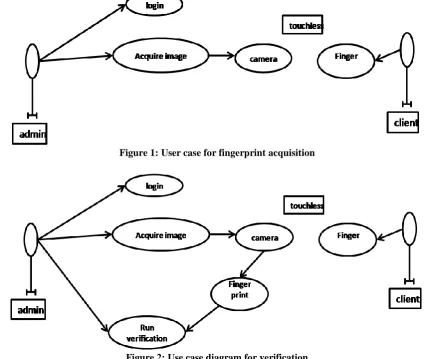
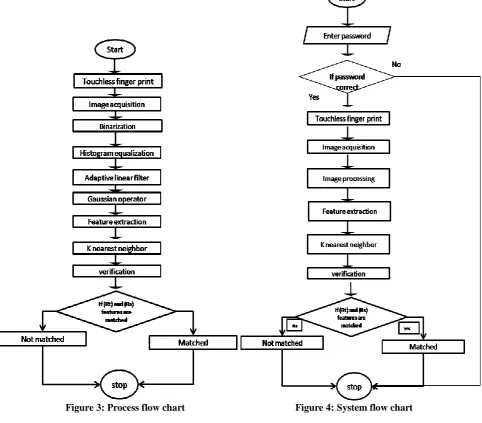
In order to realize the model, Unified Modeling Language (UML) was employed. UML aims to provide a common vocabulary of object-based terms and diagramming techniques that is rich enough to model any system development project from analysis to design [13]. For our model, we make use of use case diagram, system flow chart (figure 4) and process flow chart (figure 3). Use case diagrams give a user point of view of a system [13], from figure 1: analyses the how the fingerprint is captured from the client without contact while figure 2. Is a use case diagram that models the operability of the system with the admin and the client as the actors.
Figure 1: User case for fingerprint acquisition
ISSN(E): 2277-128X, ISSN(P): 2277-6451, pp. 9-13
Figure 3: Process flow chart Figure 4: System flow chart
VII. CONCLUSION
This work have revealed some of the diseases that occurs in the human finger, most of them are communicable diseases and can easily be transmitted from one person to another, mainly through body metabolic fluids (sweat). We also notice that due to the effect of these diseases, victims are discriminated and most times disenfranchised of their civil responsibilities. Despite the fact that this epidemic can affect the texture of the finger, the skin colour, and finger size (swollen finger), papillary lines on finger tips, however, the finger patterns remains constant. Hence we develop a novel technology that captures this finger patterns without contact, but using an image acquisition tool (HD Camera recommended) to capture the print and run verification. This will go a long way to control the spread of diseases and ensure that every individual is accorded his or her civic right.
REFERENCES
[1] Nigerian educational research and development council (NERDC) 2003. Scheme for basic education (grade 1-3)
[2] http:// www.sciencefocus.com
[3] John A., Jamie B., Yves C. and Jackie S., (2009) Water sanitation and hygiene standards for schools in low cost
settings. Genevea , Switzerland.
[4] Chulhan Lee, Sanghoon Lee and Jaihie Kin (2006); A study of Touchless fingerprint recognition system. Yonsei Univeristy, Korea.
[5] http://www.wikipedia.com/wikipedia project/2019
[6] Martin D., Michal D., Jaroslav U., Eva B., and Tai-hoon K., (2012); influence of skin disease on fingerprint recognition; Journal of biomedical and biotechnology.
[7] K. Wolff, R. A. Johnson, and D. Suurmond, Fitzpatrick’s Color Atlas and Synopsis of Clinical Dermatology,
ISSN(E): 2277-128X, ISSN(P): 2277-6451, pp. 9-13
[8] W. D. James, T. G. Berger, and D. M. Elston, Andrew’s Diseases of the Skin—Clinical Dermatology, Elsevier
Saunders, Ontario, Canada, 10th edition, 2006.
[9] J. Štork et al., Dermatovenerologie, Galén, Prague, Czech Republic, 2008
[10] T. Matsumoto, H. Matsumoto, K. Yamada, and S. Hoshino, ”Impact of artificial ”gummy” fingers on fingerprint
systems”, In Proceedings of SPIE Vol. Num.4677, Jan 2002.
[11] Chioma O (2018). Implementation Of Daugman’s Algorithm And Adaptive Noise Filtering Technique For
Digital Recognition Of Identical Twin Using Mathlab,
[12] Asogwa T.C and Ituma C. (2018); the application of machine learning for digital recognition of identical twins
to support global crime investigation.
[13] Ambrose A. Azeta, Nicholas A. Omoregbe, Adewole Adewumi, Dolapo Oguntade, Design of a Face