ISSN-L: 2501 - 1235 Available on-line at: www.oapub.org/edu
Copyright © The Author(s). All Rights Reserved.
doi: 10.5281/zenodo.1491794 Volume 5 │ Issue 1 │ 2018
CONSTRUCTION OF PHYSICAL FITNESS TEST ITEMS NORMS
OF TAEKWONDO PLAYER OF GURU NANAK DEV
UNIVERSITY, AMRITSAR, INDIA
Baljinder Singh Bal1i,
Gagandeep Singh2,
Kamal Kishore2,
Surinder Singh2
1Dr., Department of Physical Education (T), Guru Nanak Dev University, Amritsar, Punjab, India 2Department of Physical Education (T), Guru Nanak Dev University, Amritsar, Punjab, India
Abstract:
The purpose of this study was to construct Norms of Physical Fitness Test Items of Taekwondo Player. To obtain data, the investigators had selected Fourty (N=40), male Inter-College level Taekwondo Player of Guru Nanak Dev University, Amritsar between the age group of 18-28. The Muscular Strength was measured by Handgrip Strength Test, Muscular Power was measured by Vertical Jump Test, Muscular Endurance was measured by Pull-Up Test, Running Speed was measured by 20-Meter Dash, Running Agility was measured by Illinois Agility Test, Jumping Ability was measured by Standing Long Jump Test, Throwing Ability was measured by Overhead Medicine Ball Throw Test, Flexibility was measured by Sit and Reach Flexibility Test and Balance was measured by Stork Balance Stand Test. The data, which was collected by administering tests, was statistically treated to develop for all the test items. In order to construct the norms, Percentile Scale was used. Further, the scores were classified into five grades i.e., very good, good, average, poor and very poor.
Keywords: muscular strength, muscular power, muscular endurance, running speed,
running agility, jumping ability, throwing ability, flexibility, balance
1. Introduction
& Goran, 1999). Physiological level of physical activity in children is determined by age, gender, and ethnicity (Reynolds et al. 1990 & Hudson, 2008).
Physical activity has positive effects on physical, psychological/social, and cognitive health on school-aged children and youth (Janssen & LeBlanc, 2010). Evidence showed that physical activity improved body composition and the prevention of overweight and obesity, improved skeletal (Gunter, Almstedt & Janz, 2012), metabolic (Janssen & LeBlanc, 2010) and cardiovascular health (Fernhall & Agiovlasitis, 2008). Despite biological benefits on biological health, physical activity also affects psychosocial health, such as reduction of symptoms of depression, stress, anxiety and improvements in self-confidence and self-esteem (Biddle & Asate, 2011).
Taekwondo has been propagated worldwide and is currently a popular sport reaching about 70 million practitioners in 204 countries (World Taekwondo Federation member status, 2013).
Taekwondo is a physically demanding sport that is dominated by kicks and punches with points scored by delivering blows to the opponent (Bueke et al, 2007 & Probst et al, 2007).
2. Material and Methods
2.1 Participants
Fourty (N=40), male Inter-College level Taekwondo Player of Guru Nanak Dev University, Amritsar between the age group of 18-28 years volunteered to participate in the study. All the subjects were informed about the objective and protocol of the study.
2.2 Variables
The following Physical Fitness Test Items were selected for the present study: a) Muscular Strength;
b) Muscular Power; c) Muscular Endurance; d) Running Speed; e) Running Agility; f) Jumping Ability; g) Throwing Ability; h) Flexibility;
i) Balance.
2.3 Procedure
The scores of each Physical Fitness Test Items were recorded by the researcher on the basis of performance in tests. The subjects were given adequate demonstration, practice trial and required instructions for all tests.
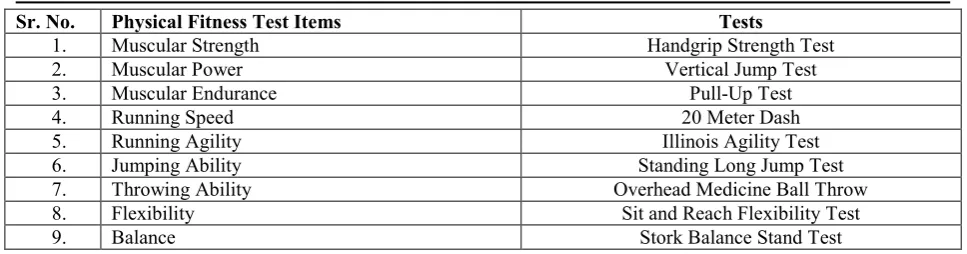
Sr. No. Physical Fitness Test Items Tests
1. Muscular Strength Handgrip Strength Test
2. Muscular Power Vertical Jump Test
3. Muscular Endurance Pull-Up Test
4. Running Speed 20 Meter Dash
5. Running Agility Illinois Agility Test
6. Jumping Ability Standing Long Jump Test
7. Throwing Ability Overhead Medicine Ball Throw
8. Flexibility Sit and Reach Flexibility Test
9. Balance Stork Balance Stand Test
3. Statistical Technique
The data, which was collected by administering tests, was statistically treated to develop for all the test items. In order to construct the norms, Percentile Scale was used. Further, the scores were classified into five grades i.e., very good, good, average, poor and very poor.
4. Results
For each of the chosen variable, the result pertaining to Descriptive Statistics (Mean & Standard Deviation) and Percentile Plot (Hi & Low) of Physical Fitness Test Items of Fourty (N=40), male Taekwondo Player of Guru Nanak Dev University, Amritsar are brought forth in Table 2:
Table 2: Descriptive Statistics (Mean & Standard Deviation) and
Percentile Plot (Hi & Low) of Physical Fitness Test Items of Taekwondo Players of Guru Nanak Dev University, Amritsar (N=40)
Sr. No. Test Items Mean
±
Standard Deviation
Hi Low
1. Muscular Strength Mean SD 43.09 5.70 57.5 34.7
2. Muscular Power Mean S.D 62.55 4.65 70 56
3. Muscular Endurance Mean SD 2.44 20 24 16
4. Running Speed Mean SD 3.15 3.56 3.2 3.1
5. Running Agility Mean SD 11.04 6.98 12.07 10.02
6. Jumping Ability Mean SD 2.23 1.22 2.48 2.10
7. Throwing Ability Mean SD 17.72 1.83 20 15
8. Flexibility Mean SD 3.25 1.12 5 2
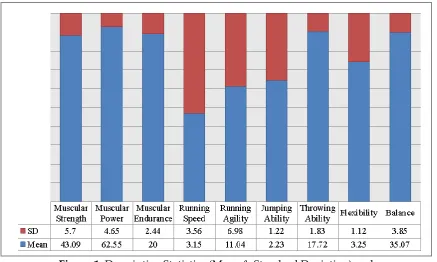
Table 2 shows that in Muscular Strength, the mean score was 43.09 and standard deviation score was 5.70. In Muscular Power, the mean score was 62.55 and standard deviation score was 4.65. In Muscular Endurance, the mean score was 20 and standard deviation score was 2.44. In Running Speed, the mean score was 3.15 and standard deviation score was 3.56. In Running Agility, the mean score was 11.04 and standard deviation was 6.98. In Jumping Agility, the mean score was 2.23 and standard deviation was 1.22. In Throwing Ability, the mean score was 17.72 and standard deviation score was 1.83. In Flexibility, the mean score was 3.25 and standard deviation score was 1.12. In Balance, the mean score was 35.07 and standard deviation score was 3.85.
Figure 1: Descriptive Statistics (Mean & Standard Deviation) and
Percentile Plot (Hi & Low) of Physical Fitness Test Items of Taekwondo Players of Guru Nanak Dev University, Amritsar (N=40)
4.1 Grades under Normal Distribution
Table 3: Descriptive Statistics (Mean & Standard Deviation) and
Percentile Plot (Hi & Low) of Physical Fitness Test Items of Taekwondo Players of Guru Nanak Dev University, Amritsar (N=40)
Test Items Very Poor Poor Average Good Very Good
Muscular
Strength Less than (<) 31.69 31.69 - 37.39 37.39 - 48.79 48.79 - 54.49 Greater than (>) 54.49 Muscular
Power
Less than
(<) 53.25 53.25 - 57.90 57.90 - 67.20 67.20 - 71.85
Greater than (>) 71.85 Muscular
Endurance Less than (<) 15.12 15.12 - 17.56 17.56 - 20 20 - 22.44 Greater than (>) 22.44 Running
Speed Greater than (>) 10.27 10.27 - 6.71 6.71 - 0.41 -0.41 - -3.97 Less than (<) -3.97 Running
Jumping Ability
Less than
(<) -0.21 -0.21 - 1.01 1.01 - 3.45 3.45 - 4.67
Greater than (>) 4.67 Throwing
Ability Less than (<) 14.06 14.06 - 15.89 15.89 - 19.55 19.55 - 21.38 Greater than (>) 21.38
Flexibility Less than
(<) 1.01 1.01 - 2.13 2.13 - 4.37 4.37 - 5.49 Greater than (>) 5.49
Balance Less than
(<) 27.37 27.37 - 31.22 31.22 - 38.92 38.92 - 42.77 Greater than (>) 42.77
1. In Muscular Strength, the scores below 31.69 are considered very poor, from about 31.69-37.39 is considered poor, 37.39-48.79 is considered average, 48.79-54.49 is considered good and the scores above 48.79-54.49 are considered very good. 2. In Muscular Power, the scores below 53.25 are considered very poor, from about
53.25-57.90 is considered poor, 57.90-67.20 is considered average, 67.20-71.85 is considered good and the scores above 71.85 are considered very good.
3. In Muscular Endurance, the scores below 15.12 are considered very poor, from about 15.12-17.56 is considered poor, 17.56-20 is considered average, 20- 22.44 is considered good and the scores above 22.44 are considered very good.
4. In Running Speed, the scores above 10.27 are considered very poor, from about 10.27- 6.71 is considered poor, 6.71-0.41 is considered average, -0.41- -3.97 is considered good and the scores below -3.97 are considered very good.
5. In Running Agility, the scores above 25 are considered very poor, from about 25-18.02 is considered poor, 18.0-4.06 is considered average, 4.06- -2.92 is considered good and the scores below -2.92 are considered very good.
6. In Jumping Ability, the scores below 0.21 are considered very poor, from about -0.21-1.01 is considered poor, 1.01-3.45 is considered average, 3.45-4.67 is considered good and the scores above 4.67 are considered very good.
7. In Throwing Ability, the scores below 14.06 are considered very poor, from about 14.06-15.89 is considered poor, 15.89-19.55 is considered average, 19.55-21.38 is considered good and the scores above 21.38 are considered very good.
8. In Flexibility, the scores below 1.01 are considered very poor, from about 1.01-2.13 is considered poor, 1.01-2.13-4.37 is considered average, 4.37-5.49 is considered good and the scores above 5.49 are considered very good.
9. In Balance, the scores below 27.37 are considered very poor, from about 27.37-31.22 is considered poor, 27.37-31.22-38.92 is considered average, 38.92-42.77 is considered good and the scores above 42.77 are considered very good.
(a) (b)
(c) (d)
(e) (f)
(g) (h)
(i)
Figure 2: Normal distribution of Physical Fitness Test Items
(i.e., a. Muscular Strength, b. Muscular Power, c. Muscular Endurance, d. Running Speed, e. Running Agility, f. Jumping Ability, g. Throwing Ability, h. Flexibility & i. Balance) of
Acknowledgements
Heartiest thanks and appreciation are extended to all players who served as subjects for this study and without whose help this study could not have been completed.
Recommendations
Physical Education teachers, coaches and athletic trainers may utilize the findings of the present study by preparing or modifying the existing training schedules for Taekwondo Player. Normative data regarding Physical Fitness Test Items will help the coaches and trainers to regulate the training programme for elite athletes.
Furthermore, future research could also explore the other variable namely, physical, physiological, anthropometrical and biomedical in addition to the variables chosen in the present study.
References
Biddle, S.,J. & Asate, M. (2011). Physical activity and mental health in children and adolescents: a review of reviews. Br J Sports Med, 45, 886-895.
Burke, D.T., Al-Adawi, S., Lee, Y.T., & Audette, J. (2007). Martial arts as sport and therapy. J Sports Med Phys Fitness, 47, 96-102.
Fernhall, B. & Agiovlasitis, S. (2008). Arterial function in youth: window into cardiovascular risk. J Appl Physiol, 105, 325-333.
Gunter, K.B., Almstedt, H.C., & Janz, K.F. (2012). Physical activity in childhood may be the key to optimizing lifespan skeletal health. Exercise and sport sciences reviews, 40(1), 13.
Hudson, C.E. (2008). An integrative review of obesity prevention in African American children. Issues in Comprehensive Pediatric Nursing, 31(4), 147–170.
Janssen, I., & LeBlanc, A.,G. (2010). Systematic review of the health benefits of physical activity and fitness in school-aged children and youth. Int. J. Behav. Nutr. Phys. Act, 7(40).
Lindquist, C.H., Reynolds, K.D. & Goran, M.I. (1999). Sociocultural determinants of physical activity among children. Preventive Medicine, 29(4), 305–12.
Probst, M.M., Fletcher, R., & Seelig, D.S.(2007). A comparison of lower-body flexibility, strength, and knee stability between karate athletes and active controls. J Strength Cond Res, 21, 451-455.
Reynolds, K.D., Killen, J.D., Bryson, S.W., Maron, D.J., Taylor, C.B., Maccoby, N. et al. (1990). Psychosocial predictors of physical activity in adolescents. Preventive Medicine, 19(5), 541–551.
Creative Commons licensing terms
Authors will retain the copyright of their published articles agreeing that a Creative Commons Attribution 4.0 International License (CC BY 4.0) terms will be applied to their work. Under the terms of this license, no permission is required from the author(s) or publisher for members of the community to copy, distribute, transmit or adapt the article content, providing a proper, prominent and unambiguous attribution to the authors in a manner that makes clear that the materials are being reused under permission of a Creative Commons License. Views, opinions and conclusions expressed in this research article are views, opinions and conclusions of the author(s). Open Access Publishing Group and European Journal of Physical Education and Sport Science shall not be responsible or answerable for any loss, damage or liability caused in relation to/arising out of conflict of interests, copyright violations and inappropriate or inaccurate use of any kind content related or integrated on the research work. All the published works are meeting the Open Access Publishing requirements and can be freely accessed, shared, modified, distributed and used in educational, commercial and