Research Article
a
April
2019
Computer Science and Software Engineering
ISSN: 2277-128X (Volume-9, Issue-4)
Study of Di-electric Pyramidal Horn Antenna on the Basis of
Geometrical Theory of Diffraction: A Survey
Ravinder Kaur*, Maninder Singh
ECE Department, Kurukshetra University, Kurukshetra, Haryana, India
[email protected], [email protected]
Abstract-The communication of speech, music, pictures and other messages by means of electrical signals is referred as electrical communication. Across small distance speech and music are communicated straight from there source to the destination by mean of acoustic wave, as the same way picture is transmitted straightly by light wave across small distance. Over long distances, wire transmission and radio transmission are used to communicate such signals, in the latter case it is the antenna system which plays the vital role in the process by coupling the source of power to free space and then directing this energy in some preferred direction. This paper introduce microwave and has briefly presented the history of antenna developments. Middle portion of the paper gives acquaintance with the work done on dielectric antennas. In the last the author has attempted to justify the reason for taking of the problem and has also briefly mentioned the aspects to be dealt with, also discussed the Geometrical theory of Diffraction.
Keywords- Electrical Communication, Acoustic Wave, Wire Communication, Radio Communications, Antenna, Microwave.
I. INTRODUCTION
In almost any electrical communication system is necessary to transfer electromagnetic energy in some form, from one place to another. The process of transferring this energy is usually referred to as the transmission and can take place either through a material medium or through the free space. In the latter case it is the antenna system which plays the vital role in the process by coupling the source of power to free space and then directing this energy in some preferred direction. An antenna which radiates in all directions equally is called an isotropic or source. There is no such antenna because every antenna exhibits some directive properties was released by hertz, who first successfully demonstrated radiation of electromagnetic waves. The present day position is that many types of microwave antennas are in use, of which the important ones are: (i) Aperture antenna consisting of horns, slot and open-ended waveguides, (ii) Dielectric and surface wave antennas comprising of the dielectric road, tube and horn antenna and (iii) Secondary antenna which can be subdivided into two classes (a) Reflectors and (b) Lenses.
II. BRIEF HISTORY OF ANTENNA
Initially Issac Newton developed law of Universal Gravitation and he was averse to disclose because his law breaches the fundamental that the action at a distance is futile. But Edmud Hally led Newton to submit the law in front of Royal Society in 1685 after the discovery of Comet. Then in 1839 Mickel Faraday issued the results of his “Experimental Researches” with curved line of force drawn-out through blank space Joseph Henry in 1842 made-up wire antennas for telegraphy by flipping a spark to a circuit of wire by his laboratory to parallel wire to 20 ft far. In 1875 Edison invented that key clicks radiated to a distance and 1885 he presented a transmission system using vertical top-loaded grounded antennas. Belated nineteenth century microwave antenna which Marconi had added Lodge‟s tuning advances to his vertical grounded antenna? From 1910-1919 many large low frequency high power antennas were discovered. Construction of “Radio Virginia” is started in1911 at Arlington. In 1913 the station was equipped with 100 kW spark communicator and a 35 kv arc communicated. VHF and microwave antenna entered into the function of radio electronics in the late of 1940‟s after centimeter wave antenna. In this connection brief history of antenna is the history of spectrum utilization. As number of regions of the spectrum is started up at many ages in time antenna discovery always taken place sometime minor often major. Mostly spectral equation is mentioned by human desire and the present level of technical usability.
A. Work Done on Dielectric Antenna
ISSN(E): 2277-128X, ISSN(P): 2277-6451, pp. 80-84
Lodge and several other scholars were also engaged on there in similar experiments generally in microwave region. In United States of America South worth [2] in 1941 took out a patent which was based on his intensive research on the radiation from dielectric rods. At Bell Telephone Laboratories, Mueller and Tyrell commenced an exclusive study on the subject in 1941. They give a method for deriving an expression for the radiation pattern of a dielectric rods exited at one end. Covering the practical expect of the problem, they have described the designing details and have shown that for microwave antennas involving gains of 15-20 dB, payloads display high efficiency and are epically suitable for a broad-side array arrangement. In 1942 Van Atta [3] discussed the limitations of the size and shape of a parabodial reflector and its effect on radiation pattern for a given field distribution over the aperture plane. He conducted experiments on a number of such reflectors maintaining the f/D ratio constant and using the same feed as primary source. He concluded that with D increasing the beam width angle of the main lob decreases and the side lobes move closer towards the axles.
B. Geometrical Theory of Diffraction
Where light propagation differs from the predictions of geometrical optics is known as diffraction process. The oldest and most widely used theory of light propagation that is known as Geometrical optics fails to account for certain optical phenomena known as diffraction. First exact conclusion for the scattering of an electromagnetic wave by a perfectly conducting circular cylinder, it was received by separations of variables, and was an infinite series of products of trigonometric functions of the angular co-ordinate.
III. PROPOSED METHODOLOGY
The more familiar condition of cylindrical wave diffraction by a wedge is of particular interest in the investigation of the horn antenna. The resolution for these fields can also be gain in the important formulation of plane wave diffraction theory. It is easy to maintain the definitions of 𝜓𝑜equals the incident angle and 𝜓 equals the diffraction angle in the direction of the required field ua. This is due to the cylindrical nature of the incident field; as discussed the plane wave
diffraction theory cannot be directly applied to obtain ua. But the solution can achieved from the reverse example with the
point of consideration and source interchanged the total field‟s ua and ub are equivalent by the reciprocity principle. The
field ub is now obtained for a plane wave incident on the wedge at an angleψ may be used to advantage as :
𝑉
𝐵(𝑟,𝜙)=
𝑉𝜙 𝑒−𝑗 (𝜌 +𝜋 /4)2𝜋𝜌
Where,
=
1 𝑛𝑠𝑖𝑛
𝜋 𝑛
𝑐𝑜𝑠𝜋𝑛−𝑐𝑜𝑠𝜙𝑛
IV. STUDY OF RADIATION PATTERN OF DIELECTRIC PYRAMIDAL HORN ANTENNA ON GEOMETRICAL THEORY OF DIFFRACTION
The design of pyramidal electromagnetic horn must take into consideration the fact that only the required mode of oscillation is excited in the horn and all other modes must be suppressed. In addition obtaining the desired gain and beam with of main lobe is also equally important.
The pyramidal shape is preferable because of the convenience of controlling beam within the E- and H-plane independently. Also it is possible to produce linearly polarized waves. The pyramidal horn will have a rectangular apex and hence has to be fed by a rectangular waveguide which is designed to as to carry the TE0, 1 mode which is transferred
to the radiating horn. However this TE0, 1 mode is modified by the process and encounter to major changes. First the
magnitude of the radial component of the electric and magnetic field vectors diminishes to a negligibly small value of large distance from the apex. Further these vector components are oriented tangential to the wave front surface, which in the case of acute pyramidal horn is a circle with its center at the apex of the horn and a slightly distorted spherical shape in the case of a wedge shape horn.
The computation of radiation characteristic of a metallic pyramidal horn necessitates the evaluation of electric and magnetic field vector in the aperture plane and then treating the aperture of the horn as equivalent to an opening of same dimension in a conducting metallic sheet of infinite size, to which diffraction can be applied as suggested by Fradin [6]. The field in the aperture plane is computed assuming that the horn is infinitely long, its wall is perfectly conducting and that flare is smooth and small.
V. RESULTS AND DISCUSSION Gain of Microwave antenna
ISSN(E): 2277-128X, ISSN(P): 2277-6451, pp. 80-84
The elementary half-wave dipole is sometimes an acceptable substitute, since its gain is accurately known, but its radiation pattern is bidirectional and its gain is inconveniently low.
Experimental evidence of this effect has been received and a theory developed which is good quantitative, agreement which present experimental data and demonstrate the physical reason why the previous “far field” criterion of 2D2 / λ is invalid. Curves are presented from which the error in gain measured at any distance may be obtained and applied as a correlation. The minimum aperture separation for which zero correction is required makes the beginning of the true Fraunhofer region.
Keeping in view an idea recently suggested by Jakes and Braun the later presented a table from which the gain of all
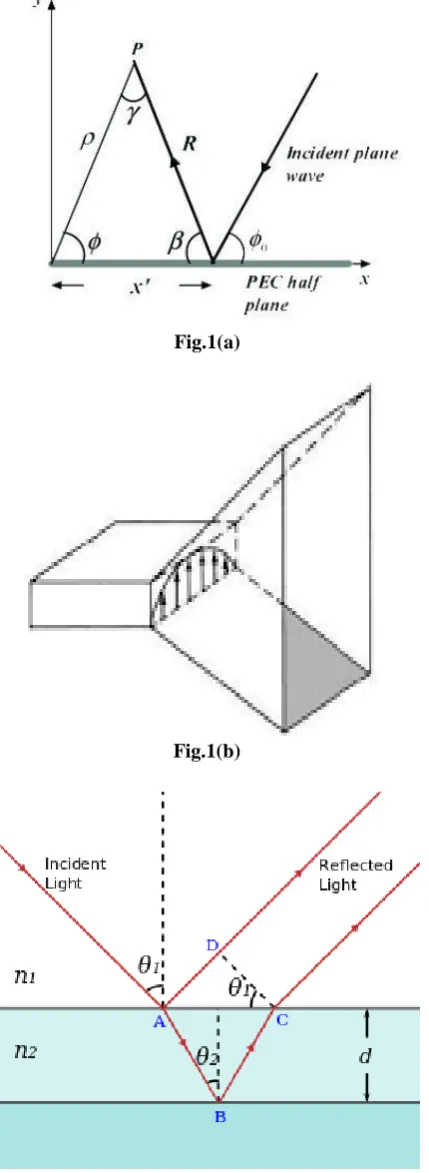
Fig.1(a)
Fig.1(b)
ISSN(E): 2277-128X, ISSN(P): 2277-6451, pp. 80-84 Study of Gain of Dielectric Pyramidal Horn on Geometrical Theory of Diffraction
Empirical formula for the far field
The equality of the radiation pattern in the far field due to a dielectric horn is controlled by the wavelength of the propagating wave, the dielectric property and the thickness of the wall of the horn in addition to its various other parameters viz. Length and flare angle. Further the phase velocity inside the horn varies with the distance between the walls parallel to the dielectric field vectors. The wave propagating through the antennas are more or less cylindrical. No attempt has been taken on our part to make predictions for the expressions of the field components in the aperture plane of the antennas. Instead a strong conjecture for the formula of electric vectors in the H- and E-planes in the far field has been made. The component functions are symmetrical in the radiating angle θ, the axes of the horn being assumed to be θ = 0 line. The thickness of the side walls of the horn has been assumed to be negligible for all practical purposes. Hence this parameter does not enter into the expression for the electric vector. Introduction of an error of one percent due to this account is only expected in the final results. We write the expression for electric component vectors in the H- and E-planes in the far field due to TE01 mode propagating through dielectric horn as:
E = E0cosθ {
−1 −cosθ}.
sinβ
sinβcosψ
Where θ = diffracted angle
β=πλL( -cosθ),
β0 =
πL
λ( - 1),
Ψ = πD
λ sin θ
= 1 − λ
2D ∈ 0/∈ L = Axial length of the horn. λ = Free space wavelength.
∈= Dielectric constant of the material used in the construction of the horn.
∈ 0 = Dielectric constant of the air.
D = Dimensions of the aperture in the H- or E- plane concerned.
VI. CONCLUSION
Antenna provides improved and „affordable‟ electronically controllable radiation characteristics. This category includes steerable beam, multiple beam and adaptive antennas from LF and EHF. Technologies such as micro strip, for antennas and microwave components, hybrid microwave integrated circuits and monolithic microwave and millimeter-wave integrated circuits; new transmission-line technologies for the millimeter-wave bands. Hybrid lens and reflector antennas with „smart‟ array feeds, which offer a mean of acquiring many of the desirable features of the electronic control at an acceptable cost. Integration and optimization of antenna in their working environments, including computer aided design methods dealing with antenna and its environment, improved random design, planar, conformal and wrap-around antennas; in conspicuous antenna; and multiband and multifunction antenna concepts to reduce the number of antenna system for any given application. Very slow side-lobe antennas (of all types) and the associated high performance RF components which can operate over band-widths of 15% or more, in multiple bands. Dule-polarised antenna system for communications and radar, which can maintain their characteristics over wide band-widths and/or in multiple, finally, the means, both the technological and „political‟ to introduce electromagnetic design concepts into an earlier stage in the design of system, vehicles and installations in general.
REFERENCES
[1] Ted Simpson, “On hertz and the speed of light”, 2017 IEEE International Symposium on Antennas and Propagation & USNC/URSI National Radio Science Meeting, IEEE Xplore: 19 October 2017.
[2] Nancy Ghattas, Atef M. Ghuniem, Sherif M. Abuelenin, “Optimization of Dielectric Rod Antenna Design in Millimeter Wave Band for Wireless Communications”, Research Gate, July, 2017.
[3] Michael J. Coleman, Frank Baginski, Robert R. Romanofsky, “The Effect of Boundary Support and Reflector Dimensions on Inflatable Parabolic Antenna Performance”, NASA/TM—2011-217110.
ISSN(E): 2277-128X, ISSN(P): 2277-6451, pp. 80-84
[5] Di Wu; Zhenghe Feng; Wei Liu “A novel conical horn antenna loaded with ball cone dielectric”, Proceedings of 2014 3rd Asia-Pacific Conference on Antennas and Propagation INSPEC Accession Number: 14824453, Date Added to IEEE Xplore: 22 December 2014.
[6] Ramesh Chandra Gupta, Surya Pal Singh, “Analysis of radiation patterns of compound box-horn antenna”, Progress In Electromagnetics Research 76:31-44, January 2007.
[7] KamillKlem-Musatov, Henning C. Hoeber, Tijmen Jan Moser, Michael A. Pelissier “Classical and Modern Diffraction Theory”, SEG Geophysics reprint series no 29, 2016.
[8] Kexin Liu, “Theoretical Investigation on Propagation and Coupling of Nonreciprocal Electromagnetic Surface Waves”, KTH School of Electrical Engineering, Osquldasvag 6, SE-100 44 Stockholm, Sweden, September 2016.