Research Article
a
June
2019
Computer Science and Software Engineering
ISSN: 2277-128X (Volume-9, Issue-6)
Digital Image Watermarking in Special and Frequency Domain
Neha Sinha*, Swati Gupta
Department of Computer Science and Engineering,
Satya College of Engineering & Technology, Palwal, Haryana, India Email- [email protected], [email protected]
Abstract— Requirement of proficient and valuable copyright protection approaches is needed because of the prompt and fabulous evolution of multimedia and the outspread use of the Internet. For countering the copying, forgery and unauthorized handling of images and video system are required to tackle this issue. Due to lack of such methods, storing images over a public network is prime concern. In this paper, digital watermarking is implemented in special domain (LSB) and frequency domain (DWT) which reveals that DWT perform better than LSB. Two examples of each of digital image watermarking are taken under consideration and obtained results are compared. This comparison reveals that the DWT based digital image watermarking outperform the corresponding LSB based watermarking technique.
Keywords— Digital Image Watermarking, LSB, NC, MSE, PSNR
I. INTRODUCTION
This The requirement of fruitful copyright protection approaches becomes essential with the great and extraordinary advancement of multimedia and the outstretched use of the Internet [1] – [5]. There is a necessity to have a check on copying, falsification and unauthorized handling of images and video through and hence, innovative techniques are required. In the absence of such methods, storing images on a public network place them at danger of theft and undiscovered alteration. Steganography, Cryptography and Digital Watermarking are the techniques which have been progressed to preserve information during the data communication from sources to destination. One can hide data or identify information with the help of digital watermarking to the digital multimedia [3], [6]. Following are two major steps involved in Digital Watermarking techniques - (i) watermark embedding, (ii) watermark extraction. Use of maximal quality equipment resulted into a watermarked imaged identical from the original image. The essential building block requirements of ideal watermarking are Integrity and Security.
There is a security concern for securing digital information in computer and networks technology which lead new world for research. The free access of digital media communication has provided the great convenience to convict to pirate copyrighted material [7]. Hence, use digital watermarking becomes instrumental in detecting and tracing the violation of copyright. Now a day’s in the field of digital multimedia the main focus of research are on data authentication, copyright protection and integrity [8].
In this paper, digital watermarking is implemented in special domain (LSB) and frequency domain (DWT). Each of the method is illustrated with two examples and obtained results are compared. The comparison table reveals that DWT perform better than LSB.
II. WATERMARKING MODEL
With the help of a simplified model we can be explain Image watermarking. The model consists of a watermark image (WI), cover image (CI), watermark embedder, several attacks, communication channel, noise, watermark detector and recovered watermarks. Attacks in image watermarking can be intentional or unintentional. The watermark image (WI) is embedded into the cover image (CI) by the watermark embedded, while the presence of the watermark is detected by the watermark detector [9]. Digital watermarking techniques must be robust in order to endure various types of noise and security attacks in the communication channel [10].
Fig. 1 A sample model of digital image watermark Watermark Embedder Communication Channel Watermark Detector Watermark CI
ISSN(E): 2277-128X, ISSN(P): 2277-6451, pp. 25-31
III. LSB BASED DIGITAL IMAGE WATERMARKING
To hide information in a cover images, Least Significant Bit (LSB) technique is used. In LSB techniques, pixels are changed by bits of hidden message inside the image. To hide the message inside image least bits needed to be changed from eight bytes of grids. Only few bits are needed in an image to modify or hide a secret message. Because the quality of the Watermarked image is very low, less than 4-bit LSB is sufficient. While changing the LSB of a pixel, it results in small changes in the intensity of the colors. So these changes cannot be visible for naked human eye. Only professional tracker solves which type of information hidden inside the image. A digital image, data can be inserted directly into each bit of image data or the more busy areas of an image can be calculated so as to hide such Messages in less noticeable parts of an image. To illustrate the LSB, five different examples have been taken.
A. Example-1 LSB watermarking results for Barbara image under different attacks
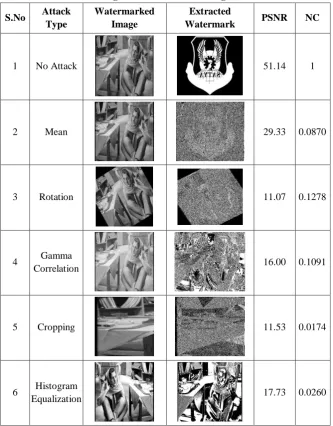
Table I illustrates another example of LSB based digital image watermarking. It has depicted the effect of six types of attacks on watermarked image and extracted image through the value of PSNR and NC. It shows that the LSB watermarking perform worst in the case of Cropping attack which leads to minimum NC value. Under no attack, we have NC value zero which reflect that extracted watermarked didn’t degraded at all.
Table I- LSB watermarking results for Barbara image under different attacks
S.No Attack
Type
Watermarked Image
Extracted
Watermark PSNR NC
1 No Attack 51.14 1
2 Mean 29.33 0.0870
3 Rotation 11.07 0.1278
4 Gamma
Correlation 16.00 0.1091
5 Cropping 11.53 0.0174
6 Histogram
Equalization 17.73 0.0260
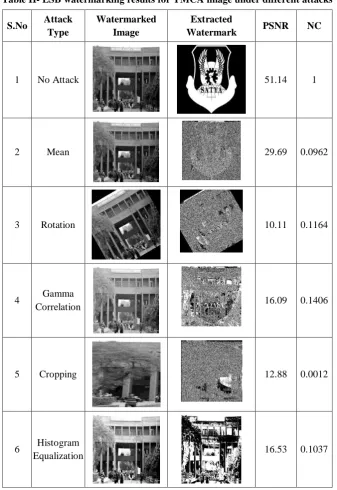
B. Example-2 LSB watermarking results for YMCA image under different attacks
ISSN(E): 2277-128X, ISSN(P): 2277-6451, pp. 25-31 Table II- LSB watermarking results for YMCA image under different attacks
S.No Attack
Type
Watermarked Image
Extracted
Watermark PSNR NC
1 No Attack 51.14 1
2 Mean 29.69 0.0962
3 Rotation 10.11 0.1164
4 Gamma
Correlation 16.09 0.1406
5 Cropping 12.88 0.0012
6 Histogram
Equalization 16.53 0.1037
IV. DWT BASED DIGITAL IMAGE WATERMARKING
The discrete wavelet transform has a huge number of applications in science, engineering, mathematics and computer science. Most notably, it is used for signal coding, to represent a discrete signal in a more redundant form, often as a preconditioning for data compression. It is shown that discrete wavelet transform (discrete in scale and shift, and continuous in time) is successfully implemented as analog filter bank in biomedical signal processing for design of low-power pacemakers and also in ultra-wideband (UWB) wireless communications. G. S Kang[19] has proposed DWT based digital image watermarking algorithm for protecting the digital image. This technique involves a visual watermark which is transformed using DCT. Then the cover image is transformed using the DWT and the watermark is embedded by modifying the coefficient of LL band. The performance of this algorithm is robust to smoothing, sharpening JPEG Compression and image cropping.
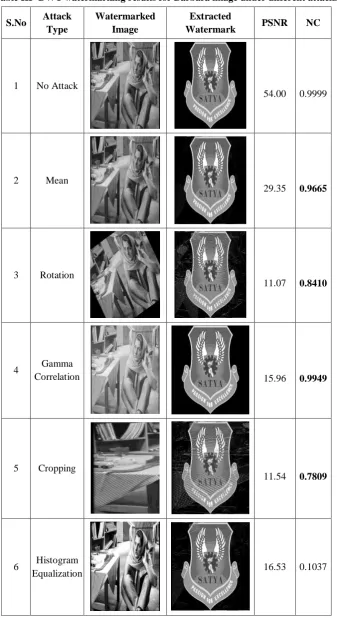
A. Example-1 DWT watermarking results for Barbara image under different attacks
ISSN(E): 2277-128X, ISSN(P): 2277-6451, pp. 25-31 Table III- DWT watermarking results for Barbara image under different attacks
S.No Attack
Type
Watermarked Image
Extracted
Watermark PSNR NC
1 No Attack
54.00 0.9999
2 Mean
29.35 0.9665
3 Rotation
11.07 0.8410
4 Gamma
Correlation 15.96 0.9949
5 Cropping
11.54 0.7809
6 Histogram
Equalization 16.53 0.1037
B. Example-1 DWT watermarking results for Barbara image under different attacks
ISSN(E): 2277-128X, ISSN(P): 2277-6451, pp. 25-31 The last two sections detailed the LSB and DWT based watermarking with each having two examples respectively. Now to compare the performance of two watermarking techniques next section have comparative tables.
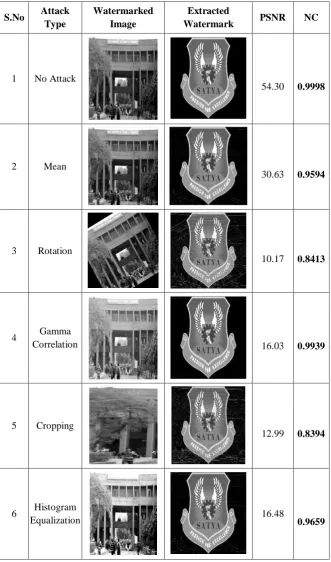
Table IV- DWT watermarking results for YMCA image under different attacks
S.No Attack
Type
Watermarked Image
Extracted
Watermark PSNR NC
1 No Attack
54.30 0.9998
2 Mean
30.63 0.9594
3 Rotation
10.17 0.8413
4 Gamma
Correlation 16.03 0.9939
5 Cropping
12.99 0.8394
6 Histogram
Equalization 16.48 0.9659
V. PERFORMANCE COMPARISONS: LSB VS DWT BASED DIGITAL IMAGE WATERMARKING
ISSN(E): 2277-128X, ISSN(P): 2277-6451, pp. 25-31 Table V- LSB Vs DWT watermarking results for BARBARA image under different attacks
For Barbara Image
S.No Attack
Name
PSNR NC
LSB DWT LSB DWT
1 No Attack 51.14 54.00 1 0.9999
2 Mean 29.33 29.35 0.0870 0.9665
3 Rotation 11.07 11.07 0.1278 0.8410
4 Gamma
Correlation 16.00 15.96 0.1091 0.9949
5 Cropping 11.53 11.54 0.0174 0.7809
6 Histogram
Equalization 17.73 17.73 0.0260 0.9485
Table VI- LSB Vs DWT watermarking results for YMCA image under different attacks
For YMCA Image
S.No Attack
Name
PSNR NC
LSB DWT LSB DWT
1 No Attack 51.14 54.30 1 0.9998
2 Mean 29.69 30.63 0.0962 0.9594
3 Rotation 10.11 10.17 0.1164 0.8413
4 Gamma
Correlation 16.09 16.03 0.1406 0.9939
5 Cropping 12.88 12.99 0.0012 0.8394
6 Histogram
Equalization 16.53 16.48 0.1037 0.9659
VI. CONCLUSIONS
The paper, digital watermarking is implemented in special domain (LSB) and frequency domain (DWT). Each of the method is illustrated with two examples and obtained results are compared. The comparison table reveals that DWT perform better than LSB.
REFERENCES
[1] Zeki, Akram M., and Azizah A. Manaf. "A novel digital watermarking technique based on ISB (Intermediate Significant Bit)." World Academy of Science, Engineering and Technology 50 (2009): 989-996.
[2] Xiong, Yin. "Covert communication audio watermarking algorithm based on LSB." 2006 International Conference on Communication Technology. IEEE, 2006.
[3] Panchal, Urvi H., and Rohit Srivastava. "A comprehensive survey on digital image watermarking
techniques." 2015 Fifth International Conference on Communication Systems and Network Technologies. IEEE, 2015.
[4] Mehto, Amit, and Neelesh Mehra. "Adaptive lossless medical image watermarking algorithm based on DCT &
DWT." Procedia Computer Science 78 (2016): 88-94.
[5] Ansari, Irshad Ahmad, and Millie Pant. "Multipurpose image watermarking in the domain of DWT based on SVD and ABC." Pattern Recognition Letters 94 (2017): 228-236.
[6] Debasish Jena and Sanjay Kumar Jena,” A novel visual cryptography scheme”, IEEE International Conference
on Advanced Computer Control, pp. 207-211, May. 2008.
[7] Kumar, V. Ashok, C. Dharmaraj, and Ch Rao. "A Hybrid Digital Watermarking Approach Using Wavelets and
ISSN(E): 2277-128X, ISSN(P): 2277-6451, pp. 25-31
[8] Zhou, Ri-Gui, et al. "Quantum color image watermarking based on Arnold transformation and LSB
steganography." International Journal of Quantum Information 16.03 (2018): 1850021.
[9] Debasish Jena and Sanjay Kumar Jena,” A novel visual cryptography scheme”, IEEE International Conference
on Advanced Computer Control, pp. 207-211, May. 2008.