Proceedings of the
Second International Workshop on
Bidirectional Transformations
(BX 2013)
Composing Least-change Lenses
Nuno Macedo, Hugo Pacheco, Alcino Cunha and Jos´e N. Oliveira
19 pages
Guest Editors: Perdita Stevens, James F. Terwilliger
Managing Editors: Tiziana Margaria, Julia Padberg, Gabriele Taentzer
Composing Least-change Lenses
Nuno Macedo1, Hugo Pacheco2, Alcino Cunha3and Jos´e N. Oliveira4
1[email protected] 2[email protected]
3[email protected] 4[email protected]
HASLab
INESC TEC / Universidade do Minho, Braga, Portugal
Abstract:
Non-trivial bidirectional transformations (BXs) are inherently ambiguous, as there are in general many different ways to consistently translate an update from one side to the other. Existing BX languages and frameworks typically satisfy fundamental first principles which ensure acceptable and stable (well-behaved) translation. Unfor-tunately, these give little insight about how a particular update translation is chosen among the myriad possible. From the user perspective, such unpredictability may hinder the adoption of BX frameworks.
The problem can be remedied by imposing a “principle of least change” which, in a state-based framework, amounts to translating each update in a way such that its result is as close as possible to the original state, according to some distance measure.
Starting by formalizing such BXs focusing on the particular framework of lenses, this paper discusses whether suchleast-change lensescan be defined by composition, an essential construct of BX frameworks. For sequential composition, two (dual) update translation alternatives are presented: a classical deterministic one and a nondeterministic. A key ingredient of the approach is the elegant formalization of the main concepts in relation algebra, which exposes several similarities and dualities.
Keywords:Bidirectional transformations, Principle of least change, Compositional-ity, Relational calculus
1
Introduction
Consider the bidirectional transformation (BX) framework oflenses[FGM+07]1.
Definition 1(Lens) A lensl:S Q Vbetween a source schemaSand a view schemaVconsists of a total functiongetl:S→V and a partial functionputl:S→V 7→S. The lens is said to be well-behaved if it satisfies two BX laws:
s0 ∈putls v⇒v=getls0 PUTGET
v=getls⇒s ∈putls v GETPUT
Person *
* follows
(a) ModelM1.
popularity : Nat Person
(b) ModelM2.
Person
(c) ModelM3.
Figure 1: Model (M1) and respective views (M2,M3) of a simplified Twitter.
Heres0 ∈ putls vmeans thatputls vis defined and thats0=putls v. ThePUTGETlaw entails
that a lens isacceptable, i.e., view updates are translated exactly byput(information in the view is not ignored). Essentially, this law imposes an upper bound on the behavior ofput(admissible behaviors). TheGETPUTlaw entails that a lens isstable, i.e., if the view is not changed, then it must be “putback” to the same source. Dually, this law imposes a lower bound on the behavior ofput(mandatory behaviors).
The classic lens framework is compositional: writing a BX amounts to writing theget trans-formation in a domain-specific language that includes a set of primitive BXs, and combinators that allow us to compose those into complex “correct-by-construction” BXs. This contrasts with other “bidirectionalization” frameworks, that perform syntactic or semantic inversion of a transformation written in a general purpose language, or that derive suitable forward and backward transformations from a declarative consistency relation specified between source and target values.
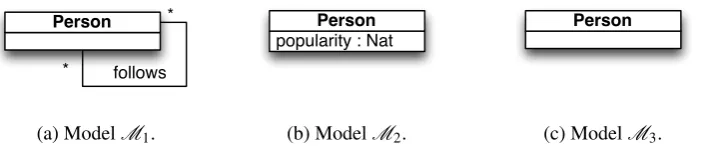
In general, the above BX laws allow multiple valid backward transformations. For instance, consider the class diagramM1 in Figure1athat models a simplified Twitter: we have people
(Person) who mayfollowother people. We could define a model transformationT1that keeps
the popularity of each person and erases thefollowsassociations, resulting in the modelM2of
Figure1b, with the constraint that popularity cannot be higher than the number of people. A second model transformationT2could also remove the popularity of each person, ending up with
M3of Figure1c, where only people that have followers are represented. To satisfyGETPUT, a
putforT1must return the same source when the view is not changed. If the view is changed, then it must satisfyPUTGET, which essentially only requires popularity preservation. For example, should somebody be added to a view with a given popularity,puthas freedom to determine who should follow her or him. Unfortunately, it is free to rearrange the followers of all other people too, as long as their popularity remains the same.
The lens laws should be taken as first principles: for example, GETPUT “only provides a relatively loose constraint on the behavior of lenses”, as originally remarked by the authors of the lens framework [Fos09]. To understand the behavior of a lens, a user cannot rely solely on the laws and must directly inspect the definition ofput. Therefore, laws providing more guarantees aboutputwould provide a better account of its behavior to users: instead of requiring only that the source remains unchanged when the view is unchanged, they could require also that an update translation should be as small as possible.
predictable. Returning to our example, and assuming that the “distance” between two source instances increases with the number of people andfollowassociations not shared by both, the behavior of aputfunction that when adding a person to the target rearranges the followers of the remaining persons would no longer beacceptable(but different puts can still be defined, reflecting the different choices of followers to be added to the new person).
In this paper, we introduceleast-change lensesby applying Meertens’ [Mee98] “principle of least change” to regular lenses. Given a preorder (a reflexive and transitive binary relation) on sources that captures the distance to a given source, least-change lenses will requireputto return minimal updates according to that preorder. We also discuss whether a compositional approach is viable to build such lenses. Indeed, Meertens did not investigate the composition of least-change maintainers and many authors [Ste10,Dis08,HPW11] view the lack of compositionality as a drawback.
Our fundamental (and novel) research question is: given two least-change lenses, is their sequential composition also a least-change lens?Suppose, for instance, thatT1is a least-change lens minimizing updates according to the distance presented above. Can it be safely composed with another least-change lens? In part, the answer depends on the distance measure used for the target model, and we will present some criteria involving this metric that enable us to answer positively the above question.
Unfortunately, the framework of deterministic lenses (whereputreturns at most one source) is too restrictive to allow composition in general. In our example, if the distance on target models ignores popularity, any transformation performed after our transformation (for example, throwing away the popularity field and leaving only people) is free to assign a very high popularity to a new person, which will obviously lead to a non-minimal update of the composed global transformation (T2afterT1). In such situations, some sort of compositionality can sometimes be achieved if we
allowputto be nondeterministic and require it to generate all sources at the minimal distance. This will allow theputof the first transformation to consider the different alternatives, and maybe return the desired least-changed sources. This nondeterministic composition is not ideal: when composing two lensesf andg,putf needs to search which intermediate candidate results ofputg
will generate minimal sources according to its preorder. Nevertheless, it is still far better than trying to discover the least-changed sources of the composed transformation directly, since for reasonable orders the guidance from the inner transformations will greatly limit the search space (indeed, it allows the construction of a search tree by composition).
2
Least-change lenses
The concept of least changes requires the definition of a family of total preorders comparing sources relative to their “distance” to some other source2. For any source values∈Swe also require the respective total preorder onS, denoted bys, to bestable.
Definition 2(Stable preorder) For any sources ∈S, a preordersis said to bestableifsis its
unique minimal value, i.e.,
s1ss⇔s1=s ORDSTABLE
ConditionORDSTABLEensures that the sourcesis the single closest value to itself, i.e.,sis the universal lower-bound ofs. One possible way to construct such total preordersis to rely
on a distance measure functiondist:S→S→Non sourcesS, such that [Mee98] s1ss2⇔(dists s1) 6 (dists s2)
where6:N→Nis the standard order on natural numbers3. The order is stable if the distance is
stable, i.e., the closest value to a sourcesis itself4:
dists s0=0⇔s=s0 DISTSTABLE
An instance ofM1of our example consists of a tuple(W,F), whereW is a set of people andF
afollowsrelation from people to people (a set of pairsF ⊆ W×W). A suitable distance measure forM1is the size of their symmetric differences:
dist1(W,F) (W0,F0) =#(W∆W0) +#(F∆F0)
whereX∆Y= (X−Y) ∪(Y−X)
An instance of M2 can be seen as a tuple(W,P), whereW is again a set of people andPis
a function from people to popularityP:W →N, which is equivalent to a multi-set of people. Again, a suitable distance measure could be the size of their symmetric differences (generalized to multi-sets with the obvious definition):
dist2(W,P) (W0,P0) =#(W∆W0) +#(P∆P0)
We could however ignore the popularity of people not contained in both instances:
dist02(W,P) (W0,P0) =#(W∆W0) +#((P ⊗ (W ∩ W0))∆(P0 ⊗(W ∩ W0)))
where(X ⊗ Y)x=ifx ∈YthenX xelse0
2Bytotalpreorder we mean a preordersuch that, for any pointsx,y, eitherx yory xholds. Anti-symmetry
is not required because any two points at the same distance will be comparable in either way and they need not be the same.
3Instead of natural numbers any well ordered set could be used in the range of the distance function, providing more
flexibility when computing distances. Notice also that if, for a givens,distsis an injective distance function, then the induced preorderwill be anti-symmetric (i.e. a partial order).
4In a metric space, this clause is known asidentity of indiscernibles. In fact, it could be reasonable to assume that
2.1 Deterministic least-change lenses
Definition 3(Least-change lens) Given a family of stable total preorderssfor everys ∈ S,
a least-changelensl:S Q V consists of a forward total transformation getl:S→V, and a
partial backward transformationputl:S→V 7→S. A least-change lens is well-behaved if it
satisfiesGETPUTand
s0 ∈putls v⇒v=getls
0∧
(∀s1.v=getls1⇒s0ss1) LEASTPUTGET
LEASTPUTGETis equivalent to the original least change principle proposed in [Mee98]. It is a refinement ofPUTGET, in the sense that the resulting source value is required to be not only acceptable, but also one of closest to the originalsamong the sources that share the same viewv. LEASTPUTGETthus lowers the upper bound forputand reduces the range of valid updates.
Although the backward transformation is more restricted, there may still be more than one valid
putfor the samegetand preorders, since there may be multiple sources at the same distance.
Consider our example transformationT1with the preorder induced by the distance measuredist1.
If we add a personpto the view with popularityn,putis free to choose who will be her followers, since any instance withnfollowers forpis at the same distance from the original source. However, it is no longer free to change the followers of other people, since this would result in more distant instances. Concerning transformationT2, if we use the preorder induced bydist2, then when
a new person is added to the viewputmust assign him popularity 0. However, if we use the preorder induced bydist02instead,putis free to assign the new person any valid popularity. In both cases,putmust preserve the popularity of the previously existing people.
Obviously, the preorder may not discriminate much, and at one end of the spectrum we may have a preorder induced by the measure that considers all different values at the same distance5:
dists s0=ifs=s0then0else1
In this case,LEASTPUTGETdegenerates into the originalPUTGET, allowing the same backward transformations as the regular lens laws, only recovering the original source when the view is not modified. The other extreme case occurs when the preorder is refined to the point where minimal values are unique and there is a single validput. This will occur whendistsis injective (resulting in a total orders), since the minimal source will always be unique.
2.2 Nondeterministic least-change lenses
As discussed in the introduction, for many pragmatic examples a deterministicputthat commits to a particular minimal update will be too restrictive to allow compositionality. Therefore, we will introduce a variant of least-change lenses whereputis nondeterministic, and enumerates all possible minimal updates. To distinguish it from the deterministic case it will be denoted asPut.
Definition 4 (Nondeterministic least-change lens) Given a family of stable total preorders
sfor everys ∈ S, anondeterministic least-change lens l:S IQ V consists of a forward total
transformationgetl:S→V, and a nondeterministic backward transformationPutl:S→V→P(S)
The lens is said to be well-behaved if it satisfiesPUTGETand
v=getl s0∧(∀s1.v=getls1⇒s0ss1)⇒s0 ∈Putls v LEASTGETPUT
In nondeterministic least-change lenses, the LEASTGETPUTlaw replaces GETPUT as the lower bound ofPutandPUTGETis kept as the upper bound. In fact,LEASTGETPUTis the dual ofLEASTPUTGET, as it states that, if a sources0(with viewv) is one of the closest tos, then it must be returned byPuts v. This duality will become clear in the next section.
Returning to our transformationT2with distance measuredist02, when a new person is added to
the view, a well-behavedPutwill return all instances with all possible popularities for this person.
3
Formalizing least-change lenses in relational algebra
In the sequel we use relational algebra [BM97] to formally specify and reason about least-change lenses. Each set-valued function f:A→P(B) is in 1-to-1 correspondence with a relation
R ⊆ B×Ain the sense thatb ∈f ais equivalent to(b,a) ∈R, orb R ausing infix notation, as in 263. Infix notation suggests writingR:B←A(orR:A→B) instead ofR ⊆ B×Aas thetype
of relationR, where the arrow captures the flow of information. This makes it easy to type the main operation of relation algebra, sequentialcomposition, as arrowchaining: given relations
R:A→BandS:B→C, their composition, denoted byS
·
R:A→C, such thatc(S·
R)ameans that there is absuch thatc S bandb R a. Arrow notation is also meaningful in typing theconverseof a relationR:A→B,R◦:B→A, which is such thata R◦bmeans the same asb R a. A function
f:A→Bis a special case of relation, in that it is deterministic and totally defined. Thus both
b f aanda f◦bmeanb=f a. For instance, expressionf◦
·
R·
gdenotes a preorder ifRis another preorder. It comparesaanda0by comparing their imagesR,(f a)R(g a0).The relational calculus enables apoint-free(or quantifier-free) formalization of first-order logic, where atomic formulas are inequationsR ⊆ S, meaningb R a⇒b S afor allaandb. To obtain the expressive power of first-order logic we also need thesplit(orfork) of relationsR:A→Band
S:A→C, denoted byRMS:A→B×C,(b,c) (RMS)aholding wheneverb R aandc S ahold. The notationa:B→Ais used to denote the constant function that returns the valuea∈Afor every input. Finally, we also use thedivisioncombinator between relationsR:C→AandS:C→B
denotedS/R:A→B(withb(S/R)aholding whenevera R cimpliesb S c, for any possiblec). The domain and range of a relationR:A→Bwill be denoted byδR:A→A(aδR a⇔ ∃b.bRa)
andρR:B→B(bρR b⇔ ∃a.bRa) respectively. These belong to a special kind of relation calledcoreflexivewhich, being subsets of the identity, act as a kind of filter.
It can be easily checked, for instance, that inequalityputs ⊆ get◦ means the same as the PUTGET law: s0 ∈ puts v⇒v=gets0. Similar re-statement of PUTGET and GETPUT in relational algebra makes it clear that they establish lower and upper bounds forput,
puts ⊆ get◦ PUTGET
ρs
·
get◦ ⊆ puts GETPUTThe principle of least change, formalized by theLEASTPUTGETandLEASTGETPUTlaws, can be encoded in terms of the so-calledshrinkoperatorRS:A→B[MO11] that minimizes the output of a relationR:A→Bin regard to a relationS:B→B, and defined as follows:
b(RS)a⇔b R a∧(∀x.b R x⇒a S x)
In relational notation this equals definingRS=R ∩ S/R◦. SoRSisat most Rand its output is aminimumin regard toS. Usingshrink, the least-change laws can be specified as follows:
puts ⊆ get◦s LEASTPUTGET
get◦s ⊆ Puts LEASTGETPUT
Clearly, these laws are dual of each other. Moreover, it can be shown that they refine the original laws in the sense thatLEASTPUTGETlowers the upper-bound imposed byPUTGETand LEASTGETPUTraises the lower-bound imposed byGETPUT.
Proposition 1 Given a family of stable total preorderss:S→S, we have
ρs
·
get◦ ⊆ get◦s ⊆ get◦Proof. The upper bound is trivial sinceget◦ ∩ s/get ⊆ get◦; for the lower bound we have
ρs
·
get◦ ⊆ get◦s ≡ {-shrink definition -} ρs·
get◦ ⊆ get◦ ∩ s/get≡ {-universal-∩; division -}
ρs
·
get◦ ⊆ get◦∧ρs·
get◦·
get ⊆ s ≡ {-ρs=s·
s◦; shunting -}s◦
·
get◦·
get ⊆ s◦·
s≡ {-ORDSTABLEthuss◦
·
s=>-} s◦·
get◦·
get ⊆ >Note howORDSTABLEis required for this proof. This was expected, since the lower bound is only restricting the result ofputfor the original sources, andORDSTABLEstates precisely that it is a minimum of the preorder. This proposition also shows thatLEASTGETPUTandPUTGETare consistent bounds.
Whereverdistsis injective (sis antisymmetric in this case) orgetis injective,get◦swill
be deterministic6andputswill also be deterministic. Moreover:
Proposition 2 Forgetsurjective andget◦sdeterministic,puts=get◦sis the only total backward transformation that gives rise to a well-behaved deterministic least-change lens. It is also the smallestPutthat gives rise to a well-behaved nondeterministic least-change lens.
Proof. Trivial, sincesis reflexive and shrinking deterministic relations by reflexive orderings
has no effect [MO11].
We can also prove the expected relationship between regular and least-change lenses.
Proposition 3 Every well-behaved deterministic least-change lens l:S Q V is a well-behaved regular lens l:S Q V.
Proof. GETPUTis a requirement for least-change lenses andPUTGETfollows from Proposition1.
Proposition 4 Every well-behaved regular lens l:S Q V is a well-behaved deterministic least-change lens l:S Q V.
Proof. Take the total preorder induced bydists s0=ifs=s0then0else1. ThenLEASTPUTGET degenerates intoPUTGET.
Finally, any well-behaved lens can also be seen as a well-behaved nondeterministic least-change lens by inferring a preorder such thatget◦sis deterministic and equal toput.
Proposition 5 Every well-behaved regular lens l:S Q V is a well-behaved nondeterministic least-change lens l:S IQ V.
Proof. For the total preorder
s00ss0⇔(s0 ∈Putls(getls0)⇒s00 ∈Putls(getls00))
get◦l sis deterministic and equal to the only possibleput. LEASTGETPUTfollows easily.
4
Criteria for composing least-change lenses
Given two well-behaved least-change lensesf:S Q Uandg:Uv Q V, we will now discuss
when can they be composed in order to obtain a well-behaved least-change lensg
·
f:S Q Vusing the lens composition combinator (
·
) [FGM+07]:getg
·
f s = (getg·
getf)sputg
·
f s= (putf s)·
(putg(getf s))In general this is not true, becauseputg
·
f is not guaranteed to return minimal values. For instance,consider the following example depicting the forward transformationsgetf andgetg, and where
distxixj=|j−i|for both lenses:
s1
getf //
u1 getg //v1
s2 //u5 //v2
s9 //u2
9
Consider the backward transformation of the viewv2over the original sources1of theg
·
f lens:first,putgv2(getf s1) =u2, sinceu2is closer tou1(the original intermediateU-view) thanu5;
then,putf s1u2=s9, since it is the only choice foru2. However, this is not the minimal result for
the least-change lensg
·
f, since the source closest tos1with viewv2iss2rather thans9. Suchissues occur because theU-view generated by the concreteputgselected from the range of valid
ones may not result in a minimumS-view when passed throughputf.
We will see that in order to preserveLEASTPUTGET, the forward transformations will need to somehow preserve the preorders. To be more precise, the goal of this section is to analyze under which conditionsLEASTPUTGETis preserved by composition, i.e.:
∀s.putf s ⊆ get◦f s∧ ∀u.putgu ⊆ get◦gvu⇒ ∀s.putg
·
f s ⊆ (getg·
getf)◦sThe simplest condition for this to hold is forgetgto be injective: sinceget◦gis deterministic,
there is a unique validputg, and thus there is no ambiguity in the choice.
Proposition 6 If f:S Q U and g:Uv Q V are well-behaved least-change lenses andgetgis injective, then g
·
f:SQV is a well-behaved least-change lens.However, as the above counter-example also shows, having an injectivegetf is not enough to
preserveLEASTPUTGET. Still, a sufficient condition ongetf is for it to be strictly increasing
between the preorderssandvgetfs:
s1≺ss2⇒(getf s1)@getfs(getf s2)
A strictly increasinggetf reads: if a sources1is smaller than another sources2(in distance to
the original sources), then its viewgetf s1shall be smaller than the view ofs2(in distance to the
original viewgetf s). In point-free notation this can be expressed as follows:
getf
·
≺s ⊆ @getfs·
getf STRICTINCIn total preorders, we haves1≺ss2⇔ ¬(s2ss1). As such, an equivalent formulation is:
(getf s1)vgetf s(getf s2)⇒s1ss2
Proposition 7 If f:S Q U and g:Uv Q V are well-behaved least-change lenses andgetf is strictly increasing betweensandvgetf sfor every s∈S, then g
·
f:SQV is a well-behaved least-change lens.Unfortunately this requirement is too restrictive, as it forcesgetf to be injective, meaning that
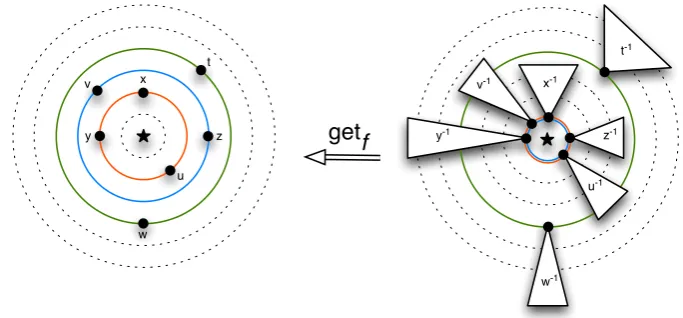
it cannot abstract information from the source. To help understand why composition succeeds whengetf is strictly increasing, Figure2shows a possible configuration under this assumption.
On the left subfigure, several values of typeUspread over concentric circles according to their distance to a hypothetical center denotinggetf s(and represented by a star). Similarly for the right
subfigure, for values of typeSand centers. x−1denotes the pre-image ofxundergetf. In this
case, we have a one-to-one correspondence sincegetf, being strictly increasing, must be injective.
x
y z
w u v
t x-1
y-1 z-1
w-1 u-1 v-1
t-1
getf
Figure 2: Strictly increasing transformation
getf smust have their pre-images at the same distance froms. Moreover, the relative distances to
the center are preserved, in the sense that, for example, sinceyvget
fsztheny
−1
sz−1. Now,
consider the backward transformation, when putting back a given target in the original source
s. Being well-behaved, putgwill return one of the values that is closest togetf s, in this case
eitherx,yoru;putf must return one of their pre-images which, due to the above assumptions, is
guaranteed to be one of the closest tos, whatever choice is made byputg.
While a strictly increasinggetf suffices to guarantee that any compositiong
·
f is also awell-behaved least-change lens, in order to attain a proper compositional language and be able to compose any sequence of transformations, this property must also be preserved by composition.
Proposition 8 If two transformationsgetf:S→U andgetg:Uv→V are strictly increasing,
thengetg
·
getf:S→V is also strictly increasing.A more interesting requirement is the following more relaxed version ofSTRICTINC, that does not imply injectivity:
(∀s3.getf s2=getf s3⇒s1≺ss3)⇒(getf s1)@getfs(getf s2)
In point-free notation this is written
(≺s/getf)
·
ρgetf ⊆ get◦
f
·
@getfs QUASISTRICTINCNow a viewgetf s1is required to be smaller than another viewgetf s2only whens1is smaller
than all sources that map to the view ofs2. An alternative formulation using the less than or equal
orders is
(getf s1)vgetf s(getf s2)⇒(∃s3.getf s1=getf s3∧s3ss2)
orρgetf
·
vgetf s·
getf ⊆ getf·
sin the point-free notation. In other words, when a viewv1is smaller than or equal to another viewv2(in distance to a viewgetf s), then at least one sourcex-1
y-1 z-1
w-1
u-1
v-1
t-1
x
y z
w u v
t
getf
Figure 3: Quasi strictly increasing transformation
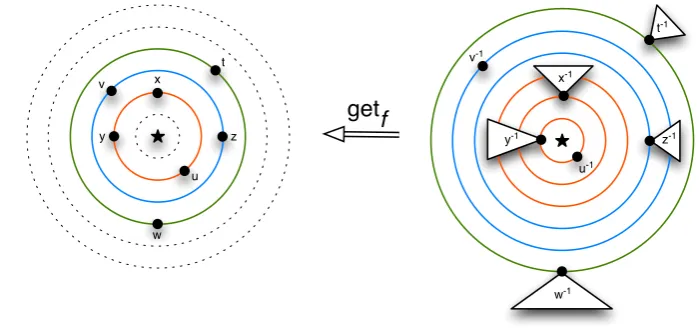
difference toSTRICTINCcan easily be seen in Figure3. Now the pre-image of a target value can contain several sources at different distances from the center. Still, for targets at the same distance togetf s, the minimum values of their pre-images must all be at the same distance froms.
Proposition 9 If f:S Q U and g:Uv Q V are well-behaved least-change lenses andgetf is quasi strictly increasing between s and vgetfs for every s∈S, then g
·
f:S Q V is a well-behaved least-change lens.Figure3also helps understanding why this proposition holds. Again,putgis free to choose any
value closest togetf sbut, whatever the choice made,putgwill always return one of the value
closest tos. An example of a transformation that is not strictly increasing but is quasi strictly increasing is determining the size of a set, with the obvious distance measures (size of symmetric difference in the source and absolute value of the difference in the target).
Unlike with strictly increasing transformations, the composition of two quasi strictly increasing transformations only remains so ifgetf is surjective.
Proposition 10 If two transformations getf :S →U and getg:Uv →V are quasi strictly increasing andgetf is surjective, thengetg
·
getf:S→V is also quasi strictly increasing.In a lens framework requiring surjectivity is not a big drawback, since it is usually already required due to totality constraints [FGM+07,PC10].
under this category are tuple projections, whose perfect complement is exactly the information projected out.
Having a perfect complement is not sufficient for a least-change lens to be composable. However, ifgetis strictly increasing among sources with the same complement, then it is also quasi strictly increasing, and thus can safely be composed.
Proposition 11 Ifgetf:S→Uvhas perfect complement and(gets1)vgets(gets2)∧cpls1=
cpls2⇒s1ss2for every s,s1,s2∈S, thengetf is quasi strictly increasing.
Proving that a transformation is quasi strictly increasing is not trivial. This is an example of a useful class of transformations where such proof can be much simplified.
Dually to the deterministic case, the necessary condition for two nondeterministic least-change lenses to be composable is the following:
∀s.get◦f s ⊆ Putf s∧ ∀u.get◦gu ⊆ Putgu⇒ ∀s.(getg
·
getf)◦s ⊆ Putg·
f sOnce again, an injectivegetgguarantees the compositionality.
Proposition 12 If f:S IQ U and g:Uv IQ V are well-behaved nondeterministic least-change lenses andgetgis injective, then g
·
f:S IQ V is a well-behaved nondeterministic least-change lens.Interestingly, the remaining laws that ensure nondeterministic compositionality are dual to those for the deterministic case: we can either reverse every law fromR ⊆ StoS ⊆ Ror, equivalently, replace every≺sbys. For example, instead of requiringgetf to be strictly increasing it suffices
to require it to be monotonic:
s1ss2⇒(getf s1)vgetfs(getf s2)
Remember that monotonicity reads the same way as the strictly increasing property, by simply replacing “smaller than” by “smaller than or equal to” in the text. An equivalent formulation in the opposite direction is:
(getf s1)@getfs(getf s2)⇒s1≺ss2
In the point-free notation we have
getf
·
s ⊆ vgetfs·
getf MONOTProposition 13 If f:S IQ U and g:Uv IQ V are well-behaved nondeterministic least-change lenses andgetf is surjective and monotonic betweensandvgetfsfor every s∈S, then g
·
f:S IQ V is a well-behaved nondeterministic least-change lens.Unlike the strictly increasing property, monotonicity no longer implies thatgetf is injective.
Unlike in Proposition7, here we requiregetf to be surjective: note that surjectivity is the dual
property of being deterministic, whichgetf always satisfies. Figure4helps understanding the
x-1
y-1 z-1
w-1
u-1
t-1
v-1
x
y z
w u v
t
getf
Figure 4: Monotonic transformation
well-behaved nondeterministic composition. Unlike in Figure2, the pre-images of the values of typeUat the same distance fromgetf sare allowed to be at different distances froms. However,
we have the restriction that, for example, wheny@getfsztheny−1≺sz−1, forcing the pre-images
of targets at different distances fromgetf sto also be at different distances froms(respecting the
relative orders). This ensures that whenputgreturns all values at the minimum distance from
getf s, all sources at the minimum distance fromsare contained in their pre-image.
An interesting fact is that, unlike in total partial-orders, a strictly increasing transformation is not necessarily monotonic. This means that we can can have transformations whose composition is well-behaved in the deterministic scenario, but not well-behaved in the nondeterministic one. Figure2helps understanding why: even ifputf returns all values closest togetf s, there is no
chance forputf to return all values closest tos, since some of the pre-images closest tosoriginate
from targets further away fromgetf s(namely,vandz).
As with strictly increasing transformations, monotonicity is preserved by composition.
Proposition 14 If two transformationsgetf:S→U andgetg:Uv→V are monotonic, then
getg
·
getf:S→V is also monotonic.Again, monotonicity can be relaxed to
(∀s3.getf s2=getf s3⇒s1ss3)⇒(getf s1)vgetfs(getf s2) or with the point-free notation:
(s/getf)
·
ρgetf ⊆ get◦f·
vgetfs QUASIMONOT Quasi monotonicity states that if a sources1is smaller than or equal to all the sources with viewv(in distance to a sources), then its viewgetf s1shall be at mostv(in distance to a viewgetf s).
Alternatively, when a viewv1is smaller than another viewv2(in distance to a viewgetf s), then
at least one source with viewv1is smaller than all sources with viewv2(in distance to a sources):
x
y z
w u v
t x
-1
y-1 z-1
w-1
t-1
v-1
u-1 getf
Figure 5: Quasi monotonic transformation
Proposition 15 If f:S IQ U and g:Uv IQ V are well-behaved nondeterministic least-change lenses andgetf is surjective and quasi monotonic betweensandvgetfsfor every s∈S, then g
·
f:S IQ V is a well-behaved nondeterministic least-change lens.Figure5illustrates this property. The difference to monotonicity is that only the minimum pre-images of each target are required to respect the relative orders. This suffices forputf to able
to return all closest sources tosgiven all closest targets togetf s.
Likewise to quasi strictly increasing transformations, preservation of quasi monotonicity by composition requires the surjectivity of the first transformation.
Proposition 16 If two transformationsgetf:S→U andgetg:Uv→V are quasi monotonic
andgetf is surjective, thengetg
·
getf:S→V is also quasi monotonic.Finally, regarding lenses with perfect complement, nondeterministic compositionality is ensured by a monotonicgetamong sources with the same complement, since this ensures thatgetis quasi monotonic.
Proposition 17 If getf:S→Uv has perfect complement and s1ss2∧cpls1=cpls2⇒
(gets1)vgets(gets2)for every s,s1,s2∈S, thengetf is quasi monotonic.
5
Related work
linguistic mechanisms to combine maintainers following the principle of least change, including composition, are proposed.
Much existing work in the context of database view updating is concerned with, given a view function, deriving an update strategy that translates view updates into source updates according to some minimization criteria. [Heg04] introduces a notion of order on sources (S) and on
views (V) and postulates, among other properties, that view updating shall be order-compatible
(getsV v⇒sSputs v). Note that his notion of order is only between two values of the
same type (henceS, for a typeS), and the above property formalizes that if an updated view
is at most an original view, then the updated source shall be at most the original source7. In the context of database tables, his particular orders imply the reflection of view insertions as source insertions, and similarly for deletions. He then establishes that, under particular conditions and for monotonicgetfunctions, there is a unique translation of insertion and deletion view updates under a constant complement approach [BS81]. More recently, [JRW10] shows the connection between the constant complement update translators of [Heg04] and lenses, by demonstrating that they arise from very well-behaved lenses in a category of ordered sets.
[Kel86] acknowledges the ambiguity of view-update translation for non-constant complement approaches (well-behaved lenses), and proposes an interactive algorithm that runs a dialog with the view programmer to choose a particularputfunction that obeys 5 minimization criteria. [LS91] claims that the view information is not sufficient to disambiguate view updates, and proposes to consider not only a dialog with the view programmer but also a dialog with the view user, obeying similar minimization criteria. Their minimization criteria can be seen as an order on sources and their algorithms as a nondeterministic least-change lens, whereas the dialog is an additional mechanism to allow choosing a minimal source from the various possible. Nevertheless, these approaches consider wholegetfunctions and do not allow reasoning by composition.
[BKT02] studies the complexity of minimizing view updates for a monotonic fragment of relational algebra, for two kinds of deletion and annotation updates, and conclude that this problem is NP-hard for queries including both projection-join or join-union. The authors consider two measures for minimality: first the number of changes in the source, and second the number of side effects in the view caused by the view update. Although our notion of order is more natural with the former measure (since the lens laws disallow view side effects), our framework of least-change lenses is general in the sense that it does not assume any particular order on states nor language of updates. Also, while they study the problem of inverting an individual lens in a minimal way, we consider the orthogonal problem of composing “minimized” lenses.
In previous work [MPC12], we claim that nondeterminism is necessary to support non-surjective BX languages and propose a language of nondeterministic lenses whoseput func-tions are the largest nondeterministic ones satisfying the BX laws. Nevertheless, as we noted in [MPC12], such nondeterminism needs to be controlled to be useful in practice and this paper proposes such an approach by selecting only the minimal values according to a known order.
A solver-based bidirectional model transformation tool is proposed by [CREP10], that intro-duces the declarative JTL language inspired by a QVT-like syntax. A JTL BX is nondeterministic
7These order-based lenses are significantly distinct from least-change lenses: our notion of order
sis “triangular”, as
because: if a modified target model has a trace to a source model, such source model is modified, otherwise all possible source model candidates are returned. In a similar approach, we propose the bidirectionalization of QVT-Relational programs using the Alloy language [MC13]. A BX in our tool is a nondeterministic least-change maintainer that finds all possible source models that are at a minimal distance to the source (and vice-versa), according to user-specified distance metrics. Still, none of these languages nor the QVT standard support composition.
Stevens [Ste10] argues that transformations should always be deterministic in order to be predictable for users, in the sense that users should not observe different results for similar executions. In our perspective, a certain degree of nondeterminism is inescapable in BXs, as predictability also requires allowing users to control the particular semantics of the transformations that the BX language is not able to capture. Notwithstanding, although we reason about composing nondeterministic lenses, we still agree that the final transformations should be deterministic, either by fixing a default choice or by providing a dialog-like mechanism to users.
6
Conclusions and future work
In this paper, we have introduced a framework of least-change lenses that is characterized by two dual scenarios: a deterministic one that only requires that transformations return minimal updates, and a nondeterministic one that requires them to return all minimal updates. We have then presented several sufficient conditions that enable composition of least-change lenses. The properties for well-behavedness and for composition arise naturally from the duality between both scenarios, which has become apparent by formalizing them using the relational calculus notation. Our criteria are still not general enough to encompass least-change lenses we believe can be composed, although more relaxed criteria will most likely not be independent of the composed transformation, denying the advantages of a truly compositional approach. This issue raises the interesting question of completeness: is there a limit on the expressiveness of a least-change lens that can be composed safely with any other such lens? Our (still unproved) conjecture is that such limit is set precisely at quasi strictly increasing transformations for the deterministic scenario, and quasi monotonic transformations for the nondeterministic one.
A problem with some of the proposed criteria is that it is also rather tedious (and unintuitive) to verify if a transformation satisfies them, and we are working on providing better intuitive explanations and proof methods to perform such task. For example, we expected our example transformationT1to be quasi monotonic (with distance measuresdist1anddist2), but have found
that such is not the case. We are currently investigating if other subtle redefinitions ofdist1and
dist2, namely using distance functions to lexicographic orders, would satisfy any of the criteria.
underlying update translation semantics.
To better suit that goal, we are studying if the composition of least-change lenses should be more flexible, by allowing different orders for different lenses over the same source type: one would writef:SQU to state that lensf is well-behaved for order. By doing so, the order
could specify more precisely the behavior of a lens, and given two least-change lensesf:SQU
andg:UQvV, an interesting research direction is to infer an order-such thatg
·
f:SQ-Vis a well-behaved least-change lens. Obviously, one could always default to the discrete metric referred in Section2, but the goal would be to derive a more precise (i.e. more predictive) order. In the future we also intend to tackle other combinators to compose BXs besides sequential composition. For example, we are currently researching whether recursive patterns for algebraic data types (like folds or unfolds) can be used to build least-change lenses from simpler ones. A final interesting direction for future work would be to generalize our theory to symmetric BX frameworks like maintainers.
We have modeled our framework in Alloy [Jac12], a lightweight formal specification language with support for automatic model finding via SAT solving. This model has proved very useful in the early stages of this research to rapidly explore and verify/discard different propositions8. Of course, such automatic verification is necessarily bounded, and full unbounded calculational proofs for all our propositions were then conducted in Isabelle/HOL [NPW12] proof assistant9.
Acknowledgements
This work is funded by ERDF - European Regional Development Fund through the COMPETE Programme (operational programme for competitiveness) and by national funds through the FCT - Fundac¸˜ao para a Ciˆencia e a Tecnologia (Portuguese Foundation for Science and Technology) within project FCOMP-01-0124-FEDER-020532. The first author is also sponsored by FCT grant SFRH/BD/69585/2010.
Bibliography
[BFP+08] A. Bohannon, J. N. Foster, B. C. Pierce, A. Pilkiewicz, A. Schmitt. Boomerang: resourceful lenses for string data. InPOPL 2008. Pp. 407–419. ACM, 2008.
[BKT02] P. Buneman, S. Khanna, W.-C. Tan. On propagation of deletions and annotations through views. InPODS 2002. Pp. 150–158. ACM, 2002.
[BM97] R. Bird, O. de Moor.Algebra of Programming. Prentice-Hall, Inc., Upper Saddle River, NJ, USA, 1997.
[BS81] F. Bancilhon, N. Spyratos. Update semantics of relational views.ACM T. Database Syst.6(4):557–575, 1981.
8 The Alloy model can be downloaded from http://wiki.di.uminho.pt/twiki/pub/Research/
FATBIT/Publications/lc-lenses.als.
9The Isabelle/HOL theory can be downloaded fromhttp://wiki.di.uminho.pt/twiki/pub/Research/
[CREP10] A. Cicchetti, D. D. Ruscio, R. Eramo, A. Pierantonio. JTL: a bidirectional and change propagating transformation language. InSLE 2010. LNCS 6563, pp. 183–202. Springer, 2010.
[Dis08] Z. Diskin. Algebraic models for bidirectional model synchronization. InMoDELS 2008. LNCS 5301, pp. 21–36. Springer, 2008.
[FGM+07] J. Foster, M. Greenwald, J. Moore, B. Pierce, A. Schmitt. Combinators for bidirec-tional tree transformations: a linguistic approach to the view-update problem.ACM T. Progr. Lang. Sys.29(3), 2007.
[Fos09] J. Foster.Bidirectional Programming Languages. PhD thesis, University of Pennsyl-vania, December 2009.
[Heg04] S. J. Hegner. An order-based theory of updates for closed database views.Annals of Mathematics and Artificial Intelligence40:63–125, 2004.
[HEO+11] F. Hermann, H. Ehrig, F. Orejas, K. Czarnecki, Z. Diskin, Y. Xiong. Correct-ness of model synchronization based on triple graph grammars. InMoDELS 2011. LNCS 6981, pp. 668–682. Springer, 2011.
[HHI+10] S. Hidaka, Z. Hu, K. Inaba, H. Kato, K. Matsuda, K. Nakano. Bidirectionalizing graph transformations. InICFP 2010. Pp. 205–216. ACM, 2010.
[HPW11] M. Hofmann, B. Pierce, D. Wagner. Symmetric lenses. InPOPL 2011. Pp. 371–384. ACM, 2011.
[Jac12] D. Jackson. Software Abstractions: Logic, Language, and Analysis. MIT Press, London, England, revised edition, 2012.
[JRW10] M. Johnson, R. Rosebrugh, R. Wood. Algebras and update strategies.Journal of Universal Computer Science16(5):729–748, 2010.
[Kel86] A. Keller. Choosing a view update translator by dialog at view definition time. In
VLDB 1986. Pp. 467–474. Morgan Kaufmann Publishers, 1986.
[KU84] A. Keller, J. D. Ullman. On complementary and independent mappings on databases. InSIGMOD 1984. Pp. 143–148. ACM, 1984.
[LS91] J. A. Larson, A. P. Sheth. Updating relational views using knowledge at view defini-tion and view update time.Information Systems16(2):145–168, 1991.
[MC13] N. Macedo, A. Cunha. Implementing QVT-R bidirectional model transformations using Alloy. InFASE 2013. Volume 7793, pp. 297–311. 2013.
[Mee98] L. Meertens. Designing constraint maintainers for user interaction. 1998. Manuscript available athttp://www.kestrel.edu/home/people/meertens.
[MPC12] N. Macedo, H. Pacheco, A. Cunha. Relations as executable specifications: taming partiality and non-determinism using invariants. In RAMiCS 2012. LNCS 7560, pp. 146–161. Springer, 2012.
[NPW12] T. Nipkow, L. C. Paulson, M. Wenzel.Isabelle/HOL: A Proof Assistant for Higher-Order Logic. Springer, 2012.
[Pac12] H. Pacheco.Bidirectional Data Transformation by Calculation. PhD thesis, Univer-sity of Minho, July 2012.
[PC10] H. Pacheco, A. Cunha. Generic Point-free Lenses. In MPC 2010. LNCS 6120, pp. 331–352. Springer, 2010.