FOR YOUR ENRICHMENT
Barry Trott, Editor
Study abroad opportunities offer students and faculty a new window on their profession. Looking at how library services are offered in other countries can shed new light on practices in US libraries but can also remind us how important librar-ies are in the lives of our users, something that can be easy to forget as we go about our day-to-day work in a library. In this edition of “For Your Enrichment,” LIS professor Jenny S. Bossaller and three of her students discuss a study abroad session in South Africa.—Editor
M
any LIS programs offer study abroad programs, which offer students an opportunity to learn in a new environment. The contact time inherent in a study abroad program might be especially valuable if students are primarily taking online courses. They offer students a chance to grow—to get to know each other and their professors, to push their personal boundaries, and to learn how to navigate a new country’s transportation sys-tems and languages. Studying abroad is often seen as an op-portunity for students to see a new country and learn about a new culture in a safe environment, but it can also be used as a window into various problems and inequalities around the world. Taking this approach might prove to be problematic, though, if the problems are presented as those of “the other” rather than as global issues or as those that are relevant to the students’ own environment. Study abroad programs should not be only fun; they should engage the students intellectu-ally through readings and class discussions and give them the opportunity to talk to library professionals and scholars.This paper focuses on a study abroad trip to Cape Town, South Africa, prefaced by the intentions and “big ideas” of two previous trips offered through the School of Information and Learning Technologies (SISLT) at the University of Missouri (MU) to the United Kingdom and Ireland. Please pardon the use of the first-person—this is about personal experiences and beliefs. Please also pardon the lack of detail about some of the social issues mentioned here—the necessary brevity of a column cannot fully explain the “biggest ideas” about what we learned. I (Jenny) put the paper together, but the students share authorship.
BACKGROUND
“Open to all? The Public Library and Social Exclusion” (2000) presented evidence that libraries, as part of the globalized in-formation society, reproduce social inequalities.1 The report
underscores the importance of libraries’ and other cultural
Jenny S. Bossaller, Jillian Frasher, Sarah Norris,
and Claire Presley Marks
Jenny S. Bossaller is an Assistant Professor of Library and Information Science at the University of Missouri’s School of Information Science and Learning Technologies (SISLT);
Jillian Frasher is a student at SISLT and a Library Assistant at Daniel Boone Regional Library; Claire Presley Marks is a Collections Assistant/Cataloger at the Missouri History Museum; Sarah Norris graduated from SISLT in 2014. Correspondence concerning this column should be addressed to Barry Trott, RUSQ Editor, 7770 Croaker Rd., Williamsburg, VA, 23188; email: [email protected].
Learning
about Social
Justice through
Experiential
institutions’ responsiveness to local, community issues. In other words, public librarians need to actively invest in social inclusion and focus on groups that face discrimination and marginalization in an information and communication tech-nologies (ICT)–driven consumer environment. That report was significant in my own development, and it spurred my interest in comparative librarianship.
In the United Kingdom, the Chartered Institute of Library and Information Professionals (CILIP) developed the Librar-ies Change Lives award, given to librarLibrar-ies to “highlight and reward partnership work that changes lives, brings people together and demonstrates innovation and creativity.”2 In
2011 and 2012, I worked with other SISLT faculty to take students to the United Kingdom to visit the winning libraries and meet the librarians behind the programs. The students earned six hours of credit in two classes: three hours in a comparative librarianship class and three in a course called “Libraries, Literacy, and Social Justice.” Going to the award-winning libraries took us to some places that were slightly off the beaten path. For instance, in 2011 I worked with librarians to organize a conference at the Barking Library in East London, where the students presented papers and participated in breakout discussions with local public librar-ians. We visited the Leeds public library to learn about their partnership with the Autism Support for Families project. In 2012, we avoided London because of the nightmarish lo-gistics presented by the Olympics, so we went to Dublin in-stead. There, the students learned about outreach services to the Traveller (Roma) population and got a behind the scenes
tour of the Linen Hall Library, an independent subscription library that holds a large collection of materials related to the Troubles, the often bloody period of religious and civil un-rest over Ireland’s fight for independence. The visit to Linen Hall proved to be an excellent preface to a tour of Derry in Northern Ireland given by a brother of a member of the Irish Republican Army who died on Bloody Sunday. The students also responded strongly to the Glasgow Women’s Library, which focuses on women’s history and equality. The visits to sites focusing on social justice were interspersed throughout the trip—we also visited the British Library, national libraries, museums, and natural landmarks, and went to the Edinburgh Fringe Festival (so we had a lot of fun, too).
SOUTH AFRICA
In 2013, Tom Kochtanek asked me if I would like to take a group of students to South Africa. Tom is the University of Missouri project leader of a digitization initiative called Proj-ect Mayibuye. The executive summary of the projProj-ect explains:
FOR YOUR ENRICHMENT
collection documents the campaign both in South Af-rica and around the world to bring down the apartheid regime. (unpublished excerpt, 2014)
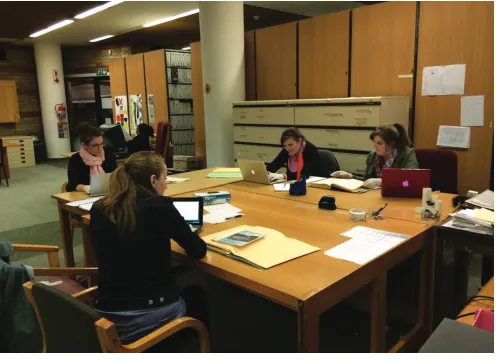
My first instinct was to say no—South Africa was not part of my plan. It made me nervous—taking students to a country that far away would be too difficult. News about Africa focuses on war, poverty, and political conflict. Recognizing my own hypocrisy, though, I did some research and realized that this was an opportunity that would be foolish to miss. Three of us went to Cape Town for a preparatory visit, and in (our sum-mer, their winter) 2014, I brought a group of four awesome LIS students to Cape Town for three weeks. We explored museums with curators, visited township schools and libraries, and had small group discussions with scholars. The final culminating experience was creating a finding aide for the vertical files in the Mayibuye Archives. Without extensive reading on the history of South Africa and the experiential learning that prefaced our work, the students would not have been able to understand the materials that we were working with. Likewise, our work in the archives brought the readings to life. See figure 1.
We spent our first weekend as tourists, taking the red hop-on/hop-off tour bus to all of the biggest tourist attractions. We dove into academic work over the next week, beginning with a tour of Robben Island. Robben Island was used as a place of exile for over 400 years but most notoriously as a prison for over 3,000 political dissidents during the Apartheid Era (1948–94). Claire Presley-Marks discusses the tour of Rob-ben Island: “it was a powerful introduction to the realities of apartheid. We read Nelson Mandela’s Long Walk to Freedom prior to the trip . . . reading it and then visiting Robben Island was very humbling—it was a personal way to interact with history.3 Being able to see where the prisoners lived, where
they worked, was such an amazing, emotionally moving ex-perience. The tour guide was a former prisoner himself, and we all were moved by his harrowing stories.”
We visited many other museums during the week. Sarah Norris explains how those tours changed her idea of diversity: “I learned growing up that the United States is considered a melting pot from all the immigrants that came and still come here. South Africa is nicknamed the Rainbow Nation because of the diversity of people who call it home. We visited the Slave Lodge, the District Six Museum, the Bo-Kaap area, and the South African Jewish Museum, places that documented the history of how these groups of people came to South Africa. At the Slave Lodge I learned that slaves in South Af-rica came from outside of the country and outside of AfAf-rica. The District Six Museum documents what was once a highly diverse area—it was the first stop for many of the new im-migrants to Cape Town, but when the law of apartheid was enacted most of its buildings were bulldozed, and its residents were relocated according to race. That same day, we visited the Bo-Kaap area, home to many of Cape Town’s Muslim set-tlers—the Cape Malay (see figure 2). The Jewish Museum was eye opening—I was previously unaware of Jewish immigra-tion to South Africa.”
We learned about the painful forced evictions as well as the importance of preserving memory at the District Six Mu-seum. Jillian (Jill) Frasher and Sarah explain how the readings helped them understand the museum: “Bennett discussed go-ing through the museum as an experience in itself . . . readgo-ing about it before we went helped me understand what District Six was, why it was so important. It was actually established by the community, and it emphasizes oral histories and shar-ing memories as opposed to material objects. The museum also challenges the ideas of truth and history by placing the focus on memory. Bennett said that they are not trying to cre-ate ‘an official history’ of the area, but rather to crecre-ate ‘exhibi-tions [that] emerge from what people remember. The space is provided to give visitors an opportunity to share their past, and the museum will not dispute an individual’s memory’ (p. 8). This article made me look at the displays and presentation within these museums carefully to see how they presented South Africa’s history.”4
Because most of our work was to take place in the ar-chives, we read about and discussed the presentation of history. Sarah discusses how the readings and experiences changed her view of cultural institutions: “One of the things that I learned was how museums in Cape Town are dealing with the story of Apartheid and other difficult aspects of their history and heritage, the topic of Crooke’s article.5 Crooke
instance, the South African Museum used to display Greek and Egyptian antiquities as art and that of South Africa’s Bush-man people with the natural history collection, effectively elevating European heritage. New practices and policies had them completely altered their African culture displays. The Slave Lodge is another newer museum, established to tell the story of South Africa’s previously obscured history of slavery.” We began working in the archives in our third week. The archives hold more than 350 collections of manuscripts and records, as well as a photographic library, a collection of art, and a collection of posters. One of the earliest collections, forming the core of Mayibuye’s holdings, is the records of the London-based International Defence and Aid Fund (IDAF), an organization created to pay legal expenses and give sup-port to families of the protesters against apartheid who were on trial or incarcerated (see figure 3).
The collection we worked with contained a wide variety of materials, including documents, handbooks, book chap-ters, books, magazines, and ephemera that were donated by people who had been involved with the struggle to end apartheid. Marxist, Communist, and anti-apartheid confer-ence materials are scattered throughout the collection, most dating from the 1980s and 90s. We were often dumbstruck
by what we found. There were files that documented, through letters, postcards, and telegraphs, the political actions, ar-rests, prison conditions, and release of prisoners and some that documented the deaths of political activists. Artifacts, such an instructional handbook on the treatment of Bantu servants, were poignant artifacts of European domination during apartheid. Likewise, we had read about pass books and papers that gave black Africans permission to visit white areas, but actually holding the pass books and papers was somehow very different.
We were tasked with creating an item-level finding aid and inventory of a three-cubic-foot collection, using Dublin Core standards, with the addition of a few unique fields. There were several challenges that we encountered while processing the collection. We had varying levels of archival experience, and we were not subject experts; therefore, we had a difficult time identifying people and events (thank you, Mayibuye staff and Google). Additionally, the collection was written in several languages. Most of the collection is in Eng-lish but included Swedish, Dutch, Afrikaans, Xhosa, French, German, and Zulu (thank you Google Translate).
FOR YOUR ENRICHMENT
the files: “Working with these documents added a personal aspect to the apartheid history of South Africa that could not be learned from the books and articles we read. I was able to see how the apartheid government worked, and how the fight to end it affected the activists and their families. Some of the items that I saw were copies of correspondence between Nelson Mandela and F. W. de Klerk, and a large collection of newspaper articles written by Ruth First, an anti-apartheid activist and scholar who was exiled to Mozambique (and later murdered). Another collection of newspaper articles covered the Rivonia trial and the children’s protests that occurred at the time. I was touched by the story of Ben Bartman, separated from his family during exile, as told through documents, pho-tographs, and other items; when his wife passed away, he had to ask for permission to enter South Africa to make arrange-ments for his children. He wanted to stay in South Africa with his children. There were newspaper articles about his children asking the government to not send their father away again. An-other story, told though newspaper articles, documented the separation of two friends as one was placed under house arrest with her family under the Suppression of Communism Act.” Claire describes the collections that were most memorable in her assigned folders: “The collections that were the most vivid for me were the ones about youth fighting apartheid. There were a lot of movements born out of high schools and universities. One particular collection followed the story of Anton Fransch, a twenty-year-old commander of Umkhonto we Sizwe, a wing of the African National Congress. He was assassinated in 1989 in Cape Town by police and South Afri-can Defense Forces for his anti-apartheid activities. The col-lection had newspaper articles about his death, programs for his funeral, handwritten letters from people who knew him, and much more. His valor was inspirational and it was really moving to see how much the community mourned him.” Jill provides another example: “There was one folder that was full of articles written by one individual journalist over the course of several years, then a few about him after he was banned from South Africa. I was able to get a sense of why this man’s articles were controversial, resulting in his exile. If I were not working on that folder in the archives I would have never known of this journalist or his story, and only seeing an article or two would not paint a full picture of what happened to him. Seeing these kinds of stories play out was a big part of what made the experience so memorable. We were able to literally hold history in our hands and see what happened and gather information about different events that occurred.”
Claire agrees: “Working in the archives was an interactive way to experience South African history using primary source materials. These amazing collections documenting the tribu-lations of South Africans struggling for freedom don’t exist anywhere else, and if you don’t have the means to travel to South Africa you don’t have any way to access them, which is why this digitization initiative is so significant. We were all so emotionally pulled in to these collections, which were all globally relevant and extremely interesting. The rest of the world needs to see them.”
Part of the appeal of working in the Mayibuye Archives was getting to work beside the archivists. Many of the people who work in the archives were involved with the struggle for freedom, so they are personally invested in the collection’s use and care. Professors in various departments of UWC were also involved with the struggle through their teaching and activism; some were imprisoned. The university is still a space for activism. Claire and Sarah explain what they learned about the relationship between the people at the university and the collection: “Meeting the archivists and working with the collections that involve them, engaging with the librar-ians and scholars who worked there, added not only another dimension to our study abroad experience but to my under-standing of archives. The staff has a responsibility for how the collection is used. Before this trip I knew that archivists and librarians had a responsibility to the items they collect, but I gained a deeper understanding of that related toward donors. I now no longer think of this responsibility in solely pragmatic terms—of how the item is stored and cared for— but also about how an item is used.”
We had several sessions with the team of archivists in which we were able to learn about the processes and chal-lenges of the collection, as well as the chalchal-lenges of digitiza-tion in general. Ownership of digital content was a recurrent theme. We were surprised and delighted when the archivists asked our opinions about what we liked in archival websites, and we had an exciting night putting together a document about our favorites.
BRINGING IT BACK HOME
One of the goals of the trip was, of course, to provide a foun-dation for students to develop their own practice of librari-anship. Jill said that “the trip enhanced my understanding of how libraries are more than just a place to store books. During our visit to Huguenot Square Public Library we met a volun-teer teacher who was setting up for her class. She taught her students job skills such as pattern making, sewing, and creat-ing mosaics. Her students then were able to start businesses and sell their crafts. The Cape Town campus of the South African National Library has a program to help local authors publish their stories . . . this is a topic that we’ve talked about in classes, but it was helpful to see it in action, and it is nice to see how libraries outside of the United States work with their communities like this.”
shared.” The work sparked a passion for preserving today’s history.
What did the students learn about themselves? Jill said, “Studying abroad taught me a lot . . . everything was so differ-ent from what I was used to. I learned how to be even more comfortable trying new things in order to fully experience the culture and not fall back on ‘safe’ options. An example of this was with food. I purchased items I would never try at home . . . I also learned how to better adapt to new situations and new places, particularly when traveling to a place outside of my comfort zone.”
Claire said that the trip changed her worldview. The township visit was particularly eye opening: “I had never been around that level of poverty before, it was staggering and makes you appreciate what you have. The township el-ementary school library was in a shambles. The books were covered in dust, outdated, not cataloged, and unusable—it was heartbreaking and made me realize how important librar-ies were in my own youth and education and how fortunate I was to have them.”
Jill, though, found that the trip reaffirmed her own call-ing: “One of my favorite things about this trip was that the library still felt like ‘home.’ With all of the other cultural dif-ferences in daily life in South Africa, the libraries looked the same and had the same type of work-culture. Libraries are hubs of information everywhere and librarians always want to help their patrons find what they need. I did not know a lot about archives before this trip, but I gained a better un-derstanding of just how important they are to preserving his-tory around the world. If there were not archivists working to preserve and keep their materials, it would be easy to forget history after a while, or to pretend that certain events never happened. Overall, it seems that the library is an important place no matter where you go, which is a great feeling for a future librarian.”
REFLECTION
First, I have found all three study abroad experiences to be incredibly humbling, and I am so grateful for the scholars, cu-rators, and librarians who were willing to spend time with us.
So what are the big ideas that have come out of all of these trips, and what do I hope students might take home?
1. The first big idea is that librarians need to resist domi-nant forces in society. As Muddiman et al. said, they need to be in tune with local people and recognize that their stories, their desires, are important.6 This idea
shined through in Ireland, England, Scotland, Wales, and South Africa, which makes me believe that it might be a universal truth.
2. Outreach means letting local people take the reins to determine the best services.
3. Librarians can play an important part in preserving local history, and that means the history of people of all walks of life—not just people who make it into history books. 4. Money and budget shortfalls are universal. Creative
problem solving is an incredibly important skill for li-brarians to possess.
5. Expect the unexpected, and embrace it as an opportu-nity for learning.
FOR MORE INFORMATION
South African History Online (www.sahistory.org.za) is an excellent reference resource written from the South African point of view.
The students’ class blog is online; it contains more details about their experiences and many beautiful pictures. See https://librarianintherainbownation.wordpress.com
References
1. Dave Muddiman et al., “Open to All? The Public Library and Social Exclusion. Volume One: Overview and Conclusions,”
Resource: The Council for Museums, Archives and Libraries, 2000, http://eprints.rclis.org/6283/1/lic084.pdf.
2. “CILIP Libraries Change Lives Award,” Chartered Institute of Library and Information Professionals, www.cilip.org.uk/cilip/ advocacy-awards-and-projects/awards-and-medals/cilip-libraries -change-lives-award.
3. Nelson Mandela, Long Walk to Freedom (Boston: Back Bay Books, 1994).
4. Bonita Bennett, “Encounters in the District Six Museum,” Curator: The Museum Journal 55, no. 3 (2012): 319–25.
5. Elizabeth Crooke, “Dealing with the past: museums and heritage in Northern Ireland and Cape Town, South Africa,” International Journal of Heritage Studies 11, no. 2 (2005): 131–42.