ISSN-L: 2501 - 1235 Available on-line at: www.oapub.org/edu
doi: 10.5281/zenodo.3235019 Volume 5 │ Issue 8 │ 2019
FACTORIAL STRUCTURE OF THE MOTORIC ABILITIES OF
FIRST AND SECOND LEAGUE SOCCER PLAYERS IN KOSOVO
Agron Thaqi1,
Bylbyl Sokoli2i
1PhD Candidate, Tetovo State University, Faculty of Physical Education and Sport,
Macedonia 2University of Pristina, Faculty of Physical Education and Sport, Kosovo
Abstract:
This study investigated a sample of 159 soccer’s from Kosovo, 79 of them from the first league and 80 from the second league, aged 18-33 years old. The aim of the present study is to determine the motoric abilities of Kosovo’s first and second League soccer players through factorial analysis. To prove motoric abilities, 9 variables are applied: Standing long jump – SLJ, Standing high jump - SHJ, Standing triple jump - STJ, foot tapping on wall - FTW, 20m run, 50m run, ball lead slalom 20m, work with the ball – WWB, ball lead 20m in corridors - BLC20m. Motoric spaces are treated with factorial analysis and are gained three latent factors: explosive strength of lower limbs factor, speed and agility, alternative speed of lower limb factor and the ability to master the ball. After basic statistic parameter analyses in motor space is concluded that exist systematic differences in favor of the first league soccer’s.
Keywords: soccer, first and second league, motoric abilities
1. Introduction
Soccer is one of the most complex sports in which the at-attainment of good results depends on multiple, strictly interconnected factors Stølen T., Chamari K., Castagna C. (2005). It is a very dynamic game featuring an ever growing number of direct one-on-one plays, requiring perfect motor, technical, tactical, and mental preparation from the players Reilly T. (2007).
Soccer is a highly dynamic and a cyclical game and a soccer player’s performance during a match involves a high variability of actions. This specific aspect of the sport requires players to undertake numerous intensive and explosive exercises, often
interrupted with rest breaks of different duration, depending a match situation. A player’s standing time during a match is about 19.5% of total match play, walking – 41.8%, forward and backward jogging and low-speed running – 29.9%, medium speed running (15 km/h) – 4.5%, high speed running (18 km/h) – 2.8%, and sprinting (30 km/h and more) – 1.4% [2]. According to Stølen et al. (2005) during a match each player performs from 1,000 to 1,400 actions. Sprints, which can last from 2 to 4 seconds, are repeated by soccer players every 1.5 minutes on the average.
During a soccer game, shortlisting exercises performed with maximal intensity (sprinting, jumping, sliding) and high intensity (counter-attacking) involving primarily anaerobic energy metabolic processes are intertwined with exercises of moderate intensity (accelerations) and low intensity (walking, jogging) involving mainly aerobic energy processes. Maximal-intensity exercise in soccer is interrupted with rest breaks lasting from a few to more than 10 seconds Spencer M., Bishop D., Dawson B., Goodman C. (2005).
Playing time, exercise intensity, and the percentage of time spent performing particular actions are all clear indicators that match performance predominantly involves aerobic energy processes, as confirmed by Bangsbo J. (1994). Low-intensity exercise and rest breaks during match play are necessary for muscle re-laxation, body recovery, and lactate utilization, as well as for paying the oxygen debt which develops during the performance of high and maximal intensity exercise. The high level of physical fitness and training accelerates all the aforementioned reactions and physiological-biochemical processes.
The characteristics of match performance indicate the significant role of the motor preparation of modern soccer players before the playing season. They directly affect players’ exploitation of their technical and tactical skills during a match.
The aim of the present study is to determine the motoric abilities of Kosovo’s first and second League football players through factorial analysis.
2. Method
In this research is applied a sample of 159 soccer’s from Kosovo, 79 of them from the first league and 80 others from the second league, aged 18-33 years old. To prove motoric abilities, 9 variables are applied: Standing long jump - SLJ, Standing high jump - SHJ, Standing triple jump - STJ, foot tapping on wall - FTW, 20m run, 50m run, ball lead slalom 20m BLS20m, work with the ball - WWB, ball lead 20m in corridors - BLC20m. The measurements were carried out in the field of the respective clubs, in the morning hours.
2.1 Factorial analysis
Table 1: The main characteristic roots
Component Total % of Variance Cumulative %
1 3.451 38.347 38.347
2 1.647 18.295 56.642
3 1.030 11.445 68.087
4 .826 9.181 77.268
5 .602 6.690 83.958
6 .499 5.546 89.504
7 .403 4.475 93.980
In selection of characteristically equations of intercreative matrices are gained nine (9) roots and nine (9) characteristic vectors. Based on Hotteling method and Gutman-Kaiser criterion are shown seven main components, which explain around 68% of general variability.
The first characteristically root explains 38.35% of general system of variance.
The second characteristic root explains 18.29% of general system of variance.
The third characteristic root explains 11.44% of general system of variance.
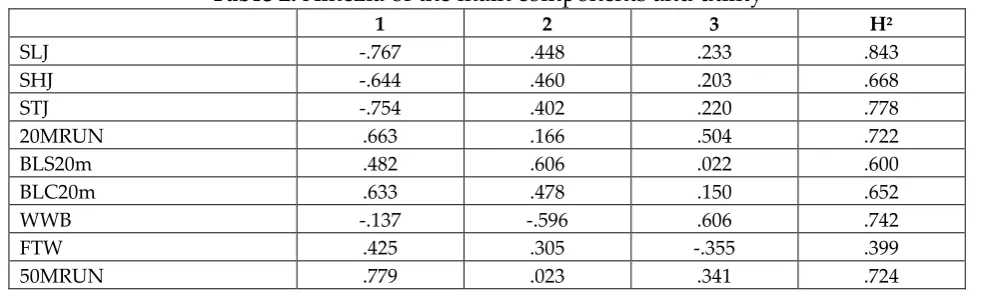
Table 2: Amezia of the main components and utility
1 2 3 H²
SLJ -.767 .448 .233 .843
SHJ -.644 .460 .203 .668
STJ -.754 .402 .220 .778
20MRUN .663 .166 .504 .722
BLS20m .482 .606 .022 .600
BLC20m .633 .478 .150 .652
WWB -.137 -.596 .606 .742
FTW .425 .305 -.355 .399
50MRUN .779 .023 .341 .724
In this table is noticed that in exclusion of variable work with the ball-WWB, all other variables have realized important projections in the first component with coefficient .428 - .779, so this component takes characteristics of a general movement factor. Highest projections in this component have variables that show explosive strength and speed; Standing long jump - SLJ, Standing high jump - SHJ, Standing triple jump - STJ, 20m run, 50m run, ball lead slalom 20m BLS20m. Other variables have realized lower projections.
Since main components don’t give complete and clear information for latent structure of matric space, main components are transformed in steep solution “OBLIMIN”.
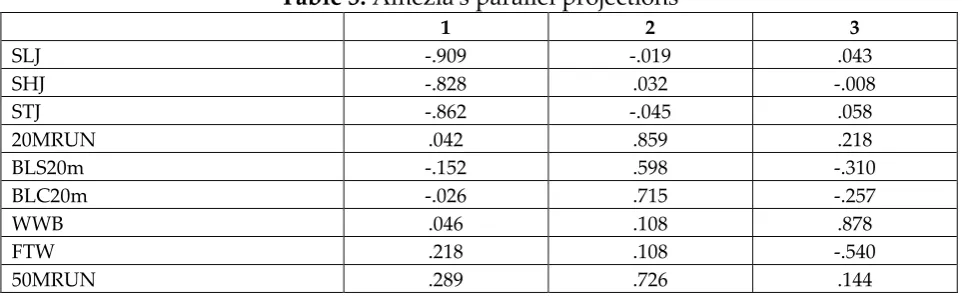
Table 3: Amezia's parallel projections
1 2 3
SLJ -.909 -.019 .043
SHJ -.828 .032 -.008
STJ -.862 -.045 .058
20MRUN .042 .859 .218
BLS20m -.152 .598 -.310
BLC20m -.026 .715 -.257
WWB .046 .108 .878
FTW .218 .108 -.540
50MRUN .289 .726 .144
As we can see in table 3, in the first factor, high projections have realized variables; SLJ-.909, SHJ-.828. Based on realized projections, this factor can be interpreted as: explosive strength factor for lower limb.
In the second factor high projections have realized variables; 20MRUN .859, BLS20m .598, BLC20m .715, 50MRUN .726.
Based on realized projections, the second factor can be defined as the factor of speed and agility.
In the third factor are projected variables; WWB .878, FTW .540. Based on realized projections, the third factor can be defined as alternative speed factor of lower limb and skills of ball control.
Table 4: Amezia's rectangular projections
1 2 3
SLJ -.917 -.341 .066
SHJ -.817 -.250 .001
STJ -.878 -.355 .086
20MRUN .332 .821 .013
BLS20m .061 .643 -.549
BLC20m .224 .767 -.427
WWB .065 -.086 .852
FTW .265 .311 -.570
50MRUN .535 .791 -.035
Table 4 contains orthogonal projection of variables in factor. The structure of this matrix doesn’t change much from intercreative matric; this shows that factors are stable.
Table 5: Amezia's intercorrelation of factors
1 2 3
Factor 1 1.000
Factor 2 .343 1.000
Factor 3 -.020 -.238 1.000
3. Discussion
The aim of the present study is to determine the motoric abilities of Kosovo’s first and second League soccer players through factorial analysis.
This study investigated a sample of 159 soccer’s from Kosovo, 79 of them from the first league and 80 from the second league, aged 18-33 years old. To prove motoric abilities, 9 variables are applied.
Motoric spaces are treated with factorial analysis and are gained three latent factors:
As we can see in table 3, in the first factor, high projections have realized variables; SLJ-.909, SHJ-.828. Based on realized projections, this factor can be interpreted as: explosive strength factor for lower limb.
In the second factor high projections have realized variables; 20MRUN .859, BLS20m .598, BLC20m .715, 50MRUN .726. Based on realized projections, the second factor can be defined as the factor of speed and agility.
In the third factor are projected variables; WWB .878, FTW .540. Based on realized projections, the third factor can be defined as alternative speed factor of lower limb and skills of ball control.
In selection of characteristically equations of intercreative matric are gained nine (9) roots and nine (9) characteristic vectors. Based on Hotteling method and Gutman-Kaiser criterion are shown seven main components, which explain around 68% of general variability.
The first characteristic root explains 38.35% of general system of variance.
The second characteristic root explains 18.29% of general system of variance.
The third characteristic root explains 11.44% of general system of variance.
References
Bangsbo J. (1994). The physiology of soccer: With special reference to intense intermittent exercise. Acta Physiologica Scandinavica 151 (Suppl. 619), 1-155.5. Bangsbo J., Krustrup P. (2008). Physical demands and training of top-class soccer
players. In T. Reilly, F. Korkusuz (eds), Science and football VI (pp. 318-330). New York, USA: Routledge 3.
Hoshikawa, Y., Iida, T., Muramatsu, M., Nakajima, Y., Fukunaga, T., & Kanehisa, H. (2008). Differences in thigh muscularity and dynamic torque between junior and senior soccer players. Journal of sports sciences, 2, pp. 129-138.
Reilly T., Williams A. M., Nevill A., Franks A. (2000) A multidisciplinary approach to talent identification in soccer. Journal of Sports Sciences 18: 695–702.
Reilly T. (2003). Motion analysis and physiological demands. In T. Reilly, A. M. Williams (eds), Science and soccer (pp. 9-72). London, UK: E & FN Spon.6.
Reilly T. (2007). The science of training – soccer: A scientific approach to developing strength, speed, and endurance. New York, USA: Routledge 4.
Spencer M., Bishop D., Dawson B., Goodman C. (2005). Physiological and metabolic responses of repeated-sprint activities. Sports Medicine 35, 1025-1044.7.
Creative Commons licensing terms