Research Article
a
August
2018
Computer Science and Software Engineering
ISSN: 2277-128X (Volume-8, Issue-8)
Optimization of Power Distribution System with Microgrids
Using Genetic Algorithm
Philip O. Adebo, Cofie Penrose, Matthew N. O. Sadiku, Foreman Justin, Sarhan M. Musa
Roy G. Perry College of Engineering, Prairie View A&M University, Prairie View, TX77446, United States
Email: [email protected]; [email protected]; [email protected]; [email protected]; [email protected]
Abstract— Distributed Energy Resources, (DER) such as solar power, wind power, fuel cell, biomass, battery, smart inverters, are becoming more prominent in power distribution systems. TheMicrogrid (MG), a mix of the DER, is a platform which harnesses the potentials locked in these DER. High penetrations of MG sources have greatly impacted the parameters of the power system network. This paper develops indices to optimize voltage stability and loss reduction on the power grid utilizing Microgrid units. The technique used to evaluate the impact of MGs on a distribution power system is the Genetic Algorithm in MATLAB, which determines the optimal placement and size of the MG unit with an emphasis on improving overall integrity of the grid network. The usefulness of the technique is validated on modified IEEE 14 and 57 bus test system.
Keywords— Distributed Energy Resources, Microgrids, Power Loss Minimization, Voltage Profile Improvement and Genetic Algorithm.
I. INTRODUCTION
Microgrid is an autonomous smaller power grid which integrates DERs and help to support the main grid by providing reliability and maintaining the integrity of the grid. Without (MGs), the potentials in these energy resources cannot be fully delivered. As a result, there has been a high penetration of MG in the recent time. MG has the capacity to reduce power loss, improve voltage profile, alleviate congestion, make security robust and boost overall grid integrity. DERs comprise of different power sources, which include solar power, wind power, fuel cell, biomass, battery, electric vehicles, smart inverters, Power storage system etc. Power electronic interface will be required before integrating MGs into the main grid. In the near future, renewable energy resources will be the backbone of power system. [1]. Due to projected increases of DERs, on a global scale, there is need for methodology in MGs placement in the power system while maintaining the stability and integrity of the network. This is why it is imperative to ensure optimal placement of MGs in power distribution system [2]. Different methods have been proposed by researchers in finding lasting solutions to the problems of loss reduction and how to improve voltage stability in power distribution system. It is important to note that MG can operate independent of the grid, which is termed as Islanded. With high penetration of MGs into the power system, the use of FACTS devices and capacitor bank, which are of course very expensive are declining.MG placement can be expressed as optimization problem. In [3], a systematic method was offered to recognize the best location where DERs can be placed to reduce losses; the size of needed resources was not considered. [4] offered a good number of voltage control schemes that combined the current voltage con trol devices and apparent power compensators with different levels of integration. This approach benefits in reducing the computational challenge greatly [5]. The author in [6] proposed a double optimization model which is good for reactive compensation via random network structure. In [7], the proposed scheme is established as a result of a new problem formulation used for load flow studies that is non-iterative. The author in [8] used GA to find the best position for distributed energy resources to reduce loss in radial distribution systems. Likewise, the author in [9] proposed a Particle Swarm Optimization scheme for best positioning and sizing of DERs in a radial network system. A meshed distribution system is proposed, which is more flexible and efficient in loss reduction, voltage stability and better power quality over a radial distribution system [10]. Distributed Energy Resources diminishes load flow traffic at the transmission corridor, hence reduce losses. It enhances voltage stability by improving the voltage profile. The test system data have been taken from IEEE 14 and 57 bus systems [11].
ISSN(E): 2277-128X, ISSN(P): 2277-6451, pp. 57-62
II. MULTI-OBJECTIVE FUNCTIONS
Basically, objective functions can be categorized into single and multiple. Our focus is on the latter technique, which delivers different objectives that do not have any mathematical relation with one another [12].
Multi-objective optimization problems can be expressed mathematically for both equality and inequality constraints as follows:
minimize
f
(
x
)
f
1(
x
),
f
2(
x
),...
..
f
k(
x
)
(1)
(
),
(
),...
..
(
)
)
(
x
g
1x
g
2x
g
x
g
k (2)
(
),
(
),...
..
(
)
)
(
x
h
1x
h
2x
h
x
h
k (3)where k is the number of the objective function and
x
is the vector of control variables.III. MINIMIZED POWER LOSS
The goal of the proposed methodology is to find the best bus location to incorporate MGs which reduce the real power losses related to the branch current flow while sustaining a given set of constraints [13]. Thus,
Ni k lossP
min
(
22
cos
)
1 2 ij j i j k i
kj
V
V
V
V
g
(4)The active and reactive power injected in buses are treated as equality constraints, while bus voltage limits, reactive generation limits, and transformer tap setting limits are defined as inequality constraints.
(a) Equality Constraints
Load Flow Constraints: Active and reactive powers are two of the major components of a power system. They are defined respectively as given below
i j ij
Nbus
j
ij j i
Gi V VY
P
1
cos (5)
i j ij
Nbus
j
ij j i
Gi
V
V
Y
Q
1
sin
(6)Nbus i1,...,
Gi
P
,Q
Gi are the active and reactive power injected at busi
, respectively.V
i andV
jare the voltage magnitude at busi
and
j
, respectively. The corresponding values
iand
j are the phase angle.Y
ijis the
ij
th element of the network admittance matrixY
.(b) Inequality Constraints
Solution is provided to equation (4) based on the following constraints, where
N
b is the total number of buses. The voltage magnitude constraints:b Gi
Gi
Gi
V
V
i
N
V
min
max,
(7)The reactive power constraints:
b Gi
Gi
Gi
Q
Q
i
N
Q
min
max,
(8)IV. WHY MICROGRIDS?
ISSN(E): 2277-128X, ISSN(P): 2277-6451, pp. 57-62
A Genetic Algorithm was written in MATLAB code to ascertain exactly the best location and sizing for a MG set.
V. VOLTAGE PROFILE IMPROVEMENT
Basically, increase or decrease in load demand will always alter the power system parameters, at any point in time. Whenever load changes, there is a corresponding change in the system voltage level. The essential function of reactive power is to regulate voltages and enable real power to do useful work. Active power will be delivered when the bus voltage levels are maintained within acceptable level, but will not be delivered if the bus voltage level is depleted. Whenever the bus level voltage is depleted, reactive power will be needed to boost the voltage level within the acceptable tolerance. The Voltage Profile Improvement Index is defined as;
n o m MGi n o m
n
i
V
V
V
VPII
2
max
1
(9)
VI. GENETIC ALGORITHM
Genetic Algorithms (GA) are a method of search, usually applied to optimization or learning problems. GA is used to solve non-linear and non-differentiable optimization problems. They are part of evolutionary computing, which uses an evolutionary analogy, “survival of the fittest”; that is, we can have several solutions to a certain problem or several possible solutions to a problem and only the best solution will be considered. GA usually starts with the initial generation of the candidate, and subsequent generations evolve from the first through the operators (selection, crossover and mutation).
GA is very popular and widely used in most research areas where an intelligent search is applied. The flowchart for optimal location of MGs and sizing is depicted in Fig. 1. [2].
Fig.1. Flowchart of GA Algorithm
VII. RESULTS AND DISCUSSION
ISSN(E): 2277-128X, ISSN(P): 2277-6451, pp. 57-62
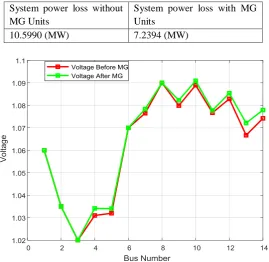
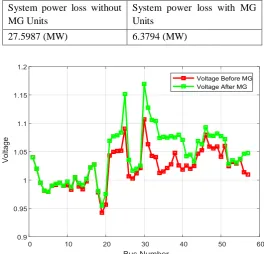
was computed to be 10.5990MW, while the system power loss with MG units reduced to 7.2394. It is apparent from the results that there is reduction in the power loss with strategic application of MG at needed locations with require MW values. The figure under 14-bus system shows an improvement in the voltage profile, which in turn enhances the voltage stability of the network. Similarly, we saw power loss reduction from 27.5987MW without MG to 6.3794MW with MG units considering 57-bus system. The figure under 57-bus system also shows an improvement in the voltage profile. Comparing the percentage reduction, we found out that 14-bus system scores a percentage reduction of 31.7%, while 57-bus system has a better percentage reduction of 76.9%. The results show the effectiveness of this algorithm. Another contribution that is worth highlighted here is the use of a meshed network instead of commonly used radial network. A meshed distribution network is more flexible and efficient in loss reduction, voltage stability and better power quality over a radial distribution system. Fig.2 and Fig.3 depict the voltage profile improvements in test bus 14 and 57 respectively.
Table ILocation and Penetration Level of MG Units
MG Units
MG Location
MG Active Power Generation (MW)
1 3 0.0732
2 8 0.0161
3 13 0.0147
4 4 0.0000
Table IIPower loss value before and after penetration of MG Units
System power loss without MG Units
System power loss with MG Units
10.5990 (MW) 7.2394 (MW)
Fig.2. Voltage magnitude of IEEE 14-bus Test System Before and After Penetration of MG Units
In this section, the simulation results have been presented for two systems. The second case is for IEEE 57-bus test system. We consider power loss minimization and voltage profile improvement by optimal placement and sizing of MG units.
Table III Location and Penetration Level of MG Units
MG Units
MG Location
MG Active Power Generation (MW)
1 27 0.1004
2 36 0.1651
3 9 0.5405
ISSN(E): 2277-128X, ISSN(P): 2277-6451, pp. 57-62
Table IV Power loss value before and after penetration of MG Units
System power loss without MG Units
System power loss with MG Units
27.5987 (MW) 6.3794 (MW)
Fig.3. Voltage magnitude of IEEE 57-bus Test System Before and After Penetration of MG Units
Fig.4. IEEE 14-bus test system
ISSN(E): 2277-128X, ISSN(P): 2277-6451, pp. 57-62
VIII. CONCLUSION
This paper presents a GA approach for best location and sizing of MGs. The objective is to optimize voltage stability and loss reduction. Simulation is carried out in MATLAB programming environment. The proposed technique is applied and validated on modified IEEE 14 and 57 bus test system. Results obtained show the practicality of the proposed technique in optimizing voltage stability and loss reduction in power distribution system with Microgrid system. This work shows MGs are valuable tools for power distribution system optimization with improved stability, security and over all integrity of the grid system.
REFERENCE
[1] Distributed Energy Resources Program Technology Review. https://www.nrel.gov/docs/fy02osti/31251.pdf October 2001
[2] Houssam Nahilia, Mohamed Boudour, “Distribution power loss minimization using particle Swarm Optimization and Genetic Algorithms: Application on Algerian isolated grid”. April 2016.
[3] EI-hattam,W.andM.M.A.Salma,“Distributed
generationtechnologies,definitionsandbenefits.”Electric.PowerSys.Res.,71:119-1283. 2004.
[4] C.L.Su,“ComparativeAnalysisofVoltageControlStrategiesinDistributionNetworkswithDistributedGeneration”, 978-1-4244-4241-6/09/©2009IEEE
[5] W. El-Khattam,K.Bhattacharya,Y.H.Hegazy,etal.: "Optimal investment planning for distributedgeneration inacompetitiveelectricitymarket",IEEETrans.Power Syst.,2004, pp.1674-1684.
[6] AndrijaVolkanovski,MarkoCepin,BorutM,“Optimizationofreactivepower compensation in distribution network”,Elektrotehniški vestnik 76(1-2): 57-62,2009,Electrotechnical Review: Ljubljana,Slovenija
[7] Caisheng,W. andM.H.Nehrir,2004.“Analyticalapproachesfor optimalplacementof distributedgenerationsources inpower systems.”IEEE Trans.PowerSys.19(4):27-34.
[8] T.N.Shukla,S.P.Singh,K.B.Naik,“AllocationofoptimaldistributedgenerationusingGA
forminimumsystemlossesinradialdistributionnetworks”,International Journal of Engineering,Scienceand
Technology,Vol.2,No. 3,2010,pp.94-106
[9] ArashAfraz,FarzadMalekinezhad,Seyed JalalSeyedShenavaandArefJlili,“Optimal SizingandSittinginRadialStandardSystemusingPSO”,AmericanJournalofScientific Research ISSN2301-2005Issue67(2012),pp.50-58
[10] G. Celli, Member, IEEE, F. Pilo, Member, IEEE, and G. Pisano, Student Member, IEEE V. Allegranza, R. Cicoria, and A. Iaria “Meshed vs. Radial MV Distribution Network in Presence of Large Amount of DG”
IEEE 2004
[11] Rich Christie, “Power System Test Case Archive”.
[12] Ebrahim Babaei, Ssdjad Galvani, Farzam Nejabatkah. “Optimal Placement of DG Units Considering Power Loss Minimization and Voltage Stability Enhancement in power system” Vol. 3 Issue 1. February 2014.