JEEECCS, Volume 5, Issue 16, pages 11-16, 2019
Development of a Prototype Remote
Controlled Multifunctional Mobile Robot for
Applications in Hazardous Environments
Bogdan George Bucur, Mihaela Oprea
Department of Automatic Control, Computers and Electronics Petroleum-Gas University of Ploiesti
Ploiesti, Romania
Abstract – The paper presents a prototype remote controlled multifunctional mobile robot, PROMM that was designed to be used for tasks executed in hazardous environments, such as air pollution monitoring and object manipulation tasks. The robot has a manipulator arm with gripper and can be remotely controlled via joystick or through haptic devices. Some laboratory experiments and potential applications are described.
Keywords-mobile robot; remote control; haptic control; hazardous environment; air quality monitoring
I. INTRODUCTION
In the last decade, several real world applications of mobile robots have been developed for various tasks in which direct human intervention would be too risky. Examples are given by radioactive material or toxic substances manipulation, demining, working in environments with high levels of air pollution. In such cases, mobile robots can work more efficiently and sustainable for specific tasks, if they are remotely controlled. One of the robot remote control technology that was intensively studied in recent years is haptic control technology [1] and interesting research work results were reported in the literature. For example, in [2] it is described a remote controlled mobile robot for planet research simulation laboratory which has a web-based control and management interface and was experimented for various scenarios such as remote photograph shooting and drilling. The HiBot framework introduced in [3] is a generic ROS-based robot-remote-control framework that implements task remote distribution, task remote monitoring and task remote robot control. Other research work were focused on using haptic control for robot learning (see e.g. [4]), robot navigation (e.g. with reactive control as presented in [5]), teleoperation (e.g. by using human hand motion tracking as in [6] or a neural network based control by means of hand gestures as in [7]).
The main objective of our research work was to develop a multifunctional prototype mobile robot that can be remotely controlled in order to execute tasks that are potential dangerous for humans, e.g. are performed in hazardous environments (such as environments with high radioactivity or high levels of air pollution) or to manipulate toxic substances or radioactive material/objects. As a first step, we have
started with a simple and cheaper prototype mobile robot for educational purposes in order to test the behavior of the robot in several working scenarios, with remote control via joystick and haptic control.
The paper is organized as follows. Section II presents details related to the development of the remote controlled prototype mobile robot, PROMM. Some experiments and potential applications are described in section III. In the last section are synthesized the main conclusion and some future work.
II. DESCRIPTION OF THE PROMMREMOTE
CONTROLLED PROTOTYPE MOBILE ROBOT
The development of the prototype mobile robot, PROMM was realized by starting with the basic guidelines provided in two excellent mobile robotics textbooks [8] and [9]. For the robot control module we have followed the main recommendations given in [10], while for the robot intelligent behavior we have used the advices emphasized in [11] for autonomous robot agents.
During the design phase, we have decided to view the mobile robot as being composed of four systems: the mobile robot core, the robot manipulator arm, the control device and the haptic control device. In our view, each system has a specific structure including all or some of the following functional components: perception, input/output, communication, control, and locomotion.
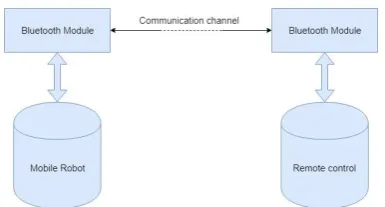
We have chosen the Bluetooth communication channel between the mobile robot and the remote control device as shown in Fig. 1.
Figure 1. The Bluetooth communication channel between the
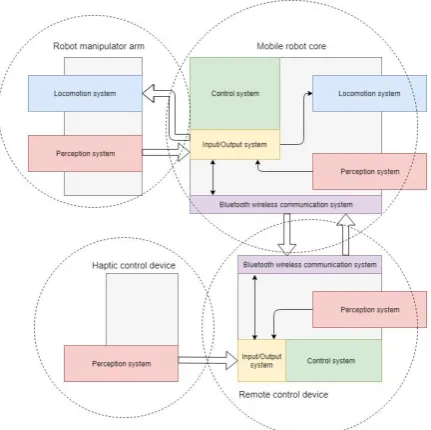
The general structure of the PROMM prototype mobile robot is depicted in Fig. 2. Thus, PROMM has four main modules with their specific functional components: the mobile robot core (perception, input/output, control, locomotion, communication), the robot manipulator arm (perception, locomotion), the haptic control device (perception) and the remote control device (perception, input/output, control, communication).
Figure 2. The general structure of the PROMM prototype
multifunctional mobile robot
The PROMM mobile robot was designed to have the following functions: autonomous and remote controlled navigation, air quality monitoring, and object manipulation by using a biaxial manipulator arm with gripper. The last function can be performed via remote (haptic) control.
For the PROMM mobile robot implementation phase we have chosen the hardware components by taking into account apart of the design specifications, the following three criteria: performance, reduced energy consumption and reduced dimensions. The whole hardware structure was built on the Arduino UNO R3 open-source microcontroller board and the Bluetooth Mate Silver communication module. The other components of the multifunctional PROMM prototype mobile robot are: a motor driver L298, four micro-motors, three servomotors, two micro-switches, an air quality monitoring sensor – SNS-MQ135. The control device is composed of a display LCD 2.8”, a biaxial joystick and three linear rotated potentiometers for haptic remote control. Fig. 3 shows the current version of the PROMM mobile robot with some indications related to the robot gripper and four basic commands (forward, backward, left and right) that can be executed via remote control with joystick.
The logic diagram of the PROMM mobile robot functioning is depicted in Fig. 4. Thus, when the Bluetooth channel is opened PROMM will analyze its environment air quality through the air quality monitoring sensor and will send the air quality report (i.e. the detection of high/normal/low air pollution
levels) to the control system waiting for certain commands that will be executed (e.g. modifying/not modifying the actuator position or performing/not performing a specific basic movement).
Figure 3. The PROMM prototype multifunctional mobile robot
Figure 4. The logic diagram of the PROMM mobile robot
Fig. 5 shows the logic diagram for the remote control functioning of the PROMM prototype mobile robot when the air quality monitoring task is executed. In case the Bluetooth connectivity is opened, the air quality report is received by the control system from the sensor that detects air pollution episodes and the LCD screen will display the values given in the report. Further, it is selected a certain command depending on the air quality analysis report (i.e. an air pollution episode detection or no air pollution). The command can be a robot movement command (e.g. forward – front movement, backward – back movement, left – left movement, right – right movement) or a robot manipulator arm command (e.g. rotation control, angle control or remote haptic control command).
Figure 5. The logic diagram of the PROMM mobile robot remote
control for air quality monitoring
Related to the PROMM functional components, we need to highlight that the mobile robot core and the robot manipulator arm have a locomotion system (composed of continuous current motors and a motor driver) that assure the execution of their specific movements.
More details related to the design and implementation of the PROMM mobile robot are given in [12].
III. EXPERIMENTS AND POTENTIAL APPLICATIONS
Some laboratory experiments were performed in order to test the main functionalities of the PROMM mobile robot. In this section we present a selection of the experiments that were done related to the remote (haptic) control of PROMM: rotation control, gripper control, angle control, and haptic control for object manipulation tasks.
Experiment 1
The first experiment included testing some basic remote control movements of the mobile robot and its gripper. Fig. 6 shows the rotation control experiment when PROMM’s gripper had to be rotated.
Figure 6. The rotation control experiment
Fig. 7 presents the gripper remote control experiment when PROMM had to do some object manipulation tasks (e.g. pick up object, hold object).
Figure 7. The gripper remote control experiment
Fig. 8 illustrates the angle control experiment when the PROMM’s gripper angle remote control was performed for a specific object manipulation task.
Figure 8. The angle control experiment
Experiment 2
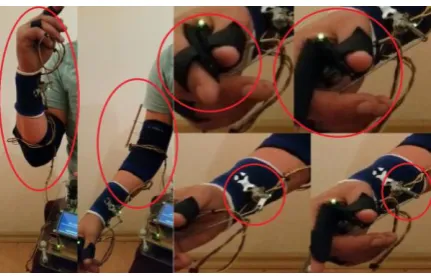
potentiometers that determine the haptic control commands are placed on the elbow, at joint and palm of the human hand. The movements necessary to control the manipulator arm of PROMM with the haptic device are described in Fig. 9.
Figure 9. The haptic control experiment
Fig. 10 presents the object manipulation task executed via remote haptic control. It is shown the initial state (left image), when PROMM starts navigation to the object position in order to grasp the object and the final state (right image) when PROMM returned to the initial position with the object hold by the gripper.
Figure 10. The object manipulation experiment via remote haptic
control (left image - initial state; right image - final state)
All the experiments that were performed either basic movements of the PROMM mobile robot or air quality monitoring and object manipulation have been successfully finalized under remote (haptic) control.
In the current version of the prototype mobile robot, the remote control can be safely performed at a maximum distance of 10 meters. In the future version of PROMM implementation we intend to extend remote control to larger areas, as e.g. to the maximum distance of 100 meters, allowing more applications in outdoor environments.
Two potential applications of the PROMM mobile robot are synthesized as follows. The first application has two scenarios for indoor hazardous environments, one inside a refinery or petrochemical plant with air
pollution and one inside a nuclear central, with air radioactive contamination. In both scenarios, the mobile robot needs to detect polluted working areas and to perform remotely some object manipulation tasks. The second application has one scenario for inside hazardous environment of a nuclear central where specialized technical staff need to manipulate toxic substances or radioactive materials by following strict procedures.
Application 1
Scenario 1: an indoor environment of an oil and gas refinery or chemical plant where can appear some air pollution episodes due to the emission of some toxic gases or air pollutants from the petrochemical or chemical processes specific to the performed activities that can affect the health of the technical staff working in that environment or its proximity.
The PROMM mobile robot is used to detect areas with significant air pollution and to manipulate via remote (haptic) control different objects from that area (e.g. to collect the objects and to deposit them in safe condition to certain locations, outside the air polluted area).
Scenario 2: an indoor environment of a nuclear central with air contamination due to some radioactive pollutants.
The PROMM mobile robot is used to detect working areas with changes in the air quality status and to remotely manipulate certain objects from those areas (e.g. to collect the objects and to deposit them in safe condition to locations outside the contaminated areas).
Similar scenarios can be designed for outdoor environments. However, in such cases the remote control of PROMM current version is limited to 10 meters.
Application 2
Scenario 1: an indoor environment of a nuclear central where the technical staff need to manipulate radioactive or toxic substances/materials by following specific technical procedures.
The PROMM mobile robot is used to manipulate the toxic/radioactive substances/materials via remote haptic control guided by the technical staff from the control room.
CONCLUSION
The paper presented PROMM, a prototype multifunctional mobile robot based on Arduino UNO R3 microcontroller that can be remotely controlled via joystick or haptic device. The main functions of the PROMM mobile robot are: navigation, air quality monitoring and object manipulation. The interaction between the mobile robot and the remote control device was implemented with Bluetooth technology.
working scenarios with hazardous environment it is useful for testing the efficiency of various remote (haptic) control techniques.
The advantages of PROMM mobile robot use are besides to its simplicity, reduced energy consumption and reduced dimensions, a good performance and easy extensibility due to its open architecture.
As a future work we shall extend the mobile robot functionalities and new testing scenarios will be run analyzing the overall performance.
REFERENCES
[1] G. Robles De La Torre, “Principles of haptic perception in virtual environments”, in Grunwald (Ed), Human haptic perception, Birkhäuser Verlag, 2008.
[2] U. Yayan, D. Özüpek, M. O. Taş, M. Altan and A.Yazici,
“Development of remote controlled mobile robot for planet research simulation laboratory”, Proceedings of International Conference on Computer Science and Engineering, Antalya, Turkey, 2017.
[3] B. Yan, D. Shi, J. Wei and C. Pan, “Hi-Bot: A generic
ROS-based robot-remote-control framework”, Proceedings of 2nd
Asia-Pacific Conference on Intelligent Robot Systems, Wuhan, China, 2017.
[4] Z. Zhu and H. Hu, “Robot learning from demonstration in
robotic assembly: a survey”, Robotics, 7, 17, 2018, doi:10.3390/robotics7020017.
[5] E. Baklouti, N. B. Amor and M. Jallouli, “Reactive control architecture for mobile robot autonomous navigation”, Robotics and Autonomous Systems, 89, 2017, pp. 9-14.
[6] I. Cerulo, F. Ficuciello, V. Lippiello and B. Siciliano,
“Teleoperation of the SCHUNK S5FH under actuated anthropomorphic hand using human hand motion tracking”, Robotics and Autonomous Systems, 89, 2017, pp. 75-84.
[7] J. O. P. Arenas, R. J. Moreno and R. D. H. Beleño,
“Convolutional neural network with a DAG architecture for control of a robotic arm by means of hand gestures”, Contemporary Engineering Sciences, vol. 11, no. 12, pp. 547-557, 2018.
[8] U. Nehmzow, Mobile robotics – A practical introduction, 2nd
edition, Springer, 2003.
[9] I. R. Nourbakhsh and R. Siegwart, Introduction to
autonomous mobile robots, MIT Press, 2004.
[10] S. G. Tzafestas, Introduction to mobile robot control,
Elsevier, 2014.
[11] S. Russell and P. Norvig, Artificial intelligence – a modern approach, Prentice Hall, 3rd edition, 2010.
[12] B. G. Bucur, “Design and implementation of a remote
controlled mobile robot for hazardous environments”, BSc diploma project, Petroleum-Gas University of Ploiesti, 2018.