Eur. Chem. Bull. 2013, 2(6), 401-406 DOI: 10.17628/ecb.2013.2.401-406
401
CORROSION INHIBITION BY AN AQUEOUS EXTRACT OF
CURCUMIN DYE FOR CARBON STEEL IN SEA WATER
V. Johnsirani,
[a]*J. Sathiyabama,
[a]Susai Rajendran
[a,b]and R. Nagalakshmi
[c]Keywords: Corrosion inhibition, curcumin, plant extract, carbon steel, sea water
The inhibition efficiency [IE] of an aqueous extract of the (Curcuma longa L.) plant material rhizome powder has been used as a corrosion inhibitor in controlling corrosion of carbon steel in sea water by the weight-loss study, in the absence and presence of Zn2+ . The main
constituent of this plant extract is curcumin. The results show that 93% IE is provided by binary system consisting of 10 mL of curcumin dye (CD) and 50 ppm of Zn2+. Polarization study reveals that CD and Zn2+ system functions as mixed type inhibitor. The nature of the
metal surface has been analysed by FTIR spectra and SEM analysis.
*Corresponding Authors
*E-mail: [email protected]
[a] PG and Research Department of Chemistry, GTN Arts college,Dindigul - 624005, TamilNadu, India.
[b] Department of Chemistry, RVS School of Engineering and Technology, Dindigul- 624005,India. E-mail: [email protected]
[c] Department of Chemistry,Arupadaiveedu Institute of Technology, Chennai. , Tamil Nadu, India. E-mail: [email protected]
Introduction
Plant extracts have again become important because they are environmentally friendly and renewable source for a wide range of needed inhibitors. Plant extracts are viewed as an incredibly rich source of naturally synthesized chemical compounds that can be extracted by simple procedures with low cost. A lot of natural products have been previously used as corrosion inhibitors for different metals in various environments.1-9 In the present research work, an aqueous
extract of the plant material rhizome powder has been taken as it is a good corrosion inhibitor for carbon steel in sea water. Turmeric has been used in India for hundreds of years and is a major part of Ayurvedic medicine. It was first used as a dye and then later for its possible medicinal properties.10 Some research results show that there are
compounds in turmeric with anti-fungal and anti-bacterial properties; however, curcumin is one of them.11 In another
preliminary research example, curcumin is being studied for whether it alters the response to chemotherapy in patients with advanced bowel cancer,12 as found in a laboratory
study. It is not very light fast.13 However, turmeric is
commonly used in Indian and Bangladeshi clothing, such as saris and Buddhist monks' robes.14
The present work is undertaken:
To evaluate the inhibition efficiency (IE) of curcumin dye (CD)-Zn2+ system in controlling corrosion of carbon steel
immersed in sea water in the absence and presence of Zn2+
by weight loss method.
To study the mechanism of corrosion inhibition by polarization study.
To analyse the protective film by FTIR spectra, Scanning Electron Microscope (SEM).
To propose the mechanism of corrosion inhibition based on the above results
.
Materials and Methods
Preparation of plant extract.
10 g of rhizome (Curcuma longa L.) powder was weighed and boiled with double distilled water. The yellow dye curcumin was filtered to remove suspended impurities and made up to 100 mL. The curcumin dye (CD) was used as corrosion inhibitor in the present study.
Preparation of Specimen
Carbon steel specimens (0.02 6% S, 0.06% P, 0.4% Mn, 0.1% C and rest iron) of the dimensions 1.0 x 4.0 x 0.2 cm were polished to a mirror finish, degreased with trichloroethylene and used for the weight-loss method and surface examination studies.
Weight – Loss Method
Carbon steel specimens were immersed in 100 ml of the medium containing various concentrations of the inhibitor in the absence and presence of Zn2+ for 1 day. The weights of
the specimens before and after immersion were determined using a balance Shimadzu AY62 model. The corrosion IE was then calculated using the equation.
where
W1 is the weight loss value in the absence of inhibitor
W2 is the weight loss value in the presence of inhibitor
Corrosion rate (CR, in mm year-1) was calculated using
the formula.15
where W- weight loss in milligram 2
100 1 (1)
1
W IE
W
87.6 W (2)
CR
D density of specimen g cm-3
A area of specimen in cm2
T exposure time in hours
Potentiodynamic Polarization Study
Polarization studies were carried out in a CHI- electrochemical work station with impedance model 660A. It was provided with iR compensation facility. A three electrode cell assembly was used. The working electrode was carbon steel. A saturated calomel electrode (SCE) was the reference electrode. Platinum was the counter electrode. From polarization study, corrosion parameters such as corrosion potential (Ecorr), corrosion current (Icorr), Tafel
slopes anodic = ba and cathodic = bc were calculated and
linear polarization study (LPR) was done. The scan rate (V s-1) was 0.01. Hold time at (E
fcs) was zero and quiet time (s)
was two.
Fourier transform infrared spectra
These spectra were recorded in a Perkin-Elmer-1600 spectrophotometer using KBr pellet. The FTIR spectrum of the protective film was recorded by carefully removing the film, mixing it with KBr and making the pellet.
Scanning Electron Microscopic (SEM) studies
The carbon steel immersed in blank solution and in the inhibitor solution for a period of one day was removed, rinsed with double distilled water, dried and observed in a scanning electron microscope to examine the surface morphology. The surface morphology measurements of carbon steel were examined using JEOL MODEL6390 computer controlled scanning electron microscope.
Results and Discussion
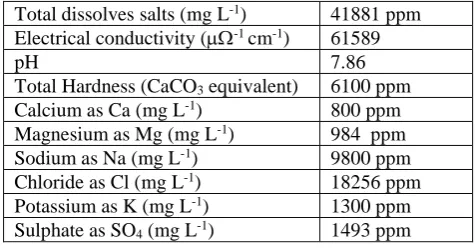
The physicochemical parameters of sea water used in the present study are given in Table 1.
Table 1. Water analysis (Thondi sea water, Tamil Nadu, India)
The calculated inhibition efficiencies (IE) of curcumin dye in controlling the corrosion of carbon steel immersed in sea water both in the absence and presence of zinc ion have been tabulated in Table 2.The calculated values indicate the ability of curcumin dye to be a good corrosion inhibitor. The inhibition efficiency is found to be enhanced in the presence of zinc ion. The formulation consisting of 10 mL of CD and
50 ppm of Zn2+ offers 93% inhibition efficiency. That is,
mixture of inhibitors shows better IE than the individual inhibitors.16
Synergism parameter (SI)
Synergism parameters are indications of synergistic effect existing between inhibitors.17-19 S
I value is found to be
greater than one indicating the synergistic effect existing between Zn2+ of concentrations 25 ppm and 50 ppm with
various concentrations of CD. The results are given in Table 3.
Synergism parameters were calculated using the relation
where
1+2 is equal with (1+2) -(12)
1 is the surface coverage of inhibitor (CD)
2 is the surface coverage of inhibitor (Zn2+)
’1+2 is the combined surface coverage of inhibitors
(CD) and (Zn2+)
The surface coverage (S) is
Potentiodynamic Polarization Study
Polarization study has been used to detect the formation of protective film on the metal surface.20-24 When a protective
film is formed on the metal surface, the linear polarization resistance (LPR) increases and the corrosion current (Icorr)
decreases. The potentiodynamic polarization curves of carbon steel immersed in various test solutions are shown in Figure 1. The corrosion parameters namely, corrosion potential (Ecorr), Tafel slopes (bc=cathodic; ba=anodic),
linear polarization resistance (LPR) and corrosion current (Icorr) are given in Table 4.
When carbon steel is immersed in sea water, the corrosion potential is -816 mV vs SCE. The formulation consisting of 10mL of CD solution and 50 ppm of Zn2+ shifts the
corrosion potential to -814 mV vs SCE. The corrosion potential shift is very small. This suggests that the CD-Zn2+
formulation functions as a mixed inhibitor controlling the anodic reaction and cathodic reaction to the same extent.
The corrosion current value and LPR value for sea water are 6.354×10⁻⁶ A cm-2 and 6.500 x 10³ ohm cm2 respectively.
For the formulation of CD (10mL) and Zn2+ (50 ppm), the
corrosion current value has decreased to 5.502 x 10⁻⁶ A cm-2,
and the LPR value has increased to 7.354 x 10³ ohm cm2.
Total dissolves salts (mg L-1) 41881 ppm
Electrical conductivity (-1 cm-1) 61589
pH 7.86
Total Hardness (CaCO3 equivalent) 6100 ppm
Calcium as Ca (mg L-1) 800 ppm
Magnesium as Mg (mg L-1) 984 ppm
Sodium as Na (mg L-1) 9800 ppm
Chloride as Cl (mg L-1) 18256 ppm
Potassium as K (mg L-1) 1300 ppm
Sulphate as SO4 (mg L-1) 1493 ppm
1 1 2
(3)
I '
1 1 2
S
(%)
(4) 100
Eur. Chem. Bull. 2013, 2(6), 401-406 DOI: 10.17628/ecb.2013.2.401-406
403
Table 2. The corrosion inhibition efficiencies and the corresponding corrosion rates (millimeter per year) of CD – Zn2+ system
Table 3. Synergism Parameter (SI)
Table 4. Potentiodynamic polarization curves of carbon steel immersed in various test solution
This indicates that a protective film is formed on the metal surface. When a protective film is formed on the metal surface LPR value increases and corrosion current value decreases.
The Tafel slope values are more or less same without inhibitor and with inhibitor. However there is a slight change in the anodic Tafel slope. This may be attributed to the formation of a passive film on the anodic sites of the metal surface. The rate of change of current with potential is reduced due to the formation of a protective film on the metal surface.
Analysis of AC impedance spectra
AC impedance spectra have been employed to detect the formation of film on the metal surface. If a protective film is formed, the charge transfer resistance increases and double layer capacitance value decreases.25-28 The AC impedance
spectra of carbon steel immersed in various solutions are shown in Fig. 2. The AC impedance parameter, namely charge transfer resistance (Rt) and double layer capacitance
(Cdl) (derived from Nyquist plot) are given in Table 5.
Table 5. AC impedance parameters of carbon steel immersed in various test solutions
It is observed that in presence of inhibitor, Rt value
increases and Cdl value decreases. This indicates the
formation of a protective film on the metal surface.
Analysis of FTIR spectra
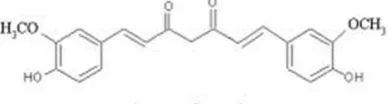
The active principle in an aqueous extract of rhizome powder is Curcuma longa L. The yellow colour of the extract is due to curcumin.29 The structure of curcumin is
shown in Scheme 2. The main constituent of rhizome powder is curcumin.
The curcumin dye extract was evaporated to dryness to get a solid mass. Its FTIR spectrum of the solid mass is shown in Fig. 3a. The –OH stretching frequency appears at 3408 cm-1.
Inhibitor CD (mL)
Zn2+(ppm)
0 25 50
IE, % CR, mm year-1 IE, % CR, mm year-1 IE, % CR, mm year-1
0 - 0.1576 16 0.1323 47 0.0835
2 48 0.0819 65 0.0551 80 0.0315
4 55 0.0709 71 0.0457 82 0.0283
6 60 0.0630 73 0.0425 85 0.0236
8 62 0.0598 75 0.0394 90 0.0157
10 63 0.0583 77 0.0362 93 0.0110
CD (mL) 1 Zn2+ 25 ppm 2
CD-Zn2+
’1+2
SI Zn2+ 50 ppm 2
CD-Zn2+ ’1+2
SI
2 4 6 8 10
0.48 0.55 0.60 0.62 0.63
0.16 0.16 0.16 0.16 0.16
0.65 0.71 0.73 0.75 0.77
1.6091 1.3034 1.2444 1.2768 2.9965
0.47 0.47 0.47 0.47 0.47
0.80 0.82 0.85 0.90 0.93
1.378 1.325 1.4133 2.014 2.8014
System Ecorr mV vs SCE bc, mV decade-1 ba, mV decade-1 LPR, ohm cm2 Icorr, A cm-2
Sea water -816 157 239 6.500 x 10³ 6.354 x 10⁻⁶
Sea water + 10mLCD + 50 ppm Zn2+
-814 156 230 7.354 x 10³ 5.502 x 10⁻⁶
System Rt ohm
cm2
C
dl Fcm-2 Impedance value
log z/ohm)
Sea water 101.10 5.0445 x 10⁻⁸ 2.060
Sea water + CD 10 mL + Zn2+ 50 ppm
Eur. Chem. Bull. 2013, 2(6), 401-406 DOI: 10.17628/ecb.2013.2.401-406
404
The C=O stretching frequency appears at 1715 cm-1. Theasymmetrical C-O-C stretching frequency of aryl alkyl ethers appears at 1224 cm-1. The band at 1087 cm-1
corresponds to the symmetrical C-O-C stretching of alkyl aryl ether. Thus, curcumin was characterized by IR spectroscopy.30
The FTIR spectrum of the protective film formed on the surface of the metal after immersed in the solution containing 50 ppm of Zn2+ and 10mL of CD shown in Fig.
3b. It is found that the -OH has shifted from 3408 cm-1 to
3400 cm-1. The C=O stretching frequency has decreased
from 1715 cm-1 to 1613 cm-1. The asymmetrical C-O-C
stretching frequency of alkyl aryl ether (1224 cm-1)
disappeared. The symmetrical C-O-C stretching of alkyl aryl ether (1087 cm-1) disappeared. It was inferred that curcumin
has coordinated with Fe2+ through the phenolic oxygen,
ethereal oxygen, and carbonyl oxygen, resulting in the formation of the Fe2+ - curcumin complex on the anodic
sites of the metal surface. The peak at 1360cm-1 is due to
Zn-O band. The peak at 3400cm-1 is due to –OH stretching.
Hence it is confirmed that Zn(OH)2 is formed on the
cathodic sites of the metal surface.31 Thus, the FTIR spectral
study leads to the conclusion that the protective film consists of the Fe2+- curcumin complex and Zn(OH)
2.32
SEM analysis of metal surface
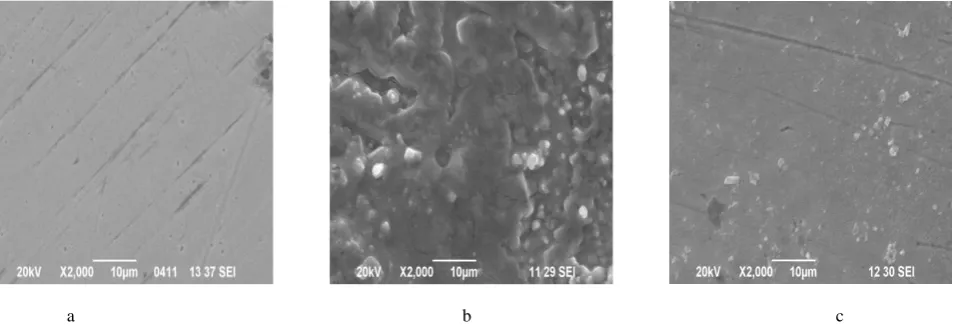
The SEM images of magnification (X2000) of carbon steel specimens immersed in sea water for one day in the absence and presence of inhibitor system are shown in Figure.4.image (b) and image (c) respectively. The SEM micrographs of polished carbon steel surface (control) in Fig. 4. Image (a) shows the smooth surface of the metal. This shows the absence of any corrosion products formed on the metal surface. The SEM micrographs of carbon steel surface immersed in sea water in Figure 4. Image (b) shows the roughness of the metal surface which indicates the corrosion of carbon steel in sea water. Figure 4. image (c) indicates that in presence of 10mL of CD- Zn2+ (50ppm) mixture in
sea water, the surface coverage increases which in turn results in the formation of insoluble complex on the surface of the metal (CD-Zn2+ inhibitor complex) and the surface is
covered by a thin layer of inhibitors which control the dissolution of carbon steel. Such results have been observed.33
Figure 1. Polarization curves of carbon steel immersed in various test solutions, (a) sea water (b) sea water + CD 10 mL + Zn2+ 50 ppm
Figure 2. AC impedance spectra of carbon steel immersed in various test solution. a) sea water b) sea water + CD 10 mL + Zn2+ 50 ppm
Scheme 1. Structure of curcumin (extract of rhizome powder)
Figure 3a. FTIR spectrum of pure curcumin dye (dried solid mass, KBr)
Eur. Chem. Bull. 2013, 2(6), 401-406 DOI: 10.17628/ecb.2013.2.401-406
405
Mechanism of corrosion inhibitionWeight loss method reveals that the formulation consisting of 10 mL of CD and 50 ppm of Zn2+ offers 93%
IE to carbon steel immersed in sea water. Polarization study reveals that CD–Zn2+ system functions as a mixed inhibitor.
FTIR spectra reveal that the protective film consists of Fe2+ -
curcumin complex and Zn(OH)2.
In order to explain the above facts in a holistic way, the following mechanism of corrosion inhibition is proposed.
When the formulation consisting of sea water, curcumin dye and Zn2+ is prepared, there is formation of Zn2+ -
curcumin complex in solution.
When carbon steel is immersed in the solution, the Zn2+ -
curcumin complex diffuses from the bulk of the solution towards the metal surface.
On the metal surface, Zn2+ - curcumin complex is
converted into Fe2+-curcumin complex and Zn2+ is released:
Zn2+ - curcumin + Fe2+ → Fe2+ - curcumin + Zn2+
This Zn2+ combines with -OH to form insoluble Zn(OH) 2
Zn2+ + 2OH- mV → Zn(OH) 2
Conclusions
The present study leads to the following conclusions:
The formulation consisting of 10mL CD and 50 ppm Zn2+
provides 93% inhibition efficiency to carbon steel immersed in sea water. Polarization study reveals that CD–Zn2+
system functions as a mixed inhibitor. FTIR spectra reveal that the protective film consists of Fe2+-curcumin complex
and Zn(OH)2.
Acknowledgement
The authors are thankful to their respective management and DRDO, India.
References
1Zhang, S. S., Jow, T. R., J. Power Sources, 2002, 109, 458. 2El Hosary, A. A., Saleh, R. M., Shams El Din, A. M., Corros. Sci.,
1972, 12, 897.
3El Hosary, A.A., Saleh, R.M., Progress in Understanding and
Prevention of Corrosion., vol.2, The Institute of Materials, London., 1993, 911.
4 Avwiri, G., Igho, F.O., Mater. Lett., 2003, 57, 3705.
5 Gunasekaran, G., Chauhan, L.R., Electrochim. Acta., 2004, 49,
4387.
6 El-Etre, A.Y., Corros. Sci., 1998, 40, 1845.
7 El-Etre, A.Y., Abdallah, M., El-Tantawy, Z. E., Corros. Sci.,
2005, 47, 385.
8Abdel-Gaber, A.M., Abd-Nabey, B. A., Sidahmed, I. M.,
El-zayady, A. M., Saadawy, M., Corros. Sci., 2006, 48, 2765.
9 Oguzie ,E. E., Corros. Sci., 2007, 49, 1527.
10Herbs at a glance: turmeric, science and safety. National Center
for Complementary and Alternative Medicine (NCCAM), National Institutes of Health .2012.
11Ragasa, C., Laguardia., M, Rideout, J., ACGCChem .Res. Comm.,
2005, 18(1), 21.
12Curry chemical’s ability to fight cancer put to the test. BBC
News. 2012-05-06. http://www.bbc.co.uk/news/health- 17959521. Retrieved 2012-05-09.
13Curry compound could fight cancer; curcumin may kill bowel
cancer cells. NY Daily News. 2012-05-08. http://www.nydailynews.com/life-style/health/curry-india- holy-powder-subject-cancer-fighting-proven-spice-curcumin-kill-bowel-cancer. 1074477?local LinksEnabled =false. Retrieved 2012-05-09.
14Brennan, J. (15. Oct. 2008). “Turmeric”. Lifestyle.
http.//www.thenational.ae/lifestyle/house-home/turmeric. Retrieved 13 May 2012.
15Fontana, M. G., Corrosion Engineering, TATA McGraw-Hill
publishing companyLimited, 3rd Ed., New Delhi, 2008 16 Umamathi, T., Arockia Selvi, J., Agnesia Kanimozhi, S.,
Rajendran, S., John Amalraj, A., Indian J. Chem.Technol.,
2008, 15, 560.
17 Agnesia Kanimozhi, S., Rajendran, S., Int. J. Electrochem .Sci.,
2009 ,4, 353.
18Noreen Anthony, Benita Sherine, H., The Arab.J. Sci.Eng., 2010,
35, 41.
a b c
Figure 4. SEM micrographs (magnification-x2000) of a) polished Carbon steel (control) b) Carbon steel immersed in sea water c)
19Rajendran, S., Agasta, M., Bama Devi, R., Shyamala Devi, B.,
Rajam, K., Jeyasundari, J., Zastit. Mater., 2009, 50, 77.
20Angelin Thangakani, J., Rajendran, S., Sathiyabama, J., Lydia
Christy, J., Surya prabha, A., Pandiarajan, M., Eur. Chem. Bull.,2013, 1(5), 265-275.
21Vijaya, N., Peter Pasgal Regis, A., Rajendran, S., Pandiarajan, M.,
Nagalakshmi, R., Eur. Chem.Bull., 2013, 2(5), 275-278.
22Agila Devi, S., Susai Rajendran, Jeyasundari, J., Pandiarajan, M.,
Eur. Chem. Bull., 2013, 2(2), 84.
23 Rajendran, S., Anuradha, K., Kavipriya, K., Krishnaveni, A., and
Angelin Thangakani, J., Eur. Chem. Bull., 2012, 1(12), 503.
24 Pandiarajan, M., Prabhakar P, Rajendran, S., Eur. Chem.Bull.,
2012, 1(7), 238.
25Kalaivani, R., Narayanasamy, B., Selvi, J. A,. Amalraj, A. J.,
Jeyasundari, J., Rajendran, S., Port. Electrochim. Acta,2009,
27, 177.
26 Rajendran, S., Jeyasundari, J., Usha, P., Selvi, J. A.,
Narayanasamy ,B., Regis, A. P., Rengan, P., Port. Electrochim. Acta, 2009, 27, 153.
27Jayashree, A., Rajammal Felicita Selvarani, J.,
WilsonSahayaraj, J., John Amalraj, A., Rajendran, S., Port. Electrochim. Acta., 2009, 27, 23.
28 Arockia Selvi, Susai Rajendran, Ganga Sri, V., John Amal Raj,
A., Narayanaswamy, B., Port. Electrochim. Act.,2009,27, 1.
29Bruneton, J., Pharmacognosy, Phytochemistry Medicinal Plants,
Paris, France: Lavoisier Publ. ., 1995, 257.
30Silverstein, R. M., Bassler, G. C., Morrill, T. C., Spectrometric,
Identification of organic Compounds, New York, NY: John Willey and Sons, 1986, 95.
31Sekine, I., Hirakawa Y, Corrosion, 1986, 42, 272.
32 Rajendran, S., Shanmugapriya, S., Rajalakshmi, T., Amal Raj
A. J., Corrosion, 2005, 61, 685
33 Benita Sherine, Jamal Abdul Nasser, A., Rajendran, S., Int. J.
Eng. Sci . Technol., 2010, 2 , 341.