Eur. Chem. Bull. 2012, 1(5), 141-145 DOI: 10.17628/ecb.2012.1.141-145
141
PROPERTIES OF WATER/SODIUM DODECYL
SULFATE/N-PROPANOL/ALLYLBENZENE MICELLAR
SYSTEMS
Monzer Fanun
[a]*, Ahmad Shakarnah
[a], O
day Mustafa
[a], Michael Schwarze
[b], Reinhard
Schomäcker
[b], Jochanan Blum
[c]Keywords: phase behavior, ultrasonic velocity, density, isentropic compressibility, hydrodynamic diameter
Water/n-propanol/sodium dodecyl sulfate/allylbenzene micellar systems were formulated. The ratio (w/w) of n-propanol/surfactant equals 2/1. The extent of the micellar region as function of temperature was determined. The micellar systems were characterized by the volumetric parameters, density, excess volume, ultrasonic velocity and isentropic compressibility. The micellar densities increase with the increase in the water volume fraction. Excess volumes of the sodium dodecyl sulfate decrease for water volume fraction below 0.3, stabilize for water volume fractions between 0.2 and 0.5 then increase for water volume fraction above 0.5. Excess volumes of the studied micellar systems increase with temperature. Ultrasonic velocities increase with the increase in water volume fraction up to 0.8 then decrease. Ultrasonic velocities increase with temperature for water volume fractions below 0.8 and increase for water volume fractions above 0.8. Isentropic compressibilities decrease with the water volume fraction up to 0.8 then increase. Isentropic compressibilities increase with temperature for water volume fractions below 0.8 and decrease for water volume fractions above 0.8. Structural transitions from water-in-oil to bicontineous to oil-in-water occur along the micellar phase. The particle hydrodynamic diameter of the oil-in-water micellar systems was found to decrease with temperature. In the diluted region nanoemulsion systems were observed.
Corresponding Author
Tel: + 972 5 22 40 60 61; Fax: + 972 22 79 69 60
E-Mail: [email protected], mfanun@ science. alquds.edu [a] Colloids and Surfaces Research Center, Al-Quds
University, East Jerusalem 51000, Palestine
[b] Institut für Chemie, Technische Universität Berlin, Strasse des 17. Juni 124, D-10623 Berlin, Germany
[c] Institute of Chemistry, The Hebrew University of Jerusalem, Jerusalem 91904, Israel
Introduction
Nanoemulsions are transparent or translucent systems that have a dispersed phase with a droplet size range of typically 20 to 500 nm. Nanoemulsions are thermodynamically unstable dispersions, of oil and water stabilized with the help of surfactant and co-surfactant.1-4 Despite their metastability, nanoemulsions can persist over many months or years due to the presence of stabilizing surfactant micelles. The small droplet size, high kinetic stability and optical transparency of nanoemulsions compared to conventional emulsions, give them advantages for their use in many technological applications.5-7Nanoemulsions are increasingly proposed for use in the chemical industries in organic synthesis as alternatives to organic solvents. Double bond isomerization in alkenes is widely observed in industrial processes such as those associated with petrochemical oil refining steps. Owing to the hydrophobic nature of most alkenes, these reactions are usually carried out in organic solvents under homogeneous conditions. The public concern about the negative effect of the organic
compounds on the environment8 picked the interest of many researchers for replacement of the harmful media by water.9 However, the application of aqueous systems arises a major problem of the insolubility of most organic reagents in water. Consequently, we developed a water-rich system that overcomes this discrepancy. This system relies on the use of an aqueous nanoemulsions of the substrates and uses a heterogenized organometallic complex that can be recovered by simple filtration as catalyst.10 We termed the catalyses by this system an emulsion-solid transport process (EST) and demonstrated its utility in catalytic C-C bond coupling reactions11 as well as in several hydrogen transfer operations such as double bond migration of hydrophobic allylic substrates in water.12 In order to achieve high efficiency in the EST reactions it is essential to characterize the nature of the microemulsions and formulate them accordingly. We now have characterized the nanoemulsions formed from allylbenzene, n-propanol and aqueous sodium dodecyl sulfate that serves as a model medium in the isomerization of water insoluble allylarenes by recyclable sol gel immobilized late transition metal catalysts shown in Scheme 1.
Experimental
Materials
further purification. Triply distilled water was used for all experiments.
catalyst in hydrophobic sol gel
[C12H25SO4]Na, H2O, nPrOH
catalyst: Pd(OAc)2, [(C8H17)3NCH3][RhCl4]
Scheme 1. Isomerization of water insoluble allylarenes by recyclable late transition metal catalysts
Methods
Sample preparation for pseudo ternary phase diagram at constant temperature
The phase behavior of a four-component system is described in pseudo ternary phase diagrams in which the weight ratio of surfactant/cosurfactant is fixed. The determination of the phase behavior was performed in a thermostated bath (T 0.1 K). Ten weighted samples composed of mixtures of (surfactant + cosurfactant) and oil were prepared in culture tubes sealed with Viton -lined screw caps at predetermined weight ratios of oil/ surfactant/cosurfactant. The mixtures were titrated with water and were equilibrated during a time interval of up to 24 h. The different phases were determined visually and optically using crossed polarizers method. Appearance of turbidity was considered as an indication for phase separation. The phase behavior was determined only after sharp interfaces had become visible. Centrifuging the samples accelerated the completion of this process. Every sample that remained transparent and homogeneous after vigorous vortexing was considered as belonging to the one phase region in the phase diagram.13,14
Ultrasonic velocity and density
The ultrasonic velocity and density were measured using a density and sound velocity analyzer (DSA 5000M- Anton Paar, Austria) with a sound velocity resolution of 0.5 ms-1 and density resolution of (5*10-6 g cm-3). A 3 ml degassed sample is introduced using Hamilton glass syringe into a U-shaped borosilicate glass tube that is being excited electronically to vibrate at its characteristic frequency. The characteristic frequency (high frequency (above 100 kHz) acoustic waves) changes depending on the density of the sample. Through precise determination of the characteristic frequency and a mathematical conversion, the density of the sample can be calculated. The measuring cell is closed by an ultrasonic transmitter on the one side and by a receiver on the other side. The transmitter sends sound waves of a known frequency through the sample. The velocity of sound was calculated by determining of the period of received sound waves and by considering the distance between transmitter and receiver. Due to the high dependency of the density and velocity of sound values on the temperature, the measuring cells have to be thermostated precisely with two integrated Pt 100 platinum thermometers together with Peltier elements provide an precise thermostating of the sample that equals ±0.01K. Viscosity-related errors were automatically corrected over the full viscosity range by measuring the damping effect of the viscous sample followed by a mathematical correction of the density value. The instrument automatically detects gas bubbles in the density measuring cell by an advanced analysis of its
oscillation pattern and generates a warning message. Measurements were made at 298, 310 and 318 K.
Dynamic light scattering
Particle size measurements were performed using Zetasizer Nano S (ZEN 1600) for the measurements of size and molecular weight of dispersed particles and molecules in solution by Malvern Instruments Ltd. (Worcestershire, United Kingdom). The equipment includes a 4mW, 633nm He-Ne laser. Size measurement range between 0.6nm to 6 m, size measurement angle equals 173º, concentration range for size measurement was between 0.1ppm (0.00001vol%) – 40wt%, molecular weight range between 103 to 107Da and temperature measurement range between 275 K to 363 K. 1.5 ml micellar sample was introduced in a disposable polystyrene cuvettes and measured at temperatures range between 273 and 323 K by steps of 5 K. The particle hydrodynamic diameter is calculated from the translational diffusion coefficient (D) using the Stokes-Einstein relationship:
dH = kBT/6ηD (1)
where dH is the hydrodynamic diameter, kB is Boltzmann’s constant, T is the absolute temperature and η is the solvent viscosity. The results are averages of 3 experiments.
Results and Discussion
Phase behavior
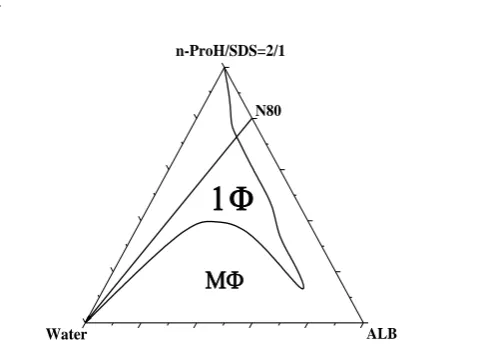
Figures 1 presents the phase behaviors of water/ sodium dodecyl sulfate /n-propanol/ allylbenzene systems at 298 K. The ratio (w/w) of n-propanol/ sodium dodecyl sulfate equals 2/1. As shown in the Figure, the phase behavior indicates that the transparent micellar region appears after the addition of about 20-wt% of water. Similar findings on the behavior of sodium dodecyl sulfate in the presence of other aromatic oils were reported.14 The area of the one phase region , AT (%), varies slightly with temperature. Similar behavior of the dependence of the phase behavior on temperature of ionic surfactants was reported elsewhere.14
Volumetric properties
Eur. Chem. Bull. 2012, 1(5), 141-145 DOI: 10.17628/ecb.2012.1.141-145
143
and probes the elastic properties of materials.15-17. Figure 2 represent the variation in the density as function of the water volume fraction for the water/n-propanol/ sodium
dodecyl sulfate /allylbenzene system at 298 K.
Figure 1. Pseudoternary phase diagram of the water/n-propanol/ sodium dodecyl sulfate /allylbenzene system at 298 K. The mixing ratio (w/w) of n-propanol/surfactant equals 2/1. The one phase region is designated by 1, and the multiple phase regions are designated by (M). N80 is the dilution line where the weight ratio of (surfactant + propanol)/allylbenzene equals 4/1.
The relation (2) can evaluate the excess volume of micelle formation, keeping in view the additivity of volumes of micellar, aqueous and oil phase,
E
mic i i
i
V V
V (2)where VE is the excess volume, V
mic is the measured micellar specific volume, i is the volume fraction of component i in the micellar system and Vi is the specific
volume of component i.
Figure 2. Variation of the density as function of water volume fraction for water/n-propanol/sodium dodecyl sulfate/allylbenzene micellar systems at 298K along the dilution line N80 presented in Figure 1
Figure 3 presents the variation in the excess volume as function of water volume fraction and temperature. The
excess volumes are negative and decrease for water volume fraction below 0.3. For water volume fractions between 0.3 and 0.5 the excess volume stabilizes. For water volume fractions above 0.5 the excess volume increase dramatically but remain negative. Negative
values of excess volume indicates that the system
Figure 3. Variation of the excess volume as function of water volume fraction for water/n-propanol/sodium dodecyl sulfate/allylbenzene micellar systems at 298, 310, and 318K along the dilution line N80 presented in Figure 1
contracts upon addition of water. The values of excess volume were also determined as function of temperature and it was found that excess volume increases with temperature indicating expansion of the systems with temperature. This behavior could be related to breakage of hydrogen bonds or to dissociation of ionic head
Figure 4. Schematic presentation of the proposed microstructures associated with the change in water volume fraction along the N80 dilution line
groups. Figure 4 presents schematically the proposed microstructures associated with the change in water volume fraction along the N80 dilution line shown in Figure 1. Figure 5 represents the variation of the ultrasonic velocity as function of the water volume fraction for the water/n-propanol/ sodium dodecyl sulfate/allylbenzene system. The ultrasonic velocity increases with the water volume fraction up to 0.8 thereafter decreases. The variation in the values of ultrasonic velocity as function of water volume fraction provides information on the state of water. At low water
ALB
Water
n-ProH/SDS=2/1
N80
0.0 0.2 0.4 0.6 0.8 1.0
880 900 920 940 960 980 1000
(
kg/m
3 )
water volume fraction ()
0.0 0.2 0.4 0.6 0.8 1.0
-6 -5 -4 -3 -2 -1
V
E *1
0
-5 (
m
3 /k
g
)
water volume fraction ()
Eur. Chem. Bull. 2012, 1(5), 141-145 DOI: 10.17628/ecb.2012.1.141-145
144
volume fraction the properties of water are very different from those of bulk (free water) indicating the entrapment of water in the micellar core suggesting the presence of water-in-oil microstructure. The increase in the values of ultrasonic velocity upon addition of water indicates structural transitions along the water dilution line. For water volume fraction above 0.8 the ultrasonic velocity approaches that of pure water indicating that water is the continuous phase and oil-in-water microstructure is present.
Figure 5. Variation of the ultrasonic velocity as function of water volume fraction for water/n-propanol/sodium dodecyl sulfate/allylbenzene micellar systems at 298K along the dilution line N80 presented in Figure 1
Since ultrasonic velocity is determined by the change of physical properties at the interface between the particle core and the continuous medium, the ultrasonic velocity variation shall also be correlated to the variation of the size of the particle core. In order to better understand these results, we analyzed the ultrasonic velocity in terms of isentropic compressibility ks, which represents a relative change of volume per unit of pressure applied at constant entropy. ks is much more sensitive to structural changes than the velocity and can provide qualitative information about the physical nature of the aggregates.
Figure 6. Variation of the isentropic compressibility as function of water volume fraction for water/n-propanol/sodium dodecyl sulfate/allylbenzene micellar systems at 298K along the dilution line N80 presented in Figure 1
The isentropic compressibility ks values have been evaluated with the help of the Laplace equation.18-20
(3)
Figure 6 presents the variation of the isentropic compressibility ks as function of the water volume fraction. The isentropic compressibility decreases with the water volume fraction below 0.8 and increases thereafter. The variation in the values of isentropic compressibility as function of increasing water volume fraction indicates structural transitions from water-in-oil to bicontinuous to oil-in-water microstructure. The values of the isentropic compressibility were determined as function of temperature (see Figure 7) and found to increase with temperature for water volume fractions below 0.8 while for water volume fraction above 0.8 the
isentropic compressibility values decrease.
Figure 7. Variation of the isentropic compressibility as function of temperature for water/n-propanol/sodium dodecyl sulfate/allylbenzene micellar systems along the dilution line N80 presented in Figure 1
Diffusion properties
On the assumption that exchange processes are negligible for the surfactant, we can estimate the hydrodynamic diameter (
d
H) of the micellar system in the water-rich region at water volume fraction equals 0.95 and above using equation 1. The variation in the values of the hydrodynamic diameter (d
H) at water volume fraction of 0.95 for the studied system as function of temperature is shown in Figures 8.0.0 0.2 0.4 0.6 0.8 1.0
1300 1350 1400 1450 1500 1550
u
(
m/s
)
water volume fraction ()
0.0 0.2 0.4 0.6 0.8 1.0
4.0 4.5 5.0 5.5 6.0 6.5
ks
*10
-10
(
m/s
)
water volume fraction ()
2
1 s k
u
295 300 305 310 315 320 4,0
4,5 5,0 5,5 6,0 6,5 7,0
ks
*10
-10
(
Pa
-1 )
T (K)
= 0.18 = 0.37 = 0.89
220 230 240 250 260 270
Dh
Eur. Chem. Bull. 2012, 1(5), 141-145 DOI: 10.17628/ecb.2012.1.141-145
145
Figure 8. Variation of the particle hydrodynamic diameter asfunction of temperature for water/n-propanol/ sodium dodecyl sulfate/ allylbenzene oil-in-water nanoemulsions.
As shown in Figure 8, the hydrodynamic diameter decreases with temperature from 269 nm at 303K to 249 nm at 323K. The values of the hydrodynamic diameter indicates that the micellar systems formed are nanoemulsions. These systems will be used as alternative reaction media for the isomerization of allylbenzene.
Conclusion
New nanoemulsions were developed for performing reactions with hydrophobic reagents that will lead to a significant reduction in the vast amount of organic solvents used currently in organic syntheses, and consequently increase the safety and diminish the cost of chemical processes. Quantitative analysis of the studied properties enabled the characterization of structural transition along the micellar phase. Determination of the particle size diameters of the diluted systems enables the distinction of the diluted micellar systems as nanoemulsions. Since the particle size of the micellar system is an important parameter in determining the yield of isomerization reaction of allylbenzene, the results presented in this study recommend performing these reactions at water volume fractions above 0.95 or at surfactant contents slightly above the critical micelle concentration and at high temperatures.
Acknowledgment
We gratefully acknowledge the financial support of this trilateral study by the Deutsche Forschungsgemeinschaft (DFG) through grant SCHO 687/8-2.
References
1 Forgiarini, A., Esquena, J., González, C.,Solans, C., Progress
in Colloid and Polymer Sci., 2000, 115 , 36.
2 Forgiarini, A., Esquena, J., González, C.,Solans, C., Progress
in Colloid and Polymer Sci., 2001, 118 , 184.
3 Solans, C., Izquerdo, P., Nolla, J., Azemar, N., Garcia-Celma,
M. Current Opinion in Colloid Interface Sci., 2005, 10, 102.
4 Maestro, A., Solè, I., González, C., Solans, C., Gutiérrez, J.
M., J. Colloid and Interface Sci., 2008, 327, 433.
5 Constantinides, P. P., Chaubal, M. V., Shorr, R., Adv. Drug
Delivery Reviews 2008, 60, 757.
6 Antonietti, M., Landfester, K. Progress in Polymer Sci., 2002,
27, 689.
7 Sarker, D.K.. Current Drug Delivery, 2005, 2, 297.
8 Wei, W., Keh, C. C. K., Li, C.-J., Varma, R. S., Clean
Technol. Environ. Policy 2004, 6, 250. and references cited therein.
9 Lindström, U. M. (Ed). Organic Reactions in Water,
Blackwell Publishing, 2007.
10 Abu-Reziq, R., Blum, J., Avnir, D. Chem. Eur. J., 2004, 10,
958.
11 Tsvelikhovsky, D., Blum, J. Eur. J. Org. Chem., 2008, 2417.
12 Nairoukh, Z., Blum, J. J. Mol. Catal. A: Chem. 2012, 358,
129. and references cited therein.
13 Fanun M. J Colloid Interface Sci., 2010, 343, 496.
14 Fanun, M., Shakarnah, A., Meltzer, D., Schwarze, M.,
Schomaecker, R., Blum J., Tenside Surf. Deterg. 2011, 48, 400.
15 Hickey, S., Lawrence, M. J., Hagan, S. A. and Buckin, V.,
Langmuir 2006, 22, 5575.
16 Mehta S. K., Bala, K., Fluid Phase Equilibria, 2000, 172, 197.
17 Alberola, C., Dederichs, T., Emeis, D., Moller, M.,
Sokolowski, T., Witten, K.P., J. Colloid Interface Sci., 2007, 307, 500.
18 Ye, L., Weitz, D. A., Sheng, P., Bhattacharya, S., Huang, J.
S., Higgins, H. J. J. Phys. Rev. Lett., 1989, 63, 263.
19 Wood, A. B. A Textbook of Sound, G. Bell, London, 1941.
20 Barret-Gultepe, M. A., Yeager, E. B., J. Phys. Chem., 1983,
87, 1039.
Received: 05.09.2012.