307
© 2018 by the Serbian Biological Society How to cite this article: Vukov TD, Kuručki M, Anđelković M, Tomašević Kolarov N. Post-metamorphic ontogenetic changes in head size and shape of the pool frog (Pelophylax lessonae, Ranidae). Arch Biol Sci. 2018;70(2):307-12.
Post-metamorphic ontogenetic changes in head size and shape of the pool frog
(
Pelophylax lessonae
, Ranidae)
Tanja D. Vukov1,*, Milica Kuručki2, Marko Anđelković1 and Nataša Tomašević Kolarov1
1University of Belgrade, Institute for Biological Research “Siniša Stanković”, Department of Evolutionary Biology, Bulevar despota Stefana 142, 11060 Belgrade, Serbia
2University of Belgrade, Faculty of Biology, Institute for Zoology, Studentski trg 16, 11000 Belgrade, Serbia
*Corresponding author: [email protected]
Received: October 4, 2017; Revised: November 6, 2017; Accepted: November 10, 2017; Published online: November 22, 2017
Abstract: Post-metamorphic ontogenetic variations of head size and shape were investigated in the pool frog (Pelophylax lessonae, Ranidae). We showed that allometry is an important aspect of the post-metamorphic ontogeny of the pool frog as most of the differences between the head shape of subadults and adults were size-related adjustments. The largest changes affected by size variations included the posterior part of the head and the snout and eye region. In comparison to subadults, adults have wider heads, shorter snouts and relatively smaller eyes. Analyses of the relationships between head size and shape and the maximum size of the prey indicated the absence of correlations in adults. A positive correlation was found in subadults, but only between head width and the maximum size of the prey. Further studies will allow us to draw more generalized conclusions about the ecological relevance of the variations in head size and shape during post-metamorphic development of the pool frog. Key words: ontogeny; allometry; anurans; diet; maximum prey size
INTRODUCTION
The vertebrate head, as a complex morphological structure, has primary functions in protecting and supporting the brain, the main sense organs and the trophic apparatus [1]. Studies of variations in head size and shape should contribute to a better understand-ing of the relationship between form and function in developmental, ecological and evolutionary contexts.
The size and shape of the vertebrate head cor-relate with a number of biological functions such as feeding, intra- and interspecies social interactions, defense against predators, agonistic behavior related to territoriality, mate acquisition and locomotion [2-5]. As head morphology is under various selective pres-sures, the outcome of such evolutionary processes can be very distinct [6-12].
One of the factors with a profound impact on vari-ations in head shape is ontogenetic scaling (increase in size during ontogeny) as an organism’s size is one of the main components of fitness affecting ecology, behavior
and physiology [13-17]. Changes in head form during ontogeny are allometric in tetrapods [15,18-22], and proximate causes of allometric scaling during cranial growth are not well known. One of the scenarios is that the ontogenetic shift in ecology can be a driver for adaptive changes in the scaling. Microhabitat utiliza-tion and therefore predator vulnerability, prey avail-ability, physical exchange with the environment and social interactions often depend on body size [23].
diet on head size and shape are scarce, especially for post-metamorphic development [28-32].
In this study, we examined the changes in post-metamorphic head size and shape in subadults and adults of the pool frog (Pelophylax lessonae, Ranidae). Additionally, in both size classes, we explored the rela-tionships between maximum prey size and head size and shape. The described pattern of head shape varia-tion (in the light of ontogenetic scaling) could provide basic information for future investigations related to the functional basis of size and shape changes in the head of this species.
MATERIALS AND METHODS Sampling
All animals were collected in accordance with permits provided by the Ministry of Energy, Development and Environmental Protection of the Republic of Serbia (no. 353-01-554/2017-17). Pool frog females (P. lessonae, Serbia, Obedska bara (44°43’ N, 19°53’ E): 16 subadults, 36 adults) were obtained from the Batrachological Col-lections of the Institute for Biological Research “Siniša Stanković”, Belgrade. To avoid bias due to pronounced sexual dimorphism in anurans [33,34], our sample was composed of one sex only. Sex was determined by inspection of the gonads. Specimens below 50-mm total body length were classified as subadults, and those above as adults [35]. The sample size in this geometric morphometric study was large enough for appropriate estimation of different parameters [36].
Data acquisition and processing
We used landmark-based geometric morphometrics to analyze the variations in head size and shape. High-resolution photographs of the dorsal head view were taken using a Sony DSC-F828 digital camera (resolu-tion 8.0 MP; Sony Corp., Tokyo, Japan). The objec-tive was set to be parallel to the head surface. Graph paper was placed under the frogs to record scale. To access variations in dorsal head size and shape across ontogenetic stadia, we chose a configuration of 13 two-dimensional landmarks. The landmarks were digitized by the same person (MK) using the program tpsDig2 [37]. To obtain shape variables, we
performed Generalized Procrustes analysis (GPA), which eliminates differences due to position, scale and orientation [38,39]. We used a symmetric component of shape variation (the average of original and mir-rored configurations of each specimen) in order to eliminate asymmetry and reduce error in the position-ing of the head relative to the camera lens [40]. As a measure of the size we calculated the centroid size (CS), which represents the dispersion of landmarks from the center of the given configuration [41]. In addition, traditional morphometric measurements, with an accuracy of 0.01 mm, were taken with digital calipers as follows: total body size from the tip of the snout to the cloaca (L), head length (Lc) and head width (Ltc). All specimens were dissected and the size of the maximum prey (prey size, PS) was measured. Statistical analysis
To explore variations in size, analysis of variance (ANOVA) with log CS as the dependent variable and ontogenetic stadium as the independent variable was performed. To test for differences in shape, multi-variate analysis of variance (MANOVA) with shape variables as dependent variables and the ontogenetic stadium as the independent variable was performed. In addition, the difference in overall (allometric + non-allometric) shape variation between subadults and adults was quantified by Procrustes distance (Pd), a linear measure of shape differences between land-mark configurations [42]. The statistical significance of shape differences between ontogenetic stadia was evaluated using a permutation test with 10000 itera-tions against the null hypothesis of no mean difference between subadults and adults [43,44].
Traditional morphometric measurements were tested for normality and were logarithmically trans-formed prior to further analyses to improve homo-scedasticity and normality. As ontogenetic stadia dif-fered in total body size (t-test, P<0.05), all traits were corrected for size by calculating the following ratios: Lc/L, Ltc/L, PS/L. Also, centroid size (CS) was cor-rected for total body size (CS/L). Differences between subadults and adults in size-corrected measures were tested by the t-test.
To access correlations between maximum prey size (PS/L) and head size and shape variables (CS/L, Lc/L, Ltc/L, symmetric component of shape), Pear-son’s correlation coefficients were calculated.
Procrustes superimposition, multivariate regres-sion and visualization of shape changes were done using the software MorphoJ [46]; t-test, MANOVA, homogeneity of slope test, and Pearson correlations were performed in Statistica 10 (StatSoft Inc.).
RESULTS
Differences in body and head size
In comparison to subadults, the pool frog adults had significantly larger total body length (L), centroid size (CS), head length and head width (Lc and Ltc) (Table 1). After correction for size, there was no difference in head length and width (Lc/L, Ltc/L). However, head size (CS/L) was significantly larger in subadults in-dicating that they had larger heads for a given body size (Table 1).
Differences in head shape
MANOVA with ontogenetic stadium as a factor in-dicated significant head shape differences between subadults and adults (Wilks’ Lambda = 0.2723,
F22,26=2.2610, P<0.05). Procrustes distance showed
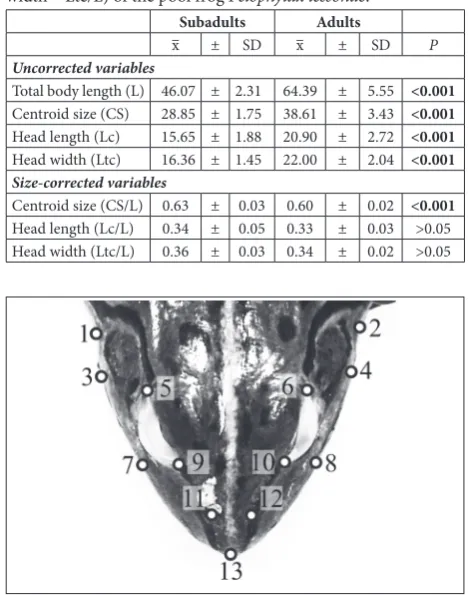
a significant difference between mean subadult and adult head shapes (Pd=0.0271, P<0.05). The main overall changes in head shape between subadults and adults involved a widening of the head (landmarks 1, 2, 3, 4), shortening of the snout (11, 12, 13) and rela-tive reduction of eyes in adults (Fig. 2).
Table 1. The mean values and the standard deviations (SD) for Uncorrected variables (Total body length – L, Centroid size – CS, Head length – Lc and Head width – Ltc) and Size-corrected variables (Centroid size – CS/L, Head length – Lc/L and Head width – Ltc/L) of the pool frog Pelophylax lessonae.
Subadults Adults
x– ± SD x– ± SD P
Uncorrected variables
Total body length (L) 46.07 ± 2.31 64.39 ± 5.55 <0.001
Centroid size (CS) 28.85 ± 1.75 38.61 ± 3.43 <0.001
Head length (Lc) 15.65 ± 1.88 20.90 ± 2.72 <0.001
Head width (Ltc) 16.36 ± 1.45 22.00 ± 2.04 <0.001
Size-corrected variables
Centroid size (CS/L) 0.63 ± 0.03 0.60 ± 0.02 <0.001
Head length (Lc/L) 0.34 ± 0.05 0.33 ± 0.03 >0.05 Head width (Ltc/L) 0.36 ± 0.03 0.34 ± 0.02 >0.05
Fig. 1. Landmarks recorded on the dorsal side of the head of the pool frog (Pelophylax lessonae). 1, 2 – jaw at the level of posterior edge of the tympanum; 3, 4 – jaw at the level of the anterior edge of the tympanum; 5, 6 – posterior corner of the eye; 7, 8 – jaw at the level of the anterior corner of the eye; 9, 10 – anterior corner of the eye; 11, 12 – nostril; 13 – tip of the snout.
Allometric and non-allometric changes in head shape
Allometry had a significant impact on the changes in head shape in the pool frog (16.47%, P<0.001). The homogeneity of the slope test revealed that allometric slopes for subadults and adults were the same (Wilks’ Lambda=0.3958, F22,24=1.6647, P>0.05). Allometric changes in head shape correspond to overall changes in head shape between subadults and adults (widen-ing of the head, shorten(widen-ing of the snout and relative reduction of eyes). After removing the effect of size on shape, Procrustes distance showed no signifi-cant difference between subadults and adults in the non-allometric component of head shape variation (Pd=0.0086, P>0.05).
Relation between head size and shape and maximum prey size
Adults consumed significantly larger prey than subadults (mean±SD, subadults: 9.74±2.43, adults: 14.18±5.82; P<0.05). However, after correction for size (PS/L), there was no difference in maximum prey size between subadults and adults (mean ± SD, subadults: 0.21±0.05, adults: 0.23±0.09; P>0.05). Prey size (PS/L) was not correlated with any of the analyzed variables (Lc/L, Ltc/L, CS/L, symmetric component of shape), except with head width in subadults (r=0.78, P<0.05).
DISCUSSION
The results of this study revealed differences in head shape between subadult and adult pool frogs, with adults characterized by wider heads and shorter snouts, but relatively smaller eyes. Since allometry had a profound impact on head shape variation, af-ter removing the effect of size, subadults and adults did not differ in head shape. Considering relations between head size and shape and the maximum size of the prey, our results showed the absence of these correlations in adults. A significant positive correla-tion was found in subadults, but only between head width and maximum size of prey.
Ontogenetic head shape changes in anurans have been studied at larval stages [29,30,47], but data re-garding the post-metamorphic development of head
are scarce. Ponssa and Candioti [32] showed that post-metamorphic ontogenetic shape variation in the skull of the Leptodactylus fuscus group is associated with elongation of maxillary bones, widening of the nasals and widening of the skull in the region of the squamosals. Like this study, we found that the most pronounced head shape changed during the post-metamorphic development of the pool frog, and en-compassed the posterior part of the head (region of squamosals) and snout (region of nasals). In addition, our study showed the relative reduction of eye size during post-metamorphic development. This pattern is in agreement with general ontogenetic scaling in tetrapods [13], where development includes the re-duction in the relative size of the sensory capsules and allometric and/or isometric growth of trophic structures. Allometry accounted for the main chang-es in head shape in our study. Isometry is generally unexpected in ontogenetic studies because different anatomical regions have to grow at different rates to maintain a function that would be lost if growth pro-ceeded geometrically [13]. For instance, the relative increase in width of the posterior part of the head in pool frog adults could be related to their diet and maintenance of successful food acquisition, process-ing and process-ingestion.
different niches, they modify their exposure to food, predators and/or conspecifics that in turn determine their survival and fitness [23]. Although prey size may influence the head size and shape, our study showed that larger individuals do not eat larger prey, apart from subadults whose head width is positively corre-lated with maximum prey size. It should be noted that a larger sample size of both ontogenetic stadia is re-quired to drawn more general conclusions. However, our results are nonetheless helpful for understanding the variations in head size and shape during the post-metamorphic development in the pool frog.
Studies of ontogenetic habitat partitioning are missing, with more in-depth access of ecological rel-evance of the ontogenetic head shape variation. Fur-ther studies are needed to improve our understanding of the relationships among ontogenetic shifts in form, function, and ecology in anurans.
Acknowledgments: This work was supported by the Serbian Ministry of Education, Science and Technological Development, Project No. 173043.
Author contributions: Study conception and design: TDV, NTK. Acquisition of data: MK, MA. Analysis and interpretation of data: MK, TDV. Drafting of manuscript: TDV, NTK. Critical revision: TDV, MK, MA, NTK.
Conflict of interest disclosure: We have no conflicts of interest to declare.
REFERENCES
1. Hanken J, Hall BK. Mechanisms of skull diversity and evolu-tion. In: Hanken J, Hall B, editors.The skull - Functional and evolutionary mechanisms. Chicago: University of Chicago Press; 1993. p. 1-36.
2. Cooper WE, Vitt LJ. Female mate choice of large male
broad-headed skinks. Anim Behav.1993;45:683-93.
3. Adams DC, Rohlf FJ. Ecological character displacement in Plethodon: biomechanical differences found from a geometric morphometric study. Proc Nat Acad Sci USA 2000;97:4106-11.
4. Arif S, Adams DC, Wicknick JA. Bioclimatic modelling, morphology, and behaviour reveal alternative mechanisms regulating the distributions of two parapatric salamander species. Evol Ecol Res. 2007;9:843-54.
5. Barros FC, Herrel A, Kohlsdorf T. Head shape evolution in Gymnophthalmidae: does habitat use constrain the evolution of cranial design in fossorial lizards? J Evol Biol. 2011;24:2423-33.
6. Gans C. Amphisbaenians-reptiles specialized for a burrow-ing existence. Nature. 1969;99:146-51.
7. Walls SC, Belanger SS, Blaustein AR. Morphological varia-tion in a larval salamander: dietary inducvaria-tion of plasticity in head shape. Oecologia. 1993;96:162-8.
8. Bonduriansky R, Rowe L. Interactions among mechanisms of sexual selection on male body size and head shape in a sexually dimorphic fly. Evolution. 2003;57:2046-53. 9. Vincent SE, Herrel A, Irschick DJ. Sexual dimorphism in
head shape and diet in the cottonmouth snake (Agkistrodon piscivorus). J Zool. 2004;264:53-9.
10. Herrel A, McBrayer LD, Larson PM. Functional basis for sexual differences in bite force in the lizard Anolis carolin-ensis. Biol J Linn Soc. 2007;91:111-9.
11. Kaliontzopoulou A, Carretero MA, Llorente GA. Head shape allometry and proximate causes of head sexual dimorphism in Podarcis lizards: joining linear and geometric morpho-metrics. Biol J Linn Soc. 2008;93:111-24.
12. Vanhooydonck B, Herrel A, Van Damme R. Interactions between habitat use, behavior, and the trophic niche of lac-ertid lizards. In: Reilly SM, McBrayer LD, Miles DB, editors. Lizard ecology: the evolutionary consequences of foraging mode. Cambridge, United Kingdom: Cambridge University Press; 2007. p. 427-49.
13. Emerson SB, Bramble DM. Scaling, allometry, and skull design. In: Hanken J, Hall B, editors.The skull - Functional and evolutionary mechanisms. Chicago: University of Chi-cago Press; 1993. p. 384-421.
14. Richard BA, Wainwright PC. Scaling the feeding mechanism of largemouth bass (Micropterus salmoides): kinematics of prey capture. J Exp Biol. 1995;198:419-33.
15. Birch JM. Skull allometry in the marine toad, Bufo marinus. J Morphol. 1999;241:115-26.
16. Brown JH, West GB. Scaling in Biology. Oxford: Oxford Uni-versity Press; 2000. 368 p.
17. Herrel A, O’Reilly JC. Ontogenetic scaling of bite force in lizards and turtles. Physiol Biochem Zool. 2006;79:31-42. 18. Monteiro LR, Abe AS. Allometry and morphological
inte-gration in the skull of Tupinambis merianae (Lacertilia: Tei-idae). Amphibia-Reptilia. 1997;18:397-405.
19. Smith MT, Collyer ML. Regional variation and sexual dimorphism in head form of the prairie rattlesnake (Crotalus viridis viridis): comparisons using new analytical and collec-tion methods. In: Hayes WK, Beaman KR, Cardwell MD, BushSP, editors. The biology of rattlesnakes. Loma Linda Loma Linda, California: University Press; 2008. p. 79-90. 20. Piras P, Colangelo P, Adams DC, Buscalioni A, Cubo J,
Kot-sakis T, Meloro C, Raia P. The Gavialis-Tomistoma debate: the contribution of skull ontogenetic allometry and growth trajectories to the study of crocodylian relationships. Evol Dev. 2010;12:568-79.
21. Chiari Y, Claude J. Study of the carapace shape and growth in two Galápagos tortoise lineages. J Morphol. 2011;272:379-86. 22. Ivanović A, Cvijanović M, Kalezić ML. Ontogeny of body form and metamorphosis: insights from the crested newts. J Zool.2011;283:153-61.
Hydrophiidae): the effects of sex, body size, and colour pat-tern. Biol J Linn Soc. 2003;80:1-10.
24. Alford RA, Crump ML. Habitat partitioning among size classes of larval southern leopard frogs, Rana utricularia. Copeia. 1982;1982:367-73.
25. D’Amore A, Kirby E, McNicholas M. Invasive species shifts ontogenetic resource partitioning and microhabitat use of a threatened native amphibian. Aquat Conserv Mar Freshw Ecosys. 2009;19:534-41.
26. Toft CA. Resource partitioning in amphibians and reptiles. Copeia 1985;1985:1-21.
27. Werner EE, Anholt BR. Predator induced behavioral indirect effects: consequences to competitive interactions in anuran larvae. Ecology. 1996;77:157-69.
28. Emerson SB. Skull shape in frogs: correlations with diet. Herpetologica.1985;41:177-88.
29. Larson PM. Chondrocranial development in larval Rana
sylvatica (Anura: Ranidae): morphometric analysis of cra-nial allometry and ontogenetic shape change. J Morphol. 2002;252:131-44.
30. Larson, PM. Chondrocranial morphology and ontogenetic allometry in larval Bufo americanus (Anura, Bufonidae).
Zoomorphology.2004;123:95-106.
31. Larson PM. Ontogeny, phylogeny, and morphology in anuran larvae: morphometric analysis of cranial develop-ment and evolution in Rana tadpoles (Anura: Ranidae). J Morphol. 2005;264:34-52.
32. Ponssa ML, Candioti MFV. Patterns of skull development in anurans: size and shape relationship during postmetamor-phic cranial ontogeny in five species of the Leptodactylus fuscus Group (Anura: Leptodactylidae). Zoomorphology. 2012;131:349-62.
33. Shine R. Sexual selection and sexual dimorphism in the Amphibia. Copeia. 1979;1979:297-306.
34. Monnet JM, Cherry MI. Sexual size dimorphism in anurans. Proc R Soc Lond B Biol Sci 2002;269:2301-7.
35. Krizmanić II. Water frogs (Rana esculenta complex) in Ser-bia: morphological data. Arch Biol Sci. 2008;60:449-57. 36. Cardini A, Elton S. Sample size and sampling error in
geo-metric morphogeo-metric studies of size and shape. Zoomor-phology. 2007;126:121-34.
37. Rohlf FJ. tpsDig2 Software. Stony Brook, New York: State Univ. of New York; 2015.
38. Rohlf FJ, Slice D. Extensions of the Procrustes method for the optimal superimposition of landmarks. Syst Biol. 1990;39:40-59.
39. Dryden IL, Mardia KV. Statistical shape analysis. New York: Wiley; 1998. 496 p.
40. Klingenberg CP, Barluenga M, Meyer A. Shape analysis of symmetric structures: quantifying variation among indi-viduals and asymmetry. Evolution 2002;56:1909-20. 41. Zelditch ML, Swiderski DL, Sheets HD. Geometric
mor-phometrics for biologists: a primer. San Diego, California: Elsevier; 2012. 443 p.
42. Bookstein FL. Morphometric tools for landmark data: geom-etry and biology. New York, USA: Cambridge University Press; 1991. 435 p.
43. Good P. Permutation test: a practical guide to resampling methods for testing hypotheses. New York, USA: Springer-Verlag; 1994. 384 p.
44. Edgington ES. Randomization tests. New York, USA: Marcel Dekker; 1995. 147 p.
45. Klingenberg CP. Size, shape, and form: concepts of allom-etry in geometric morphometrics. Dev Genes Evol. 2016;226:113-37.
46. Klingenberg CP. MorphoJ: an integrated software pack-age for geometric morphometrics. Mol Ecol Resour. 2011;11:353-7.
47. Garriga N, Llorente GA. Chondrocranial ontogeny of Pelo-dytes punctatus (Anura: Pelodytidae). Response to competi-tion: geometric morphometric and allometric change analy-sis. Acta Zool. 2012;93:453-64.
48. Pierce BA, Mitton JB, Jacobson L, Rose FL. Head shape and size in cannibal and noncannibal larvae of the tiger salaman-der from west Texas. Copeia.1983;1983:1006-12.
49. Bernays EA. Diet-induced head allometry among foliage-chewing insects and its importance for graminivores. Sci-ence. 1986;231:495-7.
50. Houston D, Shine R. Sexual dimorphism and niche diver-gence: feeding habits of the Arafura file snake. J Anim Ecol. 1993;62:737-48.
51. Queral-Regil A, King RB. Evidence for phenotypic plasticity in snake body size and relative head dimensions in response to amount and size of prey. Copeia. 1998;1998:423-9. 52. MacLeod CD, Reidenberg JS, Weller M, Santos MB,
Her-man J, Goold J, Pierce GJ. Breaking symmetry: the marine environment, prey size, and the evolution of asymmetry in cetacean skulls. Anat Rec. 2007;290:539-45.
53. Edwards S, Tolley KA, Vanhooydonck B, Measey GJ, Herrel A. Is dietary niche breadth linked to morphology and per-formance in Sandveld lizards Nucras (Sauria: Lacertidae)? Biol J Linn Soc. 2013;110:674-88.
54. Dollion AY, Measey GJ, Cornette R, Carne L, Tolley KA, Silva JM, Boistel R, Fabre A-C., Herrel A. Does diet drive the evolution of head shape and bite force in chameleons of the genus Bradypodion? Funct Ecol. 2017;31:671-84.
55. Wittorski A, Losos JB, Herrel A. Proximate determinants of bite force in Anolis lizards. J Anat. 2016;228:85-95. 56. Nicoară A, Nicoară M, Bianchini F. Diet composition
dur-ing breeddur-ing period in populations of Bufo viridis, Pelobates fuscus and Rana esculenta complex from Ciric River’s basin (Iaşi. Romania). Analele Stiintifice ale Universitatii” Al. I. Cuza” din Iasi Sectiunea Biologie Animala. 2005;51:179-87. 57. Paunović A, Bjelić-Čabrilo O, Šimić S. The diet of water frogs (Pelophylax esculentus complex) from the Petrovara-dinski Rit marsh (Serbia). Arch Biol Sci. 2010;62:797-806. 58. Cicort-Lucaciu AS, Pelle C, Borma IT. Note on the food
composition of a Pelophylax ridibundus (Amphibia) popula-tion from the Dubova locality region, south-western Roma-nia.Biharean Biol. 2013;7:33-6.
59. Balint N, Citrea L, Memetea A, Jurj N, Condure N. Feeding ecology of the Pelophylax ridibundus (Anura, Ranidae) in Dobromir, Romania. Biharean Biol. 2008;2:27-37.