Available online throug
ISSN 2229 – 5046
The Transmuted Weighted Exponential Distribution: Theory and Application
YASSMEN, Y. ABDELALL*
Department of Mathematical Statistics,
Institute of Statistical Studies and Research, Cairo University, Egypt.
(Received On: 19-04-16; Revised & Accepted On: 23-05-16)
ABSTRACT
A
generalization of the weighted exponential distribution so-called transmuted weighted exponential distribution is proposed and studied. We will use the quadratic rank transmutation map (QRTM) in order to generate a flexible family of probability distributions taking weighted exponential distribution as the base value distribution by introducing a new parameter that would offer more distributional flexibility. Various structural properties including explicit expressions for the moments, quantiles, moment generating function and order statistics of the new distribution are derived. Its parameters were estimated using the method of maximum likelihood for estimating the model parameters and obtain the observed information matrix. Three real data sets are used to compare the flexibility of the transmuted version versus the weighted exponential distribution. Results obtained by Oguntunde et al. (2016) can be considered as a special case from present results.Key words: Weighted exponential distribution, maximum likelihood estimation, order statistics, transmutation map, reliability function.
1. INTRODUCTION
The weighted exponential distribution being a competitor to the weibull, gamma and Generalized exponential distributions has received appreciable usage in the fields of engineering and medicine. The weighted exponential distribution has been rigorously explored in the area of probability distribution theory. For instance, Alqallaf et al.
(2015) used five different estimation methods (maximum likelihood, moments, L-moments, ordinary least squares and weighted least squares) to estimate the parameters of the weighted exponential distribution. Oguntunde (2015) also generalized the weighted exponential distribution using the Exponentiated family of distributions to propose the exponentiated weighted exponential distribution.
Some other weighted distributions have also been defined in the literature, for example, the weighted inverted exponential distribution, Hussian (2013), the weighted weibull distribution, Mahdy (2013) and Shahbaz et al. (2010), the weighted multivariate normal distribution, Kim (2008), the weighted inverse weibull distribution, Kersey (2010), a weighted three parameter weibull distribution (Essam and Mohamed, 2013). Oguntunde et al. (2016) introduced two-parameter weighted exponential distribution based on a modified weighted version of Azzalini’s (1985) approach, the cumulative distribution function (cdf) of the weighted exponential distribution can be defined by
( )
( 1)1
x,
0 ,
0,
0 ,
G x
= −
e
− +β αα
>
β
x
(1) where,α
is a scale parameter,β
is a shape parameter. The corresponding probability density function (pdf) is given by( ) (
)
( 1)1
x,
0 ,
0,
0 ,
g x
=
β
+
α
e
− +β αα
>
β
x
(2)The aim of this paper is to provide more flexible extension of the weighted exponential distribution using the transmutation map technique introduced by Shaw and Buckley (2007) called the transmuted weighted exponential distribution. According to the quadratic rank transmutation Map (QRTM) approach a random variable X is said to have transmuted distribution if its cdf is given by
(
)
2( )
1
( )
( ),
1,
F x
= +
λ
G x
−
λ
G x
λ
≤
(3)where
G
(
x
)
is the cdf of the base distribution. An extensive information about the quadratic rank transmutation map is given in Shaw and Buckley (2007). Observe that at λ = 0 we have the distribution of the base random variable.© 2016, IJMA. All Rights Reserved 120 Many authors deal with the generalization of some well-known distributions. Aryal and Tsokos (2009) defined the transmuted generalized extreme value distribution and they studied some basic mathematical characteristics of transmuted Gumbel probability distribution and it has been observed that the transmuted Gumbel can be used to model climate data. Also Aryal and Tsokos (2011) presented a new generalization of the Weibull distribution called the transmuted Weibull distribution. Khan and King (2013) introduced the transmuted modified Weibull distribution which extended recent developments on the transmuted Weibull distribution by Aryal and Tsokos (2009). Recently, Afify et al. (2015) introduced the transmuted Weibull Lomax and studied its mathematical properties. In the present study we will provide mathematical formulations of the transmuted weighted exponential distribution and some of its properties. We will also provide possible area of applications.
The rest of this article is organized as follows, In Section 2 we demonstrate transmuted probability distribution. In Section 3, we find the reliability functions of the subject model. The statistical properties include quantile functions, moments and moment generating functions are derived in Section 4. The minimum, maximum and order statistics models are discussed in Section 5. Section 6 we demonstrate the maximum likelihood estimates and the asymptotic confidence intervals of the unknown parameters. In section 7, the transmuted weighted exponential distribution is applied to a real data set. Finally, in Section 8, we provide some conclusion.
2. TRANSMUTED WEIGHTED EXPONENTIAL DISTRIBUTION
In this section we studied the transmuted weighted exponential distribution and the sub-models of this distribution. Now using (1) and (3) we have the cdf of transmuted weighted exponential distribution.
( 1) ( 1)
( )
1
x1
x.
F x
= −
e
−α β+
+
λ
e
−α β+
where
α
is a scale parameter andβ
is a shape parameters representing the different patterns of the transmuted weighted exponential distribution andλ
is the transmuted parameter. Hence, the pdf of transmuted weighted exponential distribution with parametersα
,
β
andλ
is( )
(
)
( )[
( )]
.
2
1
1
e
1xe
1xx
f
=
α
β
+
−α β+−
λ
+
λ
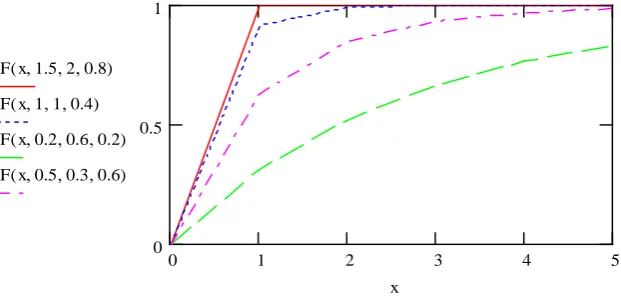
−α β+Figure 1and 2 illustrates some of the possible shapes of the pdf and cdf of a transmuted weighted exponential distribution for selected values of parameters
α
,
β
,
andλ
.0 1 2 3 4 5
0 5 10
f x 1.5( , ,2,0.8) f x 1( , ,1,0.4) f x 0.2( , ,0.6,0.2) f x 0.5( , ,0.3,0.6)
x
Figure-1: The pdf’s of various transmuted weighted exponential distributions.
0 1 2 3 4 5
0 0.5 1
F x 1.5( , ,2,0.8) F x 1( , ,1,0.4) F x 0.2( , ,0.6,0.2) F x 0.5( , ,0.3,0.6)
x
Note that the transmuted weighted exponential distribution is an extended model to analyze more complex data and it generalizes some of widely used distributions. In particular, for
β
=
0
we have the transmuted exponential distribution as discussed in Shaw and Buckley (2007). The weighted exponential distribution is clearly a special case forλ
=
0
as discussed inOguntunde et al. (2016). Whenβ
=
λ
=
0
then the resulting distribution is an exponential distribution with parameterα
.3. RELIABILITY ANALYSIS
The reliability function
R
(
t
)
, which is the probability of an item not failing prior to some time t, is defined by)
(
1
)
(
t
F
t
R
=
−
. The reliability function of a transmuted weighted exponential distribution can be a usefulcharacterization of life time data analysis. It is defined as
( )
[
]
[
( )]
{
t t}
e
e
t
F
t
R
1 1
1
1
1
)
(
1
)
(
+ − +
−
+
−
−
=
−
=
β α β
α
λ
The other characteristic of interest of a random variable is the hazard rate function defined by
)
(
1
)
(
)
(
t
F
t
f
t
h
−
=
,which is an important quantity characterizing life phenomenon. It can be loosely interpreted as the conditional probability of failure, given it has survived to the time t. The hazard rate function for a transmuted weighted exponential distribution is defined by
( )
(
{
[
)
( ( ) )[
]
[
( )(]
}
)]
.
1
1
1
2
1
1
1 1
1 1
t t
t t
e
e
e
e
t
h
− + − ++ − +
−
+
−
−
+
−
+
=
ααββ α β α βλ
λ
λ
β
α
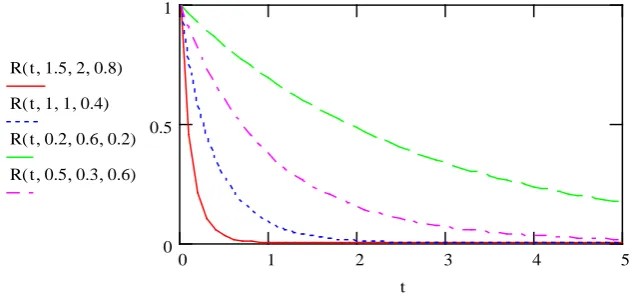
Figure 3 and 4 illustrates some of the possible shapes of the hazard rate function and survival function of transmuted weighted exponential distribution for selected values of the parameters
α
,
β
,
andλ
.0 1 2 3 4 5
0 5 10
h t 1.5( , ,2,0.8) h t 1( , ,1,0.4) h t 0.2( , ,0.6,0.2) h t 0.5( , ,0.3,0.6)
t
Figure-3: The hazard function of various transmuted weighted exponential distributions
0 1 2 3 4 5
0 0.5 1
R t 1.5( , ,2,0.8) R t 1( , ,1,0.4) R t 0.2( , ,0.6,0.2) R t 0.5( , ,0.3,0.6)
t
© 2016, IJMA. All Rights Reserved 122 4. STATISTICAL PROPERTIES
In this section, the statistical properties of the transmuted weighted exponential distribution is studied. Specifically the quantile function and random number generation, moments and moment generating function.
4.1 Quantile function and Median
The quantile function
x
qof the transmuted weighted exponential distribution is real solution of the following equation(
)
(
)
,
0
1
,
2
4
1
1
1
ln
1
1
2≤
≤
+
−
+
−
−
−
+
=
q
q
x
qλ
λ
λ
λ
β
α
(4)The above equation has no closed form solution in
x
q, so we have to use a numerical technique such as a Newton- Raphson method to get the quantile. By puttingq
=
0
.
5
in Equation (4) we can get the median of transmuted weighted exponential distribution.4.2 Random Number Generation
The random number generation of the transmuted weighted exponential distribution is defined by the following relation
(
)
(
)
,
2
4
1
1
1
ln
1
1
2
+
−
+
−
−
−
+
=
λ
λ
λ
λ
β
α
u
x
qwhere u is a uniform distribution (0,1).
4.3 Moments
The rth non-central moment of X , denoted by
µ
r', of the transmuted weighted exponential distribution is given by the following theorem.
Theorem 1: If X is a continuous random variable has the transmuted weighted exponential distribution, then the rth non-central moment of X is given by
[ ]
( )
(
)
[
+
]
−
+
+
Γ
=
=
r r rr
r
X
E
2
1
1
1
'
λ
λ
β
α
µ
Proof: The rth non-central moment is given by
(
)
∫
( )(
( ))
∫
∞ + − + − ∞+
−
+
=
=
0 1 1 0 '2
1
1
)
(
dx
e
e
x
dx
x
f
x
x x r r r β α βα
λ
λ
β
α
µ
(
) (
)
( )( )
( )
+
−
+
=
∫
∞ − +∫
∞ − +dx
e
x
dx
e
x
r x r x0 1 2 0 1
2
1
1
λ
α βλ
α ββ
α
Let
[
α
(
β
+
1
)
x
]
=
y
, then(
)
[
+
1
]
=
β
α
y
x
, therefore(
) (
)
( )
(
)
[
]
( )
[
(
( )
)
]
+
+
Γ
+
+
+
Γ
−
+
=
+1 +1'
1
2
1
2
1
1
1
1
r rr
r
r
β
α
λ
β
α
λ
β
α
µ
( )
(
)
[
+
]
−
+
+
Γ
=
r
r r2
1
1
1
λ
λ
β
α
.Which completes the proof. Therefore, the expected value
µ
and varianceσ
2 of a transmuted weighted exponential random variable X are, respectively, given by[ ]
[
(
)
]
,
2
1
1
1
−
+
=
=
λ
β
α
and the variance is
[ ]
(
)
[
1
]
1
2
4
.
1
2 2 2
−
−
+
=
=
λ
λ
β
α
σ
Var
X
The skewness and kurtosis measures can be obtained from the expressions
[ ]
3' 2' 33
3
2
Skewness
X
µ
µ µ
µ
,
σ
−
+
=
[ ]
4' 3' 2 2' 44
4
6
3
kurtosis
X
µ
µ µ
µ µ
µ
,
σ
−
+
−
=
Upon substituting for the moments.
4.4 Moment Generating Function
In this subsection we derived the moment generating function of the transmuted weighted exponential distribution.
Theorem 2: If X is a continuous random variable has the transmuted weighted exponential distribution, then the moment generating function of X is given by
(
)
(
)
[
]
∑
∞ =
−
+
+
+
Γ
=
02
1
1
!
1
)
(
r r r r Xr
r
t
t
M
λ
λ
β
α
Proof: The moment generating function of the random variable X is given by
( )
[ ]
( )
∑
∫
∫
∞ = ∞ ∞=
+
+
+
+
+
=
=
=
0 0 2 2 0!
)
(
...
!
...
!
2
1
)
(
r r r n n x t x t Xr
X
E
t
dx
x
f
n
x
t
x
t
x
t
dx
x
f
e
e
E
t
M
(
)
(
)
[
1
]
1
2
.
!
1
0∑
∞ =
−
+
+
+
Γ
=
r r r rr
r
t
λ
λ
β
α
Which completes the proof.5. ORDER STATISTICS
In fact, the order statistics have many applications in reliability and life testing. Let
X
1,
X
2,...,
X
n be a randomsample from a continuous population with cdf
F
X(
x
)
and pdff
X(
x
)
. LetX
(1)≤
X
(2)≤
...
≤
X
(n) denote the order statistics obtained from this sample then the pdf ofX
(j),j
=
1
,
2
,...,
n
is given by( ) ( ) ( )
[
] [
]
n jX j
X X
X
f
x
F
x
F
x
j
n
j
n
x
f
j − −−
−
−
=
(
)
(
)
1
(
)
!
!
1
!
1 ) ( .The pdf of the jth order statistic for transmuted weighted exponential distribution is given by
( ) ( ) ( ) ( )
( )[
( )]
( )
{
}
{
( )}
[
x x]
j[
{
(
( )x)
(
( )x)
}
]
n j x x Xe
e
e
e
e
e
j
n
j
n
x
f
j − + − + − − + − + − + − + −+
−
−
+
−
×
+
−
+
−
−
=
1 1 1 1 1 1 11
1
1
1
1
2
1
1
!
!
1
!
) ( β α β α β α β α β α β αλ
λ
λ
λ
β
α
The pdf of the largest order statistic
X
(n)=
max
(
X
1,
X
2,...,
X
n)
is therefore:( )
(
)
( 1)[
( 1)]
[
{
( 1)}
{
( 1)}
]
11
1
2
1
1
) ( − + − + − + − + −−
+
−
+
+
=
x x x x nX
x
n
e
e
e
e
f
n β α β α β α βα
λ
λ
λ
β
α
.and the pdf of the smallest order statistic
X
(1)=
min
(
X
1,
X
2,...,
X
n)
is given by:( )
(
)
( )[
( )]
[
{
(
( ))
(
( ))
}
]
.
1
1
1
2
1
1
1 1 1 1 1) ( − + − + − + − + −
−
+
−
−
+
+
=
x x x x nX
x
n
e
e
e
e
f
j β α β α β α βα
λ
λ
λ
© 2016, IJMA. All Rights Reserved 124 6. ESTIMATION AND INFERENCE
In this section we discuss the maximum likelihood estimators (MLEs) and inference for the parameters
(
α
,
β
,
λ
)
of the transmuted weighted exponential distribution. Let(
X
1,
X
2,...,
X
n)
be a random sample of size n from thisdistribution with unknown parameter vector
ν
=
(
α
,
β
,
λ
)
T. The likelihood function forν
,l
( )
ν
;
x
can be written as( )
(
)
( )[
( )]
.
2
1
1
;
1 1 1 1 i n i i x n i x n ne
e
x
l
− += + −
+
−
∏
∑
+
=
= α ββ α
λ
λ
β
α
ν
Then, the log-likelihood function,
, becomes:(
)
(
)
[
( )]
.
2
1
ln
1
1
ln
ln
1 1 1∑
∑
= + − =+
−
+
+
−
+
+
=
n i x n i i ie
x
n
n
α
β
α
β
λ
λ
α β
Therefore the score vector is
( )
T
U
∂
∂
∂
∂
∂
∂
=
∂
∂
=
λ
β
α
ν
ν
,
,
. Let ( )xii
e
P
=
−α β+1(
)
(
(
(
)
)
)
,
2
1
1
2
1
1 1∑
∑
= =
+
−
+
−
+
−
=
∂
∂
n i i i i n i iP
P
x
x
n
λ
λ
λ
β
β
α
α
(
)
(
(
)
)
,
2
1
2
1
∑
=1∑
=1
+
−
−
−
+
=
∂
∂
n i i i i n i iP
P
x
x
n
λ
λ
λ
α
α
β
β
and(
)
(
)
.
2
1
1
2
1∑
=
+
−
−
=
∂
∂
n i i iP
P
λ
λ
λ
We can find the estimates of the unknown parameters by setting the score vector to zero,
U
( )
ν
=
0
,
and solving themsimultaneously yields the MLEs
,
,
∧ ∧
β
α
and∧
λ
. These equations cannot be solved analytically and statistical software can be used to solve them numerically by means of iterative techniques such as the Newton-Raphson algorithm. For the three parameters transmuted weighted exponential distribution all the second order derivatives exist. Thus we have the inverse dispersion matrix is given by
∧ ∧ ∧λ
β
α
~
λλ λβ λα βλ ββ βα αλ αβ ααλ
β
α
V
V
V
V
V
V
V
V
V
N
,
−
=
− λλ λβ λα βλ ββ βα αλ αβ ααV
V
V
V
V
V
V
V
V
E
V
1 (5)where
,
2 2α
αα∂
∂
=
V
,
2 2β
ββ∂
∂
=
V
2,
2
λ
λλ∂
∂
=
V
,
2β
α
αβ
∂
∂
∂
=
V
,
2λ
α
αλ
=
∂
∂
∂
V
and.
2
λ
β
βλ
∂
∂
∂
=
V
By solving this inverse dispersion matrix these solutions will yield asymptotic variance and covariances of these MLs
for
,
,
∧ ∧
β
α
and∧
λ
. Using (5), we approximate100
(
1
−
γ
)
% confidence intervals forα
,
β
,
andλ
are determined respectively asαα γ
α
z
V
2
±
∧
,
β
z
γV
ββ 2±
∧
and
λ
z
γV
λλ 2±
∧
7. APPLICATION
In this section, the flexibility and potentiality of the transmuted weighted exponential distribution are examined using three real data sets to show that the transmuted weighted exponential distribution can be a better model than one based on the weighted exponential distribution. the analysis involved in this research was performed with Mathcad software package.
Data set 1: This data has been previously used by Ghitany et al. (2008) and Alqallaf et al. (2015). It represents the waiting time (measured in min) of 100 bank customers before service is being rendered. The data is as follows:
0.8 0.8 1.3 1.5 1.8 1.9 2.1 2.6 2.7 4.6 6.2 8.6
3.3 3.5 3.6 4.0 4.1 4.2 4.3 4.3 4.4 3.1 8.2 6.2
4.7 4.8 4.9 4.9 5.0 5.3 5.7 5.7 6.1 18.9 10.9 4.7
6.3 6.7 6.9 7.1 7.1 7.1 7.4 7.6 7.7 13.1 13.3 3.2
8.6 8.6 8.8 8.8 8.9 8.9 9.6 9.7 9.8 10.7 19.0
11.0 11.1 11.2 11.2 11.5 11.9 12.5 12.9 13.0 8.0 19.9
13.7 13.9 14.1 15.4 15.4 17.3 18.1 18.2 18.4 6.2 13.6
20.6 21.3 21.4 21.9 23.0 27.0 33.1 38.5 2.9 4.4 11.0
The estimates of the unknown parameters for the distributions by the maximum likelihood method,-2log-likelihood, Akaike Information Criteria (AIC), Bayesian Information Criteria (BIC), and the Consistent Akaike Information Criteria (CAIC) are used to compare the candidate distributions. The best distribution corresponds to lower for 2log-likelihood, AIC, BIC, and CAIC statistics values.
Table-1: maximum likelihood estimates (MLs) and their corresponding standard errors (in parentheses) of the model parameter, AIC, BIC, and CAIC values for waiting time (measured in min) of 100 bank customers.
Distributions
MLs Measures
∧
α
β
∧λ
∧−
2
AIC BIC CAICtransmuted weighted exponential 0.067 (0.013)
0.517 (0.300)
-0.700
(0.672) 653.831 659.831 659.831 660.081
weighted exponential 0.004
(0.002)
20.389
(10.790) 658.042 662.042 664.042 662.292
From Table 1,we observe that the transmuted weighted exponential distribution is a competitive distribution compared with another distribution. In fact, based on the values of the statistics we observe that the transmuted weighted exponential distribution provides the best fit for these data.
Data set 2: This data represents the lifetime of 20 electronic components. The data has been previously used by Teimouri and Gupta (2013) and Nasiru (2015). The data is as follows:
0.03 0.22 0.73 1.41 1.52 1.80 2.38 2.87 3.14 5.09 0.12 0.35 0.79 1.25 1.79 1.94 2.40 2.99 3.17 4.72
Table-2: MLs and their corresponding standard errors (in parentheses) of the model parameter, AIC, BIC, and CAIC values for the lifetime of 20 electronic components.
Distributions
MLs Measures
∧
α
β
∧λ
∧−
2
AIC BIC CAICtransmuted weighted exponential 0.357 (0.173)
0.455 (0.700)
-0.250
(0.611) 65.991 71.991 69.894 73.491
weighted exponential 21.761
(8.279)
-0.976
© 2016, IJMA. All Rights Reserved 126 Data set 3: Data is from an accelerated life test of 59 conductors. It has been previously used by Nasiri et al. (2011). The data is as follows:
6.545 9.289 7.543 6.956 6.492 5.459 8.120 4.706 8.687 2.997
8.591 6.129 11.038 5.381 6.958 4.288 6.522 4.137 7.459 7.495
6.573 6.538 5.589 6.087 5.807 6.725 8.532 6.663 6.369 7.024
8.336 9.218 7.945 6.869 6.352 4.700 6.948 9.254 5.009 7.489
7.398 6.033 10.092 7.496 4.531 7.974 8.799 7.683 7.224 7.365
6.923 5.640 5.434 7.937 6.515 6.476 6.071 10.491 5.923
Table-3: maximum likelihood estimates and their corresponding standard errors (in parentheses) of the model
parameter, AIC, BIC, and CAIC values for the accelerated life test of 59 conductors.
Distributions
MLs Measures
∧
α
β
∧λ
∧−
2
AIC BIC CAICtransmuted weighted exponential 0.098 (0.079)
0.991 (1.603)
-0.704
(0.829) 319.819 325.819 330.444 326.255
weighted exponential 34.558
(11.604)
-0.995
(0.001) 364.418 350.418 367.960 350.632
From the above results, it is evident that the transmuted weighted exponential distribution is the best distribution for fitting these data sets compared to the weighted exponential distribution, and it is a strong competitor to other distribution commonly used in literature for fitting lifetime data.
8. CONCLUSION
Here we propose a new model, the so-called the transmuted weighted exponential distribution which extends the weighted exponential distribution in the analysis of data with real support. It is provides larger flexibility in modeling real data. We derive expansions for moments and for the moment generating function. The estimation of parameters is approached by the method of maximum likelihood, also the information matrix is derived. An application of transmuted weighted exponential distribution to real data show that the new distribution can be used quite effectively to provide better fits than weighted exponential distribution.
REFERENCES
1. Afify, A. Z., Nofal, Z. M., Yousof, H. M., El Gebaly, Y. M., and Butt, N. S. (2015) . The Transmuted Weibull Lomax Distribution: Properties and Application. Pakistan Journal of Statistics and Operation Research. XI (1). 151-168.
2. Alqallaf, F., M.E. Ghitany and C. Agostinelli, 2015. Weighted Exponential Distribution: Different methods of Estimations. Applied Math. Inform. Sci. 9. 1167-1173.
3. Aryal, G. R., and Tsokos, C. P. (2009). On the Transmuted Extreme Value Distribution with Application. Nonlinear Analysis: Theory, Methods and Applications. 71(12). 1401-1407.
4. Aryal, G. R., and Tsokos, C. P. (2011). Transmuted Weibull Distribution: A Generalization of the Weibull Probability Distribution. European Journal of Pure and Applied Mathematics. 4(2). 89-102.
5. Azzalini, A. (1985). A class of Distributions which includes the Normal ones. Scandinavian Journal of Statistics. 12. 171-178.
6. Essam, A. A. and Mohamed, A. H. (2013). A Weighted Three-Parameter Weibull Distribution. J. Applied Sci. Res. 9. 6627-6635.
7. Ghitany, M. E., Atieh, B. and Nadarajah, S. (2008). Lindley Distribution and its Application. Math.Comput. Simulat. 78. 493-506.
8. Hussian, M. A. (2013). A Weighted Inverted Exponential Distribution. Int. J. Adv. Stat. Probab. 1. 142-150. 9. Kersey, J. X. (2010). Weighted Inverse Weibull and Beta Inverse Weibull Distribution. M.Sc. Thesis, Georgia
Southern University, Statesboro, Georgia.
10. Khan, M. S., and King, R. (2013). Transmuted Modified Weibull Distribution: A Generalization of the Modified Weibull Probability Distribution. European Journal of Pure and Applied Mathematics. 6(1). 66-88. 11. Kim, H. J. (2008). A class of Weighted Multivariate Normal Distributions and its Properties. J. Multivariate
Anal. 99. 1758-1771.
12. Mahdy, M. (2013). A class of Weighted Weibull Distributions and its Properties. Stud. Math. Sci. 6. 35-45. 13. Nasiri, P., Makhdoom, I. and Yaghoubian, B. (2011). Estimation parameters of the Weighted Exponential
Distribution. Aust. J. Basic Applied Sci. 5. 2007-2014.
15. Oguntunde, P. E. (2015). On the Exponentiated Weighted Exponential Distribution and its Basic Statistical Properties. Applied Sci. Rep. 10. 160-167.
16. Oguntunde, P. E., Owoloko, E. A., and Balogun, O. S. (2016). On A New Weighted Exponential Distribution: Theory and Application. Asian Journal of Applied Sciences. 9(1). 1-12.
17. Shahbaz, S., Shahbaz, M. and Butt, N.S. (2010). A class of Weighted Weibull Distribution. Pakistan Journal of Statistics and Operation Research. 6. 53-59.
18. Shaw, W. T., Buckley, I. R. (2007). The alchemy of probability distributions: be-yond Gram-Charlier expansions, and a skew-kurtotic-normal distribution from a rank transmutation map. Research report.
19. Teimouri, M. and Gupta, A. K. (2013). On the Three-Parameter Weibull Distribution shape parameter Estimation. Journal of Data Science. 11. 403-414.
Source of support: Nil, Conflict of interest: None Declared
[Copy right © 2016. This is an Open Access article distributed under the terms of the International Journal of Mathematical Archive (IJMA), which permits unrestricted use, distribution, and reproduction in any