RADIATION EFFECTS ON UNSTEADY MHD FLOW OVER A VERTICAL PLATE
WITH RAMPED WALL TEMPERATURE IN THE PRESENCE OF CHEMICAL REACTION
B. PRABHAKAR REDDY*
*Department of Mathematics, College of Natural and Mathematics Sciences,
The University of Dodoma, P. Box. No. 259, Dodoma, Tanzania.
&
*Department of Mathematics (S&H), Geethanjali College of Engineering and Technology,
Cheeryal (V), Medchal (Dist) -501301, Telangana State, India.
Received On: 07-06-17; Revised & Accepted On: 28-06-17)
ABSTRACT
T
he effects of radiation on unsteady MHD free convection flow of an incompressible viscous, electrically conducting fluid near an infinite vertical plate with ramped wall temperature in the presence of chemical reaction has been studied. The motion of the plate is a rectilinear translation with an arbitrary time dependent velocity. The radiative flux is described using the differential approximation for radiation. The partial differential equations governing the flow are transformed into a non-dimensional form and are solved by Ritz FEM. The results obtained are discussed for the influence of magnetic field that is fixed relative to the fluid and plate. It has been found that when the thermal and mass Grashof numbers are increase, the thermal and concentration buoyancy effects are enhanced and the fluid velocity increases. Furthermore, when the magnetic field, heat absorption parameter and chemical reaction parameter increase the fluid velocity decrease. These results are in good agreement with earlier results.Key words: Radiation, MHD, free convection, ramped wall temperature, chemical reaction.
1. INTRODUCTION
The problem of magneto-hydrodynamics (MHD) boundary layer flow of an electrically conducting fluid with heat and mass transfer plays an important role in different areas of science and technology like chemical engineering, mechanical engineering, biological science, petroleum engineering, biomechanics, irrigation engineering and aerospace technology. The class of exact solutions of the unsteady magneto-hydrodynamic free convection flows studied by Tokis (1985). Gokhale and Samman (2003) presented the effects of mass transfer on the transient free convection flow of a dissipative fluid along a semi-infinite vertical plate with constant heat flux. Aldose and Al-Nimr (2005) presented the effect of local acceleration term on the MHD transient free convection flow over a vertical plate.The effects of chemical reaction, heat and mass transfer along a wedge with heat source and concentration in the presence of suction or injection presented by Kandasamy et. al (2005). Chaudary and Jain (2007) studied combined heat and mass transfer effects MHD free convection flow past an oscillating plate embedded in a porous medium. Heat and mass transfer of an unsteady MHD natural convection flow of a rotating fluid past a vertical porous flat plate in the presence of radiative heat transfer studied by Mbeledogu and Ogulu (2007). Sharma et. al (2007) presented the Hall effect on MHD mixed convective flow of a viscous incompressible fluid pasta vertical porous plate immersed in a porous medium with heat sourec/sink. Thermal radiation effects on unsteady MHD free convection flow past a vertical plate with temperature dependent viscosity presented by Mohamoud (2009). Finite element analysis of heat and mass transfer of an unsteady MHD natural convection flow of a rotating fluid past a vertical porous plate in the presence of radiative heat transfer presented by Reddy and Rao (2010). Shanaker et. al (2010) presented the radiation and mass transfer effects on unsteady MHD free convective fluid flow embedded in a porous medium with heat generation/absorption. Seth et. al (2011) studied MHD natural convection flow with radiative heat transfer past an impulsively moving plate with ramped wall temperature. Fluctuating heat and mass
Corresponding Author: B. Prabhakar Reddy*
transfer on unsteady MHD free convection flow of radiating and reacting fluid past a vertical porous plate in slip-flow regime studied by Singh and Kumar (2011). Ghara et. al (2012) presented the effect of radiation on MHD free convection flow past an impulsively moving vertical plate with ramped wall temperature. Ravi kumar et. al (2012) presented heat and mass transfer effects on MHD flow of viscous fluid through non-homogenous porous medium in presence of temperature dependent heat source. Seshaiah et. al (2013) presented the induced magnetic field effects on free convective flow of radiative, dissipative fluid past a porous plate with temperature gradient heat source. Ahmed and Dutta (2013) studied transient mass transfer flow past an impulsively started infinite vertical plate with ramped plate velocity and ramped wall temperature. Narahari and Debnath (2013) studied unsteady magneto-hydrodynamic free convection flow past an accelerated vertical plate with constant heat flux and heat generation/absorption. Unsteady magneto-hydrodynamic free convection flow of a second grade fluid in a porous medium with ramped wall temperature studied by Samiulhaq et. al
(2014). Seth et. al (2015) presented Soret and Hall effects on unsteady MHD free convective flow of radiating and chemically reactive fluid past a moving vertical plate with ramped wall temperature in rotating system. Mass transfer effects on unsteady MHD free convective flow of an incompressible viscous dissipative fluid an infinite vertical porous plate presented by Reddy (2016).
Hence, based on the above investigations and applications, the objective of the present paper is to analyze the radiation effects on unsteady MHD free convection flow of an incompressible, electrically conducting fluid near an infinite vertical plate with ramped wall temperature in the presence of chemical reaction. The motion of the plate is a rectilinear translation with an arbitrary time dependent velocity. The Ritz FEM has been adopted to solve the system of partial differential equations which is more economical from computational point of view. The fluid is electrically conducting and regarding the applied magnetic field two cases are considered, namely, when the magnetic lines of force are fixed to the fluid and plate. The differences between fluid velocities in the two cases are studied and some properties are highlighted.
2. MATHEMATICAL ANALYSIS
Consider unsteady MHD free convection flow of an incompressible, electrically conducting fluid near an infinite vertical plate with ramped wall temperature and constant concentration. The motion of the plate is a rectilinear translation with an arbitrary time dependent velocity. We introduce a coordinate system with
x
′ −
axis along the plate in the vertical upward direction, andy
'
−
axis normal plate. A uniform transverse magnetic field of strengthB
0is applied. Initially, at timet
=
0
the plate and the fluid are at rest with the same temperatureT
∞ the species concentration in the fluidC
∞. After time0
t
=
+ the plate moves with the velocityU f t
0( )
in its own plane along thex
′ −
axis. Here,U
0 is a constant velocity and( )
f
⋅
is a dimensionless piecewise continuous function whose valuesf
(0)
=
0.
Heat is supplied to the plate as a time-ramped function in the presence of heat source and chemical reaction. The species concentration at the plate is constant.
w
C
we further assume that:1) The magnetic Reynolds number is small so that the induced magnetic field is negligible in comparison to the applied magnetic field.
2) Viscous dissipation and Joule heating terms are neglected in the energy equation (usually in free convection flows the velocity has small values).
3) No external electric field is applied and the effect of polarization of ionized fluid negligible, therefore, electric field is assumed to be zero.
4) There exists a first order chemical reaction between the fluid and species concentration. The level of the species concentration is very low, so that the heat generated by chemical reaction can be neglected.
Since the plate is infinite extended in
x
andz
directions, therefore all the physical quantities are functions of the spatial coordinatey
andt
only. Then, under the Boussinesq’s approximation, the flow governed by the following system of equations:(
)
(
)
2 022
( , )
( , )
( , )
( , )
( , )
T C
B
u y t
u y t
g
T y t
T
g
C y t
C
u y t
t
y
σ
β
β
ν
ρ
∞ ∞
∂
=
−
+
−
+
∂
−
∂
∂
(1)(
)
2 2
( , )
( , )
( , )
r p
q
T y t
T y t
C
k
Q T y t
T
t
y
y
ρ
∂
=
∂
−
∂
−
−
∞∂
∂
∂
(2)(
)
2 2
( , )
( , )
( , )
m r
C y t
C y t
D
k C y t
C
t
y
∞∂
=
∂
−
−
Where
u T
,
andC
are velocity, temperature and species concentration of the fluid, respectively,ν
is kinematic viscosity of the fluid,g
is the acceleration due to gravity,ρ
is the fluid density,C
p is the specific heat at constant pressure,k
isthe thermal conductivity of the fluid,
D
m is the chemical molecular diffusivity,β
T is the volumetric coefficient of thermal expansion,β
C is the volumetric coefficient of concentration expansion,Q
is the heat generation or absorption coefficient,k
r is the chemical reaction parameter,B
0 is the uniform magnetic field,t
is the time.Equation (1) is valid, when the magnetic lines of force are fixed relative to the fluid. If the magnetic field is fixed to the plate, the momentum equation (1) is replaced by [1, 17]
(
)
(
)
2 02(
)
0 2
( , )
( , )
( , )
( , )
( , )
( )
T CB
u y t
u y t
g
T y t
T
g
C y t
C
u y t
U f t
t
y
σ
β
β
ν
ρ
∞ ∞
∂
∂
=
−
+
−
+
−
−
∂
∂
(4)Equations (1) and (4) combined as:
(
)
(
)
2 02(
)
0 2
( , )
( , )
( , )
( , )
( , )
( )
T CB
u y t
u y t
g
T y t
T
g
C y t
C
u y t
U f t
t
y
σ
β
β
ν
ε
ρ
∞ ∞
∂
=
−
+
−
+
∂
−
−
∂
∂
(5)where
0,
ε
=
ifB
0is fixed relative to the fluid
=
1,
ifB
0is fixed relative to the plate.The corresponding initial and boundary conditions are:
( , 0)
0, ( , 0)
, ( , 0)
,
u y
=
T y
=
T C y
∞=
C
∞y
≥
0
0 0
0
0
(
)
, 0
(0, )
( ), (0, )
,
,
w
w
t
T
T
T
t
t
t
u
t
U f t T
t
T t
t
∞ ∞
+ −
< ≤
=
=
>
(0, )
wC
t
=
C
( , )
, ( , )
, ( , )
u y t
< ∞
T y t
→
T C y t
∞→
C
∞a s y
→ ∞
(6)
By using the Rosseland approximation, the radiative flux vector
q
rcan be written as:4
4
( , )
3
r
T
y t
q
k
y
σ
∗ ∗∂
=
∂
(7)It is assumed that the temperature differences within the flow are sufficiently small so that T4( , )y t can be expanded in a Taylor series about the free stream temperature T∞, so that after neglecting the higher order terms
4( , ) 4 3 ( , ) 3 4
T y t ≈ T T y t∞ − T∞ (8)
The energy equation after substitution of equations (7) and (8) can be written as:
(
)
3 2 2 2 216
( , )
( , )
( , )
( , )
3
p pT
T y t
k
T y t
T y t
Q T y t
T
t
c
y
c k
y
σ
ρ
ρ
∗ ∞ ∞ •∂
∂
∂
=
+
−
−
∂
∂
∂
(9)The following non-dimensional quantities introduced to transform equations (3), (5), (6) and (9) into dimensionless form:
0 0
0 0 0
,
,
,
,
,
c,
r p,
,
w w m
C
T
T
C
C
u
y
t
u
y
t
T
C
S
P
M
t B
U
t
t
T
T
C
C
D
k
µ
ν
ν
σ
µ
ν
∗ ∗ ∗ ∗ ∞ ∗ ∞ ∞ ∞−
−
=
=
=
=
=
=
=
=
−
−
(
)
3 0 0 0 0 1 0 0(
)
16
,
,
,
,
.
3
C w T wr r r m
p
g
t C
C
Qt
g
t T
T
T
k
k t K
Q
G
G
k k
C
U
U
Dropping out the star notions, the non-dimensional forms of governing equations are:
(
)
2 2 2( , )
( , )
( , )
( , )
( , )
( )
r mu y t
u y t
G T y t
G C y t
M
u y t
f t
t
y
ε
∂
=
∂
+
+
−
−
∂
∂
(10)2 1 2
1
( , )
( , )
( , )
rK
T y t
T y t
QT y t
t
P
y
+
∂
=
∂
−
∂
∂
(11)2 2
( , )
1
( , )
( , )
r c
C y t
C y t
k C y t
t
S
y
∂
=
∂
−
∂
∂
(12)where
G
r is the thermal Grashof number,G
m is the mass Grashof number,M
is the magnetic parameter,K
1 is the radiation parameterP
r is the Prandtl number,Q
is the heat absorption parameter,S
c is the Schmidt number,k
r is the chemical reaction parameter.
The corresponding boundary conditions in non-dimensional form are:
( , 0)
0, ( , 0)
, ( , 0)
,
u y
=
T y
=
T C y
∞=
C
∞y
≥
0
, 0
1
(0, )
( ), (0, )
( ) (
1) (
1), (0, ) 1
1,
1
t
t
u
t
f t T
t
tH t
t
H t
C
t
t
≤ ≤
=
=
>
=
− −
−
=
( , )
, ( , )
0, ( , )
0
u y t
< ∞
T y t
→
C y t
→
a s y
→ ∞
(13) where
0,
0
( )
1,
0
t
H t
t
≤
=
>
is the Heaviside unit step function.3. METHOD OF SOLUTION
The systems of partial differential equations (10) - (12)are solved numerically using the Ritz FEM, subject to the boundary conditions given in equation (13). The Ritz FEM has been employed extensively by the authors in many challenging heat transfer, biomechanics and metallurgical transport phenomena problems over the past few years. The method entails the following steps.
1. Division of the whole domain into smaller elements of finite dimensions called “finite elements”. 2. Generation of the element equations using variational formulations.
3. Assembly of element equations as obtained in step 2.
4. Imposition of boundary conditions to the equations obtained in step 3. 5. Solution of the assembled algebraic equations.
The assembled equations can be solved by any of the numerical technique viz. Gauss-Seidal iteration method. Due to simple and efficient use in computations, linear shape functions are used in the present problem. To prove convergence and stability of the Ritz FEM, the computations are carried out by making a small changes time
t
andy
−
directions. For these slightly changed values, no significant change was observed in the values of velocityu
,
temperatureθ
and concentrationC
. Hence, the Ritz finite element method is convergent and stable.4. NUMERICAL RESULTS AND DISCUSSION
The velocity profiles versus the spatial variable
y
for constant plate velocity(
f t
( )
=
H t
( )
)
are presented in figures 1-6 respectively. The figures, corresponding to the velocityu y t
( , )
are plotted when the magnetic field is being fixed to the fluid(
ε
=
0
)
and to the moving plate(
ε
=
1 .
)
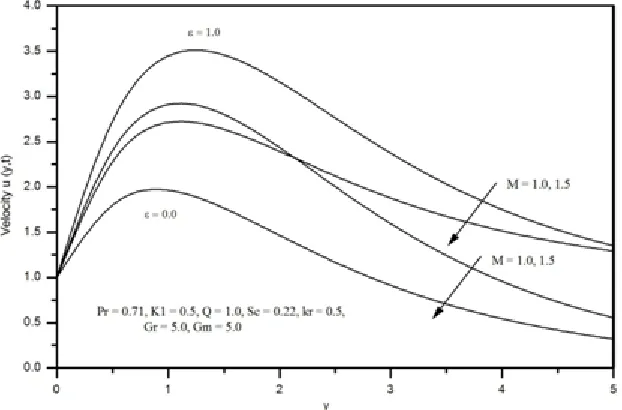
Figure 1 depicts the effect of the magnetic field
M
on the velocity field. It is seen that fluid velocity decreases as the magnetic field increases. We note that, under the influence of magnetic field on an electrically conducting fluid, a resistive force arises (so called the Lorentz force). This force has tendency to slow down the fluid motion in the boundary layer. The effects of the thermal Grashof numberG
r and mass Grashof numberG
m on the velocity field are presented in the figures 2 and 3, respectively. It is seen that the fluid velocity increases with increasing values of both thermal Grashof numberG
rand mass Grashof numberG
m.
It is further observed that the fluid velocity has a maximum value in the vicinity of the plate and tends to the finite value for larger values of the spatial coordinatey
.
Figure 4 depict the effect of radiation parameterK
1on the velocity field. It can be seen that an increase in the radiation parameter leads to increase in the fluid velocity. The effects of the heat absorption parameter
Q
on the velocity field are presented in the figure 5. It is seen that the fluid velocity decreases with increasing values of heat absorption parameter. The influence of the dimensionless chemical reaction parameterk
r on the velocity field is presented in figure 6. It is observed that the fluid velocity decreases withincreasing values of chemical reaction parameter. Also, it is noted that if the magnetic field is fixed to the fluid
(
ε
=
0
)
the values of the fluid velocity are lower than in the case of the magnetic field is fixed to the plate
(
ε =
1 .
)
Figure-2: Effect of thermal Grashof number Gron the velocity profiles
Figure-3: Effect of mass Grashof number Gm on the velocity profiles
Figure-5: Effect of heat absorption parameter Qon the velocity profiles
Figure-6: Effect of chemical reaction parameter kr on the velocity profiles
CONCLUSIONS
The effects of radiation on unsteady MHD free convection flow of an incompressible, electrically conducting fluid near an infinite vertical plate with ramped wall temperature and constant concentration in the presence of chemical reaction has been studied. The motion of the plate is a rectilinear translation with an arbitrary time dependent velocity, the plate temperature changes as a time-ramped function and the concentration on the plate is constant. The problem is governed by system of coupled partial differential equations and are solved by Ritz FEM. The results obtained are discussed for the transverse magnetic field that is fixed relative to the fluid
(
ε
=
0
)
and plate(
ε
=
1 .
)
The fluid velocity differs significantly, when the magnetic field is fixed relative to the moving plate from the fluid velocity corresponding to the case of magnetic field is fixed relative to the fluid. An increase in the magnetic parameter decreases the fluid velocity. i.e., stronger magnetic field leads to slower flows. The fluid velocity increases with increasing values of the thermal Grashof number and mass Grashof number and decreases with an increase in heat absorption parameter and chemical reaction parameter. The magnetic field is fixed to the fluid(
ε =
0 ,
)
the values of the fluid velocity are lower than in the case of theREFERENCES
1 Tokis J. N., (1985) A class of exact solutions of the unsteady magneto-hydrodynamic free convection flows, Astrophys, Space Sci,. 112, pp. 413-122.
2 Gokhale, M. Y and Samman F. M. A., I (2003) Effects of mass transfer on the transient free convection flow of a dissipative fluid along a semi-infinite vertical plate with constant heat flux, Int. J. Heat and Mass Transfer, 46, pp. 999-1011.
3 Aldose T.K and Al-Nimr M.A., (2005) Effect of local acceleration term on the MHD transient free convection flow over a vertical plate, Int. Num. Heat and Fluid flow, 15, pp. 296-305.
4 Kandasamy R, Periasamy K, and Prabhu K. K. S., (2005). Effects of chemical reaction, heat and mass transfer along a wedge with heat source and concentration in the presence of suction or injection, Int. J. Heat and Mass Transfer, 48, pp.1288 – 1304.
5 Chaudary R and Cand Jain A., (2007) Combined heat and mass transfer effects MHD free convection flow past an oscillating plate embedded in a porous medium, Rom. J. Phy, 52, pp. 505-524.
6 Mbeledogu I. U and Ogulu A., (2007) Heat and mass transfer of an unsteady MHD natural convection flow of a rotating fluid past a vertical porous flat plate in the presence of radiative heat transfer, Int. J. Heat and Mass Transfer, 50, pp.1902 -1908.
7 Sharma BK., Jha AK and Chaudary R C., (2007) Hall Effect on MHD mixed convective flow of a viscous incompressible fluid pasta vertical porous plate immersed in a porous medium with heat sourec/sink, Rom. J. Phys, 52 (5-7), pp. 487-503.
8 Mohamoud M. A. A., (2009) Thermal radiation effects on unsteady MHD free convection flow past a vertical plate with temperature dependent viscosity, Can. J. Chemical Engg, 87, pp. 441-450.
9 Prabhakar Reddy, B and Anand Rao J., (2010) Finite analysis of Heat and mass transfer of an unsteady MHD natural convection flow of a rotating fluid past a vertical porous plate in the presence of radiative heat transfer, J. of Energy, Heat and Mass Transfer, 13, pp. 223 – 241.
10 Shanaker, B, Prabhakar Reddy B and Anand Rao J., (2010) Radiation and mass transfer effects on unsteady MHD free convective fluid flow embedded in a porous medium with heat generation/absorption, Ind. J. Pure and Applied Phys, 48, pp. 157-165.
11 Seth, G. S Ansari MD and Nandkeolyara R., (2011) MHD natural convection flow with radiative heat transfer past an impulsively moving plate with ramped wall temperature, Heat Mass Transfer, 47, pp. 551-561.
12 Singh K. D and Kumar R., (2011) Fluctuating heat and mass transfer on unsteady MHD free convection flow of
radiating and reacting fluid past a vertical porous plate in slip-flow regime, J. Appl. Fluid Mech, 4 (40), pp. 101-106.
13 Ghara, N Das, S Maji. S L and Jana R N., (2012) Effect of radiation on MHD free convection flow past an impulsively moving vertical plate with ramped wall temperature, Am. J. Sci. Ind. Res, 3 (6), pp. 376-386.
14 Ravi kumar, V Raju M. C and Raju G. S., (2012) Heat and mass transfer effects on MHD flow of viscous fluid through non-homogenous porous medium in presence of temperature dependent heat source, Int. J. Comp. Math. Sci. 7 (32), pp. 1597 – 1604.
15 Seshaiah, B Raju, M. C and Verma S.V.K., (2013) Induced magnetic field effects on free convective flow of radiative, dissipative fluid past a porous plate with temperature gradient heat source, Int. J. Engg. Sci. Tech, 5 (7), pp. 1397 – 1412.
16 Ahmed, N and Dutta, M., (2013) Transient mass transfer flow past an impulsively started infinite vertical plate with ramped plate velocity and ramped wall temperature, Int. J. of Phys. Sci 8 (7), pp. 254-263.
17 Narahari, M and Debnath, L., (2013) Unsteady Magneto-hydrodynamic free convection flow past an accelerated vertical plate with constant heat flux and heat generation/absorption, ZAMM, Z, Angew, Math. Mech, 93(1), pp. 38 – 49.
18 Samiulhaq Ahmad, S Vieru, D Khan, I and Shafie, S., (2014) Unsteady mgneto-hydrodynamic free convection flow of a second grade fluid in a porous medium with ramped wall temperature, PLOS ONE, Vol. 9, No. 5, e88766, doi:10.1371 /journal. pone.0088766.
19 Seth, G. S Kumbhakar, B Sarkar, S., (2015) Soret and Hall effects on unsteady MHD free convective flow of radiating and chemically reactive fluid past a moving vertical plate with ramped wall temperature in rotating system, Int. J. Eng. Sci. and Techn, 7 (2), pp. 94-108.
20 Prabhakar Reddy, B., (2016) Mass transfer effects on an unsteady MHD free convective flow of an incompressible viscous dissipative fluid an infinite vertical porous plate, Int. J. Appl. Mech. and Engg, 21, pp. 143 – 155.
Source of support: Nil, Conflict of interest: None Declared.