Address for correspondence Dr. Mahwish Zahoor,
Department of Dermatology, Unit II, King Edward Medical University/ Mayo Hospital, Lahore
Email: [email protected]
Original Article
Comparison of efficacy and safety of 0.005%
calcipotriol ointment versus 0.05% betamethasone
dipropionate ointment versus calcipotriol plus
betamethasone ointment for the treatment of vitiligo
Introduction
Vitiligo is an autoimmune disorder presenting as depigmented lesions of skin and mucous membranes which are due to substantial loss of epidermal and hair follicle melanocytes.1 It is clinically characterized by well-circumscribed hypomelanotic macules and patches, initially occurring at the sun-exposed sites.2 It affects 1%
of the world’s population and occurs in all races but the incidence and psychosocial impact due to cosmetic disfigurement is greater in racially pigmented individuals.2 Vitiligo presents as generalized, localized and segmental forms. The treatment options depend upon extent, distribution and rate of progression of the lesions.3 Severity of the disease and response to treatment is measured by Vitiligo Area Scoring Index (VASI).4
Treatment of vitiligo is prolonged and unsatisfactory.5 Potent or very potent topical corticosteroids are almost universally accepted Mahwish Zahoor, Shehla Shaukat, Muhammad Saleem Khan, Tahir Jamil Ahmad
Department of Dermatology, Unit II, King Edward Medical University/ Mayo Hospital, Lahore
Abstract
Objective To compare the efficacy and safety of calcipotriol ointment versus betamethasoneointment versus calcipotriol plus betamethasone ointment in patients of vitiligo.
Methods Patients with vitiligo (n=159) were randomized in three equal groups A, B and C. Group A (n=53) applied topical calcipotriol ointment, group B (n=53) applied topical betamethasone dipropionate ointment and group C (n=53) applied calcipotriol plus betamethasone ointment for a total of three months and were followed up for further 1 month. They were evaluated for improvement in pigmentation using Vitiligo Area Scoring Index (VASI)and side effects.
Results Out of a total of 159 patients, females (66.7%) out-numbered male patients (33.3%). Mean of change in VASI was 38.77 in group C, 26.23 in group B and 18.30 in group A. Overall change in VASI was highest in group C with a statistically significant p = 0.008. All the groups showed few side effects like erythema, burning, atrophy and acneiform eruption, which were not statistically significant.
Conclusion Alltopical therapies were found to be efficacious and safe in the treatment of vitiligo. But out of these three drugs, the combination of calcipotriol and betamethasone was superior in efficacy.
Key words
as first-line treatment for localized or non-segmental vitiligo.6 However, they are associated with adverse effects i.e. skin atrophy, telangiectasias, striae etc.6
Betamethasone dipropionate is a potent glucocorticoid steroid which has antiinflammatory and immunosuppressive properties.7 It enhances the protective and antidestructive mechanism of melanocytes, inhibits the local immune changes thus allowing the melanocytes to reactivate and repigment.8
Calcipotriol is a vitamin D3 analogue, which inhibits T cell activation and stimulates growth and differentiation of keratinocytes and melanocytes. It restores calcium homeostasis by reducing abnormal calcium influx into the melanocytes and thus induces melanogenesis.3
Calcipotriol plus betamethasone is a combination of steroid and vitamin D3 analogue. It has a dual action of immunosuppression, as well as, melanogenesis. With this combination therapy, better results are obtained with reduced incidence of adverse effects.9
Vitiligo has great psychosocial impact on patient’s life. This study was designed to compare calcipotriol which is a newer drug, with betamethasone dipropionate alone and their combination in order to find efficacious and safer treatment option for vitiligo in our community.
Methods
It was a comparative interventional study conducted at the department of dermatology unit II, KEMU/ Mayo Hospital, Lahore. Inclusion criteria included age 12 or above, either gender, clinically diagnosed cases of vitiligo, confirmed on Wood’s lamp examination, involving <20%
patients already on any topical treatment for vitiligo during last one month and systemic therapy during last two months. Pregnant and lactating females, patients with known hypersensitivity to any of these drugs, lip-tip vitiligo, facial vitiligo, patients with any bacterial, viral or fungal skin infection were excluded. Patients with autoimmune diseases like thyroid dysfunction, diabetes mellitus, alopecia areata, etc., on the basis of history and/or investigations were also excluded.
Data were collected on a pre-designed proforma. After approval of the ethical committee of KEMU, the study was conducted as follows: 159 patients, fulfilling the selection criteria, were enrolled from outpatient of Dermatology Department, KEMU/ Mayo Hospital, Lahore. Informed consent was taken from the patients. History and clinical examination was recorded on the first visit. Complete blood count, blood sugar levels, thyroid function tests were done in order to exclude other autoimmune diseases like diabetes mellitus, thyroid dysfunctions etc. Then patients were randomly selected by lottery method. A fellow doctor on duty in the dermatology outpatient department observed the results of each treatment group on every follow-up visit. By taking all these measures, personal bias of the investigator in selection of the patients and observation of treatment results was eliminated although the investigator was aware of the drug given to the patients.
of pigmentation. Photographs of all the lesions were taken before the treatment in order to compare them with the subsequent photographs. VASI score was calculated at the beginning of therapy and at each monthly follow-up. Clinical response at each monthly visit and at the end of study was reassessed by finding the difference between the initial and the final VASI score. Patients were inquired and examined for expected side effects (itching, tingling, burning, atrophy) of given treatment. Efficacy and safety were assessed.
SPSS Version 18 was used for data analysis. Mean and standard deviation were used to represent the quantitative variables like age, duration of vitiligo and body surface area involved. Frequency and percentage were calculated for qualitative variables like gender and site of involvement. Repeated measure ANOVA test was used when VASI score and residual depigmentation was measured at different intervals i.e. baseline till 4th month. Friedman test was used when residual depigmentation was presented in the form of categories. A p value of <0.05 was considered as significant.
Results
A total of 159 cases (53 in each group) fulfilling the inclusion/exclusion criteria were enrolled. Mean age of the patients was 26.26 ± 13.01 years. The mean age in group A, B and C was 27.94 ± 13.89 years, 28.37 ± 13.077 years and 22.47 ± 11.32 years, respectively. Out of 159, 53 (33.3%) patients were males and the remaining 106 (66.7%) patients were females. Most of the subjects in our study were unmarried i.e. 94 (59.1%). 52.8% patients had vitiligo for ≥1 year while 47.2% were suffering from this disease for <1 year.
Involvement of different body areas like hands, upper extremities, trunk and lower extremities is also compared among the three study groups (Table 1).
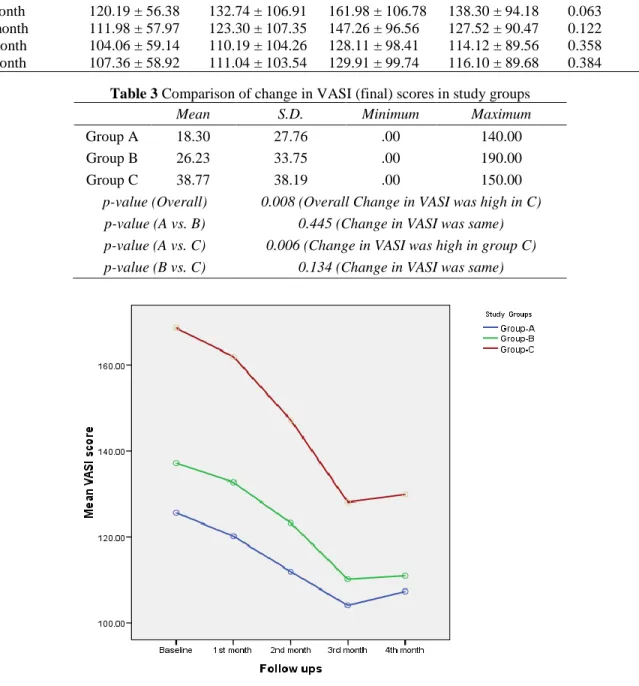
VASI score of all the patients was calculated at the baseline, at every visit for three months and one month after the treatment (Table 2). Change in VASI was calculated among all the study groups. At the end of study, mean VASI of group A and B was 18.30 and 26.23, respectively while for group C, it was 38.77 (overall p=0.008). The p-value significantly reduced at 4th month in all the study groups but change in VASI score was more in group C when compared to group A and group B (Table 3, Figure 1). Comparison of the efficacy was also done among all the study groups (Table 4).
Table 1 Comparison of percentage body area involved in study groups Body area
involved
Study Groups Chi-square P value
Group A Group B Group C
Hand 7 (13.2%) 11 (20.8%) 7 (13.2%) 1.51 0.468
Upper extremity 13 (24.5%) 11 (20.8%) 14 (26.4%) 0.484 0.785
Trunk 10 (18.9%) 7 (13.2%) 9 (17.0%) 0.644 0.725
Feet 11 (20.8%) 14 (26.4%) 9 (17.0%) 1.42 0.491
Lower extremity 13 (24.5%) 12 (22.6%) 15 (28.3%) 0.468 0.792
Table 2 Comparison of VASI scores in study groups.
VASI score Group A Group B Group C Total P value
Baseline 125.66 ± 57.85 137.26 ± 106.83 168.68 ± 113.77 143.87 ± 97.21 0.061 1st month 120.19 ± 56.38 132.74 ± 106.91 161.98 ± 106.78 138.30 ± 94.18 0.063 2nd month 111.98 ± 57.97 123.30 ± 107.35 147.26 ± 96.56 127.52 ± 90.47 0.122 3rd month 104.06 ± 59.14 110.19 ± 104.26 128.11 ± 98.41 114.12 ± 89.56 0.358 4th month 107.36 ± 58.92 111.04 ± 103.54 129.91 ± 99.74 116.10 ± 89.68 0.384
Table 3 Comparison of change in VASI (final) scores in study groups
Mean S.D. Minimum Maximum
Group A 18.30 27.76 .00 140.00
Group B 26.23 33.75 .00 190.00
Group C 38.77 38.19 .00 150.00
p-value (Overall) 0.008 (Overall Change in VASI was high in C) p-value (A vs. B) 0.445 (Change in VASI was same) p-value (A vs. C) 0.006 (Change in VASI was high in group C) p-value (B vs. C) 0.134 (Change in VASI was same)
Figure 4 Comparison of mean VASI score over different follow-ups.
p value = 0.004 (significantly reduced at 4th month in all study groups, but change in VASI score was more in group C when compared to group A and group B)
Table 4 Comparison of efficacy in all study groups.
Grades of efficacy Study groups Total
Group A Group B Group C
Minimally improved 32 (60.4 %) 22 (41.5%) 11 (20.8%) 65 (40.9%)
Improved 8 (15.1%) 16 (30.2%) 23 (43.4%) 47 (29.6%)
Much improved 9 (17%) 7 (13.2%) 3 (5.7%) 19 (11.9%)
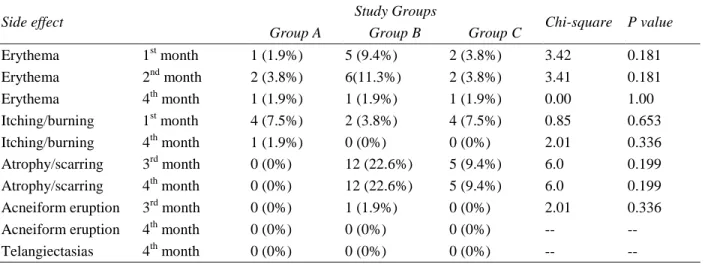
Table 5 Comparison of side effects in study groups.
Side effect Study Groups Chi-square P value
Group A Group B Group C
Erythema 1st month 1 (1.9%) 5 (9.4%) 2 (3.8%) 3.42 0.181
Erythema 2nd month 2 (3.8%) 6(11.3%) 2 (3.8%) 3.41 0.181
Erythema 4th month 1 (1.9%) 1 (1.9%) 1 (1.9%) 0.00 1.00 Itching/burning 1st month 4 (7.5%) 2 (3.8%) 4 (7.5%) 0.85 0.653 Itching/burning 4th month 1 (1.9%) 0 (0%) 0 (0%) 2.01 0.336 Atrophy/scarring 3rd month 0 (0%) 12 (22.6%) 5 (9.4%) 6.0 0.199 Atrophy/scarring 4th month 0 (0%) 12 (22.6%) 5 (9.4%) 6.0 0.199 Acneiform eruption 3rd month 0 (0%) 1 (1.9%) 0 (0%) 2.01 0.336 Acneiform eruption 4th month 0 (0%) 0 (0%) 0 (0%) -- --
Telangiectasias 4th month 0 (0%) 0 (0%) 0 (0%) -- --
Side effects were studied in all the groups. The main side effects seen were erythema, burning/ itching, atrophy, scarring, acneiform eruption etc. Erythema was seen in all the study groups throughout the treatment sessions, however itching or burning was mainly observed during first month of treatment. Atrophy and scarring was seen in Group B and Group C while acneiform eruption was seen only in Group B (Table 5).
Discussion
Vitiligo is an acquired disorder of pigmentation, which has great psychological impact on patient’s quality of life. Although the condition is cosmetically disfiguring for all the patients but
dark-skinned individuals,2 unmarried young
adults especially females and those who have patches over exposed parts encounter severe psychological distress.
Sometimes, treatment options of vitiligo are very disappointing because they fail to fulfil the hopes and expectations of the patient as well as the physician. Therefore, there is always room for efficacious and safe therapeutic options. Topical steroids, though the gold standard for the treatment of vitiligo, have side effects after prolonged use. This study would turn out to be
another milestone in the pursuit of achieving revolutionary treatment options to help the patients of vitiligo, in our country.
The study was conducted to compare the
efficacy and safety of topical 0.005%
calcipotriol ointment versus 0.05%
betamethasone dipropionate ointment versus calcipotriol plus betamethasone ointment for the treatment of vitiligo. Distribution of the disease in various demographic features were also taken into account like age, gender, marital status and duration of vitiligo. Vitiligo Area Scoring Index (VASI) was used to assess the severity of the
disease and response to the treatment.4 There are
many other scoring systems but VASI is the simplest, absolute and most evident scoring system and has been widely used in other national and international studies.4,10
According to the gender, female patients outnumbered males in our study. Similar findings were observed in the study by Alam et al.11 The reason could be that the females are more conscious of their appearance so they consult early.
In my study, marital status was studied in various study groups. 41% patients included in the study were married while 59% patients were unmarried. A study was conducted in India to observe the impact of vitiligo on the quality of life of patients and its psychological impact, 65% of the evaluated patients were married
which correlates with our study.13
Distribution of lesions was also observed by
Alam et al,11 they divided the body into head and
neck, trunk and extremities. Their findings concurred with our study results. The major areas involved in all the study groups were extremities, which include upper extremities, hands, lower extremities and feet.
For the assessment of treatment response in patients and severity of disease, VASI score was calculated. The effect of treatment was observed in this study by comparing the VASI score at baseline and each visit for four months. The mean of VASI score at baseline was 126, 137 and 169 in Group A, B and C respectively. It was reduced to 107, 111 and 130 by the end of 4th month.
Mean of change of VASI (final VASI) was also calculated in each group which turned out to be 18, 26 and 39 in Group A, B and C respectively. The overall change in VASI was calculated among all the study groups and was found significant only in Group C (p-value 0.008). The treatment was found efficacious in all the study groups and results were significant within each treatment group. Efficacy of all the drugs was
efficacious in Group C patients who were treated
with combination of calcipotriol and
betamethasone. In this group, only 21% patients showed minimal improvement of vitiligo, however 49% showed an improvement of (10-50%) and 30% patients showed very much improvement (>50% and above). Kumaran et al9 also observed similar results. They reported that with the use of combination of steroid and calcipotriol, 28% patients showed >50% improvement of the disease, 47% patients exhibited 10-50% improvement and 27% again showed 0-10% improvement in vitiligo. Xing et
al12 showed that 29% patients showed very
much improved disease (>50%) while 23% had minimal or no improvement.
Efficacy of the three drugs was also compared with respect to the duration of disease. The p-value was found to be significant only in less than one-year group for all the drugs. Considering the <1 year disease duration category, Group A showed an improvement of disease in almost 52%, Group B and Group C had 72% and 77% improvement of disease respectively. Results achieved by Alam et al,11 were comparable to our study, as improvement of disease in <1 year duration, was 65%, 70% and 45% respectively.
Different adverse effects were also seen in all the study groups but they were not statistically significant. They mainly include erythema, itching, burning, scarring/atrophy and acneiform
eruption etc. Xing et al12 reported complaints of
pruritus and acne in his study. Erythema, burning, dryness, scaling and pruritus were the
main complaints seen by Alam et al.11 Apart
from the usual side effects, Kumaran et al9
observed some other side effects such as
perilesional hyperpigmentation and
Conclusion
It is concluded from our study that vitiligo is seen more frequently among female patients, which is probably due to the increased cosmetic concerns. Betamethasone ointment, calcipotriol ointment and calcipotriol plus betamethasone ointment, all are efficacious and safe in the treatment of vitiligo. But out of the three drugs,
the combination of calcipotriol and
betamethasone is superior in efficacy.
References
1. Gonzalez U, Whitton M, Eleftheriadou V, Pinart M, Batchelor J, Leonardi-Bee J. Guidelines designing and reporting clinical trials in vitiligo. Arch Dermatol. 2011;147:1428-36.
2. Anstey AVP. Disorder of skin color. In: Burns T, Breathnach S, Cox N, Griffiths C, eds. Rook’s Textbook of Dermatology, 8th edn. Oxford, UK: Wiley-Blackwell Publishing; 2010. P.58.46-9.
3. Mahmoud BH, Hexsel CL, Hamzavi IH. An update on new and emerging options for the treatment of vitiligo. Skin Ther Lett. 2008;13(2):1-6.
4. Kawakami T, Hashimoto T. Disease severity index and treatment evaluation criteria in vitiligo. Dermatol Res Prac [Internet]. 2011. Available from:
URL:http://www.hindawi.com/journals/dro/ 2011/750342
5. Falabella R, Barona MI. Update on skin repigmentation therapies in vitiligo. Pigment Cell Melanoma Res. 2009;22:42-65.
6. Vitiligo. [Internet] online. Available from: URL:http://www.bad.org.uk/site/885/default /.aspx.
7. Betamethasone. [Internet] online Wikipedia, the free encyclopedia. Available from: URL:http://en.m.wikipedia.org/wiki/Betame thasone.
8. Saldanha KD, Machado Filho CD, Paschoal FM. Action of topical mometasone on the pigmented halos of micrografting in patients with vitiligo. An Bras Dermatol. 2012;87:685-90.
9. Kumaran MS, Kaur I, Kumar B. Effect of topical calcipotriol, betamethasone dipropionate and their combination in the treatment of localized vitiligo. J Eur Acad Dermatol Venereol. 2006;20:269-73. 10. Mythili G, Sarma KLAP. Design and
development of an area estimating system to find the body surface area affected by vitiligo using simulation approach. Int J Adv Res Comp Sci Sof Eng. 2012;2(3):75-81. 11. Alam MN, Wahab MA, Khondker L, Khan
MSI. Comparative efficacy and safety of the combination of betamethasone dipropionate and calcipotriene with topical betamethasone dipropionate and calcipotriene alone in the treatment of localized vitiligo. J Pak Assoc Dermatol. 2014;24:143-9.
12. Xing C, Xu A. The effect of combined calcipotriol and betamethasone dipropionate ointment in the treatment of vitiligo: an open, uncontrolled trial. J Drugs Dermatol. 2012;11:52-4.