AUSTRALIAN JOURNAL OF BASIC AND
APPLIED SCIENCES
ISSN:1991-8178 EISSN: 2309-8414 Journal home page: www.ajbasweb.com
Open Access Journal
Published BY AENSI Publication
© 2016 AENSI Publisher All rights reserved
This work is licensed under the Creative Commons Attribution International License (CC BY).
http://creativecommons.org/licenses/by/4.0/
To Cite This Article: K. Suresh Manic, Uma Suresh, R. Senthil., Design of Multi-loop PI Controllers for TITO Systems using TLBO Algorithm. Aust. J. Basic & Appl. Sci., 10(5): 111-116, 2016
Design of Multi-loop PI Controllers for TITO Systems using TLBO
Algorithm
1K. Suresh Manic, 2Uma Suresh, 3R. Senthil
1Caledonian College of Engineering, University College, Sultanate of Oman, Muscat. 2
St. Peter’s University, Chennai, Tamilnadu, India.
3K.C.G College of Technology.
Address For Correspondence:
K. Suresh Manic, Caledonian College of Engineering, University College, Sultanate of Oman, Muscat E-mail: [email protected]; +968 245393851
A R T I C L E I N F O A B S T R A C T
Article history:
Received 12 January 2016 Accepted 22 February 2016 Available online 1 March 2016
Keywords:
Two Input Two Output system,
Multi-loop PI controller, Heuristic
algorithms, Performance measure.
In this manuscript, design of multi-loop PI controllers for Two Input Two Output (TITO) process models has been proposed using the Teaching Learning Based Optimization (TLBO) algorithm. In the proposed method, the search dimension for the heuristic algorithm is assigned as four (Kp1, Ki1, Kp2, Ki2) and the weighted sum of objective function is framed to guide the TLBO search in order to get the optimal controller gains. The proposed method is tested using the well known TITO systems such as Wood and Berry (WB) column model and Wardle and Wood (WW) model. The effectiveness of the proposed scheme has been validated through a comparative study with the Particle Swarm Optimization (PSO) and Firefly Algorithm (FA) based controller design procedures. The result evident that, the TLBO algorithm tuned multi-loop PI controller offers better result compared with the alternatives in set point tracking and disturbance rejection operations.
INTRODUCTION
From the recent control literature, one can observe that, heuristic algorithm based PI/PID controller tuning procedures are widely adopted to find best possible controller parameters for Single Input Single Output (SISO) and Two Input Two Output (TITO) processes because of its simplicity and model independent nature (Suresh Manic, K., et al., 2015; Suresh Manic, K., et al., 2015).
In chemical industries, most of the significant processes are multivariable in nature. Distillation is one of the separation technique extensively adopted in the petroleum and chemical industries for purification of final products. Due to its industrial significance, the distillation column is one of the generally chosen imperative multivariable processes by the researchers (Coelho, L.S. and V.C. Mariani, 2012; Sivakumar, R., and K. Balu, 2010; Sivakumar, R., et al., 2010).
The control literature presents the traditional/modern approach based design and implementation of the PI/PID controllers for TITO systems. The existing controller design procedure can be categorized as (i) centralized and (ii) decentralized methods. In centralized system, controller design task is quite complex compared with the decentralized system due to the interaction between the loops. In the proposed work, we proposed heuristic algorithm assisted centralized PI controller deign for the most common TITO systems, such as Wood & Berry (WB) and Wardle & Wood (WW) models. A four dimensional search is considered during the optimization exploration and the separate PI controllers are designed for the Top Product (TP) loop and Bottom Product (BP) loop.
et al., 2011). This algorithm is theoretically similar to the teaching-learning scenario existing in the class room
(Suresh Chandra Satapathy and Anima Naik, 2014; Rajinikanth, V., and Suresh Chandra Satapathy, 2015). Matlab based simulation study is carried using the TLBO and the performance of the proposed method is validated with Particle Swarm Optimization (PSO) and Firefly Algorithm (FA). In order to execute a fair comparison, all the algorithms are assigned with similar population size, iteration number, stopping criteria and objective function.
The top product loop and the bottom product loop are separately analyzed for set point tracking and disturbance rejection operations. From this study, it is noted that, TLBO tuned controller offers better convergence and smoother response compared with PSO and FA algorithms considered in this study.
2 Overview:
In industries, traditional and modern controllers are generally used to improve the overall efficiency of the process plant. The literature shows that, optimally tuned controller will minimize the waste and maximize the production rate (Rajinikanth, V., and K. Latha, 2012). In chemical industries, most of the important processing units are multi-variable in nature. Design of optimal controllers for such systems is a challenging work. In recent years traditional and heuristic approach based controller design procedures are discussed for the bench mark TITO systems existing in the literature (Coelho, L.S. and V.C. Mariani, 2012; Sivakumar, R., and K. Balu, 2010; Sivakumar, R., et al., 2010; Angeline, V.D. and N. Devarajan, 2014).
Fig 1. shows the generalized Two Input Two Output (TITO) system.
PI1 PI2 Gp11 Gp12 Gp21 Gp22 + + + + + + - -
r1 u1
u2
y1
y2 r2
Fig. 1: Block diagram of generalized TITO system
In order to get the required top product (y1) and bottom product (y2) values, it is necessary to have optimally
tuned values for the controllers PI1 and PI2. In this work, parallel form of PI controller is considered and its
structure is given below;
s i K p K 1
PI = 1 + 1 (1)
s i K p K 2 PI 2 2 +
= (2)
The performance of the considered controller design procedure is analyzed using well known benchmark TITO systems, such as WB and WW distillation column models.
WB distillation column is designed to separate the methanol and water from the input mixture. In this, the top product is methanol and the bottom product is typically water (Sivakumar, R., and K. Balu, 2010; Sivakumar, R., et al., 2010; Wayne Bequette, 2003). Eqn.3 represents the TITO model of WB.
+ − − + − + − − + − = 1 s 4 . 14 s 3 e 4 . 19 1 s 9 . 10 s 7 e 6 . 6 1 s 21 s 3 e 9 . 18 1 s 7 . 16 s e 8 . 12 ) s ( 2 y ) s ( 1 y (3)
Eqn. 4 shows the mathematical model of WW system widely considered by the researchers (Sivakumar, R., and K. Balu, 2010; Sivakumar, R., et al., 2010; Wayne Bequette, 2003).
+ − − + − + + − − + − = 1 s 35 s 8 e 12 . 0 1 s 38 s 8 e 094 . 0 ) 1 s 45 )( 1 s 48 ( s 12 e 101 . 0 1 s 60 s 6 e 126 . 0 ) s ( 2 y ) s ( 1 y (4)
3 Teaching Learning Based Optimization:
approach to attain the collective explanation during the exploration. A complete clarification about the TLBO can be found in the recent literature (Rao, R.V., et al., 2011; Suresh Chandra Satapathy and Anima Naik, 2014; Rajinikanth, V., and Suresh Chandra Satapathy, 2015). In this work, conventional TLBO is adopted to tune the PI controllers for the TITO process.
The TLBO has two necessary stages, such as teacher stage and learner stage as shown below:
START;
Initialize algorithm parameters, such as number of learners (N), parameters to be optimized (D), Maximum
number of iteration (Miter) and objective function (Jmin)
; Randomly initialize ‘N’ learners for xi (i = 1, 2, … n);
Evaluate the performance and select the best
solution f(xbest);
WHILE iter = 1:Miter; %TEACHER STAGE %
Use f(xbest) as teacher;
Sort based on f(x), select other teachers based on : f(x)s = f(xbest) – rand for f(x)s = 2,3, . . . , T;
FOR i = 1:n
Calculate TFi =round[1+rand(0,1){2−1}];
)]; x . T ( x
)[ 1 , 0 ( rand x
xinew= i + teacher− Fi mean
%Calculate objective function for f(xinew)%
If f(xinew) < f(xi), then xi = xinew;
End If % End of TEACHER STAGE% %STUDENT STAGE %
Arbitrarily Select the learner xi, such that j≠i;
If f(xi) < f(xj), then xinew=xi+rand(0,1)(xi-x j);
Else xinew=xi+rand(0,1)(x j - xi);
End If
If xinew is better than xi, then xi= xinew;
End If % End of STUDENT STAGE% End FOR
Set k = k+1;
End WHILE
Record the controller valus, Jmin, and performance
measures;
STOP;
In this work, heuristic algorithms such as Particle Swarm Optimization (PSO) and Firefly Algorithm (FA) are considered to validate the performance of TLBO.
3.1 Particle Swarm Optimization:
PSO is developed by modeling the group activities in flock of birds or school of fish (Rajinikanth, V., and K. Latha, 2012). Due to its high computational capability, it is widely considered by the researches to solve constrained and unconstrained optimization problems. In this work, PSO with the following mathematical expression is considered:
) S G ( R C ) S P ( R C V . W ) 1 t (
Vi + = t it + 1 1 it − it + 2 2 it − it (5)
) 1 ( )
1
(t+ =Xit+Vi t+ i
X (6)
where Wtis inertia weight ( chosen as 0.6), R1 and R2 are random values [0,1], C1 and C2 is allotted as 2.0
and 1.5 correspondingly.
3.2 Firefly Algorithm:
FA is originally invented by Yang (2011). This technique utilizes the mathematical representation of a firefly, searching for a mate in the assigned search space. The details of FA can be found in (Raja, N.S.M., et al., 2013; Yang. X.S., 2011). The association of an attracted firefly towards a mate can be expressed as:
½) -(rand )
X X ( e β X
Xit 1 it 0 γd tj it 1 2
ij
α + − +
= −
where Xit is early location; Xit+1is updated location; β0e γd (Xtj Xit)
2 ij
−
−
is attraction among fireflies;
β0 is preliminary attractiveness; γ is absorption coefficient; α1 is randomization operator and rand is random
number [0,1]. In this paper, the following values are chosen for FA parameters: α1= 0.15; β0 = 0.1and γ = 1.
4 Implementation:
The controller design problem deals with finding optimal values of Kp and Ki for the top and bottom process loops. In this work, the TLBO explores the four dimensional search space in order to find the optimal controller values as depicted in Fig. 2.
PI1
PI2
Gp11
Gp12
Gp21
Gp22
+ +
+ + +
+ - -
r1 u1
u2
y1
y2
TLBO Algorithm Initial algorithm
parameters
Objective Function
r2
Kp Ki
Kp1 Ki1
Fig. 2: TLBO implementation for PI tuning
For the controller design problem, a weighted sum of cost function is assigned to guide the heuristic search as given below.
ITAE . 4 W ITSE . 3 W s t . 2 W p M . 1 W min
J = + + + (8)
where Mp is peak overshoot, ts is settling time, ITSE is integral time squared error and ITAE is integral time
absolute error. The weights are assigned as W1 = W2 = 5 and W3 = W4 = 2.
The heuristic algorithm based search continuously explores the four dimensional search universe until the cost function is minimized. For all the heuristic algorithms, the population size is assigned as 25 and maximum
iteration number is chosen as 1000 and the stopping criterion is chosen as Jmin.
RESULTS AND DISCUSSION
The problem of assigning the optimal parameters for multi-loop PI controllers which stabilise TITO system is addressed in the paper. A centralised PI controller design procedure is implemented on some well known bench mark systems, such as WB and WW model. A comparative study among the heuristic algorithms, such as PSO and FA are presented. This study shows that, TLBO algorithm offers better convergence and cost function compared with the alternatives.
Initially the proposed work is tested on the WB distillation column model. In this work, the optimization exploration is repeated 20 times with each considered heuristic algorithm and the mean value among the trial is chosen as the optimal controller parameter.
During the search, the mean value of the iteration for the convergence with the TLBO algorithm is obtained as 618 and the PSO and FA offered 692 and 740 iterations respectively. From this, one can note that, the TLBO offers better convergence time compared with the PSO and FA.
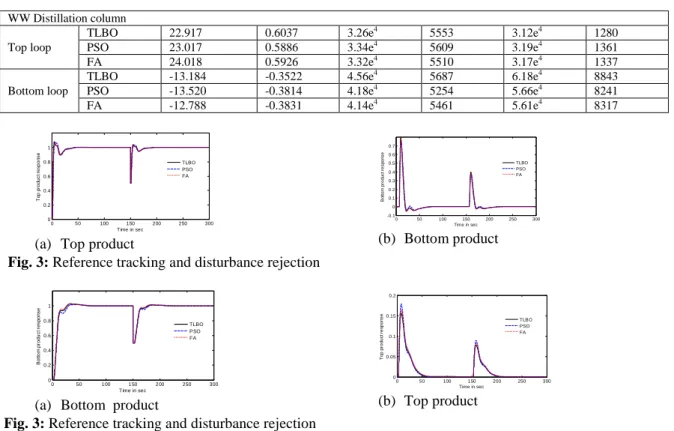
In this work, the reference tracking and disturbance rejection operations are analyzed separately. Table 1. presents the controller values obtained with the heuristic algorithms for WB and WW processes.
Table 1: Controller value and its performance measure
Loop Method Kp Ki ITAE ITSE ITAE1 ITSE1
WB Distillation column Top loop
TLBO 0.6612 0.0534 329.7 70.04 297.1 14.34
PSO 0.5388 0.0526 354.4 76.74 295.3 16.20
FA 0.6366 0.0496 342.3 71.81 322.1 16.32
Bottom loop
TLBO -0.0592 -0.0126 667.1 164.3 835.7 271.3
PSO -0.0618 -0.0117 662.7 162.6 873.6 274.4
WW Distillation column Top loop
TLBO 22.917 0.6037 3.26e4 5553 3.12e4 1280
PSO 23.017 0.5886 3.34e4 5609 3.19e4 1361
FA 24.018 0.5926 3.32e4 5510 3.17e4 1337
Bottom loop
TLBO -13.184 -0.3522 4.56e4 5687 6.18e4 8843
PSO -13.520 -0.3814 4.18e4 5254 5.66e4 8241
FA -12.788 -0.3831 4.14e4 5461 5.61e4 8317
0 50 100 150 200 250 300
0 0.2 0.4 0.6 0.8 1
Time in sec
T o p p ro d u c t re s p o n s e TLBO PSO FA
(a) Top product
0 50 100 150 200 250 300
-0.1 0 0.1 0.2 0.3 0.4 0.5 0.6 0.7
Time in sec
B o tt o m p ro d u c t re s p o n s e TLBO PSO FA
(b) Bottom product
Fig. 3: Reference tracking and disturbance rejection
0 50 100 150 200 250 300 0 0.2 0.4 0.6 0.8 1
Time in sec
B o tt o m p ro d u c t r e s p o n s e TLBO PSO FA
(a) Bottom product
0 50 100 150 200 250 300
0 0.05 0.1 0.15 0.2
Time in sec
T o p p ro d u c t re sp o n s e TLBO PSO FA
(b) Top product
Fig. 3: Reference tracking and disturbance rejection
Initially a unity setpoint is applied for the top product (r1) by keeping the other input (r2) as zero. A
disturbance of 0.5 (50% of set point) is then applied at 150 sec. From Fig. 3(a) and 3(b), it can be observed that, the proposed method offers better result. In Table 1, the ITSE and ITAE values offered by the TLBO is better than the PSO and FA.
Then, similar procedure is repeated on the WB model with unity setpoint on the bottom product (r2) by
keeping the other input (r1) as zero. A disturbance of 0.5 (50% of set point) is then applied at 150 sec. From Fig.
4(a) and 4(b), it can be observed that, the proposed method outperforms the alternatives. The error values (ITAE1 and ITSE1) are also better than FA.
The above said procedure is repeated with the WW model and for the TLBO algorithm, the average iteration is obtained as 816. For PSO the average iteration is 818 and for the FA the iteration is 810. The coppesponding PI controller values are available at Table 1.
0 500 1000 1500 2000 2500 0 0.2 0.4 0.6 0.8 1
Time in sec
T o p p ro d u c t re s p o n s e TLBO PSO FA
(a) Top product
0 500 1000 1500 2000 2500 0 0.1 0.2 0.3 0.4 0.5 0.6 0.7 0.8
Time in sec
B o tt o m p ro d u c t re s p o n s e TLBO PSO FA
(b) Bottom product
Fig. 5: Reference tracking and disturbance rejection - WW
0 500 1000 1500 2000 2500 0 0.2 0.4 0.6 0.8 1
Time in sec
B o tt o m p ro d u c t re s p o n s e TLBO PSO FA
(a) Bottom product
0 500 1000 1500 2000 2500 0 0.02 0.04 0.06 0.08 0.1 0.12 0.14 0.16
Time in sec
T o p p ro d u c t re sp o n s e TLBO PSO FA
(b) Top product
Fig. 6: Reference tracking and disturbance rejection - WW
The reference tracking and the disturbance rejection operations are carried out seperately on the top product loop and bottom product loop and the results are presented in Table 1, Fig. 5(a), 5(b), 6(a) and 6(b).
Conclusion:
The problem of tuning the optimal PI controller parameters for TITO system using TLBO algorithm is addressed in this paper. A centralised PI controller design procedure is implemented on some well known bench mark systems, such as WB and WW model. A comparative study among the heuristic algorithms, such as PSO and FA are presented. This study shows that, TLBO algorithm based optimization offers better convergence and performance compared with the alternatives..
REFERENCES
Angeline, V.D. and N. Devarajan, 2014. Design of optimized PI controller with ideal decoupler for a non linear multivariable system using particle swarm optimization technique, International Journal of Innovative Computing, Information and Control, 10(1): 341-355.
Coelho, L.S. and V.C. Mariani, 2012. Firefly algorithm approach based on chaotic Tinkerbell map applied to multivariable PID controller tuning, Computers and Mathematics with Applications, 64(8): 2371-2382.
Raja, N.S.M., K. Suresh Manic and V. Rajinikanth, 2013. Firefly Algorithm with Various Randomization Parameters: An Analysis, In B.K. Panigrahi et al. (Eds.): SEMCCO 2013, Part.1, Lecture notes in computer science (LNCS 8297), pp: 110-121.
Rajinikanth, V., and K. Latha, 2012. Setpoint weighted PID controller tuning for unstable system using heuristic algorithm, Archives of Control Sciences, 22(4): 481-505.
Rajinikanth, V., and Suresh Chandra Satapathy, 2015. Design of Controller for Automatic Voltage Regulator Using Teaching Learning Based Optimization, Procedia Technology, 21: 295-302.
Rao, R.V. and V. Patel, 2013. An improved teaching-learning-based optimization algorithm for solving unconstrained optimization problems, Scientia Iranica D, 20(3): 710-720.
Rao, R.V., V.J. Savsani and D.P. Vakharia, 2011. Teaching–learning-based optimization: A novel method for constrained mechanical design optimization problems, Computer-Aided Design, 43(3): 303-315.
Sivakumar, R., and K. Balu, 2010. ANFIS based distillation column control, In IJCA special issue on evolutionary computation for optimization techniques, pp: 67-73.
Sivakumar, R., K.S. Manic, V. Nerthiga, R. Akila, and K. Balu, 2010. Aplication of Fuzzy Model Predictive Control in Multivariable Control of Destillation column, International Journal of Chemical Engineering and Aplications, 1(1): 39-42.
Suresh Chandra Satapathy and Anima Naik, 2014. Modified Teaching–Learning-Based Optimization algorithm for global numerical optimization—A comparative study, Swarm and Evolutionary Computation, 16: 28-37.
Suresh Manic, K., Sarath Ananthasivam and V. Rajinikanth, 2015. Soft computing approach to design PID controller for tank liquid level control problem, Journal of Engineering Science and Technology, EURECA 2014 Special Issue, pp: 82-97.
Suresh Manic, K., V. Rajinikanth, Sarath Ananthasivam and Uma Suresh, 2015. Design of Controller in Double Feedback Control Loop–An Analysis with Heuristic Algorithms, Chemical Product and Process Modeling, De Gruyter publications, 10(4): 253-262.
Wayne Bequette, 2003. Process Control Modelling design and simulation, PHI Publication.