O R I G I N A L R E S E A R C H
Open Access
The role of a checklist for assessing the
quality of basic life support performance:
an observational cohort study
Johanna van Dawen
1, Lina Vogt
2,3, Hanna Schröder
2,3*, Rolf Rossaint
2, Lina Henze
3, Stefan K. Beckers
2,4and Sa
š
a Sopka
2,3Abstract
Background:Training lay rescuers in Basic Life Support (BLS) is essential to improve bystander cardiopulmonary resuscitation (CPR) rates; in addition, simple methods are needed to provide feedback on CPR performance. This study evaluated whether a simple observational checklist can be used by BLS instructors to adequately measure the quality of BLS performance as an alternative to other feedback devices.
Methods:The BLS performances of 152 first-year medical students (aged 21.4 ± 3.9 years) were recorded on
video, and objective data regarding the quality of the BLS were documented using Laerdal PC SkillReporting software. The performances were categorized according to quality. Ten BLS instructors observed the videos and completed a ten-point checklist based on the Cardiff Test of BLS (version 3.1) to assess the performances. The validity of the checklist was reviewed using interrater reliability as well as by comparing the checklist-based results with objective performance data.
Results:Matching the checklist-based evaluation with the objective performance data revealed high levels of
agreement for very good (82%) and overall insufficient (75%) performances. Regarding the checklist-based evaluation, interrater reliability depended on the checklist item; thus, some items were more easily identified correctly than others. The highest and lowest levels of agreement were observed for the items “undressed torso” and “complete release between compressions” (mean joint-probability 95 and 67%, respectively).
Conclusions: The observational checklist adequately distinguished sufficient from insufficient BLS performances and offered an assessment of items not incorporated by SkillReporting software such as the initial assessment or undressing the chest. Although its usefulness was reduced for scaling intermediate performance groups, the checklist may be overall a useful rating tool in BLS-training if objective feedback devices are not available, for example, due to large groups of participants or limited training time.
Keywords:Basic life support (BLS), Cardiopulmonary resuscitation (CPR), External chest compression (ECC), Assessment checklist, Training, Medical education
* Correspondence:[email protected]
2Department of Anaesthesiology, University Hospital Aachen, Medical
Faculty, RWTH Aachen University, Pauwelsstr. 30, 52074 Aachen, Germany 3Interdisciplinary Training Centre for Medical Education and Patient Safety–
AIXTRA, Medical Faculty, RWTH Aachen University, Wendlingweg 2, 52074 Aachen, Germany
Full list of author information is available at the end of the article
Background
Worldwide, about 17 million people per year die as a re-sult of cardiovascular diseases [1]. In 25% of these cases, patients experience sudden cardiac death [2]. The high number of patients dying from sudden cardiac death as well as the low success rates of cardiopulmonary resusci-tation (CPR) make sudden cardiac death a persisting predicament in patient care and public health [3–5].
In order to improve the currently insufficient imple-mentation of CPR measures in out-of-hospital cardiac arrest (OHCA) patients in most countries, it is essential that lay rescuers receive efficient and extensive Basic Life Support (BLS) training [6]. Bystander-CPR is cru-cial to improving survival rates and neurological out-come in OHCA [7–9]. Furthermore, lay people trained in BLS are more willing to perform CPR in emergencies [7,10]. As part of its latest guidelines, the European Re-suscitation Council (ERC) recommends providing BLS training to every member of a community [7]. A 2013 study conducted the USA in 2013 revealed that finan-cial factors are a main barrier for learning CPR in low-income environments and showed the necessity for low-cost or free BLS training in order to increase the number of lay people capable of performing CPR [11]. In addition, the implementation of BLS training may not proceed due to limited resources; for example, lim-ited funds for CPR courses at schools, which under-scores the importance of inexpensive but efficient learning strategies [12].
Several studies have estimated the cost-effectiveness of extensive CPR-training for laypersons since economic factors must be considered within health care systems, but further research is needed [13–15]. As feedback is an essential part of BLS training, several devices are available to assess CPR performance [16, 17]. For ex-ample, directive or audio feedback devices are recom-mended within the current ERC guidelines to improve the ability to perform CPR [7]. As such high-fidelity de-vices may not be available in low-income environments or financially weak surroundings, a simpler method of assessment is needed to provide feedback on CPR per-formance in these settings.In 1999, Graham et al. tested a scoring system based on simple observation as an inexpensive but effective method to assess CPR perform-ance. The results suggested that an observation-based scoring system is an objective method to reflect the abil-ity to perform BLS [18].
In the present study used a simple ten-point checklist modified after the Cardiff Test of BLS [19] to assess BLS performance recorded on video. The objective was to evaluate the checklist as a sufficient rating tool and an alternative instrument compared to SkillReporting soft-ware for CPR quality measurement using BLS training manikins.
Methods
The data used for this study were acquired within the emergency medicine course for first-year medical students during the first three weeks of their curriculum at the Medical School of RWTH in Aachen, Germany in 2013. In total, 278 first-year medical students were included in the study.
Clinical experts in the field of emergency medicine and medical education designed the checklist based on the Cardiff test of BLS (version 3.1). The Cardiff test lists ten points associated with the quality of CPR based on the established ERC Guidelines.
The study was approved by the ethics committee of the Medical School of RWTH Aachen, Germany (EK-100/12).
Setting
Each participant was confronted with the same stan-dardized scenario. They were expected to resuscitate a collapsed person represented by a BLS manikin (Resusci Anne™, Laerdal, Stavanger, Norway). None of the partici-pants had received BLS training during their medical studies up to this point. Each student performance was recorded on videotape and performance data were obtained using Laerdal PC SkillReporting System Soft-ware (Version 2.4.1, Laerdal, Stavanger, Norway). The students were guided following a structured protocol and every student received exactly the same instructions. The scenario started equally every time, described as follows:
The participant was asked to enter a room in which a BLS manikin was lying on the floor with a zippered jacket covering the torso. No information about the scenario was provided in advance. The standardized text was read by the course instructor:“Imagine you are witnessing a person collapsing right in front of you. The manikin represents this person. There is no one else nearby. Please take all measures you would take if the manikin was a real person. Keep going until you receive a signal to stop.”
The performance was terminated 120 s after the first ex-ternal chest compression (ECC). If the participant did not perform CPR, the scenario was stopped after 90 s. No further instructions were provided during the performance.
Measurement and data acquisition
≥60% correct compression depth
Average compression rate of 100–120 min−1
≥60% compressions with complete release
Based on these criteria, the participant performances were assigned to four different categories based on the collected data and on how many of the criteria were met. The categories were color-coded and referred to a“traffic light classification.”An additional black category was de-fined for those who did not meet any of the criteria:
Green: all three criteria were met
Yellow: two of the three criteria were met
Red: one of the criteria were met
Black: none of the criteria we met
In order to compare the results regarding the quality of ECC assessed by either the Laerdal PC SkillReporting Software or by the checklist-based evaluation, the par-ticipant performances were recorded on video from the time that they entered the scenario until they were sig-naled to stop. Ten experienced BLS instructors were in-vited to rate the performance of every participant using the checklist. The raters were asked to use a nominal scale (1 = yes, 2 = no) to rate the criteria. The checklist rating criteria were defined as follows:
Undressed torso
Adequate minimum no-flow time (no longer than
2 s for two rescue breaths)
Correct hand position
Correct compression depth
Correct compression rate
Complete release between compressions
Arms kept straight
Vertical direction of compressions
No delay to start CPR
Compression-ventilation ratio of 30:2
The same standardized conditions were applied to the raters and the rating process. As a requirement, all raters had to be BLS instructors. The raters were instructed to observe each video for at least one minute and to evalu-ate the performance by means of the checklist. Soon after data collection, the video rating took place. None of the observers were involved in the training of the medical students whose performances were assessed since instructors assessing their own students reportedly tend to overestimate their competences [19]. The raters were informed in advance that the elements of the checklist were self-explanatory and no questions were answered during the evaluation process.
The Laerdal Rescue Anne with SkillReporting System Software assessed the following five items: correct hand
position, correct compression depth and rate, complete release between compressions, and minimum no-flow time. After the study, all data were exported from the software.
At the time the study was performed, the current ERC Guidelines recommended an average compression rate of 100–120 min−1
, a compression depth of at least 50 mm, and complete chest recoil after each compres-sion [20].
Statistical methods
The interrater reliability was investigated for every item on the checklist by means of joint probability of agree-ment (in %) as well as Light’s Kappa (multi-rater version of Cohen’s kappa) in order to determine the agreement between the raters as a quality feature of the checklist as a rating tool. An average Kappa across all rater pairs was determined for every item of the check-list (mean Light’s kappa).
In order to examine the validity of the checklist items, the results of the checklist-based evaluation were com-pared to the performance data assessed by the Laerdal PC SkillReporting Software also using the joint probabil-ity of agreement and Light’s Kappa.
Sensitivity and specificity (in %) were calculated for the “correct compression rate,” “correct compression depth,” and “complete release between compressions” criteria. For sensitivity calculations, the number of per-formances correctly detected by the raters as matching the criteria was set as the “true positives.” To identify the true positive rate (sensitivity), the proportion of true positives was calculated among all performances that were classified as correct by the Laerdal PC SkillReport-ing System. Thus, the specificity or true negative rate was defined as the proportion of performances not matching the criteria which were correctly identified as such by the raters.
To compare the results of performance data and checklist-based evaluation in terms of the traffic light categories, the“correct compression rate”,“correct com-pression depth”and“complete release between compres-sions” checklist criteria were also used to assign the performance to one of the traffic light categories. For one of the criteria to apply, the mean checklist value across all raters for that item had to be less than 1.5 as a nominal scale was used to evaluate the performance (1 = yes, 2 = no). Using the classification by traffic lights for both performance data and checklist-based evaluation, it was possible to identify the number of performances that were assigned to the same traffic light category by both methods.
Results
Study population
Of 278 potential participants, 152 were included in the study. All participants were first-year medical students at the medical faculty of RWTH Aachen University and had no relevant medical experience prior to their stud-ies. Their mean age was 21.4 ± 3.9 years (range: 17–39). Among the participants, 67% were female, 26% were male, and 7% did not report their sex. One hundred and
twenty-six subjects were excluded due to missing per-formance data, written consent, or video data.
Observed endpoints Performance data
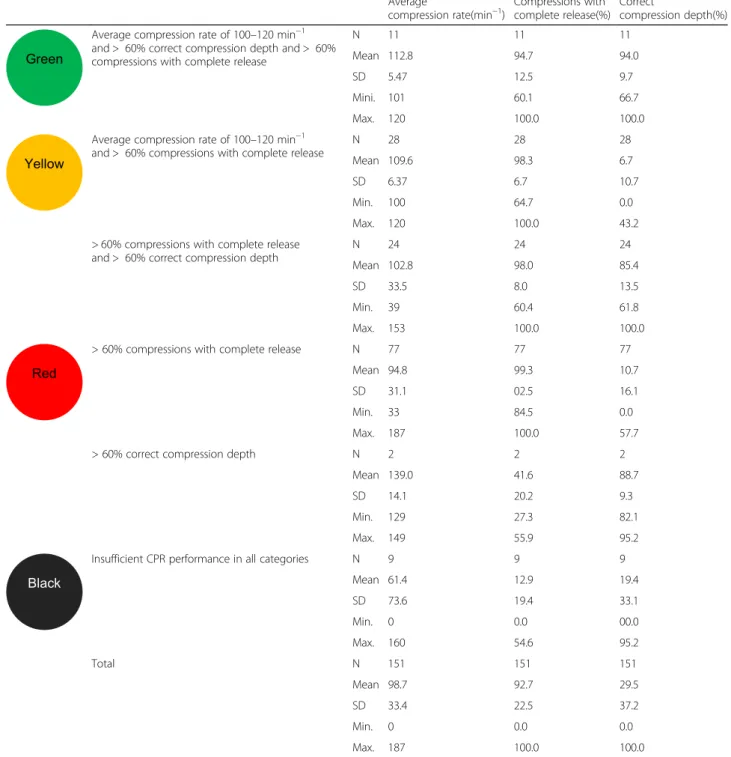
The distributions of participants across the traffic light categories showed that only a small number of students achieved an overall adequate CPR performance by fulfill-ing all criteria (n= 11). The yellow category (fulfilling
Table 1Performance data according to traffic light category
Average
compression rate(min−1)
Compressions with complete release(%)
Correct
compression depth(%)
Average compression rate of 100–120 min−1 and > 60% correct compression depth and > 60% compressions with complete release
N 11 11 11
Mean 112.8 94.7 94.0
SD 5.47 12.5 9.7
Mini. 101 60.1 66.7
Max. 120 100.0 100.0
Average compression rate of 100–120 min−1 and > 60% compressions with complete release
N 28 28 28
Mean 109.6 98.3 6.7
SD 6.37 6.7 10.7
Min. 100 64.7 0.0
Max. 120 100.0 43.2
> 60% compressions with complete release and > 60% correct compression depth
N 24 24 24
Mean 102.8 98.0 85.4
SD 33.5 8.0 13.5
Min. 39 60.4 61.8
Max. 153 100.0 100.0
> 60% compressions with complete release N 77 77 77
Mean 94.8 99.3 10.7
SD 31.1 02.5 16.1
Min. 33 84.5 0.0
Max. 187 100.0 57.7
> 60% correct compression depth N 2 2 2
Mean 139.0 41.6 88.7
SD 14.1 20.2 9.3
Min. 129 27.3 82.1
Max. 149 55.9 95.2
Insufficient CPR performance in all categories N 9 9 9
Mean 61.4 12.9 19.4
SD 73.6 19.4 33.1
Min. 0 0.0 00.0
Max. 160 54.6 95.2
Total N 151 151 151
Mean 98.7 92.7 29.5
SD 33.4 22.5 37.2
Min. 0 0.0 0.0
two out of three criteria) consisted of 52 (34.5%) partici-pants. The largest group was represented by the red cat-egory (n= 79; 52,3%) consisting of participants whose performance matched only one criterion. Within the red group, 77 of 79 students achieved a complete release be-tween compressions, two showed sufficient compression depth, and < 60% showed a complete release. The black group (none of the criteria) contained nine participants (Table1).
Interrater reliability
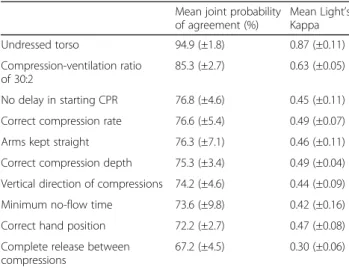
There were considerable differences in the interrater reli-ability between the checklist items. While the items “un-dressed torso”(mean joint probability of agreement 94.9%; mean Kappa 0.866) and“compression-ventilation ratio of 30:2” (mean joint probability of agreement 85.3%; mean Kappa 0.630) had equal explicit measurements across all raters, the item“complete release between compressions” (mean joint probability of agreement 67.2%; mean Kappa 0.295) showed great variation (Table2).
Matching rater evaluations and performance data
Comparison of the checklist-based evaluation by the raters with the performance data obtained by the Laerdal PC SkillReporting software revealed differences in the descriptive values of mean Light’s Kappa between items. The joint probabilities of agreement (%) between raters and software were close for the items (Table3).
Across all categories, the item “correct compression rate” showed the highest agreement between perform-ance data and checklist-based evaluation (mean joint probability of agreement 72.6%; mean Kappa 0.41). The largest range was observed for the item “complete re-lease between compressions” (mean joint probability of agreement 67.7%; range 47.3–82.7%).
The sensitivity and specificity of the different checklist items were also highest for the item “correct compres-sion rate”, while the item “complete release between compressions” had the lowest sensitivity and specificity. Generally, the sensitivity was slightly higher than the specificity for all items (Table3).
Regarding the item“compression rate”, a compression rate lower than 100 min−1 was more often correctly identified as wrong (sensitivity mean: 90.0%; range: 77.1–97.1%) than a compression rate higher than 120 min−1(sensitivity mean: 38.4%; range: 17.1–87.8%).
Concerning the traffic light classification, out of all performances defined as “green” by the performance data (n= 11), 81.8% (n= 9) of the performances were also assigned to the green category using the checklist-based evaluation. In terms of the black category, 75.0% (n= 6) of the participants were allocated correctly using the checklist data.
In contrast, within the yellow category (n= 52), only 50.0% (n= 26) matched that category according to the checklist-based evaluation data. Within the red category (n= 79), the result was even lower (35.4%, n= 28) (Table4).
Discussion
This observational cohort study evaluated whether an observational checklist was an adequate assessment tool for BLS instructors to estimate the quality of a CPR performance.
The main result was that the use of the observational checklist appropriately distinguished between overall good and overall insufficient performances. This was demonstrated by the allocation of the participants to the green and the black categories based on the checklist in accordance with the objective performance data-based distribution. Regarding all adequate CPR performances (as defined by the skill reporter), 81.8% were identified as such by the checklist-based evaluation. In contrast, Table 2Interrater reliability for all subjects (n= 152)
Mean joint probability of agreement (%)
Mean Light’s Kappa
Undressed torso 94.9 (±1.8) 0.87 (±0.11)
Compression-ventilation ratio of 30:2
85.3 (±2.7) 0.63 (±0.05)
No delay in starting CPR 76.8 (±4.6) 0.45 (±0.11)
Correct compression rate 76.6 (±5.4) 0.49 (±0.07)
Arms kept straight 76.3 (±7.1) 0.46 (±0.11)
Correct compression depth 75.3 (±3.4) 0.49 (±0.04)
Vertical direction of compressions 74.2 (±4.6) 0.44 (±0.09)
Minimum no-flow time 73.6 (±9.8) 0.42 (±0.16)
Correct hand position 72.2 (±2.7) 0.47 (±0.08)
Complete release between compressions
67.2 (±4.5) 0.30 (±0.06)
Table 3Agreement between performance data and checklist-based evaluation for all subjects (n= 152)
Mean joint
probability of agreement (%)
Mean Light’s Kappa
Sensitivity Specificity
n Range(%) Mean(%) n Range(%) Mean(%)
Correct compression rate 72.6 (±7.3) 0.41 (±0.14) 39 48.7–94.9 77.5 111 55.0–91.0 71.0
Correct compression depth 70.1 (±6.4) 0.35 (±0.14) 37 50.0–94.3 74.3 113 50.9–78.9 68.8
the low agreement between the performance data-based and the checklist-based allocation regarding the yellow and the red categories suggests that the use of the checklist is not suitable to differentiate between medi-ocre performances.
The study further indicated that crucial elements of CPR, such as minimum delay to start CPR, correct compression-ventilation ratio, and undressing the torso, were accurately assessable by simple observation, which is shown by the high interrater reliability. However, these aspects cannot be recorded by skill reporter systems. The low interrater reliability for complete release be-tween compressions suggests that this item is not easily accurately identified by simple observation and benefits from SkillReporting software.
Furthermore, the comparison of the sensitivity and specificity suggests that correct performance was easier for the raters to identify, whereas incorrect performance was more difficult to detect.
Graham et al. also suggested that a simple scoring system is a valid method to assess CPR performances. Students were evaluated based on a 10-point checklist and were assigned penalty points when the element was performed incorrectly. The scoring system differed between minor, moderate, and serious errors in the number of penalty points. The participants were assigned only to “pass” or “fail”categories without distinguishing the quality of CPR. Their study presented observed and performance data but, unlike the present study, did not compare their results to objectively obtained data from SkillReporting software [18].
In a more recent study, Kim et al. also used a checklist-based evaluation to assess BLS performances in medical students. The checklist consisted of 11 items repre-senting the BLS algorithm such as initial patient assessment and calling for help, as well as performing CPR, including compression-ventilation ratio and correct hand position as independent items, whereas compression rate and depth was a single item. The participants were assessed as “cor-rect” or “incorrect” for each item and graded on a scale from 1 to 5 for the whole performance. Within their study, the assessment by BLS instructors was compared to self-assessment by the students, both using the same check-list. Interestingly, the analysis showed no significant differ-ences between tutor and self-assessments [21].
Whether the checklist used within our study could also be used for adequate self-assessment by medical students or laypersons is a topic for further study. Add-itionally, the influence of the implied setting on the applicability of the checklist, for example, in different study populations, requires further investigation.
If the checklist-based evaluation was used to assess real cases of CPR in OHCA, it could be interesting to in-vestigate whether the raters would evaluate perfor-mances differently if they were aware of the patient outcomes.
Another point of interest was how the raters are influ-enced while evaluating a CPR performance by means of the checklist. It is possible that a good performance for most items on the checklist might lead the rater to be more indulgent with an inaccurate performance for Table 4Distributions of traffic light categories by checklist-based evaluation within traffic light categories of performance data
Traffic light category by performance data Traffic light categoryby checklist-based evaluation Total
n 9 1 1 0 11
Number of performances within category (%) 81.8 9.1 9.1 0.0 100.0
n 17 19 11 5 52
Number of performances within category (%) 32.7 36.5 21.2 9.6 100.0
n 9 24 23 23 79
Number of performances within category (%) 11.4 30.4 29.1 29.1 100.0
n 1 0 1 6 8
other items. In addition, an altogether poor performance could bias the rater to more negatively evaluate each criterion.
A low-tech feedback device such as the checklist used in the current study might be useful in the implementa-tion of CPR training for large groups such as school classes, where high-fidelity manikins might not be avail-able, for example, due to limited funds. Training school-children in CPR is a highly effective method to improve bystander CPR and patient outcome in OHCA [22–24].
Limitations
Due to the recording of the performance from only one perspective, some of the video data could not be assessed by the raters. This is a limitation to use the checklist to evaluate performances, but only if the rater is unable to directly observe the performance.
Most of the performances were inadequate because untrained lay persons were observed in this study. Hav-ing mainly negative performances makes false positive evaluations carry more weight than false negative ones. Due to that fact, both sensitivity and specificity have been calculated.
In terms of the traffic light categories, compression rates not between 100 and 120 min−1were identified as wrong based on the ERC guidelines. Thus, a compres-sion rate of 121 was valued the same as a rate of 0. This example of two different performances not matching the previously determined criteria cannot have equally nega-tive effects on patient outcome. In this particular case, the developed checklist might allow users to distinguish between the two since it is slightly more inaccurate and accepts performances with compression rates very close to the recommended range while also detecting inad-equate compression rates with a high specificity.
Conclusions
A simple observational checklist can be used to assess BLS quality and identify sufficient and insufficient per-formances. In order to provide more detailed feedback concerning CPR, skill feedback devices may be useful in addition to the checklist. The checklist is a valuable assessment tool if high-tech feedback devices are not available or useful; for example, due to high numbers of participants in training groups or limited training time.
Abbreviations
BLS:Basic life support; CPR: Cardiopulmonary resuscitation; ECC: External chest compression; OHCA: Out-of-hospital cardiac arrest
Acknowledgements
We thank the first-year students of the medical faculty at RWTH Aachen Uni-versity, Aachen, Germany, and the ten BLS instructors for participating in this study.
Funding
This is an author-initiated observational cohort study. No funds were received.
Availability of data and materials
The datasets used and analyzed during the current study are available from the corresponding author upon reasonable request.
Authors’contributions
JvD, SS, and SB developed the study concept and design. SS and RR had the primary idea for this study. Data were collected by JvD. SS wrote the ethical approval. JvD was responsible for the data acquisition, analysis, and interpretation. LH supervised the statistical analysis. JvD drafted the article. SS, LV, SB, and RR provided input. HS, LV, and SS revised the article critically for important intellectual content. HS coordinated the submission procedure. All authors read and approved the final version of the manuscript. All authors agreed to be accountable for all aspects of the work.
Ethics approval and consent to participate
The study was approved by the local ethics committee of the medical faculty at RWTH Aachen University (No. EK- 100/12). All participants and raters provided written consent to contribute to this study.
Consent for publication
Not applicable.
Competing interests
The authors declare that they have no competing interests.
Publisher’s Note
Springer Nature remains neutral with regard to jurisdictional claims in published maps and institutional affiliations.
Author details
1St. Augustinus Hospital, Renkerstraße 45, 52355 Düren, Germany. 2
Department of Anaesthesiology, University Hospital Aachen, Medical Faculty, RWTH Aachen University, Pauwelsstr. 30, 52074 Aachen, Germany. 3Interdisciplinary Training Centre for Medical Education and Patient Safety–
AIXTRA, Medical Faculty, RWTH Aachen University, Wendlingweg 2, 52074 Aachen, Germany.4Emergency Medical Service, Fire Department Aachen, Stolberger Str. 155, 52060 Aachen, Germany.
Received: 4 June 2018 Accepted: 2 November 2018
References
1. World Health Organization. Cardiovascular diseases (CVDs). Fact sheet No317, September 2012. 2012.http://www.who.int/cardiovascular_diseases/ en/. Accessed 16 May 2018.
2. Priori SG, Blomström-Lundqvist C, Mazzanti A, et al. 2015 ESC Guidelines for the management of patients with ventricular arrhythmias and the prevention of sudden cardiac death. Eur Heart J. 2015;36:2793–867. 3. Zheng ZJ, Croft JB, Giles WH, Mensah GA. Sudden cardiac death in the
United States, 1989 to 1998. Circulation. 2001;104:2158–63. 4. Ornato JP, Becker LB, Weisfeldt ML, Wright BA. Cardiac arrest and
resuscitation. Circulation. 2010;122:1876–9.
5. Hasselqvist-Ax I, Riva G, Herlitz J, et al. Early cardiopulmonary resuscitation in out-of-hospital cardiac arrest. N Engl J Med. 2015;372:2307–15.
6. Kanstad BK, Nilsen SA, Fredriksen K. CPR knowledge and attitude to performing bystander CPR among secondary school students in Norway. Resuscitation. 2011;82:1053–9.
7. Greif R, Lockey AS, Conaghan P, et al. European resuscitation council guidelines for resuscitation 2015. Section 10. Education and implementation of resuscitation. Resuscitation. 2015;95:288–301.
8. Perkins GD, Jacobs IG, Nadkarni VM, et al. Cardiac arrest and cardiopulmonary resuscitation outcome reports: update of the Utstein resuscitation registry templates for out-of-hospital cardiac arrest. Resuscitation. 2015;96:328–40.
9. Kragholm K, Wissenberg M, Mortensen RN, et al. Bystander efforts and 1-year outcomes in out-of-hospital cardiac arrest. N Engl J Med. 2017;376: 1737–47.
10. Sopka S, Biermann H, Rossaint R, et al. Resuscitation training in small-group setting--gender matters. Scand J Trauma Resusc Emerg Med. 2013;21:30. 11. Sasson C, Haukoos JS, Bond C, et al. Barriers and facilitators to learning and
bystander cardiopulmonary resuscitation prevalence and high rates of cardiac arrest in Columbus, OH. Circ Cardiovasc Qual Outcomes. 2013;6:550–8.
12. Van Raemdonck V, Monsieurs KG, Aerenhouts D, De Martelaer K. Teaching
basic life support: a prospective randomized study on low-cost training strategies in secondary schools. Eur J Emerg Med. 2014;21:284–90. 13. Bouland AJ, Risko N, Lawner BJ, et al. The price of a helping hand:
modeling the outcomes and costs of bystander CPR. Prehospital Emerg Care. 2015;19:524–34.
14. Friesen J, Patterson D, Munjal K. Cardiopulmonary resuscitation in resource-limited health systems-considerations for training and delivery. Prehosp Disaster Med. 2015;30:97–101.
15. Nichol G, Huszti E, Birnbaum A, Mahoney B, Weisfeldt M, Travers A, et al. Cost-effectiveness of lay responder defibrillation for out-of-hospital cardiac arrest. Ann Emerg Med. 2009;54:226–35.
16. Zapletal B, Greif R, Stumpf D, et al. Comparing three CPR feedback devices and standard BLS in a single rescuer scenario: a randomised simulation study. Resuscitation. 2014;85:560–6.
17. Sopka S, Biermann H, Rossaint R, et al. Evaluation of a newly developed media-supported 4-step approach for basic life support training. Scand J Trauma Resusc Emerg Med. 2012;20:37.
18. Graham CA, Lewis NF. A scoring system for the assessment of basic life support ability. Resuscitation. 2000;43:111–4.
19. Whitfield RH, Newcombe RG, Woollard M. Reliability of the Cardiff test of basic life support and automated external defibrillation version 3.1. Resuscitation. 2003;59:291–314.
20. Nolan JP, Soar J, Zideman DA, et al. European resuscitation council guidelines for resuscitation 2010 section 1. Executive summary. Resuscitation. 2010;81:1219–76.
21. Kim SJ, Choi SH, Lee SW, Hong YS, Cho H. The analysis of self and tutor assessment in the skill of basic life support (BLS) and endotracheal intubation: focused on the discrepancy in assessment. Resuscitation. 2011;82:743–8. 22. Böttiger BW, Semeraro F, Wingen S.“Kids save lives”: educating
schoolchildren in cardiopulmonary resuscitation is a civic duty that needs support for implementation. J Am Heart Assoc. 2017;6(3):e005738. 23. Plant N, Taylor K. How best to teach CPR to schoolchildren: a systematic
review. Resuscitation. 2013;84:415–21.