Cost Effectiveness Analysis of Childhood
Obesity Primary Prevention Programmes:
A Systematic Review
Şebnem Erdöl(1), Walter Mazzucco(2), Stefania Boccia(2,3)
Background: childhood obesity is associated with enormous health consequences and costs to society. This study aims to systematically review the studies on cost Effectiveness analysis (cEa) of primary prevention programmes of childhood obesity, discussing the gaps and providing recommendations for future research.
METhods: all the studies on the cost effectiveness evaluation of primary prevention of obesity among children were included. studies were retrieved from MEdLInE and google scholar, up to 31st March 2012, with only English language papers being eligible. The quality of the retrieved studies was evaluated by using the drummond scale.
rEsuLTs: Eight studies were included, five of which concerning community-based intervention programmes, while three school-based programmes. Fifty-percent of the studies, 3 school-based and 1 community-based primary prevention programme reported the intervention being cost effective. The studies were heterogeneous in terms of study design, quality, target population and outcome measures. use of the drummond scale showed that the eight studies were of low-medium quality.
concLusIons: although model-based studies may be considered as practical measures applicable to different type of programmes and settings, we auspicate for a convergence towards the use of homogenous clinical and outcome measures in order to properly evaluate the added value of obesity primary prevention programmes in childhood.
Key words: cost-effectiveness, childhood obesity, overweight, primary prevention, systemic review.
(1) Master International Healthcare Management, Economics and Policy XIII - SDA Bocconi School of Management
(2) Section of Hygiene, Institute of Public Health, Università Cattolica del Sacro Cuore;
(3) IRCCS San Raffaele Pisana, Rome, Italy
Corresponding author: Şebnem Erdöl, 1Master International Healthcare Management, Economics and Policy XIII - SDA Bocconi School of Management, Via Bocconi, 8 , 20136 Milan, Italy, Tel.: +90 535 567 58 55. E-mail: [email protected]
doi: 10.2427/9416
InTroducTIon
Childhood obesity is associated with enormous health consequences and costs to society [1]. It is not only a health but also an
of treating obesity once it has fully developed. Long-term outcome data on the effectiveness of treatment approaches are limited [4], also in view of the cumulative consequences of obesity on health over time, which are not reversed completely with weight loss [5]. Thus, in order to achieve the greatest impact on the health, and to reduce economic costs associated with obesity, more attention needs to be placed to the prevention strategies [1, 6-8].
In view of the increasing prevalence of childhood obesity in the world [9], there’s a consensus on the need for investments in the primary prevention programmes of obesity among children. Primary prevention should be based on the promotion of a healthy and active lifestyle, so to keep children within a range of body weight considered to be healthy [10]. Almost all the primary prevention strategies focus on the promotion of the physical activity and diet interventions. These strategies should be culture specific, ethnical, and consider the socio-economical aspects of the targeting population. Additionally, reducing sedentary behaviour, like watching television and playing computer games, and encouraging free play has been more effective than focusing on forced exercise or reducing food intake. Primary prevention activities can be initiated at home and in preschool institutions, schools or after-school care services [11-12].
Although there is a considerable amount of literature on the efficacy and effectiveness of both primary interventions of obesity in children, few programmes have included economic evaluations so far. The critical information that policymakers and educators need is how to achieve the greatest reduction in obesity for the fixed budget they have available or, in other words, how they can achieve the greatest “bang for the buck”. Cost-Effectiveness Analysis (CEA) is the method that can answer this question because it compares various interventions in terms of their costs per unit of benefit [13-14].
Systematic reviews on evidence based prevention studies can be used to summarize the results of studies evaluating cost effectiveness of prevention programme. The quality of the published reports is also necessary to implement an accurately and reliably assessment of prevention interventions. This study aims to systematically review all the existing literature on the
cost-effectiveness evaluation of childhood obesity primary prevention in order to address which are - from an economic point of view – the most appropriate primary interventions of childhood obesity.
METhods
Eligibility criteria and study selection
This review was drafted according to Preferred Reporting Items for Systematic reviews and Meta-Analysis (PRISMA) statement [15-17]. We systematically reviewed all published studies in English till 31st March 2012, dealing with cost-effectiveness evaluation of primary prevention programmes for preventing childhood obesity.
Pre-established inclusion and exclusion criteria have been defined and reported below. For the source of clinical and economical outcomes, randomized controlled trials (RCT), cohort studies and model based studies were included. Studies measuring the cost of intervention per Disability Adjusted Life Years (DALY) saved, and Quality Adjusted Life Years (QALY) saved, cost of intervention per kilogramme (kg) weight gain prevented, or % reduction in Body Fat (BF), were eligible for inclusion.
Exclusion criteria were defined as follows: 1. Short notes, editorials, study protocols,
and abstracts from conferences. 2. Studies which do not measure and
link clinical outcomes to economical outcomes are excluded.
Information sources and search
The search in MEDLINE and Google Scholar was conducted by using the following key words: cost-effectiveness, childhood overweight, primary prevention.
summary Measures
implemented for childhood obesity. Economical measures adopted were cost of intervention per DALY or QALY saved in Cost Effectiveness (CER) and Incremental Cost Effectiveness (ICER) ratios, cost of intervention per kg weight gain prevented or % of body fat reduction.
Quality assessment
We used the Drummond checklist to further evaluate the quality of the 8 studies included in the systematic review [18]. The checklist assessed the quality of an economic evaluation considering the following areas: study design, data collection, analysis and interpretation of results. All of the 35 items were explored by two independent reviewers (S.E., W.M.) for each of the included study.
rEsuLTs
results of literature search
Figure 1 represents the flow of information resulting from the systematic review. The searches produced a total of 5089 titles and abstracts for review. MEDLINE search returned 9 papers, of which only one [19] was determined as eligible and accessible for assessment. Of the 170 screened articles coming from the Google Scholar search two were immediately excluded. Of the remaining 168 full text articles, 164 were not considered meeting the eligibility criteria, while four [20-23] were included for assessment in this study. By screening the references of the four eligible papers, we finally included three additional papers [24-26].
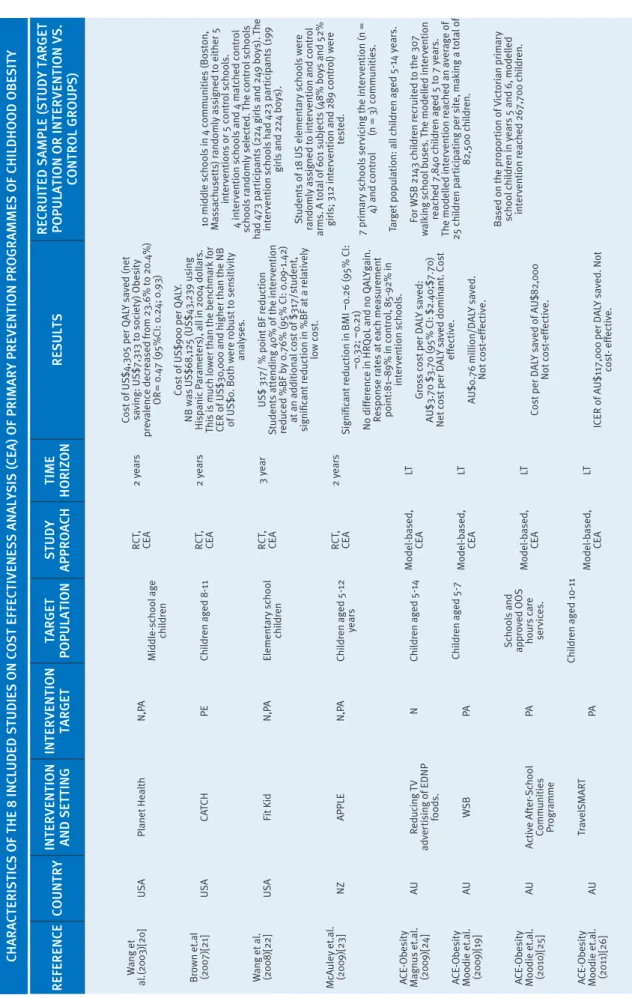
In total, 8 studies were eligible and their main characteristics are reported in Table 1. Half of the studies [19, 24-26] used DALYs as health outcome measures, while three [20- 21, 23] measured cost effectiveness in QALYs and one calculated cost per % point body fat reduction [22].
studies description
Five of the studies reported on the cost-effectiveness of community-based intervention programmes, while three were school-based programmes. Overall, the studies largely differed
according to the age groups, the outcome measures, the study designs, and included cost components, which limits the comparability. Potential sources of heterogeneity were explored through qualitative assessment of the study population, as later described.
The study by Wang et al. was the first to assess cost effectiveness of a school-based primary prevention programme reporting the cost per QALY saved and the net cost to society of such programme [20]. The programme included an interdisciplinary curriculum approach, which infuses intervention material into major subject areas and physical education, using grade- and subject-appropriate skills and competencies. The trial showed a significant decrease in the prevalence of obesity among a large sample of girls during the two-year intervention, while no significant difference was observed among boys. Three categories of costs were measured: intervention costs that are incurred during programme calculated retrospectively, medical care costs associated with adulthood overweight, and costs of productivity loss associated with adulthood overweight. Results showed a cost of US$4,305 per QALY saved and a net saving to society of US$7,313. Results remained cost-effective under all scenarios considered and cost-saving under most scenarios.
Refe R ence count R y Inte R vent Ion and sett Ing Inte R vent Ion ta R get ta R get Po Pulat Ion s tudy aPPR oach tI me h o RI zon Results Rec R u Ited s am Ple (s tudy ta R get Po Pulat Ion o R Inte R vent Ion vs. cont R ol g R ou Ps) W ang et al.(2003)[20] Br own et.al
(2007)[21] Wang et al. (2008)[22]
McAuley et.al. (2009)[23] ACE-Obesity Magnus et.al. (2009)[24] ACE-Obesity Moodie et.al. (2009)[19] ACE-Obesity Moodie et.al. (2010)[25] ACE-Obesity Moodie et.al. (2011)[26]
U
SA
U
SA
U
SA NZ AU AU AU AU
Planet Health
C
AT
CH
Fit Kid APPL
E
Reducing
TV
adv
er
tising of E
DN P foods. WSB Activ e After -School
Communities Progr
amme Tr av elSM A RT N,P A
PE N,PA N,PA N PA PA PA
Middle-school age
childr
en
Childr
en aged 8-11
Elementary school
childr
en
Childr
en aged 5-12 years
Childr
en aged 5-14
Childr
en aged 5-7
Schools and appr
ov ed OOS hours car e ser vices. Childr
en aged 10-11
R CT , CE A R CT , CE A R CT , CE A R CT , CE A Model-based, CE A Model-based, CE A Model-based, CE A Model-based, CE A 2 y ears 2 y ears 3 y ear 2 y
ears LT LT LT LT
Cost of U
S$4,305 per Q
A
LY sav
ed (net
saving: U
S$7,313 to society) Obesity
pr
ev
alence decr
eased fr
om 23.6% to 20.4%)
O
R= 0.47 (95%CI: 0.24; 0.93) Cost of U
S$900 per Q
A
LY
.
N
B was U
S$68,125 (U
S$43,239 using
Hispanic P
ar
ameters), all in 2004 dollars.
This is much lo
w
er than the benchmark for
CE
R of U
S$30,000 and higher than the N
B
of U
S$0. Both w
er
e r
obust to sensitivity
analyses.
U
S$ 317/ % point BF r
eduction
Students attending 40% of the inter
vention
reduced %BF b
y 0.76% (95% CI: 0.09-1.42)
at an additional cost of $317/student,
significant r
eduction in %BF at a r
elativ
ely
lo
w cost.
Significant r
eduction in B
M
I
−
0.26 (95% CI:
−
0.32;
−
0.21)
No differ
ence in H
RQoL
and no Q
A
LYgain.
Response r
ates at each measur
ement
point:81–89% in contr
ol, 85-92% in
inter
vention schools.
Gr
oss cost per D
A
LY sav
ed:
A
U$3.70 $3.70 (95% CI: $2.40;$7.70)
Net cost per D
A
LY sav
ed dominant. Cost
effectiv e. A U$0.76 million/D A LY sav ed. Not cost-effectiv e.
Cost per D
A
LY sav
ed of A
U$82,000
Not cost-effectiv
e.
ICE
R of A
U$117,000 per D
A
LY sav
ed. Not
cost- effectiv
e.
10 middle schools in 4 communities (Boston, Massachusetts) r
andomly assigned to either 5
inter
ventions or 5 contr
ol schools.
4 inter
vention schools and 4 matched contr
ol
schools r
andomly selected.
The contr
ol schools
had 473 par
ticipants (224 girls and 249 bo
ys).
The
inter
vention schools had 423 par
ticipants (199
girls and 224 bo
ys).
Students of 18 U
S elementary schools w
er
e
randomly assigned to inter
vention and contr
ol
arms. A total of 601 subjects (48% bo
ys and 52%
girls; 312 inter
vention and 289 contr
ol) w
er
e
tested.
7 primary schools ser
vicing the inter
vention (n =
4) and contr
ol (n = 3) communities.
Tar
get population: all childr
en aged 5-14 y
ears.
For
WSB 2143 childr
en r
ecruited to the 307
walking school buses.
The modelled inter
vention
reached 7,840 childr
en aged 5 to 7 y
ears.
The modelled inter
vention r
eached an av
er
age of
25 childr
en par
ticipating per site, making a total of 82,500 childr
en.
Based on the pr
opor
tion of
Victorian primary
school childr
en in y
ears 5 and 6, modelled
inter
vention r
eached 267,700 childr
and the NB was US$68,125 (US$43,239 using Hispanic parameters). The calculated CER resulted much lower than the threshold for CER of US$30,000 and higher than the NB of $0 and thus the programme considered the intervention as cost effective.
The study of Wang et al. [22] assessed the cost effectiveness of a 3-years (after-) school based prevention programme named “FitKid Project”, designed to prevent obesity among elementary schools students. The intervention included physical activity, healthy snacks, homework assistance, and academic improvement. Net intervention costs were calculated by subtracting the usual after-school care costs from the intervention costs. The effectiveness of the intervention was measured as %BF reduction compared with a control condition. Results showed that the reduction in %BF was not significant among students attending less than 40% of the intervention sessions. Per capita intervention costs were estimated dividing the total intervention costs by the 182 students who attended at least 40% of the sessions to avoid overestimating the cost effectiveness of the intervention.
McAuley et al. assessed the cost effectiveness of “A Pilot Programme for Lifestyle and Exercise” Project (The APPLE), 2-year controlled
community-based obesity prevention initiative utilizing activity coordinators in schools and nutrition promotion in New Zealand children, with the purpose to prevent excessive weight gain in 5-12 years old children by enhancing opportunities for healthy and non-curricular physical activity [23]. According to two-year findings, intervention children reported a significant lower BMI values compared with control children. No differences in health-related quality of life were observed in the current study, thus were unable to calculate QALYs. The remaining four studies [19, 24-26] included were model-based cost effectiveness studies on primary prevention addressing childhood obesity as a part of Assessing Cost Effectiveness-Obesity (ACE) project. Following a societal perspective, a simulation-modelling technique was used to obtain the cost-effectiveness ratio and its 95% confidence intervals. Benefits were modelled as changes in BMI and DALYs saved. Intervention costs were compared to future health-care cost offsets in terms of reduced prevalence of obesity-related health conditions.
Among the 4 studies mentioned, Magnus et al. performed the cost effectiveness of a community-based primary prevention approach: banning in Australia television (TV) advertisements for energy-dense, nutrient poor food and beverages during children’s peak
fIguRe 1
flow of InfoRmatIon foR systematIc RevIew
In
cl
ud
ed
El
ig
ib
ili
ty
Sc
re
en
in
g
Id
en
tif
ic
at
io
n
8 records were excluded
9 records screened
1 record included in the qualitative
synthesis 9 records identified
through PubMed
5080 records identified through Google Scholar
170 screened
168 full text articles found e ligible for assessment
168 full text articles excluded due to not meeting
e ligibility criteria 2 duplicates excluded
4 articles found e ligibile and included in qualitative
synthesis
8 articles in total (from PubMed and Google Scholar and by hand) found e ligible and
included in qualitative synthesis
Bibliographies of e ligible articles were scanned other salient publications 3 articles
viewing times [24]. The intervention - was 'dominant', because it resulted in both a health gain and a cost offset compared with current practice.
The other model based study by Moodie et al. assessed cost-effectiveness of the obesity primary prevention “Walking School Bus” (WSB) programme in Australia, aiming to increase the number of primary school children walking to school [19]. The evidence base was judged as 'weak' as there were no available data documenting the increase in the number of children walking due to the intervention. Under current modelling assumptions, the WSB programme was not considered to be a cost-effective measure to reduce childhood obesity.
Active After-School Communities (AASC) programme, under the ACE-Obesity Project, was modelled for a 1-year time horizon for Australian primary school children. The intervention focused on the recruitment of children who were previously inactive during the after-school period, so the current practice comparator equated with no intervention. Physical activity co-ordinators were appointed to work with national, state, and regional sporting organizations to develop and deliver a physical activity programme specific to the needs of each school/service. Selected sites were required to offer 2–3 sessions per week [25]. The programme, however, was not cost-effective under base-case modelling assumptions.
The last study from the ACE project was about the TravelSMART Schools (TSS) Curriculum- a school based programme, aiming to assess the increase active transport in 10- to 11-years-old Australian children as an obesity prevention measure [26]. The modelled intervention was based on the TSS programme, a curriculum-based programme specifically targeted at children in years 5 and 6 (age 10 and 11 years). It aimed to decrease traffic congestion around schools, increase physical activity levels and the community capacity to work together by planning more active ways for children to travel to school. The result of such intervention was not cost-effective under base-run modelling assumptions.
Quality of the included studies
The results of the qualitative evaluations reported in Table 2. Over all, according to
Drummond’s checklist, all of the included studies were judged to be of low-medium quality.
Four of the seven items related to the study design were totally adherent in the 8 studies. As for the remaining questions, Moodie [19] and Magnus [24] clearly stated the economic importance of the research question. We documented a clear justification for the choice of form of economic evaluation in relation to the questions addressed in McAuley [23] and Moodie [19]. No other than Moodie [25] and Moodie [26] stated the rationale for choosing the alternative programmes or interventions compared.
All of the studies presented many similar lacks in the data collection section, being totally adherent to 6 of the items explored. Item deficiencies have been highlighted referring to details of the method of synthesis or meta-analysis of estimates, details of the subjects from whom valuations were obtained, justification in the choice of model used and the key parameters on which it was based, and productivity changes reporting and importance. Four studies [20-23, 25] reported separately quantities of resources from their unit costs, while only McAuley [23] and Moodie[19] clearly provided for details of currency of price adjustments for inflation or currency conversion. Details of any model used were not clearly given by Wang [22].
Lastly, the inconsistency for items number 25, 28 and 30 documented further methodological limits in the analysis and the interpretation of results for all of the eight studies [19-26]. Particularly, Wang [22] was not adherent to all of this section items, except three. A scarce adherence was documented as well for items 24 and 27. Incremental analysis as well as answer to the study question was not clearly reported for three studies [20-22]. On the opposite, all included studies provided for appropriate caveats and data report following in the conclusions. Items 22, 23, 26 where adherent in all of the studies except Wang 2008. Major outcomes are correctly presented in all study except three [19, 22- 23].
dIscussIon
RefeRee’s checklIst study Id
Item wang
2003
bRown 2007
wang 2008
mcauley 2009
moodIe 2009
magnus 2009
moodIe 2010
moodIe 2011
s
tudy
des
Ign
(I) The research question is
stated Y Y Y Y Y Y Y Y
(2) The economic importance of
the research question is stated NC NC NC NC Y Y N N
(3) The viewpoint(s) of the analysis are clearly stated and
justified Y Y Y Y Y Y Y Y
(4) The rationale for choosing the alternative programmes or
interventions compared is stated N N N N N N Y Y
(5) The alternatives being
compared are clearly described Y Y Y Y Y Y Y Y
(6) The form of economic
evaluation used is stated Y Y Y Y Y Y Y Y
(7) The choice of form of economic evaluation is justified in relation to the questions addressed
NC NC NC Y Y N N N
d
ata
collect
Ion
(8) The source(s) of effectiveness
estimates used are stated Y Y Y Y Y Y Y Y
(9) Details of the design and results of effectiveness study are
given (if based on a single study) Y Y Y Y Y Y Y Y
(10) Details of the method of synthesis or meta-analysis of
estimates are given (overview) N N N N N N N N
(11) The primary outcome measure(s) for the economic
evaluation are clearly stated Y Y Y Y Y Y Y Y
(12) Methods to value health states and other benefits are
stated Y1 Y5 N Y Y Y Y Y
(13) Details of the subjects from whom valuations were obtained
are given NC NC N N N N N N
(14) Productivity changes (if included) are reported
separately N N N N N N N N
(15) The relevance of productivity changes to the study question is
discussed N NC N N N N N N
(16) Quantities of resources are reported separately from their
unit costs Y NC6 Y Y N N Y8 NC
(17) Methods for the estimation of quantities and unit costs are
described Y2 Y Y Y Y Y Y Y
(18) Currency and price data are
recorded Y Y Y Y Y Y Y Y
table 2
RefeRee’s checklIst study Id
Item wang
2003
bRown 2007
wang 2008
mcauley 2009
moodIe 2009
magnus 2009
moodIe 2010
moodIe 2011
d
ata
collect
Ion
(19) Details of currency of price adjustments for inflation or
currency conversion are given N N N Y Y NC N N
(20) Details of any model used
are given Y Y NC Y Y Y Y Y
(21) The choice of model used and the key parameters on which
it is based are justified N N N N NC N N N
a
nalys
Is
and
Inte
RPR
etat
Ion
of
R
esults
(22) Time horizon of costs and
benefits is stated Y Y NC Y Y Y Y Y
(23) The discount rate(s) is
stated Y Y N Y Y Y Y Y
(24) The choice of rate(s) is
justified NC3 N N N Y N Y N
(25) An explanation is given if costs or benefits are not
discounted N4 N N N7 N N N N
(26) Details of statistical tests and confidence intervals are
given for stochastic data Y Y NC Y Y Y Y Y
(27) The approach to sensitivity
analysis is given Y Y N N Y N N Y
(28) The choice of variables for
sensitivity analysis is justified N N NC N N N N N
(29) The ranges over which the
variables are varied are stated Y Y Y Y Y Y Y Y
(30) Relevant alternatives are
compared N N N N N N N N
(31) Incremental analysis is
reported NC NC NC Y Y Y Y Y
(32) Major outcomes are presented in a disaggregated as
well as aggregated form Y Y N N N Y Y Y9
(33) The answer to the study
question is given NC NC N Y Y Y Y Y
(34) Conclusions follow from the
data reported Y Y Y Y Y Y Y Y
(35) Conclusions are
accompanied by the appropriate
caveats Y Y Y Y Y Y Y Y
Legend: Y= yes; N= not; NC= not clear.
1National Center for Health Statistics developed a health and activity limitation index for measuring YHL, 2Values provided by Harvard
Prevention Research Centre, 3Only Ref.14 is stated for annual discount rate, 4 No explanation for not discounting benefits, 5QALY
weights were estimated using National Health Interview Survey (NHIS) data, 6Trainer unit cost suppressed for confidentiality, 7No
explanation for not discounting benefits, 8Reported in Supplementary table S1, 9Presented in Table 4 table 2 (contInued)
outcomes, intervention and comparators, the context in which the programme implemented and any theory supporting the study needs to be taken into consideration.
The limited evidence on the cost effectiveness of interventions may partly be attributed to the lack of outcome measures that are amenable in health economic evaluations. Much of the evidence on the effectiveness of prevention strategies concerns crude measures such as average weight loss rather than response rates with short follow-up. In clinical research, more information from quality-of-life questionnaires throughout the intervention and follow-up period would help assess how valuable any clinical improvement is to the individual. This would allow greater comparison between types of intervention and improve assumptions made in cost-effectiveness analyses [27]. Although model-based studies may be considered as practical measures applicable to many different type of programmes and settings, a need of oversimplification on the programmes’ structure was suggested by the review. Also retrospectively collected cost data may not be reliable due to loss of information or lack of registration. However, cost effectiveness
studies with long term follow-up and run in parallel will contribute to results. Convergence towards the use of homogenous clinical and outcome measures may encourage comparing and reaching a conclusion about the cost effectiveness of childhood obesity primary prevention programmes. Another limit affecting the review was the low-medium quality of all of the included studies. Deficiencies were documented in the study design, data collection and analysis and interpretation of results sections, giving a not strong consistency to the systematic review.
concLusIon
Future studies of better methodological approach of higher economical quality are needed to be published to implement the most appropriate primary interventions into childhood obesity and to better support a decision-making process, oriented by CEA.
aCknowledgements: There was no outside funding/ support for this study.
references
[1] Registered Nurses’ Association of Ontario (2005). Primary Prevention of Childhood Obesity. Available from: http://rnao.ca/fr/sites/rnao-ca/files/Primary_ Prevention_of_Childhood_Obesity.pdf [Accessed March 4, 2012].
[2] Finkelstein EA, Ruhm CJ, Kosa KM. Economic Causes and Consequences of Obesity. Annual Review of Public Health 2005;26: 239-57.
[3] Australian Government National Preventative Health Taskforce. Technical Report No.1. Obesity in Australia: a need for urgent action. Available from: http://www.fairfieldcity.nsw.gov.au/upload/ pfpib32593/nathealth_prevant_obesity.pdf [Accessed April 30, 2013]
[4] American Academy of Paediatrics. Policy statement: prevention of paediatric overweight and obesity. Paediatrics. 2003; 112:424−30. Available from: http:// pediatrics.aappublications.org/content/112/2/424.full [Accessed March 6, 2012]
[5] World Health Organization. Obesity: preventing and managing the global epidemic: report of a WHO con
sultation. Geneva: WHO, 2000. Available from: http:// apps.who.int/bookorders/anglais/detart1.jsp?sessla n=1&codlan=1&codcol=10&codcch=894 [Accessed March 6, 2012]
[6] Institute of Medicine of the National Academies. Early childhood Obesity Prevention Policies. Report Brief June 2011. Available from: http://www.iom.edu/~/ media/Files/Report%20Files/2011/Early-Childhood-Obesity-Prevention-Policies/Young%20Child%20 Obesity%202011%20Report%20Brief.pdf [Accessed March 6, 2012]
[7] Lin B-H, Guthrie J, Frazao E. American children’s diet not making the grade. Food Rev 2001; 24; 8-17. Available from: http://www.ers.usda.gov/publiction/ Food Review/MAy2001/FRV2412b.pdf [Accessed March 6,2012]
[9] de Onis M, Blossner M, Borghi E. Global prevalence and trends of overweight and obesity among pre-school children. Am J Clin Nutr 2010; 92(5):1257-1264. Available from: http://ajcn.nutrition.org/con-tent/92/5/1257.long [Accessed March 6, 2012] [10] Zwiauer KF. Prevention and treatment of overweight
and obesity in children and adolescents. Eur J Pediatr 2000; 159 (1 Suppl):56S-68S.
[11] Caterson ID, Gill TP. Obesity: epidemiology and possible prevention. Best Pract Res Clin Endocrinol Metab 2002; 16:595–610.
[12] Dehghan M, Akhtar-Danesh N, Merchant AT. Childhood obesity, prevalence and prevention. Nutr J 2005; 4:24.
[13] Cawly J. Cost Effectiveness of Programs to Prevent or Reduce Obesity. Arch Pediatr Adolesc Med. 2007; 161(6):611-614.
[14] Kropski JA, Keckley PH, Jensen GL. School-based Obesity Prevention Programs: An Evidence-based Review. Obesity 2008; 16:1009–1018.
[15] Moher D, Liberati A, Tetzlaff J, Altman DG, The PRISMA Group. Preferred reporting items for system-atic reviews and meta-analyses: The PRISMA state-ment. J Clin Epidemiol 2009; 62:1006-12.
[16] Boccia S.PRISMA: an attempt to improve standards for reporting systematic review and meta-analy-sis.2009; 6:4.
[17] Liberati A, Altman DG, Tetzlaff J,et al. The PRISMA statement for reporting systematic reviews and meta-analyses of studies that evaluate health care interven-tions: explanation and elaboration. Ann Intern Med 2009; 151:W.-65-94
[18] Drummond MF, Jefferson TO. Guidelines for authors and peer reviewers of economic submissions to the BMJ. BMJ 1996; 313:275-83.
[19] Moodie M, Haby M, Galvin L, Swinburn B, Carter
R. Cost-effectiveness of active transport for primary school children - Walking School Bus program. Int J Behav Nutr Phys Act 2009; 6:63.
[20] Wang LY, Yang Q, Lowry R, Wechsler H. Economic analysis of a school-based obesity prevention pro-gram. Obes Res 2003; 11:1313-24.
[21] Brown HS, Pérez A, Li YP, Hoelscher DM, Kelder SH,Rivera R. The cost-effectiveness of a school-based overweight program. Int J Behav Nutr Phys Act.2007; 4:47.
[22] Wang LY, Gutin B, Barbeau P, et al. Cost-effectiveness of a school based obesity prevention program. J Sch Health 2008; 78:619-24.
[23] McAuley KA, Taylor RW, Farmer VL, et al. Economic evaluation of a community-based obesity prevention program in children: The APPLE project. Obesity, 2009; 18; 131-6.
[24] Magnus A, Haby MM, Carter R, Swınburn B. The cost-effectiveness of removing television advertis-ing of high-fat and/or high sugar food beverages to Australian children. Int J Obes 2009; 33; 1094-102. [25] Moodie ML Carter RC, Swinburn BA, Haby MM. The
cost-effectiveness of Australia’s active after-school communities program. Obesity.2010;18:1585-1592. [26] Moodie ML,Haby MM, Swinburg B, Carter R.
Assessing cost effectiveness in obesity: Active transport program for primary school children: TravelSMART Schools Curriculum program. J Phys Act Health 2011;8(4):503-515.