Enhanced Dynamic Bandwidth Allocation
Algorithm for Intelligent Home
Networks
1
Themba L. Nkosi,
2Maredi Mphahlele,
3Sunday O. Ojo, and
4Topside E. Mathonsi
1,2,3,4Department of Information Technology, Tshwane University of Technology, South Africa
Abstract: Internet of Things (IoT) has been seen playing a tremendous change in the Information Technology (IT) environments, and thus its importance has also been realized and played a vital role within Intelligent Home Networks (IHNs). This is because IoT establishes a connection between things and the Internet by utilizing different sensing devices to implement the intelligence to deal with the identification and management of the connected things. IHNs use intelligent systems to perform their daily operations. Meanwhile, these networks ensure comfort, safety, healthcare, automation, energy conservation, and remote management to devices and users. Apart from that, these networks provide assistance in self-healing for faults, power outages, reconfigurations, and more. However, we have realized that more and advanced devices and services continue to be introduced and used in these networks. This has led to competitions of the limited available network resources, services, and bandwidth. In this paper, therefore, we present the design and implementation of a Novel Dynamic Bandwidth Allocation (NoDBA) algorithm to solve the performance bottleneck incurred with IHNs. The proposed algorithm deals with the management of bandwidth and its allocation. In the proposed algorithm, this study integrates two algorithms, namely; Offline Cooperative Algorithm (OCA) and Particle Swarm Optimization (PSO) to improve the Quality of Service (QoS). PSO defines the priority limits for subnets and nodes in the network. Meanwhile, OCA facilitates dynamic bandwidth allocation in the network. The Network Simulator-2 (NS-2) was used to simulate and evaluate the NoDBA and it showed improved results compared to the traditional bandwidth allocation algorithms. The obtained results show an average throughput of 92%, an average delay of 0.8 seconds, and saves energy consumption of 95% compared to Dynamic QoS-aware Bandwidth Allocation (DQBA) and Data-Driven Allocation (DDA).
Keywords: IHNs, Dynamic Bandwidth Allocation, PSO, OCA, QoS, NoDBA.
1.
Introduction
In the recent past, the Internet of Things (IoT) has played a tremendous change in the Information Technology (IT) industry. This is because IoT establishes a connection between things and the Internet by utilizing different sensing devices to implement the intelligence to deal with the identification and management of the connected things. The information sensing devices include Radio Frequency Identification Devices (RFID), infrared sensors, Global Positioning System (GPS), laser scanner devices, and more [1]-[28]. These devices are all connected to the Internet to implement remote perception and control. This has led to the advent of computer networks, and thus, there has been a consistent need to have these sensing devices in any environment. This further aids in communication among various devices to share the available network resources and services. Over the past few years, the need for communication among these devices has resulted in the connection of home devices, thus creating networks called
Intelligent Home Networks (IHNs). IHNs provide and ensure comfort, safety, healthcare, automation, energy conservation, and remote management to devices and users within it [1]-[28].
IHNs use intelligent systems to perform their daily operations. The benefits of using intelligent systems in IHNs provide assistance in self-healing for faults, power outages, reconfigurations, and more [2]. In addition, these networks can be accessed and managed either locally or remotely, enabling monitoring, scheduling, and controlling of various devices and users. In its most general form, IHNs are comprised of sub-networks (subnets) such as Wireless Fidelity (Wi-Fi), ZigBee, Smart Grid, Bluetooth, Body Area, Ultra Wide Band (UWB), and more [3]. In this study, these subnets have been given different priorities based on their importance and workflow procedures. For remote communications, the devices in each subnet are connected to Sub Network Gateways (SNGs). On the other hand, the SNGs are connected to Home Network Gateways (HNGs). The responsibility of HNGs is to enable the integration of IHNs with other networks such as the Internet and more. However, it has been realized that more and advanced devices and services continue to be introduced and used in these environments. On the other hand, the current migration from Internet Protocol version 4 (IPv4) to IPv6 standards also plays its vital role in IHNs. Apart from that, the addition of more and advanced devices and network resources into these networks also plays its impact and has resulted in congestion problems. On the other hand, this addition of more devices leads to competitions of the limited available network resources and services as well as available bandwidth. These networks, therefore, continue to experience and suffer from poor Quality of Service (QoS) when performing operations both locally and remotely. Furthermore, the poor QoS results to unavailable, unreliable and inefficient bandwidth to the consumers of these networks. The research in [4] concurred that effective resource allocation algorithms are important for bandwidth management in order to improve QoS and to satisfy the demands of its customers as well.
its workflow. Therefore, the subnets with higher workflow procedures than others are given high priority and assigned more bandwidth than other subnets. Consequently, the proposed algorithm integrates two optimization algorithms known as Offline Cooperative Algorithm (OCA) and Particle Swarm Optimization (PSO). OCA basis itself on the game-theoretical framework to any bandwidth allocation problem. Therefore, in the proposed algorithm it does the allocation of bandwidth in the network dynamically. On the other hand, PSO defines the priority limits for all subnets and nodes in the network.
The proposed algorithm was simulated, tested, and evaluated using Network Simulator-2 (NS-2). The experimental evaluation of the proposed algorithm was against Dynamic QoS-aware Bandwidth Allocation (DQBA) proposed and developed in [5] and Data-Driven Allocation (DDA) in [6]. NS-2 is a discrete-event network simulation tool built by the Virtual Inter-Network Testbed (VINT) research group at the University of California. From the simulation results, the NoDBA algorithm seemed to reduce congestions and bandwidth usage. Consequently, NoDBA seemed to improve throughput, reduced energy consumption, and delay compared to DQBA and DDA.
The remainder of this paper is structured as follows. In Section 2, we present a brief discussion of related works. In Section 3, we provide an overview of the PSO and OCA algorithms. The system design and architecture of the proposed IHNs is discussed in Section 4. In Section 5, we present the implementation of the proposed model and further discuss the analysis of the results obtained. Lastly, we conclude this study and discuss future enhancement in Section 6.
2.
Related Work
Over the past years, a lot of work has been presented in the field of dynamic bandwidth allocation, and thus, several algorithms have been presented and developed. However, most of these algorithms have been developed for wireless networks such as Wireless Mesh Networks (WMNs) and more. Meanwhile, recent traditional algorithms were proposed for Mobile Ad hoc Networks (MANETs). Apart from that, the focus has been more on energy consumption and the dissemination of the message. The primary reason is that most of the traditional algorithms apply flooding techniques during message transmission as MANETs do not have dedicated servers. As mentioned in [7] flooding techniques lead to network overhead in most cases. On the other hand, flooding techniques consume a lot of bandwidth, computation resources, and battery resources [8].
In this section, we provide discussions on existing bandwidth allocation algorithms for IHNs. We then discuss the various gaps available in these algorithms.
In [9] an algorithm was developed to facilitate QoS, meanwhile providing mobility management to the next-generation home networks and named Dynamic Load Balancing (DLB). This algorithm seemed to respond well to network changes during link failures or node mobility in home networks. This algorithm incorporated Langrangian Relaxation, Dijkstra algorithm, and Column Generation to have a stable load balancing. By integrating these algorithms enabled the development and use of the Inter MAC layer. Dijkstra algorithm was utilized to establish the shortest path when signals have to travel between sources and destinations
and thus guaranteed minimal bandwidth usage and reduced delay. On the other hand, sessions that shared the same source, destination, and level of QoS were aggregated and used. Meanwhile, Column Generation was applied to solve linear programming variable problems, yielding iteration. This algorithm offered efficient use of link bandwidth, the mobility of users, and a reduction in delay. However, NoDBA utilized VLAN protocol in classifying subnets, prioritized, and scheduled services offered by the network as opposed to the previous approaches.
In [10] an algorithm to priority schedule real-time systems was developed. The algorithm dealt with scheduling and assigning a fixed priority to each process. In the algorithm, processes with lower priority had longer waiting and response time and thus, there were most often interrupted by incoming higher priority processes. Consequently, higher priority processes experience the least waiting time and packet loss compared to lower priority processes. Looking at this algorithm, it works similar to NoDBA as it also considered classifying and prioritizing processes which are services and resources offered in the network. However, NoDBA uses DSCP to deal with classifying, prioritizing, and scheduling subnets in the entire network. This reduced delay duration packet transmission between nodes in the network, eliminating starvation and ensured optimized performance of intelligent home networks irrespective of the increase in several devices and services into it.
In [11] a home network QoS harmonization algorithm was used. This algorithm used a class-based communication protocol. The purpose of the algorithm was to assist with differentiating priorities in the third and second layers. Similarly, this algorithm used DSCP to change signal states, priority levels, and protocol Identification (ID) of classified and marked packets in layer three from standardized to harmonize. The purpose of the IDs was to recovered DSCP values in the second layer from the mapping table. This aided in optimizing bandwidth allocation in the network. However, NoDBA applied OCA to deal with the allocation of bandwidth dynamically. Consequently, we realize an optimized QoS in-home networks irrespective of the increase in several devices and services.
On the other hand, we have realized that several routing protocols have been proposed in the field of computer networks. Though, most of the existing protocols were designed and developed for particular computer networks in terms of sizes. One of the major objectives of these routing protocols is to find the shortest distances between source and destination nodes.
3.
Overview of Particle Swarm Optimization
and Offline Cooperative Algorithms
This section of the study discusses the integrated PSO and OCA algorithms. These two algorithms were integrated to eradicate the various gaps available in the conventional QoS and dynamical bandwidth allocation algorithms for IHNs. Furthermore, we provide discussions on the benefits and drawbacks of the two integrated algorithms.
3.1 Particle Swarm Optimization
The PSO algorithm is the most well-regarded algorithm in the literature of optimization algorithms. The research in [15] concurred that PSO is the most recent and important method to deal with optimization in networking environments. This algorithm was proposed and developed in [16] to deal with optimization in continuous nonlinear functions. It is a stochastic algorithm and mimics the navigation and forging of a flock of birds or school of fish. In this algorithm, every solution to a given problem is considered as a particle. The concept behind this algorithm was to mimic three behaviors of flocks in a swarm. (i) Cohesion wherein birds stick together. (ii) Separation wherein birds do not come too close to each other. (iii) Alignment wherein each follows the general heading of the flock in a swarm. On the other hand, the research in [13] stated that this algorithm simulates search randomly in the design space to obtain the maximum value of the objective. The research further stated that it was implemented on two paradigms, namely, one globally-oriented (GBEST) and one locally-globally-oriented (LBEST). The major benefit of PSO is that it has been employed in a variate of fields in both science and industry. In this study, therefore, we applied this algorithm to deal with classifying and putting different levels of priorities to relay and child nodes on the network.
3.2 Offline Cooperative Algorithm
The OCA was proposed and design by Guo et al. (2016) in [17] based on the game-theoretical framework. This algorithm proposed to deal with bandwidth allocation for datacenter networking environments. The idea behind this algorithm was taken from two interesting results in the bargaining game approach discussed as follows; (i) dual variables wherein each server can be updated independently with local information and (ii) iteration of each rate which requires the bandwidth information of the hosting servers. The research further stated that the two techniques motivated the design of Falloc to obtain the optimal rate in a distributed cooperative manner [17]. As discussed in Chapter 1, this algorithm basis itself on the game-theoretical framework to any bandwidth allocation problem. In this study, therefore, we have employed this algorithm to deal with the allocation of bandwidth in the IHNs dynamically.
4.
Novel Dynamic Bandwidth Algorithm
In this Section, we briefly provide discussions on the proposed system architectures and further discuss how the integration of PSO and OCA aided in designing the proposed NoDBA. On the other hand, we discuss various system building components used and the configurations done in designing the proposed network. We also discuss each device’s configuration and connection on the network which was done to optimize the network by considering dynamic bandwidth allocation.
4.1 System Architecture
Over the past few years, it has been realized that the addition of more home devices causes traffic load, competition, and depletion of the limited network resources. This results in poor QoS on IHNs. Consequently, we proposed to employ the system architecture designed in [2, 3]. The proposed architecture is in the form of star topology to ensure centralized management and configurations as Illustrated in Figure 1. The proposed topology is comprised of six segmented subnets, namely; UWB, Wi-Fi, ZigBee, Body Area, Bluetooth, as well as Smart Grid subnetworks. This subdivision of these subnets promotes prioritization, thereby, ensuring adequate distribution of the available limited services and resources.
Figure 1. A typical IHN system architecture proposed in [2,3]
market include DES – 3200 series, S3100 series, S3610 series, and more. It has been assured that SNGs have VLAN numbers and names which aids in easier identification. On the other hand, we have utilized the Dynamic Host Control Protocol (DHCP) pool to dynamically allocate IP addresses to subnet devices. This aids in limiting the direct involvement of users in allocating IP addresses. Meanwhile, we have configured wireless subnets to use Linksys wireless routers as SNGs. As shown in Fig 1, Linksys routers are marked with subnetwork names and provided with passwords to aid in authentication and authorization to intended users only. This aids in limiting the wastage of network bandwidths, meanwhile it enhances security. The internet interfaces of the Linksys wireless routers have been assigned IP addresses to aid in connection to the rest of the network and remote locations.
In the network, we have enabled DHCP and configured static IP addresses to be supported by wireless subnets. This permits the introduction of more devices into the subnets. The secure server is configured to host databases, emails, configurations, management, security, and more. This permits the provision of timely and available IHN services, resources, and operations. The IP address of the server doubles up as Domain Name System (DNS) address. It is used by devices to access server resources. For remote connectivity, we used Secure Router and Virtual Private Network (VPN). Furthermore, the secure router connects to remote sites via Internet Service Provider (ISP) or Digital Subscriber Line (DSL). The VLAN database of the secure router is configured with the assigned VLAN names and numbers to identify and prioritize incoming remote signals. Meanwhile, a single gateway at the secure router helps in traffic management from and/or to the VLANs.
4.2 System Modelling
In this section, we present the proposed service discovery model integrating PSO and OCA algorithms. These two behavioral inspired algorithms are employed to eradicate the various gaps found in the existing dynamic bandwidth allocation algorithms to be applied in IHNs.
In implementing the proposed model, the researcher has modeled the network by a directed graph which is represented as a tree of
T
=
(
V
,
E
)
whereby V is the set of nodes and E is the set of links in the network. Therefore)
,...,
,
(
v
1v
2v
nV
=
andE
=
(
e
1,
e
2,...
e
m,
)
. On the otherhand, let n ∈ V be wired/wireless nodes. For each link let
E
t
n
s
=
(
,
,
)
1
be wired/wireless links. Furthermore, the algorithm distinguishes three different types of nodes in the network and gives them different responsibilities. The nodes are categorized as follows: i) root node, ii) relay node, and iii) child node. The root node is a special node acting as the central coordinator of the network. It carries out the task of gateway nodes. On the other hand, the relay node receives the external requests and forwards them to the child nodes. In addition, each relay node forwards node join request to its root node. These nodes perform dynamic slot assignment on receipt of the traffic demands from their children nodes. The child nodes always have exactly one adjacent link. The child nodes are the end-points of the network to carry out the task of receiving control packets, generating node join request, and sending bandwidth demands to their parent nodes. We decided to logically divide the proposed IHN into 1-hop clusters as shown in Figure 1. Therefore, the clusters exhibita parent-child relationship and have identical behavior. Consequently, we have introduced the process of relay nodes optimization to solve the bottleneck with bandwidth allocation. Moreover, we have applied the Offline Cooperative Algorithm (OCA) to solve the bottleneck with bandwidth allocation in the network.
Based on Figure 1, relay nodes are classified and prioritized using Particle Swarm Optimization (PSO). The relay nodes are represented by
s
. In the model, we begin by defining priority limits for each relay node as shown in (1).R
X
s
X
X
X
s s H s s L s
=
6
,..
3
,
2
,
1
...
(1)In which
X
represents the priority given to each relay node depending on the workflow procedures.L
represents the least prioritized relay node.H
represents the highest prioritized relay node.R
represents that priority given to each subnet is real.Therefore, we predetermine the priority of relay nodes as shown below:
If
min
s
{
1
,
2
,...
6
}
=
1
Relay node 1 becomes least prioritized. Else if
max
s
{
1
,
2
,...
6
}
=
6
Relay node 6 becomes the highest prioritized.
Because each relay node,
s
, contains child nodes within it. Based on equation (1), we prioritize and schedule each child node,d
, in the subnets using weighing factor numbers as shown in (2):R X d X X X d d H d s L d = ,... 3 , 2 , 1 ... (2)
In which
X
represents the priority given to each child node.L
represents the least prioritized child node in a relay node.s
represents the highest prioritized child node in a relay.R
represents that priority given to each child node in the relay node is real. Therefore, we predetermine the priority of child nodes as follows:If
min
d
{
1
.
2
.
3
...
}
=
1
Child node
1
becomes the highest prioritized. Ifmax
d
{
1
.
2
.
3
...
}
=
Child node
becomes least prioritized.To successfully compute the total bandwidth, b, used in the network, equation (1) was used, to sum up, the bandwidth for relay nodes as shown in (3):
==
+
+
+
+
+
ni
b
ib
b
b
b
b
b
6 5 4 3 2 1 1 (3)It has been realized that not all packets would successfully be transmitted in the network. Therefore, we compute packet loss as shown in (4).
100 1 1 =
n n t t t t packet sent packet dropped losspacket
(4)
Insection1, in order to implement the proposed NoDBA algorithm in IHNs successfully, we applied OCA to dynamically enforce rate allocation relying on the requiring traffic demand of each node. The design of this algorithm is comprised of two components; the bandwidth allocation algorithm on each server and the communication protocols between servers as shown in the algorithm below:
Algorithm: Offline Cooperative Algorithm (OCA)
Input:
The step-size:
Server bandwidth capacity: Cm,mM
Bandwidth demand matrix: [Di,j]NN,mM,iN
VM placement: W M N M N
i m
i
m ] , ,
[ ,
The total number of iteration rounds: S The gap between two consecutive iterations:
Output:
1: while
s
S
orr
i(,sj)−
r
i,sj−1
do2: Update allocated bandwidth
I i
i mi
I pm E i
i mi
E
pm W r r W r
r =
, , =
,3: Update dual variables as (3)
))
(
,
0
max(
m PEE m E
m
=
−
C
−
r
m
))
(
,
0
max(
m PII m I
m
=
−
C
−
r
m
4: for all
r
i,j,
i
V
m do5: Update
E=
mE6: Obtain
I=
Il from serverl
,
j
V
l7: if
j i j i i E
j i
L U K
, ,
, −
+
then
8:
r
isjU
i,j ) (,
+
9: else10:
i E
j i j i s j i
K L
r
+
+
= ,
, ) (
,
11: end if
12: end for
13: Update step-size:
14: Update iteration round:
s
+
s
=
1
15: end while
5.
Implementation
of
Novel
Dynamic
Bandwidth Allocation Algorithm
In this Section, we provide discussions on how the implementation of the proposed NoDBA. This includes the simulation environment and the development of the proposed topology. We also discuss and analyze the simulation results. The following performance metrics were analyzed during the simulation: service discovery throughput, service availability, service selection, and service discovery delay. The aforementioned metrics were chosen because they are vital factors affecting QoS during service discovery in WMNs.
5.1 Simulation Environment
In this study, we carried out the simulations using NS-2 Version 2.35 (NS-2.35). The benefit of NS-2 is that it has models such as IEEE 802_11b/g, and more. On the other hand, this tool is a free source simulation environment, and thus is freely available on the Internet and that’s the reason we employed it. Apart from that, it works on different operating systems. On the other hand, it has an online user group chat wherein users help each other with various networking projects. We developed the proposed simulation topology as shown in Figure 2.
Figure 2. Typical WMN of 43 nodes
The simulation topology we developed consists of 8 stationary computer nodes. These nodes are randomly placed (except the server) on a network and given numbers ranging from 0–7. We fascinated multicasting transmission and reception of data. We used simplex-link layer (SLL) to process and transmit messages between nodes. In addition,
we used LTEQueue/ULAirQueue and
LTEQueue/DLAirQueue to assign different priority limits to every relay node. The defined priority limits are based on workflow procedures. This was achieved by employing the PSO algorithm. The bandwidth was dynamically allocated using OCA. The proposed model is implemented on the distribution (server) layer of the network. We decided to run the simulations 100 seconds each during the evaluations.The evaluations were performed several times in order to obtain promising results. The reason behind performing several simulations is that NS-2 is not scalable, thus at times, the simulation results might not be reliable enough.
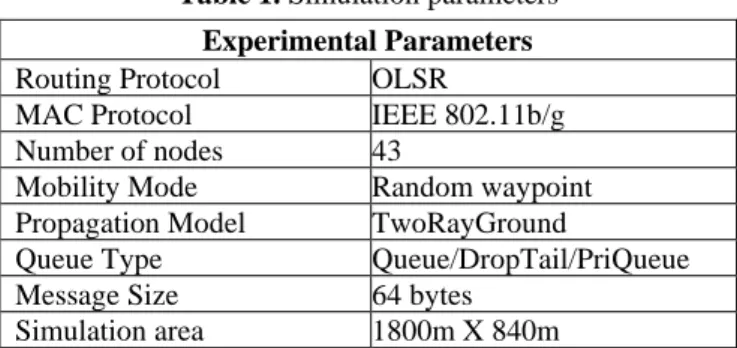
The table below shows the simulation parameters and values used during the simulations.
Table 1. Simulation parameters
Experimental Parameters Routing Protocol OLSR
MAC Protocol IEEE 802.11b/g
Number of nodes 43
Mobility Mode Random waypoint Propagation Model TwoRayGround
Queue Type Queue/DropTail/PriQueue
Message Size 64 bytes
Simulation area 1800m X 840m
Figure 2 represented the Network Animator (NAM) created during the experimental evaluations of the proposed model. This NAM interface shows the proposed topology used to carry out the simulations. This interface was used through various simulations of the proposed model against DQBA and DDA.
5.2 Simulation Results and Analysis
For the purpose of evaluating the proposed algorithm against others, we had to set up a framework that deals with issues affecting QoS in IHNs. As mentioned before, we recorded performance results to attain the objectives of this study.The DQBA and DDA algorithms were chosen as both portray similar traffic scenarios. Also, the objectives of these algorithms were to improve network throughput and delay as well as energy consumption.Apart from that, the motivation also came from the following similarities and differences. Both DQBA and DDA used OLSR protocol, relying on bandwidth and energy consumption to compute optimal paths on the network.
However, these algorithms did not consider assigning different priority limits to relay nodes to guarantee a certain level of performance during data transmission in the network. In the proposed model, therefore, we integrated PSO and OCA algorithms to solve the incurred bottleneck. The performance metrics discussed below were considered to evaluate the performance of the proposed NoDBA algorithm against DQBA and DDA.
• Average Throughput – the measurement of the number of transmissions that can be made between two nodes in a network at a given time.
• Average Delay – the measurement of the time it takes packet transmissions between network nodes. • Energy Consumption – the measurement of the
energy consumed by nodes during traffic transmissions in a network at a given time.
In the proposed NoDBA, we observed promising average network throughput compared to DQBA and DDA algorithms. This has been clearly shown in Figure 3. The reason behind this is, NoDBA defines priority limits for all relay nodes wherein each node is given a certain priority level depending on its workflow procedure. On the other hand, NoDBA permits a maximum number of clients, in priority order, to access the resources and services offered by the network, which provides improvements on QoS.
Figure 3. Average Throughput
Figure 4. Average Delay
Herein, we present and discuss the average network delay obtained by NoDBA through multiple extensive simulations compared to DQBA and DDA algorithm. NoDBA algorithm reduced the average network delay compared to other algorithms. This has been achieved by using the PSO algorithm to define priority limits to all the nodes in the network. The reduced delay was also achieved by minimizing congestion, which is achieved by permitting a maximum number of nodes to access the network in priority order. This also minimizes bandwidth usage.
Energy consumption has been well improved to the NoDBA compared to DQBA and DDA algorithm as shown in Figure 5. The reason behind this good improvement is that the NoDBA algorithm integrated PSO and OCA, which provide a promising and minimized bandwidth usage as compared to other existing bandwidth allocation algorithm. Furthermore, by using the PSO algorithm, the proposed NoDBA algorithm reduces congestions which on the other hand also plays a vital role in saving energy consumption.
6.
Conclusion and Future Work
In this study, we discussed and provided possible solutions to eradicate various factors affecting the performance of IHNs as a result of bandwidth allocation in these networks. We presented an overview of IHNs, the benefits, and the drawbacks of these networks.Apart from that, we discussed traditional algorithms developed and employed in IHNs. On the other hand, we presented various gaps found in the existing dynamic bandwidth allocation algorithms. Furthermore, we presented experimental evaluations and provide results and discussions of the proposed NoDBA. Those results were analyzed and graphically plotted using R statistical programming.
In the proposed algorithm, we integrated two well-known algorithms in the field of networking to eradicate the performance bottleneck incurred on IHNs as a result of bandwidth allocation. The PSO algorithm was employed to define the priority limits for all subnets and nodes in the network. This shall guarantee a certain level of performance during data transmission on IHNs. On the other hand, we employed OCA to dynamically allocate bandwidth to different nodes in the network.
The NS-2 tool was used to simulate, test, and evaluate the proposed NoDBA against DQBA and DDA. The simulation results show that the proposed bandwidth allocation algorithm can largely improve the throughput of users and decrease the delay of the content received. As a result, NoDBA yielded an average throughput of 92%, an average delay of 0.8 seconds, and saves energy consumption of 95% compared to the other algorithms.
Furthermore, the advanced research of this study could focus on applying the improved PSO, known as Accelerated Particle Swarm Optimization (APSO). On the other hand, we plan to look into security issues for IHNs as a result of the technologies such as the IoT, and more introduced recently.
7.
Acknowledgments
We would like to thank the Tshwane University of Technology for its financial support.
References
[1] S. Majumder, E. Aghayi, M. Noferesti, H. Memarzadeh-Tehran, T. Mondal, Z. Pang, and M. Deen, “Smart homes for elderly healthcare—Recent advances and research challenges,” Sensors, 17(11), p.2496, 2017. [2] M.K. K'Obwanga, O.P. Kogeda, and M. Lall, “An
Improved-Cross Layer Scheduling model for intelligent home networks”, In 2016 IST-Africa Week Conference, IEEE, pp. 1-9,2016.
[3] M.K. K’Obwanga, O.P. Kogeda, and M. Lall, “Performance Optimization of Intelligent Home Networks”, In Connectivity Frameworks for Smart Devices, Springer, Cham, pp. 209-234, 2016.
[4] L. Song, Y. Li, and Z. Han, “Resource allocation in full-duplex communications for future wireless
networks”, IEEE Wireless Communications, 22(4), pp.88-96, 2015.
[5] I. Hussain, Z.I. Ahmed, D.K. Saikia, and N. Sarma, “A QoS-aware dynamic bandwidth allocation scheme for multi-hop WiFi-based long distance networks”, EURASIP Journal on Wireless Communications and Networking, 4(1), pp.160-170, 2015.
[6] B. Fan, S. Leng, and K. Yang, “A dynamic bandwidth allocation algorithm in mobile networks with big data of users and networks”, IEEE Network, 30(1), pp.6-10, 2016.
[7] M. Krebs, “Dynamic virtual backbone management for service discovery in wireless mesh networks”, IEEE Wireless Communications and Networking, pp. 1-6, 2009.
[8] M. Zakarya, and I. Rahman, “A short overview of service discovery protocols for MANETs”, VAWKUM Transactions on Computer Sciences,1(2), pp.1-6, 2013. [9] D. Macone, G. Oddi, A. Palo, and V. Suraci, “A
dynamic load balancing algorithm for Quality of Service and mobility management in next-generation home networks”, Telecommunication systems, 53(3), pp.265-283, 2015.
[10]A. McEwen, and H. Cassimally, “Designing the internet of things”, John Wiley & Sons, 22(3), pp.1-15, 2013. [11]G. Bhatti, “QoS harmonization for home networks”,
IEEE Broadband Multimedia Symposium, pp.1 – 5, 2010.
[12]S.S. Manvi, M.S. Kakkasageri and C.V. Mahapurush, “Performance analysis of AODV, DSR, and Swarm Intelligence Routing Protocols in Vehicular Ad Hoc Network Environment”, International Conference on Future Computer and Communication, Kuala Lumpur, Malaysia, pp.21-25, 2009.
[13]L. Ndlovu, O.P. Kogeda, and M. Lall, “Enhanced service discovery model for Wireless Mesh Networks”, Journal of Advanced Computation Intelligence and Intelligent Informatics, 22(1), pp.44-53, 2018.
[14]V.R. Shruthi, and S.R. Hemanth, “Simulation of ACO technique using NS2 simulator”. International Journal of Engineering Trends and Technology, 23(8) pp.403-406, 2015.
[15]V. Selvi and D.R. Umarani, “Comparative analysis of ant colony and particle swarm optimization techniques”, International Journal of Computer Applications, 5(4), pp.1-6, 2010.
[16]R.C. Eberhart, and J. Kennedy, “A new optimizer using Particle Swarm theory”, In Proceedings of the Sixth International Symposium on Micro Machine and Human Science, Nagoya, Japan, pp.39-43, 1995.
[17]J. Guo, F. Liu, J.C.S. Lui, and H. Jin, “Fair Network Bandwidth Allocation in IaaS datacenters via a cooperative game approach”, IEEE/ACM TRANSACTIONS ON NETWORKING, 24(2), pp.873-886, 2016.
[18]B.E. Buthelezi, M.I. Mphahlele, D.P. duPlessis, P.S. Maswikaneng, T.E Mathonsi, “ZigBee Healthcare Monitoring System for Ambient Assisted Living Environments”, International Journal of Communication Networks and Information Security (IJCNIS),11(1), pp.85-92, 2019.
[19]T. E. Mathonsi, O. P. Kogeda, and T. O. Olwal, “Intersystem Handover Decision Model for Heterogeneous Wireless Networks," In the Proceedings of IEEE Open Innovations Conference 2018 (IEEE OI 2018), pp.1-7, 2018.
[20]T. E. Mathonsi, O. P. Kogeda, and T. O. Olwal, "A Survey of Intersystem Handover Algorithms in Heterogeneous Wireless Networks," Asian Journal of Information Technology, 16(6), pp. 422-439, 2017. [21]T. E. Mathonsi and O. P. Kogeda, "Handoff Delay
[22]T. E. Mathonsi, O. P. Kogeda, and T. O. Olwal, "Intersystem Handover Delay Minimization Model for Heterogeneous Wireless Networks," In the Proceedings of South African Institute of Computer Scientists and Information Technologists 2017 (SAICSIT 2017), pp. 377, 2017.
[23]T. E. Mathonsi, “Optimized Handoff and Secure Roaming Model for Wireless Networks”, In the Proceedings of the Second International Conference on Information Security and Cyber Forensics 2015 (InfoSec2015), pp.134–139, 2015.
[24]T. E. Mathonsi, O.P. Kogeda and T.O. Olwal, “Transferrable Payoff Based Bandwidth Allocation for Small and Medium Enterprises”, Asian Journal of Information Technology, 16(6), pp.440–450, 2017. [25]T.E. Mathonsi, T.M. Tshilongamulenzhe and B.E.
Buthelezi, “Blockchain Security Model for Internet of Things”, In the Proceedings of Academics World 158th International Conference, Pages 52-56, 2019.
[26]T.L. Nkosi, M.I. Mphahlele, S.O. Ojo, and T.E. Mathonsi, “Dynamic Bandwidth Allocation Algorithm to improve Quality of Service on Intelligent Home Networks.” In the Proceedings of IEEE Open Innovations Conference 2019, pp.83–88, 2019.
[27]T.E. Mathonsi and O.P. Kogeda, “Enhanced Bandwidth Sharing Scheme for Small and Medium Enterprises”, In the Proceedings of the World Congress on Engineering and Computer Science 2014, pp.765–770, 2014.
![Figure 1. A typical IHN system architecture proposed in [2,3]](https://thumb-us.123doks.com/thumbv2/123dok_us/8121524.2154023/3.892.471.814.343.754/figure-a-typical-ihn-system-architecture-proposed-in.webp)