STUDY OF DIAGNOSTIC EVALUATION OF A PATIENT WITH
SUSPECTED VAP
Ramesh M K
1, Dr. RajenderaParsad Sharma
2Department of Nursing
1,2
Shri Venkateshwara University, Gajraula (Uttar Pradesh) – India
Abstract
In the recent past, various advancements have taken place in the management of VAP. Several studies have provided important insights into the relationship of the histology and bacteriology of VAP, various epidemiological researches have allowed the establishment of concepts for empiric antimicrobial treatment, and various updates on state-of-the-art care have been outlined. However, despite these measures, a majority of issues related to the management of VAP remain unresolved and are subject to controversy. This is particularly true for the diagnostic evaluation of a patient with suspected VAP. The lack of consensus regarding the best way to diagnose VAP largely explains why the incidence rates vary so widely from one study to another — from 5 to 50% of mechanically ventilated intensive care unit (ICU) patients.
Keywords: VAP, patient, intensive, care, unit etc.
1. INTRODUCTION
The primary task of nursing research is to contribute to the scientific base of nursing practices. Studies are needed to determine the effectiveness of nursing intervention and nursing care. Through research efforts, the science of nursing will grow and a scientifically based rationale for making changes in nursing practice will be generated. As the patients’ needs become more complex in the critical care setting nurses with increased expertise are needed to expand the research based knowledge and apply existing knowledge in practice setting. For example the knowledge and correct practices of suctioning is very important for nurses because improper suctioning can lead to hypoxia, cardiac arrhythmias, hypotension, increased respiratory work, unexplained cardio vascular collapse and sudden death.Research is needed to refine suction technique to identify patients at greatest risk for adverse response to suctioning. so also with other procedure that need to be performed skillfully in the intensive care unit (ICU) A researcher recommended that research should be done to assess the teaching strategies which should be used effectively 2 to yield most beneficial results and to determine what skills nurse need to perform independently to improve the condition of the patient in ICU.
contaminated etc. Ventilated patients developed pneumonia and other complications which could be prevented.So the nurses need to improve the knowledge and skills in endotracheal suctioning. The researcher was motivated to conduct this study and to provide staff nurses a structured protocol with teaching programme to improve their knowledge and skills regarding care of patient on ventilator.
Over the next decade or so, ICUs began to be created in hospitals across Europe, the USA, and Australasia. In other countries, ICUs are a more recent development - for example, the first ICU in China was established in 1982.Early ICUs were somewhat isolated, slightly mysterious, and rather frightening places; staff and visitors (when allowed) were often gowned with protective shoe covers, even masks - adding to the sense of anxiety for the patient and their families. Patients were often heavily sedated to facilitate mechanical ventilation and in the belief that this approach would reduce patient agitation and discomfort. Visiting hours were highly restricted to avoid any increase in physiologic stress for the patient, any interference with the provision of care, and to limit the spread of infection in these vulnerable patients.
2. LITERATURE REVIEW
Rello J, Ollendorf DA, Oster G, et al (2002)[1] Ventilator-associated pneumonia (VAP) is a typical nosocomial disease in basically sick patients that is associated to poor clinical and financial results, including longer term of mechanical ventilation, longer ICU and doctor's facility stay, expanded mortality, and expanded healing centre charges. It is the main source of death among nosocomial contaminations, surpassing rates of death optional to focal line diseases, serious sepsis, and respiratory tract diseases in non-intubated patients. The effect of VAP on our human services frameworks is impressive, with evaluations that VAP represents around 17 000 ICU days for every year (2% of all ICU days) and 46 million dollars for every year in the Canadian social insurance framework. Annihilation of this preventable nosocomial contamination would spare lives and save rare medicinal services assets. Given these discoveries, systems that adequately forestall VAP are critically required, and streamlined techniques for all inclusive usage are vital.
Muscedere J, Dodek P, Keenan S, et al (2008)[2] VAP is preventable, and many practices have been shown to lessen the frequency of VAP and its associated weight of ailment. We ought to along these lines initially survey the distributed confirmation based rules for VAP aversion. The Canadian Critical Care Trials aggregate at first distributed far-reaching proof based clinical practice rules for VAP counteractive action in 2004, with a refresh distributed in 2008. Groups are a strategy used to execute prove based clinical practice rules. Packs are a gathering of best practices that, when utilized exclusively, are observed to be viable. The Institute for Healthcare Improvement (IHI) pushed the utilization of packs, characterized as 'a little, clear arrangement of practices – by and large three to five – that, when performed all things considered and dependable, have been demonstrated to enhance quiet results'. The IHI built up the 'Ventilator Bundle' comprising of four proof based practices to enhance the results of patients requiring mechanical ventilation and gave the philosophy to package usage and estimation of consistency.
uncovered major methodological imperfections in the outline, detailing, and aftereffects of the four distributed reviews that were investigated. The methodological imperfections of the reviews included inclination, puzzling, and absence of generalizability and blocked any convincing proclamations about the package's adequacy or cost-viability. These creators inferred that, to guarantee productive designation of the constrained medicinal services assets, thorough assessment of ideal systems for VAP anticipation is expected to set up best practices and make a benchmark against which new advances' esteem can be evaluated. The ventilator package is not a reasonable quality measure in the ICU as of now.
Schweickert et al. (2004) [4] assessed 128 mechanically ventilated patients accepting ceaseless narcotic mixtures. Patients were randomized to either day by day intrusion of narcotic imbuements (n ¼ 66) or sedation coordinated by the therapeutic ICU group without this procedure (n ¼ 60). Every day sedation intrusions lessened ICU length of stay (6.2 versus 9.9 days, P < 0.01), and the span of mechanical ventilation (4.8 versus 7.3 days, P < 0.003), and occurrence of complexities. Patients are conflictingly assessed for extubation on the premise of subjective appraisal via guardians. Numerous patients are in this way unintentionally left intubated when they could have been extubated, consequently expanding their danger of VAP.
Dries et al. (2004)[5] led a review in which they utilized an institutionalized weaning convention to study diminishment in the times of mechanical ventilation. They found that using this standard convention, they decreased the number from 0.47 to 0.33 Ventilators days/ICU days. They likewise found that they had lessened rates of VAP (15% in control patients versus 5% in convention patients).
Unahalekhaka A, Jamulitrat S, Chongsuvivatwong V, et al (2007)[6] various reviews have shown the positive effect of usage of the Ventilator Bundle or an altered VAP package on the diminishment of VAP in ICUs. As expressed before, a hefty portion of these is hard to translate as they don't report package consistency rates, don't control for other particular VAP chance elements, and utilize the clinical meaning of VAP. Without a vigorous technique to gather information on the predominance of VAP with all associatedriskfactors and particular VAP definitions, the effect of the care packages on enhancing results for this part of care is as yet obscure.
3. OBJECTIVES
To make enhancements in the research venture and furthermore
To recognize problems that must be counter checked and disposed of before the real study is
endeavored
4. RESEARCH METHODOLOGY
The research methodology can be taken as a set of orderly discipline procedures involved in the deliberate collection, analysis and interpretation of the data. It includes Research approach, Research Design, Identification of Target, Sample, Sampling Technique, Sampling Size, Inclusive and Exclusive criteria of sample, Tool Preparation, Feasibility of the study, Validity Reliability Pilot study, and Data gathering process.
A pilot study is a littler variant of the proposed research study, directed to modify and refine the data gathering process, the treatment, intercessions or the research tool. As per Polit and Hungler, Pilot study is a little scale variant or preliminary run, it is done in anticipation of a noteworthy study
4.1
RESEARCH DESIGN AND STRATEGIESThis research is designed as exploratory research. Following data collection strategies would be used.
Primary Data Collection:
Primary source is a source from where we collect first-hand information or original data on a topic. Data would be collected primarily from open-ended questionnaires that can justify the ventilator associated pneumonia.
Secondary data collection
We have collected secondary data from the published financial statements of the firms, newspaper and articles. This is the minor part of this research but important as well. In this part data would be collected from the websites, journals, books, published articles, records of an organization. This type of data have been collected and recorded by another person or organization, sometimes for altogether different purposes.
4.2 RESEARCH HYPOTHESIS
Primary Hypothesis:
Ventilator-Associated Pneumonia (VAP) is a major cause of hospital morbidity, mortality and increased health care costs.
Secondary Hypothesis:
Try to demonstrate the hypothetical relationship between the use of transfusions and nosocomial pneumonia.
4.3 DATA ANALYSIS
The data we would get from the primary data collection would be analysed through SPSS tools for concluding the results. Also, we will use content analysis method for secondary data.
5. ANALYSIS
tracheotomy) and controls (patients without tracheotomy).In total, 1,402 patients were eligible for inclusion. Surgical tracheotomy was performed in 226 (16%) patients and matching was successful for
177 (78%). The rate of VAP (22 versus 14 VAP episodes·1,000 MV-days−1) was significantly higher in
controls than in cases. The rate of VAP after tracheotomy in cases, or after the corresponding day of MV
in controls, was also significantly higher in control than in case patients (9.2 versus 4.8 VAP
episodes·1,000 MV-days−1). In multivariate analysis, neurological failure (odds ratio (95% confidence
interval) 2.7 (1.3–5)), antibiotic treatment (2.1 (1.1–3.2)) and tracheotomy (0.18 (0.1–0.3)) were associated with VAP.).
5.1 Patient and Methods
The present retrospective observational case–control study was performed in a 30-bed ICU from January 1996–January 2001. All data were prospectively gathered. As the study was observational, Institutional Review Board endorsement was not required as per Institutional Review Board Regulation.
All patients intubated and ventilated for >7 days were eligible. Trauma patients, immunodepressed patients and patients with tracheotomy at ICU admission were not eligible for inclusion in the study.
A) Study population
Patients were intubated either by means of the oral or nasal route as indicated by the clinical status and the propensities for the doctor in control. The oropharyngeal cavity was cleaned four times each day with chlorhexidine arrangement. Ceaseless subglottic suctioning was not used. The ventilator circuit was not changed routinely. In all patients, a warmth moisture exchanger was situated between the Y piece and the patient, the warmth moisture exchangers were changed each 48 h or all the more every now and again if unmistakably grimy
B) Definitions
All cases were tracheotomised patients and controls were patients without tracheotomy. Tracheotomy was considered as late in the event that it was performed >7 days after the initiation of MV. VAP was defined by the presence of new or progressive radiographical infiltrate associated with two of the following
criteria: temperature >38.5°C or <36.5°C; leukocyte count >10,000·μL−1
or <1,500·μL−1; purulent
tracheal aspirate; and a positive (≥106
colony forming units·mL−1) tracheal aspirate culture. VAP episodes
were identified by prospective surveillance of nosocomial infections.
C) Matching criteria
D) Statistical analysis
Cases were contrasted and controls utilizing a Chi-squared test or Fisher's precise test when fitting for subjective variables, and Mann–Whitney U-test for quantitative variables. Results are displayed as frequency (%) for subjective variables or mean±SD for quantitative variables.
5. 2 Results
A) Study population
In total, 1,402 patients were eligible for inclusion into the current study. Surgical tracheotomy was performed in 226 (16%) patients and matching was successful for 177 (78%). The mean duration of MV before tracheotomy was 21±12 days. Tracheotomy was performed >7 days after the start of MV in 128 (72%) out of 177 patients. A total of 178 VAP episodes were diagnosed in 124 patients, including 151 (84%) with late-onset VAP. There were 69 VAP episodes that occurred after tracheotomy in case patients, or after the corresponding day of MV in control patients (fig. 1). The mean time between the start of MV and first episode of VAP was 15±10 days. The mean time between tracheotomy, or the
corresponding day of MV in control patients, and subsequent VAP episode was 4.5±2.1 versus. 4.9±2.5
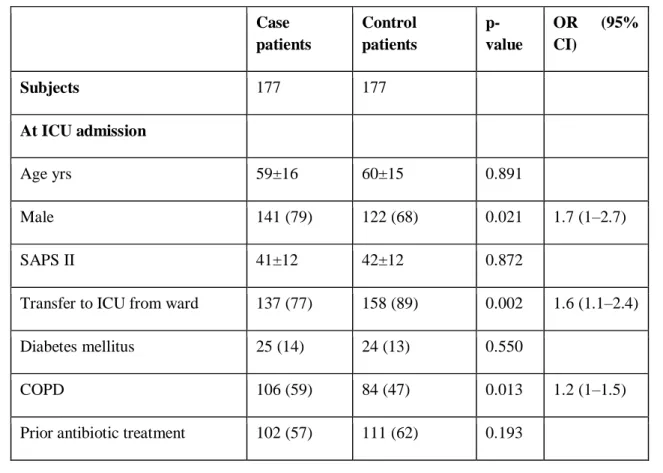
days (p = 0.514) in case and control patients, respectively. Albeit male gender and COPD rates were essentially higher in cases than in controls, exchange to the ICU from a ward was more successive in controls than in cases. Other patient attributes were comparative in case and control patients
Table 1: Characteristics of Study Patients
Case patients
Control patients
p-value
OR (95% CI)
Subjects 177 177
At ICU admission
Age yrs 59±16 60±15 0.891
Male 141 (79) 122 (68) 0.021 1.7 (1–2.7)
SAPS II 41±12 42±12 0.872
Transfer to ICU from ward 137 (77) 158 (89) 0.002 1.6 (1.1–2.4)
Diabetes mellitus 25 (14) 24 (13) 0.550
COPD 106 (59) 84 (47) 0.013 1.2 (1–1.5)
Surgery 39 (22) 39 (22) 0.551
Failed organs 1.4±0.6 1.6±0.8 0.575
Type of organ failure
Cardiac 27 (15) 40 (22) 0.052
Respiratory 146 (82) 153 (86) 0.189
Renal 24 (13) 30 (16) 0.230
Neurological 29 (16) 21 (11) 0.143
Digestive 7 (3) 7 (3) 0.607
During ICU stay
Stress ulcer prophylaxis 91 (51) 95 (53) 0.375
Antibiotic treatment 106 (59) 104 (58) 0.457
Duration of antibiotic treatment
days 12±12 15±15 0.060
Data are presented as n, mean±SD or n (%), unless otherwise stated. OR: odds ratio; CI: confidence
interval; ICU: intensive care unit; SAPS: simplified acute physiology score; COPD: chronic obstructive pulmonary disease
The present study demonstrates that tracheotomy is autonomously associated with lower rates of VAP. Neurological failure and antibiotic treatment are free risk factors for VAP. Furthermore, early tracheotomy is associated with lower rates of VAP and ICU mortality, and shorter term of MV and ICU remain as contrasted and late tracheotomy. Past investigations distinguished tracheotomy as a free risk factor for VAP 7–10; notwithstanding, no change was performed for the length of MV, which is likely the most significant risk factor for VAP 14. To the present creators' information, the present study is the first to assess the relationship between tracheotomy and VAP utilizing coordinating for a few significant frustrating factors, including term of MV. The high rate of VAP found by this study could be clarified by the way that lone patients requiring mechanical ventilation for >7 days were incorporated.
Preventive measures incorporate evasion of endotracheal intubation and utilization of noninvasive MV at whatever point conceivable, inclination of orotracheal and orogastric tubes, weaning of ventilation joined with weaning of narcotics, utilization of a solitary ventilator circuit for each patient, utilization of antibacterial-covered ETT ideally with a polyurethane sleeve, goal of subglottic secretions, patient situating, shirking of superfluous intra-emergency clinic exchanges, inclination for enteral sustenance, utilization of oral germ-killers, great cleanliness rehearses by health professionals, and disinfection of emergency clinic settings and restorative gadgets. Administration of probiotics has indicated promising outcomes, despite the fact that, until this point, no rules suggest its utilization.
REFERENCES
1. Rello J, Ollendorf DA, Oster G, et al., VAP Outcomes Scientific Advisory group. Epidemiology
and outcomes of ventilator-associated pneumonia in a large US database. Chest 2002; 122:2115–2121.
2. Muscedere J, Dodek P, Keenan S, et al., VAP Guidelines Committee and the Canadian Critical
Care Trials group. Comprehensive evidence-based clinical practice guidelines for ventilator-associated pneumonia: prevention. J Crit Care 2008; 23:126–137.
3. Zilberberg MD, Shorr AF, Kollef MH. Implementing quality improvements in the intensive care
unit: ventilator bundle as an example. Crit Care Med 2009; 3791:305–309
4. Schweickert WD, Gehlbach BK, Pohlman AS, et al. Daily interruption of sedative infusions and
complications of critical illness in mechanically ventilated patients. Crit Care Med 2004; 32:1272–1276.
5. Dries DJ, McGonigal MD, Malian MS, et al. Protocol-driven ventilator weaning reduces use of
mechanical ventilation, rate of early reintubation, and ventilatorassociated pneumonia. J Trauma 2004; 56:943–951.
6. Unahalekhaka A, Jamulitrat S, Chongsuvivatwong V, et al. Using a collaborative to reduce
ventilator-associated pneumonia in Thailand. JtComm J Qual Patient Saf 2007; 33:387–394
7. Lansford T, Moncure M, Carlton E, et al. Efficacy of a pneumonia prevention protocol in the
reduction of ventilator-associated pneumonia in trauma patients. Surg Infect (Larchmt) 2007; 8:505–510.
8. Rosenthal VD, Maki DG, Jamulitrat S, Medeiros EA, Todi SK, Gomez, et al. International
Nosocomial Infection Control Consortium(INICC) report, data summary for 2003-2008, issued june 2009. Am J Infect Control 2010;38:95- 104.
9. Hunter JD. Effects of anaesthesia on the human immune system. Hosp Med 2009;60:658–63.
10. Johanson WG, Pierce AK, Sanford JP. Changing pharyngeal bacterial flora in hospitalized
11. Bahrani-Mougeot FK, Paster BJ, Coleman S, Barbuto S, Brennan MT, Noll J, et al. Molecular analysis of oral and respiratory bacterial species associated with ventilator-associated pneumonia. J ClinMicrobiol 2017;45:1588–93.
12. Hunter JD. Ventilator associated pneumonia. BMJ 2012;344:e3325.
13. Pugin J. Clinical signs and scores for the diagnosis of ventilator-associated pneumonia. Minerva
Anestesiol 2012;68:261–5.
14. Dimopoulos G, Poulakou IA, Armaganidis A, Kollef MH, Matthaiou DK. Short versus
long-duration antibiotic regimens for ventilator-associated pneumonia: a systematic review and meta-analysis. Chest 2013;144:1759-67.
15. Munro CL, Grap MJ. Oral health and care in the intensive care unit: state of the science.
American Journal of Critical care. 2014; 13: 25-34.
16. Koeman M. Oral decontamination with chlorhexidene reduces the incidence of ventilator
associated pneumonia. Intensive care medicine.2016; 10(2): 242-245
17. Fraise AP. Biocide abuse and antimicrobial resistance—a cause for concern? J
Antimicrobchemother. 2012; 49 (1): 11-12.
18. Ray, B., Samaddar, D. P., Todi, S. K., Ramakrishnan, N., John, G., &Ramasubban, S. (2009).
Quality indicators for ICU: ISCCM guidelines for ICUs in India. IndianJournal of Critical Care
Medicine : Peer-Reviewed, Official Publication of Indian Society of Critical Care Medicine,