Original Research Article
Evaluation of Calf circumference as a procedure to screen low birth
weight babies: a hospital based cross sectional study
Arshiya Rehman Sheikh
1*, Sushama Subhash Thakre
1, Subhash Thakre
2,
Chaitanya Rangangouda Patil
1, Prithvi B. Petkar
1INTRODUCTION
In spite of the interventions being taken, low birth weight still persists as a public health problem in low and middle-income countries.1
In spite of the interventions being taken, low birth weight still persists as a public health problem in low and middle-income countries.1 World Health Organization
defines low birth weight as birth weight less than 2500
gm. Low birth weight is one of the leading causes of death among the under 5 children across the world.2 To
combat this problem, global nutrition targets were set by World Health Organization. One of the global nutrition targets is reduction in low birth weight by 30% around the world by 2025.1
Birth weight has been universally used as a measure of low birth weight because its correlation with gestation and ease of recording in hospital setting.3 Around 66% of 1Department ofCommunity Medicine, Indira Gandhi Government Medical College, Nagpur, Maharashtra, India
2Department ofCommunity Medicine, Indira Gandhi Government Medical College, Gondia, Maharashtra, India
Received: 30 July 2017
Accepted: 04 September 2017
*Correspondence:
Dr. Arshiya Rehman Sheikh, E-mail: [email protected]
Copyright: © the author(s), publisher and licensee Medip Academy. This is an open-access article distributed under the terms of the Creative Commons Attribution Non-Commercial License, which permits unrestricted non-commercial use, distribution, and reproduction in any medium, provided the original work is properly cited.
ABSTRACT
Background: In spite of the interventions being taken, low birth weight still persists as a public health problem in low and middle-income countries. World Health Organization defines low birth weight as birth weight less than 2500 gm. There is a constant search to find newer methods to detect low birth weight babies so that early methods can be instituted. This study was conducted to evaluate calf circumference as procedure to screen low birth weight babies in tertiary care hospital in Nagpur.
Methods: A cross sectional study was conducted in tertiary care hospital of Nagpur, Maharashtra for a period of 4 months. The study subjects were babies delivered at the hospital. Birth weight was recorded using a digital weighing scale within 24 hours of the delivery. Length, calf circumference, head and chest circumference were measured according to standard guidelines.
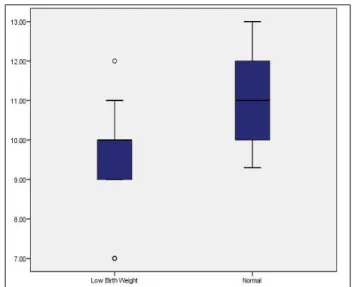
Results: Majority of mothers were in the age group of 20 to 24 years of age group, were educated up to primary school and belonged to Hindu religion. The mean calf circumference of low birth weight babies was 9.64±1.13 cm and was 10.96±1.01 cm in normal weight babies. The mean values of calf circumference were significantly lower in low birth weight babies (p <0.001). The sensitivity and specificity for the best cut off of calf circumference was found to be 89.97% and 42.86% respectively.
Conclusions: Measuring calf circumference was found to be a good test with higher sensitivity but lower specificity. Hence, calf circumference can be used as an alternative method to screen babies born in remote areas, where the facility of weighing the baby at birth is not available.
Keywords: Calf circumference, Low birth weight, Newborn
children in India are not weighed at birth.4 Many
measures are being taken to increase the institutional delivery in India; but, some studies still report home deliveries occurring in rural and urban poor families.5-8
According to UNICEF estimates, the institutional delivery rates are 90.9%. The remaining 9.1% are deliveries at home.9
So, taking accurate weight is a problem due to unavailability of weighing scale and trained personnel. There is a constant search to find newer methods to detect low birth weight babies so that early methods can be instituted. Several studies have mentioned the surrogates to measurement of birth weight as in remote and rural areas mostly proper weighing machine is not available. 10-20 So, this study was conducted to evaluate calf
circumference as procedure to screen low birth weight babies in tertiary care hospital in Nagpur.
METHODS
A cross sectional study was conducted in tertiary care hospital of Nagpur, Maharashtra for a period of 4 months. The study subjects were babies delivered at the hospital. All babies delivered during this period were included in the study. Babies with congenital anomalies and serious illness were excluded from the study. Permission from institutional ethics committee was sought before initiation of the present study.
A study conducted by Taksande A et al found that the specificity for calf circumference to be 75.6%.13 Using
this specificity, 95% confidence interval and 11% allowable error the minimum sample size was found to be 179.21 We included 200 babies for convenience of
calculations. Post-natal mothers were interviewed after
obtaining informed consent using pre-designed
questionnaire. The data instrument included age, educational status, and religion, type of delivery and gender of the baby. Educational status was classified using the Indian standard for classification of educational status and classification of religion was based on Census of India.22-23 Birth weight was recorded using a digital
weighing scale within 24 hours of the delivery. Length, calf circumference, head and chest circumference were measured according to standard guidelines.24 Birth weight
was classified using the World Health Organization guidelines into low birth weight and normal birth weight.2 Statistical analysis:
Data was collected and compiled using EPI Info version 7.2. Qualitative variables were expressed in percentages. Continuous variables were expressed in mean and standard deviation. The difference between two means was computed using unpaired t test. Box and Whisker plots were used to depict the calf circumference in both low birth weight and normal weight babies. Statistical Software for Social Sciences was used to calculate the
Pearson’s correlation coefficient between calf
circumference and birth weight. Receiver operating
characteristic curves were constructed. Further
sensitivity, specificity, positive predictive value, negative predictive value and diagnostic accuracy were calculated for the best cut off point of calf circumference.
RESULTS
Table 1 shows the socio demographic characteristics of the study population. Majority of mothers were in the age group of 20 to 24 years of age group, were educated up to primary school and belonged to Hindu religion. A total of 113 children were delivered by Caesarean section and majority were males. Among 200 children, 21% were low birth weight according to World Health Organization classification.
Table 1: Socio demographic characteristics of the study population.
Demographic characteristics
Number
(n=200) Percentage
Age group of mothers*
<20 8 4
20-24 100 50.00
25-29 85 42.5
30-35 7 3.5
Educational status of mother$
Illiterate 11 5.5
Primary 78 39
Upper primary 45 22.5
Secondary 30 15
Senior secondary 32 16
Graduate and above 4 2
Religion
Hindu 96 48
Muslim 55 27.5
Sikh 4 2
Buddhist 37 18.5
Others 8 4
Type of delivery
Normal delivery 87 43.5
Caesarean section 113 56.5
Gender of the baby
Male 121 60.5
Female 79 39.5
Birth weight of the baby
<2.5 kg 42 21
≥2.5 kg 158 79
*In years; $: Based on Indian Standard of Educational Classification
circumference were significantly lower in low birth weight babies (p<0.001).
Figure 1: Scatter diagram showing correlation between calf circumference and birth weight of the
study subjects.
Figure 2: Box and Whisker plots of calf circumference in low birth weight and normal birth weight babies.
Figure 3 shows the receiver operating characteristic curve for calf circumference. The area under curve was 0.80 (0.73 to 0.87) and the best cut off was 9.75 cm of calf circumference. The sensitivity and specificity for the best cut off off calf circumference was found to be 89.97% and 42.86% respectively.
Table 3: Evaluation of calf circumference.
Best
cut off* Sensitivity Specificity
Positive
predictive value
Negative predictive value
Diagnostic accuracy
9.75cm 89.97% 42.86% 85.54% 52.94% 80%
*Based on ROC curve analysis
Figure 3: Receiver operating curve for calf circumference.
DISCUSSION
One of the high-risk groups among under 5 children in low birth weight babies. Since, they have significantly
higher chances of morbidity and mortality. This cross-sectional study was conducted to evaluate calf circumference as procedure to screen low birth weight babies. In the present study, 21% of the study subjects were low birth weight category. We found a moderately positive correlation between calf circumference and birth weight of the babies. On receiver, operating characteristic curve analysis calf circumference can be used as a good test to differentiate low birth weight babies. A cut off point of 9.75 cm calf circumference yielded 89.97% sensitivity and 42.86% specificity.
A study by Kakrani V et al and Sumeetha B et al found the Pearson’s correlation coefficient between calf circumference and birth weight to be 0.72 (p<0.001) and 0.70 (p <0.001) respectively.12,11 This was in accordance
with the present study findings. Higher coefficients were reported by Sunil Kumar P et al, Kulkarni YR et al, Alia RA et al, Kaur M et al, Jyoti SD et al, Das JC et al and Kumar S et al.10,14-16,18,20 A study by Kulkarni YR et al
found the best cut off of calf circumference to be 9.6cm. Similar studies by Taksande A et al reported 9.75 cm,
0 0.5 1 1.5 2 2.5 3 3.5 4
6 8 10 12 14
B i r t h
w e i g h t
Sumeetha B et al as 9.7 cm and Kumar SP et al as 9.8 cm as their best cut off to screen the infants.10,11,13,14 These
studies were in accordance with the present study. Higher cut off points were reported by Kumar S et al, Das JC et al, Kusharisupeni et al and Jyoti SD et al.10,16-18
Present study had higher sensitivity and lower specificity for cut-off point of calf circumference in screening the infants. Similar results were found by Jyoti SD et al and Kusharisupeni et al.16,17 But, some studies conducted by
Kumar S et al, Das JC et al, Kulkarni YR et al, Taksande A et al and Sunil Kumar P et al found higher specificity for their cut off point.10,13,14,18 Based on the area under
curve, we found that calf circumference can be used as a good test to screen the infants. Similar results were found by study conducted by Kusharisupeni et al.17
These values which we have found are from one hospital and one geographical location. So, generalizability to whole of the population will be an issue. In spite of these limitations, calf circumference is an easy and feasible method to screen babies born in remote areas.
CONCLUSION
In the present study, calf circumference correlated moderately with birth weight of the babies. Measuring calf circumference was found to be a good test with higher sensitivity but lower specificity. Hence, calf circumference can be used as an alternative method to screen babies born in remote areas, where the facility of weighing the baby at birth is not available. Larger studies with more representative population using the uniform standardised techniques have to be conducted to obtain precise results.
Funding: No funding sources Conflict of interest: None declared
Ethical approval: The study was approved by the Institutional Ethics Committee
REFERENCES
1. WHO Global nutrition targets 2025: Low Birth
Weight Policy Brief. 2012. Available at
http://www.who.int/nutrition/topics/globaltargets_lo wbirthweight_policybrief.pdf
2. World Health Organisation: Low birth weight fact
sheet. Available at
www.who.int/whosis/whostat2006NewbornsLowBi rthWeight.pdf.
3. Maternal, newborn, child and adolescent health.
Available at
http://www.who.int/maternal_child_adolescent/topic s/newborn/care_of_preterm/en/
4. Multiple Indicator Cluster Survey Manual 2005: Monitoring the situation of children and women.
Available at
http://mics.unicef.org/files?job=W1siZiIsIjIwMTUv MDQvMDgvMDgvMjgvNTIvODQ2L01JQ1MzX0
NoYXB0ZXJfMF9fX1RpdGxlX1BhZ2VfYW5kX0 NvbnRlbnRzLnBkZiJdXQ&sha=9434bf73f759e625
5. Janani Suraksha Yojana. Available at
https://www.nhp.gov.in/janani-suraksha-yojana-jsy-_pg
6. Thind A, Mohani A, Banerjee K, Hagigi F. Where to deliver? Analysis of choice of delivery location from a national survey in India. BMC Public Health. 2008;8:29.
7. Das S, Bapat U, More NS, Chordhekar L, Joshi W,
Osrin D. Prospective study of determinants and costs of home births in Mumbai slums. BMC Pregnancy Childbirth. 2010;10:38.
8. Devasenapathy N, George MS, Jerath GS, Singh A,
Negandhi H, Alagh G, et al. Why women choose to give birth at home: a situational analysis from urban slums of Delhi. BMJ Open. 2014;4(5): e004401. 9. Maternal of newborn disparities in India. Available
at
https://data.unicef.org/wp-content/uploads/country_profiles/India/country profile_IND.pdf
10. Sunilkumar P, Sudarshan K, Kumari V. A
comparative study of calf circumference with other anthropometric measurements to measure low birth weight babies at risk: a hospital based study. J Evol Med Dent Sci. 2013;2(12):1958-65.
11. Suneetha B, Kavitha VK. A Study of relationship between birthweight and various anthropometric parameters in neonates. IOSR J Dent Med Sci. 2016;15(2):50-7.
12. Kakrani V, Holambe V, Garad S, Gupte A.
Alternative predictors of low birth weight. Indian J Prev Soc Med. 2008;39(3):161-4.
13. Taksande A, Vilhekar KY, Chaturvedi P, Gupta S, Deshmukh P, Able T. Predictor of low birth weight
babies by anthropometry. J Trop Pediatr.
2007;53(6):421-3.
14. Kulkarni Y. Comparison of various anthropometric parameters as predictors of the birth weight in newborns. Int J Sci Res. 2016;5(3):728-30.
15. Kaur M, Singh Z, Kaur G, Goyal LD. Correlation of
birth weight with other anthropometric
measurements of newborns. Indian J Basic Appl Med Res. 2013;8(2):870-9.
16. Jyothi S, Gopal K. Utility of anthropometric measurements to predict low birth weight newborns. Int J Pediatr Res. 2016;3(11):781-91.
17. Kusharisupeni, Putra WKY, Achmad EK.
Anthropometric measurements for detecting low birth weight. Paediatr Indones. 2013;53(3):177-80. 18. Das J, Khanam S, Afroze A, Paul N. Comparative
evaluation of anthropometric parameters in
detecting low birth weight infants. Ulutas Med J. 2015;1(1):10-5.
19. Taksande AM, Lakhkar B, Gadekar A.
Anthropometric measurements of term neonates in tertiary care hospital of Wardha district. Al Ameen J Med Sci. 2015;8(2):140-3.
20. Alia RA, Mannan MA, Fatema K, Begum F.
anthropometric variables in detection of low birth weight (LBW) babies. J Dhaka Natl Med Coll Hos. 2011;17(1):29-32.
21. Hajian-Tilaki K. Sample size estimation in diagnostic test studies of biomedical informatics. J Biomed Inform. 2014;48:193-204.
22. Indian Standard Classification of Education, 2014.
Available at
http://mhrd.gov.in/sites/upload_files/mhrd/files/stati stics/InSCED2014_0.pd
23. Distribution of population by religion. Available at censusindia.gov.in/Ad_Campaign/drop_in.../04-Distribution_by_Religion.pdf
24. WHO. Physical status: the use and interpretation of
anthropometry. Report of a WHO Expert
Committee. World Health Organization technical report series. 1995:1-452.
Cite this article as: Sheikh AR, Thakre SS, Thakre S, Patil CR, Petkar PB.Evaluation of Calf