152
QUALITATIVE AND QUANTITATIVE ANALYSIS OF RED WINES
ANTHOCYAN
MARKOVIĆ, N.1A, MENKOVIĆ, N.2
1Belgrade University, FacultyofAgriculture, Department for horticulture, Belgrade, Serbia; 2 Institute for the study of medicinal herbs „Dr Josif Pancic“
1a coresponding author e-mail: [email protected]
Key words: Hilandar, Merlot, Cabernet Fran, Cabernet Sauvignon, wine, anthocyanins, sugar, acids
ABSTRACT The most important quality
parameters of colored wines are analyzed in the paper, with special reference to qualitative and quantitative anthocyanins content. Anthocyanins possess a diverse biological activity such as antioxidant, anti-inflammatory, anticancer, cardio protective, anti-atherogenic, as well as activity in reducing diabetic risk and prevention of cognitive functional disorders. Basis of analyzes is related to typified varietal (monocomponent) and "Cuvée" (mixed) wines made in Greece - on Mount Athos - at the Hilandar monastery and in Serbia, in comparison with wines of similar composition from other viticultural world areas.
Wines of Hilandar are distinguished with high anthocyanins content, both in mixed combination and monocomponent wines-from 101.4 mg/L for the Savino Polje wine of 2010, to 781.3 mg/L for the Cabernet Fran varietal wine from 2016. The most important anthocyanins in wines
of Hilandar are malvidins. Younger wines contain from 151.9 mg/L to 671.0 mg/L malvidin ingredients. In addition to malvidins, these wines also contain a significant amounts of peonidine and vitizine A. Concerning a content of sugar and total acidity in must, superior clones of Merlo variety are -181, 345, 346, in which sugar content in must varying in range from 23.8-31.6%, while total acids content varying in range from 6.1-9.2 g/L in some vintages. Cabernet Fran clones 210 and 214 are complemented by yield and grape quality (a sugar content in must is ranges from 22,8-27,4%, total acidity 5,8-8,7 g/L). For Cabernet Sauvignon clones 15, 169 and 337 sugar content ranged from 23.6-28.2%, and total acidity was 5.5-7.8 g/l.
Such sugar to acid ratio in listed varieties resulted with alcohol content of 13.5-15.5 vol.% and with a number of varietal characteristics complemented with minerality, specific fragrances and other indicators of superior wines.
INTRODUCTION Having in mind actuality of testing of
certain anthocyan compounds in wine due to their importance in biological, enological, medical, chemical and pharmacological science and practice, at the paper we are presenting a synthesis of several years of research in this field, which were running at the Institute for medicinal plants "Dr. Josif Pančić" Belgrade and the Faculty of Agriculture of the University of Belgrade.
153
activity of lowering diabetic risk and prevention of cognitive functional disorders. The basis of the analyzes carried out is related to typified varietal (monocomponent) and "Cuvée" (mixed) wines made in Greece - at the peninsula of Mount Athos - as well as those made in Serbia, which were compared with the similarly composed wines that originating from other viticulture areas in the world.
Mount Athos, a most eastern of the three peninsulas at Halkidiki in Northern Greece, is named according to the mountain on its very end coast, which suddenly rises to 2030 m over Aegean Sea. The Athos peninsula is approximately 50 km long, and 5 to 12 km wide. Since it is for over a thousand years a hub of monks in numerous monasteries and sketes, the Athos is also called the Holy Mountain, in Greek, "Agion Oros". Today it is organized as autonomous region of the modern Greece, the unique community that is self-governed by Orthodox Christian monks.
First viticulture and wine making at Athos area was recorded by Herodotus. With a monastic culture that raised there after the Antiquity, a viticulture and wine making were well preserved. Athonite monastic wine even become famous as a trading brand in Byzantine world. A visible decline of winemaking due to the Ottoman rule, at Athos was relative, comparing to the rest of Balkan. Monasteries has not trading anymore, but they were remaining as an important link in cultivating and making wine for their purposes, until modern age.
The Hilandar Monastery, whose wine is of an interest for our work, is located on the northeast side of the Mount Athos. Although it has been founded before 1015., the Hilandar Monastery was deserted much before 1198. when it came to the patronage of a former ruler of Serbia, the Great Prince Stefan Nemanja, at the time monk Simeon, and his youngest son monk Sava. They have restored it and
reestablish as a Serbian Monastery of so called "Monastic Republic" of Mount Athos.
Supported by all of successors of Nemanja at the Serbian throne, Hilandar Monastery has become a spiritual and intellectual center of Serbian Christianity and Culture through centuries. Within Serbian history until today it’s remains a symbolic institution of continuity and antiquity, as well as of the monastic ethos.
To the purpose of our paper it is good to mention that the Hilandar Monastery was oldest recorded Serbian vinicultural and winemaking entity that continuously grown grapes and making wine each year since it has been established until today.
By using knowledge gained through immediate sightseeing of the Hilandar Monastery's estate, having insight into necessary documentation that was available, while sampling of soil from vineyard and wine from the Hilandar winery, as well as applying of appropriate scientific methodology we have been designed this paper as a synthesis of obtained results, as their interpretation and appropriate comparison with a results of the relevant researches that are available in the professional and scientific literature.
154
planted, respectively. All planted grafts have been grafted on the vine substrate Р110. All plantations are positioned in the row with the planting distance 2.5 х 1.0 m directions of the rows southeast-northwest, except table 8 where rows are positioned north-south.
All of the vintages, manually performed during the period 2010-2016, has gained expected yield. Expected quality of the grapes was also achieved of all of the mentioned varieties and their clones. Grape processing was performed using standard techniques with the aid of contemporary machines and equipment (grape and wine press, stainless steel vinification tanks, tanks for wine stabilization and aging, peristaltic and mono pumps, cooling systems etc.), as well as wooden tanks from 225 and 5000 L which were used for wine aging. The treatment of wine producing and maintenance have been performed in accordance with the standard methodology used for making the red wines, following the principles of open and closed fermentation using suitable enological
means during the fermentation process, wine maintaining, pre-preparation for bottling and the bottling itself.
This paper is dealing with the most important parameters of quality of the Hilandar wines, with the special focus on the qualitative and quantitative content of anthocyanin compounds in wine.
In addition to previous facts, it should be pointed that biosynthesis of anthocyanin is in direct correlation with soil quality, climatic conditions related to vine cultivation, selected cultivars, technology of planting and applied ampelotechnique, as well as with the ways and conditions used for vinification. Having in mind that the quality of a wine is very dependent on the content of anthocyanin compounds, the idea to place these compounds at the researching focus of the quality of Hilandar wines, has been confirmed by obtained results. These results point out to the highest quality of Hilandar wines and the high degree of positive differentiation in comparison to wines of the same or the similar cultivar composition of other manufacturers.
MATERIALS AND METHODS In the new Hilandar vineyard, on the
Field of St. Sava location, at the largest part of the area of around 15 ha, is cultivated with the following noble Euro/Asian grapevine cultivars: Merlot, Cabernet Sauvignon, and Cabernet Franc. These cultivars are characterized by high-quality grape which is used for the production of top quality black and red colored wines.
Grapes of the selected cultivars in this area ripe successively during the second half of August and September, which enables that harvest of the different cultivars is taking place gradually and can be performed with the smaller number of workers hired for the harvest. Also, this enables quality processing of the grapes and care for the produced young wine. All
these cultivars have been grafted onto grapevine substrate .Р110 (Berlandieri × Rupestris R110).
155
mildew, while relatively solid resistant to gray mold. Resistance to low temperatures is another trait of the cultivar. The highest production for this cultivar is obtained with mixed pruning, with cane length of 10-12 buds. It belongs to a group of low to medium-yield cultivars. Depending on the clone, a yield of Merlot varies from 8,000 to 11,000 kg/ha. Selected clones 181, 346 and 347 differ from each other by their yield, content of accumulated sugars and acids, as well as the synthesis of aromatic compounds.
Cabernet Franc is French grape variety grown in France, Italy, Spain, Portugal, Russian Federation, Ukraine, Moldova, Romania, Bulgaria, Serbia, Greece, etc. It is characterized by lush grapevine, morphologically and functionally hermaphroditic flowers. The berry is oval and medium-sized. The skin is medium thick, blue-black color and covered with bloom. The cluster is medium sized and medium compact, with a conical shape. This cultivar is moderately resistant to downy mildew and powdery mildew and resistant to gray mold. It is highly resistant to low temperatures. Depending on the applied cutting technique the yield for this cultivar can variate from 9000 to 150000 kg per hectare. The wine is very drinkable, varying in color from light to dark rubin red. Flavor and taste of the wine are varietal characteristics. The flavor profile of Cabernet Franc wine is herbaceous. During aging its quality increases. During coupage, it fits adequately with wines obtained from cultivars Cabernet Sauvignon and Merlot. Clones 210 and 214 are in the category of those wines that give the most intensive flavor characteristic for this cultivar.
Cabernet Sauvignon is cultivated for purpose of producing high quality and quality colored wines. It originates from France where it is mostly cultivated today. During the last decades, it is intensively expanding in the vine growing regions of
Greece. It is characterized by lush vine, normal flower and regular and good fertilization. The berry is oval and medium-sized with dark-blue color. The cluster is medium sized, with a conical shape and average berry mass from 90 to 120 g. This cultivar is moderately resistant to downy mildew and powdery mildew and very well resistant to gray mold. Also, it is highly resistant to low temperatures. The average yield of grapes fluctuates greatly, depending on used clones, applied growing technique etc. Most often yield is around 8.000 kg/ha. It represents excellent raw material for the production of high-quality wines. The Cabernet Sauvignon wine is of very good quality and with has a specific flavor which resembles the smell of violet. The color of the wine is dark rubin red. These wines are very good for the coupage in order to fix the quality of wines obtained from other colored cultivars. Clones 15, 169 and 337 are usually used for the preparation of wine with intensive color and specific flavor which complement final wine bucket.
156
1. Grape crushing,
2. Sulphitation of the must,
3. Adding of yeast pure culture to the must in order to produce alcohol fermenation,
4. Draining of fermented must, 5. Sulphitation of young wine, 6. Precipitation of young wine,
7. Separation of precipitate from wine – the first rack of the new wine (middle of October),
8. The second rack of the wine (beginning of December),
9. Transfer of the wine into pots for wine aging,
10. Wine clarification,
11. Wine filtration and bottling.
In the process of grape crushing the skin of the berries is damaged which enables faster flowing of the juice. During the crushing stems and seeds were not squeezed. Modern winepress has been used (electrical) with stem separator. Crushed grape reached the metal vinificators (for “closed” fermentation) and plastic vats (for “open” fermentationу). During the grape crushing, sulphitation of the must with potassium metabisulfite in the form of powder has been performed by sprinkling it over the layers of must in the vessels for fermentation. At the same time, wine yeast strains have been added. These strains are resistant to higher amounts of sugar, or higher amounts of alcohol in the must, they can bear higher temperature span and are richer with certain enzymes.
About 30% of the vessels volume in which fermentation process took place was free. “Orchestrated” fermentation started when the temperature of the must reached 15 – 18 °C. During the fermentation, the temperature of the must increase, but it was not higher than 23 – 26 °C. On average, fermentation process lasted 10 – 25 days.
In the rooms where fermentation took place, the temperature was between
18 – 20 °С. The drainage of the fermented must was performed using a pneumatic press. After separation of the free-run juice, shaking of the husks have been performed as well as the additional wine drainage. The drained wine has been left for precipitation (during 12 hours) and then racked into vessels where the silent fermentation has been performed.
After the second racking the wain was transferred to the wooden barrels of 225 and 5000 L for aging and maturation during 6 – 48 months, depending on the age of the vessels and the level of extraction from the oak. After aging, until filtration and bottling, the wine was placed in inert, metal inox vessels with adequate measures of care and quality control.
The content of sugar in the must has been determined using Oechslemeter, an instrument that measures the density of the must which is expressed in Oechsle degrees (Оео). Oechsle degrees represent the difference between water density on 4 оС and must density at the same
temperature. The percent of accumulated sugar is calculated on the base of the formula: % sugar=оОе × 0.266-3.
The content of total acids has been determined by process of neutralization of all acids in the must using the solution of sodium hydroxide (NaOH). The content of acids can be calculated using the following formula:Total acids (g/L) = The volume of spentNaOH × 0.75 × F, where F is the base concentration (factor of base normality).
The content of alcohol in wine, the specific gravity of wine, the content of total and free sulfur dioxide, pH of wine, as well as other parameters of quality have been determined using the standard laboratory physical and chemical methods.
157
2010-2016, „Merlot“, „Cabernet Franc“ and „Cabernet Sauvignon“ (monocomponental wines)produced in 2015 and 2016, as well as in commercial wines: „Aleksandar“ (producer „Bovin“, Macedonia, year of production 2014), „Cabernet Sauvignon“ (producer „Errazuriz“, Chile, year of production 2014), „Zavet“ (producer „Winery Janko“, Serbia, year of production 2015) and „Ergo“ (producer „Temet“, Serbia, year of production 2015).The obtained results have been compared with the available literature data about the qualitative and quantitative content of wines made from the same or similar cultivars and coupage from Brasil, Uruguay, Chile, Australia, France, Greece and other countries.
Spectrophotometry analisys The identification of total anthocyanin content was
donespectrophotometry method regulated by Ph. Eur. 8.
HPLC DAD analisys
The HPLC analisys was done using Agilent 1200 (Agilent Technologies, Palo Alto, CA, USA) connected to an Agilent 1100 Series HPLC instrument (Agilent Technologies, Waldbronn, Germany), with a degasser(DAD) model G1315B, a binary pump model G1312A, an autosampler model G1313A, a column compartment equipped with a Zorbax SB-Aq column (5 µm, 4.6 mm × 250 mm).
Before HPLC analisys skin berry extract was fitred thgrough membran filter (0,45 μm). As mobile phaye was used combination of water, formic acid and acetonitril in ratio 87:10:3 (v/v/v) (fase A) i 40:10:50 (v/v/v) (fase B). Injektion sample volum was 50 μl, and elauuation was done in gradient on next rule: 0-15 min, 6-30 % B; 15-30 min, 30-50 % B; 30-35 min, 50-60% B, 35-41 min, 60-6 % B. UV
absorbtion it was mesured on 520 nm. Column temperature was 40ºC.For quantitative anthocianyn analisys used calibrated curves make after injecton of standard cocentration standards of malvidin, delfinidin, pheonidin and petunidin.
HPLC-MS аnalisys
The identification of anthocyanin compounds was done using 6210 Time-of-Flight LC–MS system (Agilent Technologies, Santa Clara, California, USA) connected to an Agilent 1100 Series HPLC instrument (Agilent Technologies, Waldbronn, Germany), with a degasser, a binary pump, an autosampler, a column compartment equipped with a Zorbax SB-Aq column (5 µm, 4.6 mm × 250 mm) and a diode-array detector, via ESI interface.
The mobile phase consisted of water containing 10% formic acid (v/v) and 3% (v/v) acetonitrile (A) and acetonitrile containing 40% water (v/v) and 10% formic acid (v/v) (B). Injekciona zapremina je iznosila 10 μL, a eluiranje je vršeno gradijentom po sledećoj šemi: 0-15 min, 6-30 % B; 15-6-30 min, 6-30-50 % B; 6-30-35 min, 50-60% B, 35-41 min, 60-6 % B, 41-46 min, 6 % B. Spectral data was collected in range from 190-900 nm.
Full scan mass spectra were measured between 100 and 1500 m/z in positive ion mode. For electrospray ionization positive ESI ionization mode has been applied with the following conitions: capillary voltage 4000 V, fragmentor voltage 140 V, skimmer voltage 60V, OCT RF voltage 250V. For drying and evaporation nitrogen was used (pressure 45 psi, temperature 350 °C, flow rate 12 L/min).
Anthocyanin ratio
158
groups, as well as anthocyanin coefficients have been calculated:
∑Df = (Df-3-О-glucoside + Df-3-О -(6′-p-coumaroyl)-glucoside)
∑Cy = (Cy-3-О-glucoside +Cy-3-О -(6′-acetyl)-glucoside)
∑Pt= (Pt-3-О-glucoside + Pt-3-О -(6′-acetyl)-glucoside)
∑Pn= (Pn-3-О-glucoside + Pn-3-О -(6’-p-coumaroyl)-glucoside)
∑Mv = (Mv-3-О-glucoside + Мv-3-О -(6′-p-coumaroyl)-glucoside + Mv-3-О -(6′-acetyl)-glucoside + Mv-3-О-(6′-p -coumaroyl)-glucoside-5-О-glucoside)
∑Non-acylated = (Df-3-О-glucoside + Pt-3-О-glucoside + Pn-3-О-glucoside + Mv-3-О-glucoside + Vitisin А)
∑Acetyl derivatives = (Мv-3-О -(6′-аcetyl)-glucoside- + Pt-3-О -(6′-acetyl)-glucoside)
∑Coumar = ∑Coumaroylated derivatives = (Df-3-О-(6′-p -coumaroyl)-glucoside + Мv-3-О-(6′-p -coumaroyl)-glucoside-5-О-glucoside + Pn-3-О-(6′-p -coumaroyl)-glucoside + Мv-3-О-(6′-p -coumaroyl)-glucoside)
∑Мv/∑Pn – the value of this coefficient points out towards the high activity of flavonoid-hydroxylase, the
enzyme responsible for hydroxylation, and also о-dihydroxy-transferase, the enzyme responsible for methylation of оrtо dihydroxy groups in the anthocynin molecule. High activity of о-dihydroxy transferase favors formation of the high content of malvidin derivatives – non-acylated glucosides, acetylated and coumaroylated derivatives of these glucosides.
∑Coumar/∑Acetyl – this coefficient directly points out towards the activity of enzyme coumaroyl-transferase. This coefficient has no impact if its value is lower than 3.
∑Мv+∑Pt+∑Df/∑Pn – this coefficient directly points out toward the activity of flavonoid-3-О-hydroxylase. In the case that the enzyme is highly active, the formation of trisubstituted derivatives is favorized, on the other hand, the content of disubstituted derivatives increases.
∑Df/∑Pn and ∑Pt/∑Pn – their values point out towards the activities of enzymes hydroxylases and methyltransferases. In the case that the both enzymes are highly active high accumulation of delphinidin (Df) and petunidin (Pt) is expected.
RESEARCH RESULTS
Climatic conditions
Favourable ecological conditions for cultivating vine in the Hilandar area have been determined on the grounds of the meteorological data for the area of Thessaloniki, which originates from the meteorological station which is the closest to the Hilandar monastery. The area is known as the Sava's field, which is on the road leading from the monastic cell of St. Vasilije leading towards the monastery complex. The total area of the parcel under the new vineyard is around 15 hectares. The bigger part of the parcel has been exposed towards Nort-West and the smaller area towards Nort-East. From the
northern side, the see is at the distance of 50 m. Through the middle of the parcel, there is a regulated water channel which collects surface runoff after heavy rains and leads them to the natural water channel – small river leading to the sea. The forest vegetation has been cut down around this parcel in order to obtain a regular form of the vineyard and to enable to use mechanization in the vineyard without any obstacles.
159
during springtime are more favorable compared to the autumn ones, which is the characteristic of the maritime coastal climate. It has ben confirmed by Kerner’s thermodromic coefficient of 8.84%.
The coldest is the January, and the warmest is July followed by August when medium temperatures are higher than 20 °C, which is very important for obtaining grapes of the very good quality.
The medium temperature of the vegetation period (April-October) is 21.2 °C.
The period of the vine vegetation begins in this area on the 20th of March and ends on the 22nd November taking for biological zero the medium daily temperature of the air of 10°C. Average vegetation period is 247 days. The sum of the active temperatures of the air (medium daily temperatures of the air equal or higher than 10 °C) for the period of vegetation is 4009.8 °C, which is sufficient for grape ripening from the earliest to very late grapevine cultivars.
Maximal temperatures of the air are very high at the beginning of the vegetation period but also at its end, which can be considered as favorable. The highest temperatures are appearing in July with an absolute maximum of 42 °C observed during 30 year time. Minimal temperatures are lowest in January, and the lowest ever in the documented period was –14 °C. Absolute year variation of the air temperature is 56 °C.
According to the data relevant to the minimum temperature of the air, it can be concluded that days with frost appear during the period from October until April. The possibility of an appearance of the negative air temperatures during the period of grapevine vegetation (April), as well as during the final stage of vegetation (October) it can be more relevant for possible damage of some green vine parts.
The duration of the sunshine in the area of Thessaloniki changes regularly
during the year. From the shortest duration in January (99 hours) it grows until July (326 hours) and then again decreases until the end of the year. It should be emphasized that duration of the sunshine has a very favorable value already at the beginning of the vegetation period and that it is much higher in autumn than in springtime, which is very important for the successful grape ripening.
Based on the annual sum of sunshine hours (2340 hours), it can be concluded that the conditions of sunshine in this area are favorable. During
vegetation season sun shines (1768 hours) in other words 76% of the annual sum.
In the area of Atos, the greatest relative air humidity is during the winter months. Advancing towards the summer months it decreases, in July it is 53%, and on August 56%. Then it rises again during autumn and winter months. This means that in this area, apart from an insufficient quantity of rainfall, the intensive evaporation is also possible.
Rainfall regime have a maritime character, meaning Mediterranean, which is characterized by the great frequency and quantity of rainfall during winter part of the year, and especially in the late fall. A secondary maximum of the rainfall occurs in March or April. The summers are dry, with the lowest quantity of rainfall during the hottest months, July and August.
160
annual fluctuation of the rainfall is 8% of the annual rainfall sum.
The lowest potential evaporation is in January (39 mm) and increases until July (224 mm) and than decreases towards the end of the year. This is the similar pattern for the potential evapotranspiration. The annual sum of evaporation from the soil surface under grapevine, meaning vegetation is following the data from the Table 3 considerably larger than the annual sum of rainfall. The annual distribution of humidity deficit in the soil is presented in the table 3 column H – E. Period from January until October have a humidity deficit meaning until the end of vegetation. In the vegetation period, from April until October, the humidity deficit is 667 mm.
According to the data, the winds in the area have been with moderate equable speeds during winter months. The greatest speeds have winds in Jun and July.
The calculated value of bioclimatic index is 1270, which can be considered as favorable value for grapevine cultivation.
Soil conditions
Agrochemical analysis represents results of the analysis of the soil samples which can be taken from the total plantation area. According to the sampling methodology, samples represent the average samples of the layers 0-30 cm and 30-60 cm and they are part of the regular control of the plantation fertility, which is conducted from the time of its establishment. The general agrochemical indicators, such as soil acidity (pH), humus content, accessible nitrogen (NH4+NO3), content of accessible phosphorous and potassium, are closely connected with the appropriate choice of the substrate and soil type, and they have indicated that the agrochemical potential for the grapevine cultivation on this parcel is good, however their agrochemical characteristics considerably variate depending on the part of the parcel and heterogenic composition
of geological substrate or the character of the alluvion.
The soil have a good agrochemical characteristics, originates from acid rocks which have been additional washed away after being brought on the designated surface. This influenced the acidity of this soil with pH value in the water around 6, or even lower in potassium-chloride (pH in KCl from 4.80 to 5.5). On one group of the parcels, the soil is carbonated, formed on the carbonate substrate, typical for the Mediterranean, which apart from the alkaline reaction (pH in water > 7.5) contains carbonates as well (1.5-18.69%).
161
Based on the obtained values about the presence of the certain soil fractions, classification of the soil was done. Soil is classified in clay and sandy loam soils. Based of everything mentioned here, it can be concluded that the mineral chemical composition of the examined soil mainly depends from petrographical characteristics, and all physical and chemical characteristics, dominant are metamorph rocks with small percent of sediment and magmatic rocks.
Main characterisitcs of wine and must
The parameters of quality of the Hilandar grape and wine are reflected in the content of sugar and total acids in the must, the content of alcohol in the wine, specific gravity of the wine, presence of certain minerals in the wine, aromatic compounds etc. The ones that especially stand out are superior clones of cultivar Merlot – 181, 345, 346 which have the content of sugar in the must between 23.8 and 31.6%, while the content of total acids varies from 6.1 to 9.2 g/L depending on the year of the production. Clones 210 and 214 of the Cabernet Franc cultivar are mutually compatible regarding their yield and quality (the content of sugar in the must is 22.8 – 27.4% and the total acids content is 5.8 –
8.7 g/ L). In the clones 15, 169 and 337 of the Cabernet Sauvignon variety, the content of accumulated sugar ranged from 23.6 – 28.2%, and the content of total acids from 5.5 – 7.8 g/ L.
This ratio between sugar and acids among the listed cultivars resulted in the level of alcohol from 13.5 – 15.5 vol.% and with the line of cultivar characteristics supplemented by minerals, specific flavor and other parameters of high-quality wines. The geological substrate (granite rocks), the presence of marble, lime rocks, volcanic tuffs, alluvial conglomerates, climate and appropriate ampelo-technic contribute to specific of total „terroir“ which presents the precondition for obtaining wines of specific quality on the St. Sava field.
Results of study of anthocyanins of monocomponent (varietal) wines
Wine "Merlot" produce in vineyard of Hilandar Monastery
The composition of the wine „Merlot“ produced during 2015 and 2016 was investigated. The total anthocyanins content in these samples was 24.21, or47.31 mg/100 mL. In wine produced in 2016, the most abundant individual anthocyanin compound was malvidin-3-О -glucoside with the concentration 20.26 mg/100 mL.
Table 1 The content of anthocyanin compounds (mg/100 mL) in the wine „Merlot“, the
Hilandar monastery, years of production 2015 and 2016
Peak number Anthocyanin
compound 2015 2016
1 Df-3-O-glc 0.49 0.75
2 Cy-3-O-glc 0.51 0.35
3 Pt-3-O-glc 0.55 0.93
4 Pn-3-O-glc 1.24 1.29
5 Mv-3-O-glc 9.02 20.26
6 Vitisin А 3.13 3.13
7 Df-3-O-glc-ac. 0.56 3.16
162
9 Pn-3-O-glc-ac 0.35 3.70
10 Mv-3-O-glc-ac 4.03 7.30
11 Pn-3-O-glc-coum 0.77 0.90
12 Mv-3-O-glc-coum 3.35 5.13
Total 24.21 47.31
The average relative content of malvidin type of anthocyanins was 68.42 %, while the average relative content of non-acylated anthocyanins was 59.08 %. The values of anthocyanin coefficients
point out towards the high activity of enzymes flavonoid-hydroxylase and о -dihydroxy transferase which are responsible for the creation of malvidin group of anthocyanins.
Table 2
The anthocyanin coefficients in the wine sample „Merlot“, the Hilandar wine, years of production 2015 and 2016
Anthocyanin coefficients 2015 201.
∑Mv/∑Pn 6.95 5.55
∑Coumar/∑Acetyl 0.80 0.41
∑Mv+∑Pt+∑Df/∑Pn 7.72 6.64
∑Df/∑Pn 0.44 0.66
∑Pt/∑Pn 0.32 0.23
In the Hilandar wine „Merlot“ produced in 2016 total anthocyanins content was 47.31 mg/100 mL, the most abundant individual anthocyanin compound was malvidin-3-О-glucoside with the concentration 20.26 mg/100 mL. This value is similar to the one obtained for the wine „Savino Polje“ with the same year of production. The average relative content of malvidin type of anthocyanins was 68.42 %, while the average relative content of non-acylated anthocyanins was 59.08 %. The values of anthocyanin coefficients point out towards the high activity of enzymes flavonoid-hydroxylase and о -dihydroxy transferase which are responsible for the creation of malvidin group of anthocyanins.
According to the literature data in the wine „Merlot“ produced in Macedonia, the content of total anthocyanins was only 91.0 mg/L, while for the most abundant one, Mv-3-О-glucoside, the content was 42.72 mg/L. This means that in the Hilandar „Мerlot“ wine the content of total anthocyanins is 5.20 fold higher compared to Macedonian „Merlot“ wine, while the content of Мv-3-О glucoside is 4.74 fold higher compared to the same wine. Similarly, in the wine „Merlot“ produced in Uruguay, the content of total anthocyanins is 2,62 fold lower, and the content of Mv-3-О-glucoside 2,7 fold lower compared to
163
Table 3
The total relative content of similar anthocyanins (%) and the content of total anthocyanins (mg/100 mL) in the Hilandar wine „Мerlot“, years of production 2015 and 2016, in „Merlot“ wines
originating from Macedonia and Uruguay
Anthocyanin group Hilandra „Мerlot“ „Мerlot“
2015 2016 МK U
ΣDf 4.34 8.26 10.91 6.76
ΣCу 2.11 0.74 4.38 2.62
ΣPt 3.14 2.83 1.68 9.33
ΣPn 9.75 12.45 11.40 7.97
ΣMv 67.74 69.10 61.64 73.08
ΣNon-acylated 61.71 56.46 61.08 62.53
ΣAcetyl 21.27 30.80 25.15 25.77
ΣCoumar 17.02 12.75 13.76 11.61
Total anthocyanins 24.21 47.31 9.10 18.06
Wine "Cabernet franc" produce in vineyard of Hilandar Monastery
In the wines “Cabernet Franc” from the Hilandar monastery, produced during 2015 and 2016, the content of anthocyanin compounds was determined. It was
established that the content of total anthocyanins was 24.31 or 78.13 mg/100 mL, while the content of most abundant anthocyanin compound malvidin-3-О-glucoside was 37.48 mg/100 mL in the wine produced in 2016.
Table 4
The content of anthocyanin compounds (mg/100 mL) in the wine „Cabernet Franc“, the Hilandar monastery, years of production 2015 and 2016
Peak number
Anthocyanin
compounds 2015 2016
1 Df-3-O-glc 0.36 0.39
2 Pt-3-O-glc 0.30 1.12
164
4 Mv-3-O-glc 8.03 37.48
5 Vitisin A 2.79 3.31
6 Df-3-O-glc-ac 0.35 0.49
7 Cy-3-O-glc-ac 3.00 3.78
8 Pt-3-O-glc-ac 0.33 0.45
9 Pn-3-O-glc-ac 0.35 0.17
10 Mv-3-O-glc-ac 4.93 22.56
11 Pn-3-O-glc-coum. 0.18 0.28
12 Mv-3-O-glc-coum 2.93 7.06
Total 24.31 78.13
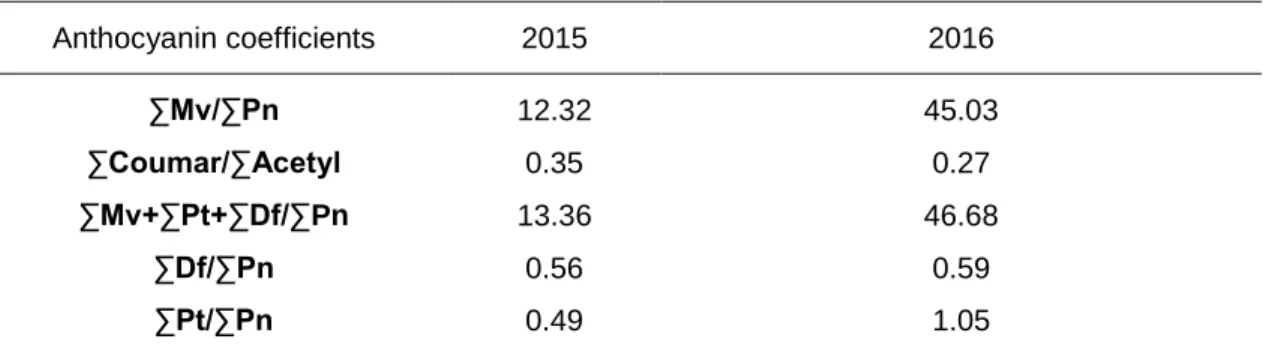
High values of anthocyanin coefficients ∑Mv/∑Pn и ∑Mv+∑Pt+∑Df/∑Pn (45.03 and 12.32, respectively) point out towards the high enzymatic activity of
flavonoid-3-О-hydroxylase, causing the formation of threesubstituted components (Mv, Pt и Df) in higher amounts compared to disubstituted ones (Cy and Pn).
Table 5
The anthocyanin coefficients in the „Cabernet Franc“ wine sample, the Hilandar monastery, years of production 2015 and 2016
Anthocyanin coefficients 2015 2016
∑Mv/∑Pn 12.32 45.03
∑Coumar/∑Acetyl 0.35 0.27
∑Mv+∑Pt+∑Df/∑Pn 13.36 46.68
∑Df/∑Pn 0.56 0.59
∑Pt/∑Pn 0.49 1.05
The total relative content of malvidin group of anthocyanins was 85.88%, while the total relative content of nonacylated anthocyanins was 55.47% in the wine produced in 2016.
Concerning the Hilandar wine „Cabernet Franc“, based on the data
presented in tables the content of total anthocyanins in this wine is 6.22 fold higher, and in the case of the most abundant component Мv-3-О glucoside it is 2.98 fold higher compared to the wine “Cabernet Franc” originating from Brasil.
Table 6
The total relative content of similar anthocyanin compounds (%) and the content of total anthocyanins (mg/100 mL) in the Hilandar wine „Cabernet Franc“, years of production
165
Anhocyanin group Hilandar „Cabernet Franc“ „Cabernet Franc“
2015 2016 B1 B2
ΣDf 2.98 1.13 13.82 16.76
ΣCу 12.39 4.84 0.77 0.81
ΣPt 2.60 2.01 10.66 15.37
ΣPn 5.33 1.91 15.28 10.00
ΣMv 65.63 85.88 59.72 51.95
ΣNon-acylated 50.60 55.47 62.25 67.11
ΣAcetyl 37.01 35.13 27.24 22.20
ΣCoumar 12.85 9.39 7.51 5.58
Total anthocyanins 24.31 78.13 12.56
Besides that, high value for the coefficient ∑Мv/∑Pn in the Hilandar wine points out towards te high activity of the enzyme methyltransferase, which is reflected with the high content of malvidin type anthocyanin derivatives (almost 90%).
Wine "Cabernet sauvignon" produce in vineyard of Hilandar Monastery
The content of anthocyanin compounds was determined in the samples of „Cabernet Sauvignon“ wine produced in 2015 and 2016. The total content of anthocyanins was 26.21 and 50.79 mg/100 mL, respectively. The dominant one was
malvidin-3-О-glucoside (10,79 and 25,82 mg/100 mL.
Malvidin group presented the most abundant group of anthocyanins – in wine produced in 2016, the total relative content of these compounds was 86.61%, and in wine produced in 2015, this content was 77.15%. In the same wine, the total relative content of non-acylated anthocyanins was 55.78%, while in one year older wine this content was 59,03%. High values of two anthocyanin
coefficients ∑Mv/∑Pn and ∑Mv+∑Pt+∑Df/ ∑Pn point out towards the high enzymatic activity of flavonoid-3-О-hydroxylase.
Table 7
The content of anthocyanin compounds (mg/100 mL) in the wine „Cabernet Sauvignon“„ the Hilandar monastery, years of production 2015 and 2016
Peak number Anthocyanin compounds 2015 2016
1 Df-3-O-glc 0.41 0.56
2 Pt-3-O-glc 0.35 0.78
3 Pn-3-O-glc 0.94 0.76
4 Mv-3-O-glc 10.79 25.82
166
6 Df-3-O-glc-ac 0.35 3.16
7 Cy-3-O-glc-ac 0.14 0.33
8 Pt-3-O-glc-ac 0.11 0.41
9 Pn-3-O-glc-ac 0.15 0.21
10 Mv-3-O-glc-ac 6.22 13.39
11 Pn-3-O-glc-coum. 0.72 0.18
12 Mv-3-O-glc-coum 3.21 4.78
Total 26.21 50.79
Table 8
The anthocyanin coefficients of the wine samples „Caberent Sauvignon“, the Hilandar monastery, produced in 2015 and 2016
Anthocyanin coefficients 2015 2016
∑Mv/∑Pn 11.17 38.25
∑Coumar/∑Acetyl 0.56 0.28
∑Mv+∑Pt+∑Df/∑Pn 11.85 45.52
∑Df/∑Pn 0.42 3.23
∑Pt/∑Pn 0.25 1.03
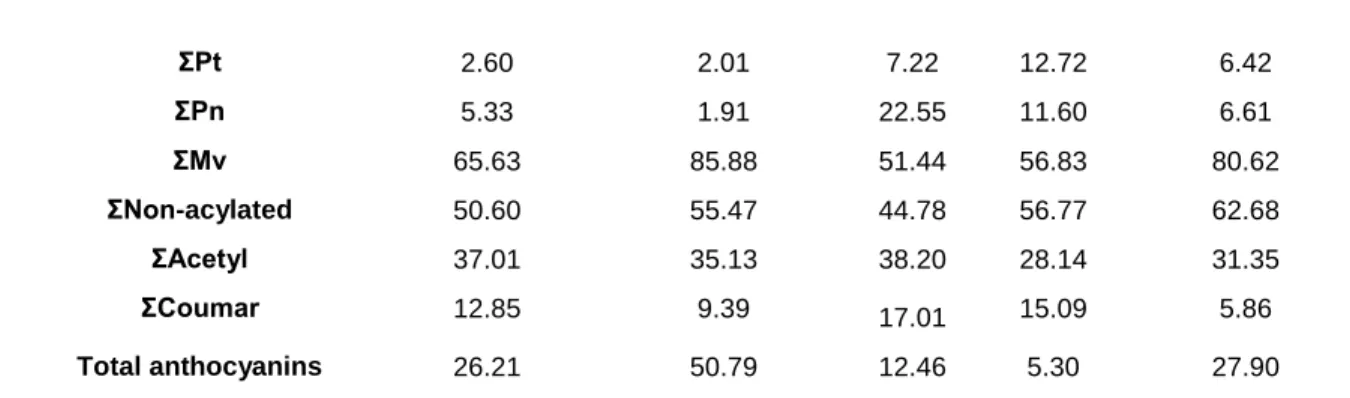
Based on present data content of total anthocyanins in the Hilandar wine „Cabernet Sauvignon“ was 4.08 higher compared to „Cabernet Sauvignon“of the producer „Еrrazuriz“from Chile. Also, the content of total anthocyanins and Мв-3-О -glucoside in the Hilandar wine „Cabernet Sauvignon“ is higher (9.58,and11.87 fold, respectively) compared to their content in
„Cabernet Sauvignon“wine originating from Macedonia. In the same wine produced in Uruguay the content of total anthocyanins is 1.82 fold lower compared to the Hilandar „Cabernet Sauvignon“ wine. The content of Мv-3-О-glucoside in the „Cabernet Sauvignon“wine originating from Uruguay is 3.26 fold lower compared to the appropriate Hilandarwine.
Table 9
The total relative content of similar anthocyanin compounds (%) and the content of total anthocyanins (mg/100 mL) in the Hilandar wine „Cabernet Sauvignon“, years of production 2015 and
2016 and in wines „Cabernet Sauvignon“ originating from Chile (producer „Еrrazuriz“), Macedonia and Uruguay
Anthocyanin type Hilandar „Cabernet Sauvignon“ „Cabernet Sauvignon“
2015 2016 Chile МК U
ΣDf 2.98 1.13 14.69 12.36 4.94
167
ΣPt 2.60 2.01 7.22 12.72 6.42
ΣPn 5.33 1.91 22.55 11.60 6.61
ΣMv 65.63 85.88 51.44 56.83 80.62
ΣNon-acylated 50.60 55.47 44.78 56.77 62.68
ΣAcetyl 37.01 35.13 38.20 28.14 31.35
ΣCoumar 12.85 9.39 17.01 15.09 5.86
Total anthocyanins 26.21 50.79 12.46 5.30 27.90
Having in mind coefficients ∑Мv/∑Pn and ∑Мv+∑Pt+∑Df/∑Pn, their values in the Hilandar „Cabernet Sauvignon“
wine were several times higher compared to the same wine originating from Chile, Macedonia and Uruguay. High values of these coefficients point out towards the high activity of enzyme flavonoid-3-О -hydroxylase that catalyzes the formation of trisubstituted components (Мv, Pt and Df).
Results of research of anthocyanins component of „Savino Polje“wine ,Hilandar monastery
The total content of investigated anthocyanins in the wine samples „Savino polje“, years of production 2010-2016, varied from 10.15 to 42.97 mg/100 mL.
In the older wines, the most abundant individual anthocyanin compound was vitisin A (years of production 2010 and 2011) with the concentration of roughly 2.5 mg/100 mL. In the younger wines (years of production 2012–2016) the most abundant was malvidin-3-О-glucoside; its concentration in the youngest wine was 20.55 mg/100 mL. As the group of similar anthocyanins, the most dominant were malvidin anthocyanins with the total relative content from varying from 43.60to80,61%.
Table 10
The content of anthocyanins (mg/100 mL) in the wine “Savino Polje“,the Hilandar monastery, years of production 2010 – 2016
Peak number
Anthocyanin
compound 2010 2011 2012 2013 2014 2015 2016
1 Df-3-O-glc 0.31 0.33 0.33 0.35 0.44 0.38 0.56
2 Cy-3-O-glc 0.33 0.09 0.08 0.09 0.31 0.09 0.15
3 Pt-3-O-glc 0.28 0.11 0.15 0.17 0.46 0.68 1.62
4 Pn-3-O-glc 0.35 0.71 1.10 0.79 1.09 0.84 1.45
5 Mv-3-O-glc 1.88 1.97 3.48 2.67 6.23 8.90 20.55
6 Vitisin А 2.54 2.44 1.38 1.44 0.19 0.33 0.39
7 Df-3-O-glc-ac. 0.31 0.29 0.31 0.38 0.49 1.45 3.08
8 Pt-3-O-glc-ac 0.09 0.08 0.12 0.09 0.21 0.21 0.33
9 Pn-3-O-glc-ac 0.03 1.35 1.39 1.39 1.39 0.35 0.58
168
11 Pn-3-O-glc-coum 1.28 0.68 0.71 0.69 0.71 0.28 0.17
12 Mv-3-O-glc-coum 1.36 1.36 1.42 1.36 1.45 2.94 4.30
Total 10.14 10.78 12.26 11.35 14.95 20.78 42.97
Table 11
Anthocyanin coefficients in the wine samples “Savino Polje“,the Hilandar monastery,years of production 2010 – 2016.
Anthocyanin coefficients 2010 2011 2012 2013 2014 2015 2016
∑Mv/∑Pn 2.67 1.72 2.09 2.08 3.03 11.00 15.75
∑Coumar/∑Acetyl 1.46 0.66 0.59 0.54 0.53 0.51 0.32
∑Mv+∑Pt+∑Df/∑Pn 3.21 2.01 2.38 2.42 3.53 12.85 18.29
∑Df/∑Pn 0.36 0.23 0.20 0.25 0.29 1.24 1.65
∑Pt/∑Pn 0.18 0.07 0.08 0.09 0.21 0.61 0.89
All of the wines have a larger amount of non-esterified compared to esterified anthocyanins. The values of anthocyanin coefficients point out towards
the high activity of enzymes flavonoid-hydroxylase and о-dihydroxy transferase which are responsible for the creation of malvidin group of anthocyanins.
Table 12
The content of anthocyanins (mg/100 mL) in „Savino Polje“ wine,Hilandar, years of production 2014 – 2016,and in commercial wines: „Aleksandar“, producer „Bovin“, year of production 2014; „Ergo“, producer „Temet“, years of production 2015 and
„Zavet“, producer „Winery Јаnkо“, year of production 2015.
Anthocyanin compound
„Savino Polje“ „Aleksandar“ „Ergo“ „Zavet“
2014 2015 2016 2014 2015 2015
Df-3-O-glc 0.44 0.38 0.56 0.38 1.01 0.64
Cy-3-O-glc 0.31 0.09 0.15 / / /
Pt-3-O-glc 0.46 0.68 1.62 0.82 1.10 0.75
Pn-3-O-glc 1.09 0.84 1.45 0.85 1.39 1.05
Mv-3-O-glc 6.23 8.90 20.55 4.65 11.78 10.93
Vitisin А 0.19 0.33 0.39 0.32 2.17 1.58
Df-3-O-glc-ac. 0.49 1.45 3.08 1.49 0.93 0.35
Cу-3-O-glc-ac / / / 0.82 1.01 0.09
Pt-3-O-glc-ac 0.21 0.21 0.33 0.28 0.21 0.19
Pn-3-O-glc-ac 1.39 0.35 0.58 1.47 0.89 0.89
169
Pn-3-O-glc-coum 0.71 0.28 0.17 0.70 0.73 0.76
Mv-3-O-glc-coum 1.45 2.94 4.30 1.60 2.19 2.33
Total 14.95 20.78 42.97 15.43 27.32 23.74
By chromatograph metodology was founded certain differences between anthocyanins content in the Hilandar wine „Savino Polje“ and the selected young commercial wines „Aleksandar“ (producer „Bovin“), „Ergo“ (producer „Temet“)and „Zavet“ (producer „Winery Јanko“) of the similar coupage.
In the Hilandar wine „Savino Polje“ the content of total anthocyanins is 1.57 – 2.78 fold higher compared to the mentioned commercial wines. Also, the content of malvidin derivatives, Мv-3-О -glucoside, malvidin-3-О-acetylglucoside and malvidin 3-О-(6′-p
-coumaroyl)-glucoside is 1.74 – 4.42; 2.34 – 4.78, and 1.84 – 2.69 fold higher compared to the mentioned commercial young wines.
The values of coefficients ∑Мv/∑Pn and ∑Мv+∑Pt+∑Df/∑Pn are several times higher (2.44 – 5.73, and 2.55 – 4.90, respectively)for the Hilandar wine „Savino Polje“ compared to relative values for the commercial wines. This indicates that during the production of the Hilandar wine, the enzyme flavonoid-3-О-hydroxylase that catalyzes the formation of trisubstituted components (Мv,Pt and Df), was more active than during the making the
commercial wines.
Table 13
The total relative content of similar anthocyanins (%) in „Savino Polje“ wine,Hilandar, years of production 2014 – 2016, and in commercial wines: „Aleksandar“, producer „Bovin“, year of production 2014; „Ergo“, producer „Temet“, years of production 2015 and „Zavet“, producer „Winery Јаnkо“, year
of production 2015
Anthocyanin group „Savino Polje“ „Aleksandar“ „Ergo“ „Zavet“
2014 2015 2016 2014 2014 2015
ΣDf 6.22 8.81 8.47 12.12 7.10 4.17
ΣCу 5.35 7.41 7.52 5.31 3.70 0.38
ΣPt 4.48 4.28 4.54 7.13 4.80 3.96
ΣPn 21.34 7.07 5.12 19.57 11.02 11.73
ΣMv 64.62 77.82 80.61 53.79 65.45 73.46
ΣNon-acylated 58.33 53.99 57.53 45.50 63.87 62.97
ΣAcetyl 27.22 30.51 32.07 39.60 25.44 24.01
170
Таble14
Anthocyanin coefficients in „Savino Polje“ wine,Hilandar, years of production 2014 – 2016, and in commercial wines: „Aleksandar“, producer „Bovin“, year of production 2014; „Ergo“, producer „Temet“,
years of production 2015 and „Zavet“, producer „Winery Јаnkо“, year of production 2015
Anthocyanin coeffcients „Savino Polje“ „Aleksandar“ „Ergo“
„Zavet “
2014 2015 2016 2014 2014 2015
∑Mv/∑Pn 3.03 11.00 15.75 2.75 5.94 6.46
∑Coumar/∑Acetyl 0.53 0.51 0.32 0.38 0.42 0.54
∑Mv+∑Pt+∑Df/∑Pn 3.53 12.85 18.29 3.73 7.02 7.17
∑Df/∑Pn 0.29 1.24 1.65 0.62 0.64 0.37
∑Pt/∑Pn 0.21 0.61 0.89 0.36 0.44 0.35
The differences between the Hilandar wine „Savino Polje“ and commercial wines („Aleksandar“ (producer „Bovin“), „Ergo“ (producer „Temet“)and „Zavet“ (producer „Winery Јanko“) are the consequence of different ratios of specific cultivars of grape in the coupage, different years of harvest, locations where the grape was produced, weather conditions, geological substrates where the grapevine was planted, as well as different
technological processes during the primary grape processing, fermentation and further wine care. Transformation of specific compounds and their stability depends on the duration of wine’s aging, quality of protection and care in appropriate vessels. In order to comment data more precisely in the further analysis, it is necessary to compare wines produced from the grapes with the same year of harvest.
CONCLUSIONS
The parameters of quality of the Hilandar grape and wine are reflected in the content of sugar and total acids in the must, the content of alcohol in the wine, specific gravity of the wine, presence of certain minerals in the wine, aromatic compounds etc. The ones that especially stand out are superior clones of cultivar Merlot – 181, 345, 346 which have the content of sugar in the must between 23.8 and 31.6%, while the content of total acids varies from 6.1 to 9.2 g/L depending on the year of the production. Clones 210 and 214 of the Cabernet Franc cultivar are mutually compatible regarding their yield and quality
(the content of sugar in the must is 22.8 – 27.4% and the total acids content is 5.8 – 8.7 g/ L). In the clones 15, 169 and 337 of the Cabernet Sauvignon variety, the content of accumulated sugar ranged from 23.6 – 28.2%, and the content of total acids from 5.5 – 7.8 g/ L.
This ratio between sugar and acids among the listed cultivars resulted in the level of alcohol from 13.5 – 15.5 vol.% and with the line of cultivar characteristics supplemented by minerals, specific flavor and other parameters of high-quality wines.
171
content of anthocyanins, in the coupage, as well as in the monocomponent wines – from 101.4 mg/L in the „Savino Polje“ wine produced in 2010, until 781.3 mg/L in the „Cabernet Franc“ wine produced in 2016.
The most abundant anthocyanin compounds in Hilandar wines are malvidin derivatives, which is accordance with the fact that in the grapevine malvidin is the terminal compound in the process of anthocyanins biosynthesis. Younger wines contain from 151.9 mg/L („Cabernet Franc“ produced in 2015) to 671.0 mg/L of malvidin compounds (the same wine produced in 2016). The content of malvidin compounds is not neglectable even in the older wines – the lowest content is in the „Savino Polje“ wine produced in 2010 (46.2 mg/L).
Besides malvidin, Hilandar wines contain significant quantities of peonidin and vitisin A. These three groups are responsible for some of the organoleptic characteristics of wine such as color and bitterness.
In all of the Hilandar wines, malvidin-3-О-glucoside and its acetylated and coumaroylated derivatives (malvidin-3-О -acetylglucoside and malvidin-3-О-(6′-p -coumaroyl)glucoside) are the most abundant. These compounds stand out because of their content and in relation to
other investigated wines under the mentioned commercial names.
The relative content of non-acylated anthocyanins, acetylated and coumaroylated derivatives is approximately equal in the Hilandar wines as well as in other investigated wines.
Besides described parametars, the other parameters of quality of the Hilandar grape and wine are also known from previous investigations and they are reflected in the content of sugar and total acids in the must, the content of alcohol in the wine, specific gravity of the wine, presence of certain minerals in the wine, aromatic compounds etc. The ones that especially stand out are superior clones of cultivar Merlot – 181, 345, 346 which have the content of sugar in the must between 23.8 and 31.6%, while the content of total acids varies from 6.1 to 9.2 g/L depending on the year of the production. Clones 210 and 214 of the Cabernet Franc cultivar are mutually compatible regarding their yield and quality (the content of sugar in the must is 22.8 – 27.4% and the total acids content is 5.8 – 8.7 g/ L). In the clones 15, 169 and 337 of the Cabernet Sauvignon variety, the content of accumulated sugar ranged from 23.6 – 28.2%, and the content of total acids from 5.5 – 7.8 g/ L.
BIBLIOGRAPHY
1. Anna Maria Quintieria (2013).Malvidin, a red wine polyphenol, modulates mammalian myocardial and coronary performance and protects the heart against ischemia/reperfusion injury.Journal of Nutritional Biochemistry 24: 1221–31.
2. Alain Decendit (2013). Malvidin-3-O-b glucoside, major grape anthocyanin,
inhibits human macrophage-derived inflammatory mediators and decreases clinical scores in arthritic rats. Biochemical Pharmacology 86:1461–
67
172 and anthocyanin profile. J Serb Chem Soc 78(9):1309–22
4. Dimitrovska M, Tomovska E, Bocevska M.(2013). Characterization of Vranec, Cabernet Sauvignon and Merlot wines based on their chromatic and anthocyanin profile. J Serb Chem Soc 78(9):1309–22
5. Joana Paix˜ao(2012). Protective Role ofMalvidin-3-Glucoside on Peroxynitrite-Induced Damage in Endothelial Cells by Counteracting Reactive Species Formation and Apoptotic Mitochondrial Pathway. Hindawi Publishing Corporation Oxidative Medicine and Cellular Longevity Volume 2012, Article ID
428538, 12 pages
doi:10.1155/2012/428538
6. Gonzalez-Neves G, Franco J, Barreiro L, Gil G, Moutounet M, Carbonneau A.(2007). Varietal differentiation of Tannat, Cabernet-Sauvignon and Merlot grapes and wines according to their anthocyanic composition. Eur Food Res Technol 225(1):111–17.
7. Gris EF, Mattivi F, Ferreira E A, Vrhovsek U, Filho DW, Pedrosa RC, Bordignon-Luiz MT.(2013). Phenolic profile and effect of regular consumption of Brazilian red wines on in vivo antioxidant activity. Journal of Food Composition and Analysis 31(1):31-40
8. Mazza G, Cacace JE, Kay, CD.(2004).
Methods of analysis for anthocyanins in plants and biological fluids. J AOAC Intl 87:129–45.
9. Makris DP, Kallithraka S, Mamalos A.(2006). Differentiation of young red wines based on cultivar and geographical origin with application of chemometrics of principal polyphenolic constituents. Talanta 70(5):1143–52
10. Marković, N., Pržić, Z., Rakonjac, V., Todić, S., Ranković-Vasić, Z., Matijašević, S., Bešlić, Z. (2017):
Ampelographic characterization of Vitis cv “Prokupac” clones by multivariate analysis.Romanian Biotechnological Letters, Vol. 22(5): 12868-12875.
11. Marković, N., Pržić, Z., Todić, S., Ličina, V., Niculescu, M., Tešević, V. (2017): Variation of structural bunch and berries indicators and physico-chemical wine properties of Cabernet sauvignon cv. under influence of defoliation and harvest time in agroecological conditions of central Serbia. Annals of the University of Craiova - Agriculture, Montanology, Cadastre Series Vol. XLVII 2017/2, ISSN 1841-8317,ISSN CD-ROM 2066-950X pp. 176-187.
12. Marković, N., Przić, Z., Tesević, V., Vuković, A., Mutavdzić, D., Vujadinović, M. and Ruml, M. (2016):
Variation of aromatic compounds in 'Cabernet Sauvignon' wine under the influence of different weather conditions and harvest dates. Acta Hortic. 1139:701-708.
13. Marković, N., Pržić, Z., Tešević, V., Mutavdžić, D., Vujadinović, M.,Vuković, A., Ruml, M. (2015):
173
14. Mattivi F, Nicolini G. (1997). Analysis of polyphenols and resveratrol in Italian wines. BioFactors 6:445–8.
15. Živković, J., Šavikin, K., Zdunić, G., Gođevac, D., Marković, N., Pržić, Z.,