
12
CURRENT STATUS IN THE CONSTRUCTION OF EQUIPMENTS FOR
DEEP CHISELLING OF THE SOIL WORLDWIDE
BĂDESCU M.1), CROITORU ŞT.1), MARIN E.2), IVAN GH.2), PETCU A.2), BORUZ S.1), KABAŞ O.3), VLĂDUŢ V.2), CABA I.4), CUJBESCU D.2, MANEA D.2) 1)University of Craiova; 2)INMA Bucharest; 3)Batı Akdeniz Agricultural Research Institute,
Antalya / Turkey 4)MUNAX SRL Timişoara / Romania
Keywords: depth, soil loosening, equipment, body work, soil
ABSTRACT
This paper presents the main achievements of the largest manufacturers of machinery and equipment for deep soil loosening, by highlighting the specific features of each product so that they achieve a very good profoundness and soil loosening, using a small power source, on the same working width
INTRODUCTION
By loosening the soil is achieved the optimum conditions required for growing plants without soil overthrow. The task of this paper is loosening soil layers located at different depths, mixing them in a lesser extent, destroy weeds and leveling the soil. At the same time loosening machines can be combined with devices for administration of substances for plant protection or for administration of nutrients to the soil.
The ideal state for loosening the soil is the dry state, because in this case the machine can develop the best soil cracking effect. Body work for loosening soil executes many channels of various sizes. In the case of wet soil the strenght resistence grows and also reduces the quality of the work of loosening.
Soil loosening machine is an independent with the task of loosening the soil layers located at greater depths. The working depth is 40-90 cm, and after configuration can be rigid or vibration system. In the case of rigid loosening machines the body has the shape of the working knife is sharp and narrow. Active bodies are arranged on a triangular support and are betwen 2-5 in number. Loosening machine with a vibration system can only work with the vibration of the active bodies or vibrating the machine frame. Necessary thrust in their case is 10-25% lower than in those with a rigid system. Equipped with auxiliary devices can be used to drain the soil, applied fertilizers and soil disinfection. Loosening machines equipped with working body in the form of a hoe can be used to loosen the soil to the depth of 35 cm.
Combined with a disc harrow, soil processing can be achieved without overturning. Loosening machines aerate the soil, remove soil compaction, and increase water permeability thereby improving the providing of necessary water and air especially important for plants with roots situated at great depth.
MATERIAL AND METHOD
The deep loosening machine is intended for work on deep soils. This paper aims to improve air and water permeability soil layers.
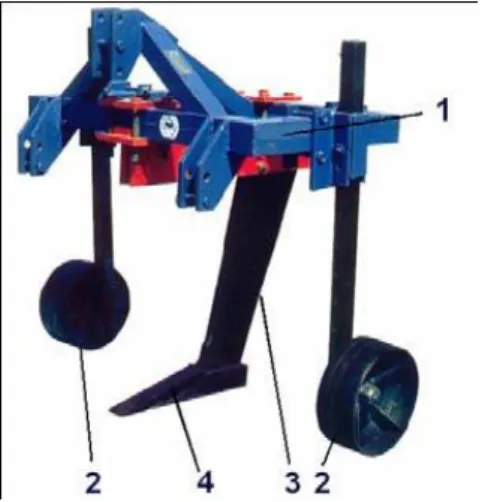
The deep loosening equipment is a simple rigid working machine (Figure 1) which is
13
and loosening body 4, called coulter. The linkage is connected to the three points of the tractor hydraulics. The frame is conected to the three point hidraulic system of the tractor.
Fig. 1 - A general construction of a deep loosening equipment
The supports of the working bodies are rigid and presents in different forms. The holder can be tilted or have parabolic shape to reduce specific energy consumption. The inferior part of the curved support surface permits the extending of the loosening work organ.
Fig. 2 - Loosening organs (coulter chisel)
The working organs of chisel coulters (fig. 2) are the most commonly used and can be mounted with ease on a variety of media types. Narrow chisel blades, having a small frontal area, facing while working a reduced running resistance compared to the other two models coulter and offers lower power consumption. For this reason, these types of soil at depths coulter provides maximum work (80 ... 100 cm), and also allows the use of a large number of working bodies, resulting in a larger working width and therefore the low number of passes, positive consequences of rigor. However narrow chisel coulters do not achieve good soil loosening depth, they managed to cut only narrow channels through the hardpan layer. To overcome this shortcoming, working bodies chisel coulters are mounted at an angle to the vertical plane.
The working organs of the chisel type coulters (Fig. 2) are used for loosening the depkts of 60…80 cm. These kinds of working organs are very robust and not once use any number greater than 3, which limits the working width subsolierului. They are typically used on heavy (clay, the more prone to hardpan), which requires a better mobilization of soil depth to hardpan destruction.
14
fins, the angle of the fins ranges from 1050° and the angle varies depending on the
energy consumption and quality of the work. From this point of view to loosening heavy soils opting for a minimum angle between the fins and the soil medium and light is chosen for its maximum value. In order to optimize this type of knife it is attempting the execution in a special form, compact, eliminating chisel tip. This complicates the blades manufacturing technology and thus increase the manufacturing cost of the equipment.
Although it provides a quality work compared to other types of working bodies, the coulter type chisel with wings do not allow the execution of work at depths greater than 60 cm, as it increases the specific energy consumption considerably and cause increased wear to the fins. With this oscillatory motion reduces drag force through the ground (Fig. 2 a) and sliding the driving wheels.
The working process of active organs is shown in Fig. 3a and Fig. 3b, through processing the depth of the soil, due to internal friction occurring in the soil results in a
working width: b0 ≈ 2a.
Fig. 3 - The working process of the deep loosening machine
RESULTS AND DISCUSSIONS
Worldwide the hard works (subsoiling, deep loosening, plowing, etc.) is executed with high productivity machinery in aggregate with wheeled tractors rated for over 150HP, of these having a high percentage are the ones with 180-240HP because they have the optimal combination between productivity and fuel consumption.
It is undeniable that the loosening organs through scarification have the greatest seniority, the first tool that man had and worked the land, it was found in a pyramid in Egypt and kept in the Museum of Cairo, consisting of a wooden hook, being closer to a stir-uper than a plow in its current meaning.
However, the documentary evidence indicates that only the construction of these tools in the last decades has made a great development. In the world today there are a large number of machines used for the deep loosening of soil.
Experiments conducted in different countries (USA, Germany, Italy, Hungary etc.) showed that developing the construction deep loosening tools for soil was directly subject to the problem of providing the thrust necessary, so the proper development of base energy.
15
Fig. 4 - Scheme of deep loosening equipment with active rigid body
The angle formed by the support blade with the vertical axis is generally between
00,349 rad. Such machines, is characterized by great simplicity design and an appropriate
degree of soil loosening, currently being use, known numerous made models in several different companies in Germany, USA, England, France, Italy, Russia and others.
These machines are equipped with 1 ... 9 working bodies and works generally at depths of 60 ... 90 cm, with tractors ranging up to 280 ... 320 kW.
The company MARTINELLI from Italy manufactures deep loosening equipment AP-1 (Fig. 5), equipped with a single active body, having maximum working depth of 50 cm. Loosening coulter is fixed to the frame through a angled support with sharp leading edge. In front of the active body is mounted vertically articulated a knife disc, whose role is to remove the vegetal remains clogging the deep loosening equipment by cutting them.
Fig. 5 - Deep loosening equipment AP-1, with a single active body [1]
The company Lemken from Germany manufactures a deep loosening equipment model P2 (Fig. 6), equipped with 2 working bodies rigid with straight stands, maximum
working depth of 50 cm and carries out the distance between loosening bodies of: 50120
cm. In aggregate with a tractor 80100 kW is achieved a productivity of about 11,5 ha / h.
Fig. 6 - Deep loosening equipment P2, with two active bodies [2]
16
Fig. 7 - Deep loosening equipment with five active bodies[3] Fig. 8 - Rigid active bodies with curved supports
The company JOHN DEERE from the US manufactures high power tractors, machinery for deep loosening the soil equipped with working stiff bodies, flat chisel coulter type, mounted on curved supports and intended for high power tractors, including twin wheel (fig . 9). Similar structures are made by deep loosening firms like Martinelli - Italy, Bomford - England, Lemken - Germany and others.
Fig. 9 - Deep loosening equipment with 7 bodies / 11 active bodies with curved supports[4]
Experiments conducted in different countries (USA, Germany, Italy, Hungary, etc.) showed that the development of construction loosening soil machinery and their increased depth is directly related to solving the problem of providing traction force, especially in the use of wheeled tractors which are prevailing in the agricultural fields.
The beginning was made in 1968, when the plow factory Brenig Bad Godesaberg from Germany conducted a mobile deep loosening equipment fitted with coulters driven PTO to the shaft of the tractor which the working body have an oscillatory movement with its support (fig .10). After 1969, the company has perfected the product, separating his support from the coulter and acting only to the active body, which is less than 1/3 of the total mass of the assembly (Fig. 11). This has achieved a reduction in traction force by about 8 ... 10%.
Fig. 10 - Deep loosening equipment with oscillating working body [5]
Fig. 11 - Deep loosening equipment with oscillating working body [5]
17
Fig. 12 – Deep loosening equipment V-Ripper[5]
In different countries were also made vibratory deep loosening equipment with 14
working bodies. Their actuation is achieved by generating vibration in the rotating
unbalanced masses, which made frequency up to 100 Hz at the low amplitude 15 mm.
On this principle were made deep loosening equipment like model Vibra Tiller and Texas in the United States, Hoes Vibra Tiller in Germany, FVA-3 and Vibrolaz-80 (fig. 13) in Hungary, Pietro Moro (fig. 14) in Italy and more.
Fig. 13- Deep loosening equipment Vibrolaz-80 [6] Fig. 14 - Deep loosening equipment Pietro Moro [7]
Presently the research are undertaken in different countries in the field of machinery for deep loosening of soil point in the downward of traction force necessary to improve the effect of loosening.
The company GASPARDO is the current world leader in the construction loosening and aeration equipment, in depth, of the poor soil, with the most constructive variants related to working width and the number of active loosening bodies. Working process of GASPARDO’s deep loosening equipments shown in figure 15 and is characterized by increasing lacunar space underlying layer of arable soil horizons, improvement of aeration, water permeability, rainfall storage capacity, and fostering the development of a radicular system more deeply and an increase in biological activity in soil culture. The soil work from arable substrate runs without returning the furrow for the elimination of impermeable soil layer (hardpan) of arable layer and substrate to allow infiltration of water in the upper layers.
Fig. 15 - Working process of GASPARDO’s deep loosening equipments [8]
Process is done by the following working bodies:
18
made of manganese sheet metal, abrasive wear-resistant, a vertical blade for cutting and two the milling cutter left - right.
Fig. 16 - Active bodies deep loosening of soil [8]
- Grinding bodies and additional leveling of processed soil (Fig. 17) in two variants: rollers with claws or sets of disks.
Fig. 17 - Grinding organs and additional leveling[8]
Rollers with claw for shredding and additional leveling (Fig. 17a) for soil processed are maintained in soil by an elastic system consisting of levers, quadrant and compression coil springs or a hydraulic system. The working bodies are the claw type mounted interleaved two-way for ground attack. The set of discs (Fig. 17b) has elements (jagged or smooth spherical discs, spools, bearings, etc.) of the composition of a harrow with discs and are fixed rigidly to the frame.
- Wheels limiters in order to regulate the working depth. These should be installed in front of active bodies for deep loosening and are made in metal version.
- Side fences to limit ravaged worked soil from active side bodies. They are composed from a sheet panel and two vertical arms mounted, hinged vertically on the sides of the frame near the active lateral bodies.
The model PINOCCHIO (FIG. 18) is the first version for working and is characterized with five active components for deep loosening the soil, the two grinding rollers with claws and additional leveling of the soil processed in the soil maintained by a spring system consisting of levers, circular sector and helical compression springs and two working wheels for depth limitation. The rollers with claws for shredding and additional land leveling have working bodies (claw type) mounted interleaved with two-way ground attack. This embodiment has the following technical characteristics: working width - approx. 2.2 m; working depth - max. 60 cm; tractor aggregation: 150-180 HP.
19
The model Attila (Fig. 19) is the constructive version of seven active organs for the deep loosening of soil identical to those of the embodiment PINOCCHIO and two grinding rollers with claws and additional leveling of the processed soil they are in maintained the soil by a hydraulic system and a tie threaded adjustable left and right. This version has no limitation wheel composed of working depth and depth adjustment is done by the two rollers and a hydraulic system. As technical equipment has a working width of about 3.0 m;
depth: max. 60 cm; tractor aggregation: 200250 HP.
Fig. 19 - Deep loosening equipment ATTILA [8] Fig. 20 - Subsolierul ARTIGLIO [8]
The model ARTIGLIO (fig. 20) is the constructive version with nine active bodies for deep loosening the soil identical to those of PINOCCHIO version, two rollers with claw for grinding and additional leveling for processed soil, they are maintained in the soil by a hydraulic system and a tie threaded adjustable left and right. This version is composed of wheels for limiting the working depth, limitation of spherical discs and two lateral overflow of processing soil.
The company PEGORARO manufactures machines for processed soil in arable substrate in two constructive variants related to working width and the number of loosening active bodies - MINI Drag and MEGA Drag.
The working process of for deep loosening equipments the company PEGORARO shown in Figure 21 and is characterized by increasing lacunar space of the underlying layer of arable soil horizons, improvement of aeration, water permeability, rainfall storage capacity, and fostering the development of a deeper radicular system and an increase in biological activity in soil culture. The tillage from the arable soil substrate runs without returning the furrow to eliminate the impermeable soil layer (hardpan) of arable layer and substrate and allowing the infiltration of water in the upper layers.
Fig. 21 - Working process for PEGORARO’s deep loosening equipments [9]
20
Regarding these deep loosening working bodies and their location, it is noted that resembles the company GASPARDO except the placement wheel for depth limiting the work that is done in the back of the machine (fig. 22).
Fig. 22 - PEGORARO working bodies for deep loosening [9]
The MINI DRAG (fig. 23) is the working version with five active organs for deep soil loosening (without shredding rollers and wheels for limited working depth) and light work requiring lower depths. This embodiment has the following technical characteristics: working width - about 2.2 m; working depth - max. 40 cm; tractor aggregation: 150 ... 180 HP.
Fig. 23 - Deep loosening equipment MINI DRAG [9] Fig. 24 - Deep loosening equipment MEGA DRAG [9]
The MEGA DRAG (fig. 24) is the working version with five active organs for deep soil loosening, two rollers for grinding and leveling claw to further processed the soil, it is maintained in soil with levers system and formed elastic compression coil springs and two fences to limit soil outpouring. The rollers with shredding claw and land leveling machines have additional working bodies (claw) interleaved mounted two-way for ground attack. This embodiment has the following technical characteristics: working width - about 2.2 m; depth: max. 60 cm; tractor aggregation: 150 ... 180 HP.
21
Fig. 25 - DONDI’s deep loosening equipment[10]
The company Collari has a wide range equipment (fig. 26) of processing arable soil substrate, with five, seven and nine active organs deep soil loosening, two rollers with shredding claw and further leveling processed soil, maintained in soil with a hydraulic system consisting of a coupling frame by holding the framework base of the machine and two hydraulic cylinders that performes the working depth limitation.
The rollers with claw and additional processed land leveling have working bodies (claw) mounted interleaved two-ways for ground attack. They can replace a battery with scalloped discs on all variants of work. Constructive range of the following technical
characteristics: working width: 1.63.0 m; depth: max. 60 cm; tractors aggregation: 6080;
7090; 90150; 120180; 180250 HP.
The company JEAN DE BRU - France, produces a deep scarifier for loosening soil equipped with rigid bodies (Fig. 27).
Fig. 26 - Collari’s deep loosening equipment[11] Fig. 27 - Scarifier for deep soil loosening equipped with rigid bodies [12]
The deep loosening equipment DWK 250 (Fig. 28), manufactured by KOENIG DAVE is typically mounted and is equipped with five active components (blades) mounted (at a distance of 500 mm) in a V-shaped framework, which gives a good working stability and low power consumption. It has a maximum depth of 800 mm and requires towing a 250 HP tractor power. Changing wheel position to support working depth adjustment is done manually with a screw-nut mechanism. Deep loosening equipment DWK 270 (fig. 28) is a semi-mounted type having also the V-shaped and can work in aggregate with the roller, making direct land preparation for sowing. Depth adjustment is achieved by changing the position of wheels, which are equipped with a hydraulic control system. It has 7 working bodies (blades) and vertical peak chisel, the distance between active organs being 500 mm. Maximum depth is 80 cm and the tractor power required is 270 HP.
Fig. 28 - Deep loosening equipment DWK 250 / DWK 270[13]
The deep loosening equipment made by Brix Herkules HKL STE 330/8 (fig. 29) is the
mounted type on tractor with power of 150200 HP. It has eight working bodies (blades)
and vertical peak chisel, working a width 3.03.3 m and maximum working depth is 60 cm.
22
with the power of 100 ... 150 kW, has 1.43 m working width and is equipped with three
vertical blades tipped chisel working the maximum depth of 60 cm.
Fig. 50 - Brix Herkules deep loosening equipment ETS 330/8 HKL / Brix Rambo 1000 BR 3[14]
Einbock deep loosening equipment EUL WK2 (fig. 30) is the mounted type on tractor with the power of 150 kW, working width of 2.4 m. It has three working bodies (blades) and vertical peak chisel, the distance between the active organs of 500-800 mm. Maximum depth is 50 cm. Everest deep loosening equipment Forest LE - 13 (Fig. 31) is the mounted type on tractor with the power of 200 kW, has 13 working bodies (blades) and vertical peak chisel, the distance between the active bodies 250-500 mm. Maximum depth is 60 cm and working width of 3.25 m.
Fig. 30 - Einbock deep loosening equipment EUL WK2 [15] Fig. 31 - Everest deep loosening equipment Forest LE - 13 [15]
Everest deep loosening equipment Garron LT - 9K (Fig. 32) is a mounted type on the
tractor of 170215 kW power. It has 9 working bodies (blades) and vertical peak chisel, the
distance between the active organs is 750 mm. Maximum depth is 60 cm and working width of 3.25 m. Deep loosening equipment FRICKE GRANIT 1/80 (Fig. 33) is a mounted type on the tractor with 150 kW power. It has three working bodies (blades) and vertical peak chisel (200 mm), the distance between the active organs of 900 mm. Maximum depth is 80 cm and working width of 3.25 m.
Fig. 32 - Everest deep loosening equipment Garron LT - 9K– 9K [16] Fig. 33 - Deep loosening equipment FRICKE GRANIT 1/80[17]
23
mounted type on the tractor of 200 kW power. It has 6 working bodies (blades) and vertical chisel tip (60 mm). Maximum depth is 70 cm and working width of 2.50 m.
Fig. 34 - Delta Hatzenbichler deep loosening equipment 2.50 [18]
Fig. 35 - KNOCHE deep loosening equipment Bison BS 6 [19]
KOTTE deep loosening equipment TM 2 -1 (Fig. 36) is mounted type tractor has two working bodies (blades) and vertical peak chisel (200 mm), the distance between the active organs is 160 mm. Maximum depth is 85-90 cm and working width of 1.60 m. Kverneland deep loosening equipment CLE-S-5 (Fig. 37) is the mounted type on tractor power with 136 kW. It has 5 working bodies (blades) and vertical chisel tip (60 mm), the distance between the active organs of 600-900 mm. Maximum depth is 70 cm and working width of 3.0-4.5 m.
Fig. 36 - KOTTE deep loosening equipment TM 2 -1[20] Fig. 37 - Kverneland deep loosening equipment -S CL-5[21]
As is known, for the basic ground work is usually used the plows. Large corporations and groups have made the agricultural machinery and various types of deep loosening equipment that replace plows or plowing work, and simultaneously performs scarification to a depth between 45 and 65 cm (depending on the power of tractor) . The purpose of this equipment is to cut and loosen the ground in depth to processed shredded layer and to intervene in the deepest layers to avoid the detrimental effect of mixing with the surface layers. Between the machinery and equipment (Scarifiers) built by specialized companies in this field include:
- Scarifiers of depth for the low and medium power tractors, ranging from 60 to 130 HP, with working widths between 1 and 3 m and maximum working depth of 45 cm. They usually work in aggregate with a toothed roller with mechanical adjustment;
- Scarifiers of depth for the average power, ranging from 90 to 180 HP, with working widths between 2.5 and 3 m and maximum working depth of 55 cm. They usually work in aggregate with a toothed roller mechanical or hydraulic adjustable;
- Scarifiers of depth for high power work, between 150 and 450 HP, with working widths between 2.5 and 5 m and maximum working depth of 65 cm. They work in aggregate with an adjustable hydraulic toothed roller.
24
maintained in working through hydraulic cylinders, connected in parallel to a line connecting the hydro-pneumatic accumulator, consisting of 6 blades spaced at 45 cm, making a working width of 2.80 m.
Fig. 38 - Equipment type "paraplow" [22]
CONCLUSIONS
Deep soil loosening machines with untrained working bodies is running the process only because the equipment is towed, receiving no additional movements. Working rigid bodies are mounted on a fixed support to the machine. Different machines for deep soil loosening works on similar principles, they distinguished between them, mainly by the shape and type of working bodies and the working depth.
Depending on the purpose of the work performed, the group of deep loosening equipment can be classified conventionally into the following categories, with names commonly used: cultivators of the soil with deep loosening called chisels used for loosening plowed layer; scarifiers used for loosening preparatory works; deep loosening equipment used for periodic renewal of work for unblocking; machines for deep loosening of soil, used for the increasing the permeability of the soil layers for the water and air.
Depending on the architecture the framework, loosening machines can be framed in V or straight frame. The first provides better stability during operation and a slight decrease in energy consumption and the straight frame are simpler in terms of construction, more robust and allow mounting a variety of working organs.
Working bodies for loosening equipment can be fixed, reciprocating or oscillating coulter only driven by the PTO of the tractor. Equipment with oscillatory working bodies makes a good loosening in depth and decreases working energy consumption for working at great depths, but have a higher design complexity, less reliable and more expensive compared to those with fixed working bodies.
The tendency of most building companies is to equip the machines for deep loosening of soil active bodies involved. Alternative active body movement is achieved through mechanisms driven from the tractor PTO shaft.
BIBLIOGRAPHY
1. Leaflet Martinelli company; 14. Leaflet Brix company;
2. Leaflet Lemken company; 15. Leaflet Einbock company;
3.Leaflet Rabewerk company; 16. Leaflet Everest company;
4. Leaflet John Deere company; 17. Leaflet FRICKE company;
5. Leaflet Brenig company; 18. Leaflet HATZENBICHLER company;
6. Leaflet Vibrolaz company; 19. Leaflet KNOCHE company;
7. Leaflet Pietro Moro company; 20. Leaflet KOTTE company;
8. Leaflet GASPARDO company; 21. Leaflet KVERNELAND ;
9. Leaflet PEGORARO company; 22. Leaflet AGRISEM International company. 10. Leaflet DONDI company;
![Fig. 5 - Deep loosening equipment AP-1, with a single active body [1]](https://thumb-us.123doks.com/thumbv2/123dok_us/8072647.2138516/4.892.363.530.555.714/fig-deep-loosening-equipment-ap-single-active-body.webp)
![Fig. 7 - Deep loosening equipment with five active bodies [3] Fig. 8 - Rigid active bodies with curved supports The company JOHN DEERE from the US manufactures high power tractors, machinery for deep loosening the soil equipped with worki](https://thumb-us.123doks.com/thumbv2/123dok_us/8072647.2138516/5.892.179.703.92.263/loosening-equipment-supports-manufactures-tractors-machinery-loosening-equipped.webp)
![Fig. 12 – Deep loosening equipment V-Ripper [5]](https://thumb-us.123doks.com/thumbv2/123dok_us/8072647.2138516/6.892.314.576.88.287/fig-deep-loosening-equipment-v-ripper.webp)
![Fig. 17 - Grinding organs and additional leveling [8]](https://thumb-us.123doks.com/thumbv2/123dok_us/8072647.2138516/7.892.311.584.374.548/fig-grinding-organs-and-additional-leveling.webp)
![Fig. 21 - Working process for PEGORARO’s deep loosening equipments [9]](https://thumb-us.123doks.com/thumbv2/123dok_us/8072647.2138516/8.892.296.597.804.1066/fig-working-process-pegoraro-s-deep-loosening-equipments.webp)
![Fig. 28 - Deep loosening equipment DWK 250 / DWK 270 [13]](https://thumb-us.123doks.com/thumbv2/123dok_us/8072647.2138516/10.892.162.735.866.1021/fig-deep-loosening-equipment-dwk-dwk.webp)
![Fig. 32 - Everest deep loosening equipment Garron LT - 9K – 9K [16] Fig. 33 - Deep loosening equipment FRICKE GRANIT 1/80 [17]](https://thumb-us.123doks.com/thumbv2/123dok_us/8072647.2138516/11.892.148.753.883.1047/everest-loosening-equipment-garron-loosening-equipment-fricke-granit.webp)
![Fig. 34 - Delta Hatzenbichler deep loosening equipment 2.50 [18]](https://thumb-us.123doks.com/thumbv2/123dok_us/8072647.2138516/12.892.102.793.110.334/fig-delta-hatzenbichler-deep-loosening-equipment.webp)
![Fig. 38 - Equipment type "paraplow" [22]](https://thumb-us.123doks.com/thumbv2/123dok_us/8072647.2138516/13.892.297.620.178.356/fig-equipment-type-paraplow.webp)
