294
STUDY ON PRODUCTIVE FEATURES OF SWEET SORGHUM HYBRIDS
GROWN IN SOUTH WEST OF ROMANIA
MATEI GHEORGHE1
1University of Craiova, Department of Agricultural and Forestry Technologies. E-mail
Key words: sweet sorghum hybrids, yields components, variability coefficient
ABSTRACT
The study conducted at the Agricultural Research and Development Caracal, located in South West of Romania emphasizes productivity elements of the crop of sweet sorghum conducted in order to produce biomass.
The new vegetable creations put on the market, indigenous or foreign, are characterized by different productive capacity caused by productivity elements which have different contribution to the formation of biomass: stalks, leaves and panicles.
For industrial processing to obtain sweet syrup, which subsequently is the raw material for the production of biofuels, stalks and their percentage contribution to the formation of production are extremely important.
Through this study we tried to test a number of 11 hybrids of sorghum with different backgrounds, analyzing the component values that form the point of view of total green mass production, focusing on the contribution of stalks.
INTRODUCTION
Food, feed and fuel are three of the necessities of life but it is not often that all three requirements can be provided by one crop. Sweet sorghum (Sorghum bicolour (L.) Moench) not only provides grain for human consumption and stove (stalks and leaves) for fodder, but it is increasingly being used in all over the world as feedstock for industrial biofuel production. It is a crop for biofuel production, it is highly favored for its effective conversion of atmospheric carbon dioxide into sugar, making it a viable alternative to sugarcane or maize for the production of ethanol (Belum V.S., 2008 ICRISAT).
There is a large diversity in sweet sorghum. The plant height ranged from 80 cm to 500 cm, the Brix in juice ranged from 7% to 28% and it can be harvested 1-3 times a year depending of climatic conditions (Li Dajue, 2010).
Sorghum biomass is burned by fast pyrolysis to produce syngas, bio-oil, and charcoal. In this system, the synthetic gas and bio-oil are used for transportation fuel, and the charcoal is applied to fields to improve soil structure.
295
MATERIAL AND METHODS
The research was carried out on the Agricultural Research Development Station Caracal, during 2014 using hybrids of sweet sorghum with different proveniences: from France, Romania and Republic of Moldova.
The tested hybrids were:
Hybrids from FRANCE:
o H1 – EUG341F
o H2 – W131F925
o H3 – W326F508
o H4 – W326F510
o H5 – W326F511
o H6 – W326F515
o H7 – W326F522
o H8 – W326F523
Hybrids from ROMANIA:
o H9 – F135ST
Hybrids from Republic of MOLDOVA:
o H10 – PORUMBENI 4
o H11 – PORUMBENI 5
During the papers we will use the notation H1 to H11 for the above mentioned sweet sorghum hybrids.
The experimental field was realized in non-irrigated conditions, having as previous plant sunflower.
As a background we use as fertilizers 250 kg/ha NPK 20:20:0 applied before sowing and were incorporated with the occasion of soil preparations.
The crop hygiene were ensured by the treatment with Ceredin, 2 l/ha applied post emergent.
Also we applied two treatments during the vegetation with Proteus 0.4 l/ha against the pests.
RESULTS AND DISCUSSION
Height’s plants – is one of the most important features of sweet sorghum hybrids due the
percentage that stalks participate to the biomass yields (table 1).
In the experimented year, the height of plants has values which range between 2.35 cm at H3 from French assortment and 3.27 cm at H11 from Republic of Moldova assortment. Hybrids from France were relatively equable, with plants of over 2.5 m tall (except H3), with a good development and a good resistance to fall.
296
Table 1 Plant’s height, standard deviation, differences and signification
registered at sweet sorghum hybrids tested in 2014
Values
- m - Standard deviation Variability coefficient
% from
average Differences Significations
H1 2,70 0,12 4,29 96,70 -0,09 -
H2 2,63 0,09 3,31 94,41 -0,16 oo
H3 2,35 0,15 6,54 84,17 -0,44 ooo
H4 2,76 0,14 5,02 98,92 -0,03 -
H5 2,51 0,08 3,36 89,90 -0,28 ooo
H6 2,70 0,19 6,78 96,59 -0,09 o
H7 2,76 0,11 4,48 98,98 -0,03 -
H8 2,81 0,07 2,60 100,72 0,02 -
H9 3,01 0,12 3,90 107,83 0,22 ***
H10 3,24 0,25 7,63 116,19 0,45 ***
H11 3,27 0,08 2,57 117,14 0,48 ***
Average
CONTROL 2,79 0,13 4,59 - - -
DL 5% 0,11
DL 1% 0,15
DL 0,1% 0,21
The calculate values for hybrids H2, H3 and H5 shows that from the entire tested assortment those has the lowest values of 2.63 m, 2.53 m and respectively 2.51 m, values which from the statistically point of view has very significant differences.
The standard deviation (table 1 and figure 1) – registered values of 0.7 on H8 hybrid and 0.25 at H10 hybrid. Related to the standard, which has a value of 0.13 we can mentioned as hybrids with a large standard deviation: H10, H6, H3 and H4.
We can notice that the hybrids had a large variability of this character, the amplitude of variation of this character is put in the light in figure 1. The hybrids with lowest variation of standard deviation were: H8, H11 and H2 with values of 0.08 and respectively 0.09.
297
The variability coefficient at sweet sorghum hybrids ranged between 2.60 on H8 and 7.63 registered at H10 (table 1).
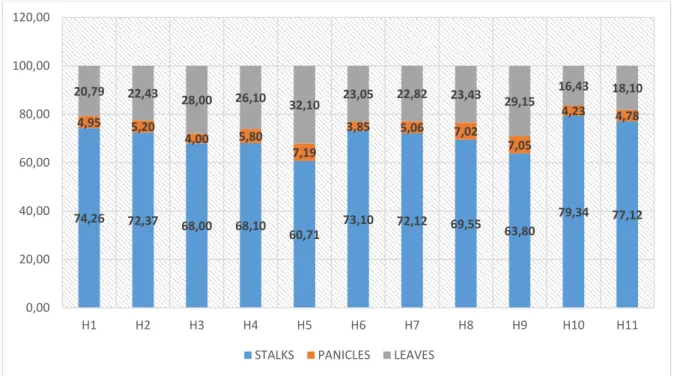
In order to determining the percentage of different parts of plant to the total green mass production we took samples of 10 square meters and separate in its components the yield: stalks, panicles and leaves. Each fraction were measured and registered as it can be seen in figure 2.
Figure 2 – Aspects from experimental fields determining the percentage of fractions of green mass yields on sweet sorghum hybrids in 2014
298
Lowest values were observed at H5 and H9 with a percent of 60.71% and respectively 63.80%.
The leaves also has very important role in the industrial process of obtaining biofuels and that fraction has values which varied between 16.43% on H10 and 32.10% at H5. With a high values of leaves percentage was observed H9 of 29.15% of participation.
The panicles had in general lowest values of 3.85% observed at H6 and 7.19% on H5. The majority of tested hybrids had values situate between 4 and 5%.
Figure 3 – The percentage of different component to the total green mass yield on sweet sorghum hybrids in 2014
CONCLUSIONS
From the presented data we can summarize, as follow:
Cultivated in the South West of Romania, the sweet sorghum find good conditions for development and producing valuable green mass yields;
The climatic factors and the technology applied to sweet sorghum had a powerful influences to the development of plants;
The highest plats were registered to hybrids of Eastern Europe (Romania and Moldova Republic), with values of over 3.0 meter;
From the point of variability of high the results shows us that the lowest values of standard deviation were obtained to hybrids from France (H2 and H8 having even the variability coefficients also lowest);
Stalks – the main component of total green mass has the highest values on hybrids from all assortment, over 77% of participation.
74,26 72,37 68,00 68,10
60,71
73,10 72,12 69,55
63,80
79,34 77,12
4,95 5,20
4,00 5,80
7,19
3,85 5,06 7,02
7,05
4,23 4,78
20,79 22,43 28,00 26,10
32,10 23,05 22,82 23,43 29,15
16,43 18,10
0,00 20,00 40,00 60,00 80,00 100,00 120,00
H1 H2 H3 H4 H5 H6 H7 H8 H9 H10 H11
299 BIBLIOGRAPHY
1. Bitzer, M. 2009. Research report: Early deheading of sweet sorghum. National Sweet Sorghum Producers and Processors Association.
2. Freeman, K.C., D.M. Broadhead, N. Zummo, and F.E. Westbrook. 1986. Sweet Sorghum Culture and Syrup Production. U.S. Dept. of Agr. Handbook No. 611, 55 pp.
3.Juerg, B., W. Thompson, W. Rooney, and B. Bean. 2009. Management of biomass and sweet
sorghum in the Southwest US. Abstract. 2009 International Annual Meetings. ASA-CSSA-SSSA. 1-5 Nov. Pittsburgh, PA.