Abstract—The multi-objective optimization problem was built to describe the extraction process of Gac oil by the experimental method. And solving the multi-objective optimization problem determined the optimal Pareto test and the optimal Pareto effect on the technological mode of Gac oil extraction. Experiments were carried out to set up the objective functions describing the influence of technological factors, including solvent volume (Z1, ml/g), time (Z2, h) and temperature (Z3, 0C), on the extraction efficiency (y1, %), the loss of β-Caroten in Gac (y2, %) and the loss of licopene in Gac (y3, %). By the application of the utopian point method, the optimal Pareto test was figured out as (Z1opt = Z1S = 15.57ml/g, Z2opt = Z2S = 6.056h, Z3opt = Z3S = 69.620C), resulting in the optimization technological mode of Gac oil extraction which affected the extraction efficiency reaching the maximum value (y1 = y1PS = 81.42%), and the loss of β-Caroten in Gac and licopene in Gac reaching the minimum value (respectively y2 = y2PS = 5.17%; y3 = y3PS = 5.34%).
Index Terms—Optimization, multi-objective optimization, extraction, gac oil.
I. INTRODUCTION
Gac is a fruit which has been verified to be rich in essential nutrients, containing many components of carotenoid and lycopene (belong to vitamin A), unsaturated fats, carbohydrates, amino acids, vitamin E, vitamin Q and other microelements. The β-carotene and lycopene in Gac oil are twice more than those in liver mackerel and about 10 times more than those in carrots [1]-[3]. Gac is a valuable fruit in the world because it only distributes in Southeast Asia and Southern China. Many studies confirmed the valuable nutriment of Gac [1]-[5], such as the ability to supply
β-carotene and lycopene (vitamin A), vitamin E, vitamin Q, unsaturated fatty acids, and mineral for human.
Currently, Gac has not been popularly used like other fruits, and important nutritional sources of Gac have been untapped effectively. By virtue of a great wealth of vitamin A and unsaturated fatty acids, Gac oil is considered as luxury vegetable oil which owns high economic value. Gac oil has been utilized as a special component in advanced food products and pharmaceutical products. Also in the pharmaceutical industry, Gac oil has been an ingredient for
Manuscript received October, 29, 2011; revised January, 30, 2012. This work was supported in part by the Faculty of Chemical and Food Technology, HCMC University of Technical Education
Nguyen Tan Dzung is from HCM University of Technical Education, 01-Vo Van Ngan Street, Thu Duc District, HCM City, Viet Nam, (e-mail: [email protected])
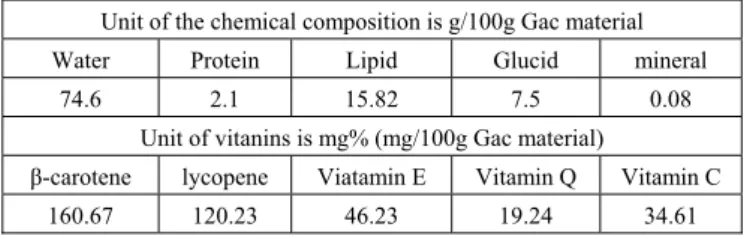
the treatment of obesity, heart disease, and hepatitis C. Moreover, in the food industry, Gac oil has been produced as a remarkable vegetable oil consisting of unsaturated fatty acids supporting the anti-cholesterol accumulation [6], [7] The chemical composition of Gac could show inTABLE1.
TABLE 1: THE CHEMICAL COMPOSITION OF GACMATERIAL
Unit of the chemical composition is g/100g Gac material
Water Protein Lipid Glucid mineral 74.6 2.1 15.82 7.5 0.08
Unit of vitanins is mg% (mg/100g Gac material)
β-carotene lycopene Viatamin E Vitamin Q Vitamin C 160.67 120.23 46.23 19.24 34.61
In Table 1 was obvious that the β-carotene, lycopene, lipid, and water content in Gac were very high. In Vietnam, the annual production of Gac is not popular, but it is only consumed in the form of raw materials. It is also noticeable that the Gac oil extraction has not received sufficient consideration [3]-[7]. The question is to find methods for processing and preservation of Gac to create valuable products.
According to [6]-[7], the methods of separating oil from Gac were contemporarily classified as two main processes, which were the press extraction and the solvent extraction. For the press method, the extracted oil was shown to be approximately 43.5% to 48.3%, but with relatively high impurities and water content the refined oil would be brought about the loss of β-carotene and lycopene in Gac, reducing the quality of the Gac oil [7].
Fig.1. The technological extraction process diagram of GAC oil.
For the solvent method, in order to facilitate the process, the water content should be decreased in advance by the conventional drying method. Due to the high drying temperature (above 1000C), it would cause the loss of
β-carotene, lycopene, and unsaturated fats of Gac oil, which has not been substantiated yet [5]-[7]. On the other hand, the
Application of Multi-Objective Optimization by the
Utopian Point Method to Determining the Technological
Mode of Gac Oil Extraction
solvent extraction of Gac oil primarily investigated the influence of technological factors (solvent volume, time and temperature) on the extraction efficiency whereas the loss of
β-carotene and lycopene, important components
characterizing the quality of Gac oil, was not examined [4]-[7].
The technological process shown in Fig. 1 was recommended to explore the problems mentioned. The separated water in Gac was carried out by cold drying method (where low drying temperature limited the loss of β-carotene, lycopene, and unsaturated fats), and the optimal technological mode of the extraction was established with these parameters, including solvent volume, time and temperature affecting simultaneously the extraction efficiency and the loss of β-carotene and lycopene [5],[8]. The subjects of extraction process was described as in Fig 2.
Fig. 2 .Diagram of subjects of extraction process.
It was certain that the extraction was a complicated process. Setting up the optimal technological mode of Gac oil extraction required to determine the following parameters: solvent volume (Z1, ml/g), time (Z2, h) and temperature (Z3, 0C), so that the extraction efficiency (y
1, %) should reach the
maximum value, and the loss of β-carotene (y2, %) and
lycopene (y3, %) should reach the minimum value. The
problem was defined as the multi-objective optimization, but particularly every objective function had its own different target, i.e. one reached the maximum value and the other reached the minimum value, encountering difficulties in solving this multi-objective optimization [8]-[10].
According to [8]-[10], there were a number of solutions to the multi-objective optimization problem, namely the linear combination [11], [12], the fuzzy data classification [11], [13], Harrington method [8]-[13], the restricted area method and the utopian point method [8], [9], [14]. In this article, the three-objective optimization problem was solved by the utopian point method with S(Z) optimal combination criteria in order to determine the optimal technological mode of Gac oil extraction.
II. THE FUNDAMENTALS OF MULTI-OBJECTIVE
OPTIMIZATION
A. Basic Concepts [8], [9], [14]
The technological subjects including m objective functions f1(Z), f2(Z), ..., fm(Z) form the vector of these functions f(Z) =
{fj(Z)} = {f1(Z), f2(Z), ..., fm(Z)}, where j = 1 to m. Every
objective function fj(Z) will be affected by n variables Z1,
Z2, ..., Zn which form the Z variable vector Z = {Zi} = (Z1,
Z2, ..., Zn), where i = 1 to n. These variables vary in the
identified domain ΩZ and the function values form the
domain of the objective function Ωf (in the two-objective
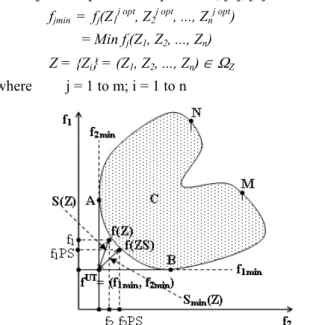
optimization problem, the domain can be performed geometrically in the closed curve A– f(Z)–f(ZS)–B–N–M (Fig. 3), [8],[9], [14].
Every objective function fj(Z) with Z variable vector Z =
{Zi} = (Z1, Z2, ..., Zn), where i = 1 to n, is considered as the
one-objective optimization problem. Hence, the m-objective optimization problem can be simply transformed into the problem to find the minimum value for the set of m one-objective optimization problems, [8], [9]:
fjmin = fj(Z1j opt, Z2j opt, ..., Znj opt)
= Min fj(Z1, Z2, ..., Zn) (1)
Z = {Zi} = (Z1, Z2, ..., Zn) ∈ΩZ (2)
Fig. 3. Dimension of objective functions of the two-objective optimization
The utopian plan and the utopian effect [8], [9]: If the variable vector ZUT = {Z
iUT} = (Z1UT, Z2UT, ..., ZnUT) ∈ΩZ is
the test for all one-objective optimization problems (1) + (2) + (3), it means that ZiUT = Zijopt with i = 1 to n. Thus, ZiUT is
called the utopian plan or the utopian test of the m-objective optimization problem.
In reality, ZiUT does not usually exist because it cannot
satisfy all of the targets. However, every one-objective optimization problem (1) + (2) + (3) has its own fjmin (with j =
1 to m) respectively, so fUT = (f
1min, f2min, ..., fmmin) does exist.
Then, fUT = (f
1min, f2min, ..., fmmin) is called the utopian effect or
the utopian point. According to Fig 3, the utopian point fUT of
the two-objetive optimization problem exists but lies outside the identified domain Ωf, i.e. the utopian test does not exist.
The dominant plan and the dominated plan [8], [9]: It is assumed that there are two variable vectors ZQ = {ZQi} and
ZV = {ZVi} with i = 1 to n. Then, there exist respectivly two
function vectors f(ZQ) = {fj(ZQ)} and f(ZV) = {fj(ZV)} with j
= 1 to m.
If with all j: fj(ZQ) < fj(ZV), ZQ is called the dominant plan
(or the dominant test) over ZV, symbolizing: ZQ ‘>’ ZV; and ZV is called the dominated plan (or the dominated test), symbolizing: ZV ‘<’ ZQ,
The optimal Pareto plan [8], [9]: The ZP plan is called the optimal Pareto plan in condition that ZP cannot be dominated by any other plans dependable on the identified domain ΩZ. Then, f(ZP) would be called an optimal Pareto
effect in the set of the optimal Pareto effects ΩfP. Fig 3 performs the set of the optimal Pareto effects ΩfP as the curve A – f(Z) – f(ZS) – B.
Theorem 1 (Theorem Pareto): If the multi-objective optimization problem has the test which is the so-called optimal one according to some definition, this test received has to be the optimal Pareto plan without the dependence on the chosen definition, [8]-[15].
Therefore, one test of the multi-objective optimization problem (1) + (2) + (3) found by any method, to be recognized as the optimal by the method chosen, must in advance be certified as the optimal Pareto plan
B. Multi-Objective Optimization By the Utopian Point Method [8], [9]
Considering the m-objective optimization problem (1) + (2) + (3): The optimal values f1min, f2min, ..., fmmin can be
determined after solving each problems, and the fact that the utopian test (the test for the whole system) does not exist still identifies the utopian point fUT = (f
1min, f2min, ..., fmmin). A S(Z)
optimal combination criterion is defined by the following expression:
( )
m 2( )
S Z sj Z
j 1∑
= =
⎡
⎤
⎢
⎥
⎣
⎦
(
( )
)
2 m
fj Z fjmin j 1∑
= −
=
⎡
⎤
⎢
⎥
⎣
⎦
(4)It is obvious that S(Z) is the distance from f(Z) to fUT,
where sj(Z) = |fj(Z) - fjmin|. Choosing S(Z) optimal
combination criterion as an objective function, the m-objective optimization problem are restated as: Find ZS = (Z1S, Z2S, ..., ZnS) ∈ΩZ in order that the objective function
S(Z) reaches the minimum value:
Smin = S(ZS) = Min S(Z)
(
( )
)
2 m
min f Zj fjmin j 1
∑
= −
=
⎧
⎡
⎤
⎫
⎨
⎢
⎥
⎬
⎣
⎦
⎩
⎭
(5)Z = (Z1, Z2, ..., Zn) ∈ΩZ
Theorem 2: If ZS of the optimization problem (5) does exist, ZS is the optimal Pareto test of the m-objective optimization problem (1) + (2) + (3), [8], [9].
Symbol: f(ZS) = fPS = (f1PS, f2PS, ..., fmPS). With the
utopian point method (i.e. the m-objective optimization problem convert into the S optimal combination criterion), the optimal Pareto test ZS will be found to have the optimal Pareto effect f(ZS) = fPS closest to the utopian point fUT =
(f1min, f2min, ..., fmmin). The case m = 2 (two objectives) is
illustrated in Fig. 3.
III. MATH MATERIALS AND METHODS
A. Materials
- The materials used for the extraction experiments were mature Gac, mainly grown in Tay Nguyen area and Southeastern area of Vietnam [1], [2].
- Before the extraction, the Gac were cold-dried until they reached the residual water content of 7.45%, [1], [2].
- Etanol was used as solvent for the extraction of Gac oil, which was considered more appropriate than hecxan, acetone and diethyl ether [6], [7].
B. Apparatus
- Satoriusbasic Type BA310S was used to determine the weight of samples with the range of 0 to 300g and the error of 0.1g.
- Cylinders were used to examine the volume of etanol with the range of 0 to 500ml and the error of 0.1g.
- Dual digital thermometer (T.P.34-23) was used to determine the temperature of solvent and samples during the extraction with the range of 0 to 1000C and the error of 0.5oC.
A timer was used to examine the extraction time.
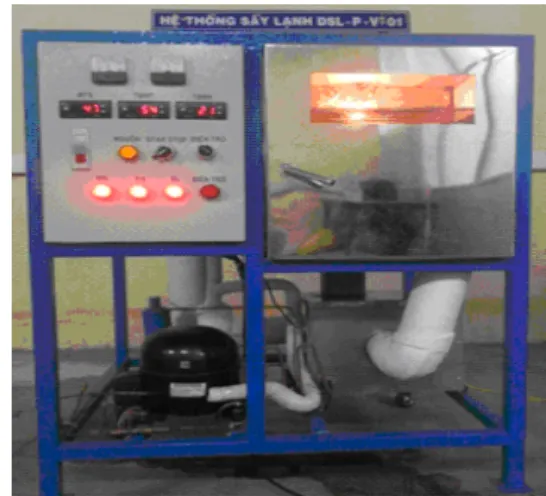
- The cold drying system DSL–P–V–01 controlled by PLC was used to dry Gac (Fig 4a) [16], [17].
Fig. 4a. The system cold drying DSL-P-V-01.
- The vacuum condense machine controlled by computer was used to recover etanol (Fig 4b).
Fig. 4b. The equipment of vacuum condense.
- The equipments of High Performance Liquid Chromatography (HPLC) were used to determine the content of β-carotene and lycopene of Gac oil. These equipments could be seen in Fig 4c and Fig 4d.
Fig. 4d. The system of HPLC.
C. Methods
Determining the extraction efficiency (y1, %): the
extraction efficiency of Gac oil was defined as the ratio of the weight of the extracted oil and the weight of the total oil in the initial Gac [3]-[18].
1
o il1
y m .100%
m oi l 2
= (6)
where: y1– the extraction efficiency of etanol, %; moil – the
weight of the total oil in the 10g initial the cold-dried Gac, g; moil2– the weight of the extracted oil from the 10g the
cold-dried Gac, g.
The maximum extraction efficiency (y1max) is 100%.
However, experimental extraction efficiency was always lower than 100% (y1 < 100%).
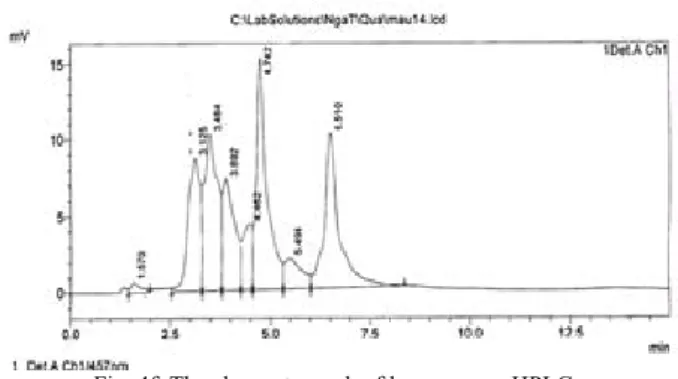
Determining the loss of β-carotene of the product (y2, %):
HPLC method in TCVN [1], [3], [18].
m1 m2 m
y2 100% 100%
m1 m1
− Δ
= = (7)
where: y2– the loss of β-carotene after extraction, %; m1 – the
content of β-carotene in the initial the cold-dried Gac, mg%; m2 – the content of β-carotene in the cold-dried Gac after
extraction, mg% (Fig 4e).
Fig. 4e. The chromatograph of β-carotene on HPLC.
Determining the loss of lycopene of the product (y2, %):
HPLC method in TCVN [1], [3], [18].
ma mb m
y3 100% 100%
ma ma
− Δ
= = (8)
where: y3 – the loss of lycopene after extraction, %; ma – the
content of lycopene in the initial the cold-dried Gac, mg%; mb – the content of lycopene in the cold-dried Gac after
extraction, mg% (Fig 4f).
Fig. 4f. The chromatograph of lycopene on HPLC.
The fact that the product achieves the best quality means y2min = 0 and y3min = 0. In fact, y2 > 0 and y3 > 0.
Orthogonal experimental planning method with
degree 2 [1, 8].
Establishing and solving 3-objective optimization problem by the utopian point method [8]- [14].
IV. RESULTS AND DISCUSSION
A. Establishing the Constituent Objective Functions of the Multi-Objective Problem
The constituent objective functions of Gac oil extraction (y1, y2 and y3) depended on the parameters, including: solvent
volume (Z1, ml/g), time (Z2, h) and temperature (Z3, 0C). The
experimental results showed that the extraction efficiency (y1, %), the loss of β-carotene (y2, %) and lycopene (y3, %)
related to Z1, Z2, Z3 with orthogonal degree 2. Therefore, the
objective functions y1, y2 and y3 were described by the
experimental planning method with the degree-2 orthogonal experimental matrix. The experimental number is determined as [8]-[13]:
N = nk + n* + n0 = 2k + 2k + n0 = 25 (9)
where: k = 3; nk = 2k = 23 = 8; n* = 2k = 2.3 = 6; n0 = 4,
carrying out 25 experiments.
These variables x1, x2, x3 were coded variables of Z1, Z2, Z3
by the following expression [8]-[13]:
xj = (Zj – Zj0)/ΔZj (10)
where: Zj0 = (Zjmax + Zjmin)/2; ΔZj = (Zjmax - Zjmin)/2;
Zjmin ≤ Zj ≤ Zjmax
The value of the star point [8]:
α= N.2
( ) ( )
k 2− −2k 1− =1.414 (11) And conditions of the orthogonal matrix [8, 9, 13]:λ = N1
(
2k + α2 2)
= 2/3 (12)k k k 2 0 j j ji j i jj j
j 1 j i; j 1 j 1
y b
b x
b x x
b x
= ≠ = =
=
+
∑
+
∑
+
∑
(13)The experimental conditions established the parameter levels affecting the process of extraction oil Gac shown in
TABLE 1.
1) Establishing the mathematical model of objective functions y1, y2 and y3
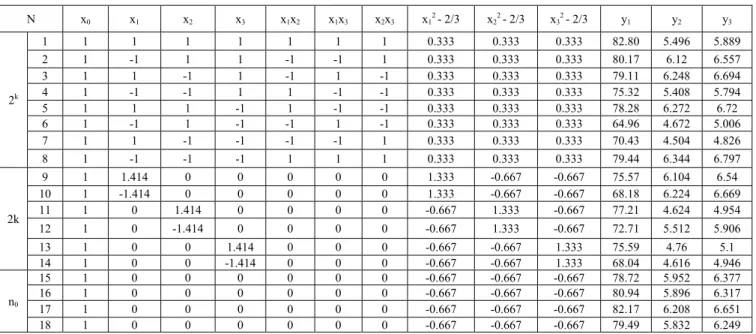
The experiments were carried out with all of the parameter levels in Table 2 to determine the value of the objective functions y1, y2 and y3. The results were summarized in Table
3.
TABLE 2: PARAMETER LEVEL DESIGN
Parameter s
Levels Deviatio n
i
Z
Δ
- α(-1.414) Low
-1
Central 0
High +1
+ α
(1.414)
Z1,(ml/g) 8.35 10 14 18 19.66 4
Z2, (h) 1.172 2 4 6 6.828 2
Z3, (0C) 38.79 45 60 75 81.21 15
TABLE3:THE DEGREE-2ORTHOGONAL EXPERIMENTAL MATRIX, K =3, N0=4
N x0 x1 x2 x3 x1x2 x1x3 x2x3 x12 - 2/3 x22 - 2/3 x32 - 2/3 y1 y2 y3
2k
1 1 1 1 1 1 1 1 0.333 0.333 0.333 82.80 5.496 5.889
2 1 -1 1 1 -1 -1 1 0.333 0.333 0.333 80.17 6.12 6.557
3 1 1 -1 1 -1 1 -1 0.333 0.333 0.333 79.11 6.248 6.694
4 1 -1 -1 1 1 -1 -1 0.333 0.333 0.333 75.32 5.408 5.794
5 1 1 1 -1 1 -1 -1 0.333 0.333 0.333 78.28 6.272 6.72
6 1 -1 1 -1 -1 1 -1 0.333 0.333 0.333 64.96 4.672 5.006
7 1 1 -1 -1 -1 -1 1 0.333 0.333 0.333 70.43 4.504 4.826
8 1 -1 -1 -1 1 1 1 0.333 0.333 0.333 79.44 6.344 6.797
2k
9 1 1.414 0 0 0 0 0 1.333 -0.667 -0.667 75.57 6.104 6.54
10 1 -1.414 0 0 0 0 0 1.333 -0.667 -0.667 68.18 6.224 6.669
11 1 0 1.414 0 0 0 0 -0.667 1.333 -0.667 77.21 4.624 4.954
12 1 0 -1.414 0 0 0 0 -0.667 1.333 -0.667 72.71 5.512 5.906
13 1 0 0 1.414 0 0 0 -0.667 -0.667 1.333 75.59 4.76 5.1
14 1 0 0 -1.414 0 0 0 -0.667 -0.667 1.333 68.04 4.616 4.946
n0
15 1 0 0 0 0 0 0 -0.667 -0.667 -0.667 78.72 5.952 6.377
16 1 0 0 0 0 0 0 -0.667 -0.667 -0.667 80.94 5.896 6.317
17 1 0 0 0 0 0 0 -0.667 -0.667 -0.667 82.17 6.208 6.651
18 1 0 0 0 0 0 0 -0.667 -0.667 -0.667 79.49 5.832 6.249
The mathematical model of regression equations (14, 15 and 16) were obtained after processing the experimental data, calculating the coefficients, testing the significance of the coefficients by the Student test, and testing the regression equations for the fitness of the experimental results by Fisher test [8]:
y1 = 76.1 + 3.582x1 + 2.6x3
– 1.99x1x3 – 1.912(x12 – 2/3)
– 0.37(x22 – 2/3) – 1.94(x32 – 2/3) (14)
y2 = 5.6 + 0.27x1 – 0.27x2
+ 0.17x3 – 0.4x1x3 + 0.3(x12 – 2/3)
– 0.24(x22 – 2/3) – 0.43(x32 – 2/3) (15)
y3 = 6.1 + 0.28x1 – 0.29x2 + 0.18x3
– 0.43x1x3 – 0.15x2x3 + 0.33(x12 – 2/3)
– 0.255(x22 – 2/3) – 0.46(x32 – 2/3) (16)
1) Establishing the mathematical model of multi-objective functions
The technological parameters (x1, x2 and x3) of the
extraction had the simultaneous impact on these objective functions (y1, y2 and y3) with the identified domain Ωx =
{-1.414 ≤ x1, x2, x3≤ 1.414}. Thus, the mathematical model
of three-objective optimization problem determining the technological mode of Gac oil extraction was restated as: Finding in common the test x = (x1opt, x2opt, x3opt) ∈ Ωx =
{-1.414 ≤ x1, x2, x3≤ 1.414} in order that:
opt opt opt
y1 f1max 1(x , x2 , x3 ) max f (x , x , x )1 1 2 3
opt opt opt
y2 f2min 1(x , x2 , x3 ) min f (x , x , x )2 1 2 3
opt opt opt
y3 f3min 1(x , x2 , x3 ) min f (x , x , x )3 1 2 3 x (x , x , x )1 2 3 x
= =
= =
= =
∀ = ∈ Ω
⎧
⎪⎪
⎨
⎪
⎪⎩
(17)
This was the multi-objective optimization problem in which the equations of the whole system (17) did not reach the same destination, i.e. one objective function towards the maximum value and the other objective functions towards the minimum value. Therefore, it was necessary that the multi-objective optimization problem (17) be modified in order that all of the objective functions should attain the minimum value as the followings:
I1(x) = I1(x1, x2, x3) = 100 - y1 = 100 - f1(x1, x2, x3) (18)
I2(x) = I2(x1, x2, x3) = y2 = f2(x1, x2, x3) (19)
I3(x) = I3(x1, x2, x3) = y3 = f3(x1, x2, x3) (20)
With 0 ≤ y1≤ 100%, consequently 0 ≤ I1(x) ≤ 100%; if y1(x)
functions (18), (19) and (20) were to find the minimum value, the multi-objective optimization problem was restated as: Finding in common the test x = (x1opt, x2opt, x3opt) ∈Ωx =
{-1.414 ≤ x1, x2, x3≤ 1.414} in order that:
opt opt opt
I1 I1min( x1 , x2 , x3 ) min{I ( x , x , x )}1 1 2 3 opt opt opt
I2 I2 min( x1 , x2 , x3 ) min{I ( x , x , x )}2 1 2 3 opt opt opt
I3 I3 min( x1 , x2 , x3 ) min{I ( x , x , x )}3 1 2 3 x ( x , x , x )1 2 3 x
= =
= =
= =
∀ = ∈ Ω
⎧ ⎪⎪ ⎨ ⎪ ⎪⎩
(21)
B. Solving the one-Objective Optimization Problems These one-objective optimization problems were found to achieve: I1min = minI1(x1, x2, x3); I2min = minI2(x1, x2, x3); I3min
= minI3(x1, x2, x3), with the identified domain Ωx = {-1 ≤ x1,
x2, x3≤ 1}. By the meshing method programmed in Matlab
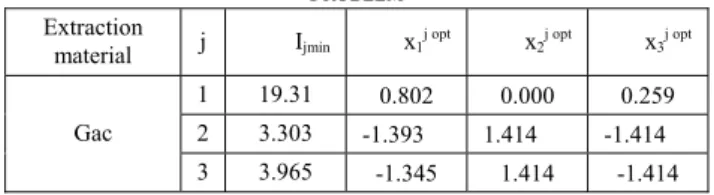
7.0, the results of the optimal parameters of every objective function (18), (19) and (20) limited in the experimental domain were summarized in TABLE4.
TABLE 4:MINIMUM TESTS OF EACH ONE-OBJECTIVE OPTIMIZATION PROBLEM
Extraction
material j Ijmin x1j opt x2j opt x3j opt
Gac
1 19.31 0.802 0.000 0.259 2 3.303 -1.393 1.414 -1.414 3 3.965 -1.345 1.414 -1.414
According to the Table 4, the utopian points were indentified: IUT = (I
1min, I2min, I3min) = (19.31, 3.303, and
3.965). However, the utopian plan did not exist, because of xjopt = (x
1jopt, x2jopt, x3jopt) ≠ xkopt = (x1kopt, x2kopt, x3kopt) where j, k
= 1 to 3, and j ≠ k.
C. Solving the Multi-Objective Optimization Problem by the Utopian Point Method
The purpose of the experiment was to reach the targets of the extraction of Gac oil which were expressed by 3 regression equations (18), (19) and (20), but the tests satisfying all function values (I1min, I2min, I3min) could not be
found. Hence, the idea of the three-objective optimization problem was to find the optimal Pareto test for the optimal Pareto effect I(xS) = IPS = (I1PS, I2PS, I3PS) closest to the
utopian point IUT = (I
1min, I2min, I3min) = (19.31, 3.303, 3.965).
Establishing the S-objective combination function S(I1,
I2, I3) = S(x1, x2, x3) = S(x) as the followings:
(
)
(
)
{
}
2 3
S x , x , x1 2 3 Ij Ijmin j 1
1.414 x , x , x 1.414
x 1 2 3
∑
= −
=
Ω = − ≤ ≤
⎧
⎪
⎨
⎪
⎩
(22)
The three-objective optimization problem needed to indentify xS = (x1S, x2S, x3S) ∈Ωx in order that S(x1S, x2S, x3S)
= Min{S(x1, x2, x3)}. The minimum value of (22) was
determined by the meshing method programmed in Matlab 7.0:
Smin = Min{S(x1, x2, x3)} = 2.726
With: x1S = 0.393; x2S = 1.014; x3S = 0.642;
Then, transforming into real variables:
Z1opt= 15.57 ml/g; Z2opt = 6.056 h; Z3opt= 69.62 0C
Substituting x1R, x2R, x3R into these equations (18), (19)
and (20), the optimal Pareto effect was obtained as: I1PS =
19.98; I2PS = 5.31; I3PS = 5.68
Similarly, substituting x1R, x2R, x3R into these equations
(14), (15) and (16), the optimal Pareto effect was obtained as: y1PS = 80.02; y2PS = 5.31; y3PS = 5.68
By the utopian point method, solving the multi-objective optimization problem with S-Optimal combination criterion which satisfied the minimum S-Optimal combination criterion (Smin= 2.726) were determined the optimal Pareto
test (or the technological mode of Gac oil extraction) as: the solvent volume of the extraction was Z1opt = 15.57 ml/g, the
extraction time was Z2opt = 6.056h, and the extraction
temperature was Z3opt = 69.620C. Corresponding with the
optimal Pareto test will be the optimal Pareto effect as: the extraction efficiency of Gac oil was y1PS = 80.02%; the loss
of β-carotene of the Gac oil was y2PR = 5.31% and the loss of
lycopene of the Gac oil was y3PR = 5.68%.
Compared with the experimental results from the table 3, these results above were suitable and satisfying with the objectives of the problem.
D. Experiment to Test the Results of Multi-Objective Optimization Problem
Carrying out the extraction of Gac oil at the optimal Pareto test: the solvent volume of the extraction of Z1opt = 15.57ml/g,
the extraction time of Z2opt = 6.056 hours, and the extraction
temperature of Z3opt =69.62 0C, the experimental results were
determined as: the extraction efficiency of avocado oil of y1=
81.42%, the loss of β-carotene of the Gac oil of y2 = 5.17%
and the loss of lycopene of the Gac oil of y3= 5.34%.
Consequently, it was very noticeable that the results from the optimization problems of the extraction process had the approximation to the experimental results.
After oil Gac was separated by the extraction method at the optimal Pareto test: Z1opt = 15.57ml/g; Z2opt = 6.056 hours;
Z3opt= 69.620C. The finished product obtained could be seen
in Fig 5.
Fig. 5. The oil was extracted from Gas.
It was certain that the optimal Pareto test and the optimal Pareto effect of the multi-objective optimization problem of Gac oil extraction be possibly applied to determine the technological mode of the extraction in the oil industry.
When the solvent volume of the extraction was fixed: x1=
0.393, correspondingly Z1 = 15.57 ml/g, the relationship
between y1, y2, y3, and S combination function with 2
variables x2, x3 was performed geometrically in 3D (Fig. 5, 6,
Fig. 6. Extration efficiency, x1=0.393.
Fig.7. loss of β-caroten,x1=0.393.
Fig.8. loss of lycopene, x1=0.393.
Fig. 9. Function s(x1,x2,x3),with x1=0.393.
V. CONCLUSION
The mathematical model of regression equations (14), (15), and (16) obtained from the experiments were the experimental statistical models which could well describe the impact of solvent volume, time and temperature on the extraction efficiency, the loss of β-carotene and the loss of lycopene of the Gac oil from the solvent extraction.
Solving multi-objective optimization problem by the utopian point method determined the optimal technological mode of Gac oil extraction, with the solvent volume of 15.57 ml/g; the extraction time of 6.056 hours; the extraction temperature of 69.620C, resulting in: the extraction efficiency of 80.02 %, the loss of β-carotene and lycopene of the Gac oil of respectively 5.31% and 5.68%.
Therefore, the technological mode of the extraction of Gac oil was feasible to be applied to industrial production.
ACKNOWLEDGMENT
The author thank Ms. Dang Thi Ngoc Dung and Student. Nguyen Thanh Khu, for help with expriments carrying out.
REFERENCES
[1] H. NTT and T. H Hung (2009). Research determined the chemical composition of Gac Vietnam, University of Industry Ho Chi Minh City, Viet Nam, http://www.vnulib.edu. vn:8000/dspace/handle 123456789/ 1234
[2] K. Betty, I. C. Turner, H. M. Chapman, and A. T. McKeon, (2004). F. Acid, and C. Composition of Gac (Momordica Cochinchinensis Spreng) Fruit, J. Agric. Food Chem, 52(2), pp 274 – 279
[3] H. AOKI, N. T. M. Kieu, N. Kuze, K. Tomisaka, and N. V. Chuyen, (2002). Carotenoid Pigments in GAC Fruit (Momordica Cochinchinensis Spreng), Food Color Laboratory Division, Toyonaka, Osaka and Department of Food and Nutrition, Japan Women’s University, Tokyo, Japan, Boisci, Biotechnol, Biochem, 66, 2479 – 2482.
[4] M. Fillon, (2007). Gac the Asian- This “Gift from heaven” Brims with an unsurpassed mix of Antioxidants, Breakthroughs in health, Vol. 2, p15-16, 47-49.
[5] V. L. T, King JC, (2003). A method for preserving gac fruit oil, a good source of β carotene and essential fatty acids, Food Nutr Bull, 24, 224-230
[6] H. NV (2006). Research detemined the technology mode of oil extraction from Gac. Journal of Science and Technology 4: 123-136, http://www.vjol.info/index.php/jst/search /results.
[7] H. NH (2008). Research oil extracted from in Gac by extraction method, using acetone solvent, Journal the Development of Science and Technology VNU.HCM 11: 16-24, http://www.vnulib.edu.vn:8000 /dspace/handle/123456789/706
[8] D. NT, D. NQ (2011), Application of Multi-Objective Optimization to Determining the Technological Mode of Avocado Oil Extraction. Canadian Journal on Chemical Engineering and Technology, Vol. 2, No. 6, July 2011, ISSN: 1923-1652, p. 106-113
[9] D. NT, D. NQ, D. T. V. and H. LX (2011). Application of Multi-Objective Optimization by S and R Optimal Combination Criteria to Determining the Freeze Drying Mode of Penaeus Monodon,
Journal of Chemical Engineering and Process Technology, USA 2:107. DOI 10.4172/2157-7048.1000107.
[10] H. L X, and L. N. T (2008). Multi-objective optimization with combination criteria applied to extraction of the high colour degree anthocyanin, Science and Technology development, VNU-Ho Chi
Minh City 11: 69-76, http://tailieu.vn/xem-tai-lieu/toi-uu-da-muc-tieu-voi-cac-chuan-toi-uu
-to-hop-s-va-r.205116.html
[11] H. N. T, H. D. X, and H. T. V (2006). A method of collective decision-making based on fuzzy data classification: GDM - FC,
Journal of Science and Technology 2: 65-74, http://www.hua.edu.vn/tc_khktnn /download .asp?ID=241
[12] H. L. X, N. N. V(2008).Multi-objective optimization for grouper (e.coioides) compounded feed formulation, Journal of Science and Technology, VietNam, 48: 123-136, http://www.vjol.info/index.php /jst/ search/results.
[13] N. Canh (2004) Planning experiments (Book), Published by VNU HCMC, 3th ed, Viet Nam, 120.
[14] D. N. T, H. L. X, and D. T. V (2010). Multi-objective optimization with optimal standard combination of R applied to determine regime technological freeze drying of penaeus merguiensis, Journal the Development of Science and Technology VNU.HCM 13: 56-68, http://www.vnulib.edu.vn:8000/dspace/handle/123456789/3614 [15] D. N. T, H. L. X, D. T. V, and B. T. D (2010). Multi-objective
optimization applied to determine regime technological freeze drying of penaeus vannamei. Journal of Fisheries Science and Technology, Vietnam 1: 82-93, http://www.vnulib.edu.vn:8000/dspace/handle /123456789/3622
[16] P. T. V (2004), Heat and mass transfer process (Book), Published by
VNU HCMC, 2th ed, Viet Nam, 385
[17] S. Khalloufi, J. L. Robert, and Ratti (2004). Solid foods Freeze drying simulation and experimental data, Journal of Food Engineering, Canada 28: 107-132. DOI: 10.1111/j.1745-4530.2005.00379.x [18] L.O. Figura, A. A Teixeira (2007). Food Physics: Physical properties
Measurement and Application, Germany, 554. http://mechmath.org/ books /82246