188
INFLUENCE OF LATE BLIGHT (PHYTOPHTHORA INFESTANS) ATTACK
ON NUTRITIONAL QUALITY OF TOMATO
MIRELA PARASCHIVU1,CRISTINA BĂBEANU2, RODICA SOARE,3MARIA DINU4,
MĂDĂLINA DRĂGOI5
1Romanian Movement for Quality
2,5
University of Craiova, Faculty of Mathematics and Natural Sciences, Department of Chemistry
3,4
University of Craiova, Faculty of Agriculture and Horticulture
Keywords: tomato, nutritional quality, pathogen, stress, antioxidant activity
ABSTRACT
The effect of natural infection with Late Blight (Phytophthora infestrans) on chemical fruit quality on six tomato (Lycopersicon esculentum) varieties (Menhir F1, Lady Rosa F1, Kilates F1, Anthalia F1, Prekos F1, Vanessa F1) was investigated in a field trial. Plants were exposed to stress produced by natural infection with P.infestans and biochemical quality parameters were analyzed as well as antioxidant activities for both treated and untreated variants. P.infestans attack on tomato was associated with lower total soluble solids and sugar content and an increased acidity. There was no significant correlation between lycopen content and pathogen attack. Antioxidant activity reflected by PPH radical scavenging activity and ABTS radical cation scavenging activity increased in case of pathogen`s attack.
INTRODUCTION
Plants are subject of various biotic and abiotic stresses due to unfavorable environmental conditions that affect their growth, metabolism and yield (Dumas et al., 2003; Atkinson et al., 2011). Phytophthora infestans is one of the most devastating tomato pathogen which are difficult to control being able to devastate all crop within 7 to 10 days (Fry, 2008). Economic losses may be in the form of reduced yield, lower quality of the fruit, diminished storability and increased cost associated with fungicide application (Nowicki et al. 2012).Tomato fruits infection may range from 41% to 100% on untreated plots and from 12% to 65% in plots protected with systemic fungicides (Fontem et al. 1996). Therefore control of Late Blight (LB) is indispensable and the LB management includes cultural practices, fungicide sprays and use of resistant cultivars. Previous studies showed that considerable efforts have been made to identify genetic source of LB resistance and transfer resistance to modern breeding lines and cultivars (Brouwer and St Clair, 2004; Fooland et al.2006). All these efforts emphasise the importance of keeping healthy tomato crops well known for their nutritional qualities. The levels of nutritional components in tomatoes depend on cultivar, ripening stage, growth stage, growth conditions and environmental influence.
189
antioxidants (Suzuki et al, 2014). Phenolic compounds are of interest nutritionally, as when present in the diet they confer health benefits related to their antioxidant activity.Plants produce phenolic compounds as a defensive mechanism in response to attack by pests or pathogens such as insects, fungi, or nematodes (EnglishLoeb et al.,1997;Treutter,2006) and in response to abiotic stresses.However, little work has been done for examination of pathogens attack on the nutritional quality of tomato. The main goal of the current study was to determine the effect of P.infestans stress on the levels of quality chemical quality parameters in tomato fruits. For a better evaluation it was made a comparative assessment between chemical quality parameters recorded on treated tomato fruits which recorded an attack degree below economical threshold and those recorded on untreated tomato fruits.
MATERIAL AND METHODS
Field experiment was carried out on Experimental Research Station Banu Maracine (luvosoil, pH 6,06-6,47) during 2012 year in order to evaluate de influence of Phythophtora infestans attack, under natural conditions, on the nutritional quality of six tomato cultivars. The experiment was a split plot design with two factors x three replications. Each plot size was 10 m2. The trail factors were: Factor A: tomato hybrid (V1-Menhir F1, V2-Lady Rosa F1, V3-Kilates F1, V4-Anthalia F1, V5-Prekos F1, V6-Vanessa F1) and Factor B: fungicide treatment. Fungicide treatments were made according with the following scheme:the 1st treatment – Dithane M 45 (mancozeb 80%) -0,2%; the 2nd treatment – Shavit F72WP (folpet 70%+triadimenol 25) -0,2%; the 3th treatment – Ridomil Gold Plus 42,5WP (cupru 40%+mefenoxam 2,5%) -0,3%; the 4th treatment – Bouille bordelaise -0,75%.
190
time. The scavenging activity of extracts was evaluated as a percentage of DPPH discoloration using the formula: % scavenging = [A0-(A1–AS)]/ A0]100, where A0 is the absorbance of DPPH alone, A1 is the absorbance of DPPH + extract and AS is the absorbance of the extract only. The Trolox calibration curve was plotted as a function of the percentage of DPPH radical scavenging activity. The final results were expressed as micromoles of Trolox equivalents (TE) per gram. (μmol TE/g fw).ABTS radical cation scavenging activity:The ABTS radical cation scavenging activity of the methanolic extract was measured using the method ofPellegrini et al.(2007) with some modifications. ABTS was dissolved in water to a 7 mmol/l concentration. ABTS radical cation was produced by reacting ABTS stock solution with 2.45 mmol/l potassium persulfate (final concentration) and allowing the mixture to stand in the dark at room temperature for 12–16 h before use. The ABTS radical cation solution was diluted with ethanol to an absorbance of 0.70 at 734 nm. 0.1 ml of sample extract was mixed with 2.9 ml of diluted ABTS radical cation solution. After reaction at room temperature for 6 min, the absorbance at 734 nm was measured. The Trolox calibration curve was plotted as a function of the percentage of ABTS radical cation scavenging activity. The final results were expressed as micromoles of Trolox equivalents (TE) per gram of fresh material. (μmol TE/g fw). All determinations were performed in triplicate, and all results were calculated as mean.
RESULTS AND DISCUSSION
The environmental conditions of 2012 year were highly conductive to Late Blight (LB) development. During April – September interval the air temperature was higher with 2,1oC than multiannual average. Heavy rain falls in April (79,3 mm) and Mai (136,7 mm) generated favorable conditions for Phytophthorainfestans infection and rapid development. The highest attack degree on fruits was observed on the hybrids Prekos F1 and Vanessa F1 (Table 1).Tomato hybrid Kilates F1 (V3) didnt reach the maturity due to the attack of Cucumber Mosaic Virus. The variants fungicide treated didn’t emphasized P.infestans
attack sympthoms on fruits.
Sugar and organic acids are the main metabolites in tomato fruits and constitute over 60% of the dry matter. The higer level of soluble solids, reducing sugar and acidity can positively influence the flavor quality of tomatoes (Auerswald et al, 1999). Total soluble solids (TSS) were significantly affected by the pathogen attack emphasizing lower levels for untreated tomato fruits. TSS values ranged between 4,1% and 5,5% for treated variants and between 3% and 5% for untreated variants (Table 1).Sugar reducing concentration was also heightened by P.infestans attack ranging between 3,31% (V1-Menhir F1) and 4,2% (V2-Lady Rosa F1) while on affected variants reducing sugar content decreased. Among all studies tomato hybrids V2- Lady Rosa recorded the highest levels of total soluble solids (5,5%) and reducing sugar (4,2%). These findings are similar with previous results obtained by Bastias et al. (2011) and Pinela et al. (2012). Generally, it was observed a depression of reducing sugar content to all attacked tomato fruits.
Acidity in tomato is attributed mainly to citric acid and malic acid (over 90% of the organic acid). It was observed that acidity is higher on variants attacked by P.infestans and no treated. This can be explained by sugar bioconversion into organic acids as a result of pathogen attack. These results confirm previous research of Toor et al. (2006), Dannehl et al. (2014). Ascorbic acid values ranged between 10 mg/100g (V2-Lady Rosa F1) and 15,01mg/100g (V5-Prekos F1) for treated tomato fruits and between 10,44 mg/100g (aV2-Lady Rosa) and 19,5 mg/100 g (aV6-Vanessa F1) for tomato fruits exposed to
P.infestansattack. The data reported in the literature were higher than current study data (Ilahy et al. 2011), but similar to those reported by other results (Toor et al, 2006).
Table 1
191
Variant
Attack Degree
on fruits (AD %)
Total soluble
solids (%)
Reducing sugar (%)
Ascorbic acid (mg/100g)
Acidity (% as citric acid)
Lycopene (mg/kg)
V1 0 4.1 3.31 12.18 0.29 73.64
aV1 7,20 4 3 12.66 0. 57 53.74
V2 0 5.5 4.2 10 0.28 65.05
aV2 9,31 5 2.45 10.56 0. 31 72.8
V4 0 5.1 3.86 12.66 0.26 49.95
aV4 4,67 4.2 3.52 10.44 0.55 42.42
V5 0 4.2 3.49 15.01 0.25 60.06
aV5 11,30 5 3.4 14.61 0. 35 79.38
V6 0 5 3.87 11.88 0.38 84.92
aV6 15,42 3 2.75 19.5 0.56 65.876
*fungicide treated variants (healthy tomato fruits)
**no treated variants (variants affected by P.infestans – diseased tomato fruits)
It was observed that studied tomato hybrids had high lycopen content leading to the conclusion that tomato fruits present good healthy beneffits. Lycopene accounts for 80 -90% of total carotenoids in tomato and when consumed is associated with a reduction in the risk of prostate and other cancers, as well as protection against cardiovascular disease (Rao and Agarwal, 2000). The concentration of lycopen in tomato samples varied between 49,95 mg/kg (V4-Anthalia F1) and 84,92 mg/kg (V6-Vanessa F1) for treated variants, while for diseases variants lycopen concentration ranged between 42,42 mg/kg (aV4-Anthalia F1) and 72,8 mg/kg (aV2-Lady Rosa F1). These results are similar with previously findings (Ilahy et al. 2011, Dannehl et al, 2014). It wasnt noticed a significant correlation between lycopen content and pathogen attack.
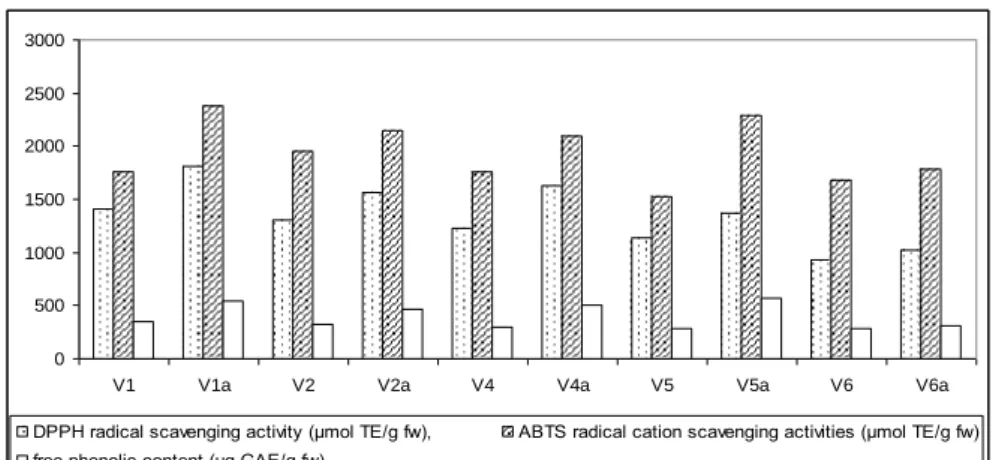
Total phenolic content showed higher levels for diseased variants comparatively with those treated with fungicides due to antioxidant character of these components (Fig.1).Total phenolic content ranged between 287.23 μg GAE/g fw (V5-Prekos F1) and 353.98 μg GAE/g fw (V1-Menhir F1) for treated variants and between 310.96 μg GAE/g fw (aV6-Vanessa F1) and 568.36 μg GAE/g fw (aV5-Prekos F1) for diseased variants.Similar results were reported by other studies (Ilahy et.al. 2011;García-Valverde et al. 2013; Pinela et al. 2012; Barros et al. 2012).
DPPH radical scavenging activity showed high values for all experimented variants (Figure 1). The values of DPPH radical scavenging activity ranged between 928.2 μmol TE/gfw (V6-Vanessa F1) and 1410.8 μmol TE/gfw (V1-Menhir F1) for treated variants and between 1015.4 μmol TE/gfw (aV6-Vanessa F1) and1805.6 μmol TE/gfw (aV1-Menhir f1) for diseased variants.
192
Figure 1. Free phenolic content (μg GAE/g fw), DPPH radical scavenging activities (μmol TE/g fw) and ABTS radical cation scavenging activities (μmol TE/g fw)
Positive correlations have been observed when DPPH radical scavenging activity and ABTS radical cation scavenging activity were compared with free phenolic compounds content, thus indicating that these compounds are responsible for the antioxidant activity.
CONCLUSIONS
Each stress biotic and abiotic factor requires an unique mechanism of response, tailored to the specific needs of the plant.Metabolic and signaling response of plants involve frequently antioxidant mechanism and few biochemical indices alteration.The attack of P.infestans to tomato fruits affects directely nutritional quality components. Total solube solids and reducing sugar were significantly affected by pathogen`s attack. It was observed also in increased acidity to diseased tomato fruits. Antioxidant activity reflected by PPH radical scavenging activity and ABTS radical cation scavenging activity increased in case of pathogen`s attack as a result of activation of enzymatic and non-enzymatic antioxidant system in order to maintain cellular redox status. Increased phenolic content levels and positive correlation between phenolic content and DPPH radical scavenging activity and ABTS radical cation scavenging activity is explained by antioxidant character of these components.
BIBLIOGRAPHY
1.Auerswald H., Schwarz D., Kornelson C., Krumbein A., Bruckner, B., 1999. Sensory analysis, sugar and acid content of tomato at different EC values of the nutrient solution,
Sci. Hortic. (Amst.) vol.82, p.227–242.
2.Atkinson N.J., Dew T.P., Orfila C., Urwin P.E., 2011.Influence of combined biotic and abiotic stress on nutritional quality parameters in tomato (Solanumlycopersicum), J. Agric. Food Chem.,vol.59, p.9673–9682
3.Babbar N., Oberoi H.S., Sandhu S.K., Bhargav V.K., 2014. Influence of different solvents in extraction of phenolic compounds from vegetable residues and their evaluation as natural sources of antioxidants, J Food SciTechnol, vol.51, (10), p.2568-2575.
4.Bastías A., Climent M.L., Valcárcel M., Rosello S., Gómez-Cadenas A., Casaretto J., 2011. Modulation of organic acids and sugar content in tomato fruits by an abscisic acid-regulated transcription factor, Physiologia Plantarum, vol.141, (3), p.215–226.
5.Brouwer, D.J., StClair, D.A., 2004. Fine mapping of the quantitative trait loci for late blight resistance in tomato using near isogenic lines (NILs) and sub-NILs.
Theor.Appl.Genet. vol.108, p.628-638.
6.Dannehl D., Huyskens-Keil S., Eichholz I., Ulrichs C., Schmidt U., 2011.Effects of direct-electric-current on secondary plant compounds and antioxidant activity in harvested tomato fruits (Solanum lycopersicon L.). Food Chem. vol.126, p.57–165.
0 500 1000 1500 2000 2500 3000
V1 V1a V2 V2a V4 V4a V5 V5a V6 V6a
193
7.Dannehl D., Suhl J, Huyskens-Keil S., Ulrichs C., Schmidt U., 2014. Effects of a special solar collector greenhouse on water balance, fruit quantity and fruit quality of tomatoes, Agricultural Water Management, vol.134, p.14– 23
8.Dumas Y., Dadomo M., Di Lucca G., Grolier P., 2003. Effects of environmental factors and agricultural techniques on antioxidant content of tomatoes, J. Sci. Food Agric., vol.83, p.369–382.
9.EnglishLoeb, G.; Stout, M. J.; Duffey, S. S.,1997.Drought stress in tomatoes: Changes in plant chemistry and potential nonlinear consequences for insect herbivores. Oikos, vol.79, p.456–468.
10.Fish W.W., Perkins-Veazie P., Collins J.K., 2002. A quantitative assay for lycopene that utilizes reduced volumes of organic solvent. Journal of Food Composition and Analysis,vol.15 (3), p.309–317.
11.Fontem, D.A., Nono-Womdin, R., Opena, R.T., Gumedzoe, Y.D., 1996. Impact of early and late blight infectious on tomato yield, TVIS Newsl, vol.1, p.7-8.
12.Fooland, M.R., Merk, H., Ashrafi, H., Kinkade, M., 2006.Identification of new sources of late blight resistance in tomato and mapping of a new resistance gene. In:22nd Annual Tomato Diseases workshop N.C. State Univ. Mountain Horticultural Crops Research & Extension Centre, Fletcher, NC, USA, p.4-8.
13.Fry, W., 2008. Phytophthora infestans. The plant (and R gene) destroyer. Mol.Plant Pathol., vol.9, p.385-402.
14.Herms, D.A., Mattson, W.J., 1992. The Dilema of Plants:To grow or Defend. The Quaterly Review of Botany, vol.67 (3), p.238-335.
15.Horsfall, J.G.,Barratt, R.W., 1945. An improved grading system for measuring plant diseases. Phytopathology vol.35, p.655-661.
16.Ilahy R., Hdiderb C., Lenucci M.S., Tlili I., Dalessandro G., 2011.Phytochemical composition and antioxidant activity of high-lycopene tomato (Solanumlycopersicum L.) cultivars grown in Southern Italy - 2011, ScientiaHorticulturae vol.127, p.255–261.
17.Miller G. L., 1959- Use of dinitrosalicylic acid reagent for detection of reducing sugar.
Anal. Chem. vol.31, p.427-431.
18.Norwicki, M., Fooland, M.R., Nowakowska, M., Kozik, E.U., 2012. Patato and tomato Late Blight Caused by Phytophthora infestans:an overview of Pathology and Resistance,Plant Dis. vol 96 (1), p.4-17.
19.Pellegrini N., Colombi B., Salvatore S., Brenna O., Galaverna G., Del Rio D., 2007.Evaluation of antioxidant capacity of some fruit and vegetable foods: efficiency of extraction of a sequence of solvents. J. Sci. Food Agric. vol.87, p.103–111.
20.Pinela J., Barros L., Carvalho A.M., Ferreira I., 2012. Nutritional composition and antioxidant activity of four tomato (Lycopersicon esculentum L.) farmer’ varieties in Northeastern Portugal homegardens, Food and Chemical Toxicology, vol.50, p.829–834.
21.Rao, A. V. R.; Agarwal, S., 2000. Role of antioxidant lycopene in cancer and heart disease.J. Am. Coll. Nutr., vol.19, p.563–569.
222Savescu A., Iacob N., Cristea N., Lefter Gh., Vonica Il., 1969. Warning and forecast in plant protection. Agroforestry Eds., Bucharest, p.57-60.
23.Suzuki, N., Rivero, R.M., Shulaev, V., Blumwald, E., Mittler, R., 2014. Abiotic and biotic stress combinations,The New Phytologist, vol.203(1), p.32 – 43.
24.Toor R.K., Savage G.P., Lister C.E., 2006. Seasonal variations in the antioxidant composition of greenhouse grown tomatoes, J. of Food Compo. and Analysis, 19,1–101.