101 | P a g e
“A Study of Effect of Corporate Social Responsibility
Awareness on Consumer Buying Patterns With Reference
To FMCG Product in Pune City”
Dr. Samreena Tariq
J&K Bank Employee
ABSTRACT:
Corporate Social Responsibility is a type of corporate self-regulation integrated into a business model. It is also
called as corporate conscience, citizenship, social performance, or sustainable responsible business. Corporate
Social Responsibility (CSR) policy functions as a built-in, self regulating mechanism whereby business
monitors and ensures its active compliance with the spirit of law, ethical standards, and international norms. The
aim of Corporate Social Responsibility (CSR) is to embrace responsibility for the company‟s actions and
encourage a positive impact through its activities on the environment, consumers, employees, communities,
stakeholders and all other members of the public sphere
KEYWORDS: Corporate Social Responsibility, Consumer awareness.
I.INTRODUCTION:
Corporate Social Responsibility (CSR)-focused businesses would actively promote the public interest by
encouraging community growth and development, and voluntarily eliminating practices that harm the public
sphere, regardless of legality. Corporate Social Responsibility (CSR) is the deliberate inclusion of public interest
into corporate decision-making that is the core business of the company or firm, and protecting the triple bottom
line: people, planet and profit.
II.STATEMENT OF PROBLEM:
The lack of knowledge about the phenomenon provokes the need for this study to provide more evidence on
how adopting a socially-oriented business approach can enhance the company‟s image, and therefore enhance
customer loyalty.
The purpose of the present study is to investigate the relationship between corporate social responsibility,
customer loyalty and customer expectation.
III.OBJECTIVES OF THE STUDY:
102 | P a g e
To study the consumer awareness about Corporate Social Responsibility (CSR)
To study the impact of Corporate Social Responsibility (CSR) on consumers.
To determine whether a significant positive relationship exist between Corporate Social Responsibility
(CSR) and customer awareness.
IV.STATEMENT OF HYPOTHESIS:
Hypothesis -I The awareness of consumers towards CSR is significantly associated with different demographic
factors of the consumers.
Hypothesis - II Different factors of the product influences the buying behavior of the FMCG products of the
companies who devote themselves for CSR.
Hypothesis -III The age, gender, education, occupation, household size, the type of CSR activity are the
independent determinants for the willingness to buy the products of companies who devote to CSR or
environmental protection.
V.RESEARCH METHODOLOGY:
Research Design: The research design for the purpose of the study is drafted and the steps to be taken in the
research were set out in a systematic manner. The present research design explains how the research process is
carried out.
Method Adopted: Having known and studied advantages & disadvantages of different research methods the
researcher decided to conduct a survey, as the objectives of the study were related to gathering awareness,
opinions, attitudes and feelings that could not be easily observed.
VI.REVIEW OF LITERATURE
Friedman (1970) , discovered that CSR although virtually typically knowledgeable, is taken into account by some to be workplace loss, managers follow CSR for private gain, not investor profit. per him, CSR is analytic
of self-seeking actions on the a part of mangers, and thus, reduces investor wealth.
Ackerman and Bauer, expressed that the suggestion of answerableness i.e., social responsibility is that of the method of simply forward associate degree obligation. This places stress on motivation instead of performance
however, they believe, such motivation isn't enough, as a result of responding to social demands is way over
deciding what to do; therefore there remains the management task of doing what one has determined to do; this
can be social responsiveness.
103 | P a g e
VII.DATA ANYSIS & INTERPRETATION
Table 1: Demographic Factors
Factor Responses (n = 500) % of Respondents
Age 21-30 (Years) 73.4
Gender 368 (Male) 73.6
Education 231 (Graduate) 46.2
Occupational Status 203 (salaried) 40.6
Household Size 295 (3-6 persons) 59
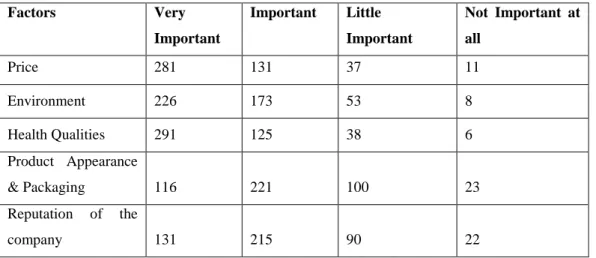
Table 2: Factors which are important for deciding which one to buy. Factors Very
Important
Important Little Important
Not Important at all
Price 281 131 37 11
Environment 226 173 53 8
Health Qualities 291 125 38 6
Product Appearance
& Packaging 116 221 100 23
Reputation of the
company 131 215 90 22
VIII.TESTING OF HYPOTHESIS
Hypothesis I - The awareness of consumers towards CSR is significantly associated with different age groups, education occupation and gender of the consumers.
Null Hypothesis (H0): The awareness of consumers towards CSR is equally distributed across different age
groups,education, occupation and gender of the consumers.
104 | P a g e
Alternative Hypothesis (H1): The awareness of consumers towards CSR is not equally distributed acrossdifferent age groups, education, occupation and gender of the consumers.
Comment:
The awareness of consumers towards CSR is equally distributed across different age groups, education,
occupation and gender of the consumers.
Hypotheses II: Different factors of the product influences the customer satisfaction.
Null Hypothesis (H0): The importance of different factors do not have higher impact in customer satisfaction.
Alternative Hypothesis (H1): The importance of different factors do have higher impact in customer satisfaction.
Factors (n=460) Mean SD F-test P-value Price 3.48 0.75 16.411 0.001
(significant) Environment 3.34 0.76
Health Qualities 3.52 0.70 Product appearance and
packaging
2.89 0.84
Reputation of the company 2.92 0.88
Values are Mean and Standard Deviation of 5 Point Likert scale. P-values are obtained using F-test (One-way
analysis of variance (ANOVA)). P-value<0.05 is considered to be statistically significant. Higher score indicate
better appreciation for buying and vice-versa.
Awareness of consumers towards CSR
Age Group 4.577 0.206 Ho = Accept
Education 7.059 0.070 Ho = Accept
Occupation 7.143 0.067 Ho = Accept
105 | P a g e
Comments:
Different factors of the products significantly have different impact on customer satisfaction for CSR
The price receive higher importance followed by health qualities and environmental factors in having higher
purchasing willingness of the CSR related products (P-value<0.001). It is interesting to note that the least
importance is being given to the product appearance and the packaging and also to the reputation of the
company.
Hypothesis -1II The age, gender, education, occupation, household size, the type of CSR activity are the independent determinants for the willingness to buy the products of companies who devote to CSR or environmental protection.
Null Hypothesis (H0): The age, gender, education, occupation, household size, the type of CSR activity are the
independent determinants for the willingness to buy the products of companies who devote to CSR or
environmental protection.
Alternative Hypothesis (H1): The age, gender, education, occupation, household size, the type of CSR activity
are not the independent determinants for the willingness to buy the products of companies who devote to CSR
or environmental protection.
Comments:
1.The variables such as education, zonal area and the type of product are the independent determinants for
willingness to buy the FMCG products of those companies who devote themselves to CSR activities.
2.Of the 6 variables entered in the model (age, gender, education, occupation, zonal area and type of product)
the most significant and powerful determinant is type of product (Wald‟s value =37.945) followed by zonal area (Wald‟s value = 5.166) and the education (Wald‟s value = 3.969) (P-value<0.05 for all these variables).
IX.SUMMARY OF FINDINGS AND CONCLUSIONS
Summary of Findings
1. The study reveals that out of 500 respondents surveyed, (73.4%) of the respondents are in the age group of
21-30, 21.3% of respondents are in the age group of 31-40, 4.4% of respondents are in the age group of
41-50 and 0.4% of respondents are in the age group of 51 & above. It is apparent that majority of respondents
belong to the age group of 21-30 years.
2. From the study, it has been observed that out of 500 respondents, the large majority of respondents (73.6%)
were males. The percentage of female respondents was only 26.4%.
3. The study shows that out of 500 respondents, the large majority of respondents 231(46.%) had completed
their graduation, only 13 (2.6%) respondents had education upto SSC level. The level of education of the
106 | P a g e
4. From the study, it has been observed that the large majority of the respondents 158 (31.6%) had theirincome below 1.0 Lakh. 149 (29.8%) had their income between 1.0 -2.5 Lakh, only 27 (5.4%) respondents
had their income above 5.0 Lakh.
5. The study shows the distribution of occupational status of the respondents which reveals that the large
majority of the respondents 203 (40.6%) had their occupational status as salaried employees. Only 67
(13.4%) respondents had business as their occupational status.
6. From the study, it is observed that the awareness regarding Corporate Social responsibility is not
significantly associated with the age groups of the consumer.
7. The study shows the distribution of awareness regarding the Corporate Social Responsibility across
different education groups of the consumers and it is observed that the awareness regarding corporate social
responsibility is equally distributed across different education groups of the consumers.
8. From the study, it has been observed that the awareness regarding corporate social responsibility is equally
distributed across different occupation groups of the consumers.
Summary of Conclusions:
1. It can be concluded that age is one of the important factor for consumers in buying FMCG products.
2. It can be concluded that Gender and Education are important demographic factors in influencing consumers
in usage of FMCG products.
3. It can be concluded that Corporate Social Responsibility activities related to education plays a major role
and have a higher impact on purchasing decisions of FMCG products.
4. It can be concluded that Corporate Social Responsibility activities related to women empowerment and
child development do not have higher impact on purchasing decisions of the FMCG products.
REFRENCES:
[1.] Ruder, David West (1995), Caste and Capitalism in Colonial India- The Nattukottai Chettiars – Munshilal
Monoharlal Publishers, Dehli.
[2.] Bayly, Charles (1983), Rulers, Townsmem and Bazaars – North Indian Society in the Age of British
Expansion 1770-1870, Cambridge University Press, Cambridge.
[3.] Singhi, N.K. (1991), „A Study of Jains in Rajasthan Town‟ in Carrithers, Michael and Caroline Humphrey
(eds), Assembly of Listeners, Jains in Society, Cambridge University Press, Cambridge, New York,
PP.149.
[4.] Sunder, Pushpa (2000), Beyond Business, from Merchant Charity to Corporate Citizenship, Tata McGraw
Hill, New Dehli.
[5.] Haynes, Dougles (1987), „From Tribute to Philanthropy – The Politics of Gift Giving in a Western Indian
City‟, Journal of Asian Studies, vol. 46, issue no. 2, May, PP. 339-60.
[6.] Majumdar, R.C., H.C. Raychaudhuri, and Kalikinkar Datta (1995), An Advanced History of India,
Macmillan India Ltd, Madras, PP. 809.
[7.] Venkatsubbiah, H. (1997), Enterprise and Economic Change, Fifth Year of FICCI, Vikas Publishing
107 | P a g e
[8.] Evan, W.M and R.E.Freeman (1998), „A Stakeholder Theory of the Modern Corporation __ Kantiancapitalism‟, (eds) T. Beauchamp and N.Bowie. Ethical theory and business. 75-93. Englewood Cliff, NJ,
Prentice Hall, Also see, Hoffman M.W. and R.E. Frederick (eds) (1995), Business Ethics __ Readings and
cases in corporate morality 3/e, McGraw –Hill Inc, US, PP. 145-154.
[9.] Eden, C. and F. Ackermann (1998), Making Strategy- The Journey of Strategic Management, SAGE
Publication, London.
[10.] Post, E. James, Preston E.Lee, and Sachs Sybilee(2002), „Managing the Extended Enterprise – The New
Stakeholder View‟, California Management Review, vol.45, issue no. 1. PP.8.
[11.] Wheeler, David and Maria Sillanpaa (1997), The Stakeholder Corporation – The Body Shop Blueprint for
Maximising Stakeholder Value, Pitman Publishing, London.
[12.] Carroll, Archie B. and Ann K. Buchholtz (2000), Business and Society – Ethics and Stakeholder
Management, South Western College Publishing, Cincinnati.
[13.] Duran, J.L and F. Sanchez (1999), „The Relationship between the companies and their Suppliers‟, Journal
of Business Ethics, vol.22, issue no. 3, PP. 273-80.
[14.] Boatright, R. John (2003), Ethics and the Conduct of Business, Pearson Education, India, PP.276.
[15.] Smith, N.C. (1995), „Marketing Strategies for the Ethics Era‟, Sloan Management Review, vol. 36, issue