FRAMEWORK HAZARDOUS MATERIALS
MANAGEMENT PLAN
TABLE OF CONTENTS
L1.0 INTRODUCTION ... 1
L2.0 PLAN PURPOSE ... 1
L3.0 PLAN UPDATES ... 1
L4.0 REGULATORY COMPLIANCE ... 1
L4.1 CERCLA/SUPERFUND AMENDMENTS AND REAUTHORIZATION ACT (40CFRPARTS 300-399) ... 1
L4.2 CLEAN AIR ACT (40CFRPARTS 50-99) ... 2
L4.3 CLEAN WATER ACT (40CFRPARTS 100-149) ... 2
L4.4 HAZARDOUS MATERIALS TRANSPORTATION ACT (49CFRPARTS 100-199) ... 2
L4.5 OCCUPATIONAL SAFETY AND HEALTH ADMINISTRATION (OSHA)(29CFRPARTS 1900-1926) ... 2
L4.6 SOLID AND HAZARDOUS WASTES (40CFRPARTS 239-299) ... 2
L4.7 TOXIC SUBSTANCES CONTROL ACT (TSCA)(40CFRPARTS 700-799) ... 3
L4.8 STATE REGULATIONS ... 3
L4.8.1 State of Wyoming ... 3
L4.8.2 State of Colorado ... 3
L4.8.3 State of Utah ... 4
L4.8.4 State of Nevada ... 4
L5.0 HAZARDOUS MATERIALS MANAGEMENT PLAN REQUIREMENTS ... 5
L5.1 CERTIFICATIONS,AMENDMENTS, AND DESIGNATION OF EMERGENCY RESPONSE COORDINATOR ... 5
L5.1.1 Certifications ... 5
L5.1.2 Amendments ... 5
L5.1.3 Emergency Response Coordinator ... 5
L5.2 FACILITIES DESCRIPTION AND INVENTORY OF MATERIALS ... 6
L5.2.1 Site Maps ... 6
L5.2.2 Inventory... 6
L6.0 HAZARDOUS MATERIALS MANAGEMENT ... 7
L6.1 TYPES OF HAZARDOUS MATERIALS ... 7
L6.2 STORAGE OF HAZARDOUS MATERIALS ... 7
L6.2.1 Physical Storage Requirements ... 8
L6.2.2 Container Labeling Requirements ... 8
L6.3 REFUELING AND SERVICING ... 9
L6.4 TRANSPORTATION OF HAZARDOUS MATERIALS ... 9
L6.5 GENERATING HAZARDOUS WASTE ... 9
L6.5.1 Prior to Construction Activities ... 9
L6.5.2 During Construction Activities ... 10
L6.5.3 After Construction Activities... 10
L6.6 DISPOSAL OF HAZARDOUS WASTE ... 10
L6.7 CONTAMINATED CONTAINERS ... 10
L6.8 WASTE OIL FILTERS ... 11
ATTACHMENTS:
ATTACHMENT A SAMPLE FORMS FOR HAZARDOUS MATERIALS MANAGEMENT
ACRONYMS
Applicant TransWest Express LLC, also TransWest
BMP Best Management Practice
CAA Clean Air Act
CCR Colorado Code of Regulations
CERCLA Comprehensive Environmental Response, Compensation, and Liability Act of 1980
CFR Code of Federal Regulations
CIC Compliance Inspection Contractor
CWA Clean Water Act
DEIS Draft Environmental Impact Statement
EIS Environmental Impact Statement
EMM Environmental Mitigation Measure
EPA United States Environmental Protection Agency HMMP Hazardous Materials Management Plan, also Plan
ID identification
MSDSs Material Safety Data Sheets
NTP Notice to Proceed
OSHA Occupational Safety and Health Administration
PCB polychlorinated biphenyl
Plan Hazardous Materials Management Plan, also NMMP
POD Plan of Development
ppm parts per million
Project TransWest Express Transmission Project, also TWE Project RCRA Resource Conservation and Recovery Act of 1976
ROD Record of Decision
ROW right-of-way
SHWD Solid and Hazardous Waste Division TransWest TransWest Express LLC, also Applicant TSCA Toxic Substance Control Act
TWE Project TransWest Express Transmission Project, also Project USDOT United States Department of Transportation
WAQSR Wyoming Air Quality Standards and Regulations WDEQ Wyoming Department of Environmental Quality
WEQA Wyoming Environmental Quality Act
WQS Wyoming Quality Standards
L1.0
INTRODUCTION
This framework Hazardous Material Management Plan (HMMP or Plan) identifies project-specific mitigation measures and other specific stipulations and methods to be taken by TransWest Express LLC (TransWest or Applicant) and its Construction Contractor(s) to address hazardous materials spill prevention, response, and cleanup procedures for the TransWest Express Transmission Project (TWE Project or Project).
The term “hazardous material,” as presented in this framework Plan, refers to hazardous substances, hazardous wastes, marine pollutants, elevated temperature materials, and materials designated as hazardous for transportation as defined in 49 Code of Federal Regulations (CFR) 171.8.
The Spill Prevention and Response Plan (Appendix S) identifies specific measures that the
Construction Contractor(s) shall take to prevent, respond to, and control a spill, should a spill occur.
L2.0
PLAN PURPOSE
The purpose of this HMMP is to reduce the risks associated with the use, storage, transportation, and disposal of hazardous materials. The Construction Contractor(s) shall use the following framework to develop a detailed HMMP.
The HMMP will clearly identify which legal requirements apply to specific types of hazardous materials and will identify best management practices (BMPs) that will be followed to reduce risks associated with hazardous materials.
The Construction Contractor(s) shall develop and implement the HMMP in accordance with the BMPs, Applicant Committed Environmental Mitigation Measures (EMMs), and applicable state and federal land management agencies’ mitigation measures to reduce the risks associated with using, storing, transporting, and disposing of hazardous materials.
L3.0
PLAN UPDATES
This HMPP framework will be updated as required for the Record of Decision (ROD) Plan of Development (POD) and Notice to Proceed (NTP) POD based on preliminary and final design and engineering. The Construction Contractor(s) will be responsible for preparing and implementing the final Plan in compliance with all local, state, and federal regulations pertaining to hazardous
materials.
L4.0
REGULATORY COMPLIANCE
For the purpose of the HMMP, the primary laws governing hazardous materials include the Comprehensive Environmental Response, Compensation and Liability Act of 1980 (CERCLA), Resource Conservation and Recovery Act of 1976 (RCRA), Clean Air Act Amendments of 1990 (CAA), and Federal Water Pollution Control Act of 1973 (Clean Water Act [CWA]). Some of these laws’ key regulations are listed below. The following list is not comprehensive. Numerous other federal, state, and local regulations also govern the use, storage, transportation, and disposal of hazardous materials.
L4.1
CERCLA/Superfund Amendments and Reauthorization Act (40
CFR Parts 300-399)
• 40 CFR Part 302, Designation, Reportable Quantities, and Notification
• 40 CFR Part 355, Emergency Planning and Notification
• 40 CFR Part 370, Hazardous Chemical Reporting: Community Right-to-Know
• 40 CFR Part 372, Toxic Chemical Release Reporting: Community Right-to-Know
L4.2
Clean Air Act (40 CFR Parts 50-99)
• 40 CFR Part 50, National Ambient Air Quality Standards
• 40 CFR Parts 61-63, National Emissions Standards for Hazardous Air Pollutants
L4.3
Clean Water Act (40 CFR Parts 100-149)
• 40 CFR Part 110, Discharges of Oil
• 40 CFR Part 112, Oil Pollution Prevention
• 40 CFR Part 116, Designation of Hazardous Substances
• 40 CFR Part 117, Determination of Reportable Quantities for Hazardous Substances
• 40 CFR Part 129, Toxic Pollutant Effluent Standards
• 40 CFR Part 131, Water Quality Standards
• 40 CFR Parts 141-149, Safe Drinking Water Act
L4.4
Hazardous Materials Transportation Act (49 CFR Parts 100-199)
• 49 CFR Part 130, Oil Spill Prevention and Response Plans
• 49 CFR Part 171, General Information, Regulations, and Definitions
• 49 CFR Part 172, Hazardous Materials Table, Special Provisions, Hazardous Materials Communications, Emergency Response Information, and Training Requirements
• 49 CFR Part 177, Carriage by Public Highway
L4.5
Occupational Safety and Health Administration (OSHA) (29 CFR
Parts 1900-1926)
• 28 CFR Parts 1900-1910, Occupational Safety and Health Act
• 29 CFR Part 1904, Recording and Reporting Occupational Injuries and Illness
• 29 CFR Part 1910.120, Hazard Communication
• 29 CFR Part 1926, Safety and Health Regulations for Construction
L4.6
Solid and Hazardous Wastes (40 CFR Parts 239-299)
• 70 CFR Parts 201-211, Noise Abatement Programs
• 40 CFR Part 243, Guidelines for the Storage and Collection of Residential, Commercial, and Institutional Solid Waste
• 40 CFR Part 261, Identification and Listing of Hazardous Waste
• 40 CFR Part 262, Standards Applicable to Generators of Hazardous Waste
• 40 CFR Part 263, Standards Applicable to Transporters of Hazardous Waste
• 40 CFR Part 273, Standards for Universal Waste Management
• 40 CFR Part 279, Standards for the Management of Use Oil
L4.7
Toxic Substances Control Act (TSCA) (40 CFR Parts 700-799)
• 40 CFR Part 710, TSCA Chemical Inventory Regulations
• 40 CFR Part 761, Polychlorinated biphenyls (PCBs) Manufacturing, Processing, Distribution in Commerce, and Use Prohibitions
L4.8
State Regulations
L4.8.1
State of Wyoming
• Wyoming Department of Environmental Quality (WDEQ), Wyoming Air Quality Standards and Regulations (WAQSR), Wyoming Environmental Quality Act (WEQA)
• WAQSR, Chapter 2, Ambient Standards
• WAQSR, Chapter 3, General Emissions Standards
• WAQSR, Chapter 6, Permitting Requirements
• WAQSR, Chapter 7, Monitoring Requirements
• WAQSR, Chapter 8, Non-attainment Area Regulations
• WAQSR, Chapter 9, Visibility Impairment/Particulate Matter Fine Controls
• WAQSR, Chapter 13, Mobile Sources
• WDEQ Water Quality Standards (WQS), Chapter 1, Surface Water Quality Standards
• WQS, Chapter 4, Regulations for Release of Oil and Hazardous Substances into Waters of the State
• WQS, Chapter 8, Quality Standards for Wyoming Groundwater
• WQS, Chapter 9, Wyoming Groundwater Pollution Control Permit
• WDEQ Solid and Hazardous Waste Division (SHWD) Hazardous Waste Permitting and Corrective Action
• SHWD Voluntary Remediation
• SHWD Inspection and Compliance
• SHWD Storage Tank Program
L4.8.2
State of Colorado
• Colorado Department of Public Health and Environment, Colorado Board of Health, Air Quality Control Commission, Solid and Hazardous Waste Commission, Water Quality Control Commission
• Air Quality Control Commission: Air Quality Standards, Designation and Emission Budgets, Common Provisions Regulation, Procedural Rules
• Air Quality Control Commission, Regulation Number 8, Control of Hazardous Air Pollutants
• Air Quality Control Commission, Regulation Number 19, Control of Lead Hazards
• Colorado Hazardous Waste Control Act, Title 25, Article 15, Parts 1, 2, 3, and 5
• Hazardous Waste Regulations, 6 Code of Colorado Regulations (CCR) 1007-3: o Part 2, Requirements for Siting of Hazardous Waste Disposal Sites
o Part 3, Requirements for Inspection of Off-Site Hazardous Waste Disposal Sites
• Hazard Waste Regulations, 6 CCR 1007-2
• Water Quality Control Commission, Regulation 31: The Basic Standards and Methodologies for Surface Water
• Water Quality Control Commission, Regulation 41: The Basic Standards for Ground Water
• Colorado River Basin Salinity Control Act
L4.8.3
State of Utah
• Utah Department of Environmental Quality: Division of Air Quality, Division of Solid and Hazardous Waste, Division of Water Quality
• Utah Administrative Code, Title 19, Chapter 2, Section 109, Air Quality Standards
• Utah Administrative Code, Title 19, Chapter 2, Section 112, Generalized Condition of Air Pollution Creating Emergency – Sources Causing Imminent Danger to Health – Powers of Executive Director – Declaration of Emergency
• Utah Administrative Code, Title 19, Chapter 6, Hazardous Substances
• Utah Administrative Code, Title R315, Environmental Quality, Solid and Hazardous Waste
• Utah Administrative Code, Title 19, Chapter 5, Section 114, Spills or discharges of oil or other substance
L4.8.4
State of Nevada
• Nevada Division of Environmental Protection: Bureau of Air Pollution Control, Bureau of Waste Management, Bureau of Water Quality Planning
• Nevada Administrative Code, Chapter 445B.2201, Hazardous air pollutants and toxic regulated air pollutants: identification
• Nevada Administrative Code, Chapter 445B.22013, Hazardous air pollutants and toxic regulated air pollutants: prohibited discharge
• Nevada Administrative Code, Chapter 445B.22097, Standards of quality for ambient air
• Nevada Administrative Code, Chapter 459.952 – 459.9542, Regulation of Highly Hazardous Substances and Explosives
• Nevada Administrative Code, Chapter 590.700 – 590.790, Cleanup of Discharged Petroleum
• Nevada Administrative Code, Chapter 445A.1236, Standards for toxic materials applicable to designated waters
• Nevada Administrative Code, Chapter 445A.226 – 445A.22755, Action Levels for Contaminated Sites
• Nevada Administrative Code, Chapter 445A.345 – 445A.348, Notification of Release of Hazardous Substance
L5.0
HAZARDOUS MATERIALS MANAGEMENT PLAN
REQUIREMENTS
The following sections provide specific methods for the Construction Contractor(s) to use in developing and implementing the HMMP. The Construction Contractor(s) shall provide TransWest with all information requested in the forms at the end of this document. Additionally, the
Construction Contractor(s) shall complete any other required federal, state, or local government forms.
L5.1
Certifications, Amendments, and Designation of Emergency
Response Coordinator
L5.1.1
Certifications
The Construction Contractor(s) shall certify that all of the information provided in the HMMP is accurate and complete to the best of its knowledge. The Construction Contractor(s) shall also certify that it is committed to implementing the HMMP as written.
L5.1.2
Amendments
The Construction Contractor(s) shall agree to make all necessary and appropriate amendments to the HMMP and submit any and all such amendments to TransWest and the appropriate federal, state, or local government agencies (if required) within seven days of finding that an amendment is necessary.
Amendments to the HMMP shall be necessary under any of the following circumstances:
• Applicable laws or regulations are revised.
• A 100 percent or more increase of a previously disclosed hazardous material is used, stored, or transported to or from a Project facility or construction site.
• Any handling of a previously undisclosed hazardous material subject to inventory requirements.
• A change in properties of a previously disclosed hazardous material (e.g., solid to liquid).
• A change of business address, name, or ownership.
• The list of emergency coordinator changes.
• The list of emergency equipment changes.
L5.1.3
Emergency Response Coordinator
The Construction Contractor(s) shall identify an Emergency Response Coordinator for hazardous materials management and emergency response. Two alternates shall also be identified. Business,
contact on a 24-hour basis. Primary and alternate emergency response coordinators shall be
knowledgeable of the chemicals and processes involved in construction of the Project, and will have the authority to commit Construction Contractor resources to implement the HMMP. The emergency response coordinator and his/her alternates shall also have stop-work authority in case of
non-compliance or danger to human health or the environment.
L5.2
Facilities Description and Inventory of Materials
L5.2.1
Site Maps
The Construction Contractor(s) shall provide site maps or facility maps in the HMMP that include storage and safety precautions for each location where hazardous materials and hazardous wastes are kept. At a minimum, the maps shall include the following information:
• Orientation and scale
• Total land area in square feet
• Entrances and exits
• Buildings and/or temporary trailers
• Parking areas
• Adjacent land uses (if business, indicate business name)
• Surrounding roads, storm drains, and waterways (including streams and wetlands)
• Locations of hazardous materials and hazardous waste storage areas
• Underground and aboveground storage tanks
• Containment or diversion structures (curbs, dikes, earthen berms, retention ponds)
• Shutoff valves and/or circuit breakers
• Location of emergency response materials and equipment
• Location of material safety data sheets (MSDSs), the HMMP and the Spill Prevention and Response Plan
• Location of emergency assembly area
L5.2.2
Inventory
The Construction Contractor(s) shall maintain a complete inventory, using TransWest-provided forms, of all hazardous materials kept at Project facilities and/or construction sites. The inventory shall include MSDSs for such materials. During each work shift, the MSDSs shall be readily available to all employees. The MSDSs shall provide basic emergency response information for small and large releases of the hazardous materials. When and where bulk hazardous materials are used, the U.S. Department of Transportation’s (USDOT) Emergency Response Guidebook shall be an acceptable reference. The Construction Contractor(s) shall be responsible for consulting with the relevant agencies if they handle extremely hazardous substances. The Construction Contractor(s) shall have a comprehensive hazardous materials management program in place and shall use non-hazardous substances in construction, operation, and maintenance activities to the extent possible.
L6.0
HAZARDOUS MATERIALS MANAGEMENT
L6.1
Types of Hazardous Materials
Hazardous materials used during Project construction may include petroleum products such as gasoline, diesel fuel, and hydraulic fluid; lubricating oils and solvents; cleansers; explosives; and other substances. Some of these materials will be used at material yards and on the right-of-way (ROW) to operate and maintain equipment during construction. Explosives may be used for blasting rock where needed to install transmission structure foundations or anchors and possibly on rare occasions to facilitate access road construction (see Appendix C – Blasting Plan). Small quantities of other materials such as pesticides, herbicides, fertilizers, paints, and chemicals may be used during Project operation and maintenance activities. Pesticides and herbicides are hazardous materials and they will be used according to manufacturer labeling (see Appendix N – Noxious Weed Management Plan).
L6.2
Storage of Hazardous Materials
The Construction Contractor(s) shall use designated material yards for storing hazardous materials. The material yards shall be located more than 100 feet from wetlands and intermittent streams, 200 feet from water supply wells or springs, and more than 500 feet from perennial streams. The Construction Contractor(s) shall coordinate with the Compliance Inspection Contractor (CIC) when topographic conditions and/or limited space may require that one or more material yards lie within the 100-, 200-, or 500-foot distances above. Hazardous materials shall not be stored in areas subject to flooding or inundation. At the material yards, the Construction Contractor(s) shall:
• Limit the quantity and the amount of time that hazardous materials are stored near water bodies.
• Per the West-wide Energy Corridor (WWEC) Final Programmatic Environmental Impact Statement (EIS) BMP PHS-11 in the Draft EIS (DEIS), the Applicant shall provide secondary containment for all on-site hazardous materials and waste storage tanks. Secondary
containment structures shall be sized to contain 110 percent of the volume of the largest single container, with sufficient freeboard to capture precipitation, where applicable. Areas that require secondary containment structures include liquid and hazardous waste drum storage areas, aboveground storage tanks, and tanker trucks that are parked at one location for more than two days. Secondary containment structures may include, but are not limited to:
o Spill containment pallets in which 55-gallon or similar-sized drums can be placed. o Earthen berms or trenches lined with plastic sheeting.
o Concrete containment pits or other impervious basins. o Double-walled aboveground storage tanks.
• Maintain adequate amounts of absorbent materials and containment booms to enable the rapid cleanup of a minor spill. The Spill Prevention and Response Plan (Appendix S) lists the actions to take should a minor or moderate to large spill occur.
• Provide adequate lighting for locations where hazardous materials are used and stored.
• Ensure that personnel trained in hazardous materials management are utilized to monitor activities at the material yards.
L6.2.1
Physical Storage Requirements
Storage ContainersIn accordance with the WWEC Final Programmatic EIS BMP PHS-10 in the DEIS, all hazardous materials, including vehicle and equipment fuels, brought to the Project site shall be in appropriate containers and shall be stored in designated and properly designed storage areas with appropriate secondary containment features. Excess hazardous materials shall be removed from the Project site after completion of the activities in which they are used.
Containers storing hazardous materials shall be compatible with the materials stored. If the container is damaged or is leaking material, the material shall be transferred to an undamaged container. The Construction Contractor(s) shall inspect containers at least once every week to verify the integrity of the containers and containment systems. Containers used for transporting hazardous materials shall comply with applicable USDOT and state department of transportation requirements.
Incompatible Materials
Hazardous materials, including hazardous wastes, shall not be placed in containers that previously held incompatible wastes or materials.
Ignitable or Reactive Materials
Containers holding hazardous wastes, or materials that are reactive or may ignite, shall be located at least 50 feet from the material yard’s property line. “No Smoking” signs shall be conspicuously placed where there is a hazard from ignitable or reactive material.
Explosives
See Appendix C – Blasting Plan.
Container Management
Containers holding hazardous wastes shall be kept closed at all times, except when it is necessary to add or remove contents. Before handling and/or transporting containers of hazardous wastes, the containers shall be inspected to ensure they are sealed properly. Per the Applicant Committed EMM TWE-61, hazardous materials shall not be drained onto the ground or into drainage areas.
Secondary Containment
Secondary containment structures may include, but are not limited to, those structures mentioned above.
Security
Hazardous materials shall be stored in secure areas to prevent damage, vandalism, or theft. All storage containers shall remain sealed when not in use. Storage areas shall be gated, locked, and/or guarded at night and/or during non-construction periods.
L6.2.2
Container Labeling Requirements
The Construction Contractor(s) shall comply with all labeling requirements for any container, including tanks used on-site to store accumulated hazardous wastes. The containers shall be labeled with the information below and as required per 40 CFR Part 262:
• The accumulation start date and/or the date the 90-day storage period began.
• The words: “Hazardous Waste.”
• Warning words indicating the particular hazards of the waste, such as flammable, corrosive, reactive, or toxic.
• The name and address of the facility that generated the waste.
L6.3
Refueling and Servicing
Construction vehicles and equipment generally shall be refueled and serviced in designated areas more than 100 feet from wetlands and intermittent streams, at least 200 feet from water supply wells or springs, and more than 500 feet from perennial streams. Refueling locations generally shall be flat to minimize the chance that a hazardous material spill could reach a water body.
In most cases, smaller rubber-tired vehicles shall be refueled and serviced at local gas stations or material yards. Tracked vehicles typically shall be refueled and serviced on-site. In some cases, pickup trucks or tankers shall be used to refuel and service construction vehicles on the ROW.
Washing of construction vehicles, such as concrete trucks, shall be allowed only in designated areas more than 100 feet from streams and wetlands. Washing areas shall be contained with barriers to prevent migration of wastewater and/or sediments into water bodies. Waste concrete material shall be removed and properly disposed of once it has hardened. In addition, all preventive measures shall be followed as they relate to vehicle washing procedures (see Appendix N – Noxious Weed
Management Plan).
L6.4
Transportation of Hazardous Materials
Procedures for loading and transporting fuels and other hazardous materials shall meet the minimum requirements established by the USDOT, applicable state departments of transportation in Wyoming, Colorado, Utah, and Nevada, and local government requirements. Prior to transporting hazardous materials, appropriate shipping papers shall be completed. Transporting hazardous materials shall be performed by a hazardous material transport firm in accordance with USDOT regulations.
Additionally, the Construction Contractor(s) shall ensure all handling or packaging of hazardous materials and all paperwork for transport of hazardous materials is performed by properly trained personnel in accordance with USDOT and applicable state regulations.
All hazardous materials used for the Project shall be properly stored in approved containers and labeled, including during transportation. Fuel trucks transporting fuel on-site shall travel only on approved access roads. Smaller containers shall be used on-site to transport needed amounts of hazardous materials to a specific location. Transfer of materials from large to small containers shall be performed using appropriate equipment, including pumps, hoses, and safety equipment; hand pouring techniques shall not be utilized. These smaller containers also shall be clearly labeled. Special provisions apply to transporting explosives (see Appendix C – Blasting Plan).
L6.5
Generating Hazardous Waste
L6.5.1
Prior to Construction Activities
Prior to the start of construction activities, the Construction Contractor(s) shall only purchase the amount of materials that are expected to be used during construction activities.
L6.5.2
During Construction Activities
The Construction Contractor(s)r shall provide all drums (Department of Transportation Spec. 1A1 or 1A2), roll-off boxes, or other containers necessary to contain wastes generated during the
performance of work, including wastes generated in response to spill response and cleanup activities, unless otherwise specified. The Construction Contractor(s) shall provide containment areas for liquids, hazardous wastes, and special wastes as required. The containment areas shall be impervious to the materials being stored and be kept in good condition. Temporary storage on the ROW shall not require protection from the weather. Temporary storage shall not exceed seven days.
During the Project’s construction activities, the Construction Contractor(s) shall make every effort to minimize the amount of hazardous wastes generated. To this end, the Construction Contractor(s) shall use alternative non-hazardous materials when available; recycle usable materials such as oils, paints, and batteries to the maximum extent; and filter and reuse solvents and thinners whenever possible.
L6.5.3
After Construction Activities
The Construction Contractor(s) shall collect all hazardous waste(s) at the close of each workday and place the waste(s) in an approved location. The Construction Contractor(s) shall be responsible for proper packaging, labeling, marking, and storing of the waste(s). The Construction Contractor(s) shall keep hazardous, non-hazardous, special, and general trash wastes separate and shall not mix waste streams. If the Construction Contractor(s) cannot adequately classify a waste, the waste shall be assumed to be hazardous.
L6.6
Disposal of Hazardous Waste
Prior to the start of construction activities, the Construction Contractor(s) shall assign personnel to dispose of hazardous wastes. The assigned personnel shall have completed training in the handling and disposal of hazardous wastes.
Any generator of hazardous waste shall apply for an U.S. Environmental Protection Agency (EPA) Identification (ID) Number, which is needed to complete the Uniform Hazardous Waste Manifest for transporting wastes off-site. A hazardous waste generator can accumulate hazardous wastes on-site for a period of up to 90 days without having to obtain a permit as a storage facility. Hazardous wastes shall not be stored for longer than 90 days.
In accordance with the WWEC Final Programmatic EIS BMP PHS-12 and PHS-17 in the DEIS, Project-related hazardous wastes, including wastes generated as a result of component cleaning, shall be properly containerized and removed periodically for disposal at appropriate off-site permitted disposal facilities. All Project-related hazardous wastes shall be disposed of in accordance with all applicable laws and regulations.
L6.7
Contaminated Containers
Containers that once held hazardous materials shall be considered as contaminated containers due to the possible presence of residual hazardous materials. To qualify as a non-hazardous waste, and to be handled as such, the containers shall meet the following requirements:
• The Construction Contractor(s) shall pump out, pour out, or aspirate the container’s contents as much as possible to empty the container.
• A container that held compressed gas is empty when the pressure in the container approaches atmospheric pressure.
The actions below shall occur within one year of the container being emptied.
• If empty containers are less than five gallons, they may be disposed of as a non-hazardous solid waste or scrapped.
• If the empty containers are greater than five gallons, they must be handled in the following manner: returned to the vendor for re-use; sent to a drum recycler for reconditioning; or used or recycled on-site.
L6.8
Waste Oil Filters
Used metal canister oil filters can be managed as non-hazardous wastes if:
• They are thoroughly drained of oil that is “free flowing.” Oil exiting drop-by-drop is not considered “free flowing.”
• The filters are accumulated, stored, and transferred in a closed, rainproof container.
• The filters are transferred for the purposes of recycling.
• The filters are not terne-plated, which is an alloy of tin and lead. Terne-plated oil filters are a hazardous waste, exhibiting the hazardous characteristic of lead. Terne-plated oil filters not recycled must be managed as a hazardous waste.
L6.9
Used Lubricating Oil
Lubrication oil is considered used oil, as indicated below:
• Any oil refined from crude oil and as a result of use has been contaminated with physical or chemical impurities.
• Any oil that is no longer useful to the original purchaser due to extended storage, spillage, or contamination with non-hazardous impurities such as dirt, rags, and water.
• Spent lubricating fluids removed from a truck, heavy equipment, automobile, or bus. Used oil may be a hazardous waste if:
• The concentrations of PCBs exceed 50 parts per million (ppm).
• Total halogens exceed 1,000 ppm.
• The oil is mixed with a hazardous waste.
Used oil not being burned or recycled shall be managed as a hazardous waste unless laboratory analysis determines that the oil is not hazardous.
ATTACHMENT A
SAMPLE FORMS FOR HAZARDOUS MATERIALS MANAGEMENT
PLAN
Certification, Amendments, and Designation of Emergency Coordinator
The Construction Contractor(s) responsible for managing the material yards shall complete and submit the following information:General Information
_________________________________________________________________________________
Business Name
_________________________________________________________________________________ Facility Street Address
_________________________________________________________________________________
City County Zip Code Phone
Mailing Address (if different)
_________________________________________________________________________________
City County Zip Code Phone
Emergency Coordinator
_________________________________________________________________________________
Primary Emergency Coordinator
_________________________________________________________________________________
Business Phone 24-hour Phone Pager/Cellular Phone
_________________________________________________________________________________ First Alternate
_________________________________________________________________________________
Business Phone 24-hour Phone Pager/Cellular Phone
_________________________________________________________________________________ Second Alternate
_________________________________________________________________________________
Business Phone 24-hour Phone Pager/Cellular Phone
Emergency Contacts
Dial 911 for Emergency Response Emergency Numbers
Emergency Response (Ambulance, Fire, Police, Sheriff, State Highway Patrol): Call 911 Poison Control Center (800) 456-7707
Nearest Hospitals (2) _________________________ Phone:___________________________ ___________________________________________ Phone:___________________________ Clean-up Contractor __________________________ Phone:___________________________ Other (specify) __________________________ Phone:___________________________ Other (specify) __________________________ Phone:___________________________
Agency Notifications (to be made by the Proponent’s environmental manager or environmental field supervisor or emergency response coordinator)
Wyoming Department of Environmental Quality (307) 777-7937 Colorado Environmental Release and Incident Reporting (877) 518-5608 Utah Department of Environmental Quality Hotline (800) 458-0145 Nevada Division of Environmental Protection Hotline (888) 331-6337
National Response Center (800) 424-8802
Other (specify) ____________________________ Phone:___________________________ Other (specify) ____________________________ Phone:___________________________ Note: The Construction Contractor(s) shall verify and update the emergency numbers on this page before and during Project construction.
Weekly Hazardous Material/Waste Inspection Log
For each item listed below, the Construction Contractor(s) shall indicate whether existing conditions are acceptable (A) or unacceptable (U). Resolution of all unacceptable conditions shall be
documented. The Construction Contractor(s) shall inspect all storage facilities on a regular basis, but not less than weekly. The Construction Contractor(s) shall keep records on file of all inspections.
I. Storage Areas for Fuels, Lubricants, and Chemicals General
A/U
_____ Material yard and storage areas secured
_____ National Fire Protection Association 704 system symbol posted in storage area or at material yard entrance
_____ Storage areas properly prepared and signed _____ No evidence of spilled or leaking materials _____ Incompatible materials separated
_____ All containers labeled properly _____ All containers securely closed _____ All containers upright
_____ No evidence of container bulging, damage, rust, or corrosion _____ Material Safety Data Sheets (MSDS) available
_____ Hazardous Materials Management and Spill Prevention and Response plans available
Secondary Containment Areas A/U
_____ Containment berm intact and capable of holding 110 percent of material stored _____ Lining intact
_____ No materials overhanging berms _____ No materials stored on berms
_____ No flammable materials used for berms
Compressed Gases A/U
_____ Cylinders labeled with contents
_____ Cylinders secured from falling
_____ Oxygen stored at least 25 feet away from fuel
_____ Cylinders in bulk storage are separated from incompatible materials by fire barriers or by appropriate distance
II. Hazardous Waste Management Waste Container Storage
A/U
_____ No evidence of spilled or leaking wastes _____ Adequate secondary containment for all wastes _____ Separate containers for each waste stream – no piles
_____ Waste area not adjacent to combustibles or compressed gases _____ All containers securely closed
_____ Bungs secured tightly
_____ Open-top drum hoops secured _____ All containers upright
_____ No evidence of container bulging, damage, rust, or corrosion
_____ Containers are compatible with waste (e.g., plastic liner for corrosives, metal liner for solvents)
_____ No smoking and general danger/warning signs posted
Waste Container Labeling A/U
_____ Containers properly labeled
_____ Name, address, and EPA ID number or ID number of generator listed _____ Accumulation start date listed
_____ Storage start date listed
_____ Chemical and physical composition of waste listed _____ Hazardous properties listed
Non-hazardous Waste Areas A/U
_____ No litter in material yard
_____ No hazardous wastes with trash such as contaminated soil, oily rags, or other oily materials _____ Empty oil and aerosol containers are completely emptied for disposal as non-hazardous waste
TABLE OF CONTENTS
M1.0 INTRODUCTION ... 1 M2.0 PLAN PURPOSE... 1 M3.0 PLAN UPDATES... 2 M4.0 HEALTH AND SAFETY PLAN IMPLEMENTATION ... 2
M4.1 PROJECT WORKERS AND THE PUBLIC... 2 M4.1.1 Site Access and Security ... 3 M4.2 SAFE WORK PRACTICES,TRAINING,DOCUMENTATION, AND REPORTING ... 3 M4.2.1 Safe Work Practices for Each Task ... 3 M4.2.2 Worker Training Procedures and Requirements... 3 M4.2.3 Hazard Training Requirements ... 4 M4.2.4 Contaminated Soils and/or Groundwater Awareness ... 4 M4.2.5 Safety Performance Standards ... 4 M4.3 FEDERAL AND STATE OCCUPATIONAL SAFETY STANDARDS ... 4 M4.3.1 Nevada ... 5 M4.3.2 Utah ... 5 M4.3.3 Wyoming ... 5 M4.4 POTENTIAL HEALTH AND SAFETY ISSUES ... 5 M4.4.1 Fire Control and Evacuation Procedures ... 6 M4.4.2 Heavy Equipment Transportation and Traffic Management ... 6 M4.5 RESPONSE ACTIONS FOR SAFETY HAZARDS ... 6 M4.5.1 Authority Notification ... 7 M4.5.2 Fire Safety Evacuation ... 7 M4.5.3 Medical Aid Kit Locations ... 8 M4.5.4 Reporting Serious Accidents ... 8 M4.6 ENVIRONMENTAL FIELD REPRESENTATIVE(S) ... 8
ACRONYMS
AED automatic external defibrillator ANSI American National Standards Institute Applicant TransWest Express LLC, also TransWest
Base Project Base
BMP Best Management Practice
CFR Code of Federal Regulations
COM Plan Construction, Operation, and Maintenance Plan CPR cardiopulmonary resuscitation
DEIS Draft Environmental Impact Statement DIR Division of Industrial Relations
EMM Environmental Mitigation Measure
JSA Job Safety Analysis
mph miles per hour
NESC National Electrical Safety Code
Nevada OSHA Nevada Occupational Safety and Health Administration
NTP Notice to Proceed
OHV off-highway vehicle
OSHA Occupational Safety and Health Administration
PCB polychlorinated biphenyl
Plan Health and Safety Plan
POD Plan of Development
Project TransWest Express Transmission Project, also TWE Project
ROD Record of Decision
ROW right-of-way
SCATS Safety Consultation and Training Section the Act Occupational Safety and Health Act of 1970 TransWest TransWest Express LLC, also Applicant
TWE Project TransWest Express Transmission Project, also Project USPS United States Postal Service
M1.0
INTRODUCTION
This document provides a framework for a Health and Safety Plan (Plan) which will describe the measures to be taken by TransWest Express LLC (TransWest or Applicant) and its Construction Contractor(s) to address potential health and safety issues and protect both workers and the public during construction, operation, and decommissioning of the TransWest Express Transmission Project (TWE Project or Project).
This framework is prepared in accordance with Environmental Mitigation Measures (EMMs) TWE-51 "The TWE Project will be designed, constructed, and operated to meet or exceed the requirements of the National Electrical Safety Code (NESC), U.S. Department of Labor, Occupational Safety and Health Administration [OSHA] standards, and the Applicant’s requirements for safety and protection of
landowners and their property" and TWE-56 "As part of the [Construction, Operation and Maintenance] COM Plan, the Applicant will provide a Health and Safety Plan, which will outline measures to protect workers and the general public during construction, operation, and decommissioning of the TWE Project".
M2.0
PLAN PURPOSE
The Construction Contractor(s) will be responsible for preparing and implementing a Health and Safety Plan in compliance with all local, state, and federal regulations pertaining to health and safety. The purpose of the Plan is to provide a description of measures that will be implemented in order to minimize safety-related situations that could occur and provide procedures to assist in the protection of workers and the public during the construction phase of the Project.
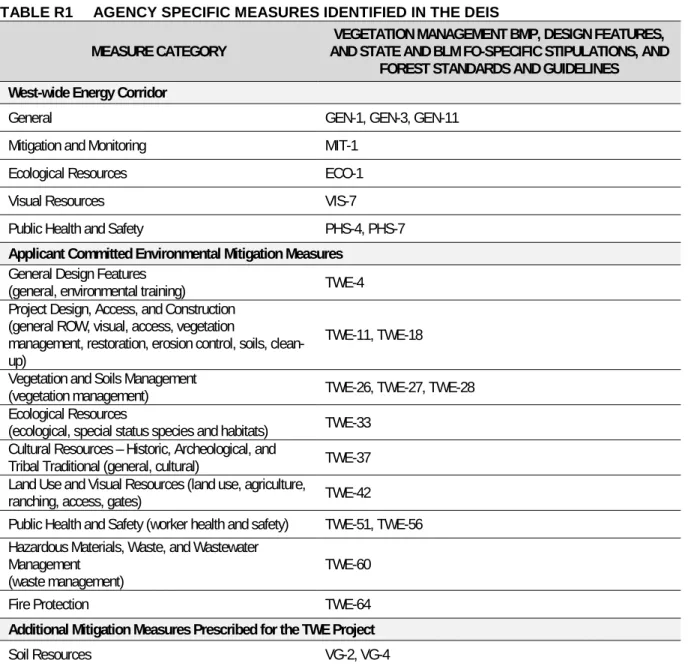
The Plan will provide specific information for implementing EMMs TWE-51 and TWE-56. Best Management Practices (BMPs) identified in the Draft Environmental Impact Statement (DEIS) which are listed below. The identified BMPs and Mitigation Measures have not been finalized at this time and may be updated, changed, or eliminated in future revisions of the Plan. BMPs which may be implemented include: PHS-4, PHS-5, PHS-6, and PHS-7, obtained from the Record of Decision (ROD) for the West-wide Energy Corridor (WWEC).
The management practices and activities in the Plan are intended to accomplish the following objectives:
• Educate construction workers on the hazards associated with the Project and how to identify them; the safety measures that must be taken to prevent injury; how to identify potentially contaminated soils and/or groundwater; and the procedures for ensuring personnel receive necessary training.
• Identify federal and state occupational standards regarding occupational safety and safe work practices.
• Establish fire safety evacuation procedures.
• Explain the appropriate response actions for each safety hazard and develop and describe the procedures and mechanisms for responding to and reporting serious accidents to appropriate agencies and for notifying the appropriate authorities of safety issues.
• Identify requirements for temporary fencing around staging areas, storage yards, and excavation areas during construction or decommissioning activities, as well as appropriate
measures to be taken during construction of the Project to limit public access to hazardous facilities.
• Designate environmental field representative(s) to be on site to observe, enforce, and document adherence to this Plan.
• Identify where medical kits are located.
M3.0
PLAN UPDATES
The Construction Contractor(s) will be responsible for preparing and implementing a Health and Safety Plan in compliance with all local, state, and federal regulations pertaining to health and safety. This framework for the Plan will be updated for the ROD Plan of Development (POD) and will includerelevant mitigation measures to ensure regulation compliance and safety. The framework for the Plan for the Notice to Proceed (NTP) POD will include updates as needed based on final design and engineering.
M4.0
HEALTH AND SAFETY PLAN IMPLEMENTATION
The following subsections describe the Health and Safety Plan to be implemented only during construction of the Project. Similar to this Plan for construction, plans developed for operation would address critical aspects of operations including, but not limited to, hazardous material and waste management, stormwater management, and monitoring for external impacting factors (e.g., seismic activity, landslides). Operating plans would establish detailed procedures, assign responsibilities, and establish self-auditing processes for evaluating overall effectiveness and sufficiency of operations. Mitigation strategies would be developed for both routine and off-normal operating conditions. Under normal operating conditions, health and safety impacts to the public from any of the approved
systems would be minimal. Mitigation of impacts under failure modes for the various systems; however, would involve both design considerations and active emergency response measures.
Decommissioning involves activities similar to construction, and thus presents many of the same health and safety hazards. These hazards mainly affect workers, but some, including increased construction traffic and the presence of potentially hazardous work areas, also affect members of the public, albeit at low risk levels. Decommissioning phases are expected to last for shorter periods of time than the construction phase and may involve fewer specific steps. In addition, the majority of activities would occur within the right-of-way (ROW), and their related health and safety impacts would be imposed primarily on the deconstruction workforce. However, impacts to the public would also occur from activities occurring off the ROW such as material storage yards; component
dismantlement; salvage recycling operations; and as a result of increased traffic on public roadways. Impacts to the public could also occur from unauthorized access to work sites and storage and recycling facilities.
M4.1
Project Workers and the Public
Workers are protected through the implementation of the Health and Safety Plan. The public is protected by restricting public access to construction work areas; implementing appropriate site security measures, traffic control, dust control, and hazardous material management plans; by coordinating with emergency service providers; and notifying property owners of any hazardous operations to be conducted, such as blasting. Construction sites should be secured at the end of the workday to protect the equipment and the general public. The following subsections provide further details regarding the procedures to be utilized for the protection of workers and the public.
M4.1.1
Site Access and Security
The Construction Contractor(s) will develop Project orientation training which will be part of the NTP POD. Project orientation training will include basic hazard awareness, site-specific hazards, safe working practices, and emergency procedures. Only personnel with a visible hard-hat decal or daily visitor pass, indicating they have completed Project orientation training, will be allowed on any Project work area. Members of the public will not be allowed access to potentially hazardous
facilities, including construction work sites and staging yards for materials and equipment. Visitors to any construction site or material yard must have a signed Safety and Environmental Visitor Form indicating that they have been apprised of basic hazards and environmental issues associated with the Project. Visitors must be escorted at all times by Project personnel, who have completed Project orientation training and are familiar with the Project site. In addition, access to material and
equipment staged at substation sites and material yards will be restricted by means of fencing, locked gates, and/or posted security guards. Where fencing is used, it will be suitable to restrict transient traffic, off-highway vehicles (OHVs), and the public from accessing potentially hazardous areas. Existing gates on the ROW will be locked, monitored, or left open as determined by the property owner. Personal vehicles must be parked in designated locations, as determined by the Construction Contractor(s). Only approved Project vehicles will be allowed on construction sites, material yards, and transmission ROWs. Security guards will be stationed at major sites as necessary. Cameras and night lighting will be utilized where warranted.
M4.2 Safe Work Practices, Training, Documentation, and Reporting
The Construction Contractor(s) will maintain appropriate standards, safe work practices, hazard training, documentation, and reporting in accordance with their respective Plans. As described in Section 4.1 Protect Workers and the Public, these plans will conform to the requirements of the OSHA.M4.2.1
Safe Work Practices for Each Task
The Construction Contractor(s) will develop a task-specific Job Safety Analysis (JSA) for each construction task. The JSA provides a list of steps, potential hazards, safety procedures, and recommended controls. They specify equipment to be used, as well as inspection and training requirements.
Training on general safe work practices is a requirement for TransWest and its contractors, as specified in their respective Plans. Training topics may also include heat illness prevention, cardiopulmonary resuscitation (CPR)/automatic external defibrillator (AED), first aid, emergency action and fire prevention, and safe driving. No horseplay or fighting will be tolerated. Drugs and alcohol are prohibited, and pets are not permitted on any Project site or ROW. Guns are prohibited on any Project site except for authorized security personnel or law enforcement officers. Unless
otherwise posted, vehicles must not exceed 15 miles per hour (mph) along approved access roads, or 5 mph in construction yards. In addition, seatbelts must be worn in all motorized vehicles.
M4.2.2
Worker Training Procedures and Requirements
All Project personnel will participate in worker training and sign a roster verifying their attendance. Information from rosters will be logged into a spreadsheet for ease of verifying Project worker training attendance records. All attendees will be provided with a hard-hat decal, as a visible means of verifying their attendance. Trade personnel will be required to receive essential skills and safety training through an appropriate apprenticeship program, which qualifies them to perform the work of their trade. Non-trade personnel will be required to have received essential skills and safety training
appropriate to their job tasks through their employers’ training programs. Records of all training will be available for audit as required.
M4.2.3
Hazard Training Requirements
Construction Contractor(s) shall have an appropriate training program in accordance with its health and safety practices, as well as federal, state, and local laws and regulations. Job-specific construction hazards may be addressed before work begins each day at a tailgate meeting. Typically, the daily tailgate meetings will include a review of the JSA for the work being performed. Other potential safety discussions could include site access, work practices, security, transportation of heavy equipment, traffic management, emergency procedures, wildlife encounters, and fire control and management. If the work plan changes later in the day, an additional tailgate meeting may be held. Anyone arriving at the site after the tailgate meeting will be briefed on the JSA and other tailgate issues discussed prior to entering the construction site, and will sign the tailgate roster.
M4.2.4
Contaminated Soils and/or Groundwater Awareness
Worker training will also address identification of and appropriate response actions for potentially contaminated soils and/or groundwater
M4.2.5
Safety Performance Standards
TransWest will monitor all Project-related workplace injuries and illnesses utilizing OSHA
Recordkeeping and Reporting Standards. This includes recordable cases, as well as first aid cases. In addition, TransWest will monitor close calls and motor vehicle incidents reflecting standard OSHA metrics, including recordable cases and cases resulting in lost time.
TransWest and its Construction Contractor(s) will provide the proper tools, equipment, personal protective equipment, and appropriate training for their respective personnel as needed to perform their specific job duties. All safety requirements will be implemented in accordance with OSHA safety standards.
M4.3
Federal and State Occupational Safety Standards
The Project will be constructed in accordance with the NESC and other relevant industry standards (e.g., American National Standards Institute [ANSI]), to insure that adequate safety clearances and provisions are provided. Safety measures including fencing, warning signs, and equipment grounding will be provided per code requirements. All construction personnel will be required to follow OSHA Standards throughout Project construction.
Section 18 of the Occupational Safety and Health Act of 1970 (the Act) encourages States to develop and operate their own job safety and health programs. OSHA approves and monitors such State plans. States must set job safety and health standards that are "at least as effective as" comparable federal standards. Most States adopt standards identical to federal ones. States have the option to promulgate standards covering hazards not addressed by federal standards. A State must conduct inspections to enforce its standards, cover public (State and local government) employees, and operate occupational safety and health training and education programs. States in the Project area with Approved
M4.3.1
Nevada
The Nevada State Plan is administered by the Division of Industrial Relations (DIR), Department of Business and Industry. Within the DIR, an enforcement section and consultation section have been established. Enforcement is provided by the Nevada Occupational Safety and Health Administration (Nevada OSHA), and Consultation is provided by the Nevada Safety Consultation and Training Section (SCATS). The Nevada State Plan applies to all public and private sector employers in the State, with the exception of federal employees, the United State Postal Service (USPS), private sector maritime, employment on Indian Lands, and areas of exclusive federal jurisdiction.
Nevada adopts federal OSHA standards by reference and enforces OSHA standards contained within 29 Code of Federal Regulations (CFR), Parts 1910 (General Industry), 1926 (Construction) and 1928 (Agriculture). In addition, Nevada has adopted additional requirements to include: safety programs, cranes, steel erection, construction projects, asbestos, explosives, ammonium perchlorate, and photovoltaic system projects.
M4.3.2
Utah
The Utah Occupational Safety and Health Division is part of Utah’s Labor Commission. The Utah State Plan applies to all public and private sector places of employment in the State, with the
exception of federal employees, the USPS, private sector maritime, Hill Air Force Base, Tooele Army Depot which includes the Tooele Chemical Demilitarization Facility, and certain agricultural related operations (field sanitation and temporary labor camps), which are subject to federal OSHA
jurisdiction. While Utah adopts most federal standards identically, the State periodically supplements federal standards with additional requirements.
M4.3.3
Wyoming
The Wyoming State Plan applies to all public and private sector places of employment in the State, with the exception of federal employees (including those employed at Yellowstone and Grand Teton National Parks), the USPS, private sector maritime, employment at Warren Air Force Base and at the Naval Petroleum and Oil Shale Reserve in Casper, and certain agricultural related operations (field sanitation and temporary labor camps), which are subject to federal OSHA jurisdiction.
The Wyoming State Plan adopts all federal standards identically except for 29 CFR Part 1910 Subparts A, B, and C, and Part 1926 Subparts A and B, which have been reworded to reflect the Wyoming's Safety Act. New standards are promulgated by the state of Wyoming within six months of promulgation by the Secretary of Labor. Wyoming cannot adopt standards that are more stringent than corresponding federal standards, but can adopt standards for industries not covered by federal OSHA. Wyoming has adopted the federal recordkeeping and reporting requirements identical to the federal rule, 29 CFR Part 1904.
M4.4
Potential Health and Safety Issues
Most occupational health and safety issues during the construction, operation, and decommissioning of electric power projects include, among others, exposure to physical hazards from use of heavy equipment and cranes; trip and fall hazards; exposure to dust and noise; falling objects; work in confined spaces; exposure to hazardous materials; and exposure to electrical hazards from the use of tools and machinery. Occupational health and safety hazards specific to electric power transmission projects primarily include:
• Working at height on poles and structures
• Exposure to chemicals (primarily handling of pesticides (herbicides) used for ROW maintenance and exposure to polychlorinated biphenyls (PCBs) in transformers and other electrical components).
Additional health and safety issues include, but are not limited to the following: • Working in or near traffic;
• Driving and hiking in rugged terrain;
• Working in inclement weather and in extremes of heat and cold; • Coming into contact with poisonous snakes, spiders, and plants; • Falling into excavation areas;
• Falling from structures or from ladders; • Working with or around blasting materials; • Working near energized electric facilities; • Working in isolated areas prone to wildland fire;
• Working in areas located far from emergency medical services; • Encountering buried utilities;
• Working around noisy equipment and/or helicopters; and • Working near abandoned mines.
M4.4.1
Fire Control and Evacuation Procedures
Refer to Appendix H – Fire Protection Plan.M4.4.2
Heavy Equipment Transportation and Traffic Management
Refer to Appendix U – Traffic and Transportation Management Plan.M4.5
Response Actions for Safety Hazards
At least two personnel on each construction crew will have first aid, CPR, AED, and bloodborne pathogen training. Fire safety personnel will periodically inspect work along the ROW and will be certified emergency responders. Crews will also be familiar with evacuation routes should emergency evacuation be needed. Additional emergency support will be available by contacting the Project Base (Base), which provides direct lines to emergency medical services, life flight, fire protection, County Sheriff’s Departments, and State Highway Patrols. Base will be staffed by personnel that are trained to monitor construction field activities, both in the air and on the ground. Base will provide and/or
appropriate, Base will trigger a call to emergency services. Crews will have direct contact with Base by means of radios, cell phones, and satellite phones if necessary. While working through the appropriate procedures, Base will provide the following support:
• Dispatching field security agents and field safety advisors to the scene of an incident/event. • Beginning an incident/event timeline as an event unfolds, documenting times when actions or
events occur.
• Launching a wide variety of notifications to Project and TransWest leadership. These notifications will be made to different distribution lists based on the level and type of
incident/event. Notifications will be made within minutes of an event and contain information regarding who, what, when, where, any action taken, and the status of the incident/event. • Staying in communication with the field personnel reporting an incident/event and the
procedure will ensure expeditious response and accurate information.
M4.5.1
Authority Notification
Construction crews will immediately alert the on-site TransWest representative of all incidents. The TransWest representative will provide appropriate notification to Base. If a TransWest representative is not on-site, Construction Contractor personnel will be provided with a radio to make notification themselves.
Base will then be responsible for notifications to appropriate Project personnel and TransWest management. These notifications will be made to different distribution lists based on the level and type of incident/events. Notifications will be made within minutes of an event and provide
information regarding who, what, when, where, any action taken, and the status of the incident/event.
M4.5.2
Fire Safety Evacuation
The Health and Safety Plan will also include fire safety evacuation procedures and incorporates the Fire Protection Plan. As previously described, TransWest will also maintain a Base operation, which will be available during all work hours, to assist with effective communications with crews,
emergency agencies, and Project management. Base will facilitate evacuation/rescue efforts if required. An evacuation route map showing safe exit routes and assembly locations will be shared as part of the worker training orientation. In the event of fire or other site emergency, the following evacuation procedures will be followed to track personnel leaving the work site:
• At each work site the designated point of contact will verify the current head count and notify Base.
• Base will notify fire dispatch and emergency responders of personnel locations, headcount, rally points, and headings to assist in evacuation operations.
• Radios and global positioning system tracking units will be monitored at Base. Updated information will be relayed to Base as needed.
• Upon arrival at the rallying points, all personnel to be evacuated will be required to checkout with Base before leaving.
M4.5.3
Medical Aid Kit Locations
Facilities/areas such as substations and construction yards will contain first aid kits that are appropriate for the number of personnel working at the respective sites. First aid kits and fire
extinguishers will also be stored in Project vehicles. An AED will be maintained at each terminal site.
M4.5.4
Reporting Serious Accidents
As previously described, Base will monitor field personnel and maintain radio communications with a designated point of contact at each work site. All incidents will be reported immediately to Base, which will initiate notifications as described previously. In addition, TransWest will have environmental monitors, field safety advisors, fire marshals, and security agents in the field to monitor, respond to, and report any incidents.
M4.6
Environmental Field Representative(s)
An environmental field representative will be designated as TransWest’s field, fire, safety, and security team lead. In this role, the environmental field representative will be responsible for safety, fire preparedness, security, and Project Base operations and will provide management oversight for Project personnel fulfilling these roles. The environmental field representative will work closely with these individuals to implement the Health and Safety Plan during construction.
APPENDIX N
FRAMEWORK NOXIOUS WEED MANAGEMENT
PLAN
TABLE OF CONTENTS
N1.0 INTRODUCTION ... 1
N1.1 PLAN PURPOSE... 1 N1.2 PLAN UPDATES ... 3 N1.3 GOALS ... 3 N1.4 AGENCY REGULATIONS ... 3 N1.4.1 All Lands ... 7 N1.4.2 Bureau of Land Management ... 7 N1.4.3 United States Forest Service ... 7 N1.4.4 National Park Service ... 8 N1.4.5 Bureau of Reclamation ... 8 N1.4.6 Utah Reclamation Mitigation and Conservation Commission ... 8 N1.4.7 State of Colorado ... 8 N1.4.8 State of Nevada ... 9 N1.4.9 State of Utah ... 9 N1.4.10 State of Wyoming ... 9 N1.5 TIMELINE ... 9 N1.6 RESPONSIBLE PARTIES ... 9
N2.0 NOXIOUS WEED MANAGEMENT PLAN ... 10
N2.1 STATE- AND COUNTY-LISTED NOXIOUS WEEDS ... 10 N2.1.1 APHIS ... 26 N2.1.2 State of Wyoming ... 26 N2.1.3 State of Colorado ... 26 N2.1.4 State of Utah ... 26 N2.1.5 State of Nevada ... 27 N2.1.6 BLM or Forest Service Invasive Weeds ... 27 N2.2 NOXIOUS WEED MANAGEMENT ... 27 N2.2.1 Weed Management Personnel Requirements ... 28 N2.2.2 Pre-Construction Noxious Weed Surveys ... 28 N2.2.3 Identification of Problem Weed Areas ... 30 N2.2.4 Preventative Measures ... 30 N2.2.5 Treatment Measures ... 31 N2.2.6 Reclamation Measures ... 32
N3.0 PESTICIDE APPLICATION, HANDLING, SPILLS, AND CLEANUP ... 32
N3.1 PESTICIDE APPLICATOR TRAINING ... 32 N3.2 PESTICIDE APPLICATION AND HANDLING ... 33
N3.3 PESTICIDE SPILLS AND CLEANUP ... 40
N4.0 MONITORING ... 40 N5.0 REFERENCES ... 41
TABLES:
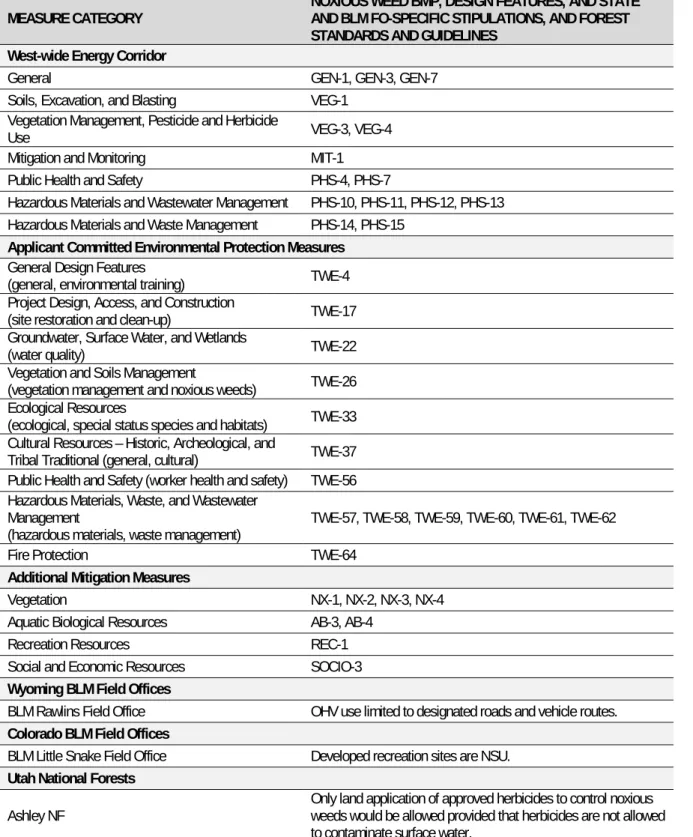
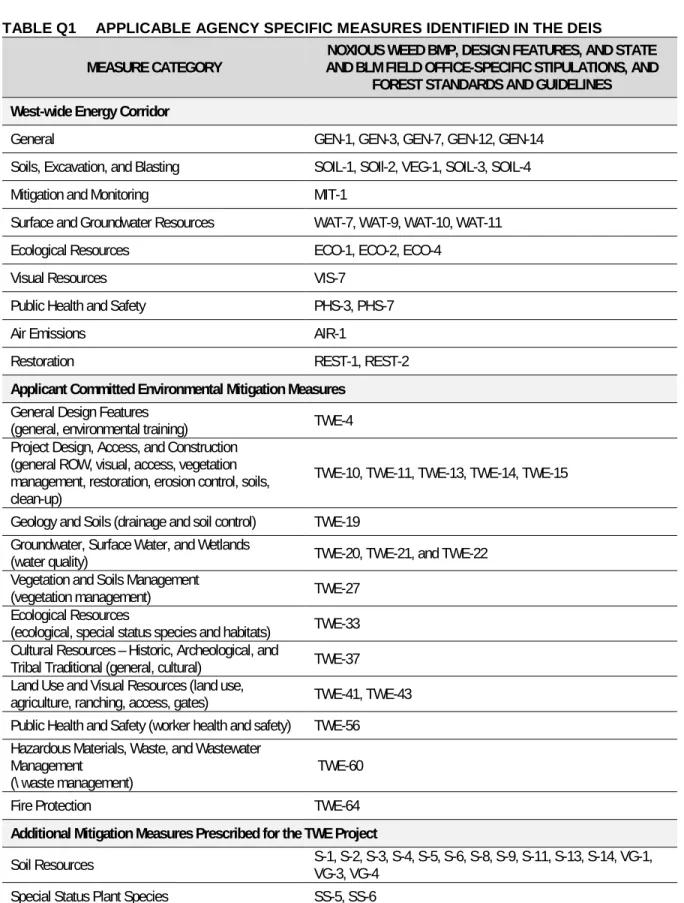
TABLE N1 APPLICABLE NOXIOUS WEED MANAGEMENT MEASURES IDENTIFIED IN
DRAFT EIS ... 2
TABLE N2 WEED PERSONNEL CONTACT INFORMATION AND COMMENTS
PROVIDED BY AGENCY FOR THE TWE PROJECT ... 4
TABLE N3 COLORADO NOXIOUS WEEDS AND POTENTIAL FOR OCCURRENCE IN
COLORADO PROJECT COUNTY (MOFFAT) ... 11
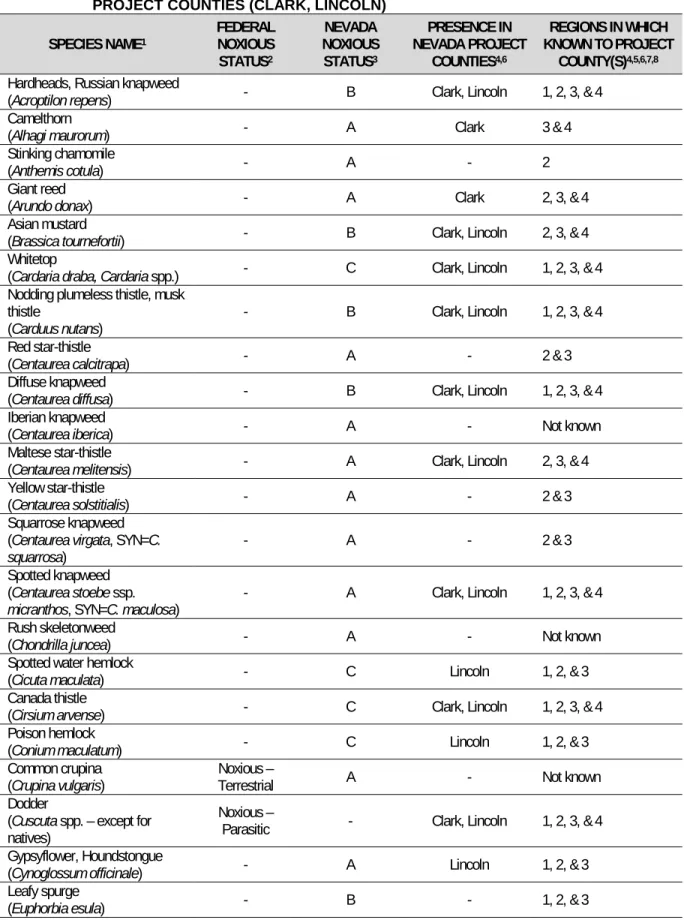
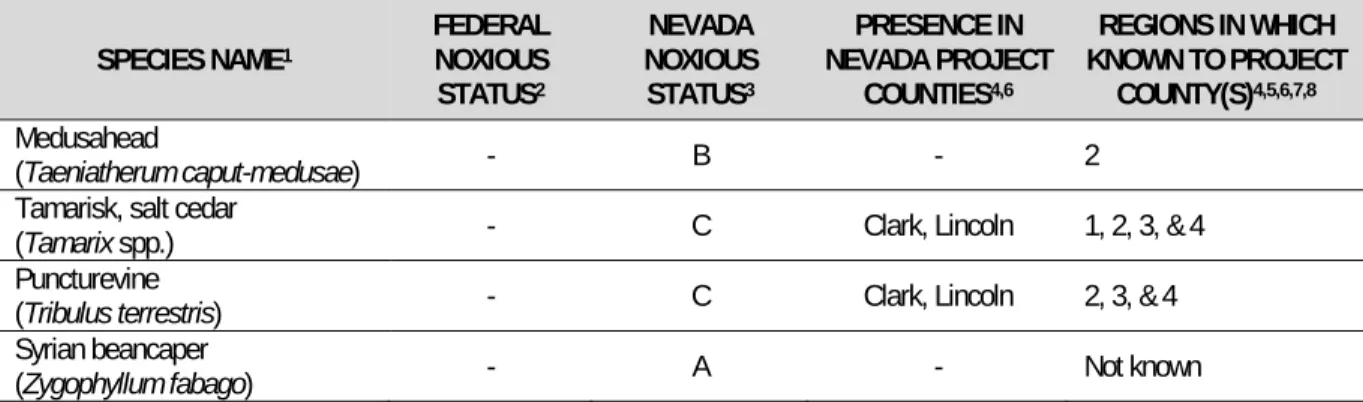
TABLE N4 NEVADA NOXIOUS WEEDS AND POTENTIAL FOR OCCURRENCE IN
NEVADA PROJECT COUNTIES (CLARK, LINCOLN) ... 19
TABLE N5 UTAH NOXIOUS WEEDS AND POTENTIAL FOR OCCURRENCE IN UTAH
PROJECT COUNTIES ... 21
TABLE N6 WYOMING NOXIOUS WEEDS AND POTENTIAL FOR OCCURRENCE IN
WYOMING PROJECT COUNTIES (CARBON, SWEETWATER) ... 24
TABLE N7 NOXIOUS WEED PROBLEM AREAS IDENTIFIED IN THE TWE PROJECT
FOOTPRINT (ROW, ACCESS ROADS, STAGING AREAS, MATERIAL
STORAGE AREAS, ETC.) ... 29
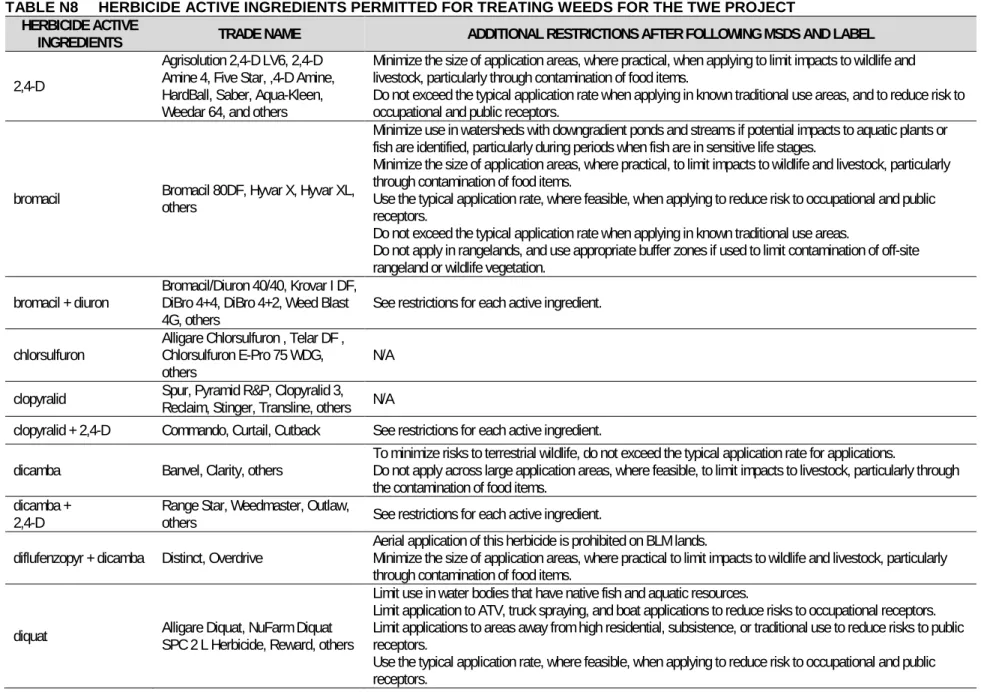
TABLE N8 HERBICIDE ACTIVE INGREDIENTS PERMITTED FOR TREATING WEEDS
FOR THE TWE PROJECT ... 36
APPENDICES:
ATTACHMENT A BLM PESTICIDE USE PROPOSAL (PUP) TEMPLATE ... 44
ATTACHMENT B FOREST SERVICE PESTICIDE USE PROPOSAL (PUP) INSTRUCTIONS
ACRONYMS
°F degrees Fahrenheit
APHIS Animal and Plant Health Inspection Services Applicant TransWest Express LLC, also TransWest
BA Biological Assessment
BE Biological Evaluation
BLM Bureau of Land Management
BMP Best Management Practice
BO Biological Opinion
CCR Colorado Code of Regulations
CFR Code of Federal Regulations
CWA Clean Water Act
DEIS Draft Environmental Impact Statement EDRR Early Detection Rapid Response EMM Environmental Mitigation Measure
EPA Environmental Protection Agency
ESA Endangered Species Act of 1973
FEIS Final Environmental Impact Statement
FIFRA Federal Insecticide, Fungicide, and Rodenticide Act FLPMA Federal Land Policy and Management Act of 1976
GPS global positioning system
mph miles per hour
MSDSs Material Safety Data Sheets NEPA National Environmental Policy Act
NPS National Park Service
NTP Notice to Proceed
Plan Noxious Weed Management Plan
POD Plan of Development
POEA polyoxyethyleneamine
Project TransWest Express Transmission Project, also TWE Project
psi pounds per square inch
PUP Pesticide Use Proposal
Reclamation Bureau of Reclamation
ROD Record of Decision
ROW right-of-way
SUP Special Use Permit
TransWest TransWest Express LLC, also Applicant
TWE Project TransWest Express Transmission Project, also Project U.S.C. United States Code
URMCC Utah Reclamation Mitigation and Conservation Commission USDA United States Department of Agriculture
USDOI United States Department of Interior USFS United States Forest Service
USFWS United States Fish and Wildlife Service
WEAP Worker Environmental Awareness Program