Chapter 6. Converter Circuits
6.1. Circuit manipulations
6.2. A short list of
converters
6.3. Transformer isolation
6.4. Converter evaluation
and design
6.5. Summary of key
points
• Where do the boost, buck-boost, and other converters originate? • How can we obtain a
converter having given desired properties? • What converters are
possible?
• How can we obtain
transformer isolation in a converter?
• For a given application, which converter is best?
6.1. Circuit manipulations
+ –
V
gL
C R
+
V
–
1
2
Begin with buck converter: derived in chapter 1 from first principles • Switch changes dc component, low-pass filter removes
switching harmonics
6.1.1. Inversion of source and load
Interchange power input and output ports of a converter Buck converter example
port 1 port 2
+ –
L
1
2
+ V1
–
+ V2
–
Power flow
Inversion of source and load
port 1 port 2
+ –
L
1
2
+ V1
–
+ V2
–
Power flow
Interchange power source and load:
V2 = DV1 V1 = 1
Realization of switches
as in chapter 4
V1 = 1
D' V2
port 1 port 2
+ – L
+ V1
–
+ V2
–
Power flow
• Reversal of power flow requires new realization of
switches
• Transistor conducts when switch is in position 2
• Interchange of D
and D’
6.1.2. Cascade connection of converters
+ –
converter 2 converter 1
Vg
+ V1
–
+ V –
D
V1
Vg = M1(D)
V
V1 = M2(D)
V1 = M1(D) Vg V = M2(D) V1
V Vg
Example: buck cascaded by boost
+ – Vg
1
2
L1
C1
+
V1
–
R
+
V
–
1
2
L2
C2
{
{
Buck converter Boost converter
V1
Vg = D
V V1 =
1 1 – D
V Vg
= D
Buck cascaded by boost:
simplification of internal filter
+ – Vg
1
2
L1
R
+
V
– 1
2
L2
C2
+
V
– 1
2
L
+ – Vg
1
2
iL
remove capacitor C1
combine inductors L1 and L2
Noninverting buck-boost converter
Noninverting buck-boost converter
+
V
– 1
2
L
+ – Vg
1
2
iL
+ –
+
V
–
Vg
iL
+ –
+
V
–
Vg
iL
Reversal of output voltage polarity
+ –
+
V
–
Vg
iL
+ –
+
V
–
Vg
iL
+ –
+
V
–
Vg
iL
+ –
+
V
–
Vg
iL
subinterval 1 subinterval 2
noninverting buck-boost
inverting buck-boost
Reduction of number of switches:
inverting buck-boost
+ –
+
V
–
Vg
iL
+ –
+
V
–
Vg
iL
subinterval 1 subinterval 2
One side of inductor always connected to ground — hence, only one SPDT switch needed:
+ –
+
V
–
1 2
Vg iL VV
g
= – D 1 – D
Discussion: cascade connections
• Properties of buck-boost converter follow from its derivation
as buck cascaded by boost
Equivalent circuit model: buck 1:D transformer cascaded by boost
D’:1 transformer
Pulsating input current of buck converter Pulsating output current of boost converter
• Other cascade connections are possible
6.1.3. Rotation of three-terminal cell
+ –
+
v
–
1
2
Vg
three-terminal cell
a
A b B
c C
Treat inductor and SPDT switch as three-terminal cell:
Three-terminal cell can be connected between source and load in three nontrivial distinct ways:
a-A b-B c-C buck converter a-C b-A c-B boost converter
Rotation of a dual three-terminal network
+ – Vg
+
v
–
1
2
thre
e-terminalce
ll
A a b B
c C
A capacitor and SPDT switch as a
three-terminal cell:
Three-terminal cell can be connected between source and load in three nontrivial distinct ways:
a-A b-B c-C buck converter with L-C input filter a-C b-A c-B boost converter with L-C output filter a-A b-C c-B Cuk converter
6.1.4. Differential connection of load
to obtain bipolar output voltage
converter 1 +
V1
– +
V – D
converter 2
+ – Vg
+ V2 –
D'
load dc source
V1= M(D) Vg
V2= M(D') Vg
Differential load voltage is
V = V1 – V2
The outputs V1 and V2
may both be positive, but the differential
output voltage V can be positive or negative.
Differential connection using two buck converters
+ V1
– +
V – +
– Vg
+ V2
–
1
2
1 2
Buck converter 1
}
Buck converter 2
{
Converter #1 transistor driven with duty cycle D
Converter #2 transistor driven with duty cycle complement D’
Differential load voltage is
V = DVg – D'Vg
V = (2D – 1) Vg
Conversion ratio M(D),
differentially-connected buck converters
V = (2D – 1) Vg
D M(D)
1 0.5
1
0
Simplification of filter circuit,
differentially-connected buck converters
+ – Vg
1
2
1 2
+ V – +
V1
– +
V – +
– Vg
+ V2 –
1
2
1 2
Buck converter 1
}
Buck converter 2
{
Simplification of filter circuit,
differentially-connected buck converters
Combine series-connected inductors
Re-draw for clarity
+ – Vg
1
2
1 2
+ V –
+ –
L
C
R
+ V –
2
1
iL Vg
1
2
H-bridge, or bridge inverter
Commonly used in single-phase inverter applications and in servo amplifier applications
Differential connection to obtain 3ø inverter
converter 1 +
V1 – converter 2 + – Vg + V2 – 3øac load dc source
converter 3 +
V3 – D1 D2 D Vn + vbn –
– v
an
+
– v
cn + V1= M(D1) Vg
V2= M(D2) Vg
V3= M(D3) Vg
With balanced 3ø load, neutral voltage is
Vn = 1
3 (V1 + V2 + V3)
Van = V1 – Vn
Vbn = V2 – Vn
Vcn = V3 – Vn
Phase voltages are
Control converters such that their output voltages contain the same dc biases. This dc bias will appear at the
neutral point Vn. It then cancels out, so phase
3ø differential connection of three buck converters
+ V1
–
+ – Vg
+ V2
–
3øac load dc source
+ V3
–
Vn + vbn –
– v
an
+
– v
3ø differential connection of three buck converters
3øac load dc source
Vn + vbn –
– v an +
– v
cn
+
+ – Vg
Re-draw for clarity:
6.2. A short list of converters
An infinite number of converters are possible, which contain switches embedded in a network of inductors and capacitors
Two simple classes of converters are listed here:
• Single-input single-output converters containing a single
inductor. The switching period is divided into two subintervals. This class contains eight converters.
• Single-input single-output converters containing two inductors. The switching period is divided into two subintervals. Several of the more interesting members of this class are listed.
Single-input single-output converters
containing one inductor
• Use switches to connect inductor between source and load, in one
manner during first subinterval and in another during second subinterval • There are a limited number of ways to do this, so all possible
combinations can be found
• After elimination of degenerate and redundant cases, eight converters are found:
dc-dc converters
buck boost buck-boost noninverting buck-boost
dc-ac converters
bridge Watkins-Johnson
ac-dc converters
Converters producing a unipolar output voltage
2. Boost
+ –
+
V
–
1
2
Vg
M(D) = 1
1 – D
1. Buck
+ –
+
V
–
1
2
Vg
M(D) = D
M(D)
D
1
0 0.5
0 0.5 1
M(D)
D
2
0 1
0 0.5 1
3 4
Converters producing a unipolar output voltage
+ – + V – 1 2 Vg3. Buck-boost M(D) = – D
1 – D
+ V – 1 2 + – 1 2 Vg
4. Noninverting buck-boost M(D) = D
1 – D
M(D) –3 0 –4 –2 –1 D
0 0.5 1
M(D)
D
2
0 1
0 0.5 1
3 4
Converters producing a bipolar output voltage
suitable as dc-ac inverters
6. Watkins-Johnson
5. Bridge M(D) = 2D – 1
M(D) = 2D – 1 D
1 2
+
– + V –
Vg 2 1 M(D) 1 –1 0 D 0.5 1 + – 1 2 1 2 Vg + V – M(D) D 0.5 1 –1 –3 –2 0 1 + V – + – 1 2 Vg or
Converters producing a bipolar output voltage
suitable as ac-dc rectifiers
7. Current-fed bridge
8. Inverse of Watkins-Johnson
M(D) = 1
2D – 1
M(D) = D
2D – 1
M(D) –1 2 –2 0 1 D 0.5 1 M(D) –1 2 –2 0 1 D 0.5 1 +
– + V –
1 2 2 1 Vg + – Vg 2 1 2 1 + V – or + V – + – Vg 1 2
Several members of the class of two-inductor converters
2. SEPIC
1. Cuk M(D) = – 1 – DD
M(D) = D
1 – D
M(D)
–3 0
–4 –2 –1
D
0 0.5 1
M(D)
D
2
0 1
0 0.5 1
3 4
+ –
+
V
–
1 2
Vg
+ –
+
V
–
Vg 1
Several members of the class of two-inductor converters
3. Inverse of SEPIC
4. Buck 2 M(D) = D2 M(D) = D
1 – D M(D)
D
2
0 1
0 0.5 1
3 4
M(D)
D
1
0 0.5
0 0.5 1
+ –
1
2 Vg
+
V
–
+ – Vg
1
2
1 2
+
V
6.3. Transformer isolation
Objectives:
• Isolation of input and output ground connections, to meet
safety requirements
• Reduction of transformer size by incorporating high
frequency isolation transformer inside converter
• Minimization of current and voltage stresses when a
large step-up or step-down conversion ratio is needed —
use transformer turns ratio
• Obtain multiple output voltages via multiple transformer
secondary windings and multiple converter secondary
circuits
A simple transformer model
n1 : n2
: n3 +
v1(t) –
+ v2(t)
–
+ v3(t)
–
i1(t) i2(t)
i3(t)
n1 : n2
: n3 +
v1(t) –
+ v2(t)
–
+ v3(t)
–
i1(t) i2(t)
i3(t)
ideal transformer
i1'(t)
LM iM(t)
Multiple winding transformer Equivalent circuit model
v1(t)
n1 =
v2(t)
n2 =
v3(t)
n3 = ...
The magnetizing inductance L
M
B(t)∝ v1(t) dt
H(t)∝iM(t)
slope ∝ LM saturation
Transformer core B-H characteristic
• Models magnetization of transformer core material
• Appears effectively in parallel with windings
• If all secondary windings are
disconnected, then primary winding behaves as an inductor, equal to the magnetizing inductance
• At dc: magnetizing inductance tends to short-circuit. Transformers cannot pass dc voltages
• Transformer saturates when
Volt-second balance in L
M
n1 : n2
: n3 +
v1(t) –
+ v2(t)
–
+ v3(t)
– i1(t) i2(t)
i3(t)
ideal transformer
i1'(t)
LM iM(t)
The magnetizing inductance is a real inductor, obeying
v1(t) = LMdiM(t)
dt
integrate:
iM(t) – iM(0) = 1
LM
v1(τ) dτ
0
t
Magnetizing current is determined by integral of the applied winding voltage. The magnetizing current and the winding currents are independent quantities. Volt-second balance applies: in
steady-state, iM(Ts) = iM(0), and hence
0 = 1
Ts
v1(t) dt
0
Transformer reset
• “Transformer reset” is the mechanism by which magnetizing inductance volt-second balance is obtained
• The need to reset the transformer volt-seconds to zero by the end of each switching period adds considerable complexity to converters • To understand operation of transformer-isolated converters:
• replace transformer by equivalent circuit model containing magnetizing inductance
• analyze converter as usual, treating magnetizing inductance as any other inductor
• apply volt-second balance to all converter inductors, including magnetizing inductance
6.3.1. Full-bridge and half-bridge
isolated buck converters
Full-bridge isolated buck converter
C R
+
v
–
L D5
D6
1 : n
: n
i(t) +
vs(t)
– +
vT(t) – +
– Vg
D1 Q1
D2 Q2
D3 Q3
D4 Q4
Full-bridge, with transformer equivalent circuit
C R
+
v
–
L D5
D6
1 : n
: n
i(t) +
vs(t)
– +
vT(t) – +
– Vg
i1(t) iD5(t) D1
Q1
D2 Q2
D3 Q3
D4 Q4
LM i1'(t) iM(t)
iD6(t) ideal
Full-bridge: waveforms
iM(t)
vT(t)
vs(t)
iD5(t) i(t) Vg 0 0 –Vg nVg 0 nVg 0 i
0.5 i 0.5 i
0
∆i I
Vg
LM –
Vg
LM
t
0 DTs Ts Ts+DTs 2Ts
Q Q
conducting
• During first switching period: transistors Q1 and Q4 conduct for time DTs , applying volt-seconds Vg DTs to primary winding
• During next switching period: transistors Q2 and Q3 conduct for time DTs , applying volt-seconds –Vg DTs to primary winding
• Transformer volt-second balance is obtained over two switching periods
Effect of nonidealities
on transformer volt-second balance
Volt-seconds applied to primary winding during first switching period:
(Vg – (Q1 and Q4 forward voltage drops))( Q1 and Q4 conduction time)
Volt-seconds applied to primary winding during next switching period:
– (Vg – (Q2 and Q3 forward voltage drops))( Q2 and Q3 conduction time)
These volt-seconds never add to exactly zero.
Net volt-seconds are applied to primary winding Magnetizing current slowly increases in magnitude
Saturation can be prevented by placing a capacitor in series with primary, or by use of current programmed mode (chapter 11)
Operation of secondary-side diodes
C R + v – L D5 D6 i(t) +vs(t) – iD5(t)
iD6(t)
vs(t)
iD5(t)
nVg
0
nVg
0 i
0.5 i 0.5 i
0 t
0 DTs Ts Ts+DTs 2Ts
Q1 D
5 Q2 D5
conducting devices:
• During second (D’) subinterval, both
secondary-side diodes conduct
• Output filter inductor current divides
approximately equally between diodes
• Secondary amp-turns add to approximately zero
• Essentially no net magnetization of transformer core by
vs(t)
iD5(t) i(t) nVg 0 nVg 0 i
0.5 i 0.5 i
0 ∆i
I
t
0 DTs Ts Ts+DTs 2Ts
Q1 Q4 D5
D6
D5 Q2
Q3 D6 D6 D5 conducting devices:
Volt-second balance on output filter inductor
V = vs V = nDVg
C R + v – L D5 D6 i(t) +
vs(t) – iD5(t)
iD6(t)
Half-bridge isolated buck converter
C R
+
v
–
L D3
D4
1 : n
: n
i(t) +
vs(t)
– +
vT(t) – +
– Vg
D1 Q1
D2 Q2
i1(t) iD3(t) Ca
Cb
• Replace transistors Q3 and Q4 with large capacitors • Voltage at capacitor centerpoint is 0.5Vg
• vs(t) is reduced by a factor of two
6.3.2. Forward converter
+ –
D1 Q1
n1 : n2 : n3
C R
+
V
–
L D2
D3 Vg
• Buck-derived transformer-isolated converter • Single-transistor and two-transistor versions • Maximum duty cycle is limited
Forward converter
with transformer equivalent circuit
+ –
D1 Q1
n1 : n2 : n3
C R
+
V
–
L D2
D3
Vg
LM
iM i1'
i1 i2 i3
+ v1 –
+
vD3
– +
v3 –
+ vQ1 –
– v2 +
Forward converter: waveforms
v1
iM
vD3
t Vg
– n1 n2 Vg
0
Vg
LM –
n1 n2
Vg
LM 0
0 0
n3 n1 Vg
DTs D2Ts D3Ts
Ts
Q D D
conducting
• Magnetizing current, in conjunction with diode D1, operates in discontinuous conduction mode
• Output filter inductor, in conjunction with diode D3, may operate in either
Subinterval 1: transistor conducts
+ –
D1 off Q1 on
n1 : n2 : n3
C R
+
V
– L
D2 on
Vg
LM
iM i1'
i1 i2 i3
+ v1 –
+
vD3 – +
v3 – –
v2 +
Subinterval 2: transformer reset
+ –
D1 on Q1 off
n1 : n2 : n3
C R
+
V
– L
D3 on Vg
LM
iM i1'
i1
i2 = iM n1 /n2
i3
+ v1 –
+
vD3 – +
v3 – –
v2 +
Subinterval 3
+ –
D1 off Q1 off
n1 : n2 : n3
C R
+
V
–
L
D3 on Vg
LM
i1'
i1 i
2
i3
+ v1 –
+
vD3
– +
v3 – –
v2 +
iM = 0
Magnetizing inductance volt-second balance
v1
iM
t Vg
– n1
n2 Vg
0
Vg
LM –
n1
n2
Vg
LM 0
DTs D2Ts D3Ts
Ts Q1
D2
D1 D3
D3 conducting
Transformer reset
From magnetizing current volt-second balance:
v1 = D ( Vg ) + D2 ( – Vg n1 / n2 ) + D3 ( 0 ) = 0
Solve for D2:
D2 = n2
n1 D
D3 cannot be negative. But D3 = 1 – D – D2. Hence
D3 = 1 – D – D2 ≥ 0 D3 = 1 – D 1 +
n2
n1 ≥ 0
Solve for D
D ≤ 1
1 + n2
n1
D ≤ 1
2
What happens when D > 0.5
iM(t)
DTs D2Ts D3Ts t
iM(t)
DT D T t
magnetizing current waveforms,
for n1 = n2
D < 0.5
Conversion ratio M(D)
C R
+
V
– L
D2 D3
+
vD3 – vD3
t
0 0
n3 n1 Vg
DTs D2Ts D3Ts Ts
Q D D
conducting
vD3 = V = n3
Maximum duty cycle vs. transistor voltage stress
D ≤ 1
1 + n2
n1
Maximum duty cycle limited to
which can be increased by increasing the turns ratio n2 / n1. But this increases the peak transistor voltage:
max vQ1 = Vg 1 +
n1
n2
For n1 = n2
D ≤ 1
The two-transistor forward converter
+ –
D1
Q1
1 : n
C R
+
V
– L
D2
D3
Vg
Q2
D4
max vQ1 = max vQ2 = Vg
D ≤ 1
2 V = nDVg
6.3.3. Push-pull isolated buck converter
C R
+
V
–
L D1
D2 1 : n
+
–
Vg Q1
Q2
+
vs(t)
– –
vT(t)
+ –
vT(t)
+
iD1(t)
i(t)
Waveforms: push-pull
iM(t)
vT(t)
vs(t)
iD1(t) i(t) Vg 0 0 –Vg nVg 0 nVg 0 i
0.5 i 0.5 i
0
∆i I
Vg
LM –
Vg
LM
t
0 DTs Ts Ts+DTs 2Ts
Q1 D Q2 D
conducting
• Used with low-voltage inputs • Secondary-side circuit identical
to full bridge
• As in full bridge, transformer volt-second balance is obtained over two switching periods
• Effect of nonidealities on transformer volt-second balance?
• Current programmed control can be used to mitigate
transformer saturation
problems. Duty cycle control not recommended.
6.3.4. Flyback converter
+
– L
–
V
+
Vg
Q1 D1
buck-boost converter:
construct inductor winding using two parallel wires:
+
– L
–
V
+
Vg
Q1 D1
Derivation of flyback converter, cont.
+
– LM
–
V
+
Vg
Q1 D1
1:1
Isolate inductor
windings: the flyback converter
Flyback converter having a 1:n turns ratio and positive output:
+ –
LM
+
V
–
Vg
Q1
D1
1:n
The “flyback transformer”
● A two-winding inductor ● Symbol is same as
transformer, but function differs significantly from ideal transformer
● Energy is stored in
magnetizing inductance
● Magnetizing inductance is
relatively small
+ –
LM
+
v
–
Vg
Q1
D1
1:n
C
transformer model
i ig
R iC
+
vL
–
● Current does not simultaneously flow in primary and secondary windings ● Instantaneous winding voltages follow turns ratio
● Instantaneous (and rms) winding currents do not follow turns ratio
Subinterval 1
vL = Vg
iC = – v
R ig = i
CCM: small ripple
approximation leads to
vL = Vg
iC = – V
R ig = I
+ –
LM
+
v
– Vg
1:n
C
transformer model
i ig
R iC +
vL –
Subinterval 2
CCM: small ripple
approximation leads to
vL = – vn
iC = in – v R ig = 0
vL = – Vn
iC = In – V R ig = 0
+ –
+
v
– Vg
1:n
C
transformer model
i
R iC i/n
– v/n + +
vL – ig
CCM Flyback waveforms and solution
vL
iC
ig
t Vg
0
DTs D'Ts
Ts conducting
–V/n
–V/R
I/n – V/R
I
Volt-second balance:
vL = D (Vg) + D' (– Vn ) = 0
Conversion ratio is
M(D) = V
Vg = n DD'
Charge balance:
iC = D (– V
R) + D' ( In – V
R) = 0
Dc component of magnetizing current is
I = nV D'R
Dc component of source current is
Equivalent circuit model: CCM Flyback
vL = D (Vg) + D' (– Vn ) = 0 iC = D (– V
R) + D' ( In – V
R) = 0
Ig = ig = D (I) + D' (0)
+ – +
– R
+
V
–
Vg + D'Vn D'In
– DVg DI
I Ig
+
– R
+
V
–
Vg
I Ig
Discussion: Flyback converter
● Widely used in low power and/or high voltage applications ● Low parts count
● Multiple outputs are easily obtained, with minimum additional parts ● Cross regulation is inferior to buck-derived isolated converters
● Often operated in discontinuous conduction mode ● DCM analysis: DCM buck-boost with turns ratio
6.3.5. Boost-derived isolated converters
• A wide variety of boost-derived isolated dc-dc converters can be derived, by inversion of source and load of buck-derived isolated converters:
• full-bridge and half-bridge isolated boost converters • inverse of forward converter: the “reverse” converter • push-pull boost-derived converter
Of these, the full-bridge and push-pull boost-derived isolated
Full-bridge transformer-isolated
boost-derived converter
C R
+
v
– L
D1
D2
1 : n
: n
i(t)
+ vT(t)
– +
– Vg
Q1
Q2
Q3
Q4 + vT(t) –
io(t)
• Circuit topologies are equivalent to those of nonisolated boost converter
• With 1:1 turns ratio, inductor current i(t) and output current io(t)
Transformer reset mechanism
• As in full-bridge buck
topology, transformer volt-second balance is obtained over two switching periods. • During first switching
period: transistors Q1 and
Q4 conduct for time DTs , applying volt-seconds VDTs
to secondary winding. • During next switching
period: transistors Q2 and
Q3 conduct for time DTs , applying volt-seconds –VDTs to secondary winding.
io(t)
t 0 Q1 D1 conducting devices: I/n vT(t)
0 0
V/n
– V/n
I/n
0
DTs D'Ts
Ts
DTs D'Ts
Ts Q2 Q3 Q4 Q1 Q2 Q3 Q4 Q1 Q4 Q2 Q3 D2
Conversion ratio M(D)
vL(t)
i(t) t Vg Q1 D1 conducting devices:
Vg –V/n
Vg
Vg –V/n
DTs D'Ts
Ts Q2 Q3 Q4 Q1 Q2 Q3 Q4 Q1 Q4 Q2 Q3 D2 I
Application of volt-second balance to inductor voltage waveform:
vL = D (Vg) + D' (Vg – V / n) = 0
Solve for M(D):
M(D) = V Vg
= n
D'
Push-pull boost-derived converter
+
–
Vg
C R
+
V
– L
D1
D2
1 : n
Q1
Q2 + vL(t) –
– vT(t) + – vT(t) +
io(t) i(t)
M(D) = V Vg
= n
Push-pull converter based on Watkins-Johnson converter
+
–
Vg
C R
+
V
– D1
D2
1 : n
Q1
6.3.6. Isolated versions of the SEPIC and Cuk converter
+ –
D1 L1
C2
+
v
– Q1
C1
L2 R
Vg
+ –
D1 L1
C2
+
v
– Q1
C1
R Vg
1 : n
ip is
i1
Basic nonisolated SEPIC
Isolated SEPIC
is(t)
i1(t)
i2(t)
t ip(t)
DTs D'Ts – i2
i1
0
(i1 + i2) / n
I1 I2 + – D1 L1 C2 + v – Q1 C1 R Vg
1 : n ip
is
i1 i
2
ideal transformer
model LM = L2
M(D) = V
Inverse SEPIC
+ –
D1
L2
C2
+
v
– Q1
C1
R Vg
1 : n
Isolated inverse SEPIC
Nonisolated inverse SEPIC
+
– L1 D1 C2
+
v
–
Q1 C1 L2
R Vg
Obtaining isolation in the Cuk converter
+
– D1
L1
C2 R
+
v
–
Q1 C1
L2
Vg
Nonisolated Cuk converter
+
– D1
L1
C2 R
+
v
–
Q1
C1a
L2
Vg
C1b
Split capacitor C1
into series capacitors C1a
Isolated Cuk converter
+
– D1
L1
C2 R
+
v
– Q1
C1a
L2
Vg
C1b
1 : n
Insert transformer between capacitors
C1a and C1b
Discussion
• Capacitors C1a and C1b ensure that no dc voltage is applied to transformer primary or secondary windings
• Transformer functions in conventional manner, with small magnetizing current and negligible energy storage within the magnetizing inductance
M(D) = V
6.4. Converter evaluation and design
For a given application, which converter topology is best?
There is no ultimate converter, perfectly suited for all possible applications
Trade studies
• Rough designs of several converter topologies to meet the given specifications
• An unbiased quantitative comparison of worst-case transistor currents and voltages, transformer size, etc.
Comparison via switch stress, switch utilization, and semiconductor cost
6.4.1. Switch stress and switch utilization
• Largest single cost in a converter is usually the cost of the active semiconductor devices
• Conduction and switching losses associated with the active semiconductor devices often dominate the other sources of loss
This suggests evaluating candidate converter approaches by
comparing the voltage and current stresses imposed on the active semiconductor devices.
Minimization of total switch stresses leads to reduced loss, and to minimization of the total silicon area required to realize the power devices of the converter.
Total active switch stress S
In a converter having k active semiconductor devices, the total active switch stress S is defined as
S =
Σ
Vj Ijj = 1 k
where
Vj is the peak voltage applied to switch j,
Ij is the rms current applied to switch j (peak current is also sometimes used).
Active switch utilization U
It is desired to minimize the total active switch stress, while maximizing the output power Pload.
The active switch utilization U is defined as
U = Pload S
The active switch utilization is the converter output power obtained per unit of active switch stress. It is a converter figure-of-merit, which
measures how well a converter utilizes its semiconductor devices. Active switch utilization is less than 1 in transformer-isolated
converters, and is a quantity to be maximized.
Converters having low switch utilizations require extra active silicon area, and operate with relatively low efficiency.
CCM flyback example: Determination of S
+ –
LM
+
V
–
Vg
Q1
D1
1:n
C
During subinterval 2, the
transistor blocks voltage VQ1,pk
equal to Vg plus the reflected load voltage:
VQ1,pk = Vg + V / n =
Vg
D'
ig
t 0
DTs D'Ts
Ts conducting
I
Transistor current coincides with ig(t). RMS value is
IQ1,rms = I D =
Pload
Vg D
Switch stress S is
CCM flyback example: Determination of U
+
– R
+
V
–
Vg
I Ig
1 : D D' : n
CCM flyback model
Express load power Pload in terms of V and I:
Pload = D' V In
Previously-derived expression for S:
S = VQ1,pk IQ1,rms = (Vg + V / n) (I D )
U = Pload
S = D' D
Flyback example: switch utilization U(D)
0 0.1 0.2 0.3 0.4
U
0 0.2 0.4 0.6 0.8 1
max U = 0.385 at D = 1/3
For given V, Vg, Pload, the designer can arbitrarily choose D. The turns ratio n
must then be chosen according to
n = V Vg
D' D
Single operating point design: choose D = 1/3. small D leads to large transistor current
large D leads to large transistor voltage
Comparison of switch utilizations
of some common converters
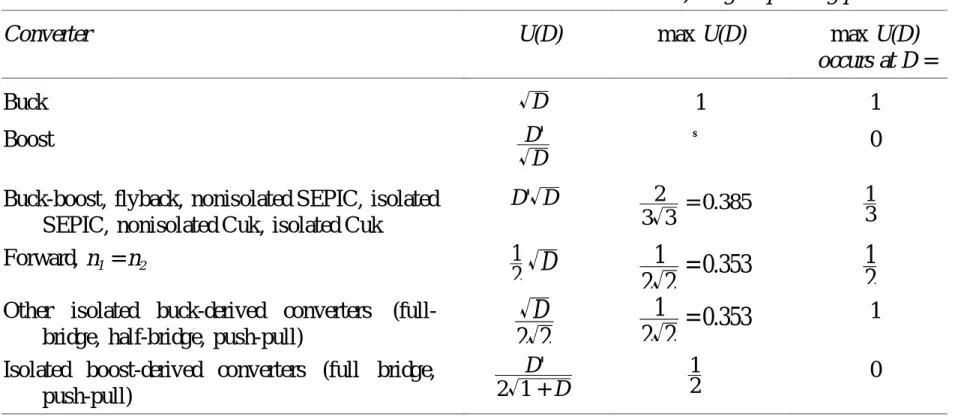
Table 6.1. Active switch utilizations of some common dc-dc converters, single operating point.
Converter U(D) max U(D) max U(D)
occurs at D =
Buck D 1 1
Boost D'
D ∞ 0
Buck-boost, flyback, nonisolated SEPIC, isolated SEPIC, nonisolated Cuk, isolated Cuk
D' D 2
3 3 = 0.385
1 3
Forward, n1 = n2 1
2 D 2 21 = 0.353 12
Other isolated buck-derived converters (full-bridge, half-(full-bridge, push-pull)
D 2 2
1
2 2 = 0.353
1 Isolated boost-derived converters (full bridge,
push-pull)
D'
2 1 + D
1
Switch utilization : Discussion
● Increasing the range of operating points leads to reduced switch utilization ● Buck converter
can operate with high switch utilization (U approaching 1) when D is close to 1
● Boost converter
can operate with high switch utilization (U approaching ∞) when D is close to 1
● Transformer isolation leads to reduced switch utilization ● Buck-derived transformer-isolated converters
U ≤ 0.353
should be designed to operate with D as large as other considerations allow
Switch utilization: Discussion
● Nonisolated and isolated versions of buck-boost, SEPIC, and Cuk
converters
U ≤ 0.385
Single-operating-point optimum occurs at D = 1/3
Nonisolated converters have lower switch utilizations than buck or boost
Active semiconductor cost vs. switch utilization
semiconductor cost per kW output power =
semiconductor device cost per rated kVA
voltage derating
factor
current derating
factor
converter switch utilization
(semiconductor device cost per rated kVA) = cost of device, divided by product of rated blocking voltage and rms current, in $/kVA. Typical values are less than $1/kVA
(voltage derating factor) and (current derating factor) are required to obtain reliable operation. Typical derating factors are 0.5 - 0.75
Typical cost of active semiconductor devices in an isolated dc-dc converter: $1 - $10 per kW of output power.
6.4.2. Converter design using computer spreadsheet
Given ranges of Vg and Pload , as well as desired value of V and other quantities such as switching frequency, ripple, etc., there are two basic engineering design tasks:
• Compare converter topologies and select the best for the given specifications
• Optimize the design of a given converter
A computer spreadsheet is a very useful tool for this job. The results of the steady-state converter analyses of chapters 1-6 can be entered, and detailed design investigations can be quickly performed:
• Evaluation of worst-case stresses over a range of operating points
Spreadsheet design example
S p eci fi cat i o ns
maximum input voltage Vg 390V
minimum input voltage Vg 260V
output voltage V 15V
maximum load power Pload 200W
minimum load power Pload 20W
switching frequency fs 100kHz
maximum output ripple ∆v 0.1V
• Input voltage: rectified 230Vrms
±20%
• Regulated output of 15V • Rated load power 200W • Must operate at 10% load • Select switching frequency of
100kHz
• Output voltage ripple ≤ 0.1V Compare single-transistor forward and flyback converters in this application Specifications are entered at top of spreadsheet
Forward converter design, CCM
+ –
D1 Q1
n1 : n2 : n3
C R
+
V
– L
D2
D3 Vg
Design variables
reset winding turns ratio n2 / n1 1
turns ratio n3 / n1 0.125
inductor current ripple ∆i 2A ref to sec
• Design for CCM at full load; may operate in DCM at light load
Flyback converter design, CCM
+ –
LM
+ V
– Vg
Q1
D1
1:n
C
Design variables
turns ratio n2 / n1 0.125
inductor current ripple ∆i 3A ref to sec
• Design for CCM at full load; may operate in DCM at light load
Enter results of converter analysis into spreadsheet
(Forward converter example)
Maximum duty cycle occurs at minimum Vg and maximum Pload. Converter then operates in CCM, with
D = n1
n3 V Vg
Inductor current ripple is
∆i = D' V Ts 2 L
Solve for L:
L = D' V Ts
2 ∆i
∆i is a design variable. For a given ∆i, the equation above can be used to determine L. To ensure CCM operation at full load, ∆i should be
Forward converter example, continued
Check for DCM at light load. The solution of the buck converter operating in DCM is
V = n3
n1 Vg
2
1 + 4K / D2
with K = 2 L / R Ts, and R = V2 / Pload
These equations apply equally well to the forward converter, provided that all quantities are referred to the transformer secondary side.
Solve for D:
D = 2 K
2n3Vg
n1V
– 1
2
– 1
D = n1
n3 V Vg
in DCM in CCM
at a given operating point, the actual duty cycle is the small of the values calculated by the CCM and DCM equations above. Minimum D
More regarding forward converter example
Worst-case component stresses can now be evaluated. Peak transistor voltage is
max vQ1 = Vg 1 +
n1
n2
Rms transistor current is
IQ1, rms = n3
n1 D I
2
+ (∆i)2 / 3 ≈ n3
n1 D I
(this neglects transformer magnetizing current)
Other component stresses can be found in a similar manner. Magnetics design is left for a later chapter.
Results: forward and flyback converter spreadsheets
Forw ard co nv ert er des i g n, C C M Fl y back conv ert er des i g n, C C M
Design variables Design variables
reset winding turns ratio n2 / n1 1 turns ratio n2 / n1 0.125
turns ratio n3 / n1 0.125 inductor current ripple ∆i 3A ref to sec inductor current ripple ∆i 2A ref to sec
R esults Results
maximum duty cycle D 0.462 maximum duty cycle D 0.316 minimum D, at full load 0.308 minimum D, at full load 0.235 minimum D, at minimum load 0.251 minimum D, at minimum load 0.179
Worst-case stresses Worst-case stresses
peak transistor voltage vQ1 780V peak transistor voltage vQ1 510V rms transistor current iQ1 1.13A rms transistor current iQ1 1.38A transistor utilization U 0.226 transistor utilization U 0.284 peak diode voltage vD1 49V peak diode voltage vD1 64V rms diode current iD1 9.1A rms diode current iD1 16.3A peak diode voltage vD2 49V peak diode current iD1 22.2A rms diode current i 11.1A
Discussion: transistor voltage
Flyback converter
Ideal peak transistor voltage: 510V
Actual peak voltage will be higher, due to ringing causes by transformer leakage inductance
An 800V or 1000V MOSFET would have an adequate design margin
Forward converter
Ideal peak transistor voltage: 780V, 53% greater than flyback
MOSFETs having voltage rating greater than 1000V are not available (in 1995) —when ringing due to transformer leakage inductance is accounted for, this design will have an inadequate design margin Fix: use two-transistor forward converter, or change reset winding turns ratio
Discussion: rms transistor current
Forward
1.13A worst-case
transistor utilization 0.226
Flyback
1.38A worst case, 22% higher than forward transistor utilization 0.284
CCM flyback exhibits higher peak and rms currents. Currents in DCM flyback are even higher
Discussion: secondary-side diode and capacitor stresses
Forward
peak diode voltage 49V
rms diode current 9.1A / 11.1A rms capacitor current 1.15A
Flyback
peak diode voltage 64V rms diode current 16.3A peak diode current 22.2A rms capacitor current 9.1A
Secondary-side currents, especially capacitor currents, limit the
Summary of key points
1. The boost converter can be viewed as an inverse buck
converter, while the buck-boost and Cuk converters arise from
cascade connections of buck and boost converters. The
properties of these converters are consistent with their origins.
Ac outputs can be obtained by differential connection of the
load. An infinite number of converters are possible, and several
are listed in this chapter.
2. For understanding the operation of most converters containing
transformers, the transformer can be modeled as a magnetizing
inductance in parallel with an ideal transformer. The
magnetizing inductance must obey all of the usual rules for
inductors, including the principle of volt-second balance.
Summary of key points
3. The steady-state behavior of transformer-isolated converters
may be understood by first replacing the transformer with the
magnetizing-inductance-plus-ideal-transformer equivalent
circuit. The techniques developed in the previous chapters can
then be applied, including use of inductor volt-second balance
and capacitor charge balance to find dc currents and voltages,
use of equivalent circuits to model losses and efficiency, and
analysis of the discontinuous conduction mode.
4. In the full-bridge, half-bridge, and push-pull isolated versions of
the buck and/or boost converters, the transformer frequency is
twice the output ripple frequency. The transformer is reset while
it transfers energy: the applied voltage polarity alternates on
successive switching periods.
Summary of key points
5. In the conventional forward converter, the transformer is reset while the transistor is off. The transformer magnetizing inductance operates in the discontinuous conduction mode, and the maximum duty cycle is limited. 6. The flyback converter is based on the buck-boost converter. The flyback
transformer is actually a two-winding inductor, which stores and transfers energy.
7. The transformer turns ratio is an extra degree-of-freedom which the
designer can choose to optimize the converter design. Use of a computer spreadsheet is an effective way to determine how the choice of turns ratio affects the component voltage and current stresses.
8. Total active switch stress, and active switch utilization, are two simplified figures-of-merit which can be used to compare the various converter circuits.