BIRTH WEIGHT, BIRTH LENGTH, AND GESTATIONAL AGE AS INDICATORS OF FAVORABLE FETAL GROWTH CONDITIONS IN A US SAMPLE
Marie Camerota
A thesis submitted to the faculty at the University of North Carolina at Chapel Hill in partial fulfillment of the requirements for the degree of Master of Arts in the Department of Psychology.
Chapel Hill 2016
Approved by:
Martha J. Cox
Peter A. Ornstein
ABSTRACT
Marie Camerota: Birth weight, birth length, and gestational age as indicators of favorable fetal growth conditions in a US sample
(Under the direction of Martha J. Cox)
The "fetal origins" hypothesis suggests that fetal conditions affect not only birth
characteristics such as birth weight and gestational age, but also have lifelong health
implications. Despite widespread interest in this hypothesis, few methodological advances have
been proposed to improve the measurement of fetal conditions. A Statistics in Medicine paper by
Bollen, Noble, and Adair examined favorable fetal growth conditions (FFGC) as a latent
variable. Their study of Filipino children from Cebu provided evidence consistent with treating
FFGC as a latent variable that mediates the effects of mother's characteristics on birth weight,
birth length, and gestational age. Our study assesses whether the FFGC model of Cebu replicates
and generalizes to a population of children from North Carolina and Pennsylvania. Using a series
of structural equation models, we find that key features of the Cebu analysis replicate and
ACKNOWLEDGEMENTS
The Family Life Project Phase I Key Investigators include: Lynne Vernon-Feagans, The
University of North Carolina; Martha Cox, The University of North Carolina; Clancy Blair, The
Pennsylvania State University; Peg Burchinal, The University of North Carolina; Linda Burton,
Duke University; Keith Crnic, The Arizona State University; Ann Crouter, The Pennsylvania
State University; Patricia Garrett-Peters, The University of North Carolina; Mark Greenberg,
The Pennsylvania State University; Stephanie Lanza, The Pennsylvania State University; Roger
Mills-Koonce, The University of North Carolina; Emily Werner, The Pennsylvania State
TABLE OF CONTENTS
LIST OF TABLES ... vi
LIST OF FIGURES ... vii
LIST OF ABBREVIATIONS ... viii
BIRTH WEIGHT, BIRTH LENGTH, AND GESTATIONAL AGE AS INDICATORS OF FAVORABLE FETAL GROWTH CONDITIONS IN A US SAMPLE ... 1
Introduction ... 1
Methods ... 3
Mother’s Traits ... 4
Birth Measures ... 5
Models ... 6
Model 1: Direct Effects Model ... 6
Model 2: FFGC Latent Variable Model ... 7
Model 3: Modified FFGC Latent Variable Model ... 7
Results ... 9
Discussion ... 140
APPENDIX: VARIABLES INCLUDED IN CEBU ANALYSIS ... 26
LIST OF TABLES
Table 1. Descriptive Statistics for Cebu and NC/PA. ... 18
Table 2. Global Fit Measures for Structural Equation Models from NC/PA Analyses. ... 19
Table 3. Chi-Squared Difference Testing of Multiple Groups Models. ... 20
Table 4. MLR Estimates of Direct Effects of Mother's Characteristics on
Favorable Fetal Growth Conditions (FFGC). ... 21
LIST OF FIGURES
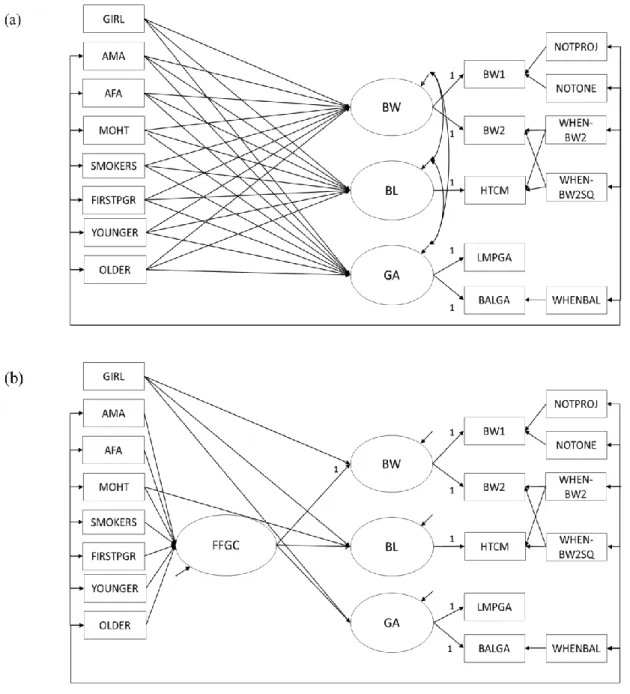
Figure 1. Structural Equation Models from Cebu Analyses. ... 23
Figure 2. Structural Equation Models from NC/PA Analyses ... 25
LIST OF ABBREVIATIONS
AA African-American
AFA Arm fat area
AMA Arm muscle area
BIC Bayesian information criterion
BW Birth weight
BL Birth length
DF Degrees of freedom
FFGC Favorable fetal growth conditions
FIRSTPRG First pregnancy
GA Gestational age
GIRL Infant biological sex is female
IFI Incremental fit index
MAR Missing at random
MI Modification indices
MLR Robust maximum likelihood
MOMHT Mother’s height
MOMWT Mother’s weight
NC North Carolina
OLDER Maternal age > 35 years
PA Pennsylvania
RMSEA Root mean square error of approximation
BIRTH WEIGHT, BIRTH LENGTH, AND GESTATIONAL AGE AS INDICATORS OF FAVORABLE FETAL GROWTH CONDITIONS IN A US SAMPLE
Introduction
Few hypotheses have received more attention than Barker’s fetal origins hypothesis
(1995), both in recent work (e.g. Fabricius-Bjerre, 2011; Zhang et al., 2013) and in the fields of
medicine and social science more broadly (Almond & Currie, 2011). Much of the existing work is focused on replicating Barker’s original finding that birth weight is inversely related to adult
risk of cardiovascular disease, using different populations, different health outcomes, or both.
Almost all studies of which we are aware use birth weight as a proxy variable for fetal growth conditions. Despite sustained interest in Barker’s hypothesis over the past two decades, few
methodological advances have been proposed to improve our measurement and modeling of fetal
growth conditions. A notable exception is recent work by Bollen, Noble, and Adair (2013),
which demonstrates a latent variable approach to modeling favorable fetal growth conditions
(FFGC). FFGC are not directly observable or measurable, which implies that they are latent. It
is this latent variable that is the force behind the fetal origins hypothesis. Given the potentially
large impact of this improved measurement and modeling approach, the current study examines
whether the FFGC latent variable model replicates and generalizes to a different country and
time period.
The fetal origins hypothesis (Barker, 1995), suggests that favorable (or unfavorable) fetal
growth conditions have life-long health consequences for outcomes such as adult blood pressure
(Huxley, Neil, & Collins, 2002; Huxley, Shiell, & Law, 2000) and diabetes risk (Whincup et al.,
the environmental, genetic, and epigenetic factors that program prenatal development. It is FFGC
that is hypothesized to affect adult health outcomes. However, little time has been devoted to
testing whether FFGC exist. Until now, empirical analyses have tended to use birth weight as a
proxy for fetal conditions, assuming rather than testing the plausibility of a FFGC latent variable.
The use of a single observed measure as a proxy variable is problematic, as this approach
assumes that birth weight is a perfectly reliable indicator of fetal conditions, thus ignoring any
possible measurement error. In their original analyses, Bollen et al. (2013) improve upon this
technique by explicitly testing whether FFGC can be modeled as a latent variable, an approach
that appropriately accounts for measurement error in each observed indicator. A key result from
their analyses is that a model with a FFGC latent variable mediating the effects of maternal
characteristics on birth outcomes (Fig 1b and Appendix) fits better than a model without it (Fig
1a). Full details on the model specification and variables are in the original publication, but an
important characteristic of the model is that birth weight, birth length, and gestational age are
indicators of latent FFGC and that most maternal characteristics affect these by influencing
FFGC. These results are an important first step in providing evidence for the existence of FFGC.
However, there are reasons to be cautious when interpreting these findings on their own. Bollen et al.’s (2013) sample was drawn from a metropolitan region of the Philippines (Cebu). In
the interest of applying this model to future studies on the fetal origins hypothesis, it is next
important to test whether birth weight, birth length, and gestational age function similarly as
indicators of FFGC in different populations. The current study tests whether there is evidence of
a FFGC latent variable in a sample of mother-infant dyads drawn from two different states,
North Carolina and Pennsylvania. While many variables are the same across the Cebu and the
developed), culture (Asian versus Western), the source of maternal and infant data (prospective
measurement versus retrospective report; Table 1), and the decade in which the births occurred
(1980s versus 2000s). Due to these differences in population, time period, and variables, the
results reported here represent a rigorous test of the FFGC model, as we are assessing the degree
to which Bollen et al.’s (2013) results both replicate and generalize while adding information on
the treatment of FFGC as a latent variable in these different contexts.
A key question is how we will know whether we have replicated or not. Our approach
reflects the idea that there are degrees of replicability. In the context of FFGC, a fundamental
aspect of replicating is to test whether a model using FFGC as a latent variable fits as well or
better than one without it, as it did for the Cebu data. A second level of replication is whether the
signs and significance of the primary coefficients are the same across these different samples.
Finally, the highest level of replication tests whether the most important coefficients are of the
same magnitude across studies. To the degree that we find evidence of replicability and
generalization, we will accumulate evidence that either supports or opposes the plausibility of a
FFGC latent variable, which will undoubtedly inform future research and theory on the fetal
origins hypothesis.
Methods
Data come from the Family Life Project, a longitudinal study conducted in two of the
four rural regions of the United States with the highest rates of child poverty (Dill, 2001).
Specifically, three counties in eastern North Carolina (NC) and three counties in central
Pennsylvania (PA) were chosen as representing the Black South and Appalachia, respectively.
While full recruitment and enrollment details have been documented elsewhere (Burchinal,
assistants had contact with all women who gave birth in the selected counties between September
2003 and September 2004 (N=5471). Families were excluded if they did not live in the selected
counties, spoke a primary language other than English in the home, or intended to move out of
the area in the next three years. These criteria may have resulted in the exclusion of some
high-risk families. Of those families eligible to participate, 68% consented, and of these, 58% were
invited to participate.
Complex sampling methods utilizing population weight and stratification variables
yielded a representative sample of 1,292 families. The current analyses include 1,199 infants in
NC (N=705) and PA (N=494) where the biological mother was the primary caregiver at 2
months of age. An additional 15 cases in NC and 8 cases in PA were excluded after being
identified as multivariate outliers, using a Mahalanobis distance measure. Another 1 case was excluded in NC because the mother’s reported height was more than 5 standard deviations below
the mean.
All data on maternal traits and infant birth measures were collected via maternal report at
a home visit when infants were 2 months of age. The Institutional Review Board at the
University of North Carolina at Chapel Hill approved all data collection activities. Written
consent was obtained from primary caregivers at the beginning of the home visit. Data from the
Family Life Project may be accessed via the Inter-University Consortium for Political and Social
Research.
Mother’s Traits. Trained research assistants conducted structured interviews with
mothers at the two month home visit. Mothers reported on their height in feet and inches
(MOMHT) as well as their pre-pregnancy weight in pounds (MOMWT). MOMHT was
of maternal nutritional stores, as they were the closest comparable variables to the measures of
maternal arm muscle (AMA) and arm fat (AFA) in the Cebu data (Appendix). Pre-pregnancy
weight was chosen, as opposed to pregnancy weight, because the latter measure is potentially
confounded with infant birth weight.
Mothers also reported the frequency and number of cigarettes they smoked during each
trimester of pregnancy. Smoker status was dichotomized into smokers and non-smokers
(SMOKERS), consistent with Bollen et al. (2013). Based on mothers’ self-reported age in years,
we created groups of women < 20 years of age (YOUNGER) or > 35 years of age (OLDER). For
these dichotomous variables, the referent category was women aged 20-35 years of age. Finally,
parity was dichotomized as first pregnancy or not (FIRSTPRG). These four dichotomous
variables (SMOKERS, YOUNGER, OLDER, FIRST) were identical in the Cebu and NC/PA
samples. Finally, mothers self-reported their primary race as either White or African-American.
We dichotomized this variable to represent whether women were African-American (AA) or not,
where White women served as the reference group.
Birth Measures. At the two month home visit, mothers were asked to recall their infant’s
birth weight (BW) in pounds and ounces, as well as birth length (BL) in inches. Weight was
converted into grams and length was converted into centimeters. To aid model convergence, birth weight was divided by 100 in all analyses. Mothers were also asked to recall their infant’s
due date and birth date. Using these two dates, we calculated infant gestational age (GA) in
weeks. All three birth outcomes were retained as continuous variables. To reduce skewness and
kurtosis, and to remain consistent with the measure of GA in Bollen et al. (2013), we used the
natural log of GA in our analyses. Infant sex was dichotomized (GIRL), with male infants
Unlike in the Cebu data, we had only one measure each for BW, BL, and GA in NC/PA.
Therefore, whereas in Cebu we could treat BW, BL, and GA as latent variables with multiple
indicators (Fig 1), in the following models, they will be manifest, or directly observed, variables
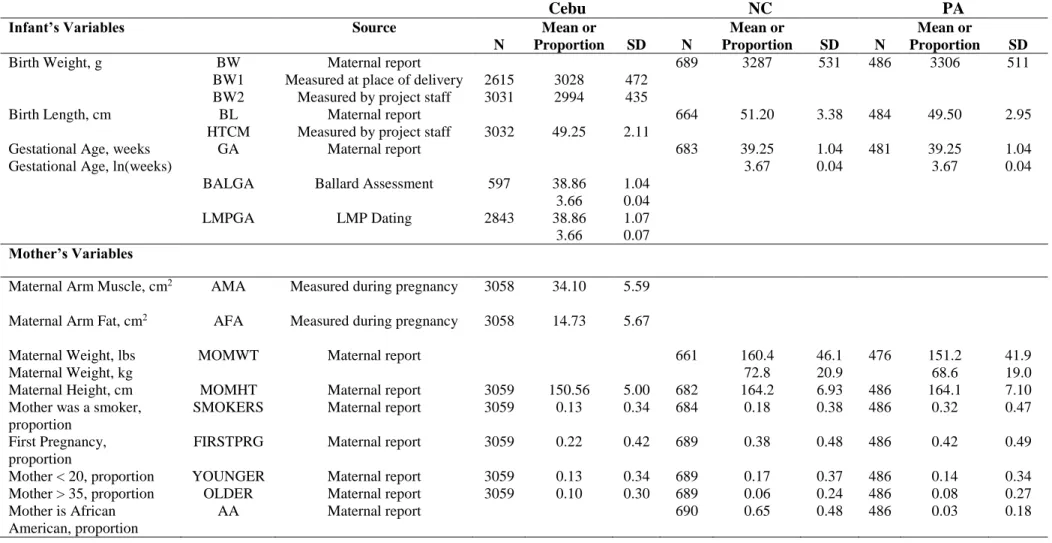
(Fig 2). Table 1 provides a comparison of descriptive statistics for all maternal and child
characteristics included in analyses in the NC/PA and the Cebu samples.
Models. A central goal of the current investigation is to test whether BW, BL, and GA
are indicators of a common latent variable we call FFGC, as concluded in Bollen et al. (2013) or
whether they are three distinct outcomes with distinct predictors. If we conclude that a model
with a latent FFGC variable fits the data better than a direct-effects only model, then we will
move to stricter tests of replication, which includes comparison of signs and significance patterns
of coefficients in Cebu and NC/PA, as well as an examination of the magnitude of the factor
loadings across samples. Because of the strikingly different contexts of the two samples, we will
also explore theoretical and empirical modifications that result in improved model fit, using the
NC sample. Finally, we will replicate any modifications using the PA sample, to test whether
these additional paths are robust to changes in sample characteristics.
Model 1: Direct Effects Model.
Our first model allows each predictor variable to have a
direct effect on BW, BL, and GA (Fig 2a). Unlike in the Cebu sample, the NC/PA sample has
only one indicator of each birth outcome; thus they are treated as manifest, rather than latent
variables, and are indicated by rectangles as opposed to ovals. All other observed variables
(GIRL, MOMHT, MOMWT, SMOKERS, FIRSTPRG, YOUNGER, OLDER) are exogenous
and are allowed to correlate with one another, as indicated by the long bar with the short arrows
connecting them. In addition, the set of exogenous observed variables directly influence BW,
allowed to correlate, to indicate that there is a residual association among them when the impact
of maternal variables and GIRL are accounted for.
Model 2: FFGC Latent Variable Model.
Our second model contains a latent variable
(FFGC) that mediates the effect of maternal characteristics on the three birth outcomes (Fig 2b).
The existence of the latent variable in this model implies that there is an unobserved variable
comprised of the genetic, environmental, and epigenetic conditions that program fetal growth,
and which gives rise to our observed measures of BW, BL, and GA. The single-headed arrows
from FFGC to BW, BL, and GA indicate that if FFGC increases, we would expect all three birth
outcomes to increase; if FFGC decreases, then all birth outcomes would decrease.
To assign a scale to the latent variable, the path from FFGC to BW is set to 1. Like in
Bollen et al. (2013), GIRL does not have an effect on FFGC; rather, it directly exerts its
influence on BW, BL, and GA. Additionally, MOMHT has an effect on FFGC as well as a direct
effect on BL, given the likely direct genetic relationship between a woman’s height and the
length of her baby at birth.
This model, which is more parsimonious than Model 1, does not allow for correlated
errors among BW, BL, and GA; this specification hypothesizes that the association between
them is explained by their common dependence on the FFGC latent variable and that there is no
residual relationship among the three birth outcomes after we account for FFGC. Like in Model
1, all exogenous variables are allowed to correlate, with the exception of GIRL.
Model 3: Modified FFGC Latent Variable Model. Using the NC data, we explored
theoretical and empirical modifications to Model 2. Theoretical modifications were made based
on the different contexts of births in the US, as opposed to in Cebu. The main theoretically
European American and African American women, the Cebu sample did not. As African
American race is associated with higher rates of low birthweight and preterm births in the US
(Martin et al., 2005), we tested whether including African American race (AA) as an additional
predictor of birth outcomes improved model fit. AA was allowed to directly influence BW, BL,
and GA, instead of having indirect effects via FFGC, because of a lack of theory suggesting why
women of AA race would have poorer fetal growth conditions overall.
Empirical modifications were also explored, using modification indices (MI) provided by
statistical software (Mplus; Muthén & Muthén, 2007). While all MI with values above 10 were
requested, we only considered modifications that were theoretically justifiable. Although MI are
a useful tool for detecting omitted paths, they are also data driven, and must be used with caution
(Bollen, 1989; Kline, 2005). Therefore, any empirical modifications were evaluated carefully to
ensure that they were substantively plausible. The only plausible path suggested by this method
was the addition of a direct path from FIRST to GA (Fig 3), which is consistent with the finding
that primiparous women in the U.S. are more likely to carry their infants past their due date
(Caughey, Stotland, Washington, & Escobar, 2009).
As an additional test of the robustness of the added paths in the model for NC, we re-ran
Model 3 using the PA sample. Because the data from PA are independent from the NC data, this
strategy allows us to assess the generalizability of the NC modifications. If the modified model
shows similar fit in the PA sample, we next plan to compare the estimates from NC and PA
using a multiple group analysis to quantify the extent of agreement between the two samples.
Finally, we will interpret the coefficients from the best fitting model, first comparing the patterns
of signs and significance of model parameters, and finally testing the statistical equivalence of
Results
All models were estimated in Mplus using full-information, robust maximum likelihood
(MLR) as our estimator. MLR was chosen because it is distributionally robust, allowing for
possible non-normality in the errors of the model. The scaled chi-square test statistic that results
from MLR cannot be used for chi-square difference testing in the normal manner. Therefore, an
adjusted calculation was used when comparing nested models in future analyses (Satorra &
Bentler, 2001). Our full-information estimation technique makes use of all cases that have at
least partial data, and assumes that any missing data are missing at random (MAR), a less
restrictive assumption than missing completely at random. In addition, we have a relatively
small proportion of data missing (Table 1).
Descriptive statistics for Cebu, NC, and PA are presented in Table 1. Babies in the NC
and PA samples tended to have higher BW than those in Cebu, but mean values of BL and GA were within sampling fluctuation of one another across the samples. Turning towards mother’s
characteristics, mothers in the US tended to be taller, and were more likely to smoke, compared
to their counterparts in Cebu. Finally, mothers in NC were much more likely to be African
American compared to mothers in PA (48% versus 3%). It was not possible to compare mean
levels of maternal nutritional stores across the two samples, since different variables were used
in Cebu and NC/PA (AMA, AFA, MOMWT).
Our first model comparison addressed whether a model with a mediating FFGC latent
variable fit the data better than a model with mother’s characteristics directly influencing birth
outcomes. Figs 1a and 1b present Model 1 and Model 2 in Cebu, while Figs 2a and 2b present
Model 1 and Model 2 in NC/PA. For this first comparison, we attempted to keep our model as
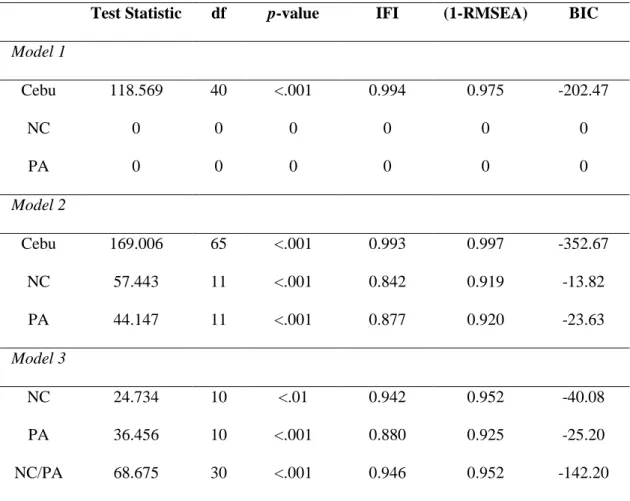
statistics for Cebu, NC, and PA. Like in Bollen et al. (2013), we report the MLR chi-square test
statistic with its corresponding degrees of freedom (df) and p-value, as well as the IFI,
[1-RMSEA], and BIC. A non-significant chi-square, a value of IFI and [1-RMSEA] close to 1, and
a large, negative BIC value all indicate good model fit.
Turning to the overall fit statistics for Model 1 and Model 2, several points are apparent.
As opposed to the Cebu sample, which had multiple indicators of BW and GA, NC/PA had only
one indicator each for BW, BL, and GA. As a result, Model 1 is fully saturated in both NC and
PA, which means that all available degrees of freedom are used up1. Because a saturated model
imposes no restrictions on the data, the model-estimated parameters will perfectly reproduce the
covariance matrix of the data. However, this seemingly perfect fit to the data is true for any
saturated model and tells us nothing about the overall fit.
In contrast to Model 1, Model 2 is overidentified, with 11 degrees of freedom with which
to judge the fit of the model. In both the NC and PA samples, we obtain statistically significant
chi-square test statistics, which is typical in moderate to large sample sizes (N=689 and N=486
in NC and PA, respectively). Both our IFI and our [1-RMSEA] values are below their ideal fit of
1. However, both models have negative BIC values. According to the Jeffreys-Raftery guidelines
(Raftery, 1995), a BIC value that is negative and larger in magnitude than 10 suggests strong
evidence in support of the model, compared to a saturated model. Using this guideline, Model 2
provides good fit to the data in both the NC and PA samples, which have BICs of -13 and -23,
respectively.
Given the mixed evidence provided by the overall fit statistics, we next consider
modifications to Model 2. As discussed previously, the first modification we considered was the
addition of a direct path from AA to BW, BL, and GA, consistent with the notion that AA
women are at higher risk of low birthweight and premature births. Next, an examination of the
empirical modifications suggested that we allow a direct path from FIRST to GA. Model 3 was
estimated with these two modifications, first in NC, and then in PA, as a check of robustness (Fig
3).
Fit statistics for Model 3 are presented in Table 2. The addition of these paths improved
model fit in NC. Although the chi-square test statistic is still significant, both the IFI and
[1-RMSEA] are closer to their ideal fit of 1. Additionally, the BIC for Model 3 is even more negative than for Model 2. The paths from AA to BW (β = -3.414), BL (β = -1.123), and GA (β
= -.001), as well as the path from FIRST to GA (β = .015) are also all significant at p < .05,
indicating that the modifications were empirically justified.
In order to verify that the additions made to Model 3 were robust, we replicated our
findings using the PA sample. Since the PA sample was not used to estimate the empirical
modifications, it served as an independent check of the effect of the added paths. As seen in
Table 2, Model 3 also fit the PA data better than Model 2. However, in PA, only the added paths from AA to BW (β = -1.726) and FIRST to GA (β = .006) were significant at p < .05. It is worth
noting that the proportion of AA women in PA was small (3%) as compared to in NC, where AA
women made up almost half the sample (46%). The small proportion of AA women in PA likely
contributed to larger standard errors, leading to the different patterns of significance between NC
and PA.
Finally, we conducted a multiple group analysis to simultaneously fit Model 3 to the NC
and PA samples. By testing a series of increasingly restrictive models, we are able to assess the
3. If the relationship between our variables is truly the same in both samples, then setting our
factor loadings, intercepts, and coefficients to be equal should not result in a significant
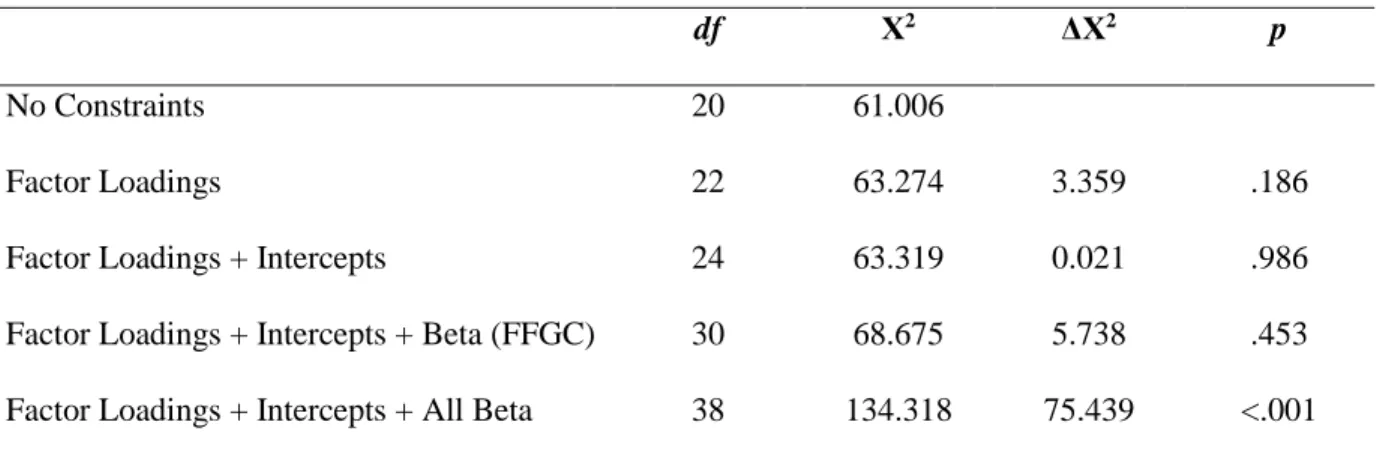
decrement in model fit. Table 3 shows the chi-square change resulting from imposing increasing
equality constraints on the NC and PA models. Setting the factor loadings and intercepts of BL
and GA to be equal, as well as the paths from each maternal characteristic to FFGC, does not
result in a significant decrement in model fit. However, forcing the direct effects of AA, FIRST,
and GIRL on BW, BL, and GA to be equal does significantly worsen model fit. Given the
differential patterns of significance for the effects of AA on each birth outcome in NC and PA, it
is not surprising that imposing this equality constraint significantly worsens model fit. However,
the equality of factor loadings, intercepts, and coefficients on FFGC between the groups provides
evidence that Model 3 fits both samples adequately well.
Complete fit statistics for the multiple group models are presented in Table 2. Although
our chi-square test statistic is significant, all other fit statistics (IFI, [1-RMSEA], BIC) indicate
good model fit. Moving to interpreting the coefficients of the model, we first examined the
patterns of signs and significance for our parameters (see Table 4). In our model, like in Cebu,
indices of maternal nutritional stores (AMA, AFA, and MOHT in Cebu; MOWT and MOHT in
NC/PA) positively predicted FFGC, while SMOKERS negatively predicted FFGC. However,
our measures of parity (FIRSTPRG) and maternal age (YOUNGER, OLDER) did not
significantly predict FFGC, as they did in Cebu. Together, our set of covariates explained 8% of
the variance in FFGC in NC and 11% of the variance in PA, compared to 11% of the variance in
Cebu.
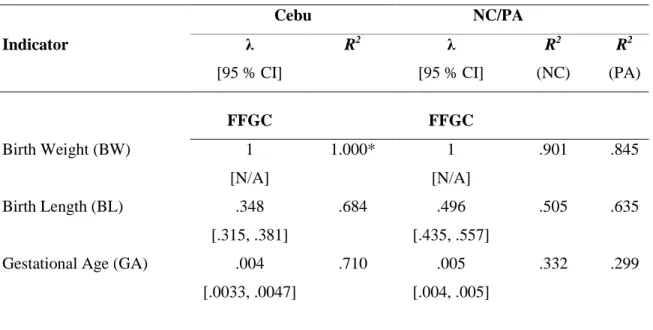
As our final, strictest check of replication, we tested whether the factor loadings of BL
analyses. Because the NC/PA and Cebu samples are independent, it was appropriate to use a
z-test to calculate the difference in coefficients between the two models, as well as the significance
of the obtained z statistic (Paternoster, Brame, Mazerolle, & Piquero, 1998). For GA, the
estimated factor loading of .005 was not significantly different than the Cebu factor loading of
.004 (z = .196, p > .05). For BL, the estimated factor loading of .496 was significantly larger than
the Cebu factor loading of .348 (z = 4.147, p < .05). Put into context, this finding means that for
a 1 unit difference in FFGC we would expect a .50 cm difference in birth length in the NC/PA
sample and a .35 cm difference in the Cebu sample. Whether this difference is substantively
important remains to be determined, but it is a difference which if replicated in future studies
would demand further investigation.
Like in Bollen et al. (2013), we tested alternative model specifications to assess whether
they had a superior fit. We first tested a model that included GA, rather than FFGC, as a mediator between mother’s characteristics and BW and BL. This model fit the data poorly. We
also attempted to model a latent GA variable by setting the reliability of its one indicator
(measured GA) to various values (e.g. 0.1, 0.3, 0.5). However, a model with latent GA as a
mediator would not converge. Finally, we attempted to estimate a model that included both a
FFGC latent variable and a direct path from GA to BW and BL; this model similarly would not
converge. Therefore, we concluded that a model with FFGC as a latent variable was the most
parsimonious and plausible alternative to the direct effects only model.
Because of the stratified sampling design of the Family Life Project, stratification and
weight values were assigned to each case in the NC/PA data. While our models were originally
estimated without these variables, we re-estimated Model 3 in both NC and PA accounting for
final analyses including all cases that were previously excluded as outliers. Although model fit
decreased with the inclusion of these unusual cases, all substantive conclusions remained the
same.
Discussion
The goal of the current investigation was to test whether Bollen et al.’s (2013) FFGC
model, a novel approach to studying the fetal origins hypothesis, replicated and generalized to a
new sample of infants born in the United States. In doing so, we demonstrated a graded approach
to reproducibility, by describing and then proceeding through a series of increasingly strict tests
of replication. Based on this series of tests, we conclude that the results first gleaned from a
sample of Filipino infants do generalize to a sample of predominantly low-income American
infants. Several theoretically-justifiable modifications were made in our analyses in order to
improve model fit, but these modifications were small in number and did not lead to dramatic
changes in other model parameters (e.g. factor loadings). Importantly, the final model, including
all modifications, fit the data equally well in the two states that we tested (North Carolina and
Pennsylvania), which suggests that these findings may be robust to variations in sampling
characteristics.
Our substantive conclusion on the generalizability of the FFGC approach is promising for
future research on the fetal origins hypothesis, as a latent FFGC variable provides a metric with
which to quantify the various environmental, genetic, and epigenetic influences on prenatal
development that may program later human health. As opposed to the heretofore popular method
of using birth weight as a proxy for prenatal conditions, the FFGC approach is unburdened by
measurement error and allows researchers to take advantage of three commonly available birth
when only one measure each of BW, BL, and GA are available, as well as when these birth
outcomes are reported by mothers retrospectively during the early postpartum period. Although
there may be concerns about the accuracy of maternal report of these variables, previous work
has shown no significant differences between hospital records and maternal report of BW and
BL (Lederman & Paxton, 1998). In addition, treating these variables as indicators of FFGC
permits random measurement error to enter the error term for each indicator. The versatility of
the FFGC latent modeling approach is promising, as it suggests that modeling FFGC may be
appropriate under a wide range of methodological scenarios.
The current study also contributes to the methodological literature by proposing and
modeling a series of increasingly rigorous tests of replication. Our first step was to examine
whether our substantive conclusions were consistent with those of Bollen et al. (2013), which
found that a model with a latent FFGC variable fit the data better than a model without it. By
comparing fit statistics from Model 1 and Model 2, we confirmed that Model 2 provided a better
fit to our data, and thus there was evidence for a FFGC latent variable. Next, we examined the
signs and significance of crucial coefficients in our model. Because a central goal was to test
whether the relationship between FFGC and its indicators functioned similarly across the two
samples, we focused on comparing the factor loadings for BW, BL, and GA. Although the
coefficient on BW was set to 1 to scale the latent variable, we found that the freely estimated
factor loadings for BL and GA were both positive, significant, and similar in magnitude to the
results from Cebu. Our final, strictest test of replication was to test the equality of the factor
loadings on BL and GA across the two samples. We found that we could not reject the null
hypothesis that the factor loadings for GA were equal in NC/PA and Cebu, while this was not
indicates a relatively strong replication success. In light of our success, we encourage
researchers to continue to test the generalizability of the FFGC model. If the FFGC model works
similarly well in diverse samples, we will accumulate evidence for the existence of a FFGC
latent variable, as well as for the fetal origins hypothesis.
As a rule, science is concerned with conducting robust and reliable research. While recent
years have seen a growing recognition of the importance of replication studies as well as a more
receptive environment to encouraging their publication (Collins & Tabak, 2014; Moonesinghe,
Khoury, & Janssens, 2007; National Science Foundation, 2015), the quantity and quality of
published replication attempts remain low (Brandt et al., 2014). Contributing to this quandary is
a lack of accepted guidelines on what constitutes a successful replication. We are hopeful that
future research will adopt a graded approach to replication, as modeled in the current analyses.
This attention to robustness is especially important for research on the fetal origins hypothesis,
given its possible lifelong implications for human health and development.
In sum, the current study confirms the existence of a latent variable representing
favorable fetal growth conditions which underlies the relationship between maternal
characteristics and child birth outcomes. However, the current study does not address whether
this latent variable predicts adult health outcomes, as would be predicted by the fetal origins
hypothesis. Future research should aim not only to confirm the existence of the FFGC latent
variable among diverse populations, but also to test the relationship between FFGC and adult
Table 1. Descriptive Statistics for Cebu and NC/PA.
Cebu NC PA
Infant’s Variables Source
N
Mean or
Proportion SD N
Mean or
Proportion SD N
Mean or
Proportion SD
Birth Weight, g BW Maternal report 689 3287 531 486 3306 511
BW1 Measured at place of delivery 2615 3028 472
BW2 Measured by project staff 3031 2994 435
Birth Length, cm BL Maternal report 664 51.20 3.38 484 49.50 2.95
HTCM Measured by project staff 3032 49.25 2.11
Gestational Age, weeks Gestational Age, ln(weeks)
GA Maternal report 683 39.25
3.67
1.04 0.04
481 39.25
3.67
1.04 0.04
BALGA Ballard Assessment 597 38.86
3.66
1.04 0.04
LMPGA LMP Dating 2843 38.86
3.66
1.07 0.07 Mother’s Variables
Maternal Arm Muscle, cm2 AMA Measured during pregnancy 3058 34.10 5.59
Maternal Arm Fat, cm2 AFA Measured during pregnancy 3058 14.73 5.67
Maternal Weight, lbs Maternal Weight, kg
MOMWT Maternal report 661 160.4
72.8
46.1 20.9
476 151.2
68.6
41.9 19.0
Maternal Height, cm MOMHT Maternal report 3059 150.56 5.00 682 164.2 6.93 486 164.1 7.10
Mother was a smoker, proportion
SMOKERS Maternal report 3059 0.13 0.34 684 0.18 0.38 486 0.32 0.47
First Pregnancy, proportion
FIRSTPRG Maternal report 3059 0.22 0.42 689 0.38 0.48 486 0.42 0.49
Mother < 20, proportion YOUNGER Maternal report 3059 0.13 0.34 689 0.17 0.37 486 0.14 0.34
Mother > 35, proportion OLDER Maternal report 3059 0.10 0.30 689 0.06 0.24 486 0.08 0.27
Mother is African American, proportion
AA Maternal report 690 0.65 0.48 486 0.03 0.18
1
Table 2. Global Fit Measures for Structural Equation Models from NC/PA Analyses.
Test Statistic df p-value IFI (1-RMSEA) BIC
Model 1
Cebu 118.569 40 <.001 0.994 0.975 -202.47
NC 0 0 0 0 0 0
PA 0 0 0 0 0 0
Model 2
Cebu 169.006 65 <.001 0.993 0.997 -352.67
NC 57.443 11 <.001 0.842 0.919 -13.82
PA 44.147 11 <.001 0.877 0.920 -23.63
Model 3
NC 24.734 10 <.01 0.942 0.952 -40.08
PA 36.456 10 <.001 0.880 0.925 -25.20
NC/PA 68.675 30 <.001 0.946 0.952 -142.20
Table 3. Chi-Squared Difference Testing of Multiple Groups Models.
Because MLR was selected as the model estimator, chi-square difference testing could not be done in the usual manner. For more information on chi-square difference testing for MLR, see Satorra and Bentler (2001).
df Χ2 ΔΧ2 p
No Constraints 20 61.006
Factor Loadings 22 63.274 3.359 .186
Factor Loadings + Intercepts 24 63.319 0.021 .986
Factor Loadings + Intercepts + Beta (FFGC) 30 68.675 5.738 .453
Table 4. MLR Estimates of Direct Effects of Mother's Characteristics on Favorable Fetal Growth Conditions (FFGC).
Coefficients for NC/PA are taken from the multiple group analysis. Although the
coefficients are set to be equal across NC and PA, the multiple group analysis results in separate R2 values for each group. AMA was not measured in NC/PA. AFA was measured in cm2 in Cebu, but only MOMWT in pounds was measured in NC/PA.
Cebu NC/PA
Exogenous Variable
β
[95 % CI]
β
[95 % CI]
FFGC FFGC
Maternal Arm Muscle (AMA) .049
[.022, .076]
Maternal Arm Fat, cm2 (AFA)/
Maternal Weight, lbs (MOMWT)
.088
[.059, .117]
.129
[.054, .204]
Maternal Height, cm (MOMHT) 1.505
[1.223, 1.787]
.106
[.063, .149]
Mother was a smoker (SMOKERS) -.835
[-1.262, -.408]
-2.318
[-3.036, -1.600]
First Pregnancy (FIRSTPRG) -1.242
[-1.642, -.842]
-.033
[-.634, .567]
Mother < 20 (YOUNGER) -.766
[-1.232, -.300]
.149
[-.735, 1.033]
Mother > 35 (OLDER) -.121
[-.629, .387]
-.409
[-1.653, .835]
R2 .110 .082 (NC)
Table 5. Factor Loadings for FFGC Indicators.
For NC/PA, the factor loadings, along with their 95% confidence intervals (in brackets), are taken from the multiple group analysis. Although the factor loadings are set to be equal across NC and PA, the multiple group analysis results in separate R2 values for each group.
Cebu NC/PA
Indicator λ
[95 % CI]
R2 λ
[95 % CI]
R2
(NC)
R2
(PA)
FFGC FFGC
Birth Weight (BW) 1
[N/A]
1.000* 1
[N/A]
.901 .845
Birth Length (BL) .348
[.315, .381]
.684 .496
[.435, .557]
.505 .635
Gestational Age (GA) .004
[.0033, .0047]
.710 .005
[.004, .005]
Figure 2. Structural Equation Models from NC/PA Analyses. Structural equation model depicting (a) direct-effects only model (Model 1) and (b) favorable fetal growth conditions (FFGC) latent variable model (Model 2) for NC/PA. BW=birth weight; BL= birth length, GA= gestational age; GIRL=newborn is a girl; MOMWT=mother’s pre-pregnancy weight;
APPENDIX: VARIABLES INCLUDED IN CEBU ANALYSIS
Infant’s Variables Description
BW1 Newborn weight at place of delivery, g
BW2 Newborn weight measured by project staff, g
HTCM Newborn length, cm
NOTONE Weight not measured day of birth, proportion
NOTPROJ Infant not weighed on project scale
WHENBW2 Infant age at weighing by project staff, days
BALGA Gestational age from Ballard assessment, weeks
LMPGA Gestational age from last menstrual period date, weeks
WHENBAL Infant age at Ballard assessment, days
GIRL Infant sex=female, proportion
Mother’s Variables Description
MOHT Height, cm
AMA Arm muscle area during pregnancy at baseline, cm2
AFA Arm fat area during pregnancy at baseline, cm2
SMOKERS Smoked during pregnancy, proportion
FIRSTPRG Primiparous, proportion
YOUNGER Age < 20 years
REFERENCES
Almond, D., & Currie, J. (2011). Killing me softly: The fetal origins hypothesis. Journal of Economic Perspectives,25(3), 153-172.
Barker, D. J. (1995). Fetal origins of coronary heart disease. British Medical Journal, 311, 171-174.
Brandt, M. J., IJzerman, H., Dijksterhuis, A., Farach, F. J., Geller, J., Giner-Sorolla, R., ... & Van't Veer, A. (2014). The replication recipe: What makes for a convincing replication? Journal of Experimental Social Psychology, 50, 217-224.
Bollen K. A. (1989). Structural equations with latent variables. New York, NY: John Wiley & Sons, Inc.
Bollen, K. A., Noble, M. D., & Adair, L. S. (2013). Are gestational age, birth weight, and birth length indicators of favorable fetal growth conditions? A structural equation analysis of Filipino infants. Statistics in Medicine, 32(17), 2950-2961.
Burchinal, M., Vernon-Feagans, L., Cox, M., & Key Family Life Project Investigators. (2008). Cumulative social risk, parenting, and infant development in rural low-income
communities. Parenting: Science and Practice, 8(1), 41-69.
Caughey, A. B., Stotland, N. E., Washington, A. E., & Escobar, G. J. (2009). Who is at risk for prolonged and postterm pregnancy? American journal of Obstetrics and
Gynecology, 200(6), 683.e1-683.e5.
Collins F. S., & Tabak L. A. (2014). Policy: NIH plans to enhance reproducibility. Nature, 505 612–3.
Dill, B. T. (2001). Rediscovering rural America. In J. R. Blau (Ed.), Blackwell Companions to Sociology (pp. 197-210). Massachusetts: Blackwell Publishing.
Fabricius-Bjerre, S., Jensen, R. B., Færch, K., Larsen, T., Mølgaard, C., Michaelsen, K. F., ... & Greisen, G. (2011). Impact of birth weight and early infant weight gain on insulin resistance and associated cardiovascular risk factors in adolescence. PLoS One, 6(6), e20595.
Huxley, R., Neil, A., & Collins, R. (2002). Unravelling the fetal origins hypothesis: Is there really an inverse association between birthweight and subsequent blood pressure? The Lancet, 360(9334), 659-665.
Huxley, R. R., Shiell, A. W., & Law, C. M. (2000). The role of size at birth and postnatal catch‐ up growth in determining systolic blood pressure: A systematic review of the
Lederman, S. A., & Paxton, A. (1998). Maternal reporting of prepregnancy weight and birth outcome: consistency and completeness compared with the clinical record. Maternal and Child Health Journal, 2(2), 123-126.
Kline, R. B. (2005). Principles and practices of structural equation modeling (2nd ed.). New York, NY: Guilford Press.
Martin, J. A., Hamilton, B. E., Sutton, P. D., Ventura, S. J., Menacker, F., Munson, M. L. (2005). Births: Final data for 2003. National Vital Statistics Reports, 54(2), 1-116.
Moonesinghe, R., Khoury, M. J., & Janssens, C. J. (2007). Most published research findings are false--but a little replication goes a long way. PLoS Medicine, 4(2), e28.
Muthén, L. K., & Muthén, B. O. (2007). Mplus user’s guide (6th ed.).Los Angeles, CA: Muthén & Muthén.
National Science Foundation. (2015). Social, behavioral, and economic sciences perspectives on robust and reliable science. Report of the Subcommittee on Replicability in Science, 1-29.
Raftery, A. E. (1995). Bayesian model selection in social research. Sociological Methodology, 25, 111-164.
Satorra, A., & Bentler, P. M. (2001). A scaled difference chi-square test statistic for moment structure analysis. Psychometrika, 66(4), 507-514.
Whincup, P. H., Kaye, S. J., Owen, C. G., Huxley, R., Cook, D. G., Anazawa, S., ... & De Rooij, S. R. (2008). Birth weight and risk of type 2 diabetes: a systematic
review. JAMA, 300(24), 2886-2897.