BIM Immersion Cube
Cory Krok
California Polytechnic State University San Luis Obispo, California
The construction industry has become one of the largest professions to struggle with effectively implementing technology. As the industry heads into the future, more and more technology will be needed to increase efficiency and reduce cost. Cal Poly, one of the leading universities for industry recruitment, needs to teach the new generation of builders to be able to implement BIM/VDC into the industry. In this project called the BIM Cube, the overall goal is to give Cal Poly students a better understanding of model coordination and clash detection. This paper outlines the
preconstruction services required for the eventual construction of the BIM Cube. These services entail three major components; a virtual 3D model, a construction schedule, and a cost estimate. This paper outlines the steps taken acquire this project, how the scope was completed, and the lessons learned from this experience.
Key Words: BIM, AEC, Clash Detection, Model Collaboration
Background
As our population grows and our needs expand, the construction industry has struggled to keep up with the demand. Within the construction industry it is becoming increasingly difficult to find skilled labor to fill the gaps and complete projects on time with a high degree of quality. This is the
challenge, but it is also an opportunity. Over the last ten years, an explosion of innovative construction technology has created a new toolset for construction firms who keep an eye to the future. Mobile devices, wireless connectivity, and Cloud storage have opened up new worlds of collaboration and communication. Smart devices, paired with innovative software tools, are bringing a new kind of functionality to the worksite, and connecting the worksite to the planning office to the contractors to the fabricators. Document management, change orders, and clash detection are elements of the building process that used have an impact on the schedule and the payroll budget.BIM data can also carry over to operations and maintenance of finished assets and can be used down the road for cost-effective renovation or efficient deconstruction (Benefits of BIM). Digital tools are simplifying and automating building processes and creating savings in time and manpower. Construction lags behind almost every other major industry in the adoption of technology and the creation of new workflows. This has been changing in recent years and as it gets harder to find the right people with the right skills, people need to start thinking about different ways to address these needs. Many firms who are leading the charge in developing digital workflows are already seeing huge gains in
productivity and efficiency, and the clock is ticking for contractors who keep using the same
techniques they have in the past. Jim Lynch, V.P. of Construction for Autodesk, stated “The ability to apply technology is going to continue to grow in importance for the entire industry” (Higgins, 2018).There are opportunities in this explosion of technology and this was the motivation to execute this project.
industry and begin the standardization of BIM in the workforce. Unfortunately, as the construction of BIM Cube was being discussed, COVID-19 struck the world in an unprecedented fashion and ultimately postponed the construction of the BIM Cube. This brought an opportunity to continue the preconstruction phase of this project by solely using BIM technology. With millions in stuck inside because of a nationwide quarantine, it became self-evident that this was an opportunity to preform these preconstruction services not only as a senior project, but as a parting gift to the future undergraduates of Cal Poly’s Construction Management program.
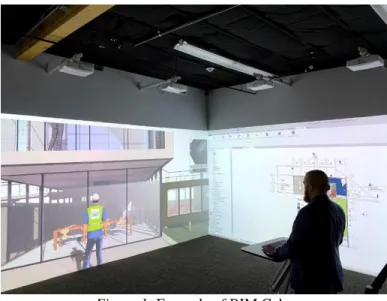
Figure 1: Example of BIM Cube
In figure 1, as shown above, the BIM Cube is a room that utilizes multiple projectors to give a duel screen view of virtual models, construction documents, and other tools. The first BIM Cube was a mobile standalone room that projects on two 20-feet by 13-feet walls using a 1:1 human scale, thus creating an immersive experience of the built environment before construction commences. As changes are made in the BIM authoring tool they are reflected instantly in the 1:1 human scaled view (Gardner, 2018).
Process
The project was first curated by Jeong Woo and Cody Nowak. Jeong Woo, being the Department Head for Construction Management at Cal Poly, understands the importance of implementing technology into the construction industry. Cody Nowak is experienced in the AEC industry coordinating projects with architects, MEP engineers, general contractors, and a variety of
subcontractors. These two brought the attention to the CM Department at Cal Poly that a project like this needed to be built so that students could have a better understanding of BIM in the construction industry. As stated earlier, COVID-19 postponed the construction of this BIM Cube but people within the CM department still wanted to see this project through.
ready”. The three major components of the scope consisted of a virtual 3D model, a construction schedule, and a cost estimate.
The first step in completing this project was to build out a 3D model. It was important to complete the 3D model first because coordination between the CM faculty and the subcontractor needed to be completed so that the project would have the proper dimensions for the cost estimate and schedule. With the final dimensions in place, the creation of the 3D model began. First, the lab layout was created to show the as built conditions of the site. Next, the walls and ceiling of the BIM Cube were created to show that there were no clashes with the as built conditions. Finally, the interior of the BIM Cube was built out to show the layout of the room itself. With the 3D model completed, it was time to create a schedule that would reflect the construction required to complete this project. First, a list of construction activities was coordinated between CM faculty and the scheduler so that the schedule would have a feasible guideline to reference. Then, the actual schedule was built out to reflect the chronological order of activities, with respect to the durations of each activity. With these steps, the construction schedule and 3D model were completed and all that was left was to build out the cost estimate. The dimensions from the 3D model and the durations of the schedule created a guideline for this estimate. Using prices from the Home Depot website, the estimate was created to reflect both the material expenses and labor expenses. With these three deliverables built out, the scope of this project was complete
Deliverables
As stated earlier, the deliverables for this project consisted of three parts:
• Cost Estimate
• Construction Schedule
• Virtual 3D Model
Figure 2: Software’s Used to Complete Project (Far Left: Revit, Middle Left: Primavera 6,
Middle Right: Excel, Far Right: Bluebeam)
Cost Estimate
cost for this project is a total of $25,641.57. Look to Figure 3, under the project pictures section to find the built-out cost estimate.
Figure 3: BIM Cube Cost Estimate
Construction Schedule
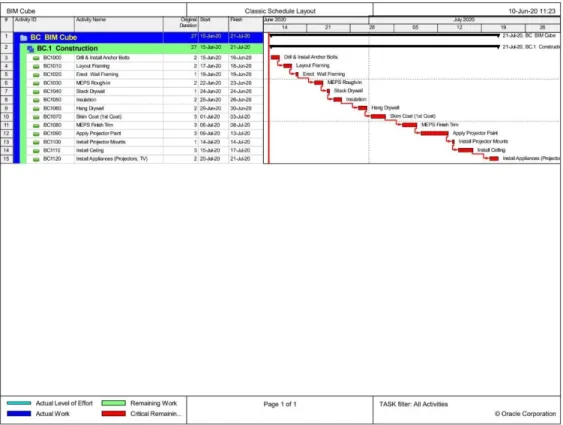
The construction schedule for this project was built using the Primavera 6 software. This schedule outlines the scope of work for this project to be completed. It consists of activities for wall framing and installation, MEP installation, and appliance installation. In total, the schedule duration is a total of 27 working days. This number was curated in reference to the crew size required to complete this project and the crew size consist of 2 general laborers for most of the construction activities and an electrician for MEP activities. Look to Figure 4, under the project pictures section to find the built-out construction schedule.
• Drill & Install Anchor Bolts – 2 Days
• Layout Framing – 2 Days
• Erect Wall Framing – 1 Day
• MEPS Rough-In – 2 Days
• Stack Drywall
• Insulation – 2 Days
• Hang Drywall – 2 Days
• Skim Coat (1st Coat) – 3 Days • MEPS Finish Trim – 3 Days
• Apply Projector Paint – 3 Days
• Install Projector Mounts – 1 Day
• Install Ceiling – 3 Days
• Install Appliances – 2 Days
Figure 4: BIM Cube Construction Schedule
Virtual 3D Model
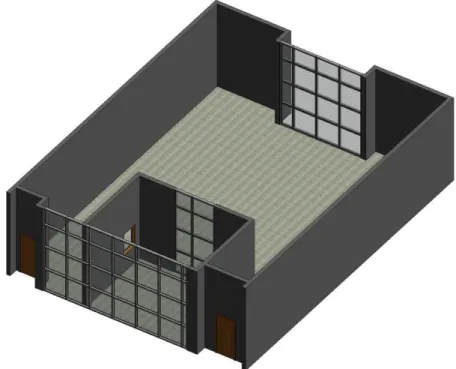
ground. These two ducts were within the space that the BIM Cube is to be constructed and so it was in the best interest to build out these ducts within the Revit model so that clashes could be mitigated. Overall, the BIM Cube dimensions consist of 15’ and 12’ walls that both have a height of 9’ 6”. These dimensions allow the BIM Cube to be clash free from the ducts that hang from above. Look to
Figures 5-7, under the project pictures section to find the pictures of the Revit model build out process.
Figure 6: As Built Conditions with Purposed BIM Cube Walls (2/3)
Lessons Learned
The biggest lesson learned from this project was the importance of communication. With COVID-19 putting the country in a nationwide lockdown, the only means of communication for this project was through technology. Emails, text messages, and Zoom meetings were the main resources used to talk to one another. A fine line between patience and consist messaging needed to be use to ensure that the project would still be completed within time and without creating tension between individuals. The lesson can be helpful in the construction industry because jobs need to be completed on time while keeping a friendly relationship between contractors and owners. Though the time table for this BIM Cube project could have been smoother, continuous implementation of this idea can improve the communication and relationships of anyone who works together on a project.
References
Benefits of BIM: Building Information Modeling. (n.d.). Retrieved from https://www.autodesk.com/solutions/bim/benefits-of-bim
Building information modeling. (2020, June 09). Retrieved June 16, 2020, from https://en.wikipedia.org/wiki/Building_information_modeling
Gardner, M. (2018, August 30). Integrating BIM for Long-term Benefits. Retrieved from https://www.wconline.com/articles/91817-integrating-bim-for-long-term-benefits
Higgins, A. (2018, December 6). The Biggest Construction Technology Challenge Facing the Industry Today. Retrieved from connect.bim360.autodesk.com website: