HEALTHCARE IN THE WELFARE STATE: ASSESSING EMERGING WELFARE STATE TYPOLOGIES IN EASTERN EUROPE USING HIERARCHICAL CLUSTER ANALYSIS
Sean Dillon Cheatle
A thesis submitted to the faculty of the University of North Carolina at Chapel Hill in partial fulfillment of the requirements for the degree of Master of Arts in the Department of Political Science, Concentration European Governance.
Chapel Hill 2016
Approved by: Gary Marks
!
"""!
ABSTRACTSean Dillon Cheatle: Healthcare in the Welfare State: Assessing Emerging Welfare State Typologies in Eastern Europe Using Hierarchical Cluster Analysis
(Under the direction of Gary Marks)
!
"#!
TABLE OF CONTENTS
LIST OF FIGURES AND TABLES ... v
CHAPTER 1: CLUSTER ANALYSIS ... 1
1. Introduction ... 1
1.1 Research Question ... 4
2. Cluster Analysis of EU27 ... 4
3. Cluster Analysis of CEE10 ... 12
CHAPTER 2: ASSESSMENT OF CLUSTERS ... 15
1. Introduction ... 15
2.1 Formal Corporatist Subgroup: Czech Republic, Estonia, Slovenia, and Poland ... 17
2.2 Informal corporatist subgroup: Hungary and the Slovak Republic ... 20
3. Developing Cluster: Latvia, Lithuania, Romania, and Bulgaria ... 22
Conclusion ... 27
!
#!
LIST OF FIGURES AND TABLES
!
$!
CHAPTER 1: CLUSTER ANALYSIS1. Introduction
The objective of this study is to reassess welfare state models in Eastern European EU member states to test for variation both within the EU and within a subset of Eastern European states. Considering that welfare encompasses a broad range of public assistance and varies from direct cash transfers such as unemployment benefits to non-cash transfer services such as education, a comprehensive welfare state assessment is a lengthy and arduous process. Furthermore, several authors (Saint-Arnaud and Bernard, 2003; Fenger, 2007) have already reexamined welfare state models in the European Union and Central and Eastern European (CEE) states. Their methodologies typically involve aggregated metrics of welfare performance indicators such as social assistance transfers and female workforce participation rate. This study builds on their findings through including states that were previously omitted – such as Romania and Bulgaria which are now EU members – and examines how the public provision of healthcare varies as a key component of the welfare state. The development of CEE states provides insight into divergences in welfare state types as the CEE states share a communist past and roughly analogous EU accession timelines. It is important, therefore, to gauge the development of these states in line with each and with the EU as a whole.
!
%!
Using Esping-Andersen’s terminology, both Western and Eastern European continental states fall under the Bismarckian system of welfare capitalism in regards to public health (Saint-Arnaud and Bernard, 2003). Other social policy domains have been disputed in the two-and-a-half decades since he produced the Three Worlds of Welfare Capitalism, but healthcare warrants study for its idiosyncratic relationship with the welfare state in Europe (Bambra, 2007). The metrics are clear and the outcomes – from Life Expectancy (LE) to Healthy Living Years (HLY) – are well documented. Western and Eastern Europe developed similar welfare states and arguably analogous healthcare systems (Fenger, 2007). The salient difference between these systems, however, is efficiency; Eastern European states fall behind the retrenchment that has transformed Western European health insurance systems into the “Neo-Bismarckian” model that more closely resembles social democratic policies (Hassenteufel and Palier, 2007, 574). From the onset, it is important to note that the makeup of healthcare systems in Europe is highly heterogeneous in both Eastern and Western Europe – insurance polices, demographic changes, and rates of disease vary from state to state. This is not to say that comparative analysis is out of the question; there are several shared factors that make assessment of the intricate healthcare systems a worthwhile endeavor – namely, its place within the framework of social policies. Public health has a prominent position in the matrix of the welfare typology in every European state because of its significance as a public service. The overarching connection that makes comparative analysis of Eastern and Western European healthcare systems feasible, however, is the shared interaction between market forces and a system of stratified social contributions that give credence to claims that either side of the former Iron Curtain is Bismarckian (Hacker, 2009). Where policies implemented at the end of the Cold War brought Central and Eastern European states closer to their Western counterparts, there is still a striking discrepancy in the quality of healthcare between the East and West.
!
&!
have its direct repercussions in financing public health and redistributing public services. It is important to note that the welfare states of continental Europe have changed significantly since Esping-Andersen’s seminal The Three Worlds of Welfare Capitalism in 1991. Policies more closely resembling the social democratic type were adopted in formerly corporatist states – such as family policies in Germany (Ostner and Stolberg, 2015) and labor policies in the Netherlands (Headey et al., 1999) – but the stratified state of healthcare financing in continental Europe is an ongoing issue. Where most European states require the majority of healthcare expenditure – roughly 70% -- to be covered by public insurance, patients cover a marginal percentage of the cost of an appointment, prescription, or procedure. Although this is designed to reduce “moral hazard”, e.g. unnecessary visits and treatments, it can have a financially deleterious effect on patients below the poverty line or with chronic diseases (Honekamp and Possenriede, 2008, 414). This plays into welfare state typologies because the healthcare facet of a welfare state has redistributive effects, i.e. the healthy pay for the sick and the rich pay for the poor. The problem with the aforementioned gaps in public insurance, however, is that while healthcare in corporatist states adheres approximately to a redistributive model whereby citizens pay according to their financial means, this model does not account for an aging population that may become a burden for financing schemes over time (Honekamp and Possenriede, 2008). A plummeting fertility rate is hardly a Western European phenomenon as birth rates in formerly communist states have starkly declined since the fall of the Berlin Wall (Reproductive Health Matters, 2004). A transforming demography will prove to be a daunting challenge for the provision of social policy and may spark retrenchment in the case of healthcare – a public service that can prove difficult to finance yet is essential for an aging population.
!
'!
rights of a citizen to access a high level of healthcare should not be determined by an unequal and informal system.
1.1 Research Question
Since the 2004 and 2007 EU Enlargements, have the admitted Central and Eastern European (CEE) states gained parity in healthcare quality and social protection with Western European states? For that matter, are the former welfare state typologies resilient despite social and quality of life advancements in Eastern Europe?
2. Cluster Analysis of EU27
!
(!
with membership in the European Union, excluding Croatia due to its later inclusion in the European Union, which puts it on a different timeline than the other CEE states. Effectively, this assessment will focus on the three segments of Central and Eastern European (CEE) states up to 2013: former soviet satellite states that attained membership in 2004 – Poland, Czech Republic, Slovakia, and Hungary; former Soviet and Yugoslav republics that attained membership in 2004 – Lithuania, Estonia, Latvia, and Slovenia; and, lastly, former soviet republics that attained membership in 2007 – Romania and Bulgaria.
Hierarchical cluster analysis is selected for this study due to its strength in classification and the methodological constraints of incorporating a maximum of 27 cases while measuring for covariance among 20 variables. In adherence with Kleinberg’s theory, an unsupervised exploratory statistical method like cluster analysis is flexible to variance in parameters and variables (Carlsson and Mémoli, 2008). Hierarchical analysis and partitional analysis both have their benefits and drawbacks, but I employ hierarchical analysis in this study due to its reproducibility and capability of demonstrating more complex relationships (Jain, 2010). Furthermore, it would be more difficult to compare my findings with Fenger (2007) and Saint-Arnaud and Bernard (2003) if my methodology deviated too far their original studies. The time period for this study is the development of CEE states from 2004-2013, though the primary focus is on the status of welfare states as of 2013. The limit is 2013 because World Bank data for the countries included in this study is complete up to this year. Furthermore, an assessment of the welfare state types in Eastern Europe according to healthcare provision has not been conducted since the Euro crisis, and the robustness of previously delineated welfare states should be tested continually to measure for convergence and divergence and, ultimately, for progress in governance.
!
)!
other industrialized states despite less than optimal outcomes (McIntosh, 2002). This process will be contextually explained in state-specific analysis, but the preliminary distinction is the appropriate management and capacity of resources for adequate public health. There are limits to the Bismarckian nomenclature in terms of healthcare, particularly when all healthcare systems in this study promise universal coverage. Conversely, the nature of welfare contributions is the key distinction between a Beveridgian and a Bismarckian system, and corporatist welfare financing schemes in tandem with informal payments lead to varying degrees of stratification. There is a problem, however, with the assumption that typologies are identical, as “welfare state models are tools, helpful instruments to sort out complex empirical data! not homogenous categories” (Steffen, 2010, 158). The CEE states, therefore, are not Bismarckian in the strictest sense but have much more in common with a corporatist welfare model than a social democratic model.
!
*!
Considering the complexity of these healthcare systems and the comparatively analogous state of economic growth between CEE states, the focus of the hierarchical cluster analysis limits economic indicators. Assessing GDP per capita in PPS is relevant to this study in analyzing cross-cluster differences, but – in adherence with Saint-Arnaud and Bernard’s (2003) reassessment of Esping-Andersen’s typology – relying on economic metrics puts too much of the emphasis on growth and not on more nuanced indicators relating to public health policy. The variables chosen for the hierarchical cluster analysis, therefore, are relatively independent of economic growth indicators. Instead, I combine the social policy indicators used in Saint-Arnaud and Bernard’s 2003 study on the resilience of Esping-Andersen’s typologies, but omitted their indications on the longevity of particular social policies and the political participation variables. Saint-Arnaud and Bernard measured longevity as the years since introduction of a given social policy and used political participation variables to assess distinctions between liberal and social democratic regimes (2003). Seeing as the concentration of this study is CEE states that reoriented social policies following the fall of the USSR, the age of certain policies is irrelevant because most CEE states implemented them around the same period. The transition to a market economy and the complete reformulation of social policies was heterogeneous within the CEE states but appeared homogenous when compared to other European states at a macro level (Pestoff, 1995). Furthermore, political participation variables and larger questions of democratic legitimacy are outside of the perimeters of this study. In order to maximize the pertinence of each variable in delineating healthcare and social policy typologies, I used 20 variables in the hierarchical cluster analysis – 11 social policy variables and 9 healthcare and quality of life variables. Data was collected from the World Bank and Eurostat databases for the year 2013, approximately a decade since Saint-Arnaud and Bernard’s study.
There is disparity in quality of healthcare amongst CEE states – where economic conditions regarding FDI and GDP growth are analogous – thus making a study in comparative politics pertinent. Table 1 delineates the variables for the hierarchical cluster analysis between welfare state indicators – used in Saint-Arnaud and Bernard’s and Fenger’s respective studies on welfare typology – and healthcare quality indicators, which are integral in forming a welfare state typology around public health.
!
+!
While there is a discrepancy between HLY and Life Expectancy (LE) as an indicator by state (Jagger et al, 2011), both metrics are useful for measuring healthcare outcomes but may reveal discrepancies between states. Regional differences reveal that Eastern and Southern Europe has a comparably shorter average life expectancy and healthy life years than Western Europe (World Health Organization, 2009) and that Eastern Europe may have a comparably longer life expectancy but proportionally less average years without illness. Newly admitted states lower regional averages, but this does not entirely account for the inequality. Poland gained full EU member state status over a decade ago, yet suffers from the “lowest health expectancies, however measured” (Jagger et al, 2011, 1030). While inequality may fluctuate over time due to economic integration, market oscillations, and certain cohesion policies (Barry, 2003), the persisting disparity between the East and West warrants assessment of public healthcare financing and outcomes.
Welfare State Indicators
Government expenditure (% of GDP)
Government expenditure on education (% of GDP)
Subsidies and transfers (Social Security and Social Assistance as % of government expenditure) Total tax rate (% of commercial profits)
Female workforce participation rate (% of female population between 15 and 65) Unemployment rate
Long term unemployment (% of total unemployment)
Gross enrollment ratio in primary and secondary education in Gender Parity Index (GPI) Gross enrollment ratio in tertiary education (GPI)
Participation rate in education and training (All age brackets and genders) People at risk of poverty or social exclusion (% of total population)
Public Health and Healthcare Quality Indicators
Health expenditure (% of GDP)
Out-of-pocket (OOP) health expenditure (% of private expenditure) Private health expenditure (% of GDP)
Physicians per 1000 people
Health expenditure per capita in US$ Life Expectancy (LE) in years at birth
Health Living Years (HLY) in absolute value at birth
Self-reported unmet needs for medical examination due to costs (at lowest income quintile) Infant morality per 1000 live births
!
,!
Furthermore, several variables were omitted in previous cluster analyses, but are essential in determining the quality and type of care, particularly in Eastern Europe. Out-of-pocket (OOP) payments and private health expenditure play significant market roles in defining healthcare coverage and stratifying the quality of care according to ability to pay. Other variables are relatively new metrics for analyzing public health policies. HLY, for example, can be utilized with other quality of life metrics as EU structural indicators of the aggregated health quality of a state. HLY is particularly pertinent because it is an amalgamation of metrics for chronic disease and measures the average quantity of disease and illness-free years for a citizen of the European Union, thus combining well with other healthcare metrics. While HLY may not be appropriate for a small quantity of homogenous states, differences in the EU27 and the CEE states may be idiosyncratic enough to distort a more straightforward indicator, like life expectancy, which does not directly account for the prevalence of chronic diseases in certain states. HLY, on the other hand, is a relatively simple metric that has the utility of life expectancy – calculated for cross national variances – and offers a reference point for all EU member states (Europa, 2009). In order to control variables to achieve a well-rounded analysis, I will utilize both HLY and LE in addition to infant mortality rate. Raftery and Dean (2006) advocate the use of multiple rotations of variables in order to reduce the number of variables down to the most essential set. While this selection process can be parsimonious, the nature of this paper including welfare state indicators and healthcare indicators warrants inclusion of additional variables. There are still limits, however, to the quantity of variables that can be added into a cluster analysis I omitted several variables – including perceived health status, prevalence of communicable diseases, and hospital assets – because these variables either confounded the clusters or were redundant and had significant covariance with other variables.
!
$-!
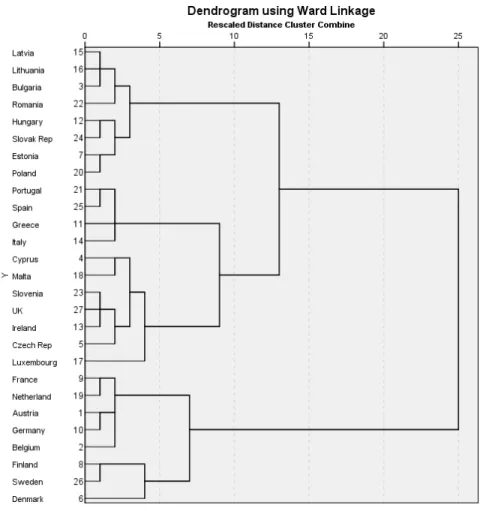
determine how CEE states have developed since EU accession. Before narrowing typologies to the CEE states, it is important to apply the same methodology to assess the place of CEE states in a classification of the EU27.
Figure 1: Cluster analysis of all variables for EU27 for 2013
!
$$!
variables exceeding 0.5 did so with a slight margin. Close variables, such as health expenditure as a percentage of GDP and health expenditure per capita in US$, never exceeded a coefficient higher than 0.7, which makes them still feasible as variables in a hierarchical cluster analysis. Although both variables measure health expenditure, there is a difference between measurements as a percentage of GDP and per capita, as the former indicates aggregated public and private expenditure and the latter is a direct representation of the capacity for healthcare expenditure on an individual level. A covariance coefficient of 0.7 shows that the two variables partially explain each other, which is logical given that they measure expenditure at different levels. I used several aggregated variables – unmet healthcare needs for all ages and genders for example – which creates a better fit for cross-referencing states and maintains the parsimonious selection of variables. Female workforce stands out as a non-aggregated variable, but is also a strong indicator of welfare state typology – typically liberal or social democratic (Esping-Andersen, 1991; Warnecke, 2008). The variance in measurement units is controlled for with the aforementioned standardized range of 0-1, making percentages comparable with non-ratio metrics. Covariance was mitigated, therefore, through careful selection of variables.
!
$%!
of difference between the clusters. While there is a clear yet nominal difference between the Southern European and Eastern European clusters, there is a more significant degree of separation between these two clusters and the Scandinavian and “Neo-bismarckian” clusters.
3. Cluster Analysis of CEE10
!
$&!
Figure 2: Cluster analysis of all variables for CEE10 for 2013
!
$'!
Esping-Andersen used averages and a sing standard deviation to separate 18 OECD states into three separate groups. What this study does, in a similar fashion to other critiques of Esping-Andersen’s methodology, is expand the range to account for another group. This separates the CEE10 into developing and corporatist states, with a subdivision of informal corporatist states acting as the middle group. The analysis of the groups, therefore, is divided into three distinct sections: formal corporatist states, informal corporatist states, and developing states. The cluster analyses demonstrated the quantitative difference between the clusters, but do not illustrate the details. In other words, qualitative assessment in tandem with outcomes from the analyses is warranted to unpack the depth and nature of the differences.
!
$(!
CHAPTER 2: ASSESSMENT OF CLUSTERS1. Introduction
Before analyzing the peculiarities of the clusters, it is integral to first establish one of the most salient distinguishing features of the two primary clusters – the staggered EU admission. While assessment of healthcare policy on a supranational level is a burgeoning development, and there is evidence of a top-down effort to regulate healthcare standards, current measures in healthcare development lie at the state level (Vollaard et al., 2016). Previous reactions to the enforcement of supranational rights, on the other hand, have been largely uncooperative as governments instead opt to oppose EU institutions (Greer and Rauscher, 2011). Standardization of healthcare access in the European Union, therefore, is a promising development, but has little effect on the convergences and divergences present in the cluster analyses.
!
$)!
The first cluster is comprised of the Visegrád states, Slovenia, and Estonia. The Visegrád Group, or VG, (Czech Republic, Slovakia, Hungary, and Poland) was the most immediate turnaround towards a more Western European system of social policy following the fall of the USSR and was formed predominantly as an instrument of “preaccession” (Dangerfield, 2008). In other words, the VG as a political entity served to expedite entrance into the European Union. Within the context of the welfare state, the Visegrád states are adjoined by Estonia and Slovenia, which harbor similar systems and problems from the vestiges of Soviet governance. The complete retrenchment of the welfare system from a state-directed, communist system, to a Bismarckian system, created an opportunity to transform the formerly dysfunctional institutions of public health and social security into more effective organizations.
!
$*!
2.1 Formal Corporatist Subgroup: Czech Republic, Estonia, Slovenia, and Poland
Following admission into the European Union, the Czech Republic overhauled its healthcare system, introducing a “new risk adjustment scheme” in 2005 for insurance contributions – in line with a more social democratic system in which the welfare state adapts to New Social Risks – while later initiating user fees for doctor visits, prescriptions, and hospital stays in 2008 (Cerami, 2008; Kinkorová and Topolcan, 2012). These changes denote some of the confusion around welfare state typology as the Czech state effected a social democratic retrenchment for emerging risks while enforcing a more liberal market policy of patient co-funding for prescriptions and doctor visits. Concerning the overall financing of the Czech healthcare system, public health insurance covers 76.6% of financing, and nine insurance companies in total provide mandatory health insurance with the patient retaining the choice of coverage (Kinkorová and Topolcan, 2012). In the climate of the Visegrád states, the Czech Republic has the most advanced system, ensuring a comparatively high level of coverage and quality for its citizens. In comparison to neighboring states, the Czech Republic’s adjustment to a market economy was smoother due, primarily, to the importance of social policy to the transitioning administration (Aspalter, 2009). The Czech state, however, has a particular location in social policy and healthcare clusters. Figure 1 illustrates the Czech Republic’s place in the EU27 – in the same cluster as historically liberal states Ireland and the UK. Yet when compared to other CEE states, the Czech Republic falls into the formal corporatist cluster. The nuanced positioning of the Czech state relates both to neo-liberal reforms undertaken in the 1990s and the advancement of formerly liberal states towards more advanced social policies in recent years (Pot"#ek, 2004). It makes sense, therefore, that the Czech Republic would fit into the formal corporatist cluster in the CEE10 analysis but place into a different cluster in a larger analysis of the EU27.
!
$+!
and Slovakia, in Estonia, only 2-3% of patients admitted to making informal payments to improve the speed and level of care (Kakuk and Domjãn, 2013; Lai, 2013). The low rate of informal payments works in tandem with Estonia’s proclivity towards reforming the healthcare system, as it was the first post-Soviet state to institutionalize family medicine reforms (Atun et al., 2006). Concerning the cluster analysis, for out-of-pocket expenses and private options, Estonia is closer to the VG than its Baltic neighbors.
Slovenia is unique in this study in that it is the only former Yugoslav republic included in the 2004 EU enlargement – Croatia did not join until 2013. Yet due to its geographic location in Central Europe, proximity to Visegrád states, and communist history, Slovenia warrants inclusion into a study of healthcare systems in CEE states. Furthermore, Slovenia’s healthcare and social policies are analogous to other frontrunners in the Visegrád cluster. Like the Czech Republic, in the EU27 analysis Slovenia placed in to the same cluster as Ireland and the UK. In terms of economic growth and wealth, Slovenia fits into the higher range of CEE states (see Table 2 for GDP per capita in PPS). The criteria with which Slovenia was admitted into the EU were similar for other CEE states, and it has had a decade to improve its healthcare system and change its welfare model. When Slovenia joined the EU in 2004, its life expectancy was considerably higher than the other states admitted but lower than the average for pre-2004 EU states (Albreht, 2009). Slovenia was the first of the states admitted in pre-2004 to enter into the Euro zone in 2007, which indicates its relative economic power (Europa, 2015).
!
$,!
associations, thus providing a hierarchical system of coverage (Aspalter et al., 2009). Since 2008, the system has been mismanaged, however, as a mixture of universal coverage and private health care provision resulted in the reduction of one third of health professional (Aspalter et al., 2009). Despite its current position as a frontrunner of other CEE states, Slovenia provides a fascinating perspective into how health provision systems can become less efficient over time. Even though Slovenia is grouped in another cluster in the EU27 analysis, it may be closer to the other Bismarckian CEE states than previously imagined, though informal payments play only a marginal role in its financing scheme, connecting it to the Czech Republic and Slovenia.
!
%-!
cluster. The state has, however, made incremental improvement in recent years with reformed healthcare administration.
2.2 Informal corporatist subgroup: Hungary and the Slovak Republic
The informal corporatist subgroup has similar characteristics to its formal counterpart, but suffers from a greater rate of informal payments in healthcare stemming from underfunding and mismanagement of public health insurance policies. While this subgroup only contains Hungary and the Slovak Republic, it warrants analysis due to its place as a halfway point between the formal subgroup and the developing cluster. Furthermore, every state in the CEE10 except for Slovenia developed from the same “Semashko-style” public health system, and it imperative to understand the differences between states a quarter century since the fall of the USSR and roughly a decade since EU accession.
!
%$!
process in Hungary have been controversial (Bos, 2013), the healthcare system persists with the same issues of corruption that have plagued it since EU accession in 2004.
Slovakia has a similar model guaranteeing universal care and competitive coverage, but has a more stratified system, with the government underfunding coverage for citizens unable to purchase insurance from a private company – the private insurance firm Dovera has a virtual monopoly on private insurance (Nemec, 2013). More alarmingly, illegal private payments permeate the market, as many Slovaks have to bribe healthcare providers in order to get proper care. Because of these glaring flaws providing universal coverage and the concomitant disparities in quality of healthcare provision, healthcare is the most corrupt social service in Slovakia (Nemec, 2013). Although the Czech Republic has a better-financed healthcare system and better economy, both states suffer from a lack of options for patients and out of pocket expenses. The Slovak Republic and the Czech Republic have a convoluted history, with the Czech Republic leading in economic development from the onset but with both states maintaining steady growth and withstanding the financial crisis of 2008 better than most other CEE states (Bolotov et al., 2013). Regardless, Slovakia trails behind the Czech Republic and the other formal corporatist groups in mitigating informal payments and out-of-pocket expenses enough to fall out of the cluster.
!
%%!
3. Developing Cluster: Latvia, Lithuania, Romania, and Bulgaria
Although the time period between enlargements was brief, there are tangible discrepancies in the quality of healthcare provided in the CEE states admitted in 2004. A large part of the Hungarian, Lithuanian, Polish, and Slovakian healthcare systems relied on informal payments to provide adequate coverage – a payment that naturally stratifies patients according to their ability to pay. Estonia and Czech republic, alternatively, have elements in their health systems that require out-of-pocket expenses, but compared to a system relying on informal payments, these systems have relatively more parity between patients. The Estonian system has undergone recent changes to its payment scheme that could put vulnerable groups at more risk. Together, the Baltic states have similar health outcomes to other CEE states but are distant from catching up to Western European and Scandinavian standards. Before the Second World War, Latvia and Lithuania were on par with the rest of Europe, but after falling behind after decades of mismanaged Soviet administration, they have to make cultural and social changes to close the gap (Barr and Boyle, 2001). In the 1990s, they collectively made considerable economic and quality of life advancements, drastically lowering mortality rates at all ages and boosting life expectancy for women and men by 2004 (Karanikolos et al., 2012; Polluste, et al., 2005). While Latvia and Lithuania have their idiosyncrasies, they have similar trajectories and analogous public health schemes.
!
%&!
Like the Visegrád states, the Baltic States gained accession to the EU in 2004. The Baltic States have similar economies to the Visegrád states and share a history of USSR occupation. But two of the three Baltic States are grouped in the Developing Cluster due to OOP and inefficiency in delivering healthcare services. Corruption plagues CEE economic development to varying degrees and may overlap with healthcare provision in certain instances, yet Transparency International studies of corruption in the Baltic States and Poland reveal that healthcare efficiency does not align with my findings (Wolf, 2010; Swartz et al., 2010). Lithuania is less corrupt than Estonia or Poland in the frequency of unofficial payments to government officials yet suffers from greater inefficiency in healthcare services than either state. It is important, therefore, to distinguish unofficial payments in healthcare provision from greater political corruption. Lithuania suffers more so from disparity in quality of healthcare provision than issues of professional integrity.
!
%'!
other states in the developing cluster. Before the introduction of the NHS, the Latvian healthcare system suffered from out-of-pocket payments and informal payments, which added up to the second largest financer behind public insurance for pharmaceuticals and doctor visits (Mittenbergs, 2012). The scope of this study extends to only a year after the introduction of the NHS and it is plausible that Latvia can reduce the prevalence of informal payments through this new system,
At a glance, Bulgaria and Romania are the outsiders in this study and come in with different systems – in the same vein of the United States and the UK in Esping-Andersen’s World of Welfare Capitalism. One of the main criticisms of Welfare Capitalism is that the cut off distinguishing the UK as a
liberal state was arbitrary, and under different measurements, the UK could have been categorized as a corporatist state (Bambra, 2007). Healthcare has a particular place in the welfare state, and over the decade since EU enlargement in CEE states major differences in quality of care and financing may have occurred. Romania and Bulgaria may be closer to already admitted CEE states than previously thought. Romania and Bulgaria are the poorest states in this study according to per capita GDP, but their admission into the EU sets them apart from other CIS states in that they have access to more capital and a larger, more technologically advanced market. Belarus and Moldova are omitted because they are outside of the scope of EU influence. It is important, therefore, to assess how their welfare systems have changed in regard to healthcare in the seven years since EU admission and the two decades since becoming independent.
!
%(!
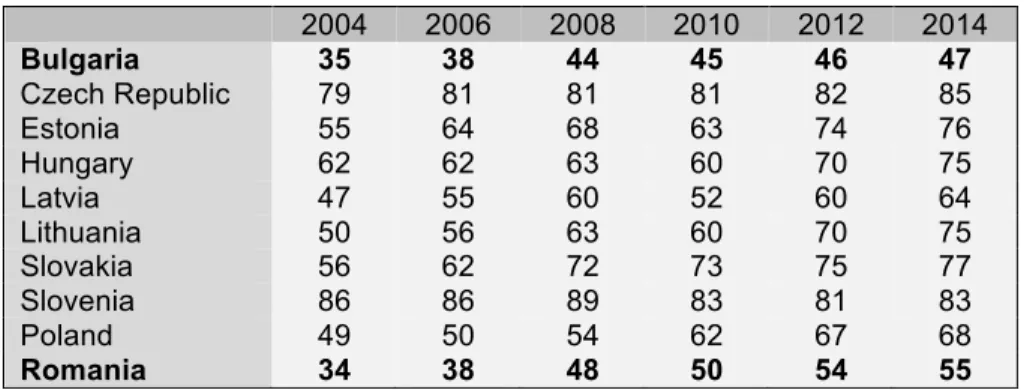
and Latvia, they still fall behind other CEE states. Furthermore, there is a salient discrepancy between Romania and Bulgaria – both states started within a point of each other in 2004 but as of 2014 Romania leads by eight points. This validates the previously stated notion of welfare management over gross healthcare expenditure; Romania is wealthier than Bulgaria but falls behind when the study is adjusted for more variables.
Table 2: GDP per capita in PPS (Eurostat, 2015)
Like other CEE states, Romania had a Semaskho style of centralized healthcare planning and financing. Romania is anomalous from other European states, however, in that its demography is shaped by emigration and a higher than average mortality rate (Vladescu, 2008). Furthermore, Romania spends significantly less than the EU average at only 4.4% of GDP on healthcare in 2004 and 5.3% in 2013 (Vladescu, 2008; World Bank, 2015). In comparison to the other CEE states in the EU, however, Romania’s expenditure as a percentage of GDP hovers above the average of 5.1% (World Bank, 2015). This warrants mention because Romania was notorious for underfunding its healthcare sector and until recently, ranked last in the EU27 (Ivan, 2013). Qualitative analysis reveals larger problems in the Romanian healthcare system that are indicative of the decline of social policy effectiveness. Labor conditions continue to deteriorate, creating higher healthcare demand while many doctors are leaving Romania for better career opportunities in the EU, which is creating a healthcare system that lacks the capacity for adequate coverage (Stanciu and Jawa, 2013). The state is hesitant to attempt reorganization of the public health institutions such as the National Health Insurance Fund because of the concomitant fear of widespread layoffs (Ivan, 2013). Given the documentation of duplicate processes in the
2004 2006 2008 2010 2012 2014
Bulgaria 35 38 44 45 46 47
Czech Republic 79 81 81 81 82 85
Estonia 55 64 68 63 74 76
Hungary 62 62 63 60 70 75
Latvia 47 55 60 52 60 64
Lithuania 50 56 63 60 70 75
Slovakia 56 62 72 73 75 77
Slovenia 86 86 89 83 81 83
Poland 49 50 54 62 67 68
!
%)!
bureaucratic structure, layoffs may yet be necessary (Purcarea, 2015). Overall, the Romania healthcare system represents the failure of a formerly communist system to enact social policy changes. The quality of coverage is low due to underfunding and lack of competition – circumstances that were common under the USSR (Fleck, 2013) – yet the available care is stratified according to OOP expenses and informal payments. The Romania model is, in many ways, the less effective manifestation of the Eastern European Bismarckian system, which works in some CEE states.
!
%*!
ConclusionThere is wide variation in the empirical qualities of the ten CEE states admitted in 2004 and 2007, but in accordance with Fenger’s assessment (2007) of post-communist states according to Esping-Andersen’s types, these states mix elements of corporatist social policies with social democratic aspirations. The presence of universal coverage, however, is undermined by the state’s inability to fully cover healthcare costs, leaving the remaining fees for the patient. The extent of coverage varies, with several states – Czech Republic, Slovenia, and Estonia – successfully mitigating the effects of informal payments on the system while some states – Lithuania, Bulgaria, Romania, and Latvia – rely heavily on informal payments. Trends in public health policies over the last decade reflect oscillations in policies from Slovenia’s healthcare regression in the wake of a financial crisis to Romania’s burgeoning commitment to increased healthcare financing and Bulgaria’s rapid improvement since EU accession. As the qualitative section of this study makes evident, the CEE states that joined the EU in 2004 and 2007 have several structural similarities but idiosyncrasies that betray the simplicity of a single label. They are Bismarckian, but also share aspects of social-democratic policies and aspirations. Where coverage may appear identical in two states – such as Estonia and Lithuania – in reality, the quality of healthcare may vary as Lithuania relies heavily on informal payments and Estonia’s system is predominantly formal.
!
%+!
!
%,!
REFERENCESAspalter, C., Jinsoo, K. and Sojeung, P. (2009), Analysing the Welfare State in Poland, the Czech Republic, Hungary and Slovenia: An Ideal-Typical Perspective. Social Policy & Administration, 43: 170– 185. doi: 10.1111/j.1467-9515.2009.00654.x
Atanasova, E., Pavlova, M. Moutafova, E. Kostadinova, T. Groot, W. (2013). Patient charges for health services: the opinions of healthcare stakeholders in Bulgaria. The International Journal of Health Planning and Management, 30: 232-245. DOI: 10.1002/hpm.2229
Atun, R.A., Menabde, N., Saluvere, K. Jesse, M., Habicht, J. (2006). Introducing a complex health innovation – Primary health care reforms in Estonia (multimethods evaluation). Health Policy, 79, 79-91. doi:10.1016/j.healthpol.2005.12.005
Baginska, E. (2004). Health care reforms in Poland. Med Law, 23, 745-51.
Bambra, C. (2007). Going beyond The three worlds of welfare capitalism: regime theory and public health research. Journal of Epidemiology and Community Health, 61(12), 1098–1102.
http://doi.org/10.1136/jech.2007.064295
Bankauskaite, V., & Jakusovaite, I.. (2006). Dealing with Ethical Problems in the Healthcare System in Lithuania: Achievements and Challenges. Journal of Medical Ethics, 32(10), 584–587.
Barr, D. A., & Boyle, E. H.. (2001). Gender and Professional Purity: Explaining Formal and Informal Work Rewards for Physicians in Estonia. Gender and Society, 15(1), 29–54.
Barry, F. (2003), Economic Integration and Convergence Processes in the EU Cohesion Countries. JCMS: Journal of Common Market Studies, 41: 897–9. DOI: 10.1111/j.1468-5965.2003.00468.x
Bohle, D. (2007). The State, Internationalization, and Capitalist Diversity in Eastern Europe. Competition and Change, 11(2), 89-115. DOI: 10.1179/102452907X181929
Bolotov, I., $ajka, R., Gajdu%ková, K. (2013). The Economic Balance of the Czech Republic and Slovakia During the Economic Crisis. Prague Economic Papers ,4, 504-523. DOI: 10.18267/j.pep.465
Bojan, B. (2015). Slovenia in crisis: A tale of unfinished democratization in East-Central Europe. Communist and Post-Communist Studies, 48.
Bos, E. (2013). Hungarian Democracy in Crisis? Changes of the Political System in Hungary after Three Years Government of Viktor Orban. Südosteuropa-Mitteilungen, 53, 128-141.
Breuss, F. (2009). An Evaluation of the EU’ Fifth Enlargement With special focus on Bulgaria and Romania. Economic Papers, 361, 1-42. DOI: 10.2765/18250
Bricocoli, M., Semenza, R., Santos, M.C., Bifulco, L. González, P., Guillén, A.M. Petmesidou, M., Santos, L.D., Lodovici, M.S., Monteleone, R., Greve, B., Sarasa, S., Colombo, A. (2008). Southern European Welfare States. Social Policy and Administration, 42, 103-209.
Burgermeister, J. (2004). New minister to tackle Poland’s healthcare crisis.BMJ!: British Medical Journal, 329(7460), 252.
!
&-!
Carlsson, G. Mémoli, F. (2008). Persistent Clustering and a Theorem of J. Kleinberg. Retrieved from http://arxiv.org/abs/0808.2241.
Cerami, A.. (2008). New Social Risks in Central and Eastern Europe: The Need for a New Empowering Politics of the Welfare State. Sociologick" #asopis / Czech Sociological Review, 44(6), 1089–1110. Czech doctors to join visegrad four protest. (2012, Oct 31). Prague Post Retrieved from
http://search.proquest.com/docview/1124743644?accountid=14244
Dangerfield, M. (2008). The Visegrád Group in the Expanded European Union: From Preaccession to Postaccession Cooperation. East European Politics & Societies, 22, 630-667. DOI:
10.1177/0888325408315840
Female Labour Force Participation: Past Trends and Main Determinants in OECD Countries (May, 2004). OECD Economics Department. Retrived from http://www.oecd.org/eco/labour/31743836.pdf
Fenger, H. (2007). Welfare regimes in Central and Eastern Europe: incorporating post-communist countries in a welfare regime typology. Contemporary Issues and Ideas in Social Sciences, 3, 1-40. Fertility Rate Declines in Central and Eastern Europe after Communism. (2004). Fertility Rate Declines in Central and Eastern Europe after Communism. Reproductive Health Matters,12(24), 228–228.
Fleck, F. (2013). Rocky road from the semashko to a new health model. World Health Organization.Bulletin of the World Health Organization, 91(5), 320-321.
Gaál P, Szigeti S, Csere M, Gaskins M, Panteli D. Hungary: Health system review. Health Systems in Transition, 2011; 13(5):1–266.
Greer, S.L., Rauscher, S. (2011). Destabilization rights and restabilization politics: policy and political reactions to European Union healthcare services law. Journal of European Public Policy, 18, 220-240. DOI: 10.1080/13501763.2011.544502
Gurgul, H., Lach, &., Mestel, R. (2011). The relationship between budgetary expenditure and economic growth in Poland. Central European Journal of Operations Research, 20, 161-182.
Hassenteufel, P., Palier, B. [2007] Towards Neo-Bismarckian Health Care States? Comparing Health Insurance Reforms in Bismarckian Welfare Systems. Social Policy and Administration, 41, 574-596. DOI: 10.1111/j.1467-9515.2007.00573.x
Heady B. Goodin, R.E., Muffels, R., [1999] Real Worlds of Welfare Capitalism. Cambridge: Cambridge University Press.
Healthy Life Years. European Commission: Public Health. Retrieved from http://ec.europa.eu/health/indicators/healthy_life_years/index_en.htm Health in Poland (18 July 2013). European Commission. Retrieved from https://ec.europa.eu/europeaid/health-poland_en
!
&$!
Jain, A.K. (2008). Data clustering: 50 years beyond K-means. Pattern Recognition Letters, 31, 651-666. doi:10.1016/j.patrec.2009.09.011
Kakuk, P., & Domjam, A. (2013). Healthcare financing and conflict of interests in hungary. Cambridge Quarterly of Healthcare Ethics, 22(3), 263-70. doi:http://dx.doi.org/10.1017/S0963180113000078
Karanikolos, M., Leon, D. A., Smith, P. C., & McKee, M.. (2012). Minding the gap: changes in life expectancy in the Baltic States compared with Finland. Journal of Epidemiology and Community Health (1979-), 66(11), 1043–1049.
Kinkorová, J., & Topol#an, O. (2012). Overview of healthcare system in the Czech Republic. The EPMA Journal, 3(1), 4. http://doi.org/10.1007/s13167-012-0139-9
Kozierkiewicz, A., Trabka, W., Romaszewski, A., Gajda K., Gilewski, D. (2005). Definition of the “Health Benefit Basket” in Poland. The European Journal of Health Economics, 6, 58-65.
Lee, A., & Willcox, B. (2014). Minkowski generalizations of ward's method in hierarchical
clustering. Journal of Classification, 31(2), 194-218. doi:http://dx.doi.org/10.1007/s00357-014-9157-8 Magnien, F. (2002). The Measure of GDP per capita in Purchasing Power Standard (PPS): a statistical indicator tricky to interpret. Organization for Economic Co-Operation and Development: Statistics Directorate.
McIntosh, M.A. (2002). The Cost of Healthcare to Americans. JONA’s Healthcare Law, Ethics, and Regulation, 4(3): 78-89.
Medvec, S. E. (2009). The European Union and Expansion to the East: Aspects of Accession, Problems, and Prospects for the Future. International Social Science Review, 84(1/2), 66–83.
Mitenbergs U, Taube M, Misins J, Mikitis E, Martinsons A, Rurane A, Quentin W. Latvia: Health system review. Health Systems in Transition, 2012; 14(8): 1'–'191
Mitenbergs, U., Brigis, G., Quentin, W. (2014). Healthcare financing reform in Latvia: Switching from social health insurance to NHS and back? Health Policy, 118, 147-152.
Mladovsky, P. Allin, S. Masseria, C. Hernández-Quevedo, C., McDaid, D., Mossialos, E. (2009). Health in the European Union: Trends and Analysis. European Observatory on Health Systems and Policies. 1-156.
Müller-Nordhorn, J. (2012). Perceived challenges to public health in Central and Eastern Europe: a qualitative analysis. European Journal of Public Health, 22, 254-255.
Murauskiene L, Janoniene R, Veniute M, van Ginneken E, Karanikolos M. Lithuania: health system review. Health Systems in Transition, 2013; 15(2): 1–150.
Nemec, J., Cankar, S.S., Kostadinova, D., Maly, I., Darmopilova, Z. (2013). How to finance health services: CEE experience with switch from “Semashko model” to health insurance systems. ICCP Panel 67: Comparative Health Reforms in Central and Eastern Europe: Europeanization versus Subsidiarity. Retrieved from http://www.icpublicpolicy.org/IMG/pdf/panel_67_s2_nemec_etal.pdf
Nistor, I. A., & Vaidean, V. L. (2010). ECONOMETRIC MODELING OF ROMANIA'S PUBLIC HEALTHCARE EXPENSES - COUNTY PANEL STUDY. Annales Universitatis Apulensis : Series Oeconomica, 12(1), 460-466.
!
&%!
Ostner, I. (2015). Investing in Children, Monitoring Parents: Parenting Support in the Changing German Welfare State. Social Policy and Society, 14, 621-632. DOI: 10.1017/S1474746415000287
Palier, B. (2010). A Long Goodbye to Bismarck? : the Politics of Welfare Reforms in Continental Europe. Amsterdam: Amsterdam University Press.
Pestoff, V.A. (1995). Reforming Social Services in Central and East Europe: “Meso-Level Institutional Change After the Fall of Communism”. The American Behavioral Scientist, 38.5, 788-806.
Pitea, M., Cojocaru, D., & Oprea, L. (2014). ETHICAL ASPECTS OF INFORMAL PAYMENTS IN THE HEALTHCARE SYSTEM. Revista Romana De Bioetica, 12(4)
Põlluste, K., Männik, G., & Axelsson, R.. (2005). Public Health Reforms In Estonia: Impact On The Health Of The Population. BMJ: British Medical Journal, 331(7510), 210–213.
Pot"#ek, M. (2004). Accession and social policy: the case of the Czech Republic. Journal of European Social Policy, 14, 253-266. doi: 10.1177/0958928704044623
Popescu, G.H. (2014). FDI and Economic Growth in Central and Eastern Europe. Sustainability,6, 8149-8163.
Raftery, A.E., Dean, N. (2006). Variable Selection for Model-Based Clustering. Journal of the American Statistical Association, 101, 168-178. DOI 10.1198/016214506000000113
Roberts, J. (1999). Sensitivity of elasticity estimates for OECD health care spending: analysis of a dynamic heterogeneous data. Health Economics, 8: 459-472. DOI:
10.1002/(SICI)1099-1050(199908)8:5<459::AID-HEC454>3.3.CO;2-L
Sagan A, Panteli D, Borkowski W, Dmowski M, Doma(ski F, Czy)ewski M, Gory(ski P, Karpacka D, Kiersztyn E, Kowalska I, Ksi*)ak M, Kuszewski K, Le+niewska A, Lipska I, Maci,g R, Madowicz J, M,dra A, Marek M, Mokrzycka A, Pozna(ski D, Sobczak A, Sowada C, -widerek M, Terka A, Trzeciak P, Wiktorzak K, W.odarczyk C, Wojtyniak B, Wrze+niewska-Wal I, Zelwia(ska D, Busse R. Poland: Health system review. Health Systems in Transition, 2011, 13(8):1–193.
Saint-Arnaud, S. Bernard, P. [2003] Convergence or Resilience? A Hierarchical Cluster Analysis of the Welfare Regimes in Advanced Countries. Current Sociology, 51, 499-547. DOI:
10.1177/00113921030515004
Stanciu, M., & Jawad, A. (2013). PUBLIC HEALTH SERVICES IN ROMANIA IN TERMS OF EUROPEAN POLICIES. Journal of Community Positive Practices,13(1), 26-44.
Statistical Offices of the European Communities (2013). Regional Statistics: Reference Guide. Luxembourg: Eurostat. Retrieved from ec.europa.eu/eurostat
Steffen, M. (2010). Social Health Insurance Systems: What Makes the Difference? The Bismarckian Case in France and Germany. Journal of Comparative Policy Analysis: Research and Practice, 12, 141-161. DOI: 10.1080/13876980903076252
Stressed Out (2013, Nov 30). The Economist. Retrieved from http://www.economist.com/news/finance-and-economics/21590956-fight-avoid-sixth-euro-zone-bail-out-reaches-climax-stressed-out
Swartz, B., Wheat, J., Wadsworth, F. (2010). Corruption in the Baltic State Region. The international Business & Economics Research Journal, 9, 109-116.
!
&&!
The 2004 Enlargement: the challenge of a 25-member EU. EUR-Lex. Retrieved from http://eur-lex.europa.eu/legal-content/EN/TXT/?uri=URISERV%3Ae50017
The World Bank (2013) World Development Indicators. New York. Retrieved from data.worldbank.org Vl/descu C, Scîntee G, Olsavszky V, Allin S and Mladovsky P. Romania: Health system review. Health Systems in Transition, 2008; 10(3): 1-172.
Vollaard, H., Martinson, D.S., van de Bovenkamp, H. (2016). The making of a European healthcare union: a federalist perspective. Journal of European Public Policy, 23, 157-176.
DOI: 10.1080/13501763.2015.1034160
Warnecke, T. L.. (2008). Women as Wives, Mothers or Workers: How Welfare Eligibility Requirements Influence Women's Labor Force Participation: A Case Study of Spain. Journal of Economic Issues, 42(4), 981–1004.
Wolf, S. (2010). Assessing Eastern Europe’s anti-corruption performance: views from the Council of Europe, OECD, and Transparency International. Global Crime 11, 99-121.