ULTIMATE CONTACT
STRATEGY
(THE)
HOW TO USE PHONE AND EMAIL
This study, derived from the data of nearly 3.5 million leads, breaks new ground, revealing that combining the right volume and frequency of both calls and emails can yield optimal conversion results. Major take-aways from this recent research include: (1) speed-to-call is the single largest driver of lead conversion, (2) calling inquiries six times is the best way to achieve optimal conversion rates, (3) conversion rates can be further increased by properly timing contact attempts, and (4) combin-ing the recommended call strategy with an optimal email strategy can yield exceptional results.
This study builds upon previous contact research by adding a new dimension — email. As we all know, an effective contact strategy does not rely on one method of communication alone. The use of email in addition to phone outreach can have a very positive impact on the ability to contact and ultimately convert a prospect into a customer.
EXECUTIVE SUMMARY
In the Ultimate Contact Strategy, Velocify revisited previous contact research to offer a fresh and current perspective in light of buyer behavior and selling strategies that continue to evolve. The case for rapid speed-to-call and appropriate levels of persistence continues to be strong after looking at research. Also, the results demonstrate that although most businesses have major opportunities to improve their con-tact strategies, businesses utilizing lead management solutions have improved their efforts.
This research can serve as a starting point for just about any inside sales team, however, it is important to note that the study reflects an aggregate of hundreds of organizations across many different types of industries. The best contact strategy for a given organization is often influenced by its industry, the type of product being sold, and the nature of the selling process in place.
The surest way to get a hold of a prospect is to call rapidly and repeatedly, non-stop until they answer the phone. But, is it also the best strategy for increasing conversion rates, revenues, and profits? The answer is obviously no. While calling every prospect that you generate 50 to 100 times per day may eventually get you close to a 100% contact rate, it most certainly won’t be economical because of the resources required, not to mention most of your prospects will not be pleased with the level of persistence. Your 100% contact rate would likely result in nearly non-existent revenues and extremely high operation costs. On the other end of the spectrum, making only one call to every prospect will yield very poor conversion results.
What’s needed is balance. But what is the right balance — one that doesn’t annoy prospects but also optimizes your conversion rate? How do you ensure your team isn’t wasting time chasing after prospects that are unlikely to convert? How about communication methods? Should you use email and phone to attempt initial contact? If so, what approach renders the best results? Velocify has previously published studies that address the question of optimal call strategy, but this is the first compre-hensive study of its kind that looks at contact strategies for both phone and email communication, together.
BACKGROUND
Study Methodology
This data reflects results aggregated across almost 3.5 million leads from more than 400 companies that span a variety of industries. The organizations represented in this study were randomly selected Velocify clients. The leads included were all generated in the first half of 2012. Milestone, call, and email data for those leads was collected through the end of the third quarter in order to allow enough time for contact and conversion.
It is important to note that while these results and recommenda-tions are widely applicable and should work for almost all industries, they may not reflect the optimal strategy for an individual industry or business.
The Impact of Lead Response Time
One key to maximizing the results of your contact strategy is to make sure your team makes the first call attempt to a new prospect, fast. Recent Velocify research revealed the simple act of placing a phone call to a new prospect within a minute of lead generation can increase your likelihood of conversion by nearly 400%.
As Figure 1 shows, each minute you wait to make the first call can greatly reduce your chances of ever converting the prospect. Calling within a minute does not guarantee you will make contact, but research consistently shows that calling a prospect within a minute drastically increases contact rates. The improved contact rate is certainly not the only factor that accounts for such a high conversion rate. It is likely that fast response builds confidence and rapport with the buyer, improving the chances of conversion.
400% 300% 200% 100% 0 m pr ov em en t o n le ad c on version rate time elapsed
1 min. 2 mins. 3 mins. 30 mins. 1 hr. 5 hrs. 24 hrs.
391%
160%
98%
62%
36%
24%
17%
Figure 1: The Impact of Speed-to-call on Conversion
CO
NV
ER
S IO
N
Six Calls Equals Success
As important as a quick first call is, more than half of all prospects that eventually convert are actually reached sometime after the first call attempt. Shockingly, however, 50% of leads are never called a second time, according to previous Velocify research. But how many calls should you make to each prospect before giving up? Figure 2 shows that 93% of all converted leads are reached by the sixth call attempt. In other words, only 7% of all leads that eventually convert are reached for the first time after seven or more call attempts, a substantial diminishing return.
The resources required to get to that additional 7% by having to make seven or more calls just to reach them is probably not worth the cost, especially when you consider
leads that require seven or more calls to achieve initial contact are 45% less likely to convert than those that are initially contacted in six or fewer calls. Leads requiring seven or more calls to make contact, not only waste more of your resources during the pre-contact stage, but if and when you finally do get them on the phone, they are almost half as likely to convert.
number of call attempts to make initial contact
48%
70% 81% 86% 90% 96% 94% 1 st call attempt 1 2 3 4 5 6 7 8 9 100% 80% 60% 40% 90% 70% 50% 30% cu m ul at iv e pe rc en ta ge o f c on ve rt ed le ad sFigure 2: The Optimal Number of Calls
97%
93%
of converted leads are contacted by the 6th call attempt.Impact of Call Timing on Conversion
Impact of Call Timing on Conversion Knowing six calls is the right level of persistence is only part of the overall strategy. Knowing when to make those six calls will further maximize conversion rates.
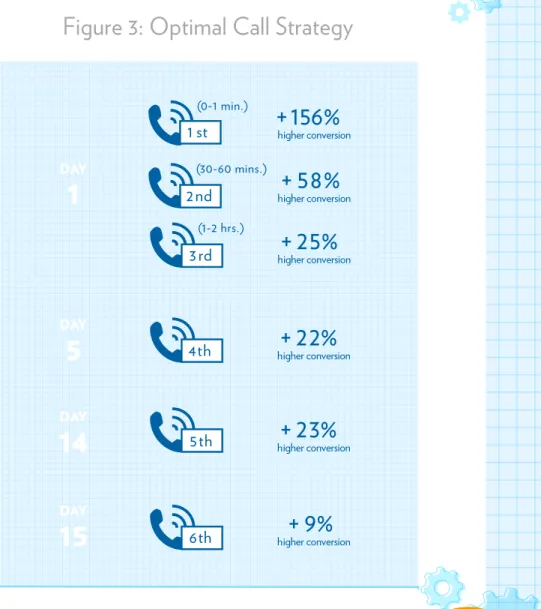
The question of when to make that first call has been answered by the results summarized in Figure 1. Calling within the first minute is clearly what all organizations should strive for. To determine when to make subsequent calls, assuming a prospect is not reached with the first call, we compared conversion rates for contacted leads on subsequent call attempts across all possible time periods. To start, we found that prospects contacted on a second call attempt that was made 30-60 minutes after the lead was generated had a higher conversion rate than all other half hour periods following the initial call. Our complete findings for the optimal call strategy are shown in Figure 3.
RESULTS
+156%
higher conversion+ 58%
higher conversion+ 25%
higher conversion+ 22%
higher conversion+ 23%
higher conversion higher conversion+ 9%
(0-1 min.) 1 st (30-60 mins.) 2 nd (1-2 hrs.) 3 rd 4th 5th 6th DAY1
DAY5
DAY14
DAY15
Optimal Email Strategy
An effective contact strategy does not rely on only one method of communication. The use of email, in addition to phone outreach, can have a very positive impact on your ability to contact and ultimately convert a prospect. Our study found that prospects who receive emails have a 16% higher chance to be contacted by phone, yet 59% of prospects in our study didn’t receive a single email. For about half of those that weren’t sent an email, it wasn’t a possibility since the email address was not collected by the seller, but even when companies collect email addresses, many still choose not to use them. About 40% of the prospects that had an email address on file are never sent an email message. Part of the reason for this may be that companies don’t have a clear strategy for sending email messages the way they might for making phone calls.
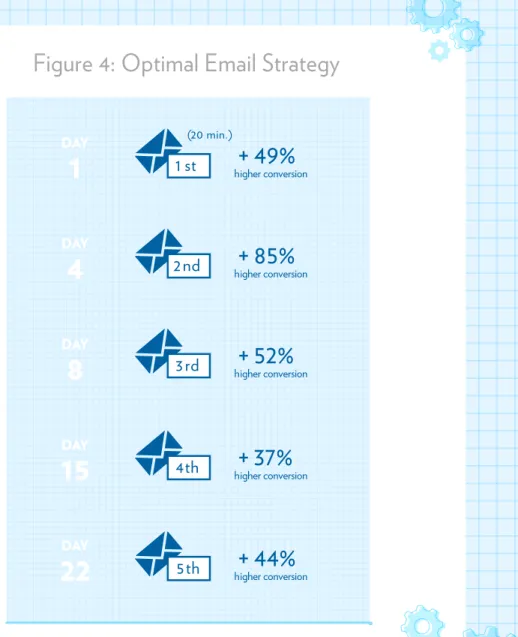
Applying the same methodology used for identifying the optimal number of phone calls, we found that the optimal number of email messages to increase conversion during the first month of a prospect’s lifetime is five. When a prospect is sent more than five email messages prior to contact, especially during a relatively short time period, the probability of conversion begins to drop significantly. The conversion rate for leads that were sent more than five email messages prior to reaching the prospect was 36% lower than the conversion rate for leads that were reached after having received one to five email messages (Figure 4).
RESULTS
+ 49%
higher conversion 1 st+ 85%
higher conversion 2 nd+ 52%
higher conversion 3 rd+ 37%
higher conversion 4th+ 44%
higher conversion 5th (20 min.) DAY1
DAY4
DAY8
DAY15
DAY22
The Ultimate Contact Strategy
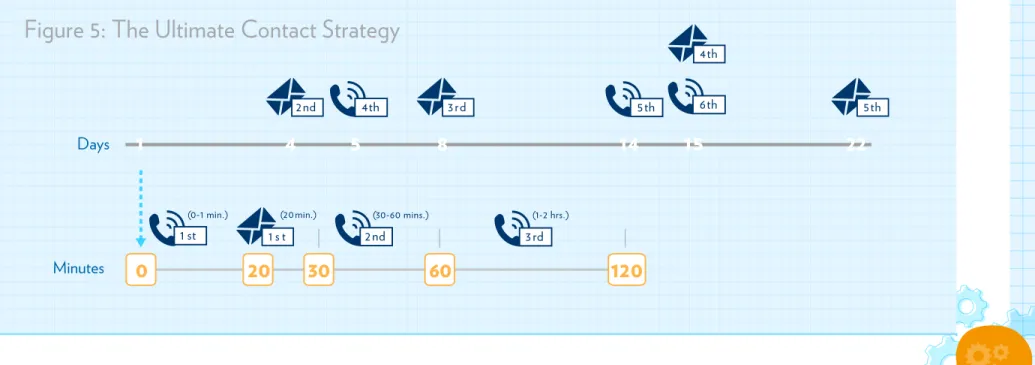
The first few weeks after a lead enters your system are critical to converting that lead. The combination of the recommended phone and email strategies described here can have a powerful impact on your overall conversion rates while also ensuring the most effective use of your staff and other resources. When looked at collectively, it is clear that this strategy provides just the right amount of persistence while maintaining the professional image your organization probably wants to portray (Figure 5).
RESULTS
The average gain in conversion by attempting the calls at the recom-mended times is 49%. When combined with the average gain that can be expected by also sending emails at the recommended times, which average a 53% gain in conversion, this strategy can result in a net conversion improvement of 128%. That means that you could more than double your revenues by keeping everything the same and simply implementing this response strategy.
Days 5th 6th 2 nd 3 rd 4th 5th 1 s t (20 min.) (0-1 min.) 1 st (30-60 mins.) 2 nd (1-2 hrs.) 3 rd Minutes 4th
1
0
20
30
60
120
4
5
8
14
15
22
Takeaways
Speed-to-call is the most significant driver of conversion rates- making a call attempt within a minute of receiving a lead increases conversion rates by 391%
Calling inquiries up to six times prior to making contact is the best way to achieve optimal conversion rates- 93% of all leads that convert are contacted in six or fewer calls
Conversion rates can be further increased by properly timing contact attempts- an average gain of 49% in conversion can be achieved with the recommended call timing
Leads that are sent email messages in-between phone contact attempts have a 16% higher chance to be contacted by phone- an average gain of 53% in conversion can be achieved with the recommended email timing
Combining the highest performing phone and email strategies (The Ultimate Contact Strategy) can result in a conversion gain of 128%
RESULTS
The easiest way to implement “The Ultimate Contact Strategy” is to have an automated system that does this for you! That way, you don’t have to rely on your staff to keep track of all leads and the type of contact method to use next with each at the appropriate time. There are a number of software solutions out there, like those offered by Velocify, that can automatically schedule calls and send out emails according to a set plan like the one recommended here.
DO YOU HAVE THE TOOLS TO
IMPLEMENT THE ULTIMATE
CONTACT STRATEGY?
About Velocify
Velocify is a market leading provider of cloud-based lead manage-ment and sales automation solutions proven to deliver smarter, more efficient lead distribution and sales processes for improved conver-sion rates. With unmatched expertise, drawn from a dedication to helping more than 10,000 clients automate and improve their lead distribution, response and conversion processes, Velocify has become the platform of choice for organizations focused on improving customer acquisition practices and business performance. Velocify is a privately held company, recently recognized as one of the fastest growing companies in North America by Deloitte. Please visit velocify.com for more information.