Professionals
Key TaKeaWays
a Wide Variety of Vendors To Choose From
Over the past few years, eCommerce solutions for SMBs have evolved to provide more well-rounded and confi gurable platforms; however, they do have restraints around the levels of customizability. Generally solutions fall into four categories: on-premises licensed soft ware, hosted/managed, soft ware-as-a-service, or full-service platforms.
Three Key evolutions in The sMB solutions Market Future
In the near future, Forrester expects to see the advent of full-service off erings such as Amazon’s suite of solutions and continued growth off the open source ecosystem. We also expect web services-based solutions through RESTful APIs to become more prominent, as they allow clients to extend platform use in creative and potentially disruptive ways.
© 2012, Forrester Research, Inc. All rights reserved. Unauthorized reproduction is strictly prohibited. Information is based on best available Why Read This RepoRT
This report is an update of our July 2010 “Market Overview: SMB eCommerce Solutions” report. Since the report was first published there have been a number of changes to the solutions market for small to medium-size businesses (SMBs) selling via the Web. New vendors have emerged on the scene, solutions have evolved, mobile commerce has become important, and global commerce is within reach for even small businesses selling online. This report aims to help answer which SMB eCommerce solution you should consider for your business.
Table Of Contents
Finding The Right eCommerce solution For you
Who Is Included And Why
Platform selection For sMBs Can Be Daunting sMB solutions Continue To Evolve
RECOMMEnDATIOns
prepare To select an eCommerce platform Carefully
hOW FORREsTER CAn hElP
Forrester Can aid in strategy assessment and Vendor selection
supplemental Material
notes & Resources
Forrester surveyed 29 vendors including Adobe systems, Amazon.com, Cleverbridge, Magento, Oxatis, and Venda.
Related Research Documents
Is An Open source Platform Right For you? June 29, 2011
eCommerce Technology selection Checklist April 4, 2011
Market Overview: sMB eCommerce solutions
July 26, 2010
A guide To selecting your eCommerce solution Across north
America And EMEA
by Brian K. Walker
with Zia Daniell Wigder, Beth hoffman, and lily Varon
2
10
11 12
Finding The RighT eCoMMeRCe soluTion FoR you
Even the largest companies need solutions aimed at smaller businesses. New products, new markets, new divisions, or new initiatives may require eCommerce solutions that serve smaller teams with
fewer complex requirements than a larger more mature multichannel business requires.1 To support
our SMB clients in finding eCommerce solutions best suited to their needs, Forrester surveyed the capabilities of 29 B2C eCommerce platform providers in North America and Europe that focus to a significant extent on serving SMB online retailers across North America and Europe.
Who is included and Why
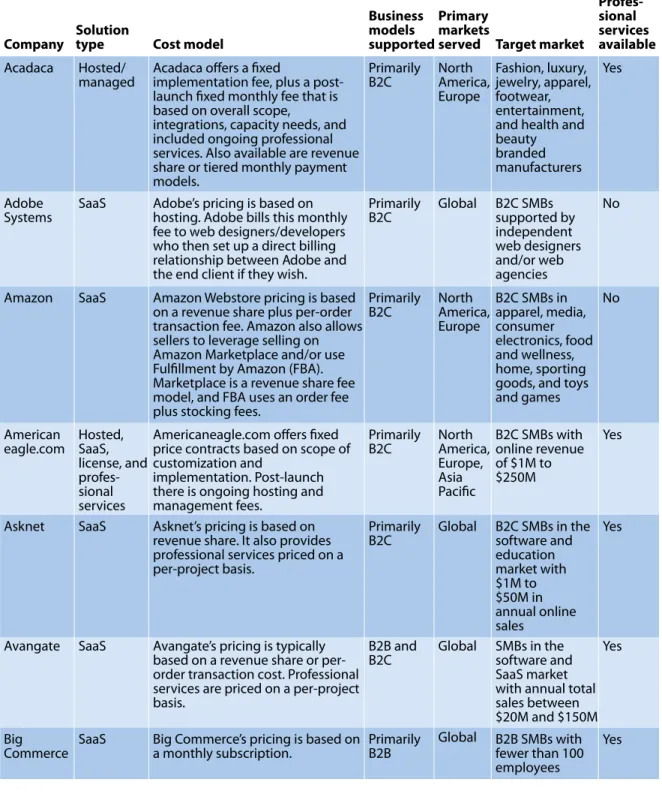
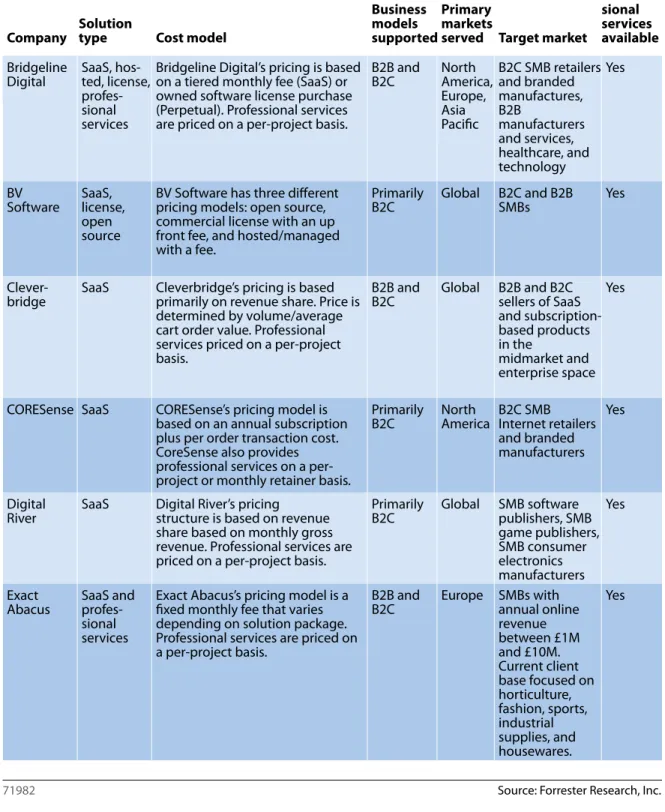
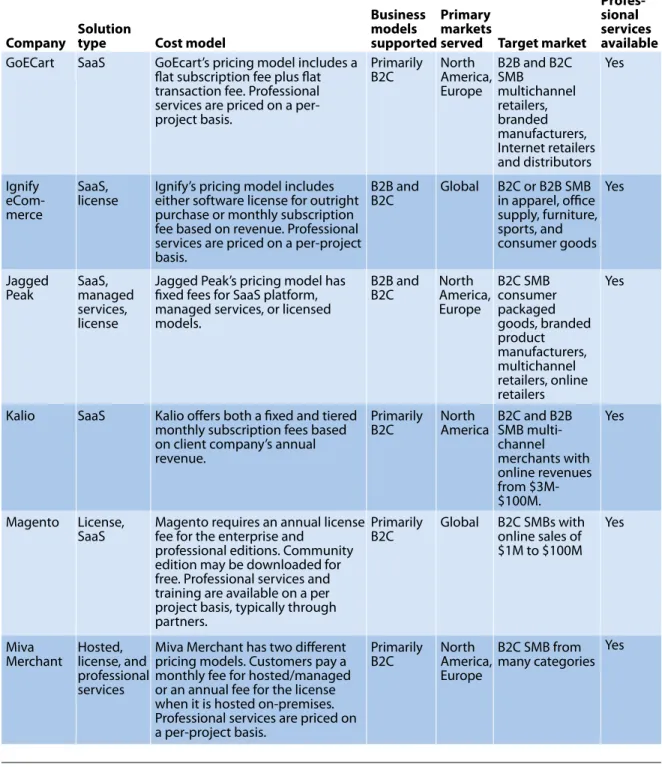
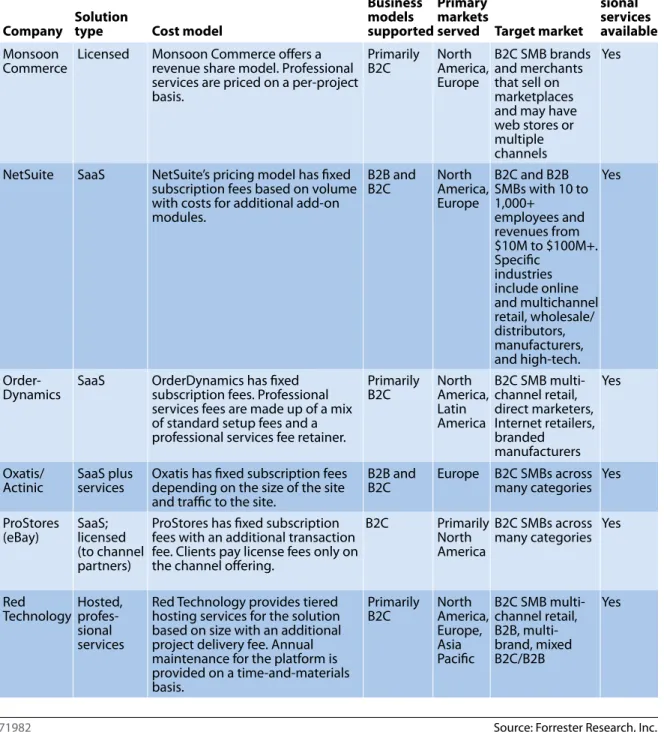
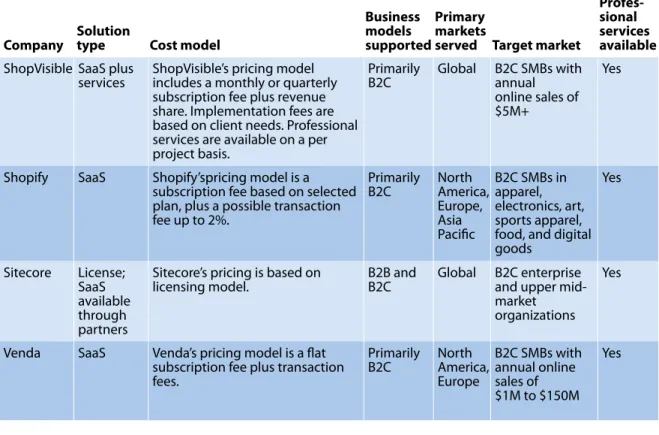
In an effort to bring forth a curated sample of the SMB eCommerce solutions providers, we developed a list of vendors that met our criteria for evaluation. We surveyed the vendors in order to better understand their current offerings and market presence and then narrowed the selection. Each vendor included in this list is focused on (see Figure 1):
■
Providing eCommerce solutions to small or medium-size businesses. The vendor provides solutions to a significant number of clients with $1 million to $10 million in annual online revenues or is otherwise explicitly geared toward the SMB eCommerce client. The vendor may also serve larger clients, but the SMB segment must make up a significant portion of their customer base.■
Providing a comprehensive tool set for SMBs selling direct-to-consumer online. The vendor provides technology and services aimed at retailers, branded manufacturers, digital goods publishers, and other businesses selling direct to consumer online. That may include web, mobile, and web services-based interfaces to support transactions, and may also include other services such as fulfillment, customer service tools, marketing tools, payment services, and creative services.■
Serving North American and/or European markets. Eleven of the 29 eCommerce platform providers surveyed have offerings that are global in scope; however, all vendors’ geographical focus is centered on North American and/or European clients.Forrester covers a great number of eCommerce applications and service providers from around the world. If a vendor is not present in this or other relevant reports and you wish to learn more, we
Figure 1 SMB B2C eCommerce Platform Solutions
Source: Forrester Research, Inc.
71982
Company Solutiontype Cost model
Business models supported
Primary markets
served Target market
Profes-sional services available Acadaca Hosted/
managed Acadaca offers a fixedimplementation fee, plus a post-launch fixed monthly fee that is based on overall scope,
integrations, capacity needs, and included ongoing professional services. Also available are revenue share or tiered monthly payment models.
Primarily
B2C NorthAmerica, Europe
Fashion, luxury, jewelry, apparel, footwear, entertainment, and health and beauty
branded manufacturers
Yes
Adobe
Systems SaaS Adobe’s pricing is based onhosting. Adobe bills this monthly fee to web designers/developers who then set up a direct billing relationship between Adobe and the end client if they wish.
Primarily
B2C Global B2C SMBssupported by independent web designers and/or web agencies
No
Amazon SaaS Amazon Webstore pricing is based on a revenue share plus per-order transaction fee. Amazon also allows sellers to leverage selling on Amazon Marketplace and/or use Fulfillment by Amazon (FBA). Marketplace is a revenue share fee model, and FBA uses an order fee plus stocking fees.
Primarily
B2C NorthAmerica, Europe
B2C SMBs in apparel, media, consumer electronics, food and wellness, home, sporting goods, and toys and games
No
American
eagle.com Hosted,SaaS, license, and profes-sional services
Americaneagle.com offers fixed price contracts based on scope of customization and
implementation. Post-launch there is ongoing hosting and management fees.
Primarily
B2C NorthAmerica, Europe, Asia Pacific
B2C SMBs with online revenue of $1M to $250M
Yes
Asknet SaaS Asknet’s pricing is based on revenue share. It also provides professional services priced on a per-project basis.
Primarily
B2C Global B2C SMBs in thesoftware and education market with $1M to $50M in annual online sales Yes
Avangate SaaS Avangate’s pricing is typically based on a revenue share or per-order transaction cost. Professional services are priced on a per-project basis.
B2B and
B2C Global SMBs in thesoftware and SaaS market with annual total sales between $20M and $150M
Yes
Big
Commerce SaaS Big Commerce’s pricing is based ona monthly subscription. PrimarilyB2B Global B2B SMBs withfewer than 100 employees
Figure 1 SMB B2C eCommerce Platform Solutions (Cont.)
Source: Forrester Research, Inc.
71982
Bridgeline
Digital SaaS, hos-ted, license, profes-sional services
Bridgeline Digital’s pricing is based on a tiered monthly fee (SaaS) or owned software license purchase (Perpetual). Professional services are priced on a per-project basis.
North America, Europe, Asia Pacific
B2C SMB retailers and branded manufactures, B2B manufacturers and services, healthcare, and technology BV
Software SaaS,license, open source
BV Software has three different pricing models: open source, commercial license with an up front fee, and hosted/managed with a fee.
Primarily
B2C Global B2C and B2BSMBs Yes
Clever-bridge SaaS Cleverbridge’s pricing is basedprimarily on revenue share. Price is determined by volume/average cart order value. Professional services priced on a per-project basis.
B2B and B2C B2B and B2C
Global B2B and B2C sellers of SaaS and subscription-based products in the midmarket and enterprise space Yes
CORESense SaaS CORESense’s pricing model is based on an annual subscription plus per order transaction cost. CoreSense also provides professional services on a per-project or monthly retainer basis.
Primarily
B2C NorthAmerica B2C SMBInternet retailers and branded manufacturers
Yes
Digital
River SaaS Digital River’s pricingstructure is based on revenue share based on monthly gross revenue. Professional services are priced on a per-project basis.
Primarily
B2C Global SMB softwarepublishers, SMB game publishers, SMB consumer electronics manufacturers Yes Exact
Abacus SaaS and profes-sional services
Exact Abacus’s pricing model is a fixed monthly fee that varies depending on solution package. Professional services are priced on a per-project basis.
B2B and
B2C Europe SMBs withannual online revenue between £1M and £10M. Current client base focused on horticulture, fashion, sports, industrial supplies, and housewares. Yes Yes Company Solutiontype Cost model
Business models supported
Primary markets
served Target market
Profes-sional services available
Figure 1 SMB B2C eCommerce Platform Solutions (Cont.)
Source: Forrester Research, Inc.
71982
GoECart SaaS GoEcart’s pricing model includes a flat subscription fee plus flat transaction fee. Professional services are priced on a per-project basis.
Primarily
B2C NorthAmerica, Europe
B2B and B2C SMB multichannel retailers, branded manufacturers, Internet retailers and distributors Ignify eCom-merce SaaS,
license Ignify’s pricing model includeseither software license for outright purchase or monthly subscription fee based on revenue. Professional services are priced on a per-project basis.
B2B and
B2C Global B2C or B2B SMBin apparel, office supply, furniture, sports, and consumer goods
Yes
Jagged
Peak SaaS,managed services, license
Jagged Peak’s pricing model has fixed fees for SaaS platform, managed services, or licensed models.
B2B and
B2C NorthAmerica, Europe B2C SMB consumer packaged goods, branded product manufacturers, multichannel retailers, online retailers Yes
Kalio SaaS Kalio offers both a fixed and tiered monthly subscription fees based on client company’s annual revenue.
Primarily
B2C NorthAmerica B2C and B2BSMB multi-channel merchants with online revenues from $3M-$100M. Yes Magento License,
SaaS Magento requires an annual licensefee for the enterprise and professional editions. Community edition may be downloaded for free. Professional services and training are available on a per project basis, typically through partners.
Primarily
B2C Global B2C SMBs withonline sales of $1M to $100M
Yes
Miva
Merchant Hosted,license, and professional services
Miva Merchant has two different pricing models. Customers pay a monthly fee for hosted/managed or an annual fee for the license when it is hosted on-premises. Professional services are priced on a per-project basis.
Primarily
B2C NorthAmerica, Europe
B2C SMB from many categories
Yes
Yes Company Solutiontype Cost model
Business models supported
Primary markets
served Target market
Profes-sional services available
Figure 1 SMB B2C eCommerce Platform Solutions (Cont.)
Source: Forrester Research, Inc.
71982
Company Solutiontype Cost model
Business models supported
Primary markets
served Target market
Profes-sional services available Monsoon
Commerce Licensed Monsoon Commerce offers arevenue share model. Professional services are priced on a per-project basis.
Primarily
B2C NorthAmerica, Europe
B2C SMB brands and merchants that sell on marketplaces and may have web stores or multiple channels
Yes
NetSuite SaaS NetSuite’s pricing model has fixed subscription fees based on volume with costs for additional add-on modules.
B2B and
B2C NorthAmerica, Europe
B2C and B2B SMBs with 10 to 1,000+
employees and revenues from $10M to $100M+. Specific industries include online and multichannel retail, wholesale/ distributors, manufacturers, and high-tech. Yes
Order-Dynamics SaaS OrderDynamics has fixedsubscription fees. Professional services fees are made up of a mix of standard setup fees and a professional services fee retainer.
Primarily
B2C NorthAmerica, Latin America
B2C SMB multi-channel retail, direct marketers, Internet retailers, branded manufacturers Yes Oxatis/
Actinic SaaS plusservices Oxatis has fixed subscription feesdepending on the size of the site and traffic to the site.
B2B and
B2C Europe B2C SMBs acrossmany categories Yes ProStores
(eBay) SaaS;licensed (to channel partners)
ProStores has fixed subscription fees with an additional transaction fee. Clients pay license fees only on the channel offering.
B2C Primarily North America
B2C SMBs across many categories
Red
Technology Hosted, profes-sional services
Red Technology provides tiered hosting services for the solution based on size with an additional project delivery fee. Annual maintenance for the platform is provided on a time-and-materials basis.
Primarily
B2C NorthAmerica, Europe, Asia Pacific
B2C SMB multi-channel retail, B2B, multi-brand, mixed B2C/B2B Yes Yes
Figure 1 SMB B2C eCommerce Platform Solutions (Cont.)
Source: Forrester Research, Inc.
71982
Sitecore License; SaaS available through partners
Sitecore’s pricing is based on
licensing model. B2B andB2C Global B2C enterpriseand upper mid-market organizations
Yes
Venda SaaS Venda’s pricing model is a flat subscription fee plus transaction fees.
Primarily
B2C NorthAmerica, Europe
B2C SMBs with annual online sales of $1M to $150M
Yes ShopVisible SaaS plus
services ShopVisible’s pricing modelincludes a monthly or quarterly subscription fee plus revenue share. Implementation fees are based on client needs. Professional services are available on a per project basis.
Primarily
B2C Global B2C SMBs withannual online sales of $5M+
Yes
Shopify SaaS Shopify’spricing model is a subscription fee based on selected plan, plus a possible transaction fee up to 2%.
Primarily
B2C NorthAmerica, Europe, Asia Pacific
B2C SMBs in apparel, electronics, art, sports apparel, food, and digital goods
Yes Company Solutiontype Cost model
Business models supported
Primary markets
served Target market
Profes-sional services available
platform selection For sMBs Can Be daunting
Small to medium-size companies selling direct-to-consumer online have a wide variety of vendors to choose from. Solutions pitched to SMBs are often simply evolutions from projects that a small agency or development firm completed for a client. But over the past number of years, a group of solutions have emerged to provide well-rounded and configurable platforms for SMB clients. That configuration extends to the customization of the front-end experience to enable companies to reflect their brand and differentiation in the end user experience, while having a base of tools upon which to manage the business online. Certainly these solutions aimed at SMBs will come with varying constraints on the business processes supported, tools provided, and level of customizability available to their clients.
However, as your mother always said, you should bite off only as much as you can chew. These solutions may indeed be all you can reasonably operate as an SMB with a small team, developing best practices with a limited budget. View these solutions as two-to-three year decisions,
understanding that your needs will change and your platform and services providers may need to change along with them.
eCommerce platforms today fall into four general categories (see Figure 2):
■
On-premises licensed software platforms. Run in-house by internal IT resources, on-premises licensed platforms offer the most flexibility over time and can be modified to the client’sspecifications without vendor assistance. Though well suited for internal IT resources to support, often systems integrators (SIs) implement and support these solutions, or they may be supported in various outsource models on a client’s behalf. In the case of many SMBs, these solutions may also be individuals or freelance resources. Open source solutions are a subset of on-premises licensed applications, typically with very modest or no licensing costs. But they will still require implementing an ongoing resource or professional services support. On-premises licensed solutions are a good fit for clients that will want to modify, adapt, and change their platform significantly over time or those that have unique requirements requiring significant customization.
■
Hosted/managed platforms. Vendors in this category implement, run, and maintain the solution on the client’s behalf. This, in turn, reduces or removes internal IT resources that on-premises licensed solutions require. This approach is similar in many ways to on-on-premises licensed software but is combined with services to support the hosting, maintenance, and ongoing development of the client’s platform. Hosted/managed solutions are a good fit for clients that need the flexibility offered by on-premises licensed solutions but that also need services to support the application over time due to a lack of internal skilled resources. An advantage of this approach is the ability to change hosting providers or bring the support for the application in-house later, though this may be easier said than done.■
Software-as-a-service (SaaS). A SaaS solution is a multi-instance application where all clients use the same technology and hosting environment. It is typically implemented considerably faster than the previous two options. Providers of these solutions typically charge via a revenue-share model, utilization model, or flat monthly fees. The solutions may also be implemented considerably faster for clients than on-premises or hosted/managed solutions since much of the software will be the same for each client. SaaS is commonly used in SMB eCommerce platform solutions and is a good fit for a relatively simple online and mobile execution where little customization is needed. SaaS solutions have matured significantly over the past few years and today represent a much more compelling solution to SMBs than they did only a few years ago.■
Full-service offerings. These solutions are exactly as they sound — inclusive of all aspects of an eCommerce platform, clients may also rely on these vendors to support creation, management, content, transcoding, fulfillment, and payment settlement. Relatively few full-service solutions exist for SMB online retailers due to low order volumes. Full-service solutions are particularly good for high-margin businesses with little to no existing direct-to-consumer business experience or infrastructure, or for largely digital goods SMB businesses.Figure 2 SMB eCommerce Solutions Are Not One-Size-Fits-All
Source: Forrester Research, Inc.
71982
Type of
platform Description Best fit
On-premises
licensed Often run in-house by internal IT resources, on-premises licensed platforms offer the most flexibility over time and can be customized or augmented to the client’s specifications. Open source applications are a type of licensed application. May be run as a hosted solution as well by agencies and commerce service providers (CSPs).
On-premises licensed solutions are a good fit for clients that will look to modify, adapt, and change their platform significantly over time or those that have unique requirements requiring significant customization.
Hosted/
managed Vendors in this category implement, run, andmaintain the solution on the client’s behalf. This in turn reduces or removes internal IT resources that on-premises licensed solutions require.
Hosted/managed solutions are a good fit for clients that need the flexibility offered by on-premises licensed solutions but that also need services to support the application over time due to a lack of skilled resources internally. SaaS A SaaS solution is a multi-instance application
where all clients use the same technology and hosting environment. It is typically
implemented considerably faster than the previous two options.
SaaS is commonly used for SMB eCommerce platform solutions and is a good fit for a relatively simple online and mobile execution where little customization is needed.
Full-service These solutions are exactly as they sound — inclusive of all aspects of an eCommerce platform, clients may also rely on these vendors to support site design, management, content, transcoding, fulfillment and payment
settlement.
Full-service solutions are particularly good for high-margin businesses with little to no existing direct-to-consumer business experience or infrastructure, or for largely digital goods SMB businesses.
sMB solutions Continue To evolve
Over the past few years, we have seen significant evolution within the SMB eCommerce solution market. Maturing solution providers, new entrants, and a growing ecosystem of support providers have led to an improved solution landscape for merchants and marketers with small businesses. Today SMBs must market to and serve end customers in a way that meets their expectations. The largest direct-to-consumer businesses selling online and via mobile today are setting expectations. Key evolutions we can expect in the near future in the SMB solutions market include:
■
The advent of full-service solutions. Amazon has now a set of solutions including Webstore, Fulfillment by Amazon (FBA), Amazon Payments, and Amazon Product Ads — together they form a strong assemblage of solutions SMBs can use to support many eCommerce capability needs. Meanwhile eBay’s X.commerce, Magento, and PayPal are developing a somewhat similar range of eCommerce, marketing, payment, and fulfillment solutions for merchants. While costs of a full-service solution can run higher than an assemblage of other services, many SMBs have very limited resources to run technology and support operational processes like fulfillment.■
The continued growth off the open source solution ecosystem. Magento and other open source solutions from Zen Cart and OXID have grown substantially over the past few years. Together with that growth has come growth in the services firms supporting these solutions. This ecosystem of freelance developers, agencies, and dev shops has sprung up to launch clients onopen source solutions. Clients should understand all sides of the decision to go down this route.3
■
The rise of web-services-based solutions. As web services have matured over the past few years, RESTful APIs have become a foundation of mobile application development and have now begun to extend well beyond that into development of web experiences and other touchpoints. Commerce platforms are responding, and as SMB eCommerce solutions such as ShopVisible build their products in a services-oriented manner, it will increase the flexibility for clients to extend how they use the platforms in creative and potentially disruptive ways.R e c o m m e n d at i o n s
pRepaRe To seleCT an eCoMMeRCe plaTFoRM CaReFully
An eCommerce platform is a critical piece of technology. In some cases your entire business will depend on it, and in other cases it powers key digital touchpoints with consumers and will influence much more business than you will transact directly with consumers through your sites and apps. Treat this as a three-to-five year decision, so before you select your B2C eCommerce platform, and in particular a solution geared at serving a small business, you should carry out the following steps:
■
Develop a five-year eCommerce and multichannel business plan. If you want thisplatform to take your business to the next level, you need to know what that level looks like. Forecast your sales and order volume growth online and understand the influence of the web channel on your total business, including wholesale sales. Understand and plan your support costs based on the models you are considering, such as in-house or outsourced technology support.
■
Understand how you will integrate with a solution. A successful eCommerce business requires effective integration of the eCommerce platform with multiple systems, even for a small business. Key integration points include product content, inventory, customer data, web content, order-level data, business intelligence, and financial reporting. Desired site functionality may or may not be supported by a poor integration with these systems. Focus on these integration points by understanding them carefully with a goal to have a rational and sustainable integration approach that will meet your business needs over time.■
Analyze the complete eCommerce platform landscape. Understand the full range of platform models and support options available, your ability to find and retain talent, and how solutions will meet your mobile, cross-channel, wholesale, and retail requirements —both today and in the future. The solution you select may have ramifications in terms of long-term cost of ownership, how easy it is to support and staff, and of course how flexible it is to meet your business needs over time.
■
Use Forrester’s STEP evaluation approach. Using Forrester’s scenario-based technology evaluation process (STEP), focus on your core business processes and customer experience scenarios as well as understand how a platform and your total eCommerce technology environment will support them. This is a critical method to ensure you are aware of the solutions fit with your business. STEP will ensure that you understand how your sites will be managed day to day and what your customers will experience.h o w f o R R e s t e R c a n h e l p
FoRResTeR Can aid in sTRaTegy assessMenT and VendoR seleCTion
Many organizations have specialists supporting vendor selection processes, such as request for information (RFI), request for proposal (RFP), or bid processes. Others look to third-party consultants for best practices and expertise in vendor selection and solution strategy. Forrester can support these activities in the following ways:
■
eCommerce technology strategy assessment. Forrester can help you optimize your opportunities to leverage existing and new investments in eCommerce platforms and technology based on your business goals and the changing needs of your customers.Forrester can provide a perspective grounded in research and experience in supporting road map development, business cases, and eCommerce and multichannel solution strategy with the goal of ensuring our clients’ success.
■
eCommerce platform vendor selection. Forrester analysts are regularly briefed by eCommerce platform providers. Analysts also publish research on major vendors in areas such as business-to-business (B2B) eCommerce platforms, B2C commerce platforms, full-service providers, global eCommerce solutions, and solutions focused on digital product delivery. Forrester analysts can provide objective, rigorous, and independent advice and perspectives on which vendors are best suited to support your eCommerce requirements and can guide you in executing a STEP process. Forrester Consulting also supports RFP development and complete vendor selection processes if needed.suppleMenTal MaTeRial
Companies interviewed For This Report
Acadaca Adobe
Amazon Webstore Americaneagle.com Asknet
Avangate Big Commerce Bridgeline Digital BV Software Cleverbridge CORESense Digital River Exact Abacus GoECart
Ignify eCommerce
Jagged Peak Kalio Magento Miva Merchant Monsoon Commerce NetSuite
OrderDynamics Oxatis
ProStores (eBay) Red Technology Shopify
ShopVisible Sitecore Venda
endnoTes
1 For more research on eCommerce platforms and solutions serving large-scale eCommerce requirements
see the January 14, 2010, “Interim Update To Forrester Wave™ Evaluation Of B2C eCommerce Platforms” report and see the October 21, 2010, “The Forrester Wave™: B2C eCommerce Platforms, Q4 2010” report.
2 Refer to the How Forrester Can Help section of this report for more information on the ways in which
clients work with Forrester to gain support for their eCommerce technology selection processes.
3 eBusiness leaders operating high-growth or maturing businesses must exercise caution and be clear on
limitations they will likely face in implementing and using open source solutions today. See the June 29, 2011, “Is An Open Source Platform Right For You?” report.
Forrester Research, Inc. (nasdaq: FORR) is an independent research company that provides pragmatic and forward-thinking advice to global leaders in business and technology. Forrester works with professionals in 19 key roles at major companies providing proprietary
«
Forrester Focuses On
eBusiness & Channel Strategy Professionals
Responsible for building a multichannel sales and service strategy, you must optimize how people, processes, and technology adapt across a rapidly evolving set of customer touchpoints. Forrester helps you create forward-thinking strategies to justify decisions and optimize your individual, team, and corporate performance.
eRic chanG, client persona representing eBusiness & Channel Strategy Professionals
them make the tough decisions necessary to capitalize on shifts in marketing, technology, and consumer behavior. We ensure your success by providing:
n Data-driven insight to understand the impact of changing consumer behavior.
n Forward-looking research and analysis to guide your decisions. n Objective advice on tools and technologies to connect you with
customers.
n Best practices for marketing and cross-channel strategy.
foR moRe infoRmation
To find out how Forrester Research can help you be successful every day, please contact the office nearest you, or visit us at www.forrester.com, For a complete list of worldwide locations, visit www.forrester.com/about.
client suppoRt
For information on hard-copy or electronic reprints, please contact Client Support at +1 866.367.7378, +1 617.613.5730, or [email protected]. We offer quantity discounts and special pricing for academic and nonprofit institutions.