HIPC
DEBT RELIEF,
THE DEBT SERVICE
BURDEN AND POVERTY
REDUCTION
With a Special Reference to
Uganda's Experience
Harpa Elín Haraldsdóttir
Serie: Desarrollo y cooperación
Número 2. HIPC Debt Relief, the Debt Service Burden and Poverty Reduction. With a Special Reference to Uganda's Experience © Harpa Elín Haraldsdóttir
© Fundació CIDOB, de esta edición Edita: CIDOB edicions
Elisabets, 12 08001 Barcelona Tel. 93 302 64 95 Fax. 93 302 21 18
E-mail: [email protected] URL: http://www.cidob.org Depósito legal: B-38.404-2006 ISSN: 1886-6999
Imprime: Cargraphics S.A.
Distribuye: Edicions Bellaterra, S.L. Navas de Tolosa, 289 bis, 08026 Barcelona www.ed-bellaterra.com
Barcelona, diciembre de 2006
HIPC DEBT RELIEF, THE DEBT SERVICE
BURDEN AND POVERTY REDUCTION
With a Special Reference to Uganda's Experience
Harpa Elín Haraldsdóttir*
December 2006
*Technical Advisor for Icelandic International Development Agency (ICEIDA) in Nicaragua
The author would like to thank Joaquim Tres for his many helpful comments and discussions regarding this work
This paper has been written in 2005
Abstract
This paper offers a review of the theories behind the architecture of the Heavily Indebted Poor Countries (HIPC) initiative and the literature concerning its link to the formulation and implementation of Poverty Reduction Strategy Papers (PRSPs), to speculate on the appropriateness of this link and its possible effects on poverty reduction. Special emphasis is placed on reviewing the literature on aid conditionality and ownership, these debates being highly relevant to the HIPC framework and its poverty reduction association. To see the advancement of the HIPC initiative, the paper offers an overview of one of the World Bank’s showcase passages through the HIPC initiatives; Uganda and its implementation of the PRSP. The paper concludes that the HIPC initiative is an important step in the right direction to foster sustainable growth in low-income countries and to integrate debt relief into a global poverty reduction strategy, but it emphasises that it is only a step. The focus on poverty reduction and participatory linkage is considered appropriate and welcome, but some possible tensions between these explicit twin objectives are highlighted.
In recent years, the academic and policymaking circles have witnessed an intense discussion about poverty, inequality and pro-poor growth. The persistence of poverty at high levels, the slow rate of poverty reduction and the high external indebtedness of developing countries pose major challenges for world leaders, policy makers and governments and have received increased attention as one of the main factors contributing to limiting the development of numerous poor countries. Various recent policy and research documents have identified pro-poor growth as the most important ingredient in achieving sustainable poverty reduction, and debt relief as critical to improving macro stability, reducing the drain on scarce resources and allowing for investments in priority sectors, such as health and education.
In theory, debt relief reduces poverty through three distinct channels. First, debt relief may increase economic growth. The idea is that debt relief stimulates private (foreign or domestic) investments and possibly international credit ratings. Second, relief of government debt releases resources that the government can use for increased spending on social sectors, which is likely to have an impact on non-income poverty. Third, debt relief may be used to change policies. In particular, donors (or creditors) may buy reforms with debt relief, making the economic environment more conducive to growth and private initiative. Debt write-off seems an obvious response to the plight of low income, and especially sub-Saharan African, economies where growth has been extremely slow, and often negative over the last two decades. It is also an eminently campaignable issue, as Jubilee 2000 and other NGO movements have shown.
External debt burden is not new to the Low-Income Countries (LICs), but it has increased significantly since the 1970s. In 1996, after almost two decades of repeated attempts to relieve many LICs of their external debt burdens, international organizations as well as bilateral creditors added to traditional debt relief mechanisms by implementing the Heavily Indebted Poor Countries (HIPC) Initiative. This initiative provides conditional
assistance to countries that meet specific policy and performance criteria and aims to reduce, within a reasonable time, the external debt burden of qualifying countries to sustainable levels. The initiative was then enhanced in 1999, in response to intense pressure to make debt relief broader, faster, and deeper, and poverty reduction emerged as a key element in the programme. The poverty reduction approach results in a comprehensive country-based strategy for poverty reduction. It aims to provide a link between national public actions, donor support, and the development outcomes needed to meet the United Nations’ Millennium Development Goals (MDGs), one of which is centred on halving poverty between 1990 and 2015. The enhanced HIPC scheme (or HIPC II) is based on conditionality, linking debt relief to policies for poverty reduction. Stated briefly, countries are required to establish a good record of implementing economic and social policy reform and prepare a Poverty Reduction Strategy Paper (PRSP) indicating how they will tackle poverty reduction, giving voice to the poor. Countries are then expected to use the surplus to meet social expenditure and other objectives for poverty reduction. The IMF and the World Bank must endorse and assess the PRSP and then agree with the government on a policy reform and macroeconomic management programme to be followed during the HIPC period.
The HIPC initiative was, among other things, a consequence of the apparently successful experience of the Brady Plan in the late 1980s, in reactivating Latin American economies as private capital returned to the region once the debt burden seemed sustainable. The debt problems of the HIPCs, though, differ in many dimensions from those of the middle-income countries. Apart from the obvious difference in middle-income per capita, the composition of debt between private and official creditors is different, as the HIPC debt is mainly to official creditors. Another important difference is that the HIPCs are characterised not only by high debt, but also by relatively poor economic performance and slow economic policy reform. The links between high debt and the implementation of policy reform are thus central.
Given the short time since the HIPC initiative was launched, its economic and social outcomes will not be known with any certainty for some years. Thus, the objective of this paper cannot be the evaluation of the success or failure of the HIPC poverty reduction linkage. The paper therefore offers a quick review of the theories behind the architecture of the HIPC initiative and the literature concerning its link to the formulation and implementation of PRSPs, to speculate on the appropriateness of this link and its possible effects on poverty reduction. Special emphasis is put on reviewing the literature on aid conditionality and ownership, these debates being highly relevant to the HIPC framework and its poverty reduction association. To see the advancement of the HIPC initiative the paper offers an overview of one of the World Bank’s showcase passages through the HIPC initiatives: Uganda and its PRSP implementation. Uganda was the first country to qualify for debt relief under both the initial and, with Bolivia, the enhanced HIPC initiative. As such, it has served as a valuable learning ground for the HIPC program. Uganda has recovered in an remarkable way from the economic devastation brought by Idi Amin. Over the last decade, Uganda’s progress in implementing a market-oriented development strategy and its commitment to poverty reduction have attracted a considerable amount of financial inflows, including Official Development Aid (ODA), and notable results: the percentage of the population living in poverty fell dramatically from 56 per cent in 1992 to 35 per cent in 2000; furthermore Uganda has recently achieved universal primary education.
The first section provides a selective review of the literature on the debt impact on economic performance, the debates behind the design of the enhanced HIPC initiative and an outline of debt relief history. Section 2 discusses the current HIPC initiative, comparing it to the original framework, and its link to poverty reduction. Section 3 illustrates Uganda’s use of HIPC funds and achievements in poverty reduction. Thus the paper offers an overview of the theories behind the HIPC initiative structure and the literature concerning its link to the formulation and implementation of
PRSPs to conclude that the HIPC initiative is an important step in the right direction to foster sustainable growth in low-income countries and to integrate debt relief into a global poverty reduction strategy, but it emphasises that it is only a step. The focus on poverty reduction and participatory linkage is considered appropriate and welcome, but some possible tensions between explicit twin objectives are highlighted.
1. The background of the HIPC initiative: debates and theories
Debt impact on economic performance
An important part of the motivation for debt relief to heavily indebted poor countries comes from the presumption that an adverse interaction exists between heavy debt burden, economic growth, and human development. Growth is important for two reasons. First, as growth rates of HIPCs have been disappointingly low, the tax base has stagnated or declined in many cases, and low or declining public revenues have contributed to the underfunding of development spending, including pro-poor spending. Second, growth can reduce income poverty by enhancing livelihood opportunities for the poor. Growth acceleration could be the key benefit of the HIPC initiative, although growth is no panacea for deep development problems – and must be undertaken in ways that ensure environmental sustainability.
The debt overhang hypothesis
It is now generally accepted that a large debt stock can impair development, but there is less agreement on how this impact might occur (OED, 2003). Theoretical analysis yields a number of hypotheses on the impact of debt on economic performance. One of special importance is the
harmful effects of a country’s debt overhang,the accumulation of a stock of debt so large as to threaten the country’s ability to repay its past loans, which in turn scares off potential lenders and investors. This hypothesis, which originally emerged in response to the middle-income countries’ debt crisis in the 1980s, has been the main theoretical argument in support of explicit debt reduction, as opposed to continued flow rescheduling (Dijkstra and Hermes, 2001) and was the basic strategic rationale for the HIPC initiative as originally conceived and operationalized. The theory is based on the premise that, if a country’s debt level is expected to exceed the country’s repayment ability with some probability in the future, expected debt service is likely to be an increasing function of the country’s output level. Therefore, some of the returns from investing in the domestic economy are effectively “taxed away” by existing foreign creditors, and investment by domestic and foreign investors is discouraged (Claessens et al., 1997). The implication would be that large debt stocks lower growth through the channel of reduced investment, and therefore a reduction in the face value of future debt obligations will reduce the distortion due to the implicit tax, and this will increase investment. Since debt reduction leads to increased investment and repayment capacity, the portion of the debt that remains outstanding becomes more likely to be repaid.
If the negative effect is strong enough, the debtor is said to be on the “wrong side” side of the debt Laffer curve1, and debt reduction may benefit
the creditors as well as the debtor. While initially the expected value of payments equals the nominal value of the debt, if the debt increases, the expected payments will be less than the nominal value. If the debt grows even further, the expected value of repayments may even decline. The country then finds itself in the downward section of the debt Laffer curve.
HIPC Debt Relief, the Debt Service Burden and Poverty Reduction
1. For detailed information about debt overhang and the debt Laffer curve, see Claessens (1990).
As the stock of public sector debt rises, investors may worry that the government will finance its debt-service obligations through distortion measures, such as inflationary financing and/or precipitate a currency depreciation/devaluation. Such uncertainty generates in possible investors a tendency to remain on the sideline, or to invest in projects with quick returns rather than in projects that enhance growth on a sustainable basis over the long term (Clements et al., 2003)
In its original formulation, the debt overhang theory focused on the adverse effects of debt on investment in physical capital. The scope of the theory, however, is quite broad. To the extent that foreign creditors are expected to appropriate some of the benefits of future growth, any activity that involves incurring costs up front for the sake of increased output in the future will be discouraged. Such activities may include investment in human capital and in technology acquisition. Furthermore, disincentives for the government to implement economic reforms (trade liberalization, privatization, fiscal reform) and invest in productive activities increase with higher debt service. This comes as the returns on such activities will be used to repay outstanding debt instead of directly improving the economic welfare of residents, leading to an immediate, political as well as economic, cost (Clements et al., 2003). If policy makers expect foreign creditors to appropriate most of the gains from policy reform through larger debt service payments, then the presence of a debt overhang may be a strong obstacle to economic reform. With government postponing much needed economic reforms and good policies, private investors become even more cautious before taking new investment decisions (Dijkstra and Hermes, 2001). This deterrent to reform would exist in any country with a heavy external debt burden, but it is of special concern in the HIPCs, where structural reforms are essential to sustaining higher growth (Clements et al., 2003). So, the channel for the debt overhang’s effect on growth may not only be through volume of investment but also through a poorer macroeconomic policy environment, which is likely to affect the efficiency of investment, and uncertainty (Patillo et al., 2002).
Harpa Elín Haraldsdóttir
Few studies have been able to determine how large the stock of external debt has to be, relative to gross domestic product (GDP), for the debt overhang to have an effect (Clements et al., 2003). A 2002 study by Patillo, Poirson and Ricci of 93 developing countries between 1969 and 1988 did, however, find strong support for the debt overhang hypothesis (Patillo et al., 2002). Their study argues that external debt begins to have a negative affect on growth when its net present value exceeds 35-40 percent of GDP and 160-170 percent of exports. The authors’ simulations suggest that doubling the average stock of external debt in these countries would slow down annual per capita growth by between a half and a full percentage point. In a follow-up study in 2004, the same authors conclude that large debt stocks negatively affect growth by dampening both physical capital accumulation and total factor productivity growth (Patillo et al., 2004). Along similar lines, another IMF working paper (Clements et al., 2003) finds that external debt slows growth after its face value reaches a threshold level estimated to be about 50 percent of GDP (in net present value terms, 20 – 25 percent of GDP) and that external debt also affects growth through its effect on public investment.
Although conceptually appealing, there are strong and contrasting views on whether the debt overhang argument is applicable to the HIPC countries. The middle-income countries’ debt crisis in the 1980s was thought to demonstrate that an excessive debt stock could create disincentives for investment, for undertaking or sustaining politically costly reforms, and for achieving growth and poverty reduction. But the situation of the middle-income countries was quite different from that of the HIPCs. For example, the former group dealt with problems in servicing their commercial debt, while HIPC countries deal with a debt problem that is largely one of bilateral and multilateral debt. Furthermore, the current HIPCs are not only characterized by high debt but also by poor economic performance, poor policies, weak government and institutions, slow reforms, deficient infrastructures, and limited administrative and managerial capacity (OED, 2003). The economic evidence of the negative
HIPC Debt Relief, the Debt Service Burden and Poverty Reduction
impact of a high debt stock, particularly of the debt overhang effect, on investment and growth is suggestive and shows in general a negative correlation between high debt stocks and growth. Still, there has not emerged a clear consensus on whether the accumulation of debt is caused by the slow growth, a result of low savings and investment and a weak policy environment, or if it is debt that is really discouraging investment and good policies and hence deterring growth (see Claessens et al., 1997; Dijkstra and Hermes, 2001; Easterly, 2001 and Patillo et. al2002 for different perspectives and empirical evidence).
Birdsall, Claessens and Diwan (2004) question the relevance of the debt overhang theory for the HIPCs, as net transfers to most of them are positive (averaging 12 per cent of GDP in Africa) and consequently there is no fear of a ‘debt tax’ – unlike Latin America in the 1980s, when net transfers turned sharply negative and the debt overhang concept entered the debate.
Though acknowledging this, the World Bank’s Operation Evaluation Department(OED, 2003) emphasises that despite the large positive net transfers, the fiscal space of HIPCs might simply be too small to simultaneously accommodate large debt service obligationsand fund the necessary infrastructure and social investment for broad-based, equitable growth and poverty reduction. This could partly reflect the inefficiency of existing aid processes such as project finance and tied procurement, but also insufficient efforts to increase budgetary revenues, inefficient management of public expenditure, or both. To effectively reduce the fiscal strain would therefore require not only debt reduction (to lower debt service obligations) but also concurrent actions on the policy front by donors and recipients alike (OED, 2003).
Berthélemy (2004) responds to Birdsall, Claessens and Diwan, arguing that as the positive transfers to the HIPCs are due to new aid flows corresponding to projects by donor agencies, thus what counts is not the total aggregate resources that a country receives but the amount of resources that the government can discretionarily allocate. The central issue to Berthélemy is whether projects financed by the donors are truly
Harpa Elín Haraldsdóttir
owned by the debtor government, i.e. whether this government would have decided on such expenditures in the absence of aid flow2. Recent
debates on the necessity to improve the ownership of reforms and development policies by governments in developing countries suggest that project aid does not always add resources to the budget that a debtor government can discretionarily allocate. This implies that, notwithstanding project aid flows which have reversed net transfers in favour of HIPCs, their debt service obligation may have actually created a taxation effect as assumed above (Berthélemy, 2004). Moreover, these positive net transfers have been maintained through a complex and inefficient restructuring and negotiation process. This uncertainty surrounding the process and the general inefficiency associated with high debt stocks can have a negative influence on both level of investment and the effective use of existing capacity3.
Other effects of debt on economic performance
Debt overhang is not the only avenue through which heavy debt burden is thought to affect economic performance. A strong case has been made for the crowding out effect, a link between growth and debt burden mediated through the fiscal account. High debt service payments crowd out high-priority public expenditures, so the smaller the debt service more resources are available to finance investment without reducing public investment expenditure. Reduced public investment can ultimately lead to lower growth rates through a reduction of:
HIPC Debt Relief, the Debt Service Burden and Poverty Reduction
2. See Cohen (2000), who also finds evidence for the debt overhang effect in HIPCs. 3. The literature on investment under uncertainty stresses that in highly uncertain
environments, even if fundamentals are improving, investors continue to exercise their
option of waiting, see Patillo et al.(2002).
– total investment (since public investment in LICs is often a significant proportion of gross domestic investment),
– private investment (as some private investment is complementary to public investment),
– investment productivity because of lost externalities for certain types of public investment, e.g. physical infrastructure4.
Heavy debt burden may also reduce growth output through its effect on human capital development, crowding out social investment spending leading to reduced investment in human capital and, ultimately, to a slower rate of increase in physical capital and growth (Serieux and Samy, 2001). Debt burden can, furthermore, affect growth through the external account, or the import compression effect (Serieux and Samy, 2001). For countries with non-traded currencies, as is the case for most LICs, external debt-service payments require the purchase of foreign currency that must be earned from exports or capital inflows, or from drawing down reserves. The increased demand for limited foreign currency causes a direct fall in output by reducing imported inputs or indirectly by reducing imported capital goods and, therefore investment. Furthermore, most low-income economies are creditrationed, that is, they do not access international capital markets and face significant human capital constraints (Claessens et al., 1997). These two features most likely make the effect of a heavy foreign debt burden on these countries significantly different from its effect on other, less constrained, economies (Serieux and Samy, 2001).
Harpa Elín Haraldsdóttir
4. The crowding out theory does not support the strategy of debt reduction over ongoing rescheduling combined with new resources in the same clear way as the debt overhang theory does, as an identical increase in investment could be obtained by giving the country a new loan instead of reducing current debt service, since a new loan would be just as effective at “crowding in” investment.
There are, thus, various ways that debt relief can be useful to raise growth. To summarize, there are three main channels. First, by reducing the debt overhang effect on private investment and economic policies. Second, by reductions in debt service payments, which, in turn, makes additional resources available for growth-enhancing (and poverty-reducing) public investment. Finally, investment and growth might be spurred by reducing uncertainty regarding debt payments and aid flows, where such uncertainty has disruptive macroeconomic effects.
Aid efficiency debates with reference to the HIPC initiative: a review
The design of the HIPC initiative takes stock of previous developments in debt relief and growth literature, acknowledging that unsustainable debt and debt service are counter-productive. It aspires to embody the emerging empirical aid studies and lessons of experience on the link between aid effectiveness and policy environment, conditionality and ownership, social impact of macroeconomic policy and public expenditure reforms, and aid coordination (OED, 2003).
The debate on the importance of the quality of policies for aid effectiveness
One of the significant conclusions of the aid-effectiveness literature has been that aid is more effective when the recipient country’s policy and institutional environment satisfies some minimal criteria, and aid should thus be allocated selectively on the basis of the quality (however defined) of prospective recipients’ economic and social policies (World Bank, 1998). In terms of the pure economic debt theories mentioned above, one may, however, question if poor policy performance is a cause or a consequence of external debt. The debt overhang theory and the more general concerns of debt distorting incentives of the borrowing countries to reform imply that
poor policy performance could be an outcome caused by external debt, at least in some of the HIPC countries, especially in the short run, as governments have much less incentive to absorb reform costs if they primarily produce income for foreign creditors. Hansen (2001 suggests that through a joint analysis of aid and debt, one might consider external debt, rather than poor policy performance, to have a negative influence on the impact of foreign aid on growth.
In the initial debt overhang literature, it was assumed that the government’s objective was to maximize the nation’s welfare. Within this framework, only the debt overhang disincentives can prevent implementation of the right economic policies. If the government, however, has different objectives (e.g., protecting vested interests), the policies it implements might be the wrong ones, whatever its debt obligations. This suggests that the impact of HIPC debt relief programmes cannot be assessed independently of the quality of economic governance in the debtor countries (Birdsall, Claessens and Diwan, 2004).
Origins of debt and HIPC debt relief: with a special reference to the experience of Sub-Saharan Africa
Following a decade of good growth in the 1960s, after independence for a large number of African states, the economic shocks of the early 1970s combined with serious economic, social, and structural constraints to rapid and broad-based growth, resulted in a long and persistent economic decline that lasted until the early 1990s (OED, 2003). Between 1980 and 1990, the low-income countries’ total stock of external debt grew rapidly from US$125 billion in 1980 to US$419 billion in 1990. In contrast, gross national product increased only from US$0.9 trillion to US$1.3 trillion in the same period. In other words, the debt-to-GNP ratio increased from less than 14% in 1980 to over 31% in 1990 (Gunter, 2002). This growth of foreign debt in the 1970s and 1980s can be traced to diverse and interrelated causes, a combination of internal and external factors. These factors include, but are not limited to:
Harpa Elín Haraldsdóttir
– Exogenous factors, such as adverse terms of trade shocks;
– The absence of sustained adjustment policies, particularly when facing exogenous shocks, which gave rise to sizable financing needs and failed to strengthen the capacity to service debt; including inadequate progress in most cases with structural reform that would promote sustainable growth of output and exports;
– The lending and refinancing policies of creditors, particularly lending on commercial terms with short repayment periods by many creditors in the late 1970s and early 1980s and non-concessional, mostly multilateral rescheduling terms for most of the 1980s;
– Lack of careful management of the currency composition of debt; – The lack of prudent debt management by debtor countries, driven in part by excessive optimism on the part of creditors and debtors about the prospects for increasing export earnings and thereby building debt-servicing capacity and;
– Political factors, such as civil war and conflict (Brooks et al., 1998). Mechanisms for restructuring or rescheduling debt have been around for a long time: the most important is the Paris Club which, since the mid-1950s, has been a framework for rescheduling sovereign debt, mainly with Organisation for Economic Co-operation and Development (OECD) creditor governments. From the late 1980s onwards, Paris Club creditors granted relief on bilateral official debts on increasingly generous terms as it became clear that the mounting debt burdens of poor countries reflected a deep solvency problem that required not only a temporary reduction in debt service, but also a reduction in the level of debt. In late 1988 the Paris club members began to grant such debt reduction in the form of concessional flow rescheduling for low-income countries under the so-called “Toronto terms”, which involved a debt reduction of about one-third of the eligible amounts. The level of debt forgiveness was then raised in two steps: London terms in late 1991 (50 per cent debt reduction), and Naples terms (two-thirds debt reduction) at the end of 1994. Some bilateral donors gave additional, separate, relief by retrospectively converting loans
HIPC Debt Relief, the Debt Service Burden and Poverty Reduction
into grants. The grant element of new flows under bilateral aid programmes also increased. As a result, the payment profiles on restructured debt became increasingly longer and lower. Paris Club rescheduling was complemented by initiatives to forgive bilateral Official Development Aid (ODA) claims. Donor governments also gave some debt reduction through debt swaps, and began to provide more and more of bilateral development assistance in the form of grants (Abrego and Ross, 2001)5.
Nevertheless, these mechanisms proved inadequate to the task, especially in the context of the continuing poor economic performance of the indebted countries and the widespread view that the adjustment programmes of the 1980s (which contributed to the build-up of multilateral debt as concessional loans were given to support adjustment) had, at best, delivered only modest gains in growth and poverty reduction. These mechanisms reduced bilateral and commercial debt, but not multilateral debt, and the debt burdens of many low-income countries continued to grow, particularly in sub-Saharan Africa (OED, 2003). The continuing support of multilateral institutions to the policy adjustment efforts of low income countries through, mostly concessional, loans was reflected in an increasing share of multilateral debt in the total debt of low-income countries. Thus, approaches that had proven successful in resolving the earlier commercial debt crises of the 1980s, in particular the Brady Plan, were by and large not applicable to HIPCs because their debt composition being overwhelmingly multilateral. To mitigate this, a number of bilateral creditors provided grants to help some countries to service their multilateral debts, e.g.
Harpa Elín Haraldsdóttir
5. Bilateral creditors not participating in the Paris Club – mainly oil exporters in the Middle East, but also China, Taiwan and a number of development countries, including some of the HIPCs, provided more limited debt restructurings than other creditors, but in turn often saw their claims increasingly falling into arrears.
Uganda (Abrego and Ross, 2001). This led some bilateral donors to question why they were effectively compensating multilateral donors for bad lending decisions, thereby facilitating a transfer of the lending risk from the multilateral agencies to their bilateral cousins (Addison et al., 2004).
The unsatisfactory situation led to increasing calls, by debtor countries themselves as well as the NGO community, for more thorough action. The growing influence of civil society, with NGO networks at its core, transformed the international debt regime through political reach into the higher levels of international governance, especially with the G-7 governments and the Development and Interim Committees of the Bretton Woods Institutions (OED, 2003). Eventually the IMF and the World Bank launched the Highly Indebted Poor Countries initiative in September 1996. The initiative aimed to reduce debt servicing to a sustainable level, defined in terms of targets for the ratios of debt to export earnings and public revenues and marked a distinct break with the traditional debt relief mechanisms being the first comprehensive attempt to deal with the debt crisis and involving multilateral debt, which became eligible for relief for the first time (Gunter, 2002)6. The original HIPC
(HIPC I) framework had a straightforward focus on the key issue that the initiative was created to address: to reduce the debt stock of publicly guaranteed disbursed and outstanding debt. The strategic rationales were that it would remove the disincentive effects on private investment of the debt overhang and allow progress toward the underlying development goal of economic growth and poverty reduction (OED, 2003). At the same time, the “savings” from reduced debt, to the extent that they were actually
HIPC Debt Relief, the Debt Service Burden and Poverty Reduction
6. Given that less than 4% of HIPCs’ total external debt was private non-guaranteed (PNG) debt, the architects of the HIPC framework decided to exclude this debt (Gunter, 2002).
realized7, would generate the much-needed fiscal space in the HIPC
governments’ budget to pursue economic growth. To qualify for the HIPC I debt relief framework, a country would have to be an “IDA-only” country8, face an unsustainable debt situation after the full application of
current debt relief mechanisms, and demonstrate an appropriate track record of adjustment and reform through IMF- and World Bank-supported programs. On the basis of these criteria, forty-one countries were eligible for debt relief9.
Three years after launching the HIPC initiative, it was clear that the original HIPC framework was not sufficient to provide the HIPCs with a permanent exit from repeated debt rescheduling, and partly due to strong public pressure and the NGO community led by Jubilee 2000, the IMF and World Bank formally agreed in September 1999 to enhance the framework. In a nutshell, the original scheme was thought to offer too little to too few and too late (Dagdeviren and Weeks, 2001; OED, 2003). The
Harpa Elín Haraldsdóttir
7. Debt principal relief does not necessarily imply debt service relief. Although a reduction in the debt stock should translate roughly into a proportional cut in the service payments, it is not so for the HIPCs. Much of the debt service is not being paid anyway, so there is a point up to which debt forgiveness will not reduce interest payments.
8. That is, they rely on financial resources from the World Bank’s International Development Association (IDA). To become an “IDA-only” country, the per capita income level is required to be $900 or lower. Originally Nigeria and Equatorial Guinea were considered to be HIPCs, but were dropped from the list of HIPCs as they were later considered to be no longer IDA-only countries. Likewise, other countries have been added to the list once they satisfied that requirement. For the current list of HIPCs and a more detailed description of the HIPC initiative, see the World Bank’s HIPC website: www.worldbank.org/hipc.
fundamental causes were thought to be the criteria for debt sustainability and the conditionality accompanying the debt relief. High debt sustainability thresholds were denounced for limiting the size of debt relief, as well as restricting the number of countries that might qualify.The prolonged negotiations among multilateral and bilateral donors, the efforts to create an integrated debt-reduction mechanism and the emphasis on policy conditionality were thought to severely delay delivery of debt relief (Killick, 2004). The initiative was thought to lack resources to fulfil its promises, and harshly criticised for missing an explicit linkage with human development and poverty reduction (Dagdeviren and Weeks, 2001). The key slogan of the initiative had been sustainable development requires sustainable debt, and thus the creation of mechanisms to direct resources released by debt relief into social expenditure, especially poverty reduction, was seen as vital for the effectiveness of debt relief (Gunter, 2002).
The enhancement certainly came as a result of strong public pressure, but the apparent slow pace of debt relief10and the high administrative burden
associated with implementing the initiative also contributed to the enhancement (OED, 2003). Debt relief is an eminently campaignable issue (as various NGO initiatives, the Jubilee 2000 campaign, Live8, etc., have shown). Yet like with other highly campaignable and popular movements there is a danger that an oversimplified solution is advocated and then adopted, possibly in a way that does not respond to the real problems of the economies in difficulties (Ranis and Steward, 2001). This is relevant to the design of the initiative, as the PRSP emphasis on social expenditure was, by some means, the result of powerful NGO campaigning.
HIPC Debt Relief, the Debt Service Burden and Poverty Reduction
10. From 1996 to 1999 only seven countries became eligible for debt relief and although eligibility criteria was handled with some flexibility, only four countries reached the Completion Point under the HIPC I: Uganda and Bolivia in 1998; and Guyana and Mozambique in 1999.
2. The Enhanced Initiative and its Poverty Reduction Link: a review
The enhancement of the initiative was an attempt to improve the original framework’s defects. While the original goal of promoting growth by removing the debt overhang was retained, the transformation from the original framework to the enhanced one took place in two dimensions: a shift in focus of the original objective related to debt service; and the addition of an explicit twin objective, linking debt relief to policies for poverty reduction with participatory PRSPs. To be eligible for the enhanced HIPC (HIPC II) debt relief, a country has to comply with a set of conditions. Two generic requirements are (a) staying on track with the IMF’s Poverty Reduction Growth Facility macroeconomic stabilization and reform program as before, and (b) the development and implementation (for at least one year) of a participatory PRSP. In addition, the World Bank, the IMF and the bilateral donors, with the government, identify key structural and social development actions or reforms that would promote progress toward sustainable development. Beyond the two generic requirements, the design allows for the triggers to be tailored, suiting the particular circumstances of a country, and expects them to be designed in full consultation with its government (OED, 2003).
While some of the major criticism of the HIPC I was on its excessive reliance on the conditionality aspect of the initiative, supported by some of the arguments of the aid efficiency-conditionality debate, the enhancement initiative pursued high conditionality, found in the moral hazard and good governance literature. The enhanced initiative clearly states that the public resources released thanks to the HIPC Initiative are to be used to reduce poverty, and it requires debtor countries to elaborate a participatory poverty reduction strategy after an extensive process of domestic consultation and participation. The participatory part is important, as it is the initiative’s attempt to develop a strong ownership of the program (OED, 2003), responding to an important defect of conditionality. Linking the enhanced HIPC initiative to the making of a PRSP is seen by many as an important
step forward; what began as a limited debt reduction scheme increasingly took on the role of a poverty-reduction programme, placing debt relief within an overall framework of poverty reduction (Dagdeviren and Weeks,
2001). However this linkage possibly involves some problems.A strong argument, based on experience of the initiative, is that the PRSP requirement either delays enhanced HIPC assistance or leads to a lower level/quality of country ownership and civil society participation (Gunter, 2002).
The Enhanced HIPC initiative: novelties and comparison to the original framework
Alongside the new emphasis on poverty reduction with the Poverty Reduction Strategy Papers, HIPC II aimed to provide deeper, broader and faster debt relief. Deeper, by lowering the ratios considered to provide debt sustainability (together with a lowering of the minimum threshold to qualify for the openness/fiscal criteria). Moreover, the sustainability analysis on reaching the decision point would no longer be based on a projection of exports and government income for the coming three years, but on an average of actual data for the preceding three years. Faster, by the provision of interim relief from some creditors between the decision point and the completion point (see Table 1 and Flowchart 1). Furthermore the concept of a floating completion point (reached by the successful provision of so-called “triggers for the floating completion point”) would replace the, in principle, fixed three-year period between decision and completion point. Finally, HIPC II aimed to be a broader initiative than its predecessor, by allowing more debtor countries to be considered for the initiative’s facilities (Gunter. 2004). This results automatically from the reduction of access thresholds.
Like the original HIPC framework, HIPC II involves two stages. The first stage is a three-year period during which the HIPC works in coordination with the support of the World Bank and the IMF to establish a record of good economic policies. At the end of this three-year period, the IMF and
HIPC Debt Relief, the Debt Service Burden and Poverty Reduction
the World Bank determine whether a country’s debt level is sustainable. For those countries whose debt burden remains unsustainable after full use of traditional debt relief mechanisms, a package of debt relief is identified. This is known as the enhance Decision Point (eDP), at which some creditors may start with the provisioning of HIPC debt relief. The decision to provide HIPC debt relief is irrevocably taken once the conditions identified at the eDP are satisfied, which is then known as the enhanced Completion Point. The amount of debt relief is determined in Net Present Value (NPV) terms, and the NPV debt-to-export ratio should be 150 percent at the eD.11. To
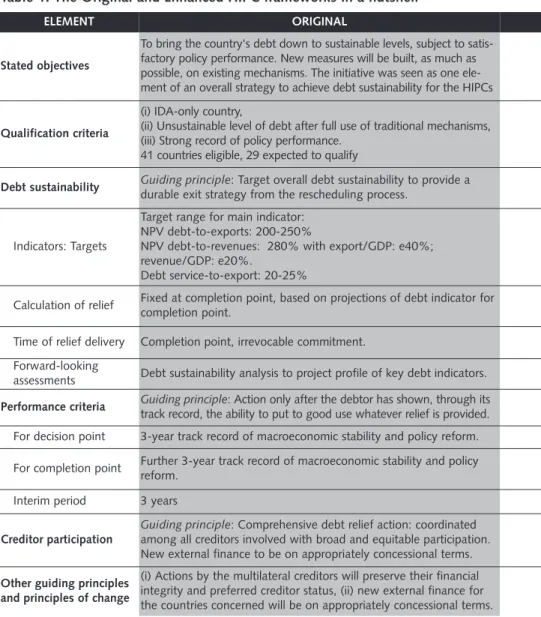
reach the eDP countries draw up a PRSP in which stakeholders are meant to participate. After the Decision Point, HIPCs would then have immediate access to debt relief by multilateral institutions (interim relief ), which should be used for implementing the PRSP. The duration of the period between Decision Point and Completion Point would be flexible, as the latter is no longer fixed in advance but floats: the country must at least implement a number of tangible reforms and start to implement a PRSP, to be certified by a Progress Report. On reaching the Completion Point, the interim relief would be continued but would now be fixed for the next 15 to 20 years, and bilateral creditors would forgive the greater part of their debt stocks. In short, HIPC I conditionality was restricted to evaluating (ex post) the track record of past performance, while HIPC II set conditions in advance (ex ante) again. Moreover, HIPC II signified that demands were set on the use of debt relief.Table 1 compares the original initiative with the enhanced one, and Flowchart 1 describes the process of the HIPC II initiative.
Harpa Elín Haraldsdóttir
11. The actual ratio of the years following the eDP may be quite different. For example, it was expected at Rwanda’s enhanced decision point that the NPV debt-to-export ratio at end-2003 would be 193 percent. However, based on the analysis at the Completion Point in April 2004, it turned out to be 326 percent (Hussain and Gunter, 2005).
HIPC Debt Relief, the Debt Service Burden and Poverty Reduction
Country establishes a second track record by implementing the policies determined at the decision point (which are triggers for reaching the floating completion point) and linked to (interim) PRSP.
- World Bank and IMF provide interim assistance
- Other multilateral and bilateral creditors and donors provide interim debt relief at their discretion. - All creditors continue to provide support within the framework of a comprehensive poverty reduction strategy designed by governments, with broad participation of civil society and donor community.
SECOND STAGE
- Timing of completion point is tied to the implementation of policies determined at the decision point. - All creditors provide the assistance determined at the decision point; interim debt relief provided between decision and completion points counts toward this assistance.
EITHER OR
Country establishes three-year track record of good performance and develops a PRSP together with civil society; en early cases, an interim PRSP
may be sufficient to reach the decision point.
FIRST STAGE
- Paris Club provides flow rescheduling in accordance with current Naples terms, i.e. rescheduling of debt
service on eligible debt falling due during the three-year consolidation period (up to 67 percent reduction on eligible maturities on a net present value (NPV) basis)
- Other bilateral and commercial creditors provide at least comparable treatment.
- Multilateral institutions continue to provide support within the framework of a comprehensive poverty
reduction strategy designed by governments, with broad participation of civil society and donor community.
Paris Club stock-of-debt operation under Naples terms and comparable treatment by other bilateral
and commercial creditors
is adequate
for country to reach sustainability by the decision point.
EXIT
(Country is not eligible for HIPC)
Paris Club stock-of-debt under Naples terms and comparable treatment by other bilateral and
commercial creditors
is not sufficient
for country to reach sustainability by the decision point.
DECISION POINT
(World Bank and IMF boards determine eligibility)
All creditors (multilateral, bilateral, commercial) commit debt relief to be delivered at the floating completion point. The amount of assistance depends on the need to bring the debt to a sustainable level at the decision point. This is calculated based on the latest available data at the decision point.
"FLOATING" COMPLETION POINT
Flowchart 1. The Enhanced HIPC Initiative framework
*Paris Club goes beyond the Naples terms to provide more concessional debt reduction of up to 90 percent in NPV terms (and, if needed, higher) on eligible debt so as to achieve an exit from unsustainable debt.
* Other bilateral and commercial creditors provide at least comparable treatment on stock of debt. * Multilateral institutions take additional measures, as may be needed, for the country's debt to be reduced to a sustainable level, each choosing from a menu of options, and ensuring broad and equitable participation by all creditors involved.
Harpa Elín Haraldsdóttir
ELEMENT ORIGINAL
Stated objectives
To bring the country's debt down to sustainable levels, subject to satis-factory policy performance. New measures will be built, as much as possible, on existing mechanisms. The initiative was seen as one ele-ment of an overall strategy to achieve debt sustainability for the HIPCs
Qualification criteria
(i) IDA-only country,
(ii) Unsustainable level of debt after full use of traditional mechanisms, (iii) Strong record of policy performance.
41 countries eligible, 29 expected to qualify
Debt sustainability Guiding principle: Target overall debt sustainability to provide a
durable exit strategy from the rescheduling process.
Indicators: Targets
Target range for main indicator: NPV debt-to-exports: 200-250%
NPV debt-to-revenues: 280% with export/GDP: e40%; revenue/GDP: e20%.
Debt service-to-export: 20-25%
Calculation of relief Fixed at completion point, based on projections of debt indicator for
completion point.
Time of relief delivery Completion point, irrevocable commitment.
Forward-looking
assessments Debt sustainability analysis to project profile of key debt indicators.
Performance criteria Guiding principle: Action only after the debtor has shown, through its
track record, the ability to put to good use whatever relief is provided.
For decision point 3-year track record of macroeconomic stability and policy reform.
For completion point Further 3-year track record of macroeconomic stability and policy
reform.
Interim period 3 years
Creditor participation
Guiding principle: Comprehensive debt relief action: coordinated among all creditors involved with broad and equitable participation. New external finance to be on appropriately concessional terms.
Other guiding principles and principles of change
(i) Actions by the multilateral creditors will preserve their financial integrity and preferred creditor status, (ii) new external finance for the countries concerned will be on appropriately concessional terms. Table 1. The Original and Enhanced HIPC frameworks in a nutshell
HIPC Debt Relief, the Debt Service Burden and Poverty Reduction
ENHANCED
Maintains original focus to remove debt overhang and provide a permanent exit from rescheduling. Puts a stronger emphasis on freeing up resources for higher social spending aimed at poverty reduc-tion to the extent that cash debt-service payments are reduced. Debt relief should reinforce wider tools of the international community to promote sustainable development and poverty reduction. Same. Applied retroactively to include countries already past decision or completion points under the original framework. 41 eligible countries, of which 38 expected to qualify.
Principle for change: Provide a clear exit from unsustainable debt burden to remove debt over-hang and provide an appropriate cushion against exogenous shocks.
Uniform application of single target: NPV debt-to-exports: 150%
NPV debt-to-revenues: 250% with export/GDP: e30%; revenue/GDP: e15%. Debt service-to-export: 10-15%
Fixed at decision point, using actual data on NPV debt for year prior to decision point and 3-year average for exports.
Decision point: on an annual basis, interim relief is bulk of anticipated post-completion point relief, it is irrevocable.
Same
Principle for change: To strengthen the incentives for debtor countries to adopt strong programs of adjustment and reform.
Same plus interim of full PRSP.
Maintenance of macroeconomic stability, completion of PRSP plus one-year PRSP implementa-tion. Performance benchmarks for structural and social reforms.
Flexible, with the introduction of floating completion point.
Principle for change: Same plus debt relief should be additional to reinforce the wider tools of the international community to promote sustainable development and poverty reduction. (i) Accompanied by proposals for financing the cost to multilateral institutions, (ii) debt relief should focus on the poorest member countries, (iii) provided in a simplified framework
The Enhanced HIPC Initiative’s poverty reduction link
The announcement of the PRSP by the World Bank and the IMF reflects the institutions’ willingness to put poverty reduction at the center of their work in low income countries. The HIPCs would be the first countries in which PRSP would be adopted, but the strategy would in the end be a key to World Bank and IMF concessional lending facilities, i.e. IDA and the Poverty Reduction Growth Facility (OED, 2003). With the explicit poverty reduction link, the HIPC initiative acknowledges that though economic growth is the basis for increasing national income, it does not necessarily result in better distribution or poverty reduction (Klasen, 2004).
The debate on Pro-Poor Growth: a review
Surrounding the initiative’s poverty-reduction effect is a quite controversial debate. Although relief itself will not affect poverty, if allocated to pro-poor expenditures, the funds associated with debt relief should reduce poverty. Pro-poor growth has been broadly defined as growth that leads to significant reductions in poverty (United Nations, 2000) and it considers both average income growth and changes in income inequality. Ideally, pro-poor growth combines high growth of average income with inequality reduction (income, asset, and gender inequality) in order to have a maximum impact on poverty12. While
Harpa Elín Haraldsdóttir
12. Empirical evidence suggests that growth is the primary driver of the rate of pro-poor growth, but changes in inequality can either enhance or reduce the pro-poor growth rate. So, accelerating the rate of pro-poor growth will require not only faster growth but also efforts to enhance the capabilities of poor households to take advantage of the opportunities growth generates. With its focus on accelerating the rate of poverty reduction, this definition is consistent with the international community’s commitment to the first MDG of reducing the proportion of people living on less than a $1 a day by half between 1990 and 2015 (Klasen, 2004).
everyone would agree that this case is the first-best-option, there is some debate as to whether (or to what extent) growth is still “pro poor” when it is only accompanied by one of the two conditions, high growth or inequality reduction (Klasen, 2004). Pro-poor growth thus aims at combining growth and social policies to achieve poverty reduction, as policies that merely concentrate on growth may only be looking at part of the development problem.
Pro-poor policies aim to promote the necessary conditions for pro-poor growth (macroeconomic stability, competitiveness, and an enabling institutional framework that will attract private investment and generate employment) and may benefit the poor directly or indirectly (Robb and Scott, 2001; Klasen, 2004). Growth that favours the sectors and regions where the poor are (or are likely to move to) and uses the factors of production that the poor possess (or are able to acquire) is a pattern of growth that would immediately raise the incomes of the poor (Klasen, 2004). While this being probably the most sustainable way of ensuring the poor benefit disproportionately from economic growth, it carries the risk that they will also suffer (possibly disproportionately) from economic contractions and high volatility (Klasen, 2004). A more indirect avenue, however, operates through public redistributive policies (especially via taxes, transfers, and other government spending). High growth could in principle be made pro-poor if it involved progressive taxation, targeted government spending on the poor and if it created jobs for the poor (Kappel et al., 2005). The government spending on the poor could either try to promote their inclusion in economic growth and thus improve the direct linkage between growth and poverty reduction, or provide transfer payments to the poor through a basic safety net that could become even more generous with the increase in economic growth (Klasen, 2004).
Since the poor are not spread evenly throughout the economy, the distribution of growth is a critical ingredient to poverty reduction/pro-poor growth. It is useful to differentiate between general politics,
HIPC Debt Relief, the Debt Service Burden and Poverty Reduction
sectoral/cross-sectoral ones, and targeted policies. General policies are those with economy-wide effects, and are designed to influence the general economic and institutional environment in order to promote growth from which the poor will benefit (e.g., macroeconomic policies and structural reforms). Sectoral and cross-sectoral policies are more specific in focus, and benefit both the poor and the non-poor (e.g. universal access to primary education). Targeted policies refer to specific targeted programs, such as social safety nets (Robb and Scott, 2001). Sectoral or cross-sectoral programs (e.g. HIV/AIDS) may be oriented to the general population, including the poor. Such programs are not confined to the social sectors (health and education) but also include, for example, rural development, land reform, small enterprise development and judicial reform.
HIPC’s Poverty Reduction Strategy Paper: some considerations
Support for a deeper pro-poor emphasis and a more holistic and participatory approach to development was emerging in its own right at the time of the HIPC review in 1999 (OED, 2003). The PRSP embodied such an approach and incorporated lessons from experience from past development efforts, emphasizing the need for ownership and participation.
The general evolution of PRSP is difficult, as there are great variations in the policies chosen to achieve the goals of growth and poverty reduction among countries. But in general, and related to the above discussion, the PRSPs involve 2 sets of policies: (i) directly related to poverty reduction and (ii) covering the macro and meso policy levels (OED, 2003). The macroeconomic framework repeats many standard policies found in stabilisation and structural adjustment programs. Commitment to low inflation and fiscal deficit reduction as well as the familiar “reforms” of privatisation, trade liberalisation, capital liberalism, and public sector
“restructuring” are common to almost all PRSPs (in some, target rates are set for each of these components)13.
The policies directly linked to poverty reduction are of 3 types. First of all, those policies fostering rural development, as the vast majority of the poor are in rural areas, a majority depend directly or indirectly on agriculture for their livelihood, and the factor of production the poor possess and pursue most is labour, sometimes land, and even more rarely human capital (Klasen, 2004). Rural development policies are expected to have direct or indirect effects on agricultural productivity that would foster economic growth and poverty reducing efforts. In second place, so-called institutional capacity building and public expenditure policies (reforms that allegedly increase efficiency and improve management of public spending and debt, transparency and fiscal accountability, and reduce corruption). Last, but not least, all PRSPs define social spending as poverty reducing, that is, expenditure on: health, education and infrastructure (access to clean water, sanitation facilities, rural access roads, etc.). So-called prioritising is always emphasized. As mentioned above, policies that promote economic growth are generally good for the poor on aggregate, and desirable for that reason (Morrissey, 2004). Specific groups, however, will suffer; these are likely to be the relatively poor, implying a need for additional, compensatory policies targeted at those groups. Broadly liberal economic policy reforms and poverty reduction objectives can thus go together (Morrissey, 2004). The PRSPs thus are meant to include pro-poor complementary policies and compensatory expenditures.
HIPC Debt Relief, the Debt Service Burden and Poverty Reduction
13. Some countries have identified specific sectors such as agriculture and tourism as drivers of growth and have expressed an intention to focus on these sectors to achieve their targets. Goals like increasing investment and public savings are also encountered among other growth promoting channels
A clear-cut merit of the PRSPs is that they force governments to think in a structured manner about the impacts of economic policies on the poor, and to identify policy areas requiring actions that are pro-poor (OED, 2003). There are, however, some problems in linking HIPC debt relief to poverty reduction strategies. In analytical terms, the poverty reduction conditionality is not much different from a condition on good economic policy-making, and the same critique goes for one type of conditionality as the other.
The debate on the Poverty Reduction Strategy Papers and ownership
“Development cannot be imposed. It can only be facilitated. It requires ownership, participation and empowerment, not harangues and dictates.”
Mkapa, President of Tanzania
With the incorporation of the PRSPs, the HIPC initiative acknowledges the literature of country ownership, discussed above, as it is explicitly stated that the PRSP process should include consultation with civil society and other interested parties. The intention of the broad-based participation requirement is to ensure a large degree of ownership; in other words, that the people consider the strategy to be ‘theirs’ (Morrissey, 2004). By putting the government in the driver’s seat and including conditionality that called for the participation of a wide cross-section of stakeholders, the PRSPs aimed to improve ownership, transparency, accountability and focus on results (OED, 2003). The initiative envisages the conditionality to emerge from the PRSP process, with broad participation from civil society in defining and supporting the adjustment program for attaining macroeconomic stability and a sound policy framework. HIPC programmes may thus, particularly through the preparation of PRSPs, have a positive institutional development impact.
Harpa Elín Haraldsdóttir
In several countries, the PRSP has created the first opportunity for dialogue between the government and citizens on development objectives (Gunter, 2002). They may also facilitate time-consistent efforts towards development objectives, insofar as they represent irreversible long-term aid commitments, and stronger ownership of the development policies by debtor governments. They also play a useful role in capacity building. In some cases, the budgetary procedures set up to allocate debt service relief proceeds have a positive influence on a government’s fiscal rules and procedures. Another example of capacity-building content of the HIPC programmes is that preparing the PRSP has, in many instances, led to new incentives to launch poverty surveys, which had been overlooked for a long time (Berthélemy, 2004). To sum up, the HIPC initiative is not simply a comprehensive debt relief programme, it also creates new development policy commitments and, occasionally, new budgetary rules for beneficiary governments. The HIPC initiative in combination with the PRSPs embraces the idea of higher degree of ownership, programmatic aid and donor coordination (World Bank, 2001).
Ownership and participation can, however, only be of limited significance if the strategy requires the International Finance Institutions’ (IFI) approval (Killick, 2004). The IMF and the World Bank must endorse and assess the PRSP and then agree with the government on a policy reform and macroeconomic management programme to be followed during the HIPC period. Consequently, there will be some degree of cross-conditionality. While commendable prima facie, involving affected parties in the design of poverty-reduction strategies is a highly demanding condition. The poorest countries, almost by definition countries with weak policy making and implementation capacity, are being required to design and implement a sophisticated programme of linked policies. This is likely to stretch political capacity and may undermine commitment. On the one hand there is no clear consensus on what actually constitutes a ‘pro-poor growth strategy’ while the impact of economic policies on poverty is not well understood. On the other hand, ‘consultation with civil society’ is a
HIPC Debt Relief, the Debt Service Burden and Poverty Reduction
politically sensitive topic (Morrissey, 2004).The dominance of multilateral institutions is criticised for limiting the influence that the participatory meetings might have had and also the degree of ownership. The weak capacity of many countries to carry out complex consultations and strategy formulations might result in either a delay in the delivery of HIPC relief or provide an incentive for countries to rush the PRSP to secure the debt relief. The HIPC II linkage has thus been criticised for seriously degrading quality by inducing governments to rush the PRSP process in order to secure the irrevocable relief that is granted on reaching the completion point. Some critiques even go so far as to state that there is an unacceptable tension between the urgent need for debt relief and the time required to build a genuinely participatory PRSP process (US GAO, 2000)14. To ease
this divergence between debt relief urgency and ownership of PRSP, an interim PRSP (I-PRSP), essentially a statement of intent and a roadmap to carry out a full PRSP, was determined to be a compromise criterion for decision point qualification. To reach the completion point, a full PRSP, with satisfactory implementation for one full year, was retained as a requirement for the completion point.
In theory, the HIPC II substitutes untied programme aid for tied donor projects, and this, too, should have beneficial effects on both transaction costs and local ownership, and in its greater concern for the social content of agreed upon policy programmes (OED, 2003). However, it is by no means clear that the move into PRSPs has actually marked a retreat from World Bank and IMF defined policy conditions. HIPC governments now have to concern themselves with further conditionality arising from the
Harpa Elín Haraldsdóttir
14. As with so many aspects of the HIPC initiative debate and in general the aid efficiency debates there are divided opinions on the subject. Some authors argue that PRSPs do not go far enough in incorporating an analysis of the ethnic, religious, and social tensions confronting the lives of most Africans (Gunter, 2002).
World Bank’s Country Assistance Strategy Papers, as well as that specific to the HIPC Completion-Point arrangements. A question that remains to be answered is whether this PRSP process strengthens or threatens governance in countries where political participation is a relatively new phenomenon.
The debate on Poverty Reduction Strategy Papers and conditionality
The initial debt overhang literature assumed that the government objective was to maximise the nation’s welfare. The HIPC initiative departs from the assertion that not all debtor governments are initially committed to good economic governance. If for this reason only, the architects of the HIPC initiative argue that pure debt relief is far from being the panacea for the countries concerned. Therefore the framework combines debt relief with conditionality on poverty reduction policies. The modifications to the track record requirements in the HIPC II are consistent with a key lesson from the Middle Income Countries’ debt crisis in the 1980s: the need to focus on countries with convincing policy track records, but once that is accomplished, the process should not delay the delivery of debt relief (Cline, 1997).
The HIPC initiative has been criticised heavily for the excessive conditionality link, and the central aim of campaigns such as the Jubilee 2000 was one-off cancellation of debts15. Campaigners in favour of the
cancellation have argued that donors use conditionality to avoid granting the promised relief. If the conditions for macroeconomic stability and policy reform are demanding, it will be difficult for debtor countries to qualify for relief. Gunter (2002), however, states that it is crucial to integrate debt relief into a global poverty reduction strategy and not to suggest an unconditional
HIPC Debt Relief, the Debt Service Burden and Poverty Reduction
write-off of all HIPC debt. An unconditional write-off will neither foster growth nor help the poor, since no country will achieve sustainable growth without internal and external peace, progress towards which can only be made by improved governance, covering a broad range of policies that aim at enhancement of the rule of law, the establishment of property rights, less corruption, and improvement in the overall legal system, and an uncorrupted public leadership. In cases where a country is serious about reducing poverty but has not reached the completion point triggers because of exogenous factors (such as a flood), reaching the enhanced completion point should not be based on checking off completion-point triggers (Gunter, 2002). Here we have entered again into the classical aid conditionality debate, where the good policy and moral hazard arguments are up against the failure of conditionality efficiency ones.
An inherent dilemma within the current HIPC arrangements is that conditions on pro-growth reforms determine eligibility for the initiative, whereas the specific pro-poor policies and expenditures only come into effect once the PRSP is accepted and resources are released (Killick, 2004). Pro-poor policies under the PRSP in HIPC II are not part of the eligibility criteria, and thus have implicitly been subject to softer conditionality based on performance indicators rather than the implementation record. Pro-poor expenditures are in a sense an add-on, being activities that support implementation of pro-poor policies, as the pro-poor element does not really come into effect until after compliance with liberal economic reforms. This delays the implementation of pro-poor policies that do not require comprehensive economic policy reform and the disbursement of pro-poor expenditures in general (Morrissey, 2004). Although the PRSP allows the debtors to set the performance indicators for the PRSP (pro-poor policies and expenditures), the IFIs, in effect, set the tighter pro-growth conditions for eligibility. Thus, tighter conditions (with greater likelihood of unsatisfactory compliance) are applied to pro-growth policies than apply to poor policies. By implication, countries that could implement pro-poor policies, especially expenditures, are being at least constrained, if not
prevented, from doing so by being denied eligibility (Morrissey, 2004). Reversing these implicit priorities could enhance the provision and effectiveness of debt relief.
It is important to note that these two ‘roles’ of conditionality may conflict. Typically, the extent of reform the donor wants to encourage will be broader and deeper than the degree of reform required to maintain aid flows. In other words, the level of reform required to continue receiving aid is less than the level of reform required to be eligible for debt relief. This conflict lies at the heart of the problem of the ineffectiveness of conditionality, as it gives rise to a signalling problem. Recipients want to signal a commitment to reform in order to be eligible for debt relief. Whatever the level of genuine reform they wish to implement, recipients will only see a need to meet the minimum requirements. If the compliance conditions are set too high, even recipients that are genuinely trying to reform may be denied relief (as mentioned before, there are many reasons other than intentional behaviour to explain failures in implementing reforms). Alternatively, if the conditions are set too low, insufficient reform is encouraged. Donors do not know how much reform a recipient really wants to implement and therefore may set the conditions at the wrong level. A general resolution to this problem is to allow the recipients to set the target level of reform, and donors can decide whether this is acceptable. This is implicit in the spirit of HIPC selection criteria, but it is not so evident in the application (Morrissey, 2004). To facilitate future fiscal and debt sustainability, donors/creditors are justified in desiring pro-growth reforms; hence such reforms have been the basis for eligibility.
OIB’s16(2003) evaluation of debt relief points out another problem of the
preconditions set on debt relief. As past experience has taught us,
HIPC Debt Relief, the Debt Service Burden and Poverty Reduction
16. Policy and Operations Evaluation Department (OIB) of the Ministry of Foreign Affairs, Netherlands.