ETSI TS 122 101
V12.6.0
(2015-01)
Universal Mobile Telecommunications System (UMTS);
LTE;
Service aspects;
Service principles
(3GPP TS 22.101 version 12.6.0 Release 12)
TECHNICAL SPECIFICATION
Reference
RTS/TSGS-0122101vc60
Keywords
LTE,UMTS
ETSI
650 Route des Lucioles
F-06921 Sophia Antipolis Cedex - FRANCE Tel.: +33 4 92 94 42 00 Fax: +33 4 93 65 47 16
Siret N° 348 623 562 00017 - NAF 742 C Association à but non lucratif enregistrée à la
Sous-Préfecture de Grasse (06) N° 7803/88
Important notice
The present document can be downloaded from:
http://www.etsi.org
The present document may be made available in electronic versions and/or in print. The content of any electronic and/or print versions of the present document shall not be modified without the prior written authorization of ETSI. In case of any
existing or perceived difference in contents between such versions and/or in print, the only prevailing document is the print of the Portable Document Format (PDF) version kept on a specific network drive within ETSI Secretariat. Users of the present document should be aware that the document may be subject to revision or change of status.
Information on the current status of this and other ETSI documents is available at
http://portal.etsi.org/tb/status/status.asp
If you find errors in the present document, please send your comment to one of the following services:
http://portal.etsi.org/chaircor/ETSI_support.asp
Copyright Notification
No part may be reproduced or utilized in any form or by any means, electronic or mechanical, including photocopying and microfilm except as authorized by written permission of ETSI.
The content of the PDF version shall not be modified without the written authorization of ETSI. The copyright and the foregoing restriction extend to reproduction in all media.
© European Telecommunications Standards Institute 2015. All rights reserved.
DECTTM, PLUGTESTSTM, UMTSTM and the ETSI logo are Trade Marks of ETSI registered for the benefit of its Members.
3GPPTM and LTE™ are Trade Marks of ETSI registered for the benefit of its Members and of the 3GPP Organizational Partners.
Intellectual Property Rights
IPRs essential or potentially essential to the present document may have been declared to ETSI. The information pertaining to these essential IPRs, if any, is publicly available for ETSI members and non-members, and can be found in ETSI SR 000 314: "Intellectual Property Rights (IPRs); Essential, or potentially Essential, IPRs notified to ETSI in respect of ETSI standards", which is available from the ETSI Secretariat. Latest updates are available on the ETSI Web server (http://ipr.etsi.org).
Pursuant to the ETSI IPR Policy, no investigation, including IPR searches, has been carried out by ETSI. No guarantee can be given as to the existence of other IPRs not referenced in ETSI SR 000 314 (or the updates on the ETSI Web server) which are, or may be, or may become, essential to the present document.
Foreword
This Technical Specification (TS) has been produced by ETSI 3rd Generation Partnership Project (3GPP).
The present document may refer to technical specifications or reports using their 3GPP identities, UMTS identitiesor GSM identities. These should be interpreted as being references to the corresponding ETSI deliverables.
The cross reference between GSM, UMTS, 3GPP and ETSI identities can be found under http://webapp.etsi.org/key/queryform.asp.
Modal verbs terminology
In the present document "shall", "shall not", "should", "should not", "may", "may not", "need", "need not", "will", "will not", "can" and "cannot" are to be interpreted as described in clause 3.2 of the ETSI Drafting Rules (Verbal forms for the expression of provisions).
Contents
Intellectual Property Rights ... 2
Foreword ... 2
Modal verbs terminology ... 2
Foreword ... 7
1 Scope
... 8
2 References
... 8
2.1 Normative references ... 9
2.2 Informative references ... 10
3 Definitions,
symbols and abbreviations ... 10
3.1 Definitions ... 10
3.2 Abbreviations ... 11
4 General
... 12
4.1 Aims of 3GPP specifications ... 12
4.2 Standardisation of Service Capabilities ... 12
4.2.1 Provision of service capabilities in shared networks ... 12
4.3 Efficient Use of Network Resources ... 12
4.3.1 Network Traffic Patterns ... 12
4.3.2 Mass Simultaneous Registration ... 13
4.3.3 Radio Interface ... 13
4.3.4 Real-time Resource Usage ... 13
4.3.5 Selected IP Traffic Offload (SIPTO) for PS Domain only ... 13
4.3.5.1 Common Requirements for SIPTO in the Mobile Operator Network and SIPTO at the Local Network ... 13
4.3.5.2 Requirements for SIPTO in the Mobile Operator Network ... 14
4.4 Compatibility with Global Standards ... 14
4.5 Void ... 15
4.6 Functionality of Serving Network and Home Environment ... 15
4.7 PLMN Architecture ... 15
4.8 Interworking Between PLMN and Wireless LANs ... 15
4.9 Network Sharing ... 15
4.10 The Evolved Packet System ... 16
4.11 User Data Convergence ... 16
4.11.1 Introduction... 16
4.11.2 Management of user data ... 16
4.11.3 User Data Modelling ... 16
5 Evolution
... 17
5.1 Support of 2G services ... 17
5.2 Provision and evolution of services ... 17
6
Classification of services ... 18
7
Principles for new service capabilities ... 18
7.1 General ... 18
7.2 Multimedia ... 19
7.2.1 Circuit Switched (CS) multimedia calls ... 19
7.2.2 IP multimedia (IM) sessions ... 20
7.2.3 Multimedia Messaging Service (MMS) ... 20
7.2.4 Text Conversation ... 20
7.2.5 Packet Switched Streaming Service ... 21
7.3 Service Management Requirements ... 21
7.4 Automatic Device Detection ... 21
9
Quality of Service (QoS) ... 22
10 Emergency
Calls
... 23
10.1 General requirements ... 23
10.1.1 Identification of emergency numbers ... 24
10.1.2 Domains priority and selection for UE attempts to emergency call ... 24
10.1.2.1 Voice and GTT only... 24
10.1.2.2 Other media ... 25
10.1.3 Call-Back Requirements ... 25
10.2 Emergency calls in the CS CN Domain ... 25
10.3 Emergency Calls in the PS CN Domain ... 25
10.4 Emergency calls in the IM CN subsystem ... 25
10.4.1 General ... 25
10.4.2 IMS Multimedia Emergency Sessions ... 26
10.4.2.1 General ... 26
10.4.2.2 UE Requirements ... 27
10.4.2.3 Originating Network Requirements ... 28
10.5 Void ... 29
10.6 Location Availability for Emergency Calls ... 29
10.7 Transfer of data during emergency calls ... 29
10.8 Supplementary service interaction during emergency calls ... 30
11 Numbering
principles
... 30
11.1 Number portability ... 30
11.1.1 Requirements for CS CN domain ... 30
11.1.2 Requirements for PS CN domain ... 30
11.1.3 Requirements for IM CN subsystem ... 30
11.2 Evolution path ... 30 11.3 Void ... 31 11.4 Void ... 31 11.5 Void ... 31 11.6 Private numbering ... 31 11.7 Numbering schemes ... 31
11.7.1 Multiple numbering scheme ... 31
11.7.2 Single numbering scheme ... 31
11.7.3 Additional numbers... 31
11.8 Optimal routing ... 31
11a Identification
Requirements
... 31
11a.1 Subscriber Identification ... 31
11a.2 Terminal Identification ... 32
11a.3 Home Environment / Serving Network Identification ... 32
11a.4 Serving Environment / Mobile Virtual Network Identification ... 32
12
Human Factors and user procedures ... 32
13
UICC, USIM and Terminal ... 33
13.1 The USIM/ISIM and User Profiles ... 33
13.1.1 The USIM ... 33
13.1.2 User Profiles ... 33
13.1.3 UICC usage in GERAN only Terminals ... 34
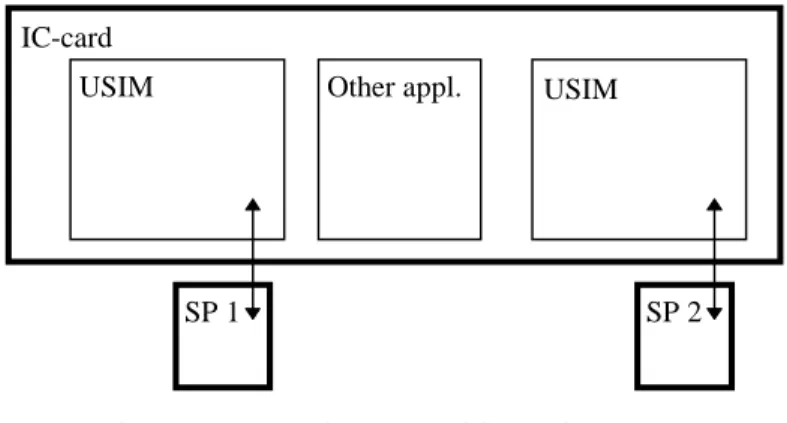
13.1.4 Multiple USIMs per UICC ... 34
13.1.5 The ISIM ... 34
13.2 The UICC ... 34
13.2.1 The UICC and Applications other than the USIM or ISIM ... 34
13.2.1a UICC applications and IMS ... 35
13.2.2 Fast Access and Retrieval of Data from UICC ... 35
13.3 Terminals and Multiple UICCs ... 35
14
Types of features of UEs ... 35
15 Relationship
between
subscription and service delivery ... 37
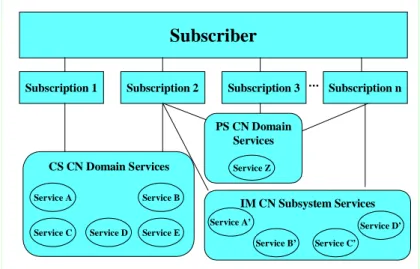
15.1 Subscription ... 37
15.3 Requirements concerning service delivery ... 38
15.3.1 Mobile Originated Voice calls ... 39
15.3.2 Mobile Terminated Voice calls ... 39
16 Charging
principles ... 39
17 Roaming
... 40
17.1 Assumptions ... 40 17.2 Principle ... 40 17.3 Requirements ... 4018 Handover
Requirements ... 41
19 Network
Selection
... 41
20 Security... 41
21
Voice Call Continuity ... 41
21.1 General ... 41
21.2 Support of Supplementary Services ... 41
21.2.1 Line Identification Services ... 42
21.2.2 All Call Forwardings ... 42
21.2.3 Call Waiting ... 42
21.2.4 Call Hold ... 42
21.2.5 Multiparty ... 42
21.2.6 All Call Barrings ... 42
21.2.7 Void ... 43
21.2.8 Void ... 43
21.2.9 All other Supplementary Services ... 43
21.3 Quality of Service ... 43
21.4 Security ... 43
21.5 Emergency calls ... 43
21.6 Charging ... 43
21.7 VCC Activation ... 43
22
IMS Centralized Services ... 44
22.1 General ... 44 22.2 Service Consistency ... 44 22.3 Service Continuity ... 44 22.4 IMS Services ... 44 22.5 Roaming Support ... 44
23 CS
IP
interconnection requirements ... 45
23.1 Introduction ... 45 23.2 IP interconnect ... 45 23.3 MSC server interconnect ... 4524 Service
Alignment & Migration ... 45
24.1 Introduction ... 45
24.2 Alignment of supplementary services settings ... 46
25
System optimisation for communication with specific characteristics ... 47
25.1 Void ... 47
25.2 Numbering Resource Efficiency ... 47
25.3 Network provided destination for uplink data ... 47
25.4 PS only subscriptions ... 47
26
Single Sign-On (SSO) Service ... 47
26.1 Requirements ... 47
26.1.1 Requirements for the UE ... 47
26.1.2 Requirements for a 3GPP SSO Service ... 48
27 Void
... 48
Annex A (normative):
Description of optional user equipment features ... 49
A.2 Indication of call progress signals ... 49
A.3 Country/PLMN indication ... 49
A.4 Service Provider Name indication ... 49
A.4a Core Network Operator Name indication ... 50
A.5 Keypad ... 50
A.6 Short message indication and acknowledgement ... 50
A.7 Short message overflow indication ... 50
A.8 International access function ... 50
A.9 Service Indicator (SI) ... 51
A.10 Dual Tone Multi Frequency (DTMF) ... 51
A.11 On/Off switch ... 51
A.12 Sub-Address ... 51
A.13 Short Message Service Cell Broadcast ... 51
A.14 Short Message Service Cell Broadcast DRX... 51
A.15 Support of the extended Short message cell broadcast channel ... 51
A.16 Network Identity and Timezone ... 52
A.17 Network's indication of alerting in the UE ... 52
A.18 Network initiated Mobile Originated (MO) connection ... 53
A.19 Abbreviated dialling ... 53
A.20 Barring of Dialled Numbers ... 54
A.21 DTMF control digits separator ... 55
A.22 Selection of directory number in messages ... 55
A.23 Last Numbers Dialled (LND) ... 55
A.24 Service Dialling Numbers ... 55
A.25 Fixed number dialling ... 55
A.26 Message Waiting Indication ... 56
A.27 Requirements for the transfer of eCall Minimum Set of Data (MSD) ... 56
A.28 Requirements for "In Case of Emergency" (ICE) information ... 57
Annex B (informative):
Additional number use case ... 60
Annex C (informative):
Change history ... 61
Foreword
This Technical Specification has been produced by the 3GPP.
The contents of the present document are subject to continuing work within the TSG and may change following formal TSG approval. Should the TSG modify the contents of the present document, it will be re-released by the TSG with an identifying change of release date and an increase in version number as follows:
Version x.y.z where:
x the first digit:
1 presented to TSG for information; 2 presented to TSG for approval;
3 or greater indicates TSG approved document under change control.
y the second digit is incremented for all changes of substance, i.e. technical enhancements, corrections, updates, etc.
1 Scope
This Technical Specification (TS) describes the Service Principles for PLMNs specified by 3GPP. Principles and requirements for interworking with WLAN are covered in TS22.234 [35].
3GPP specifications provide integrated personal communications services. The system will support different
applications ranging from narrow-band to wide-band communications capability with integrated personal and terminal mobility to meet the user and service requirements of the 21st century.
3GPP specifications allow the realisation of a new generation of mobile communications technology for a world in which personal communications services should allow person-to-person calling, independent of location, the terminal used, the means of transmission (wired or wireless) and the choice of technology. Personal communication services should be based on a combination of fixed and wireless/mobile services to form a seamless end-to-end service for the user.
3GPP specifications should be in compliance with the following objectives:
a) to provide a single integrated system in which the user can access services in an easy to use and uniform way in all environments;
b) to allow differentiation between service offerings of various serving networks and home environments; c) to provide a wide range of telecommunications services including those provided by fixed networks and
requiring user bit rates of up to 100 Mbits/s as well as services special to mobile communications. These services should be supported in residential, public and office environments and in areas of diverse population densities. These services are provided with a quality comparable with that provided by fixed networks such as ISDN and fixed broadband Internet access;
d) to provide services via hand held, portable, vehicular mounted, movable and fixed terminals (including those which normally operate connected to fixed networks), in all environments (in different service environments - residential, private domestic and different radio environments) provided that the terminal has the necessary capabilities;
e) to provide support of roaming users by enabling users to access services provided by their home environment in the same way even when roaming.
f) to provide audio, data, video and particularly multimedia services; g) to provide for the flexible introduction of telecommunication services;
h) to provide within the residential environment the capability to enable a pedestrian user to access all services normally provided by fixed networks;
i) to provide within the office environment the capability to enable a pedestrian user to access all services normally provided by PBXs and LANs;
j) to provide a substitute for fixed networks in areas of diverse population densities, under conditions approved by the appropriate national or regional regulatory authority.
k) to provide support for interfaces which allow the use of terminals normally connected to fixed networks.
2 References
The following documents contain provisions which, through reference in this text, constitute provisions of the present document.
• References are either specific (identified by date of publication, edition number, version number, etc.) or non-specific.
• For a non-specific reference, the latest version applies. In the case of a reference to a 3GPP document (including a GSM document), a non-specific reference implicitly refers to the latest version of that document in the same Release as the present document.
2.1 Normative
references
[1] 3GPP TS 22.105 "Services and Service Capabilities" [2] Void
[3] 3GPP TS 22.038: "SIM application toolkit, stage 1"
[4] 3GPP TS 22.001: " Principles of Circuit telecommunication services supported by a Public Land Mobile Network (PLMN)".
[5] 3GPP TS 22.004: General on supplementary services"
[6] 3GPP TS 22.030: "Man-Machine Interface (MMI) of the User Equipment (UE)"
[7] 3GPP TS 22.066: "Support of Mobile Number Portability (MNP); Service description; Stage 1" [8] 3GPP TS 22.079: " Support of Optimal Routing; Stage 1"
[9] 3GPP TS 22.129: "Handover Requirements between UTRAN and GERAN or other Radio Systems"
[10] 3GPP TS 33.102: "Security Architecture" [11] 3GPP TS 22.011: "Service Accessibility"
[12] 3GPP TS 22.016: "International mobile Station Equipment Identities (IMEI)" [13] 3GPP TS 24.008: " Mobile Radio Interface Layer 3 Specification"
[14] 3GPP TS 22.003: "Circuit Teleservices supported by a Public Land Mobile Network (PLMN)" [15] 3GPP TS 21.133: "Security Threats and Requirements"
[16] 3GPP TS 33.120: "Security Principles"
[17] 3GPP TS 22.042: "Network Identity and Time Zone, Service Description, Stage 1" [18] 3GPP TS 42.009: "Security Aspects"
[19] 3GPP TS 31.102: "USIM Application Characteristics" [20] 3GPP TS 23.221 "Architectural Requirements"
[21] 3GPP TS 22.002: "Circuit Bearer Services (BS) supported by a Public Land Mobile Network (PLMN)"
[22] 3GPP TS 22.060: "General Packet Radio Service (GPRS)" [23] 3GPP TS 29.002: "Mobile Application Part (MAP) specification " [24] 3GPP TR 23.972: "Circuit Switched Multimedia Telephony". [25] 3GPP TS 22.140: "Multimedia messaging service; Stage 1". [26] 3GPP TS 22.226: "Global Text Telephony, Stage 1."
[27] 3GPP TS 22.228: "IP multimedia (IM) CN subsystem, stage 1" [28] RFC 3261: "SIP: Session Initiation Protocol"
[30] 3GPP TS 26.233: "Packet Switched Streaming Service (PSS) ; General Description" [31] 3GPP TS 26.234: "Packet Switched Streaming Service (PSS) ; Protocols and Codecs" [32] 3GPP TR 22.934: "Feasibility study on 3GPP system to Wireless LAN interworking" [33] RFC 2486: "The Network Access Identifier"
[34] TS 51.011: "Specification of the Subscriber Identity Module - Mobile Equipment (SIM-ME) interface", Release 4
[35] TS22.234: "Requirements on 3GPP system to wireless local area network (WLAN) interworking" [36] 3GPP TS 31.101: "UICC-terminal interface; Physical and logical characteristics"
[37] OMA Device Management V1.2 specifications [38] OMA Client Provisioning V1.1 specifications [39] void
[40] 3GPP TS 22.173: " IMS Multimedia Telephony Service and supplementary services - Stage 1" [41] 3GPP TS 22.082: " Call Forwarding (CF) supplementary services - Stage 1"
[42] 3GPP TS 22.278: "Service Requirements for the Evolved Packet System (EPS)" [44] 3GPP TS 22.071: "Location Services (LCS); Service description; Stage 1"
[45] 3GPP TR 22.985: "Service requirement for the 3GPP User Data Convergence (Release 9)" [46] DD CEN/TS 15722:2009 'Road Transport and Traffic Telematics, eSafety, eCall Minimum Set of
Data (MSD)'
[47] 3GPP TS 23.226: "Global text telephony (GTT); Stage 2"
[48] 3GPP TS 22.220: " Service requirements for Home NodeBs and Home eNodeBs"
[49] ETSI TS 181 019 V2.0.0 (2007-11): "Telecommunications and Internet converged Services and Protocols for Advanced Networking (TISPAN); Business Communication Requirements" [50] 3GPP TS 23.335: "User Data Convergence (UDC); Technical realization and information flows";
stage 2.
[51] OpenID Foundation: "OpenID Authentication 2.0", http://openid.net/specs/openid-authentication-2_0.html.
2.2 Informative
references
[43] GSMA PRD IR.34: "Inter-Service Provider IP Backbone Guidelines"
3
Definitions, symbols and abbreviations
3.1 Definitions
3GPP SSO Authentication: Authentication performed between an SSO-capable UE and 3GPP SSO Identity Provider
using Operator-controlled credentials and without requiring user involvement.
3GPP SSO Identity Provider: An entity that maintains Operator-controlled identity and credential information for a
3rd Party SSO Identity Provider: An entity that maintains identity and credential information (that is not
Operator-controlled) for a user, performs authentication, and asserts the user"s identity to a Data Application Provider.
Attended Data Traffic: Data traffic of which the user is aware he/she initiated, e.g. based on the screen/keypad lock
being deactivated, length of time since the UE last received any input from the user, known type of application (e.g. an application monitoring a user's health – "mHealth" – which may need its data always treated as Attended Data Traffic.)
eCall: A manually or automatically initiated emergency call,(TS12) from a vehicle, supplemented with a minimum set
of emergency related data (MSD), as defined under the EU Commission"s eSafety initiative.
Data Application Provider: An entity that offers data application services to users (e.g., over the public Internet). The
data applications can be browser or non-browser based services.
IMS Centralized Services: The provision of communication services wherein services and service control are based on
IMS mechanisms and enablers, and support is provided for a diversity of access networks (including CS domain and IP based, wireless and wireline), and for service continuity between access networks.
MSD: The Minimum Set of Data [46] forming the data component of an eCall sent from a vehicle to a Public Safety
Answering Point or other designated emergency call centre. The MSD has a maximum size of 140 bytes and includes, for example, vehicle identity, location information and time-stamp.
RAN user plane congestion: The situation where the demand for RAN resources to transfer user data exceeds the
available RAN capacity to deliver the user data for a significant period of time in the order of few seconds or longer.
SSO Provider: An entity that provides SSO Service. The SSO Provider enables a user to authenticate to an IdP and
thereby to have their identity asserted to a DAP. Each data application, whether provided by different DAPs or the same DAP, may have its own policy regarding authentication. In the 3GPP SSO Service, the SSO Provider is the 3GPP Operator.
SSO Service: A service in which the user of a data application is authenticated once, and as a result of that
authentication is provided with seamless and transparent access to multiple data applications offered by one or more Data Application Providers.
SSO Local User Authentication: Authentication performed by the UE that establishes the presence of the registered
user of the data application by requiring input which only the registered user would be able to provide.
Unattended Data Traffic: Data traffic of which the user is unaware he/she initiated, e.g. based on the screen/keypad
lock being activated, length of time since the UE last received any input from the user, known type of app (e.g. an application monitoring a user's health – "mHealth" – may need its data never treated as Unattended Data Traffic.) Further definitions are given in 3GPP TR 21.905 [29].
3.2 Abbreviations
For the purposes of this TS, the following abbreviations apply: DAP Data Application Provider
IdP Identity Provider
IVS In Vehicle System (eCall terminal and associated sub-systems in vehicle)
ME Mobile Equipment
OTT Over The Top
PC Personal Computer
SSO Single Sign-On
4 General
4.1
Aims of 3GPP specifications
It shall be capable of delivering audio, text, video and graphics direct to people and provide them with access to the next generation of information based services. It moves mobile and personal communications forward from existing systems, delivering mass market low-cost digital telecommunication and IP-based multimedia services.
The aims are:
- to enable users to access a wide range of telecommunications services, including many that are today undefined as well as multi-media and high data rates.
- to facilitate the provision of a high quality of service (particularly speech quality) similar to that provided by fixed networks;
- to facilitate the provision of small, easy to use, low cost terminals with long talk time and long standby operation;
- to provide an efficient means of using network resources (particularly radio spectrum).
4.2
Standardisation of Service Capabilities
Existing systems have traditionally standardised the complete sets of teleservices, applications and supplementary services which they provide. As a consequence, substantial efforts are often required to introduce new services or simply to modify the existing one (customisation). This makes it more difficult for operators to differentiate their services. At the same time however, this may reduce the complexity of providing a service across different operators" networks.
3GPP shall therefore preferentially standardise service capabilities. In circumstances where the service is meant to be used across different operators" networks, hence a common specification set is of paramount importance, the service should be standardised to a level of detail sufficient to ensure interoperability and interworking across different operators" networks. Service capabilities consist of bearers defined by QoS parameters and the mechanisms needed to realise services. These mechanisms include the functionality provided by various network elements, the communication between them and the storage of associated data. This TS provides a conceptual description of a service architecture and architecture requirements which aim to provide service capabilities. It is intended that these standardised capabilities should provide a defined platform which will enable the support of speech, video, multi-media, messaging, data, teleservices, user applications and supplementary services and enable the market for services to be determined by users and home environments.
4.2.1
Provision of service capabilities in shared networks
The provision of services and service capabilities that is possible to offer in a network shall not be restricted by the existence of the network sharing It shall be possible for a core network operator to differentiate its service offering from other core network operators within the shared network.
It shall be possible to control the access to service capabilities offered by a shared network according to the core network operator the user is subscribed to.
4.3
Efficient Use of Network Resources
4.3.1
Network Traffic Patterns
Service capabilities shall take account of the discontinuous and asymmetric nature of most teleservices, multimedia services and user applications and consider the overheads and signalling surge caused by frequent transmissions of small amount of data by mobile data application, in order to make efficient use of network resources (particularly radio resources).
4.3.2
Mass Simultaneous Registration
When a large number of subscribers enter in a registration area in which they have not registered, the core and radio access network shall be able to provide a capability to optimize the mass simultaneous registration traffic at a given instance of time. The core and radio access network shall be able to keep providing the service (e.g. mobile originated and mobile terminated services) without interruption for those subscribers who are originally in the cell which receive the mass simultaneous registration traffic.
4.3.3 Radio
Interface
Service capabilities shall be provided in a wide range of radio operating environments (where a radio environment is characterised in terms of propagation environment, mobile equipment relative speeds and traffic characteristics). Although 3GPP aims to minimise the number of radio interfaces and to maximise commonality between them, it may utilise several radio interfaces, each optimised for different environments. Each radio interface may provide differing service capabilities. 3GPP specifications include UTRA(N) radio interface supporting two modes (TDD and FDD), an Evolved UTRA(N) radio interface and GERAN radio interface. Additionally, it may be possible to connect to the 3GPP system using radio interfaces and fixed access technologies specified outside of 3GPP.
3GPP specifications shall provide a mechanism which will enable a piece of user equipment (UE) to adapt to different radio interfaces as necessary and to determine the service capabilities available. The specifications shall also provide a mechanism which will enable a UE to select radio interfaces capable of providing appropriate service capabilities and support mobility between multiple radio interfaces.
4.3.4 Real-time
Resource Usage
To enable network operators to render services efficiently, dimension their networks and set tariffs that more accurately reflect radio resource usage, real time information on resource usage is needed. When requested, it shall be possible for the serving cell type (e.g. RAT), cell ID / UTRAN Service Area Identity and cell / Service Area capability usage (e.g. HSDPA, E-DCH) information to be made available to the core network. Cell / Service Area capability usage
information may include, for example, user(s) identity, start and finish time of data transfer, up-link and down-link data rates, volumes of data and other statistical information.
4.3.5
Selected IP Traffic Offload (SIPTO) for PS Domain only
4.3.5.1
Common Requirements for SIPTO in the Mobile Operator Network and
SIPTO at the Local Network
It shall be possible to offload selected traffic (e.g. internet) towards a defined IP network close to the UE's point of attachment to the access network.
The following requirements apply to Selected IP Traffic Offload:
- The mobile operator may enable/disable Selected IP Traffic Offload on a per UE per defined IP network basis (e.g. based on tariff, subscription type etc.).
- It shall be possible for IP traffic of a UE associated with a particular defined IP network to be offloaded while IP traffic of that same UE associated with other defined IP network(s) is not offloaded.
- It shall be possible to perform Selected IP Traffic Offload for pre-Release 10 UEs.
- Offloading selected IP traffic for a UE shall not affect services running in parallel for the same UE. - The mobile operator shall be able to collect signalling performance measurements (e.g. session
connection/disconnection, etc) related to Selected IP Traffic Offload for each user.
- Selected IP Traffic Offload shall not compromise the security of the mobile operator's network.
- Service Continuity of IP data session(s) for Selected IP Traffic Offload may be supported during the following mobility events:
- mobility between H(e)NBs.
During both these mobility events, based on home mobile operator policies, the impact of mobility events as perceived by the user shall be reduced by minimising any interruption to the data flow.
- It shall be possible for the HPLMN to provide the VPLMN with the following information for a particular user: - An indication of whether the user"s IP traffic is permitted to be subjected to Selected IP Traffic Offload in
the visited network;
- The defined IP network(s) for which Selected IP Traffic Offload is permitted.
Requirements specific to SIPTO at the local residential/enterprise IP network can be found in section 5.9 in [48].
4.3.5.2
Requirements for SIPTO in the Mobile Operator Network
The following requirements apply to Selected IP Traffic Offload in the mobile operator network:
- The mobile operator shall be able to enable/disable Selected IP Traffic Offload for certain parts of the network. - Selected IP Traffic Offload shall not compromise integrity and confidentiality of offloaded traffic.
- The mobile operator shall be able to collect statistics for the offloaded traffic for each user.
- The network shall be able to perform Selected IP Traffic Offload without any user interaction based on mobile operator policies.
- Service Continuity of IP data session(s) within the mobile operator network shall be supported for Selected IP Traffic Offload. Based on home mobile operator policies, the impact of mobility events within the macro network as perceived by the user shall be reduced by either:
- minimising any interruption to the data flow; or
- preventing interruption to the data flow e.g. for voice services.
- Service Continuity of IP data session(s) for Selected IP Traffic Offload may be supported during the following mobility events:
- mobility between the macro network and H(e)NBs; and - mobility between H(e)NBs.
During both these mobility events, based on home mobile operator policies, the impact of mobility events as perceived by the user shall be reduced by preventing interruption to the data flow e.g. for voice services.
4.4
Compatibility with Global Standards
3GPP specifications aim to be compatible with IMT-2000 and to provide global terminal mobility (roaming), enabling the user to take his/her terminal to different regions of the world and to be provided with services. It is probable that different regions of the world will adopt different radio interface technologies. IMT-2000, as a global standard, should therefore enable a IMT-2000 terminal to determine the radio interface technology and the radio interface standard used in a region. Global terminal roaming also requires the global standardisation of service capabilities. As far as possible the method of indication of the radio interface standard and available service capabilities shall be aligned with IMT-2000.
3GPP specifications shall enable users to access the services provided by their home environment in the same way via any serving network provided the necessary service capabilities are available in the serving network.
The 3GPP specifications will be available for the partner organisations to adopt as their regional standards. For example in Europe, ETSI may adopt them as standards for both GSM and UMTS.
4.5 Void
4.6
Functionality of Serving Network and Home Environment
The following functionality shall be the responsibility of the home environment: - User Authentication.
- SIM/USIM Issue. - Billing.
- User Profile/VHE Management.
The following functionality shall be the responsibility of the serving network: - Radio or other means of access.
- Transport and signalling.
The following functionality may be the responsibility of either the serving network, the home environment or an appropriate combination of both
- Service Control. - QoS negotiation.
- Mobility management, including roaming. - Automatic establishment of roaming agreements.
4.7 PLMN
Architecture
The network is logically divided into a radio access network and a core network, connected via an open interface. From a functional point of view the core network is divided into a Packet Switched CN Domain, IP Multimedia (IM) CN subsystem [27] and a Circuit Switched CN Domain. IM CN subsystem utilises PS CN domain bearer services.
CS CN domain supports bearer independent transport. There is no difference in service offering or UE functionality due to different transport.
A PS only 3GPP core network is possible as defined within the specification for the Evolved Packet System (EPS) [42]. For further information see 3GPP TS 23.221 [20].
4.8
Interworking Between PLMN and Wireless LANs
Aspects related to interworking between PLMN and WLAN are captured in TS 22.234 [35].
4.9 Network
Sharing
Network sharing shall be transparent to the user. The specifications shall support both the sharing of:
(i) radio access network only;
(ii) radio access network and core network entities connected to radio access network
Note: In a normal deployment scenario only one or the other option will be implemented.
It shall be possible to support different mobility management rules, service capabilities and access rights as a function of the home PLMN of the subscribers.
4.10
The Evolved Packet System
Evolved Packet System is an evolution of the 3G UMTS characterized by higher-data-rate, lower-latency, packet-optimized system that supports multiple RATs. The Evolved Packet System comprises the Evolved Packet Core together with the evolved radio access network (E-UTRA and E-UTRAN).The service requirements for the Evolved Packet System are specified in TS22.278 [42].
4.11 User
Data
Convergence
4.11.1 Introduction
The UDC concept [45] supports a layered architecture, separating the data from the application logic in the 3GPP system, so that user data is stored in a logically unique repository allowing access from core and service layer entities, named application front-ends. And such unique repository shall be possible to be shared among different PLMNs that have trusted relationships.
Network elements and functionalities should be designed to access profile data remotely and without storing them permanently locally, i.e. the front-ends shall work in a subscriber dataless configuration.
In some cases, services may depend on user data scattered over UDC and other network elements. UDC may support the ability to access necessary network elements to fetch user data on behalf of these services, while minimizing impacts on existing Network Elements in which the data is located.
Applications can subscribe to specific events which will likely occur on specific user data, and those should be notified when those events do appear. The events can be changes on existing user data, addition of user data, and so on. Third party applications and non trusted network elements should only be able to access the user data after proper authentication and authorization taking into account security and privacy requirements, i.e. it should be possible to present different views on the data to the parties which require access, dependent on the authorization.UDC concept is backwards compatible with 3GPP systems, i.e. it does not have an impact on traffic mechanisms, reference points and protocols of existing network elements.
The UDC concept preserves user authentication and authorization of services across domains, ensuring secured users" access to network.
4.11.2 Management
of user data
Due to the logical centralization of user data, it is necessary for UDC to support the provisioning of the user data, that is, user data manipulation like creation, deletion, reading, modification and other operations. Provisioning shall be possible via an external system, self care or dynamically via applications offering e.g. user service configuration facilities.
Operations carried out in the framework of UDC shall support the ACID (Atomicity, Consistency, Isolation, and Durability) characteristics.
4.11.3
User Data Modelling
User Data Modelling refers to the different models that apply to user data convergence: Information Models and Data Models.
An Information Model denotes an abstract, formal representation of entity types, including their properties and
relationships, the operations (e.g. read, write…) that can be performed on them, and related rules and constraints. In the information model, entities might have network topology relationship with each other.
In order to accommodate multiple applications and services, existing and new ones, a common baseline information model shall be developed and shall, at minimum, clearly distinguish a number of concepts as entity types:
- Subscriber with relation to several users (e.g. a company and its employees),
- A user attached to different subscriptions (e.g. for a private and a professional service usage) - A user using multiple devices (e.g. mobiles or fixed)
- Grouping of users to certain categories - A particular user as member of a certain group
- Service providers" services provided by network operators - Enterprise services provided by network operators
The baseline information model shall be future proof. It shall not be tied to any specific implementation of the data base or its interfaces. It shall provide flexibility (in its data structure and content), extensibility and multi-application
approach.
By extensible, it shall be understood that new applications and/or new service profiles can be added by the operator, if necessary. The flexibility shall permit new data for existing applications to be introduced, or modified.
Data Models are practical implementations of the information model, e.g. Tree-like modelling. The common information model shall allow deriving one or more data models. A reference data model shall be standardized for the message exchange over Ud interface [50], in order to enable multivendor interoperability.
Each application shall only interface the UDC for the data it is dealing with, and not be impacted by other data that UDC stores for other applications. It corresponds to the concept of a data view specific to a given application.
An application can allow access by other applications to data for which it is responsible. This can be done under certain constraint customized by operators.
Access to the UDC data shall be independent of the structure of the data models, i.e. the changes in the data models shall not affect the interface.
5 Evolution
5.1
Support of 2G services
The 3GPP specifications shall be capable of supporting existing 2G services in a manner which is transparent to the users of these services.
5.2
Provision and evolution of services
Since a phased approach has been adopted, the same general service principles shall apply to each phase. Support of services from an end user perspective is understood to be an important driver for established mobile users to stay with their existing operator while taking the new services into use. It is therefore important to enable operators to offer continued support of legacy services in future releases. Previous release services shall as a principle also be supported in the following releases.
Networks shall be capable of providing a specified core set of capabilities.
The core set of capabilities should permit home environment to offer a range of distinctive services including those which cannot be implemented on systems based on previous release specifications.
It shall be possible for the home environment to develop services with full roaming capability.
The radio interface should not unnecessarily restrict the development of new services (within physical limitations). The standard shall provide a mechanism which allows a terminal to be easily upgraded so that it can access new services which are within the physical limitations of the terminal.
6
Classification of services
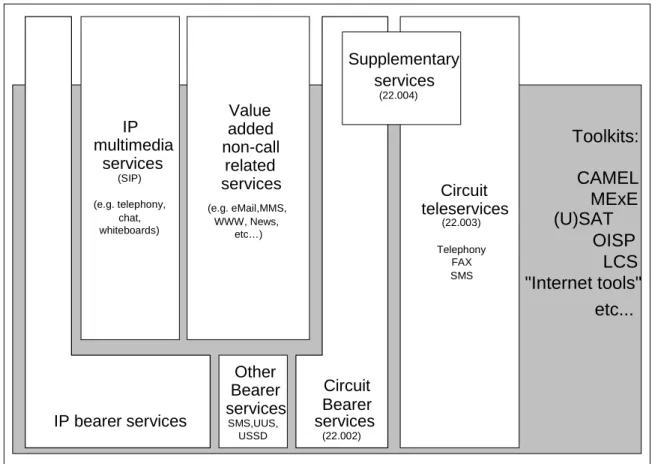
In the CS CN domain, the basic services are divided into circuit teleservices (3GPP TS 22.003 [14]) and bearer services (3GPP TS 22.002 [21]) and they can utilise standardised supplementary services (3GPP TS 22.004 [5]).
The PS CN Domain provides IP bearer services. SMS, USSD and UUS can also be considered as bearer services for some applications.
IP multimedia services are the IP based session related services, including voice communications. IP multimedia sessions use IP bearer services provided by the PS CN Domain.
Value added non-call related services include a large variety of different operator specific services/applications. They are usually not specified by 3GPP. The services can be based on fully proprietary protocols or standardised protocols outside 3GPP.
In order to create or modify the above services (both call and non-call related services) operators may utilise toolkits standardised by 3GPP (such as CAMEL or LCS) or external solutions (e.g. Internet mechanisms). Pre-paid is an example of an application created with toolkits that may apply to all of the above services categories.
Toolkits:
CAMEL
MExE
(U)SAT
OISP
LCS
"Internet tools"
etc...
Circuit
teleservices
(22.003) Telephony FAX SMSValue
added
non-call
related
services
(e.g. eMail,MMS, WWW, News, etc…)IP
multimedia
services
(SIP) (e.g. telephony, chat, whiteboards)Other
Bearer
services
SMS,UUS, USSDIP bearer services
Circuit
Bearer
services
(22.002)Supplementary
services
(22.004)Figure 1: Service classification
7
Principles for new service capabilities
7.1 General
3GPP specifications shall enable the user of a single terminal to establish and maintain several connections simultaneously. It shall efficiently cater for applications which have variable requirements relating to specific QoS parameters (e.g. throughput) whilst meeting other QoS targets. It shall also cater for applications which are able to take adapt to a range of variations in QoS.
7.2 Multimedia
3GPP specifications shall support development of multimedia services and provide the necessary capabilities. Multimedia services combine two or more media components (e.g. voice, audio, data, video, pictures) within one call. A multimedia service may involve several parties and connections (different parties may provide different media components) and therefore flexibility is required in order to add and delete both resources and parties.
Multimedia services are typically classified as interactive or distribution services.
Interactive services are typically subdivided into conversational, messaging and retrieval services:
Conversational services are real time (no store and forward), usually bi-directional where low end to end delays (< 100 ms) and a high degree of synchronisation between media components (implying low delay variation) are required. Video telephony and video conferencing are typical conversational services."
Messaging services offer user to user communication via store and forward units (mailbox or message handling devices). Messaging services might typically provide combined voice and text, audio and high-resolution images. Retrieval services enable a user to retrieve information stored in one or many information centres. The start at which an information sequence is sent by an information centre to the user is under control of the user. Each information centre accessed may provide a different media component, e.g. high resolution images, audio and general archival information. Distribution services are typically subdivided into those providing user presentation control and those without user presentation control.
Distribution services without user control are broadcast services where information is supplied by a central source and where the user can access the flow of information without any ability to control the start or order of presentation e.g. television or audio broadcast services.
Distribution services with user control are broadcast services where information is broadcast as a repetitive sequence and the ability to access sequence numbering allocated to frames of information enables the user (or the user"s terminal) to control the start and order of presentation of information.
7.2.1
Circuit Switched (CS) multimedia calls
CS multimedia call is a Bearer Service which utilises Synchronous Transparent Data service. The following basic requirements shall be supported for CS multimedia calls [24]:
- CS multimedia call shall be based on a 3GPP specific subset of H.324M.
- All call scenarios shall be supported, i.e. Mobile Originating and Mobile Terminating call against Mobile, ISDN and PSTN call party.
- Single and multiple numbering schemes shall be supported.
- Fallback to speech (TS 11 [14]) shall be supported from 3.1kHz Ext. PLMN multimedia bearer, i.e. if setup of the multimedia call fails the call will be set up as a speech call.
- Service change and fallback shall be supported for UDI/RDI multimedia bearer and speech, to allow fallback to a less preferred service if the preferred service is unsupported, and to change the service between speech and multimedia during the call.
- In the case where a CS multimedia call includes speech (e.g. video call) then the following requirements apply: - A user shall be able to change between a speech and CS multimedia call, when desired.
- When the CS multimedia call is no longer supported, for example due to degraded coverage conditions (including UTRAN to GERAN only transitions), service change shall occur automatically from a CS multimedia call to speech.
- When a CS multimedia call can be supported, for example due to improved coverage conditions (including GERAN only to UTRAN or UTRAN/GERAN transitions), service change back to the CS multimedia call may be initiated by the network.
- Other services than CS multimedia call may exist which utilise the Synchronous Transparent Data service. Service transition to/from speech described for CS multimedia call in this clause shall only apply to CS multimedia call and not Synchronous Transparent Data services in general.
- Different bitrates as specified at 3GPP TS 22.002 [21] shall be supported.
- Supplementary services apply to multimedia calls as for Synchronous Transparent Data service according to 3GPP TS 22.004[5].
- When accepting a multimedia call, the user shall be able to request a service change to speech before the call is answered, such that the multimedia path is never actually connected through to the user"s phone.
- The user shall be able to deny a service change to multimedia during the call.
7.2.2
IP multimedia (IM) sessions
IP multimedia services are not the evolution of the circuit switched services but represent a new category of services, mobile terminals, services capabilities, and user expectations. Any new multimedia service, which may have a similar name or functionality to a comparable standardised service, does not necessarily have to have the same look and feel from the user's perspective of the standardised service. Voice communications (IP telephony) is one example of real-time service that would be provided as an IP mulreal-timedia application.
The following basic requirements are be supported for IP multimedia [27]: - IP multimedia session control shall be based on SIP [28].
- All session scenarios shall be supported; i.e. Mobile Originating and Mobile Terminating sessions against Internet/Intranet, CS or IM Mobile, ISDN, PSTN call party.
- MSISDN and SIP URL numbering and addressing schemes shall be supported.
- IP multimedia applications shall as a principle, not be standardised, allowing service provider specific variations.
7.2.3
Multimedia Messaging Service (MMS)
The following basic requirements are be supported for MMS:
- Store-and-forward multimedia messaging service with mobile and non-mobile users [25].
- MMS shall be capable of supporting integration of different types of messaging (e.g. fax, SMS, Multimedia, voicemail, e-mail etc.) in a consistent manner.
- Streamed and batch delivery for both message download from the network to the terminal, and messages upload from the terminal to the network.
7.2.4 Text
Conversation
Global Text Telephony ( GTT ) is a feature that enables real-time text conversation [26].
- GTT enables real time, character by character, text conversation to be included in any conversational service, Circuit Switched as well as IP based.
- It is possible to use the text component in a session together with other media components, especially video and voice.
- Interworking with existing text telephony in PSTN as well as emerging forms of standardised text conversation in all networks is within the scope of this feature.
- The text media component can be included initially in the session, or added at any stage during the session. - The text component is intended for human input and reading, and therefore supports human capabilities in text
- GTT specifies limited interoperation with Multimedia Messaging Services including a possibility to divert to messaging in case of call failure and sharing user interface equipment and external UE interfaces.
7.2.5 Packet
Switched Streaming Service
The following basic requirements are to be supported for streaming :
- The streaming service uses a client / server model which is transparent to the PLMN. The client controls the initiation and execution of the service.
- The streaming service [30] shall use existing standards (codecs and protocols [31]) where these are available. - The streaming service utilises the PS Domain with the QoS requirements as specified in 3GPP TS 22.105 [1].
7.3
Service Management Requirements
3GPP specifications shall include standardised protocols enabling service management. It shall enable control, creation and subscription of service capabilities and services, and the management of user profiles.
7.4
Automatic Device Detection
The home environment should be automatically notified when a user, identified by a SIM/USIM, has changed ME and should be informed of the identity of the new ME. This should be applicable to any ME. It should also be possible to achieve Automatic Device Detection for users using any SIM/USIM.
Note: The purpose of this is to enable an automatic configuration of terminals by the operator for specific applications/services if so needed. The procedure for such an automatic configuration need not to be standardized by 3GPP.
The notification that a user has changed ME shall be given as early as possible.
8 Service
architecture
M obility M an. Call Control Bearer Control Service Platform W ired Subnetwork W ireless Subnetwork UIM Teleservice/ Application M M I Suppl. Service
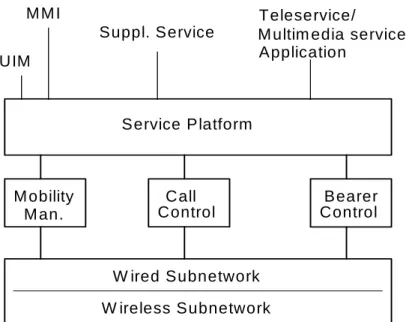
Figure 2: Service Architecture
M ultim edia service/
Figure 2: Service Architecture
A number of bearers shall be provided that can differ in flexibility and offer different capabilities. Bearers may be characterised by parameters such as "throughput", "delay tolerance", "maximum bit error rate", "symmetry" etc. These bearers enable information to be transferred appropriate to the provision of teleservices, multimedia services and end user applications generally, via subnetworks which typically provide different specified qualities of service.
The assignment and release of bearers is provided by the bearer control function. Provision should be made for several bearers to be associated with a call and for bearers to be added to a call and/or to be released from a call following call establishment. The bearers should be independent of radio environments, radio interface technology and fixed wire transmission systems.
Adaptation/Interworking functions are required in order to take account of the differences between the bearers used for the provision of a teleservice/multimedia service/application in the fixed network and the bearers.
Adaptation/Interworking functions are required which take account of the discontinuous and/or asymmetrical nature of most teleservices/multimedia services/applications.
The service platform shall provide interfaces (to serving networks and home environments) appropriate to the support, creation and control of supplementary services, teleservices, multimedia services and user applications. The service platform will also provide interfaces enabling subscribers to control supplementary services, teleservices, multimedia services and user applications.
Supplementary service provision and control will be independent of radio operating environment, radio interface technology and fixed wire transmission systems.
As far as possible, the service platform is required to enable new supplementary services, teleservices, multimedia services and/or end user applications to be supported at minimum cost, with minimum disruption of service and within the shortest possible time.
9
Quality of Service (QoS)
The Quality of Service (QoS) parameters should be identified together with appropriate parameter values which set targets to be reached when designing 3GPP specifications, and which also will serve as guidelines for network design and service provision.
The QoS for call set-up time, as an example, can be defined in terms of a mean value and as a percentage of cases which should not exceed a certain time limit. Further information can be found in 3GPP TS 22.105[1].
The performance requirements for the All-IP Network can be found in 3GPP TS 22.278[42].
For UE initiated QoS control OMA device management shall be the primary method for provisioning QoS parameters.
10 Emergency
Calls
10.1
General requirements
It shall be possible to establish an emergency speech call or GTT [26] call (subject to national requirements). The term "Emergency call" henceforth refers to speech calls, and GTT Emergency calls if applicable. The term 'other media' henceforth refers to media other than speech and GTT. Support of other media types during an emergency call when the IM CN subsystem is used is referred to as 'IMS Multimedia Emergency Session' (MES) and is specified in subclause 10.4.2. Emergency calls will be routed to the emergency services in accordance with national regulations for where the subscriber is located. This may be based upon one or more default emergency call numbers stored in the ME. It shall be allowed to establish an emergency call without the need to dial a dedicated number to avoid the mis-connection in roaming case, such as menu, by use of a 'red button', or a linkage to a car air bag control. Emergency calls shall be supported by the UE without a SIM/USIM/ISIM being present. No other type than emergency calls shall be accepted without a SIM/USIM/ISIM.
Emergency calls shall be supported by UEs that are subject to service restrictions, e.g. for UEs camping on a cell in a forbidden PLMN or in a forbidden LA (see 3GPP TS 22.011 [11]), or on a CSG cell without the subscriber being a member of that CSG (see 3GPP TS 22.220 [48]). Such emergency calls shall be accepted by the network if required by local regulation.
The Emergency service is required only if the UE supports voice.
Note 1: It will be left to the national authorities to decide whether the network accepts emergency calls without the SIM/USIM/ISIM.
It shall be possible to initiate emergency calls to different emergency call centres, depending on the type of emergency. The following types of emergency calls shall be possible:
- Police - Ambulance - Fire Brigade - Marine Guard - Mountain Rescue
- Manually Initiated eCall (MIeC) - Automatically Initiated eCall (AIeC) - Spare
When a SIM/USIM is present, subscriber specific emergency call set-up MMI shall be provided. The Home
Environment operator shall specify preferred emergency call numbers (e.g. 999 for UK citizens or 110, 118 and 119 for Japanese citizens). These emergency call numbers shall be stored in the SIM/USIM and the ME shall read this and use any entry of these digits to set up an emergency call. It shall be possible to store more than one instance of this field.
Note 2: Release '98 and earlier SIM cards have the capability to store additional emergency call numbers. However in many cases this has not been used.
It shall be possible to tie any emergency call number to any single emergency call type or to any combination of emergency call types. The association between emergency call numbers and emergency call type shall be able to be programmed by the Home Environment operator into the SIM/USIM.
Example:
100 Police and Fire Brigade (Greek cities) 100 Ambulance and Fire Brigade (Belgium) 112 Police and Ambulance (Italy)
112 General emergency call, all categories (Sweden) 115 Fire Brigade (Italy)
144 Ambulance (Austria)
If the UE does not recognise the emergency call numbers but the serving network recognises the dialled number as an emergency call number used in the country, a normal call set up shall take place over the radio interface and after the serving network has recognised the emergency number the call shall be routed as an emergency call.
The user friendly MMI that specifies the type of emergency call directly (e.g. menu) should be supported for use in any (i.e. home or visited) PLMN to avoid the mis-connection in roaming case. This shall be allowed both with and without SIM/USIM being present.
When emergency call establishment is initiated, the emergency call type shall be sent by the UE if it is available. The serving network may download emergency call numbers to the UE in order to ensure that local emergency call numbers are known to the UE. The UE shall regard these emergency numbers as valid in that country only (as identified by the MCC) and shall discard them when a new country is entered.
Note 3: The UE can inform the user if the emergency call type for an emergency number received from the serving network differs from that configured on the USIM/SIM for the same number. How this is implemented is outside the scope of 3GPP and takes into consideration operator policy and regulatory requirements.
If permitted by local regulation, it shall be possible for the user to prevent the sending of his public user identifiers and the location information to the PSAP (i.e. emergency response centre).
Note 4: Operator policies (e.g. requirements for support of emergency communications) may over-ride the user request for suppression.
10.1.1 Identification of emergency numbers
The ME shall identify an emergency number dialled by the end user as a valid emergency number and initiate emergency call establishment if it occurs under one or more of the following conditions. If it occurs outside of the following conditions, the ME should not initiate emergency call establishment but normal call establishment. Emergency number identification takes place before and takes precedence over any other (e.g. supplementary service related) number analysis.
a) 112 and 911 shall always be available. These numbers shall be stored on the ME. b) Any emergency call number stored on a SIM/USIM when the SIM/USIM is present.
c) 000, 08, 110, 999, 118 and 119 when a SIM/USIM is not present. These numbers shall be stored on the ME. d) Additional emergency call numbers that may have been downloaded by the serving network when the SIM/USIM
is present.
10.1.2
Domains priority and selection for UE attempts to emergency call
10.1.2.1
Voice and GTT only
A UE that is connected to a domain in which it is possible for the UE to make non emergency calls using the particular media requested by the user, shall use that domain to attempt an emergency call unless serving network policy (based on regulatory requirements and operator needs) requires the UE, including an unauthenticated UE, to attempt the emergency call on a specific domain first.
If the UE is connected to more than one domain in which it is possible for the UE to make non emergency calls using the particular media requested by the user, the UE shall attempt an emergency call on the same domain it would use to originate a non-emergency call using the same media unless serving network policy (based on regulatory requirements and operator needs) requires the UE, including an unauthenticated UE, to attempt the emergency call on a specific domain first.
In the case where an emergency call attempt by a UE fails, the UE should automatically make a second attempt on the other domain if the UE supports it.
If the user aborts the emergency call setup during the subsequent automatic attempt and immediately tries to set up an emergency call again, then the UE shall immediately attempt in the domain in which the user aborted the emergency call.
10.1.2.2 Other
media
The following applies in addition to 10.1.2.1.
If an emergency call attempt that includes a request for both (i) voice and/or GTT and (ii) other media cannot be supported or fails in all connected access types in the PS CN domain, the UE shall attempt the emergency call in the CS domain if available and shall only include the request for voice and/or GTT.
10.1.3 Call-Back
Requirements
Subject to local/regional regulations the network shall support a call-back from a PSAP.
It shall be possible to supply the user"s Directory Number/MSISDN/SIP URI as the CLI to the PSAP to facilitate call-back. The CLI used on call-back shall allow the PSAP to contact the same terminal that originated the emergency call. If the incoming call can be identified by the core network as a call-back to an emergency call (i.e. coming from a PSAP) then supplementary services at the terminating party shall be handled as described in TS 22.173 [40] for Multimedia Telephony (e.g. Communication Diversion, Communication Hold, Communication Barring).
Note: There is no specific callback requirement for CS supplementary services.
A call-back may be attempted for a period of time defined by local regulations after the emergency call release. In case of a UE in limited service state, call-back is not required.
10.2
Emergency calls in the CS CN Domain
A CS CN Domain shall support the emergency call teleservice as defined in 3GPP TS 22.003 [14] (TS12).
If a UE supports TS11(Telephony)[14], then it shall also support TS12(Emergency Calls)[14]. It shall be possible to set up emergency calls initiated by an emergency call number.
10.3
Emergency Calls in the PS CN Domain
Without the IM CN subsystem, emergency calls are not supported in the PS CN domain.
10.4
Emergency calls in the IM CN subsystem
10.4.1 General
The IM CN subsystem shall support IMS emergency calls. It shall be possible to set up emergency calls initiated by an emergency call number.
If a UE supports IMS Multimedia Telephony service with speech media as specified in TS 22.173 [40] via an access network, then it shall also support IMS emergency calls via that access network.
Subject to the regulatory requirement, the IM CN subsystem shall be able to unambiguously identify each emergency service defined in the national numbering plan for the country in which the UE is located.
In accordance with national regulations for where the subscriber is located, if the UE does not recognise a dialled number as an emergency call number but the IM CN where the subscriber is located does recognise the dialled number as an emergency call number (e.g. a number used in the local emergency numbering plan) then the call shall be routed as an emergency call indicating the type of emergency service to the correct PSAP. Subject to operator setting the call may be prioritized.
Note 1: The above does not preclude the network rejecting the call and requesting the UE to setup a new emergency call to the same emergency service.
Emergency calls may be initiated using a private numbering plan [49].
Note 2: There can be an overlap between the private numbering plan of a hosted enterprise and the public numbering plan, which makes translation of emergency numbers necessary.
Emergency calls may be initiated by a service when requested by the user. Note 3: It is not intended to enable automatic setup of emergency calls.
Note 4: Only speech and GTT-IP [47] media are supported, when required per subclause 10.1, for emergency services towards a CS PSAP.
An emergency call shall take precedence over any other services a UE may be engaged in, if required by local regulation.
Emergency calls from an unauthenticated UE (as far as the IM CN is concerned) shall be supported by the IM CN subsystem, if required by local regulation.
Subject to regulatory requirements, when UEs must be authenticated, both the network and the UE shall support the same authentication and security methods that are used for non-emergency sessions.
10.4.2
IMS Multimedia Emergency Sessions
10.4.2.1 General
For IMS emergency calls towards IP PSAPs, other media types may be supported by the UE and the IMS, subject to regulatory requirements.
The media types that may be supported during an IMS MES include:
- Real time video (simplex, full duplex), synchronized with speech if present; - Session mode text-based instant messaging;
- File transfer;
- Video clip sharing, picture sharing, audio clip sharing; - Voice; and
- GTT.
Note 1: An IMS MES need not contain voice or GTT.
To avoid interworking issues, a UE and IMS that supports text based instant messaging shall support a common session mode text-based instant messaging protocol.
IMS MES does not include support for legacy store and forward messaging such as the Short Messaging Service (SMS).