Executive Summary
Cloud services available so far mainly focus on horizontal solutions and rarely con sider industry-specific requirements in terms of functionality or security. While in this way the cost benefits of cloud-based services can be achieved (by maximizing economies-of-scale effects), it is at the same time a major disadvantage in many potential application areas. In various industries such as healthcare or in the public sector, for instance, strict regulations inhibit the broad adoption of cloud computing although the fundamental concept is interesting for many companies.
To overcome these limitations, Siemens IT Solutions and Services aims at establishing so called “community clouds“. Community clouds are clouds that are tailored to the shared needs of a business community, which in general is a specific industry such as healthcare. Community clouds provide the capability to realize business processes “in the cloud“ and at the same time preserve a high security level by means of hybrid deployment models. Non business-critical information and processing can be sourced to the public cloud, while business critical services are kept in-house or in a private cloud environment at a trusted outsourcing partner.
A pilot in the media industry demonstrates the characteristics and benefits of a community cloud: Currently, media companies are looking for low-cost, agile and simple solutions to improve the efficiency of content production. Most productions involve an extended ecosystem of partners. This presents logistical challenges in sharing audio-visual content securely across geographic and / or organizational boundaries for collaboration and decision-making. The solution today often involves copying the content to physical media (DVD or tape) and using couriers for transport, which has major disadvantages in terms of cost, time, transparency and security. Siemens IT Solutions and Services
The Media community cloud provides a secure and flexible platform for online exchange of file-based digital media content, together with configurable workflows to support B2B collaboration (in particular the review and approval process). This solution has been implemented using Microsoft Azure as the underlying cloud platform (an example of a public cloud) but also providing the possibility to run certain elements at the media companies or in Siemens IT Solutions and Services data centers (private cloud).
Benefits for users are manifold. For instance, the web-based nature of the solution enables near real-time content and information sharing across organizations (firewall-friendly, browser-based and with no client-side installations). Cross-orga n-izational processes can be set up quickly and easily without the need to invest in own hardware or software. Furthermore, the solution includes advanced federated security features such as role-based access and identity and access management. The principle is transferable to many other processes and industries like healthcare or the public sector. Community clouds are particularly suited for customers that want to realize or optimize cross-organizational processes or collaborative processes where participants are geographically distributed, resource requirements fluctuate, and / or implementing the solution in-house is not feasible (e.g. due to a large re-quired preinvestment). Additionally, the concept allows the bundling and integrating of different solutions and thus reduces the sourcing complexity for customers. Even third- party vendors can be integrated in order to establish an industry-specific net-work of user organizations and providers. Ultimately the aim is to form industry-spe-cific ecosystems in which Siemens IT Solutions and Services orchestrates and manag-es its own and third party servicmanag-es, prmanag-esenting an integrated solution for customers and acting as the preferred point of contact to the cloud.
Contents
Executive Summary …………...……….…...…... 1
Introduction ……...….. 4
Siemens structuring of Cloud Computing …... 5
Key questions for Cloud Computing adoption ……... 7
How can companies manage the increased sourcing complexity? ...…… 8
How can companies ensure (federated) security? …...… 9
How can industry-specific collaborative business processes be supported? …... 10
Community Clouds – the next big thing in Cloud Computing ...… 12
A Community Cloud Example – the Media Cloud ...…...… 12
Community Clouds from a providers perspective ... 14
Roles in a community cloud scenario ... 15
The Siemens value add ... 15
Community Cloud Technical Architecture ... 17
Community Clouds from a customers perspective …...… 18
The Siemens roadmap towards Community Clouds ...… 19
Introduction
Cloud computing is a non-linear innovative business model that leads to a paradigm change for the production and consumption of IT-based services. The way in which such services are procured and used represents a switch from ownership of resources towards usage of services (the “aaS” models). On the level of technical and solution architecture it requires a migration from features and functions (implemented on dedicated hardware and in monolithic software) towards virtual appliances and read-ily adaptable service compositions. In addition, such IT services can be delivered and used in a utility model just like electricity or water. Cloud services are already used in various scenarios such as email, CRM solutions, or server and storage infrastructure. The focus here lies on horizontal solutions in which economies of scale lead to signifi - cant cost advantages. However, the benefits of cloud computing can also be lever-aged for vertical, industry-specific solutions. For instance, companies can profit from an increased scalability and lower pre-invests by implementing collaborative business processes “in the cloud“. This, however, requires deep industry know-how as well as Cloud providers that can ensure the specific legal and security requirements of a giv-en industry. Siemgiv-ens IT Solutions and Services defines a Cloud as follows: “Highly scalable, on-demand, web-accessed IT resources with major cost / cash and flexibility benefits due to standardization, modularization, and virtualization using scaling ef-fects” (Siemens IT Solutions and Services 2009). Depending on the type of resource used in a Cloud model, one can further differentiate between three fundamental de-livery models in cloud computing (see Mell and Grance 2009): Software-as-a-Service (SaaS), Platform-as-a-Service (PaaS) and Infrastructure-as-a-Service (IaaS):
SaaS: Application software is delivered as a service via the internet and is charged on a pay-per-use or subscription-based model. The multi-tenant architecture of the application allows sharing across multiple customers.
PaaS: A platform that supports the entire lifecycle of an application including runtime, test and development environments is delivered as a service via internet. SaaS vendors and developers can use the platform to develop software and to deploy it in the cloud for customer use.
Figure 1
Elements of cloud computing.
Siemens supports customers in reaping the benefits of an “aaS” model for their busi-ness by focusing on “XaaS” offerings within the framework of Community Clouds. Community Clouds are cloud solutions that are tailored to industry-specific customer requirements in terms of functionality and security. The main characteristics include a strong industry und process focus, the bundling and integration of cloud services for the customers and the capability to combine multiple deployment models, includ-ing public or private clouds as well as traditional dedicated resources.
In this whitepaper, the Community Cloud concept, which is the next evolutionary step of cloud computing, is outlined and major characteristics are described.
Siemens structuring of Cloud Computing
Traditionally, companies have to decide whether to provide IT internally or outsource part of the IT to an external provider. Both internal and outsourced IT is today based on standard delivery and deployment models, as specified by for instance best practice definitions documented in ITIL (see e.g. the ITIL Official Website: http://www.itil-officialsite.com/home/home.asp). Internal IT mostly uses on- premise software and hardware. Software licenses are purchased and the software is installed on a dedicated hardware as well as managed within the boundaries of the company. Likewise, outsourcing in general also implies dedicated IT resources per customer and a license-based model. Traditional application management services
third party, but still basing business and contractual models on traditional procure-ment and delivery procedures.
Cloud computing can be regarded as a new sourcing opportunity that complements existing in-house and outsourcing options by new delivery and deployment models. Subject to external or internal deployment and whether or not access to the services is restricted, the following deployment models can be distinguished for cloud computing:
Public cloud:
• The cloud is available to the general public and is owned by an organization selling cloud services. The cloud services are accessible to everyone via standard internet connection.
Private cloud:
• The cloud infrastructure is operated solely for one organization. It may be managed by the organization or a third party and may exist on premise (at the user organization) or off premise (e.g. managed by an outsourcing provider). Hybrid cloud:
• A hybrid cloud is a combination of different deployment models such as a public and a private cloud. In this model users typically outsource non business-critical information and processing to the public cloud, while keeping business critical services and data in their control.
Siemens IT Solutions and Services takes into account all layers of Cloud Computing. We offer a growing set of SaaS solutions to the market as well as virtualized server and storage on-demand (IaaS). In the PaaS domain, Siemens IT Solutions and Ser-vices cooperates with leading platform vendors such as Microsoft, Oracle, and VM-ware. Additionally, consulting and systems integration services for cloud computing are part of our portfolio. The objective is to help customers identify opportunities and risks associated with the new models.
When it comes to deployment models, we focus on private or hybrid models but do not aim at public cloud offerings. Public cloud offerings are relevant in the consumer market and in some cases also for business use. In many cases, however, they do not qualify for business-critical applications and services. Therefore, hybrid sourcing will dominate the IT landscape in the near future. Hybrid models can be used to imple-ment different but interrelated services combining different deployimple-ment models. For instance, certain parts of a process may be implemented on a (public) cloud platform whereas certain data is still stored on premise. On the other hand, a hybrid model may be used to realize different quality levels of the same service. For in-stance, standard mailboxes (e.g. for the majority of employees) can be provided by a cloud provider (such as Google or Microsoft) with limited SLA and security standards while some mailboxes, e.g. for the legal department and the executive management, are provided in-house or by a hosting provider (like Siemens IT Solutions and Ser vices) which adheres to higher security standards.
Key questions for Cloud Computing adoption
Companies will have to decide which part of the IT support for the business should be sourced using which delivery and deployment model, while taking cost, risk and agil-ity factors into consideration. In the early phase of the adoption of cloud computing, non-critical commodity services and services that are at the periphery of the organi-zation are sourced to the cloud, whereas services that are of strategic value and that are at the core of the enterprise will most likely be kept in a traditional delivery model.
Figure 2
The major benefits of this strategy are cost savings (for the non-critical services). In the next evolutionary step, however, the focus of cloud computing will be on business innovation. Customers will want to leverage the flexibility which IT Services delivered through the Cloud provide in order to increase their agility and the possi-bility of interacting better with business partners and customers. This implies a shift in focus from cost cutting to driving business growth.
However, the growing number of cloud services to choose from at all layers of the Cloud stack (SaaS, PaaS and IaaS) and the tendency towards hybrid models result in customers facing an ever larger number of options and tradeoffs which need to be dealt with appropriately to reap the optimal results from an adoption of the cloud. These center around managing complexity, ensuring security, and supporting industry-specific requirements.
How can companies manage the increased sourcing
complexity?
Complexity comprises several aspects that have to be considered, namely manage-ment complexity, complexity of integration and complexity of choice:
Complexity of choice:
• The cloud market is an immature market in rapid develop-ment, with ongoing mergers and acquisitions. In addition to established compa-nies, many new players are stepping into the arena. On the other hand, some startups are already disappearing, and parts of the cloud business of some other, more established companies are being discontinued . The high number of potential providers and the lack of experience with them make it difficult for customers to choose the “right” provider. To provide an overview of this supplier market, and keep track of the changes, the Technische Universität Munich together with Siemens developed a cloud services database (www.opencloudwatch.com). It is currently (March 2010) in closed beta but already includes almost 2000 cloud services and over 800 service providers.
Complexity of management:
• Cloud computing creates a new ecosystem for IT
deployment and service delivery. Many SaaS providers, for example, engage sub-contractors that deliver the infrastructure and hosting part or use a cloud platform such as Microsoft Azure. Customers have to handle the various roles (infrastructure provider, platform provider, software provider) in the cloud space. Furthermore, since cloud computing basically means selective outsourcing of services, a high number of different cloud providers may have to be managed, which results in significant overhead costs in terms of service levels and performance monitoring, financial controlling and contract management.
Complexity of integration:
• Diverse applications and services from multiple
pro viders – in-house and externally – have to be integrated. This requires adequate technical capabilities (e.g. developing or configuring the appropriate adapters for an enterprise service bus) as well as the necessary systems integration skills. The technical integration of cloud services is further complicated by a lack of agreed standards in cloud computing (apart from web services). At the platform layer, for instance, one can observe a diversity of platforms emerging, each with specific programming models, data access layers and development tools.
How can companies ensure (federated) security?
Security is a major inhibitor of cloud computing today. It is regularly ranked as the number one concern of companies that want to adopt cloud services (see Figure 3). Therefore, hybrid models will be preferred where sensitive data is still stored in a secure private environment (the customer’s or a trusted provider’s environment). However, managing security in a hybrid environment is challenging. Different provid-ers and services have to be included in one comprehensive security concept. Security policies need to be enforced in a federated manner, which in turn requires adequate security services in the cloud, especially for identity and access management.
How can industry-specific collaborative business
processes be supported?
For customers to leverage Cloud Computing in order to improve their business processes and to enable business growth, cloud models need to evolve in two different ways:
First, cloud computing needs to be extended into (parts of) the core business •
processes. On the one hand, this can be achieved by customization of horizontal
applications, e.g. archiving, to be able to adapt local or industry-specific
require-ments. On the other hand, some core business applications such as PLM can also be provided in a SaaS delivery model. The hybrid model gives the flexibility to select the delivery model of choice depending on the strategic value and criticality of the application. Security enhancements such as Enterprise Rights Management for PLM are a necessary foundation for this development.
Second, cloud computing needs to be used collaboratively across organizational •
boundaries. Cloud computing can be leveraged to realize inter-enterprise work-flows or can be combined with Enterprise 2.0 aspects to foster collaboration and open innovation. IDC found that “the ability to integrate SaaS business workflows
Figure 3
Customer concerns when adopting cloud computing.
These developments will shift the focus from purely cost saving aspects towards real cloud computing business value in terms of innovation and flexibility and from horizontal commodity services to vertical process-oriented business services. This next evolutionary step in cloud computing requires “cloud integrators and aggre-gators” which can implement, operate and support business processes “in the cloud” and additionally help customers overcome the security and complexity issues out-lined above. The Siemens IT Solutions and Services’ answer to this requirement are Community Clouds. The concept is described below in more detail.
How can industry-specific collaborative business
processes be supported?
For customers to leverage Cloud Computing in order to improve their business processes and to enable business growth, cloud models need to evolve in two different ways:
First, cloud computing needs to be extended into (parts of) the core business •
processes. On the one hand, this can be achieved by customization of horizontal
applications, e.g. archiving, to be able to adapt local or industry-specific
require-ments. On the other hand, some core business applications such as PLM can also be provided in a SaaS delivery model. The hybrid model gives the flexibility to select the delivery model of choice depending on the strategic value and criticality of the application. Security enhancements such as Enterprise Rights Management for PLM are a necessary foundation for this development.
Second, cloud computing needs to be used collaboratively across organizational •
boundaries. Cloud computing can be leveraged to realize inter-enterprise work-flows or can be combined with Enterprise 2.0 aspects to foster collaboration and open innovation. IDC found that “the ability to integrate SaaS business workflows with the enterprise’s business processes” and the “ability to collaborate across business units or enterprises” are regarded as the most important considerations when deciding about a SaaS provider (see Figure 4).
Figure 4
Customer considera-tions when adopting cloud computing.
Community Clouds – the next big thing in Cloud
Computing
Community clouds are clouds that are tailored to the shared needs of a business com-munity, which in general is a concrete industry such as healthcare, media or public sector. Community clouds provide the capability to realize business processes “in the cloud“ and at the same time preserve a high security level by means of hybrid deploy-ment models. Non business-critical information and processing can be sourced to the public cloud, while business critical services are kept in-house or in a private cloud environment with a trusted outsourcing partner.
A Community Cloud Example – the Media Cloud
A pilot solution which is well suited to explain the characteristics and benefits of a community cloud from a customers’ perspective has been set up by Siemens IT Solu-tions and Services for the media industry. Figure 5 outlines the basic features of a community cloud in the media sector.
Currently, media companies are looking for low-cost, agile and simple solutions to
Figure 5
Community cloud in the media industry.
approval on some work-in-progress or a decision on which shot to use; or editorial approval is needed to ensure a piece of footage is compliant with legal or editorial guidelines. These collaborative process steps are made more difficult by two growing trends:
the increasing use of overseas locations and the outsourcing of non-creative tasks and ancillary production functions.
The solution today often involves copying the content to physical media (DVD or tape) and using couriers for transport. This creates a variety of issues including wast-ed time (delays and bottlenecks in the production process) and the cost of physical media and couriers. It is also difficult or impossible to track material once it has left the organization and security can be compromised. At the same time, challenges in the macro-market are putting additional pressure on all media companies to cut their costs and improve their competitiveness / speed-to-market. These include revenue pressure due to the advertising downturn; increased competition for audiences due to the proliferation of channels and new media services; the increased cost and technical / process challenges of delivering content over multiple platforms, to be consumed by multiple end-user devices.
The Media community cloud provides a secure and flexible platform for near real-time exchange of file-based digital media content, together with configurable work-flows to support B2B collaboration (in particular the review and approval process). The solution allows secure sharing of audio-visual content – regardless of geographi-cal location or organizational boundaries. This reduces costs and process bottlenecks in media production. The media community cloud leverages commodity components of cloud-based computing, specifically CPU, storage and bandwidth. The solution has been implemented using Microsoft Azure as the underlying cloud platform (public cloud) but it is also possible to run certain elements of the solution within the media companies or in Siemens data centers (private cloud).
Concrete benefits in the media sector can be summarized as follows:
Implementing the workflow based on a cloud platform enables easy content •
sharing and collaboration. Since the service is a web application built on Microsoft Azure, participants can easily access it via standard internet connection. This is a major advantage compared to traditional (on-premise) workflow solutions that are
There is no need to invest in additional hardware and software. Being cloud-based, •
the solution only requires a client device with a browser supporting the Microsoft SilverLight UI-plugin. It can be deployed quickly, and users are charged only when they are actually using the service. This is especially relevant in this case, since media productions tend to have periods of high reviewing activity separated by times where the function is not used.
Built-in platform components facilitate the development of new features and •
services. New services can be made available immediately to every user accessing the service.
The community cloud currently focuses on a single business process (review and approval) but will be extended to other relevant processes in the media sector.
Community Clouds from a providers perspective
In order to provide the benefits to customers as described above, Siemens IT Solutions and Services is expanding its traditional value chain of an established IT services provider to cover new roles and responsibilities which previously did not exist. The activities required to provide a seamless service experience to the end customer which is composed of multiple cloud services provided through various hosting models is depicted in Figure 6.
Figure 6
Community cloud insight.
Roles in a community cloud scenario
The key roles of the provider of a community cloud are those of a cloud integrator and a broker. The broker manages the solution for the customer which includes coordinating other partners such as a platform provider like Microsoft. Gartner (2009) defines three generic roles of a broker:
Cloud Services intermediation: The broker matches customer demands with pro-•
vider capabilities and enhances services. Potential enhancements include identity and access management, performance management, security and compliance management, auditing and billing and service management dashboard.
Cloud Services aggregation: The role of an aggregator involves combining services. •
Added value services include data cleansing and integration, data modeling, service federation (e.g. identity management) and trust management.
Cloud Services arbitration: Potential activities in these areas are to provide second •
sources for services, “least cost service routing” for commodity services or service migration and substitution offerings. The objective is to guarantee freedom of choice for customers and to avoid potential lock-in effects.
The Siemens value add
The community cloud provider offers a business solution to several customers by
aggregating services. The services can be either operated by the community cloud
provider or by other service providers. Aggregation requires technical integration of the services as well as management of the integrated solution. Additionally, the community cloud provider enriches the services (e.g. offering consolidated billing / charging or enhanced business functionalities), orchestrates services to a workflow and manages security in the cloud and across various service providers.
The value add a customer can expect from Siemens IT Solutions and Services from a technical and operational perspective directly refers to theses generic activities:
Integrate: The value add is the technical integration of different cloud services •
and the integration of these services with on-premise applications. It comprises systems integration capabilities and expert know-how on selected platforms (e.g. Microsoft Azure) as well as the set-up and operation of the required technical
Aggregate: The Siemens IT Solutions and Services value add is to reduce complex-•
ity of choice and management for the customer by bundling services to an inte-grated solution. The customer does not have to deal with different services and providers but gets an aggregated service that is adapted to industry-specific needs. Aggregating may include 3rd party integration, provider management as well as SLA aggregation.
Enrich: Third party services can be enriched by specific business functions, •
performance monitoring or a billing service.
Orchestrate: The Siemens value add is implementing a business process “in the •
cloud“. Business process and industry know-how is required for this purpose. Additionally, Siemens IT Solutions and Services can provide process management by means of a workflow system.
Secure: The Siemens value add is the management of a federated identity and •
access management as well as service-specific security enhancements such as Enterprise Rights Management for product lifecycle management. Additionally, trust management and compliance and audit capabilities are important factors. In some cases this means hosting certain service components in dedicated sites catering for the specific security requirements of that service. This is a key aspect of the hybrid cloud model.
Manage: This includes service management and operations for the community •
cloud and individual services.
Not all of these value adds may be relevant for all community clouds. For instance, in the Media cloud example described above, bundling and integrating services of different cloud providers is not in the scope of supply at the moment. Instead, the focus lies on orchestrating a collaborative business process in the cloud and managing and securing the overall solution.
Community Cloud Technical Architecture
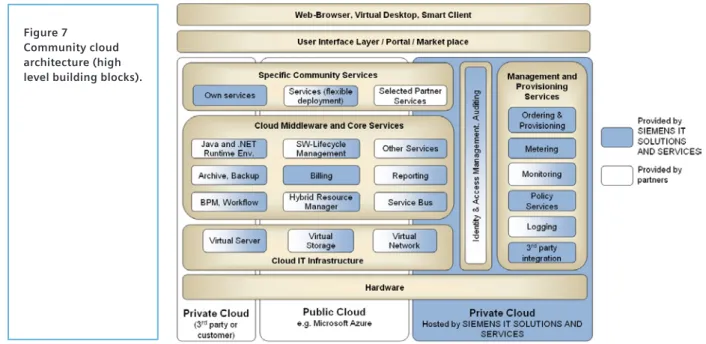
Figure 7 shows an architecture example of a community cloud, including different architectural layers such as hardware, cloud software environment or cloud services. Orthogonal to these layers are federated security features for identification, authen-tication and access management as well as management capabilities and operations interfaces. The figure also illustrates how components may be distributed between a public cloud and private clouds.
In the pilot for the Media industry (see above) and for the public sector, Microsoft Azure is used as a public cloud platform hosting the web application. It enables fast development and deployment in the cloud. Since public sector data is very sensitive, most of the other components such as the workflow engine are hosted on premise. The community cloud provider manages the overall architecture and ensures service delivery.
Figure 7
Community cloud architecture (high level building blocks).
Community Clouds from the customer’s perspective
The essential characteristics of a community cloud from a customers perspective are as follows:
The cloud is tailored to the shared requirements of multiple parties •
(the “community”). It meets industry-specific requirements e.g. regarding functionality or security.
The cloud services delivered by a community cloud are business process oriented •
rather than pure infrastructure services. Yet, the typical benefits of cloud comput-ing like pay-per-use priccomput-ing can be leveraged. Cloud commodity services at the infrastructure and platform layer are used to ensure high scalability and cost effectiveness.
Various deployment models can be used (hybrid model). Business-critical informa-•
tion, for instance, can be stored inside enterprise boundaries while less critical data is stored in the cloud. The community cloud provider acts as an integrator ensuring delivery of an overall solution. This may even comprise bundling and aggregating third party cloud services.
With industry-specific clouds it is also possible to create real (social or professional) communities using Web 2.0 and Enterprise 2.0 functionalities. Thus community clouds enable and support inter- and intra-organizational knowledge sharing for industry-specific topics.
In summary, the benefits for customers include the following: Reduced CapEx and adaptive OpEx
•
Access to innovative services •
Freedom of choice for the deployment model •
Integration support for legacy systems •
Federated security •
Speed of deployment (using e.g. platforms such as Microsoft Azure) and reduced •
time-to-market for new business solutions
Improved business through collaborative business processes in the cloud •
Service aggregation of best-of-breed services •
Reduced complexity through support for and management of services selection, •
contracts, SLA (a single trusted partner rather than many service providers) Greater business agility in the emerging global value networks
•
The vision of a community cloud is to lay the foundation of an industry network or ecosystem that spans customer organizations as well as potential providers. Community clouds are the next evolutionary step in cloud computing and are consequently focused on increased business value and innovation in business networks.
The Siemens roadmap towards Community Clouds
Siemens IT Solutions and Services is the only IT provider embedded within a globally integrated technology company. With community clouds, Siemens IT Solutions and Services positions itself as a cloud integrator with industry DNA, and leverages core Siemens strengths. Community clouds bundle the Siemens know-how and solutions for specific industries. Our customers profit from the Siemens experience and stability. We envision community clouds as industry networks for example for energy, health-care or the manufacturing industry, where innovative Siemens and third party solu-tions are deployed and delivered on demand. The emerging ecosystem around those clouds will be beneficial both for customers and for providers and can be a steady source of innovation and improvement. Siemens IT Solutions and Services will be the enabler of such ecosystems by contributing strong service provider and systems integration knowledge.
There are already many scenarios for community clouds:
Public sector: Legal and political restrictions in the public sector limit the adoption •
of public cloud offerings. A government cloud answers the strategic requirements of local, national and international public administration and ensures a high level of security. Governmental processes that involve several institutions and agencies can be easily realized by the government cloud. Examples are invoice approval, infrastructure planning and public hearing processes. Besides business-to-admini-stration processes citizen-to-adminibusiness-to-admini-stration processes which span administrative boundaries are also candidates for the cloud.
Healthcare: In healthcare many opportunities for community cloud implemen-•
tations exist, ranging from patient-centric cloud platforms to process-centric solutions for hospitals. Hybrid models will be key in healthcare, as sensitive data cannot be put into the public cloud.
Energy: In the energy sector, there are also various scenarios for community clouds. •
For instance, community clouds can bundle the comprehensive portfolio of Siemens solutions addressing sustainability issues. In the area of water management a com-munity cloud may offer advanced water information and analytics solutions. For the management of power distribution grids, a shared access to up-to-date network quality data, maintenance best practices and know-how for the utilities themselves but also third party maintenance companies and equipment providers improves maintenance processes and the availability of the electrical power grid.
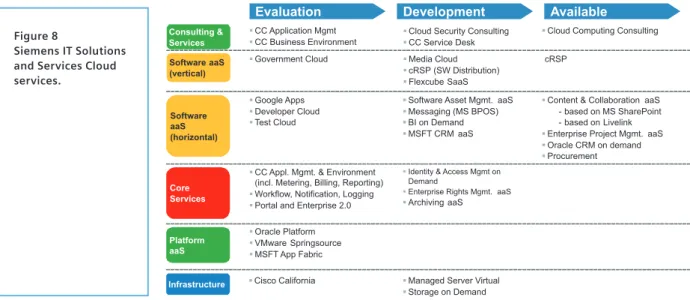
Depending on the scenario, different services can be bundled in a community cloud. Figure 8 provides an overview of the current (as of Jan. 2010) cloud portfolio of IT solutions which also contains services which may be elements of community clouds.
Figure 8
Siemens IT Solutions and Services Cloud services.
Resume
In this whitepaper, an introduction to the community cloud approach of Siemens IT Solutions and Services has been given. A community cloud aggregates industry-specific business solutions which are tailored to the shared requirements of multiple parties (the “community”) and delivered “as a service”.
Community clouds are particularly suited for customers in the following situations: Customers wanting to realize or optimize cross-organizational processes or •
processes where participants are spatially scattered: Here the benefit stems mainly from the collaboration capabilities of a community-cloud approach. The implementation of an on-premise workflow-based solution is not feasible •
(due to constraints for time-to-market or SW / HW pre-invest): a community-cloud based workflow can be set up significantly faster and with lower investments. Demand for IT resources is fluctuating: this is a case where a cloud-based solution •
is generally favorable.
Industry-specific requirements hinder the adoption of a pure public cloud solution: •
the hybrid hosting models of a community cloud may be a viable alternative. A platform is required to integrate and bundle industry-specific solutions: •
a commu nity cloud concept is the right means for this purpose, leveraging industry expertise and economies of scale.
Community clouds combine the best of various deployment models. As an established outsourcing provider and systems integrator, Siemens IT Solutions and Services has the capabilities to build and operate the solutions for the customers. With community clouds, Siemens IT Solutions and Services improves customer processes by combining cloud computing with the strong industry experience and process know-how of Siemens. Siemens IT Solutions and Services has already implemented reference projects with strong partners such as Microsoft using leading-edge cloud computing technologies and platforms (e.g. Microsoft Azure). These pilot projects demonstrate the business value of community clouds. In the future, further community clouds will
Forrester recently analysed our unique approach to community clouds and came to the conclusion that: “The cloud positioning that Siemens IT Solutions and Services has thus created, initially for the media industry, represents a best practice for how vendor marketing professionals can develop a cloud story – in this case, around the concept of a community cloud, which targets different client stakeholders.” (Source: “Case Study: Siemens IT Solutions And Services Successfully Positions A Community Cloud,” Forrester Research, Inc., January, 2010.)
References
Gartner (2009):Three Types of Cloud Brokerages will enhance Cloud Services (May 2009) Mell and Grance (2009):
The NIST Definition of Cloud Computing, Peter Mell and Tim Grance, National Institute of Standards and Technology (2009):
http://csrc.nist.gov/groups/SNS/cloud-computing/
Forrester (2010):
Case Study: Siemens IT Solutions And Services Successfully Positions A Community Cloud, Forrester Research, Inc., January 2010
(http://www.forrester.com/rb/Research/case_study_siemens_it_solutions_ and_services/q/id/55869/t/2)
Siemens AG
Siemens IT Solutions and Services
Your contact: Siemens AG
Siemens IT Solutions and Services and Cloud Computing. Matthias supports customers and
Siemens in developing strategies to best take advantage of the benefits offered by a cloud based IT service delivery.
Dr. Achim Luhn is an innovation manager. He takes up strategic innovation topcis like cloud computing, initiates their implementation, and coaches their adoption by business units. Achim currently leads the community cloud development activities at Siemens IT Solutions and Services.
All hardware and software names used are brand names and/or trademarks of their respective holders.