Journal of Athletic Training 2016;51(2):142–152 doi: 10.4085/1062-6050-51.4.04
Óby the National Athletic Trainers’ Association, Inc
www.natajournals.org original research
Age Differences in Recovery After Sport-Related
Concussion: A Comparison of High School and
Collegiate Athletes
Lindsay D. Nelson, PhD*; Kevin M. Guskiewicz, PhD, ATC, FNATA, FACSM†;
William B. Barr, PhD‡; Thomas A. Hammeke, PhD*; Christopher Randolph,
PhD§; Kwang Woo Ahn, PhD*; Yanzhi Wang, PhD
jj
; Michael A. McCrea, PhD*
*Medical College of Wisconsin, Milwaukee; †University of North Carolina at Chapel Hill; †New York University School of Medicine, NY; §Loyola University Medical Center, Chicago, IL;jjCollege of Medicine, University of Illinois at Peoria
Context: Younger age has been hypothesized to be a risk
factor for prolonged recovery after sport-related concussion, yet few studies have directly evaluated age differences in acute recovery.
Objective: To compare clinical recovery patterns for high
school and collegiate athletes.
Design: Prospective cohort study.
Setting: Large, multicenter prospective sample collected
from 1999–2003 in a sports medicine setting.
Subjects: Concussed athletes (n¼621; 545 males and 76
females) and uninjured controls (n¼150) participating in high school and collegiate contact and collision sports (79% in football, 15.7% in soccer, and the remainder in lacrosse or ice hockey).
Main Outcome Measure(s): Participants underwent
evalu-ation of symptoms (Graded Symptom Checklist), cognition (Standardized Assessment of Concussion, paper-and-pencil neuropsychological tests), and postural stability (Balance Error Scoring System). Athletes were evaluated preinjury and followed serially at several time points after concussive injury:
immediately, 3 hours postinjury, and at days 1, 2, 3, 5, 7, and 45 or 90 (with neuropsychological measures administered at baseline and 3 postinjury time points).
Results: Comparisons of concussed high school and
collegiate athletes with uninjured controls suggested that high school athletes took 1 to 2 days longer to recover on a cognitive (Standardized Assessment of Concussion) measure. Compar-isons with the control group on other measures (symptoms, balance) as well as direct comparisons between concussed high school and collegiate samples revealed no differences in the recovery courses between the high school and collegiate groups on any measure. Group-level recovery occurred at or before 7 days postinjury on all assessment metrics.
Conclusions: The findings suggest no clinically significant
age differences exist in recovery after sport-related concussion, and therefore, separate injury-management protocols are not needed for high school and collegiate athletes.
Key Words: mild traumatic brain injury, adolescents, adults
Key Points
High school and collegiate athletes recovered at equivalent rates in terms of symptom and balance measures. Cognitive recovery took 1–2 days longer in the concussed high school versus collegiate cohort, with comparisons
between each injured group and uninjured controls revealing equivalent courses of cognitive recovery.
To the degree that any age differences in clinical recovery exist between high school and collegiate athletes, they
are minimal and of insufficient degree to warrant separate injury-management protocols at these levels of competition.
S
port-related concussion (SRC) is common in con-tact- and collision-sport athletes,1,2 and significantstrides have been made in recent years to document the natural course of recovery after this injury. It is well documented that clinical recovery (ie, recovery from symptoms and of cognitive and balance measures) after SRC occurs within 5 to 7 days for the vast majority of athletes.39 However, the seminal work in this area
emphasized collegiate samples, and researchers have questioned whether these findings generalize to younger athletes. As participation in high school sports is extremely common,10it is important to understand how
developmen-tal factors influence the response to and recovery after
concussion and to determine whether assessment and clinical management decisions should be altered for younger athletes.
Numerous biomechanical and neurologic factors may explain why children and adolescents sometimes manifest slower recovery after SRC than adults.1114 For example,
differences in neck strength, skull thickness, brain size, cerebral blood volume, degree of myelination, and other physiologic factors may mediate the biomechanical forces necessary to produce concussion in younger versus older athletes as well as age differences in recovery after injury.11,1517 Additionally, cohort effects may explain or
different levels of play (ie, those who progress to collegiate or professional athletics may be more resilient to concussive injury on average than more heterogeneous high school samples).
Due to concerns that immature brains may demonstrate more prolonged or incomplete recovery, current consensus guidelines regarding SRC encourage caution in managing concussed youth.18,19 However, the empirical support for
these concerns is limited. Outcomes after moderate to severe traumatic brain injuries are poorer in children than in adults,20,21and children and adolescents are known to be at
increased risk (as compared with adults) for the malignant cerebral edema that occurs rarely after mild traumatic brain injury,22,23 but only a few authors have directly examined
differences in recovery times after SRC in athletes of various ages, and the evidence is somewhat mixed.
Findings have been particularly variable regarding whether symptom recovery is longer in younger athletes. In one of the first examinations of age differences in acute recovery from SRC,24 concussed high school athletes
(predominantly male football players) took longer than collegiate athletes to reach the low symptom ratings of uninjured controls: High school athletes still reported elevated symptoms (versus controls) at day 5, whereas collegiate athletes reported more symptoms at day 3 but not at day 5 and beyond.24This sample was relatively small (n
¼54 total concussions), however, and direct comparisons between younger and older injured groups were not performed on the symptom variable. Similarly, in the Zuckerman et al25 sample of 200 concussed athletes (37%
football, 21% male and female soccer), the younger cohort (ages 1316 years) took about 2 days longer than the older cohort (ages 1822 years) to return to individual preseason baseline levels of postconcussive symptoms, although the average time to recover was still within about a week for all participants. Also, most athletes across age groups achieved full symptom (and cognitive) recovery within 1 month. In contrast to these findings, patterns of symptom recovery were no different between high school and collegiate athletes (41% female) in another sample,26 and broader
investigations into predictors of clinical recovery have shown factors other than age (eg, initial symptom burden) to be more predictive of prolonged symptom recovery.27,28
Although few researchers have evaluated age differences in recovery on neuropsychological measures, the findings in this area are more consistent in that younger athletes generally require slightly more time to demonstrate recovery on cognitive measures. For example, the high school athletes in the Zuckerman et al25sample required 2
to 2.5 days longer than older athletes to reach complete neuropsychological recovery on the Immediate Post-concussion Assessment and Cognitive Testing battery (ImPACT, ImPACT Applications, Inc, Pittsburgh, PA), consistent with findings from other samples using this computerized assessment tool.26,29 In one study,29 high
school football players appeared to require more time to demonstrate recovery on ImPACT than National Football League (NFL) athletes, although methodologic factors could have biased these results in favor of the more elite athletes (ie, concussed athletes were compared with normative rather than individual baselines, and the NFL players were assessed at shorter intervals, possibly allowing
them to reach normative performance levels faster due to larger practice effects).
Consistent with findings regarding ImPACT, high school athletes have demonstrated slightly longer recovery times on a traditional paper-and-pencil test of memory (Hopkins Verbal Learning Test-Revised [HVLT-R]), with high school athletes performing worse than collegiate athletes at day 3 but not at day 5 or beyond.24 This study involved
predominately male football players (94% of sample). In comparison, evaluation of each group relative to age-matched controls showed equal patterns of memory recovery, with both injured groups performing worse than controls at 24 hours but equal to them at day 3. In 2 meta-analyses,30,31younger age was noted to be a risk factor for
more significant neuropsychological deficits during the acute period (710 days) postinjury, although duration of recovery on these measures could not be ascertained.
Thus, a small portion of the literature points to slightly more pronounced neuropsychological deficits and longer cognitive recovery in high school versus older athletes, but findings regarding age differences in symptom recovery have been mixed. One reason for the variable results could be the wide variety of methods used to quantify recovery (ie, return to individual or normative baselines, comparison with cohort-matched uninjured controls, or direct compar-ison between concussed groups who vary in age). To better understand how age relates to recovery after SRC, it will be important to replicate the existing literature by testing new samples and using additional measures that are common in clinical practice. Toward this end, we examined, in a large prospective sample of high school and collegiate athletes, age differences in recovery on multiple measures com-monly used clinically, including components of the Sport Concussion Assessment Tool (symptom checklist, Stan-dardized Assessment of Concussion [SAC], and Balance Error Scoring System [BESS]) and traditional paper-and-pencil neuropsychological measures. To quantify recovery from multiple vantage points, our analyses compared concussed high school and concussed collegiate athletes with both uninjured controls and each other. Based on the literature reviewed, we expected to observe minimal to no differences in the rates of symptom recovery between high school and collegiate athletes, with slightly longer (roughly 2 days) cognitive recovery in concussed high school athletes.
METHODS
Participants
In this study, we aggregated datasets from 3 parallel, multicenter, prospective studies of SRC conducted between 1999 and 2003.4,27,3234 In particular, the data were
followed after concussion were available for analysis. A total of 150 matched, uninjured control participants (89 high school, 61 college) were also tested serially in an identical manner and at the same time points as the injured athletes. The sample was distributed by sport as follows: 79.0% in American football, 15.7% in soccer, 3.1% in lacrosse, and 0.5% in ice hockey.
The studies were approved by the institutional review boards for the protection of human subjects at the host institutions of the principal investigators (Waukesha Memorial Hospital [Wisconsin] for Project Sideline, University of North Carolina at Chapel Hill for the CPI, and both in the case of the NCAA study). Written informed consent was obtained from the participants or their parents or guardians before the study. Participation in this research was voluntary and uncompensated.
Study Design and Procedures
Preseason Baseline Testing. All enrolled athletes completed a preseason baseline evaluation that consisted of a standard battery of tests known to be sensitive to the effects of concussion, which included (in protocol order) the Graded Symptom Checklist (GSC), the SAC, the BESS, and (for the NCAA and CPI studies) paper-and-pencil neuropsychological tests. The paper-and-pencil neuropsychological battery contained the HVLT-R trials 13, Trail Making Test–Part B (Trails B), Symbol Digit Modalities Test, Stroop Color and Word Test, and HVLT-R delayed recall and recognition. Although the NCAA protocol also included the Controlled Oral Word Association Test (COWAT), we excluded this variable from these analyses because no COWAT data were available for high school athletes. Examinations were conducted at the athletes’ schools in classrooms or other quiet indoor settings and were individually proctored by trained research assistants.
Postconcussive and Control Group Follow-Up Testing. Concussed athletes were identified and evaluated on the sideline by a certified athletic trainer or team physician using the same procedures as in the preseason baseline with the caveat that immediate postinjury assessments were performed on the sideline or in a nearby training room.
Concussion was defined according to the American Academy of Neurology guidelines for management of sports concussion (as it was the most widely accepted definition in the clinical and scientific communities at the onset of the study) as an injury resulting from a blow to the head causing an alteration in mental status and 1 or more of the following symptoms: headache, nausea, vomiting, dizziness/balance problems, fatigue, difficulty sleeping, drowsiness, sensitivity to light or noise, blurred vision, memory difficulty, and difficulty concentrating.35,36
For 2 of the 3 studies compiled for this paper (Project Sideline and NCAA), an uninjured control was selected from each injured player’s team and was matched for age, years of education, and baseline performance on concus-sion-assessment measures. Restricted resources in years 2 and 3 of the NCAA study precluded enrollment of controls, although this ultimately had a limited effect on the degree of matching between groups overall. A list of potential controls for each player was formed after preseason baseline testing, which facilitated the immediate selection
of controls after concussions and allowed follow-up testing to be performed under the same conditions and retest intervals as for injured athletes.
Concussed and control athletes were evaluated at baseline, immediately after injury, 2 to 3 hours postinjury, and at days 1, 2, 3, 5, 7, and 45 or 90 postinjury. More extensive neuropsychological testing was administered only at baseline and at 1 to 2 days, 6 to 7 days, and either 45 or 90 days postinjury. Over the study period, the remote recovery time point was changed from 90 to 45 days postinjury (these time points were combined into a single day 45/90 time point for the present analyses).
The GSC, BESS, SAC, and a brief neuropsychological test battery were used to assess self-reported symptoms, postural stability, and cognitive performance, respectively. The GSC asks participants to rate the presence and severity of common postconcussive symptoms on a 0 to 6 (not present to severe) Likert-type scale.37 Although different
versions of the questionnaire were used across the study subsamples, there was a high degree of overlap among items, with participants in this combined dataset rating 14 shared items (summed to create the total symptom score referenced in the results; possible range¼084): headache, nausea, vomiting, balance problems/dizziness, fatigue, trouble sleeping, sleeping more than usual, drowsiness, sensitivity to light, sadness, numbness/tingling, feeling like
‘‘in a fog,’’ difficulty concentrating, and difficulty remem-bering. Ratings on the full and 14-item scale correlated at 0.97 (P,.001).
The SAC screens abilities in 4 cognitive domains: orientation, concentration, immediate memory, and delayed memory (total score range¼030). The BESS is a brief measure of postural stability (score range ¼ 060). The neuropsychological tests consisted of several traditional paper-and-pencil tests and included the HVLT-R,38 Trails
B,39COWAT,40Symbol-Digit Modalities,41and the Stroop
Color and Word Test.37For the GSC, BESS, and Trails B,
lower scores represent better (more normal) performance. The psychometric properties and sensitivity to concussion for the GSC,4 SAC,8,42,43 BESS,4,4446 and the
neuropsy-chological tests47have been reported elsewhere.
The measures were administered in a standardized fashion by trained study personnel (eg, certified athletic trainers, research assistants, neuropsychologists) supervised by the investigators. Alternate forms were used for repeat neurocognitive examinations (ie, SAC and all neuropsy-chological measures except for Stroop) to reduce practice effects. Tests were administered in the same order for all participants.
Data Analysis
cognitive recovery (approximately 2 days) in concussed high school athletes. Because the final assessment point varied between 45 and 90 days over the study period, these mutually exclusive time points were combined into a single day 45/90 variable for these analyses. Systematic differ-ences in symptom reporting were found between high school and collegiate control participants, and thus, for the GSC, injured high school and collegiate samples were compared with their age-matched control groups. However, because control-group performance on other measures did not vary by age group, high school and collegiate control samples were collapsed for the analyses of SAC, BESS, and neuropsychological measures.
Repeated-measures analysis of variance was performed to test for an interaction between time and group and for group differences at the multiple assessment time points. The unstructured covariance matrix of errors was used as it showed the lowest Akaike information criterion48 among
compound symmetric, autoregressive order 1, and unstruc-tured covariance structures. Multiple imputation (with 20 imputations) was used to account for the missing data (15%).49This method is widely accepted in the biostatistics
community and has been used in other published work by our research group.4,27,50
Symptom, cognitive, and postural-stability recovery curves were created for the injured and control groups using 95% confidence intervals based on the estimated models. Because multiple group comparisons were per-formed within each measure (due to multiple time points and pairwise comparisons of interest), a correction was applied to adjustP values for multiple comparisons using the false-discovery rate-control method.51 Adjusted P
values are referred to as ˜p in the results and can be interpreted in the same fashion as standard P values (ie, relative to an a ¼ .05 criterion). All analyses were performed in SAS (version 9.2; SAS Institute Inc, Cary, NC).
RESULTS
Sample Characteristics
Demographic data for the high school and collegiate concussed and control groups are presented in Table 1. As would be expected, the collegiate athletes were older, taller, and heavier and had played their sport for more years than the high school athletes. The concussed high school group reported more concussions and had a higher proportion of females than the collegiate or control samples. Group differences in demographics that could confound the result regarding age differences were further explored for potential moderation of the primary effects of interest. In particular, we explored the degree to which any demo-graphic differences among groups predicted the outcome measures (GSC, SAC, BESS, and neuropsychological indices) to determine whether any variables should be added as covariates in the statistical models. The number of prior concussions was the only variable with any predictive value for an outcome measure (GSC score), so we adjusted for the number of prior concussions in the model estimate of symptoms. In contrast, sport and sex were not predictive of any outcome measure (eg, GSC, SAC, and BESS P
values for sport/sex ¼ .90/.91, .16/.45, and .32/.15,
respectively). Years of play (different between the high school concussed and high school control groups) did not predict any outcome measure within the high school sample (eg, GSC, SAC, and BESS P values¼.69, .07, and .29, respectively). Age (statistically different between the 2 collegiate subsamples) did not predict any outcome measures in the collegiate sample (eg, GCS, SAC, and BESS Pvalues¼.60, .09, and .13, respectively). Rates of loss of consciousness and posttraumatic amnesia, although different between concussed high school and collegiate participants, did not predict any outcome measure (eg, P
values predicting GSC, SAC, and BESS for loss of consciousness/retrograde amnesia ¼ .34/.94, .18/.07, .14/ .31, respectively).
Group Differences in Recovery on Outcome Measures
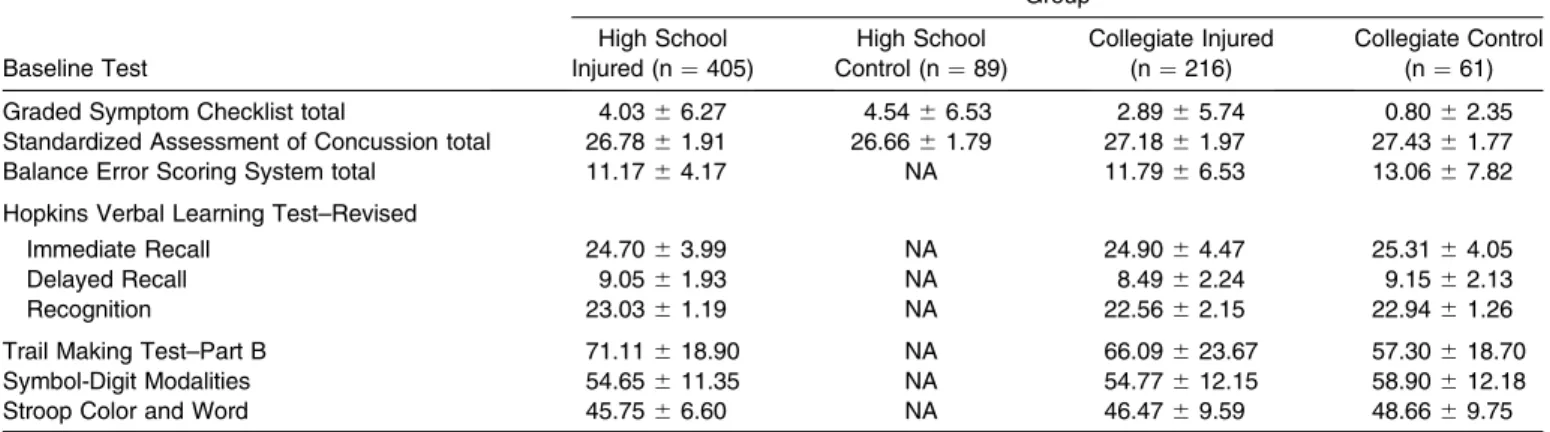
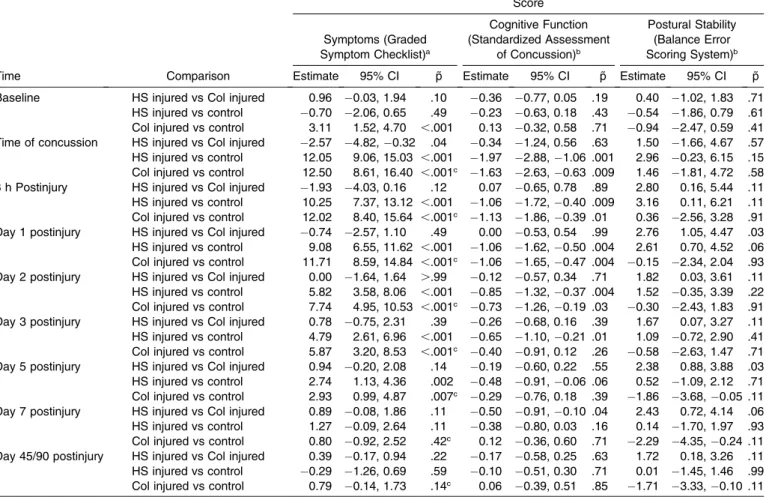
The baseline and postinjury performance for the sample by age/level of play (high school, college) and injury status (concussed, control) on the GSC, SAC, and BESS, respectively, is depicted in Figures 1 through 3. Descriptive statistics for the GSC, SAC, BESS, and neuropsychological measures at baseline are presented in Table 2. Estimated group differences for these measures at each time point are depicted in Tables 3 (GSC, SAC, BESS) and 4 (neuropsy-chological measures). As stated under ‘‘Data Analysis,’’
high school and collegiate control groups were collapsed for all measures except the GSC. To provide different vantage points from which to understand patterns of recovery and to compare our findings optimally with the various methods employed by prior investigators in this area, we compared both the concussed high school and collegiate samples as well as each concussed group and uninjured controls. Time 3 group interactions were significant (P, .0001) for the GSC, SAC, and BESS and were nonsignificant (P . .05) for the paper-and-pencil neuropsychological measures.
responses to concussion and courses of symptom recovery in the injured groups.
Standardized Assessment of Concussion.On the SAC, both concussed samples performed significantly worse than control participants immediately postinjury and through the day 2 follow-up, with only concussed high school athletes still below control participants at day 3 (concussion versus control differences were all nonsignificant at day 5). This finding might suggest a cognitive recovery that was 1 to 2 days longer for high school athletes. However, direct comparisons of the concussed groups showed that concussed high school and collegiate athletes were equivalent on the SAC at the baseline, immediate postinjury, 3-hour postinjury, and majority of other time points, indicating no marked difference in preinjury or early
postinjury cognitive performance. A single significant group difference on the SAC at day 7 appeared to result from a slight decline in performance for high school athletes between days 5 and 7 and, thus, does not meaningfully inform the present study question.
Balance Error Scoring System.Concussed high school athletes performed worse than concussed collegiate athletes at select time points (days 1 and 5) but not at other time points on the BESS. However, no injured- versus control-group differences were significant on the BESS.
Neuropsychological Tests.As illustrated in Table 4, we did not observe meaningful group differences on any neuropsychological measures; only 1 measure showed a group difference, and this difference was observed at 1 week postinjury but not at earlier time points. Of note, the n’s were smaller for these measures (n ¼126 concussed high school; n¼73 concussed collegiate; n¼129 control) than for the GSC, SAC, and BESS due to differences in the protocol across the 3 aggregated studies.
DISCUSSION
In this large, prospective sample (n ¼ 621 concussed athletes, 150 noninjured controls), we found little evidence for different rates of acute clinical recovery from concussion for high school versus collegiate athletes. Two sets of analyses (direct comparisons of concussed high school versus collegiate athletes and comparisons of concussed athletes within each age group with matched uninjured controls) revealed equivalent courses of symptom recovery, with both high school and collegiate athletes showing, on average, elevated symptoms through day 5 postinjury that resolved by day 7. On the SAC, concussed high school athletes took 1 to 2 days longer than collegiate athletes to reach control-group performance levels, but both groups demonstrated a relatively rapid cognitive recovery within a few days of injury. Given that the high school athletes’ injuries were somewhat more severe (according to rates of loss of consciousness and posttraumatic amnesia) and direct comparisons of concussed high school and
Figure 1. Baseline and postinjury performance on the Graded Symptom Checklist. Higher scores reflect more severe symptoms. Error bars indicate 95%confidence intervals.
Figure 2. Baseline and postinjury performance on the Standard-ized Assessment of Concussion. Lower scores reflect poorer cognitive performance. Error bars indicate 95%confidence inter-vals.
collegiate athletes showed equivalent performance at each assessment, the overall findings suggest more overlap than discrepancy in the rates of cognitive recovery across the 2 age levels. These findings are largely consistent with prior work2426,28,29 on age differences in symptom and
neuro-cognitive recovery. Furthermore, there were no significant findings to suggest an association between age and cognitive recovery on a more extensive neuropsychological test battery or on measures of postural stability, although the lack of sensitivity of these measures to concussion in this sample limits our ability to draw conclusions about age differences in recovery for these areas of functioning.
Current expert consensus guidelines18suggest that more
conservative injury-management practices may be warrant-ed in child and adolescent (versus adult) athletes due to longer recoveries and other potential neurologic vulnera-bilities unique to these populations. Our findings of large overlap in the rate of clinical recovery between adolescent and adult athletes imply that concussion-management protocols need not differ for high school and collegiate athletes, at least not due to assumptions about differential recovery trajectories. That said, there might be other reasons why clinical decisions may vary for younger athletes. For all student-athletes, the demands of school need to be weighed against the magnitude of their acute impairments after SRC, particularly in light of the potential consequences of participating in cognitively demanding activity soon after concussive injury, which can exacerbate symptoms.52 Arguably, children, more than adults, are
expected to continuously build upon basic academic and life skills, and consequently, removal from school for a cognitive rest protocol18 could theoretically be more
disruptive to a child’s development of core skills and academic achievement. Yet collegiate athletes are also students whose brains are still developing. Therefore, it could be justifiable to consider similar factors in making their return-to-play decisions. Recent findings53 of slower
symptom resolution in young athletes randomly assigned to stricter rest after injury underscores the importance of making balanced decisions about clinical management recommendations for athletes and highlights the need for further research on the effect of different clinical
management practices on recovery for all concussed athletes.
It is worth keeping in mind that our finding of similar rates of clinical recovery between age groups does not necessarily translate into equivalent physiologic responses and recovery patterns in these groups. Emerging research suggests that neurophysiologic recovery may extend beyond what is apparent on standard clinical measures,5456
and increased understanding of the course and predictors of physiologic recovery may lead to adjustments in clinical decision-making strategies for younger and older athletes. Furthermore, our data cannot speak to the extent to which younger children (below the high school level) respond differently to concussive injury. As there is no validated concussion-assessment tool for younger children and few empirical data on SRC in children, it will be important in the future to validate assessment protocols for children and to document the clinical and physiologic effects of concussion in younger samples.
This dataset offered a number of methodologic advan-tages that bolstered our findings, including the largest sample size to date in a study that directly compared concussed high school and collegiate athletes, the avail-ability of uninjured control participants tested at similar time intervals, fine-grained (frequent) measurements of clinical recovery during the acute postinjury period, and the availability of individual preseason baseline data that allowed us to confirm that injured and control samples were matched premorbidly on symptoms and performance measures. By testing a large sample and comparing concussed samples with each other and with matched uninjured controls, we were able to draw stronger conclusions about the minimal age differences in clinical recovery and perhaps address some of the ambiguity of prior studies that used variable methods for quantifying recovery and assessed relatively smaller samples of concussed athletes. Furthermore, our research team is currently conducting a large-scale study of high school and collegiate athletes that will allow for replication of these findings in a new sample and extension to additional clinical measures.
Table 2. Descriptive Statistics for Baseline Test Performance (Mean6SD)a
Baseline Test
Group
High School Injured (n¼405)
High School Control (n¼89)
Collegiate Injured (n¼216)
Collegiate Control (n¼61)
Graded Symptom Checklist total 4.0366.27 4.5466.53 2.8965.74 0.8062.35 Standardized Assessment of Concussion total 26.7861.91 26.6661.79 27.1861.97 27.4361.77 Balance Error Scoring System total 11.1764.17 NA 11.7966.53 13.0667.82
Hopkins Verbal Learning Test–Revised
Immediate Recall 24.7063.99 NA 24.9064.47 25.3164.05
Delayed Recall 9.0561.93 NA 8.4962.24 9.1562.13
Recognition 23.0361.19 NA 22.5662.15 22.9461.26
Trail Making Test–Part B 71.11618.90 NA 66.09623.67 57.30618.70 Symbol-Digit Modalities 54.65611.35 NA 54.77612.15 58.90612.18 Stroop Color and Word 45.7566.60 NA 46.4769.59 48.6669.75
Abbreviation: NA, not applicable.
aPvalues for group differences on symptom and performance ratings are presented in Tables 3 and 4. Given that the number of high school
These strengths should not be considered without equal consideration of the study’s limitations, which included some degree (15%) of missing data, a control group that was small relative to the concussion group and not equivalently matched to the concussed athletes (although supplementary analyses did not find evidence that these group differences moderated the reported effects), and limited sensitivity of the BESS and paper-and-pencil neuropsychological measures to concussion. Of course, it is possible that other clinical measures not included in this study (eg, computerized neurocognitive tests) may be more consistently sensitive to individual differences in concus-sion recovery. Another limitation is that the sample was made up mostly of male football players, for whom age may have a different relationship with recovery course than for females or athletes in other sports. Ongoing research efforts to recruit more heterogeneous samples will be critical to fully elucidate the interplay between develop-mental factors in recovery from concussion for a wider variety of athletes.
In closing, this study used multiple methods for investigating acute clinical recovery time in high school and collegiate athletes affected by SRC. Our data suggest
that there are no reliable age differences in symptom and neurocognitive recovery after SRC, and therefore, separate injury-management protocols for athletes at these levels of play are not needed. Future work that focuses more on child and female athletes, that includes a broader range of clinical measures, and that explicates the trajectory of physiologic recovery after SRC will be important to increase the evidence base for injury-management protocols for all athletes.
CONCLUSIONS
High school and collegiate athletes showed equivalent patterns of postconcussive symptom recovery, with symp-toms enhanced through day 5 postinjury and normalized by day 7 on average. Although comparisons of concussed high school and collegiate athletes with uninjured controls suggested that high school athletes took slightly longer (by 12 days) to recover on a cognitive screening measure (SAC), direct comparisons between concussed high school and collegiate samples revealed no differences between injured groups on any measure. The findings suggest that there are no reliable, clinically significant age differences in recovery after SRC, and therefore, separate
injury-manage-Table 3. Estimated Differences Between High School (HS) and Collegiate (Col) Injured and Control Groups on Graded Symptom Checklist, Standardized Assessment of Concussion, and Balance Error Scoring System
Time Comparison
Score
Symptoms (Graded Symptom Checklist)a
Cognitive Function (Standardized Assessment
of Concussion)b
Postural Stability (Balance Error Scoring System)b
Estimate 95% CI ˜p Estimate 95% CI ˜p Estimate 95% CI ˜p
Baseline HS injured vs Col injured 0.96 0.03, 1.94 .10 0.36 0.77, 0.05 .19 0.40 1.02, 1.83 .71 HS injured vs control 0.70 2.06, 0.65 .49 0.23 0.63, 0.18 .43 0.54 1.86, 0.79 .61 Col injured vs control 3.11 1.52, 4.70 ,.001 0.13 0.32, 0.58 .71 0.94 2.47, 0.59 .41 Time of concussion HS injured vs Col injured 2.57 4.82,0.32 .04 0.34 1.24, 0.56 .63 1.50 1.66, 4.67 .57 HS injured vs control 12.05 9.06, 15.03 ,.001 1.97 2.88,1.06 .001 2.96 0.23, 6.15 .15 Col injured vs control 12.50 8.61, 16.40 ,.001c 1.63 2.63,0.63 .009 1.46 1.81, 4.72 .58
3 h Postinjury HS injured vs Col injured 1.93 4.03, 0.16 .12 0.07 0.65, 0.78 .89 2.80 0.16, 5.44 .11 HS injured vs control 10.25 7.37, 13.12 ,.001 1.06 1.72,0.40 .009 3.16 0.11, 6.21 .11 Col injured vs control 12.02 8.40, 15.64 ,.001c 1.13 1.86,0.39 .01 0.36 2.56, 3.28 .91
Day 1 postinjury HS injured vs Col injured 0.74 2.57, 1.10 .49 0.00 0.53, 0.54 .99 2.76 1.05, 4.47 .03 HS injured vs control 9.08 6.55, 11.62 ,.001 1.06 1.62,0.50 .004 2.61 0.70, 4.52 .06 Col injured vs control 11.71 8.59, 14.84 ,.001c 1.06 1.65,0.47 .004 0.15 2.34, 2.04 .93
Day 2 postinjury HS injured vs Col injured 0.00 1.64, 1.64 ..99 0.12 0.57, 0.34 .71 1.82 0.03, 3.61 .11 HS injured vs control 5.82 3.58, 8.06 ,.001 0.85 1.32,0.37 .004 1.52 0.35, 3.39 .22 Col injured vs control 7.74 4.95, 10.53 ,.001c 0.73 1.26,0.19 .03 0.30 2.43, 1.83 .91
Day 3 postinjury HS injured vs Col injured 0.78 0.75, 2.31 .39 0.26 0.68, 0.16 .39 1.67 0.07, 3.27 .11 HS injured vs control 4.79 2.61, 6.96 ,.001 0.65 1.10,0.21 .01 1.09 0.72, 2.90 .41 Col injured vs control 5.87 3.20, 8.53 ,.001c 0.40 0.91, 0.12 .26 0.58 2.63, 1.47 .71
Day 5 postinjury HS injured vs Col injured 0.94 0.20, 2.08 .14 0.19 0.60, 0.22 .55 2.38 0.88, 3.88 .03 HS injured vs control 2.74 1.13, 4.36 .002 0.48 0.91,0.06 .06 0.52 1.09, 2.12 .71 Col injured vs control 2.93 0.99, 4.87 .007c 0.29 0.76, 0.18 .39 1.86 3.68,0.05 .11
Day 7 postinjury HS injured vs Col injured 0.89 0.08, 1.86 .11 0.50 0.91,0.10 .04 2.43 0.72, 4.14 .06 HS injured vs control 1.27 0.09, 2.64 .11 0.38 0.80, 0.03 .16 0.14 1.70, 1.97 .93 Col injured vs control 0.80 0.92, 2.52 .42c 0.12 0.36, 0.60 .71 2.29 4.35,0.24 .11
Day 45/90 postinjury HS injured vs Col injured 0.39 0.17, 0.94 .22 0.17 0.58, 0.25 .63 1.72 0.18, 3.26 .11 HS injured vs control 0.29 1.26, 0.69 .59 0.10 0.51, 0.30 .71 0.01 1.45, 1.46 .99 Col injured vs control 0.79 0.14, 1.73 .14c 0.06 0.39, 0.51 .85 1.71 3.33,0.10 .11
Abbreviations: CI, confidence interval of estimate; ˜p,Pvalue adjusted for multiple comparisons using the false-discovery rate-control method.
aHS and Col injured samples were compared with age-matched controls. Because some groups differed in concussion history and
concussion history was significantly related to symptom ratings (Graded Symptom Checklist score), these comparisons were adjusted for baseline differences in concussion history.
bHS and Col controls were combined into a single group.
ment protocols are not needed for high school and collegiate athletes in clinical settings.
ACKNOWLEDGMENTS
This research was supported by the NCAA and the National Operating Committee on Standards for Athletic Equipment, Centers for Disease Control and Prevention’s National Center for Injury Prevention and Control, University of North Carolina Injury Prevention Research Center, Waukesha Memorial Hospital Foundation, National Academy of Neuropsychology, National Federation of State High School Associations, NFL Charities, Green Bay Packer Foundation, Milwaukee Bucks, Herbert H. Kohl Charities, Waukesha Service Club, Michael Emme, and the Medical College of Wisconsin General Clinical Research Center (M01 RR00058 from the National Institutes of Health).
REFERENCES
1. Bakhos LL, Lockhart GR, Myers R, Linakis JG. Emergency
department visits for concussion in young child athletes.Pediatrics.
2010;126(3):E550–E556.
2. Daneshvar DH, Nowinski CJ, McKee AC, Cantu RC. The
epidemiology of sport-related concussion.Clin Sports Med. 2011;
30(1):1–17, vii.
3. Macciocchi SN, Barth JT, Alves W, Rimel RW, Jane JA. Neuropsychological functioning and recovery after mild head injury
in collegiate athletes.Neurosurgery. 1996;39(3):510–514.
4. McCrea M, Guskiewicz KM, Marshall SW, et al. Acute effects and recovery time following concussion in collegiate football players: the
NCAA concussion study.JAMA. 2003;290(19):2556–2563.
5. Echemendia RJ, Putukian M, Mackin RS, Julian L, Shoss N. Neuropsychological test performance prior to and following
sports-related mild traumatic brain injury.Clin J Sport Med. 2001;11(1):23–
31.
6. Erlanger D, Kaushik T, Cantu R, et al. Symptom-based assessment of
the severity of a concussion.J Neurosurg. 2003;98(3):477–484.
7. Hinton-Bayre AD, Geffen GM, Geffen LB, McFarland KA, Friis P. Concussion in contact sports: reliable change indices of impairment
and recovery.J Clin Exp Neuropsychol. 1999;21(1):70–86.
8. McCrea M, Kelly JP, Randolph C, et al. Standardized assessment of
concussion (SAC): on-site mental status evaluation of the athlete.J
Head Trauma Rehabil. 1998;13(2):27–35.
9. McCrea M. Standardized mental status testing on the sideline after
sport-related concussion.J Athl Train. 2001;36(3):274–279.
10. Landis MJ, Peppard PP, Remington PL. Characteristics of school-sanctioned sports: participation and attrition in Wisconsin public high
schools.WMJ. 2007;106(6):312–318.
11. Kirkwood MW, Yeates KO, Wilson PE. Pediatric sport-related concussion: a review of the clinical management of an oft-neglected
population.Pediatrics. 2006;117(4):1359–1371.
12. McCrory P, Collie A, Anderson V, Davis G. Can we manage sport
related concussion in children the same as in adults?Br J Sports Med.
2004;38(5):516–519.
13. Taylor AM. Neuropsychological evaluation and management of
sport-related concussion.Curr Opin Pediatr. 2012;24(6):717–723.
14. Davis GA, Purcell LK. The evaluation and management of acute
concussion differs in young children.Br J Sports Med. 2014;48(2):
98–101.
15. Ommaya AK, Goldsmith W, Thibault L. Biomechanics and
neuropathology of adult and paediatric head injury.Br J Neurosurg.
2002;16(3):220–242.
16. Proctor MR, Cantu RC. Head and neck injuries in young athletes.
Clin Sports Med. 2000;19(4):693–715.
17. Bauer R, Fritz H. Pathophysiology of traumatic injury in the
developing brain: an introduction and short update. Exp Toxicol
Pathol. 2004;56(12):65–73.
18. McCrory P, Meeuwisse W, Aubry M, et al. Consensus statement on concussion in sport: the 4th International Conference on Concussion
in Sport held in Zurich, November 2012. Clin J Sport Med. 2013;
23(2):89–117.
19. Giza CC, Kutcher JS, Ashwal S, et al. Summary of evidence-based guideline update: evaluation and management of concussion in sports: report of the Guideline Development Subcommittee of the
American Academy of Neurology. Neurology. 2013;80(24):2250–
2257.
20. Anderson V, Catroppa C, Morse S, Haritou F, Rosenfeld J. Functional plasticity or vulnerability after early brain injury?
Pediatrics. 2005;116(6):1374–1382.
21. Ewing-Cobbs L, Prasad MR, Kramer L, et al. Late intellectual and academic outcomes following traumatic brain injury sustained during
early childhood.J Neurosurg. 2006;105(suppl 4):287–296.
22. McCrory P, Berkovic SF. Second impact syndrome. Neurology.
1998;50(3):677–683.
23. Snoek JW, Minderhoud JM, Wilmink JT. Delayed deterioration
following mild head injury in children.Brain. 1984;107(1):15–36.
24. Field M, Collins MW, Lovell MR, Maroon J. Does age play a role in recovery from sports-related concussion? A comparison of high
school and collegiate athletes.J Pediatr. 2003;142(5):546–553.
25. Zuckerman SL, Lee YM, Odom MJ, Solomon GS, Forbes JA, Sills AK. Recovery from sports-related concussion: days to return to
neurocognitive baseline in adolescents versus young adults. Surg
Neurol Int. 2012;3:130.
26. Covassin T, Elbin RJ, Harris W, Parker T, Kontos A. The role of age and sex in symptoms, neurocognitive performance, and postural
stability in athletes after concussion.Am J Sports Med. 2012;40(6):
1303–1312.
27. McCrea M, Guskiewicz K, Randolph C, et al. Incidence, clinical course, and predictors of prolonged recovery time following
sport-related concussion in high school and college athletes. J Int
Neuropsychol Soc. 2013;19(1):22–33.
28. Meehan WP, Mannix RC, Stracciolini A, Elbin RJ, Collins MW. Symptom severity predicts prolonged recovery after sport-related
concussion, but age and amnesia do not.J Pediatr. 2013;163(3):721–
725.
29. Pellman EJ, Lovell MR, Viano DC, Casson IR. Concussion in professional football: recovery of NFL and high school athletes assessed by computerized neuropsychological testing—part 12.
Neurosurgery. 2006;58(2):263–274.
30. Dougan BK, Horswill MS, Geffen GM. Athletes’ age, sex, and years of education moderate the acute neuropsychological impact of
sports-related concussion: a meta-analysis.J Int Neuropsychol Soc. 2014;
20(1):64–80.
31. Kontos AP, Braithwaite R, Dakan S, Elbin RJ. Computerized neurocognitive testing within 1 week of sport-related concussion:
meta-analytic review and analysis of moderating factors. J Int
Neuropsychol Soc. 2014;20(3):324–332.
32. Guskiewicz KM, McCrea M, Marshall SW, et al. Cumulative effects associated with recurrent concussion in collegiate football players:
the NCAA concussion study.JAMA. 2003;290(19):2549–2555.
33. Randolph C, Millis S, Barr WB, et al. Concussion symptom inventory: an empirically derived scale for monitoring resolution of
symptoms following sport-related concussion. Arch Clin
Neuro-psychol. 2009;24(3):219–229.
34. McCrea M, Hammeke T, Olsen G, Leo P, Guskiewicz K. Unreported concussion in high school football players: implications for
prevention.Clin J Sport Med. 2004;14(1):13–17.
35. Kelly JP, Rosenberg JH. Diagnosis and management of concussion in
sports.Neurology. 1997;48(3):575–580.
37. Golden CJ.Stroop Color and Word Test: A Manual for Clinical and Experimental Uses. Wood Dale, IL: Stoelting Co; 2002.
38. Benedict RH, Schretlen D, Goninger L, Brandt J. Hopkins Verbal Learning Test–Revised: normative data and analysis of inter-form
and test-retest reliability.Clin Neuropsychol. 1998;12(1):43–55.
39. Reitan RM, Wolfson D. The Halstead-Reitan Neuropsychological
Test Battery: Theory and Clinical Interpretation. Tuscon, AZ: Neuropsychology Press; 1985.
40. Strauss E, Sherman EMS, Spreen O. A Compendium of
Neuropsy-chological Tests: Administration, Norms, and Commentary. 3rd ed. New York, NY: Oxford University Press; 2006.
41. Smith A.Symbol Digit Modalities Test. Los Angeles, CA: Western
Psychological Services; 1982.
42. McCrea M, Kelly JP, Randolph C, Cisler R, Berger L. Immediate
neurocognitive effects of concussion. Neurosurgery. 2002;50(5):
1032–1040; discussion 10401042.
43. Barr WB, McCrea M. Sensitivity and specificity of standardized
neurocognitive testing immediately following sports concussion. J
Int Neuropsychol Soc. 2001;7(6):693–702.
44. Guskiewicz KM, Ross SE, Marshall SW. Postural stability and
neuropsychological deficits after concussion in collegiate athletes.J
Athl Train. 2001;36(3):263–273.
45. Riemann BL, Guskiewicz KM. Effects of mild head injury on
postural stability as measured through clinical balance testing.J Athl
Train. 2000;35(1):19–25.
46. Bell DR, Guskiewicz KM, Clark MA, Padua DA. Systematic review
of the balance error scoring system.Sports Health. 2011;3(3):287–
295.
47. Collins MW, Grindel SH, Lovell MR, et al. Relationship between concussion and neuropsychological performance in college football
players.JAMA. 1999;282(10):964–970.
48. Akaike H. A new look at the statistical model identification.IEEE
Trans Automat Control. 1974;19(6):716–723.
49. Rubin DB. Multiple Imputation for Nonresponse in Surveys. New
York, NY: Wiley; 1987.
50. McCrea M, Barr WB, Guskiewicz K, et al. Standard regression-based
methods for measuring recovery after sport-related concussion.J Int
Neuropsychol Soc. 2005;11(1):58–69.
51. Benjamini Y, Hochberg Y. Controlling the false discovery rate: a
practical and powerful approach to multiple testing.J Royal Stat Soc
Ser B Stat Methodol. 1995;57(1):289–300.
52. Grady MF. Concussion in the adolescent athlete.Curr Probl Pediatr
Adolesc Health Care. 2010;40(7):154–169.
53. Thomas DG, Apps JN, Hoffmann RG, McCrea M, Hammeke T. Benefits of strict rest after acute concussion: a randomized controlled
trial.Pediatrics. 2015;135(2):213–223.
54. Prichep LS, McCrea M, Barr W, Powell M, Chabot RJ. Time course of clinical and electrophysiological recovery after sport-related
concussion.J Head Trauma Rehabil. 2013;28(4):266–273.
55. Ellemberg D, Henry LC, Macciocchi SN, Guskiewicz KM, Broglio SP. Advances in sport concussion assessment: from behavioral to
brain imaging measures.J Neurotrauma. 2009;26(12):2365–2382.
56. Gosselin N, Theriault M, Leclerc S, Montplaisir J, Lassonde M. Neurophysiological anomalies in symptomatic and asymptomatic
concussed athletes.Neurosurgery. 2006;58(6):1151–1161.